Every framework, step by step
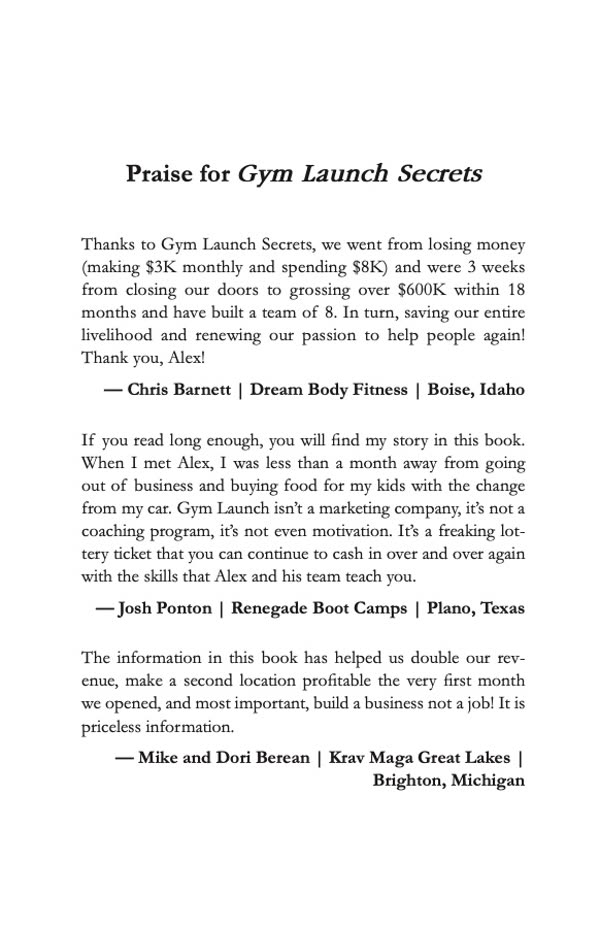
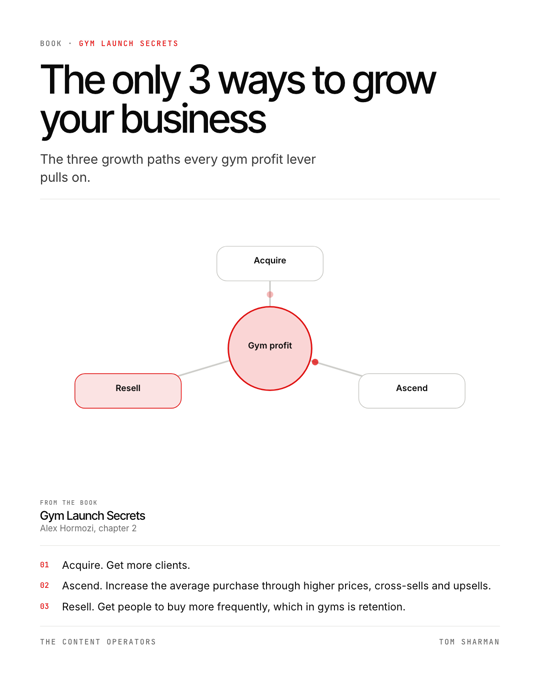
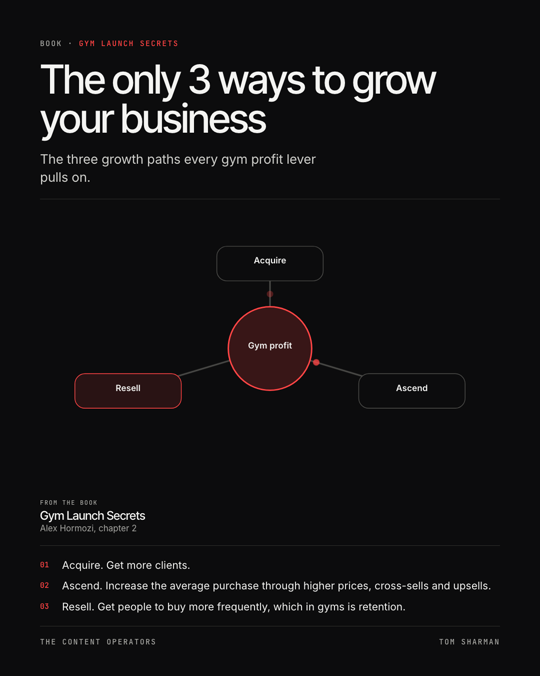
The three growth paths every gym profit lever pulls on.
- Acquire. Get more clients.
- Ascend. Increase the average purchase through higher prices, cross-sells and upsells.
- Resell. Get people to buy more frequently, which in gyms is retention.
From chapter: Chapter 2, A Client-Acquisition Model That Works, pp. 71–84
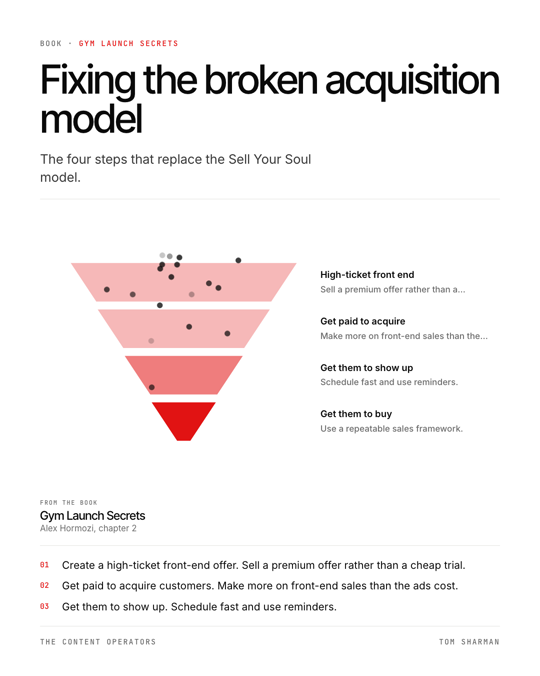
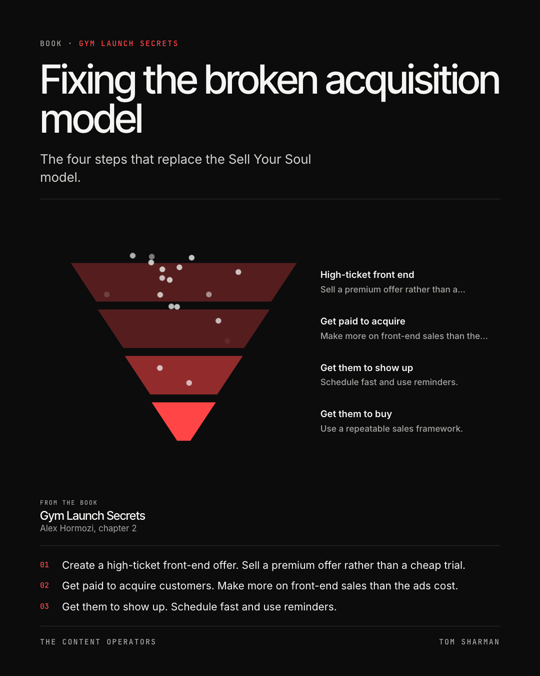
The four steps that replace the Sell Your Soul model.
- Create a high-ticket front-end offer. Sell a premium offer rather than a cheap trial.
- Get paid to acquire customers. Make more on front-end sales than the ads cost.
- Get them to show up. Schedule fast and use reminders.
- Get them to buy. Use a repeatable sales framework.
From chapter: Chapter 2, A Client-Acquisition Model That Works, pp. 71–84
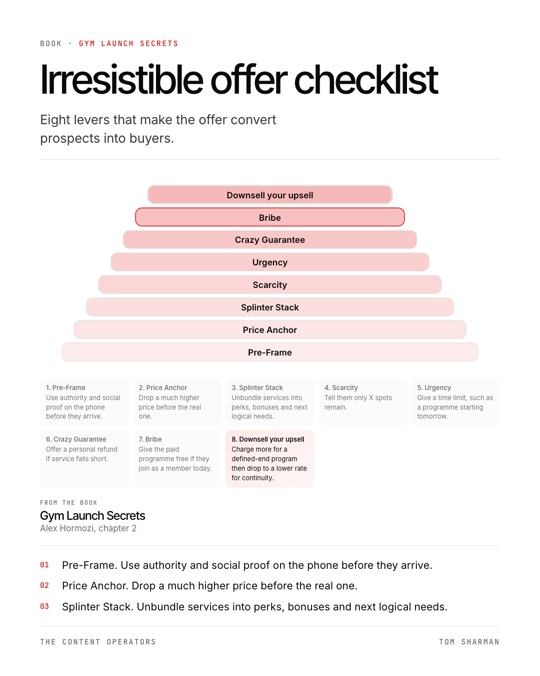
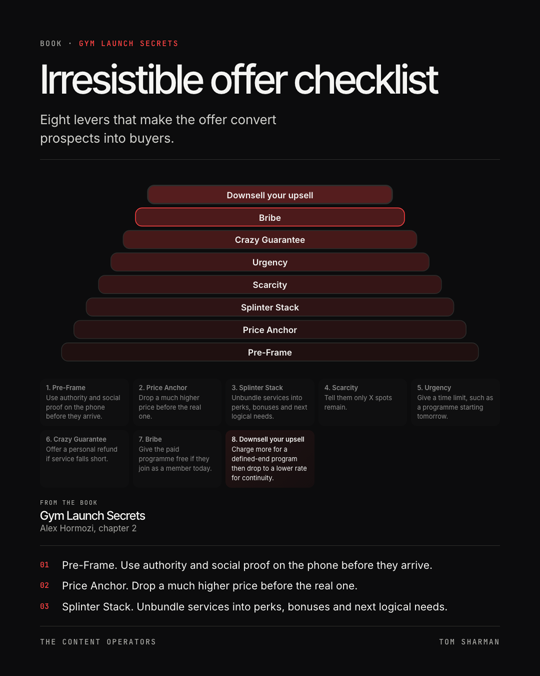
Eight levers that make the offer convert prospects into buyers.
- Pre-Frame. Use authority and social proof on the phone before they arrive.
- Price Anchor. Drop a much higher price before the real one.
- Splinter Stack. Unbundle services into perks, bonuses and next logical needs.
- Scarcity. Tell them only X spots remain.
- Urgency. Give a time limit, such as a programme starting tomorrow.
- Crazy Guarantee. Offer a personal refund if service falls short.
- Bribe. Give the paid programme free if they join as a member today.
- Downsell Your Upsell. Charge more for a defined-end program then drop to a lower rate for continuity.
From chapter: Chapter 2, A Client-Acquisition Model That Works, pp. 71–84
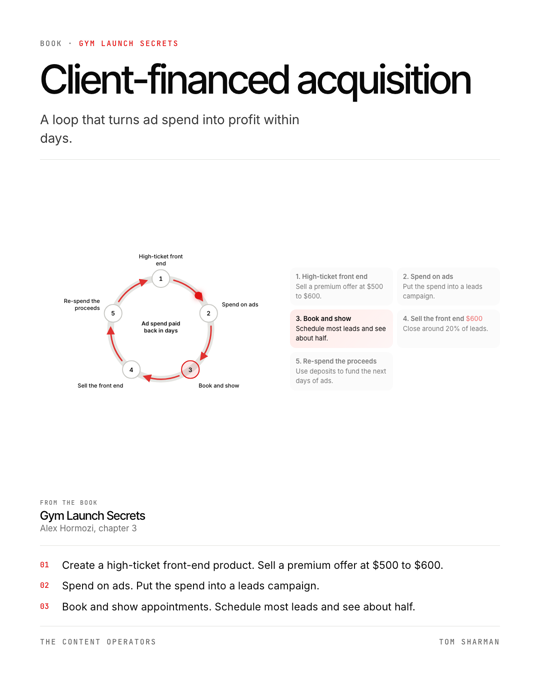
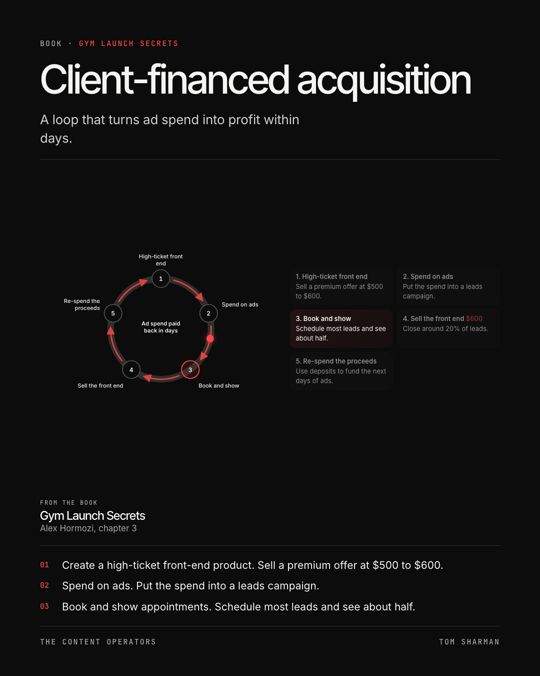
A loop that turns ad spend into profit within days.
- Create a high-ticket front-end product. Sell a premium offer at $500 to $600.
- Spend on ads. Put the spend into a leads campaign.
- Book and show appointments. Schedule most leads and see about half.
- Sell the front end. Close around 20% of leads.
- Re-spend the proceeds. Use deposits to fund the next days of ads.
From chapter: Chapter 3, Get Paid To Acquire Customers, pp. 85–94
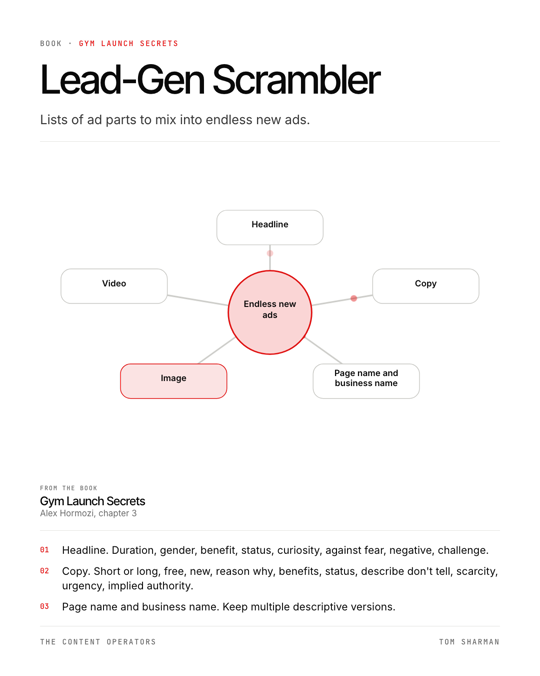
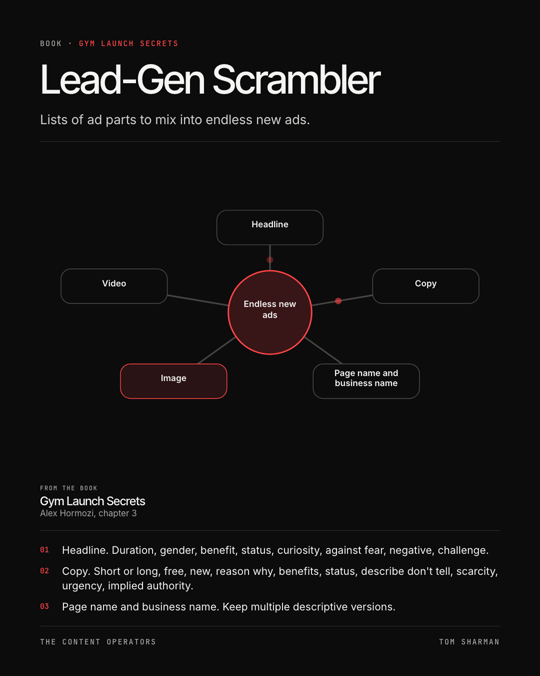
Lists of ad parts to mix into endless new ads.
- Headline. Duration, gender, benefit, status, curiosity, against fear, negative, challenge.
- Copy. Short or long, free, new, reason why, benefits, status, describe don't tell, scarcity, urgency, implied authority.
- Page name and business name. Keep multiple descriptive versions.
- Image. Contrast, group pictures, selfies, workout and class shots, memes.
- Video. Testimonials, facility tour, whiteboard, pitching, subtitles.
From chapter: Chapter 3, Get Paid To Acquire Customers, pp. 85–94
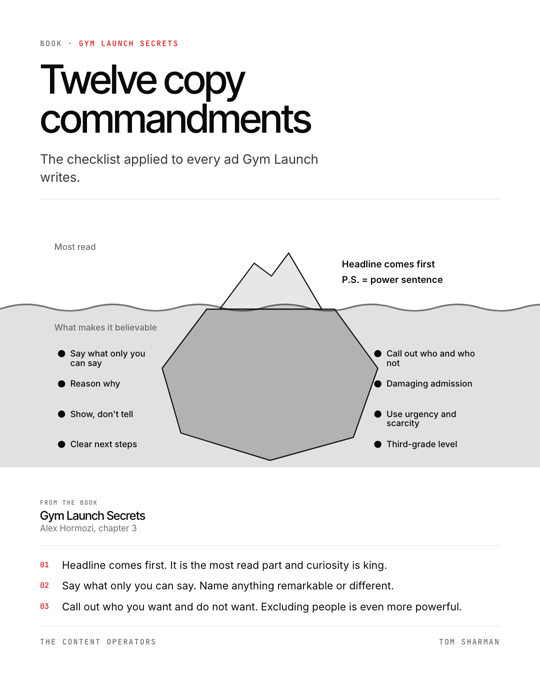
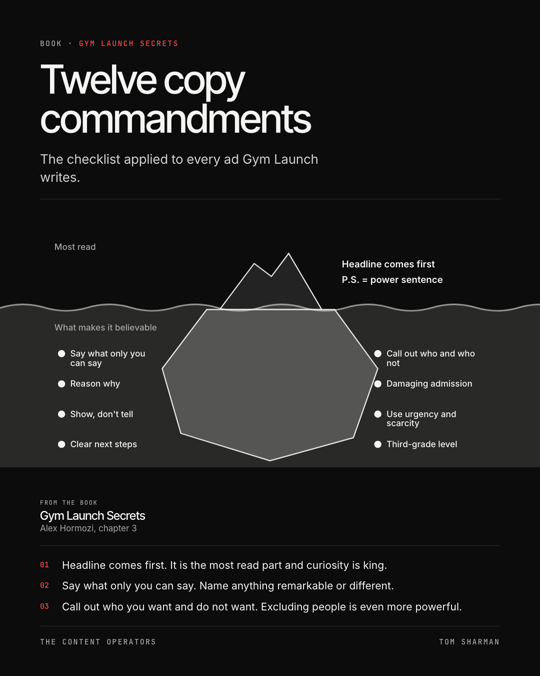
The checklist applied to every ad Gym Launch writes.
- Headline comes first. It is the most read part and curiosity is king.
- Say what only you can say. Name anything remarkable or different.
- Call out who you want and do not want. Excluding people is even more powerful.
- Reason why. Always say why you are running the promotion.
- Damaging admission. Own your flaws to make the rest believable.
- Show, don't tell. Describe the emotion rather than the claim.
- Tie benefits to status. Make the benefit about how others will see them.
- Use urgency and scarcity. Keep both legitimate.
- Implied authority. State credentials and results.
- P.S. = power sentence. Headline and P.S. are the most read words.
- Clear next steps. Make it stupid simple with steps one, two and three.
- Third-grade level. Check the reading level with a free tool.
From chapter: Chapter 3, Get Paid To Acquire Customers, pp. 85–94
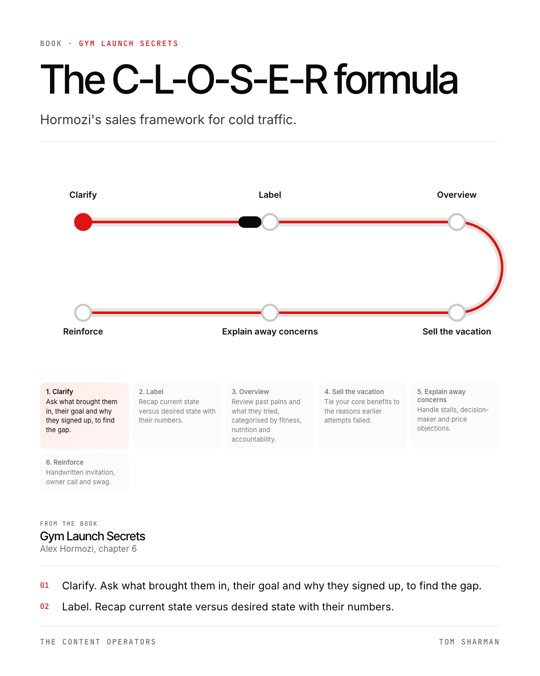
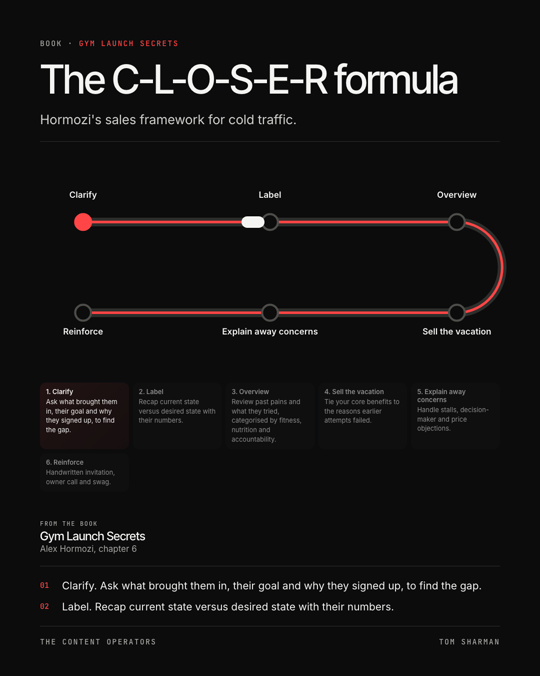
Hormozi's sales framework for cold traffic.
- Clarify. Ask what brought them in, their goal and why they signed up, to find the gap.
- Label. Recap current state versus desired state with their numbers.
- Overview. Review past pains and what they tried, categorised by fitness, nutrition and accountability.
- Sell the vacation. Tie your core benefits to the reasons earlier attempts failed.
- Explain away concerns. Handle stalls, decision-maker and price objections.
- Reinforce. Handwritten invitation, owner call and swag.
From chapter: Chapter 6, The C-L-O-S-E-R Formula, pp. 111–130
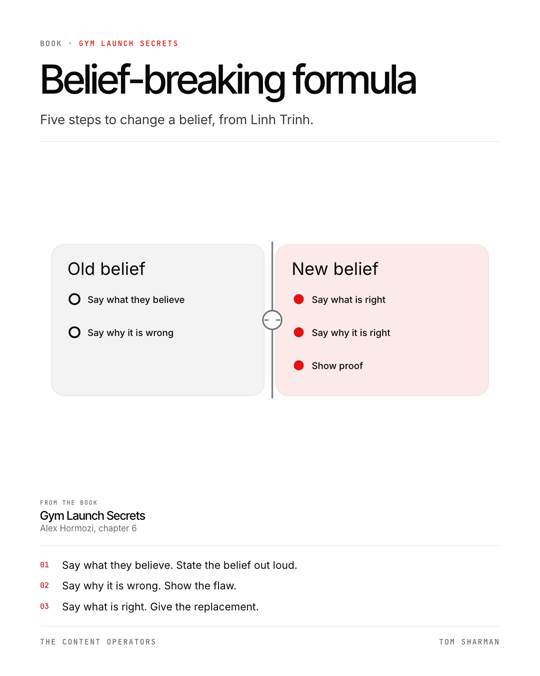
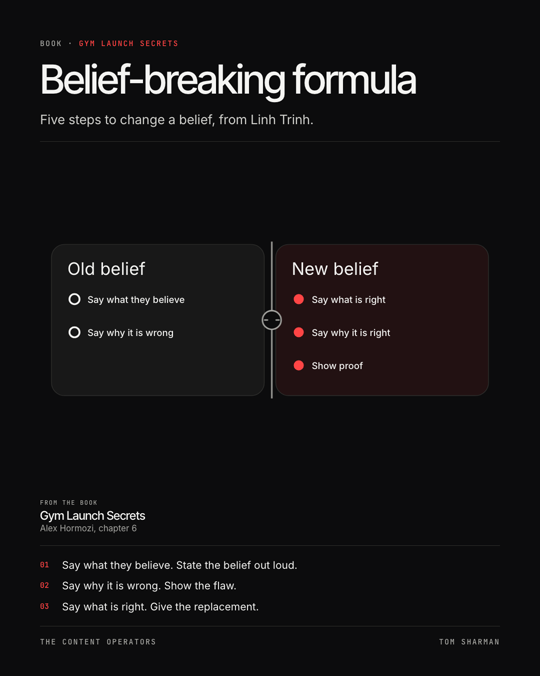
Five steps to change a belief, from Linh Trinh.
- Say what they believe. State the belief out loud.
- Say why it is wrong. Show the flaw.
- Say what is right. Give the replacement.
- Say why it is right. Explain the reason.
- Show proof. Testimonials and third-party stats.
From chapter: Chapter 6, The C-L-O-S-E-R Formula, pp. 111–130
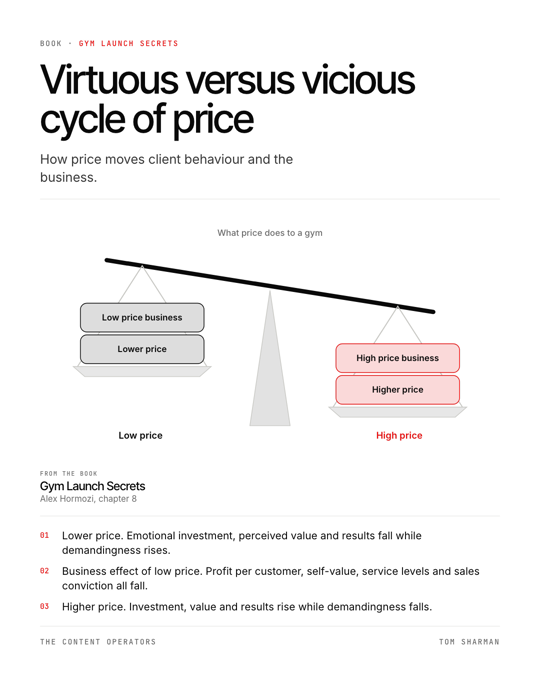
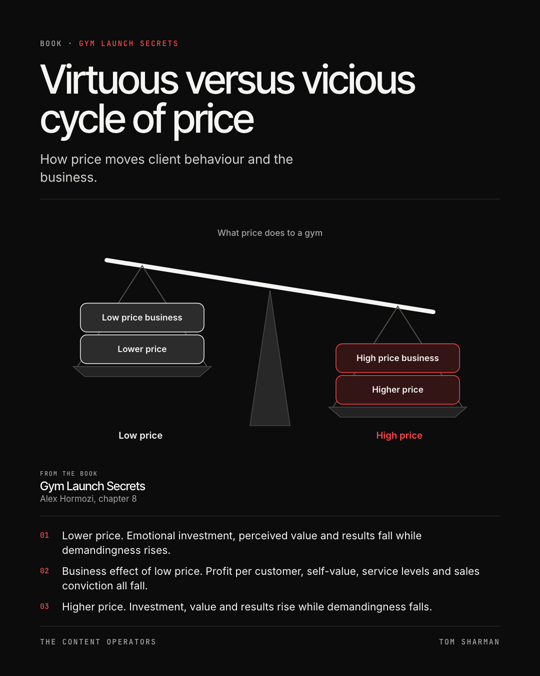
How price moves client behaviour and the business.
- Lower price. Emotional investment, perceived value and results fall while demandingness rises.
- Business effect of low price. Profit per customer, self-value, service levels and sales conviction all fall.
- Higher price. Investment, value and results rise while demandingness falls.
- Business effect of high price. More profit to reinvest, higher service levels and stronger sales conviction.
From chapter: Chapter 8, Price-Profit Levers, pp. 141–164
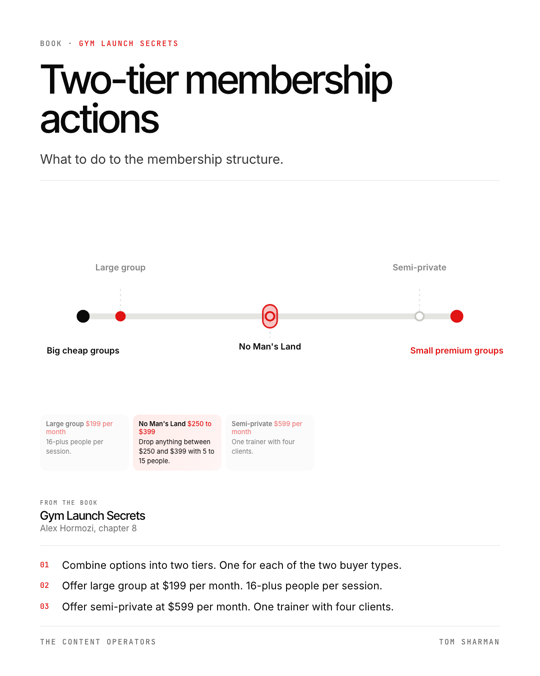
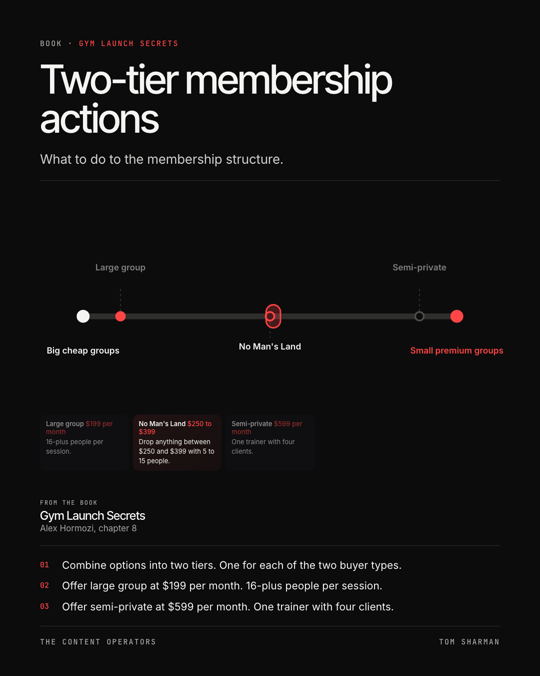
What to do to the membership structure.
- Combine options into two tiers. One for each of the two buyer types.
- Offer large group at $199 per month. 16-plus people per session.
- Offer semi-private at $599 per month. One trainer with four clients.
- Remove No Man's Land price points. Drop anything between $250 and $399 with 5 to 15 people.
- Switch billing to weekly pricing on 28-day cycles. Sell at $39 to $49 per week.
From chapter: Chapter 8, Price-Profit Levers, pp. 141–164
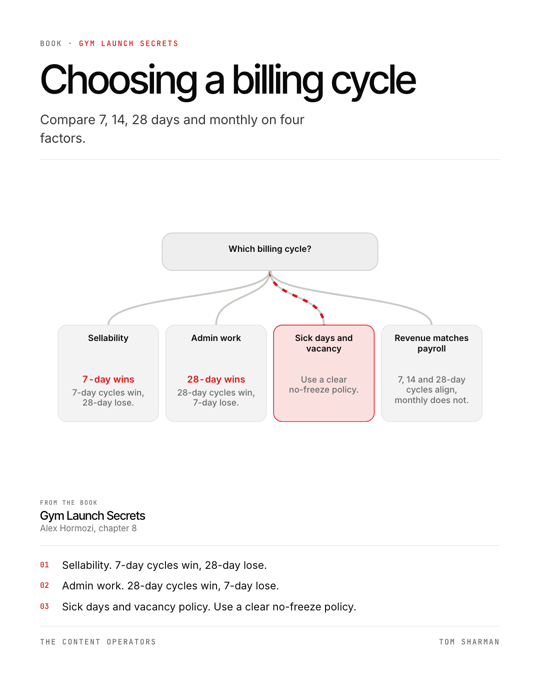
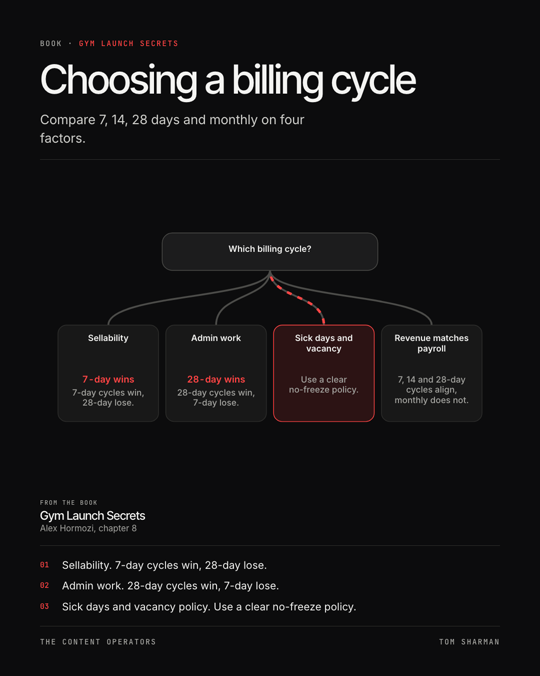
Compare 7, 14, 28 days and monthly on four factors.
- Sellability. 7-day cycles win, 28-day lose.
- Admin work. 28-day cycles win, 7-day lose.
- Sick days and vacancy policy. Use a clear no-freeze policy.
- Revenue aligned with payroll. 7, 14 and 28-day cycles align, monthly does not.
From chapter: Chapter 8, Price-Profit Levers, pp. 141–164
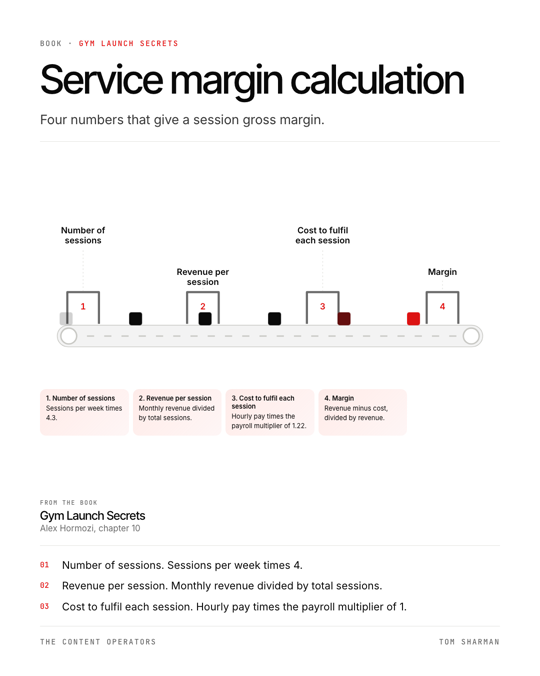
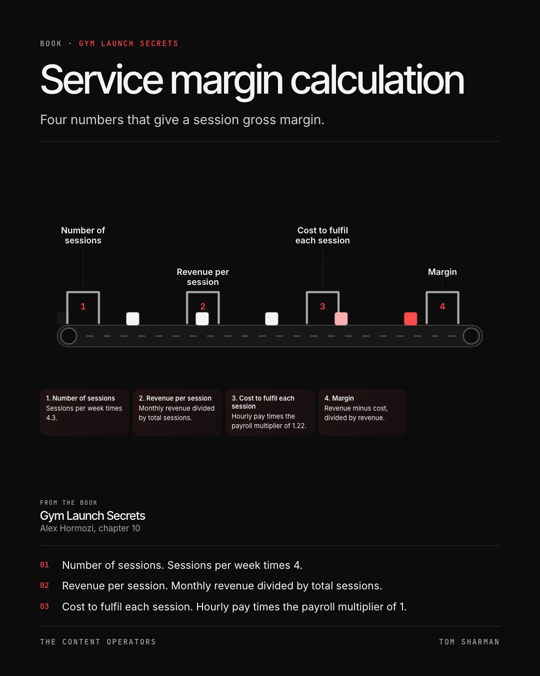
Four numbers that give a session gross margin.
- Number of sessions. Sessions per week times 4.3.
- Revenue per session. Monthly revenue divided by total sessions.
- Cost to fulfil each session. Hourly pay times the payroll multiplier of 1.22.
- Margin. Revenue minus cost, divided by revenue.
From chapter: Chapter 10, The Overhead Lever, pp. 183–192
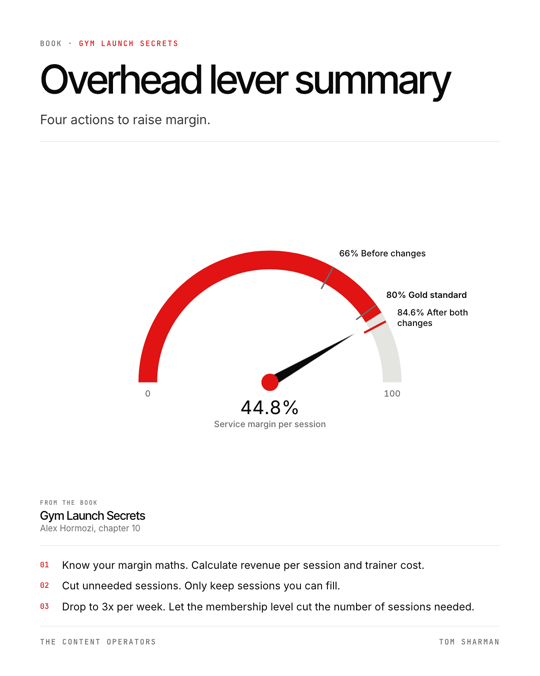
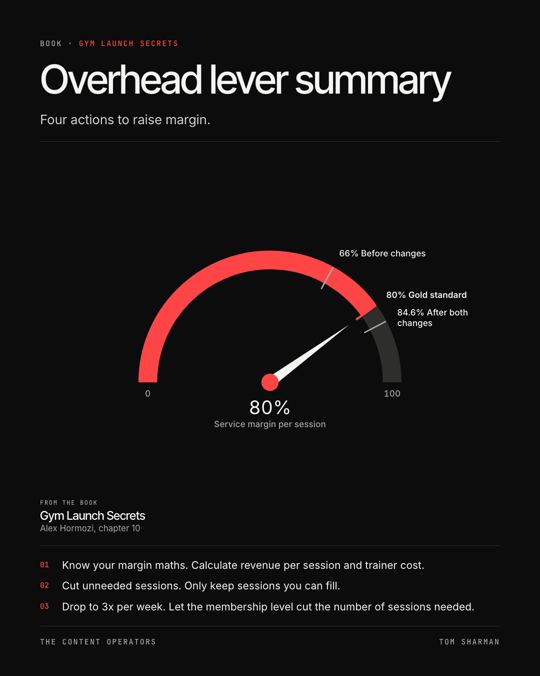
Four actions to raise margin.
- Know your margin maths. Calculate revenue per session and trainer cost.
- Cut unneeded sessions. Only keep sessions you can fill.
- Drop to 3x per week. Let the membership level cut the number of sessions needed.
- Calibrate trainer pay if needed. Standardise pay across trainers.
From chapter: Chapter 10, The Overhead Lever, pp. 183–192
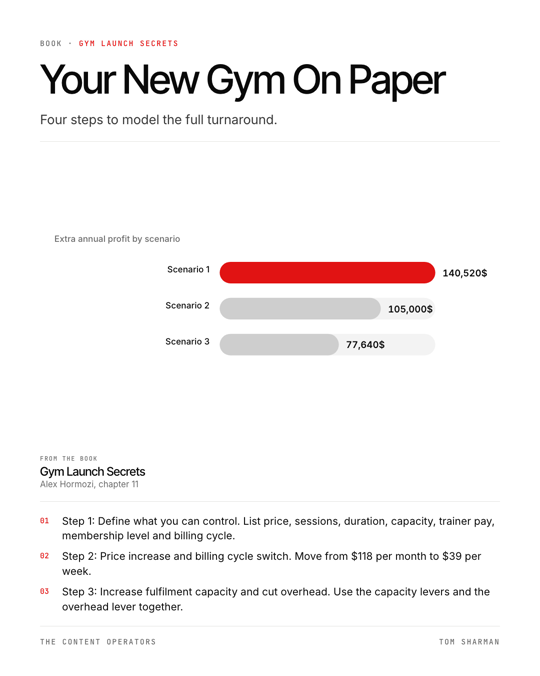
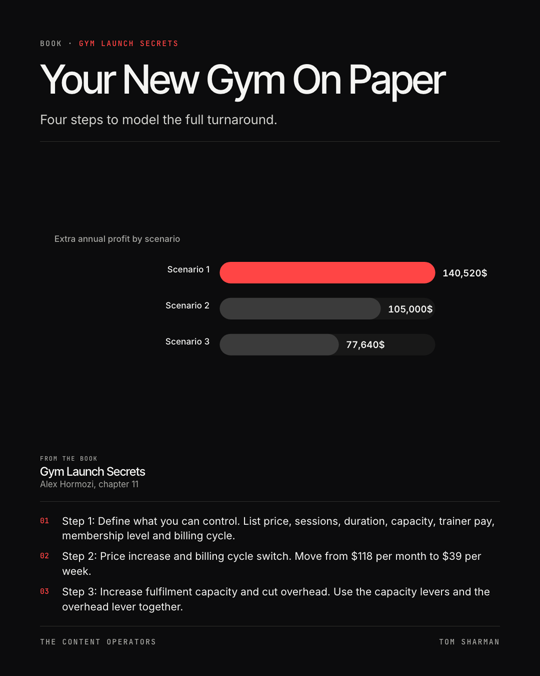
Four steps to model the full turnaround.
- Step 1: Define what you can control. List price, sessions, duration, capacity, trainer pay, membership level and billing cycle.
- Step 2: Price increase and billing cycle switch. Move from $118 per month to $39 per week.
- Step 3: Increase fulfilment capacity and cut overhead. Use the capacity levers and the overhead lever together.
- Step 4: Do the maths. Compare revenue, overhead and profit under three scenarios.
From chapter: Chapter 11, Your New Gym On Paper, pp. 193–206
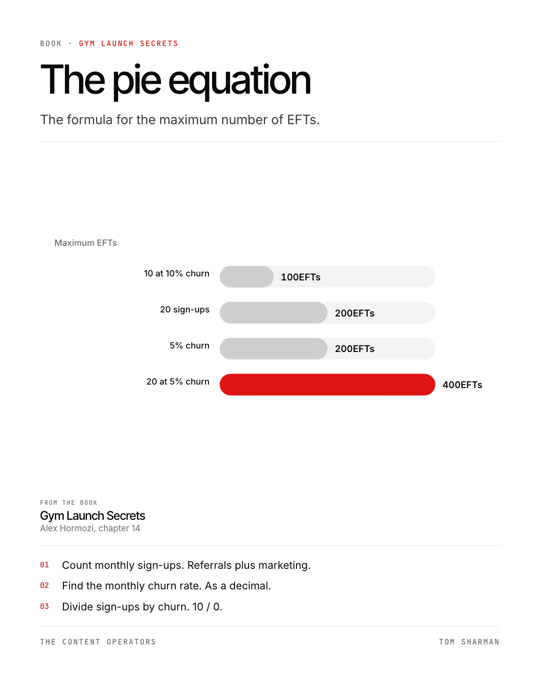
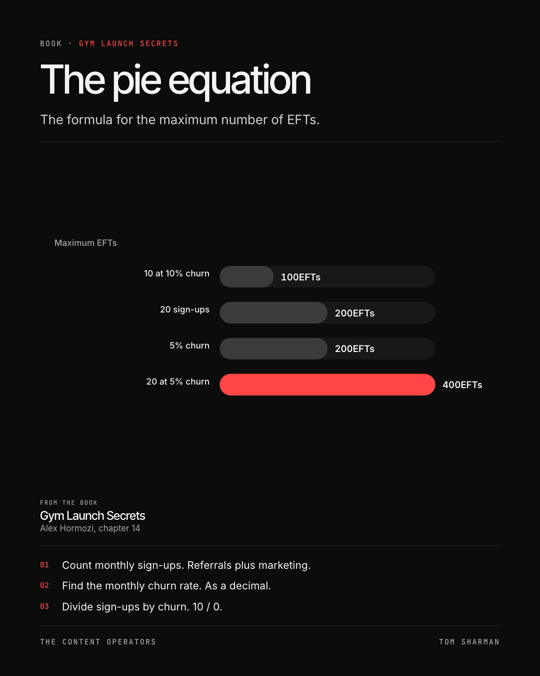
The formula for the maximum number of EFTs.
- Count monthly sign-ups. Referrals plus marketing.
- Find the monthly churn rate. As a decimal.
- Divide sign-ups by churn. 10 / 0.1 = 100 maximum EFTs.
- Change one input. 20 sign-ups gives 200, 5% churn gives 200.
- Change both. 20 sign-ups at 5% churn gives 400.
From chapter: Chapter 14, How Retention Multiplies Revenue, pp. 239–246
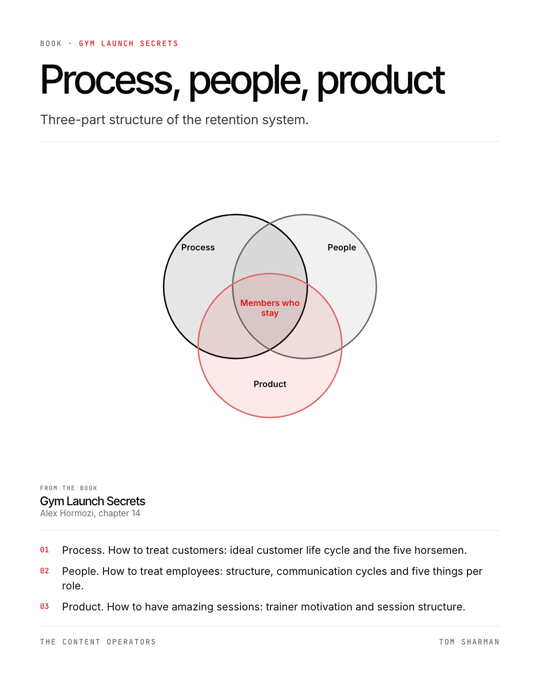
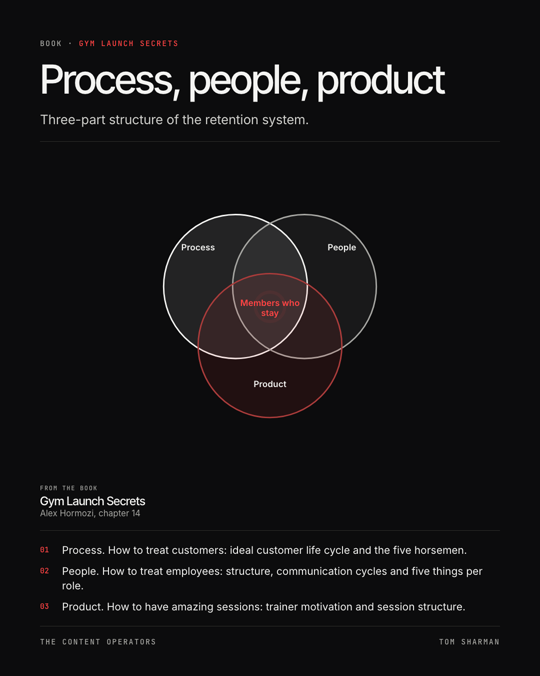
Three-part structure of the retention system.
- Process. How to treat customers: ideal customer life cycle and the five horsemen.
- People. How to treat employees: structure, communication cycles and five things per role.
- Product. How to have amazing sessions: trainer motivation and session structure.
From chapter: Chapter 14, How Retention Multiplies Revenue, pp. 239–246
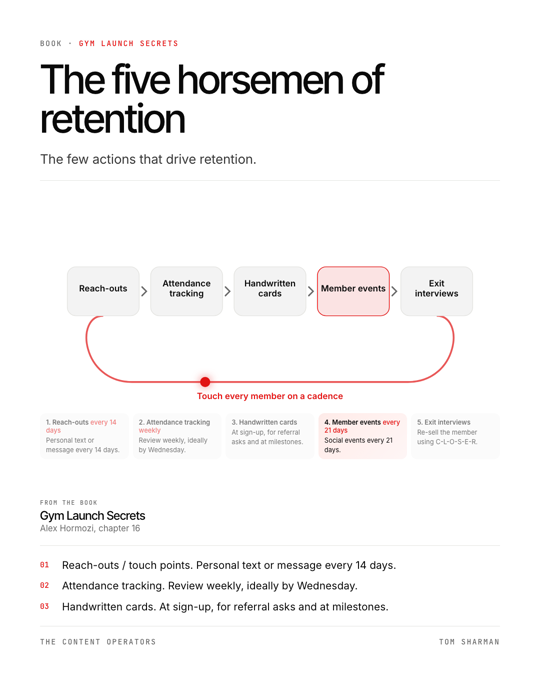
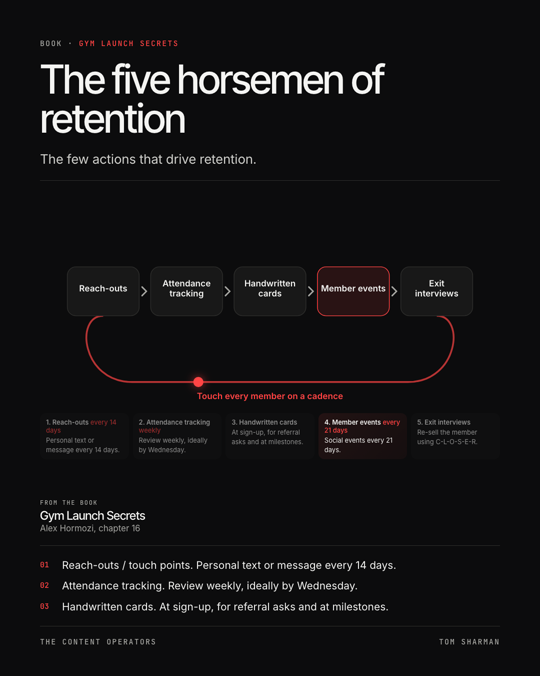
The few actions that drive retention.
- Reach-outs / touch points. Personal text or message every 14 days.
- Attendance tracking. Review weekly, ideally by Wednesday.
- Handwritten cards. At sign-up, for referral asks and at milestones.
- Member events. Social events every 21 days.
- Exit interviews. Re-sell the member using C-L-O-S-E-R.
From chapter: Chapter 16, PROCESS:, pp. 253–266
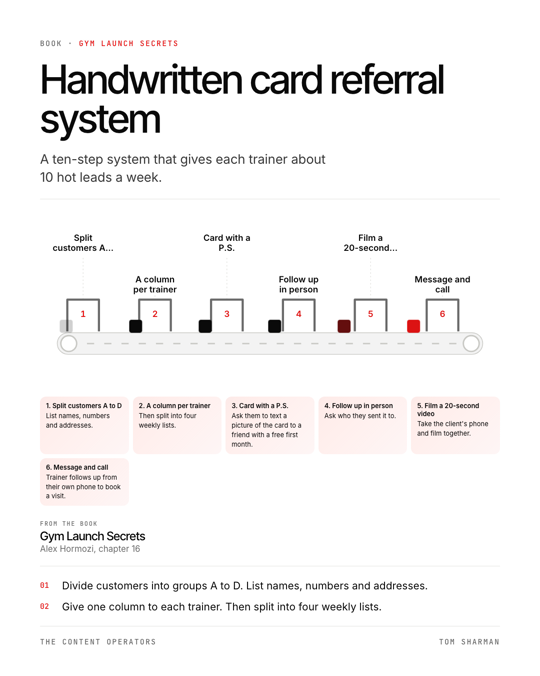
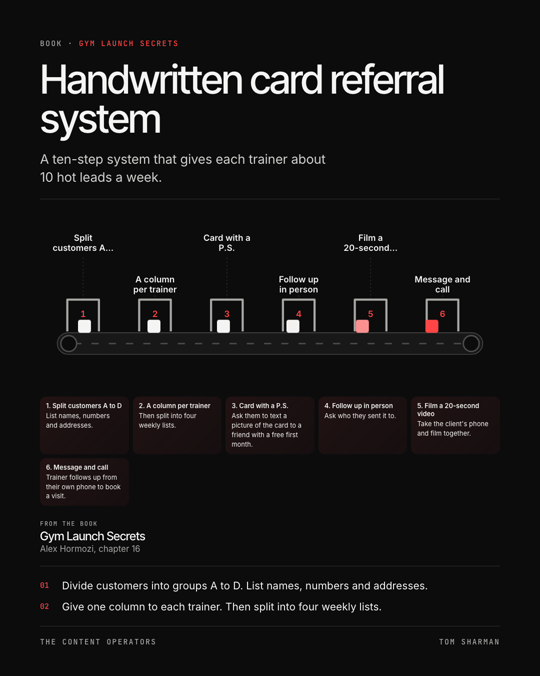
A ten-step system that gives each trainer about 10 hot leads a week.
- Divide customers into groups A to D. List names, numbers and addresses.
- Give one column to each trainer. Then split into four weekly lists.
- Write a card with a P.S.. Ask them to text a picture of the card to a friend with a free first month.
- Follow up in person. Ask who they sent it to.
- Record a 20-second video. Take the client's phone and film together.
- Message the prospect and call. Trainer follows up from their own phone to book a visit.
From chapter: Chapter 16, PROCESS:, pp. 253–266
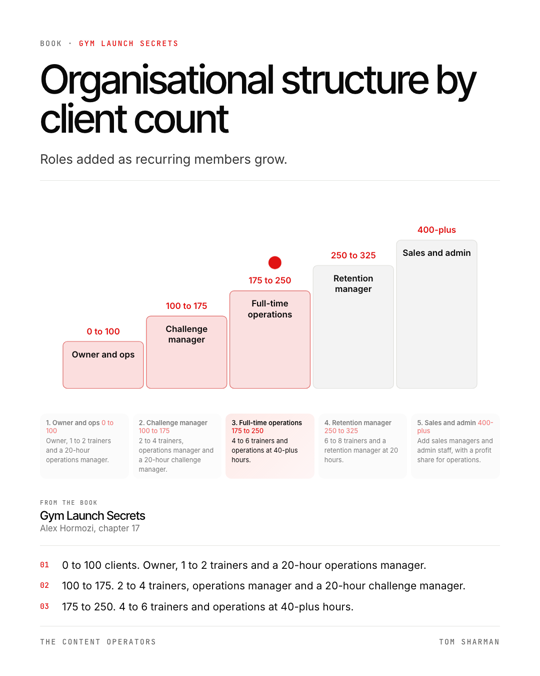
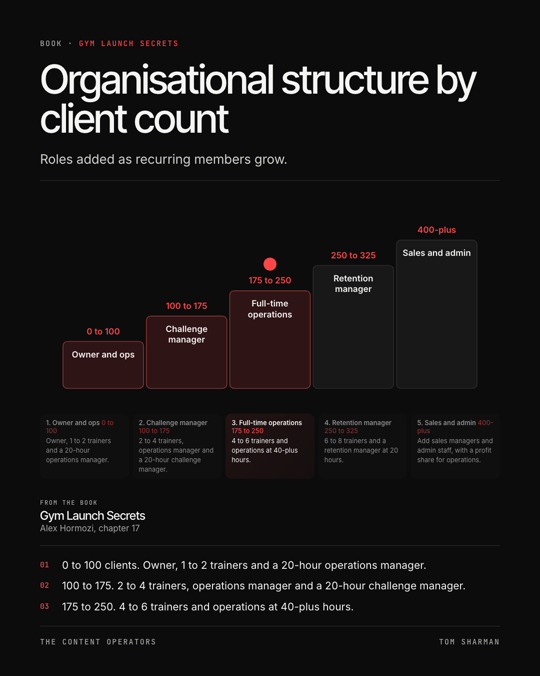
Roles added as recurring members grow.
- 0 to 100 clients. Owner, 1 to 2 trainers and a 20-hour operations manager.
- 100 to 175. 2 to 4 trainers, operations manager and a 20-hour challenge manager.
- 175 to 250. 4 to 6 trainers and operations at 40-plus hours.
- 250 to 325. 6 to 8 trainers and a retention manager at 20 hours.
- 400-plus. Add sales managers and admin staff, with a profit share for operations.
From chapter: Chapter 17, PEOPLE:, pp. 267–272
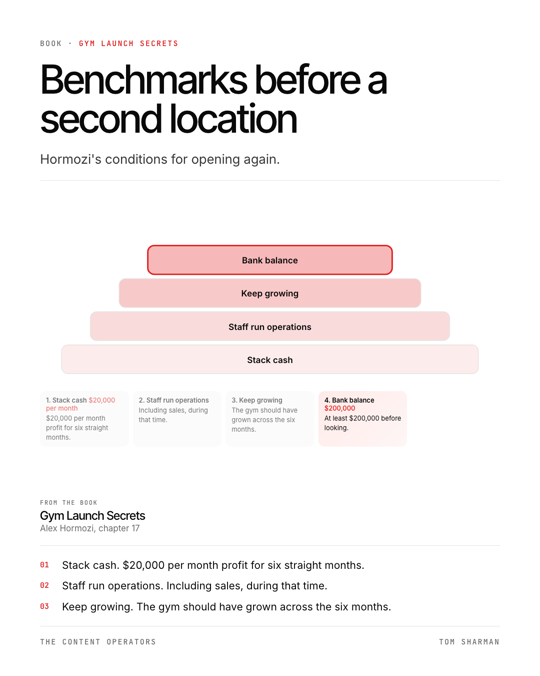
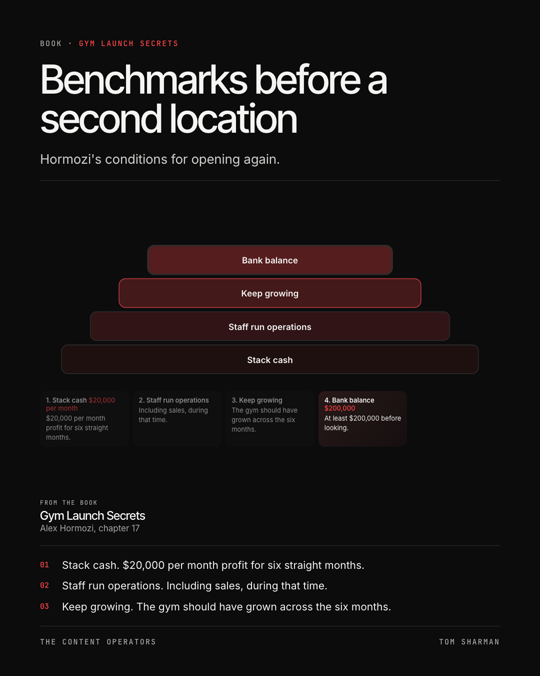
Hormozi's conditions for opening again.
- Stack cash. $20,000 per month profit for six straight months.
- Staff run operations. Including sales, during that time.
- Keep growing. The gym should have grown across the six months.
- Bank balance. At least $200,000 before looking.
From chapter: Chapter 17, PEOPLE:, pp. 267–272
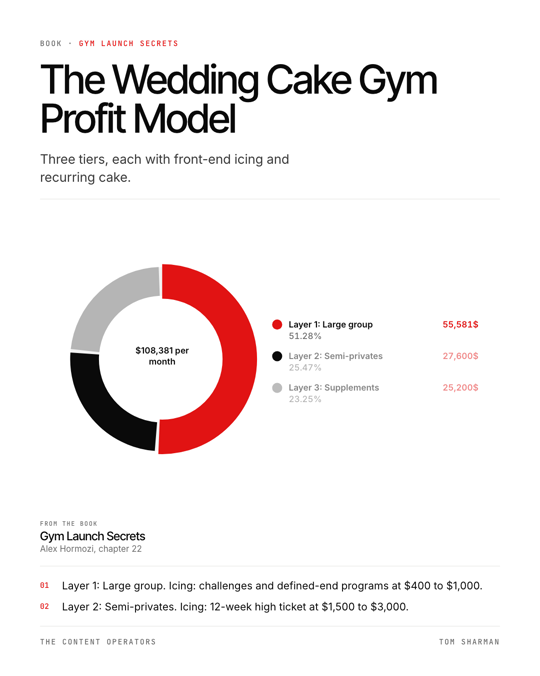
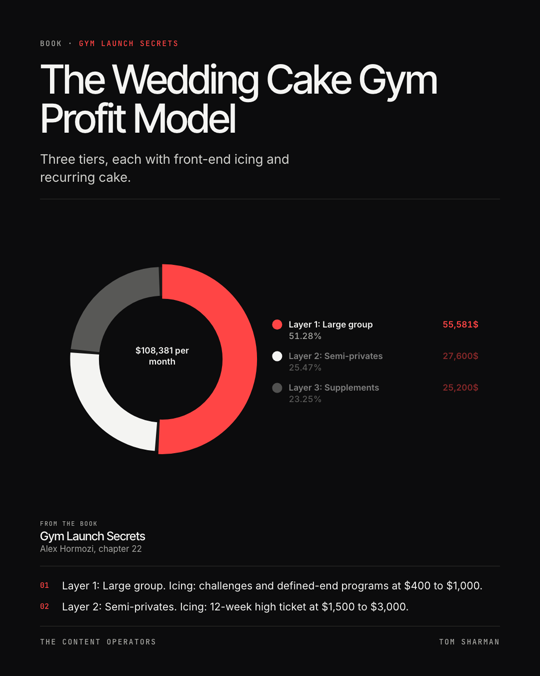
Three tiers, each with front-end icing and recurring cake.
- Layer 1: Large group. Icing: challenges and defined-end programs at $400 to $1,000. Cake: recurring EFT at $167 to $225 per month.
- Layer 2: Semi-privates. Icing: 12-week high ticket at $1,500 to $3,000. Cake: 1-on-4 EFT at $500 to $700 per month.
- Layer 3: Supplements. Icing: packages at $500 to $5,000. Cake: autoship at $200 to $400 per month.
- Sprinkles: Internal plays. A traffic source feeding every layer.
From chapter: Chapter 22, The Wedding Cake Gym Profit Model, pp. 309–318
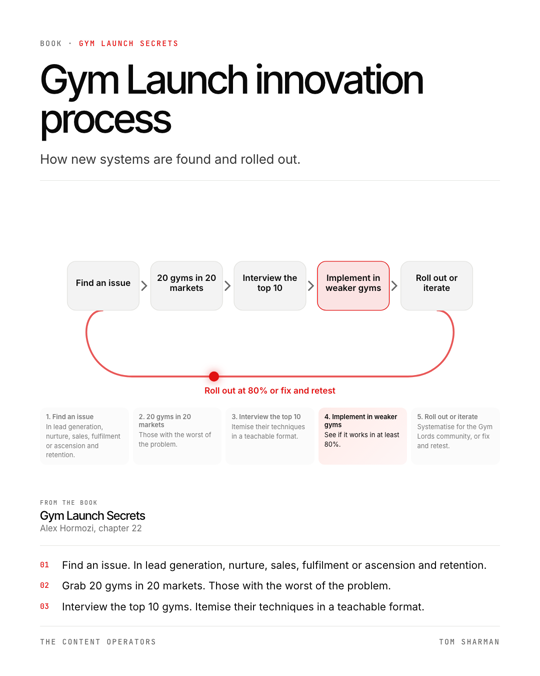
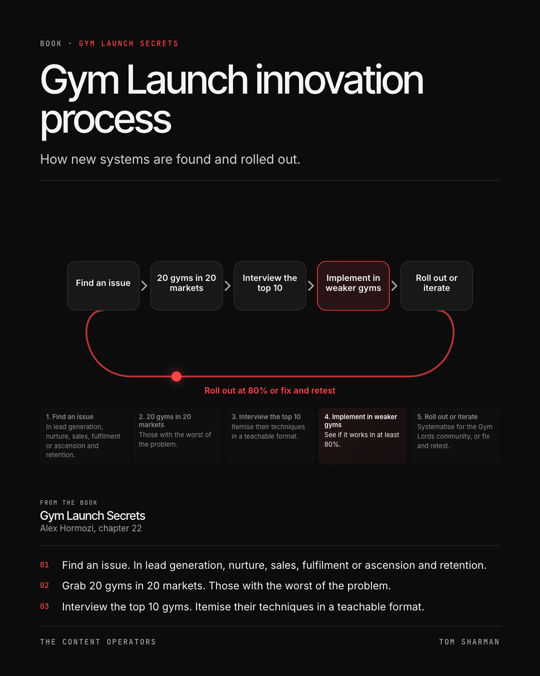
How new systems are found and rolled out.
- Find an issue. In lead generation, nurture, sales, fulfilment or ascension and retention.
- Grab 20 gyms in 20 markets. Those with the worst of the problem.
- Interview the top 10 gyms. Itemise their techniques in a teachable format.
- Implement in weaker gyms. See if it works in at least 80%.
- Roll out or iterate. Systematise for the Gym Lords community, or fix and retest.
From chapter: Chapter 22, The Wedding Cake Gym Profit Model, pp. 309–318
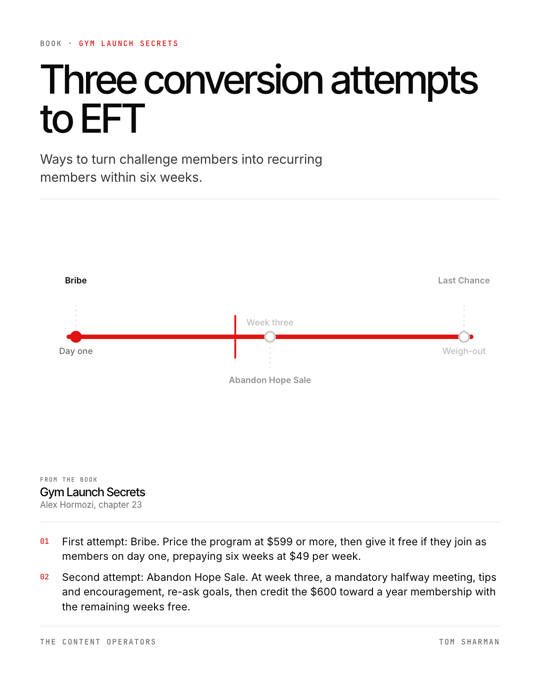
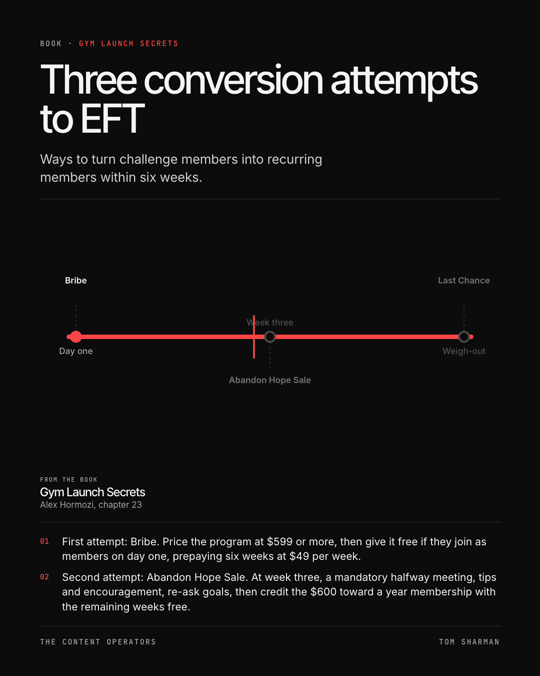
Ways to turn challenge members into recurring members within six weeks.
- First attempt: Bribe. Price the program at $599 or more, then give it free if they join as members on day one, prepaying six weeks at $49 per week.
- Second attempt: Abandon Hope Sale. At week three, a mandatory halfway meeting, tips and encouragement, re-ask goals, then credit the $600 toward a year membership with the remaining weeks free.
- Third attempt: Last Chance. At the weigh-out, credit $25 per pound lost spread over a chosen number of months to land on the target EFT.
From chapter: Chapter 23, Tier 1:, pp. 319–334
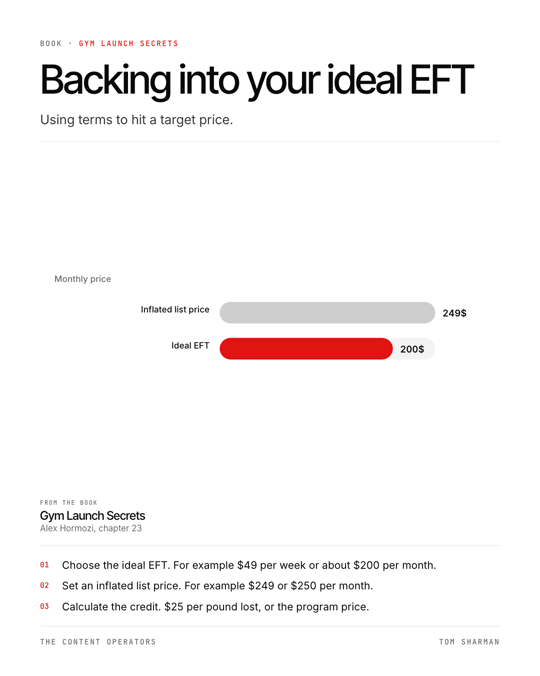
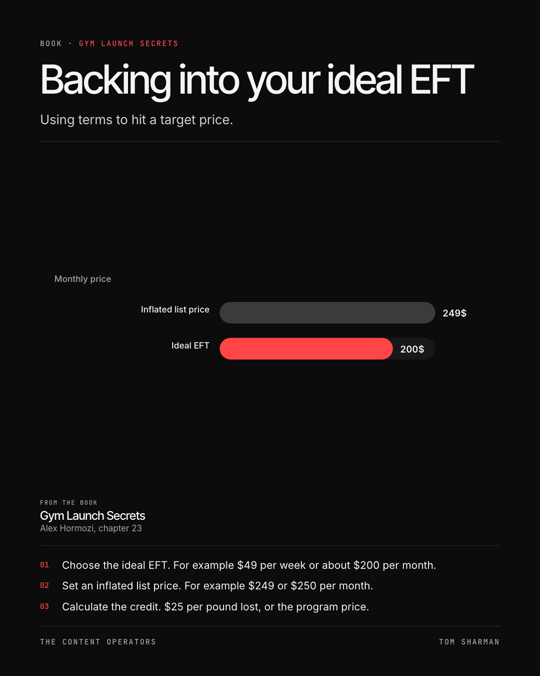
Using terms to hit a target price.
- Choose the ideal EFT. For example $49 per week or about $200 per month.
- Set an inflated list price. For example $249 or $250 per month.
- Calculate the credit. $25 per pound lost, or the program price.
- Spread the credit over months. Choose months so the monthly discount lands on the target.
From chapter: Chapter 23, Tier 1:, pp. 319–334
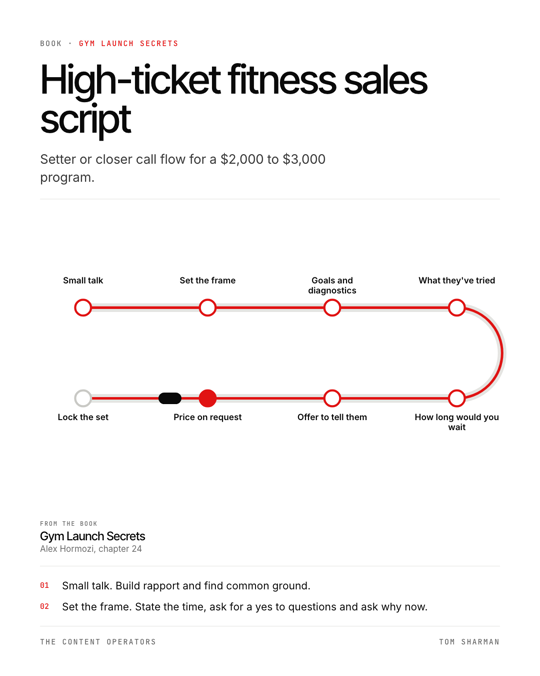
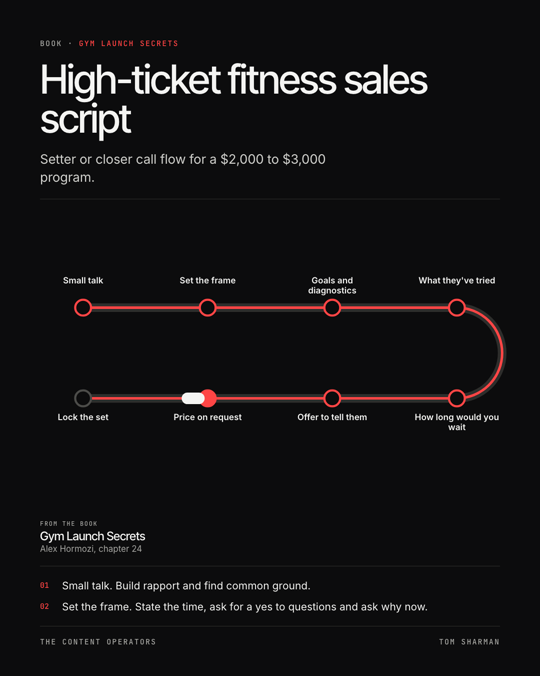
Setter or closer call flow for a $2,000 to $3,000 program.
- Small talk. Build rapport and find common ground.
- Set the frame. State the time, ask for a yes to questions and ask why now.
- Goals and diagnostics. Future pace 12 months and dig into why it matters.
- What they've tried. What's stopping them from getting there alone.
- How long would you wait. Test urgency, and disqualify if they are not ready.
- Offer to tell them. Recap, then shut up and let them ask.
- Price on request. Give the total, then the discount for showing up.
- Lock the set. Card, deposit, decision-maker and payment method confirmed.
From chapter: Chapter 24, Tier 2:, pp. 335–348
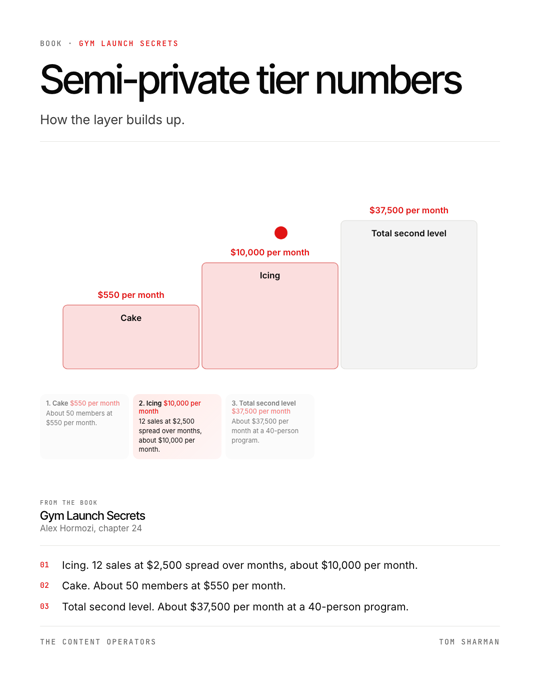
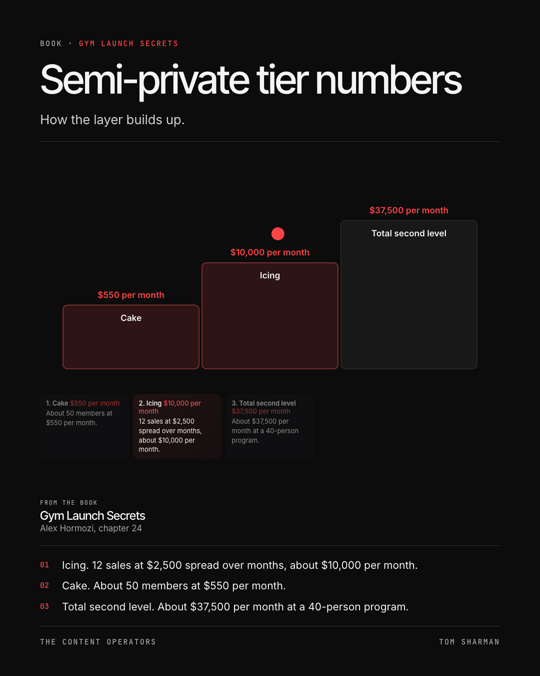
How the layer builds up.
- Icing. 12 sales at $2,500 spread over months, about $10,000 per month.
- Cake. About 50 members at $550 per month.
- Total second level. About $37,500 per month at a 40-person program.
From chapter: Chapter 24, Tier 2:, pp. 335–348
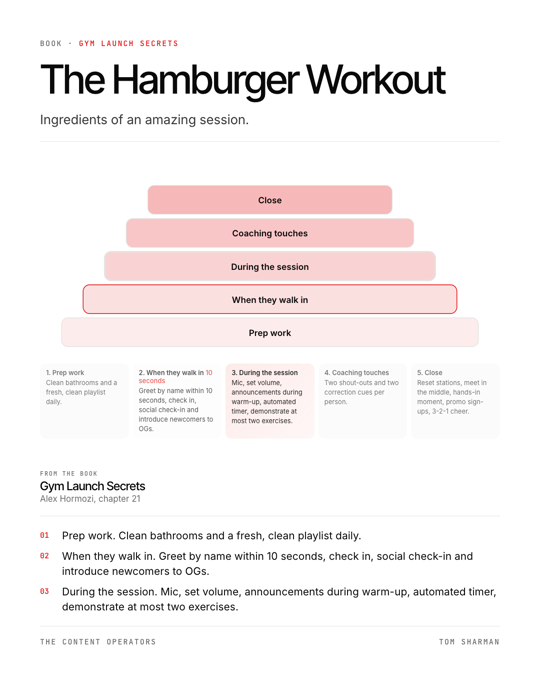
Ingredients of an amazing session.
- Prep work. Clean bathrooms and a fresh, clean playlist daily.
- When they walk in. Greet by name within 10 seconds, check in, social check-in and introduce newcomers to OGs.
- During the session. Mic, set volume, announcements during warm-up, automated timer, demonstrate at most two exercises.
- Coaching touches. Two shout-outs and two correction cues per person.
- Close. Reset stations, meet in the middle, hands-in moment, promo sign-ups, 3-2-1 cheer.
From chapter: Chapter 21, PRODUCT: How To Run An, pp. 295–308
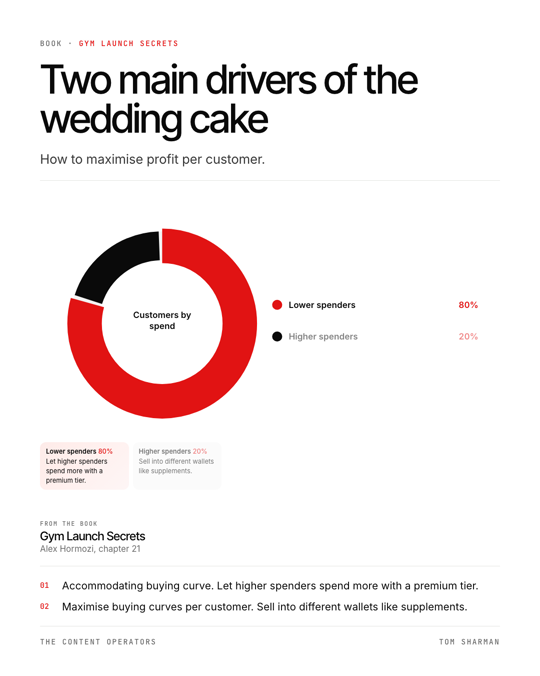
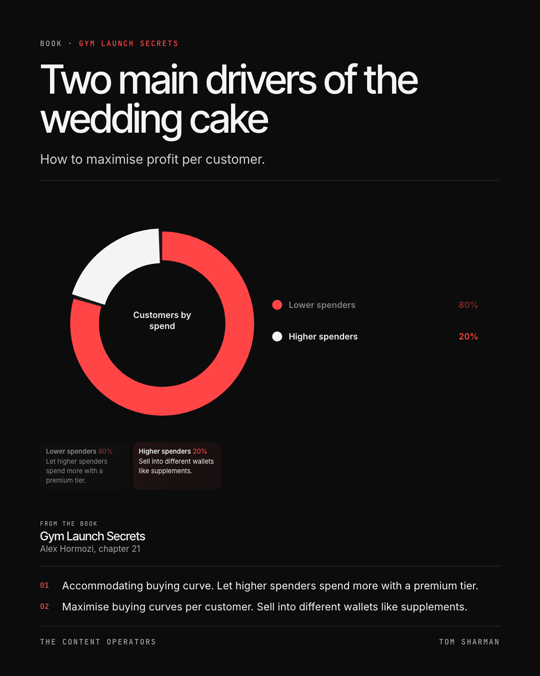
How to maximise profit per customer.
- Accommodating buying curve. Let higher spenders spend more with a premium tier.
- Maximise buying curves per customer. Sell into different wallets like supplements.
From chapter: Chapter 21, PRODUCT: How To Run An, pp. 295–308
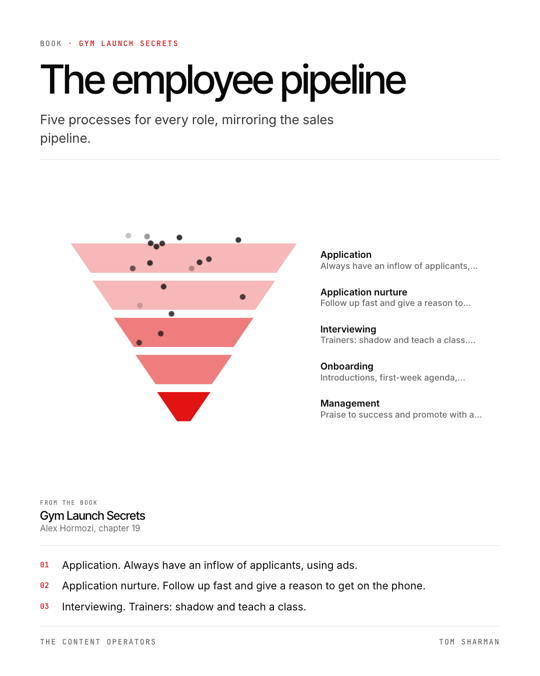
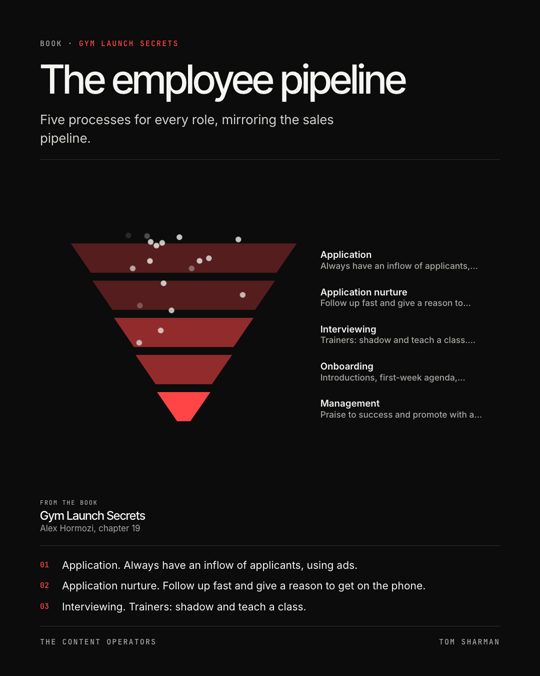
Five processes for every role, mirroring the sales pipeline.
- Application. Always have an inflow of applicants, using ads.
- Application nurture. Follow up fast and give a reason to get on the phone.
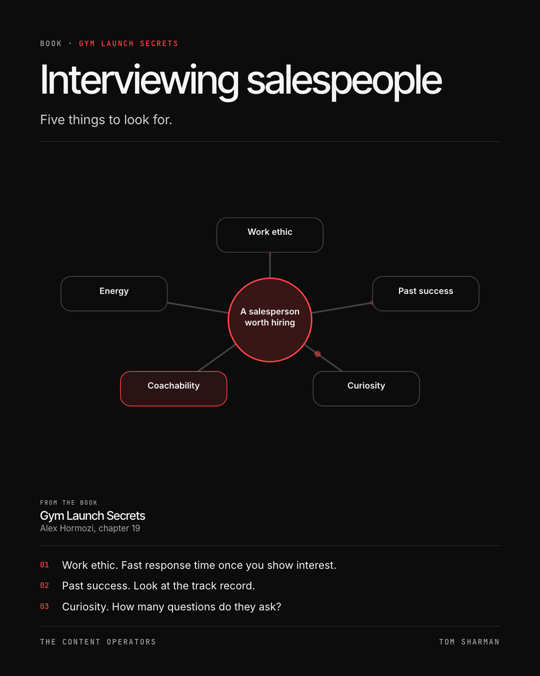
- Interviewing. Trainers: shadow and teach a class. Salespeople: work ethic, past success, curiosity, coachability, energy.
- Onboarding / training. Introductions, first-week agenda, values, growth path, communication cycle, perfect day, numbers.
- Management / ascension. Praise to success and promote with a clear growth path.
From chapter: Chapter 19, PEOPLE:, pp. 279–286
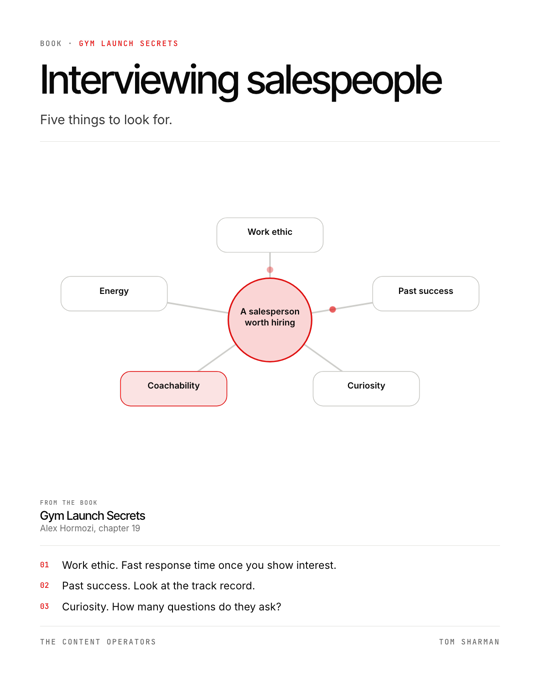
Five things to look for.
- Work ethic. Fast response time once you show interest.
- Past success. Look at the track record.
- Curiosity. How many questions do they ask?
- Coachability. Have them sell you, then give feedback.
- Energy. Upbeat and positive.
From chapter: Chapter 19, PEOPLE:, pp. 279–286
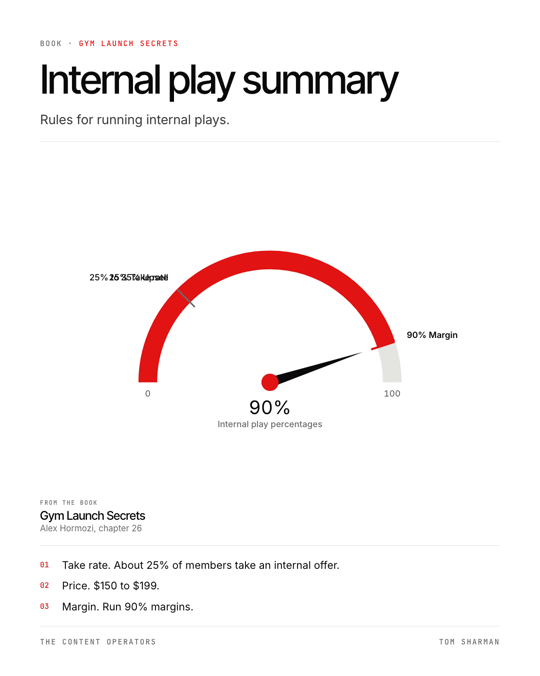
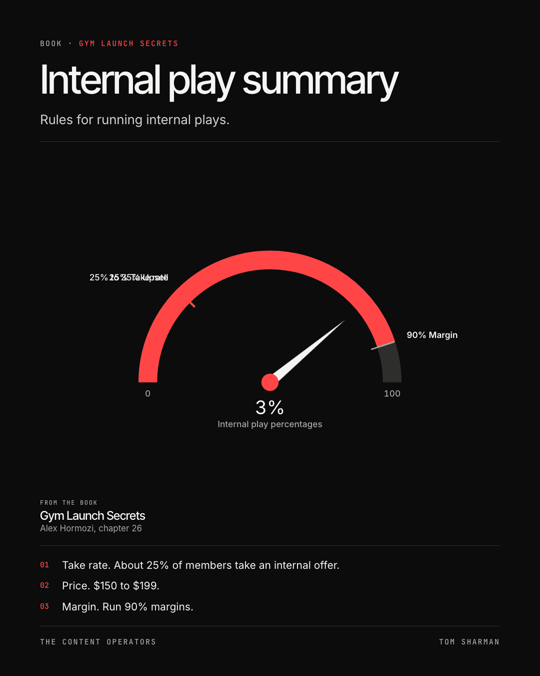
Rules for running internal plays.
- Take rate. About 25% of members take an internal offer.
- Price. $150 to $199.
- Margin. Run 90% margins.
- Cadence. Run every six weeks, with a promo of four to six weeks.
- Upsell. Move 25% to 35% into HTP if you have it.
- Fulfilment. Weekends during off hours.
- Stack. Sell supplements and other ancillary services.
From chapter: Chapter 26, Sprinkles:, pp. 359–430
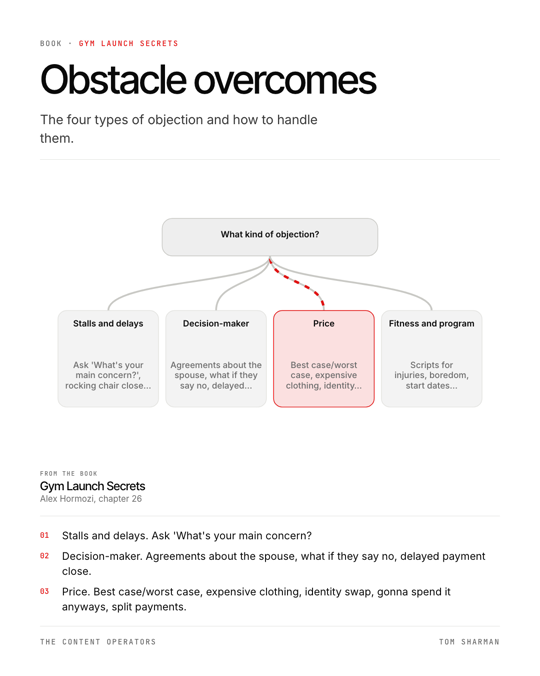
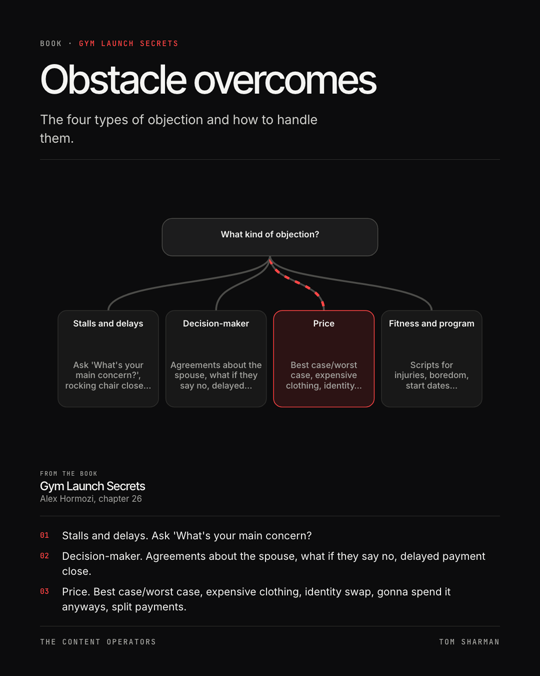
The four types of objection and how to handle them.
- Stalls and delays. Ask 'What's your main concern?', rocking chair close, three questions, scale 1 to 10.
- Decision-maker. Agreements about the spouse, what if they say no, delayed payment close.
- Price. Best case/worst case, expensive clothing, identity swap, gonna spend it anyways, split payments.
- Fitness and program related. Scripts for injuries, boredom, start dates, alcohol, cheat days, conditions.
From chapter: Chapter 26, Sprinkles:, pp. 359–430
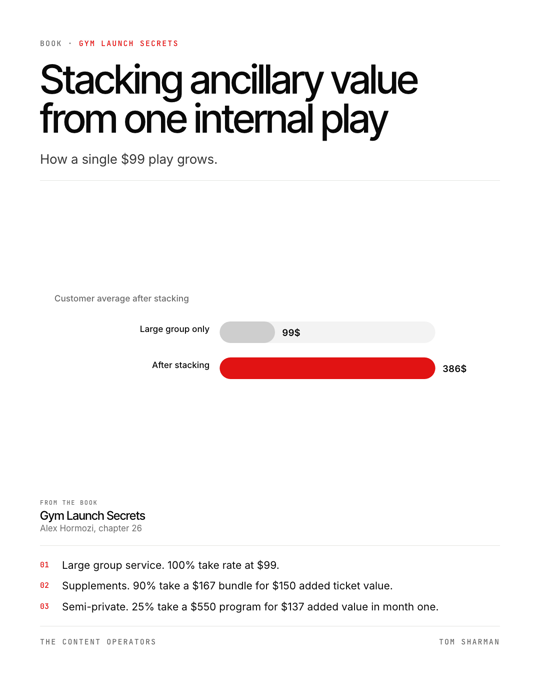
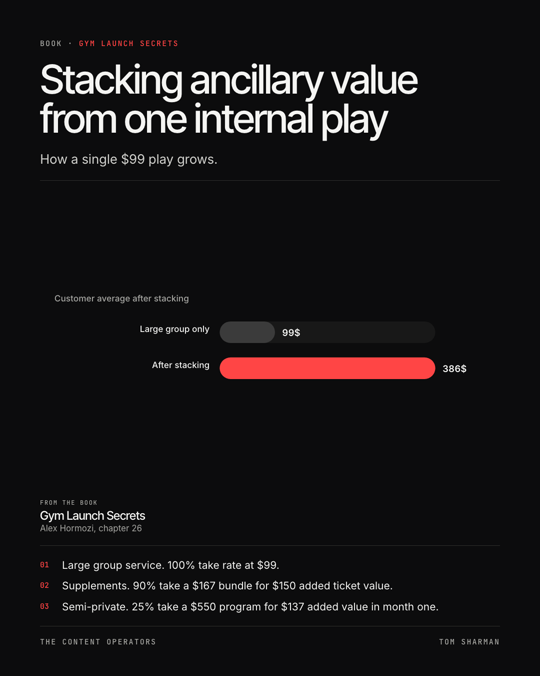
How a single $99 play grows.
- Large group service. 100% take rate at $99.
- Supplements. 90% take a $167 bundle for $150 added ticket value.
- Semi-private. 25% take a $550 program for $137 added value in month one.
From chapter: Chapter 26, Sprinkles:, pp. 359–430