What it argues
Mochary, who coaches the CEOs of Coinbase, OpenDoor and AngelList, argues that a founder becomes a great CEO by installing a small set of habits and systems rather than by talent. Start with personal productivity (GTD, Inbox Zero, two hours on one Top Goal), then group habits such as writing before talking, impeccable agreements and honest feedback. Keep the team to six or fewer until product market fit, then accept about a day a week of meetings, goals and one-on-ones. Fundraising, recruiting and sales are the same trust-based process, best run by asking about the other person's life and remembering it. Write everything down, give each function one owner and a backup, and track a few KPIs with counter-metrics. Note: the file is the book as imported, with pages 62 to 64 and 81 blank and the author field empty in the library.
Every framework, step by step
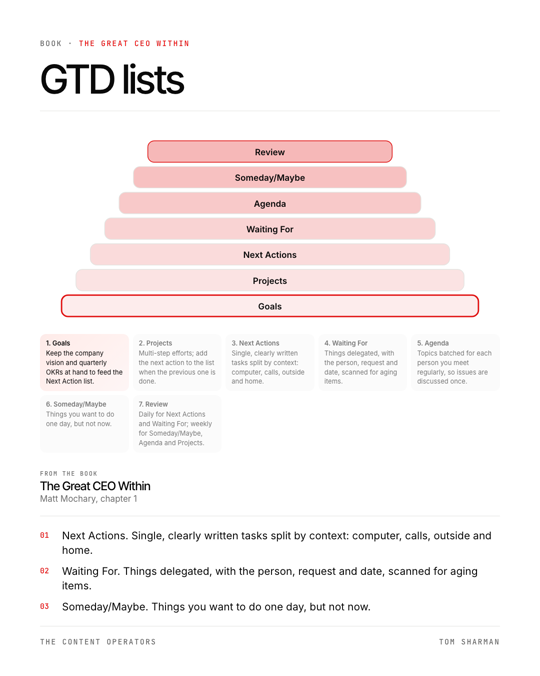
David Allen's Getting Things Done system as Mochary uses it, plus a Goals list of his own.
- Next Actions. Single, clearly written tasks split by context: computer, calls, outside and home.
- Waiting For. Things delegated, with the person, request and date, scanned for aging items.
- Someday/Maybe. Things you want to do one day, but not now.
- Agenda. Topics batched for each person you meet regularly, so issues are discussed once.
- Projects. Multi-step efforts; add the next action to the list when the previous one is done.
- Review. Daily for Next Actions and Waiting For; weekly for Someday/Maybe, Agenda and Projects.
- Goals. Keep the company vision and quarterly OKRs at hand to feed the Next Action list.
From chapter: Chapter 1: Getting Started, pp. 5–11
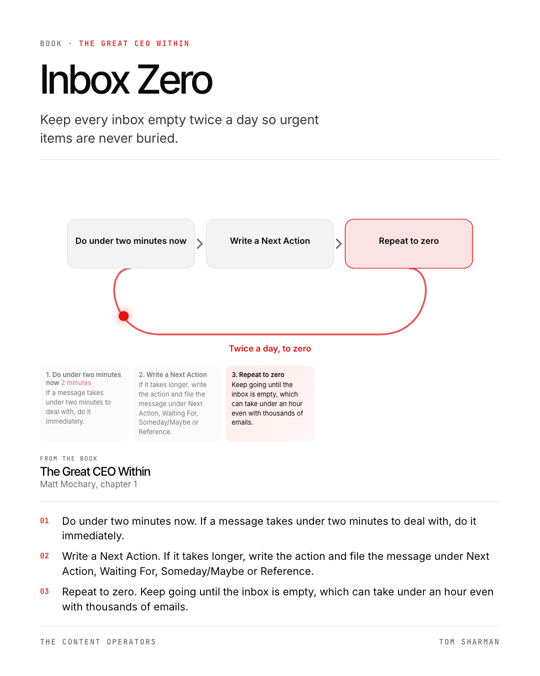
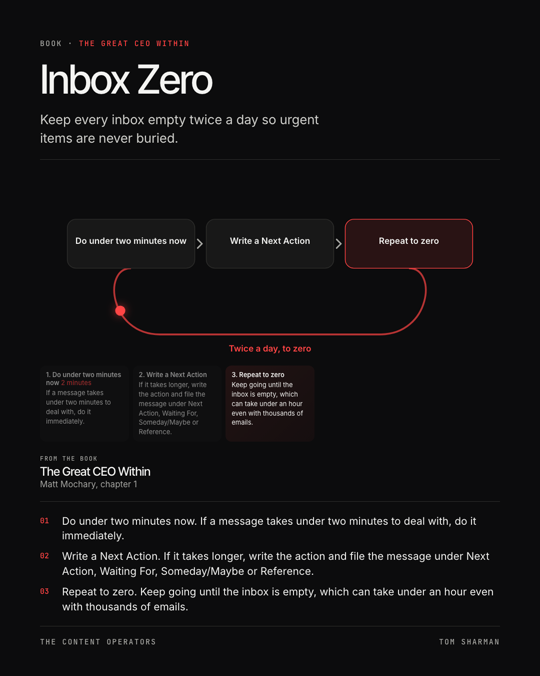
Keep every inbox empty twice a day so urgent items are never buried.
- Do under two minutes now. If a message takes under two minutes to deal with, do it immediately.
- Write a Next Action. If it takes longer, write the action and file the message under Next Action, Waiting For, Someday/Maybe or Reference.
- Repeat to zero. Keep going until the inbox is empty, which can take under an hour even with thousands of emails.
From chapter: Chapter 1: Getting Started, pp. 5–11
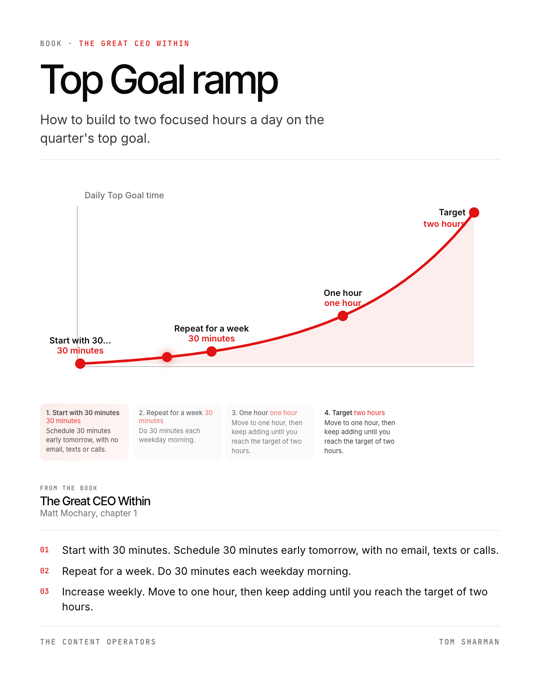
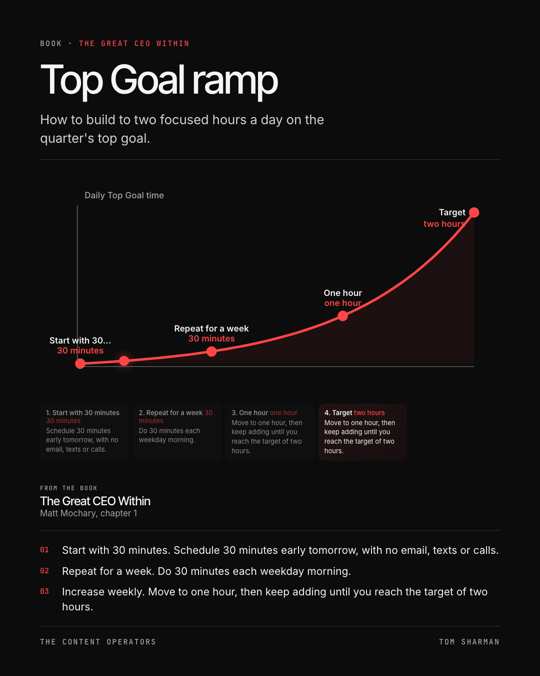
How to build to two focused hours a day on the quarter's top goal.
- Start with 30 minutes. Schedule 30 minutes early tomorrow, with no email, texts or calls.
- Repeat for a week. Do 30 minutes each weekday morning.
- Increase weekly. Move to one hour, then keep adding until you reach the target of two hours.
From chapter: Chapter 1: Getting Started, pp. 5–11
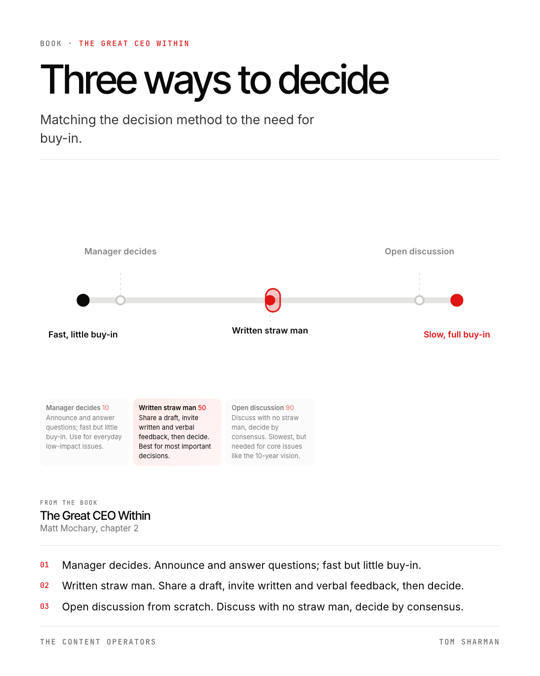
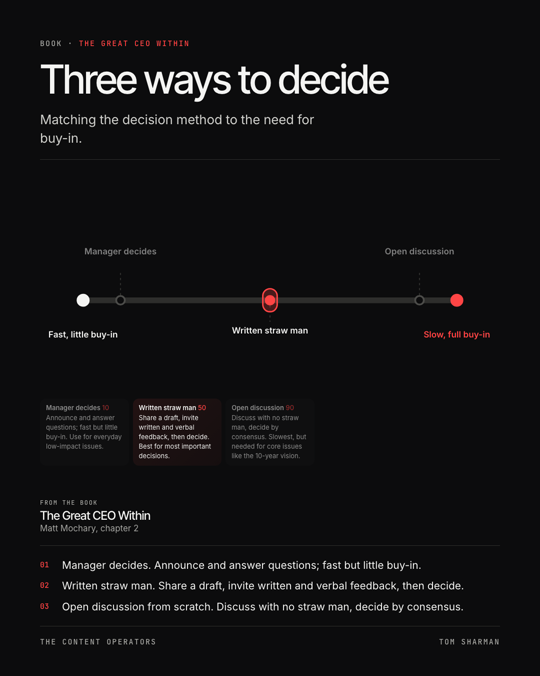
Matching the decision method to the need for buy-in.
- Manager decides. Announce and answer questions; fast but little buy-in. Use for everyday low-impact issues.
- Written straw man. Share a draft, invite written and verbal feedback, then decide. Best for most important decisions.
- Open discussion from scratch. Discuss with no straw man, decide by consensus. Slowest, but needed for core issues like the 10-year vision.
From chapter: Chapter 6: On Time and Present, pp. 12–19
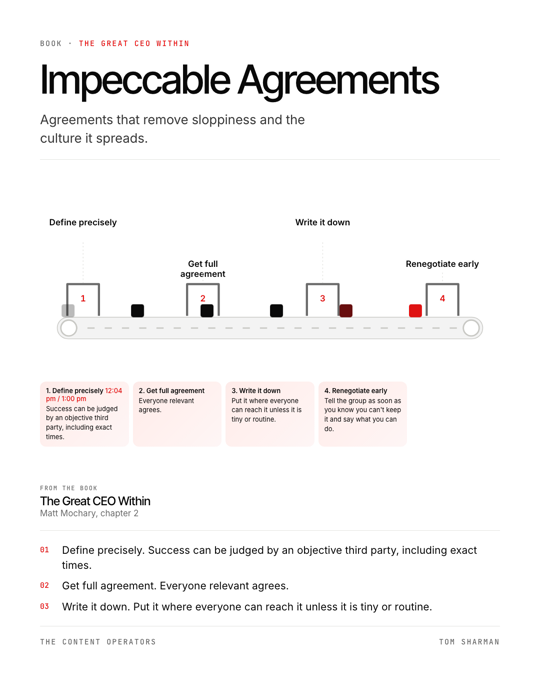
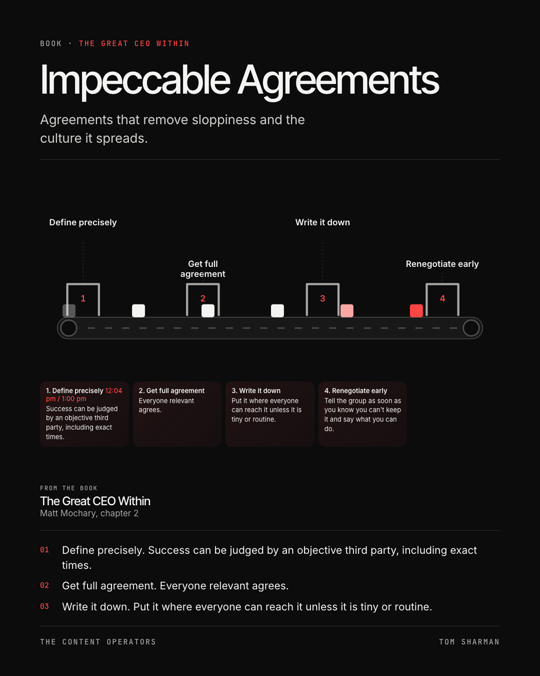
Agreements that remove sloppiness and the culture it spreads.
- Define precisely. Success can be judged by an objective third party, including exact times.
- Get full agreement. Everyone relevant agrees.
- Write it down. Put it where everyone can reach it unless it is tiny or routine.
- Renegotiate early. Tell the group as soon as you know you can't keep it and say what you can do.
From chapter: Chapter 6: On Time and Present, pp. 12–19
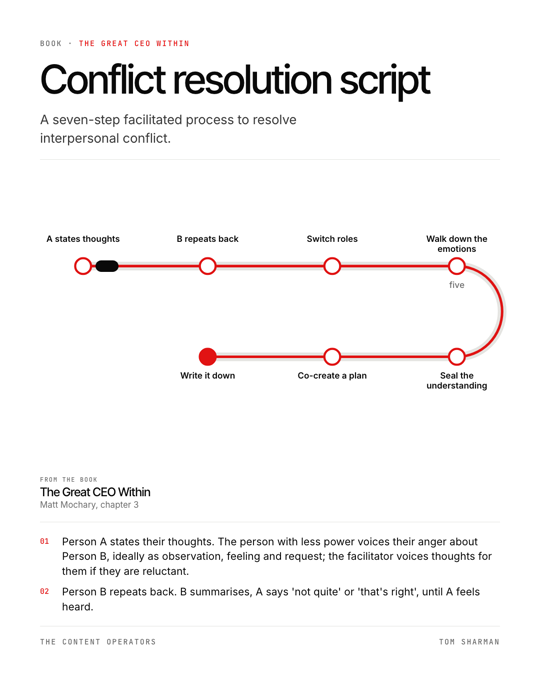
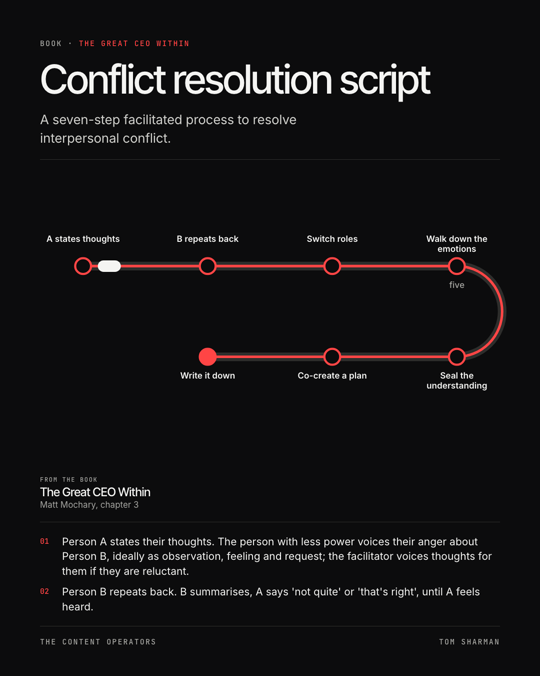
A seven-step facilitated process to resolve interpersonal conflict.
- Person A states their thoughts. The person with less power voices their anger about Person B, ideally as observation, feeling and request; the facilitator voices thoughts for them if they are reluctant.
- Person B repeats back. B summarises, A says 'not quite' or 'that's right', until A feels heard.
- Switch roles. Person B shares their anger and is heard.
- Walk down the emotions. Repeat for fear, then sadness, then joy and excitement.
- Seal the understanding. When the ah-ha moment comes, add a hug, handshake or high-five.
- Co-create a plan. Person A goes first and they agree how misunderstanding will not return.
- Write it down. Record next actions, owners, due dates and a check-in time so the agreement is impeccable.
From chapter: Chapter 14: Conflict Resolution, pp. 20–30
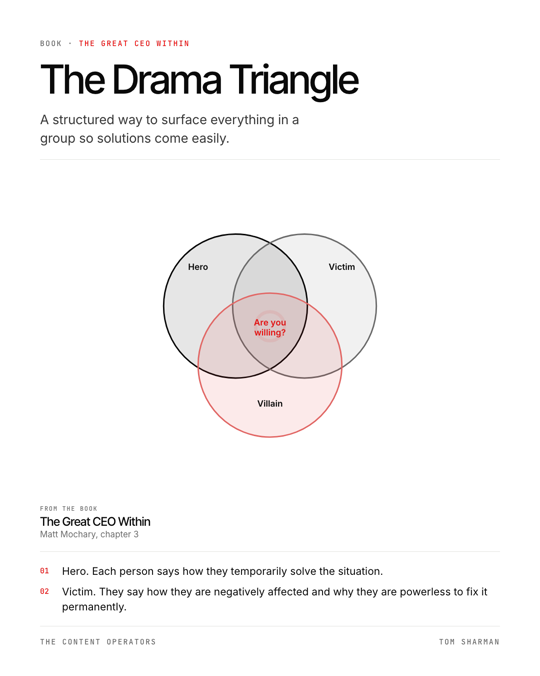
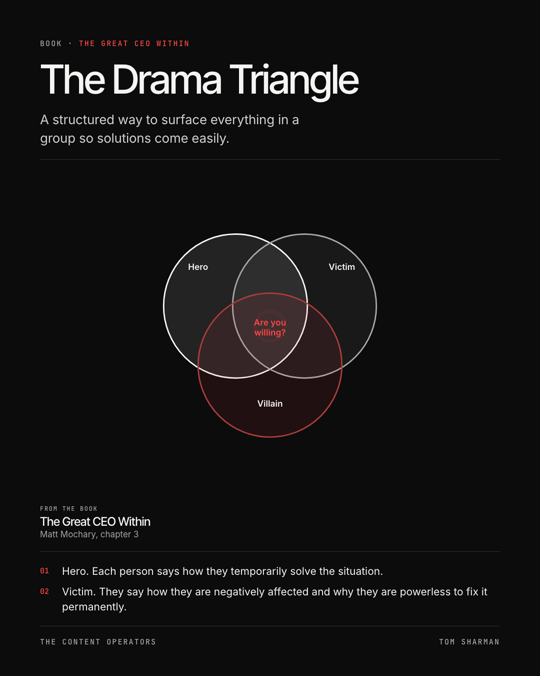
A structured way to surface everything in a group so solutions come easily.
- Hero. Each person says how they temporarily solve the situation.
- Victim. They say how they are negatively affected and why they are powerless to fix it permanently.
- Villain. They name a real person they blame and the real action, including themselves, until no one is left to blame.
- Ask for willingness. 'Are you willing for this issue to easefully and playfully be settled in this meeting?' Then brainstorm.
From chapter: Chapter 14: Conflict Resolution, pp. 20–30
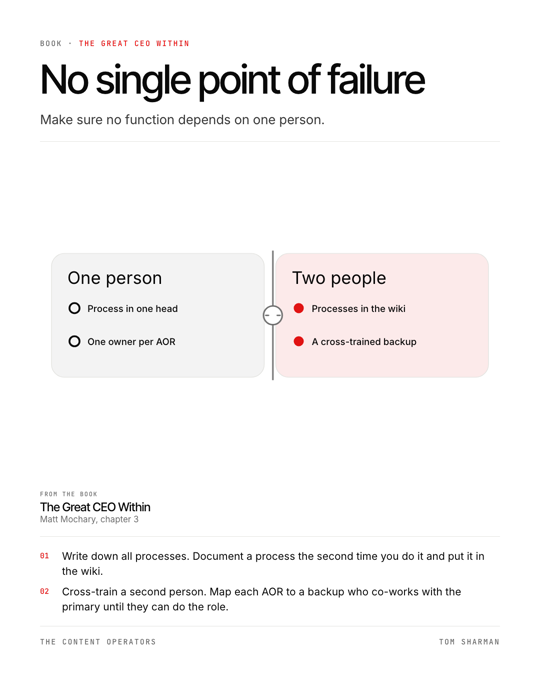
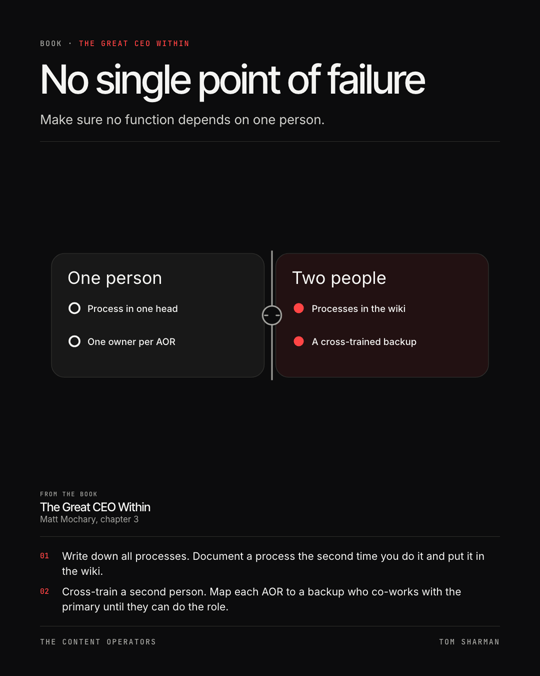
Make sure no function depends on one person.
- Write down all processes. Document a process the second time you do it and put it in the wiki.
- Cross-train a second person. Map each AOR to a backup who co-works with the primary until they can do the role.
From chapter: Chapter 14: Conflict Resolution, pp. 20–30
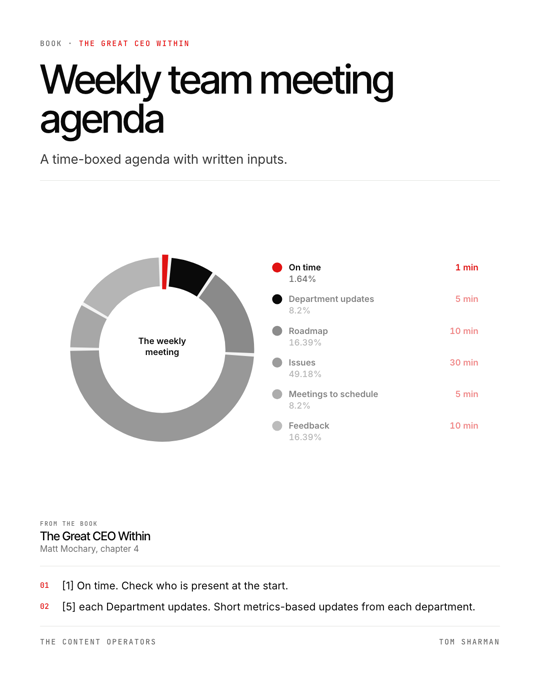
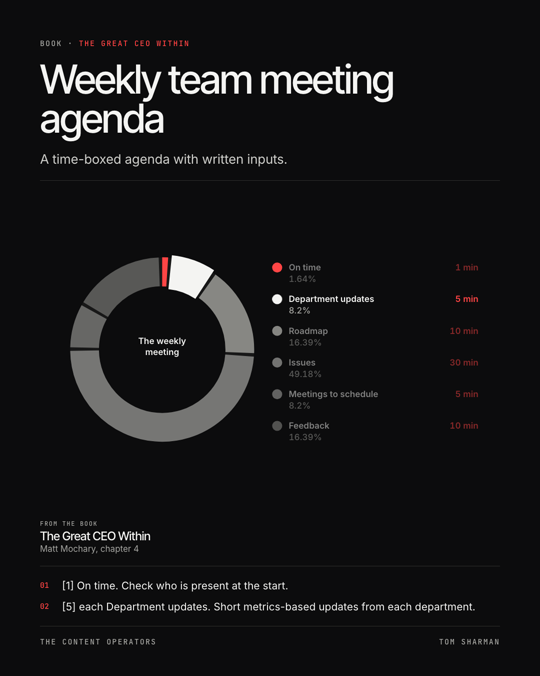
A time-boxed agenda with written inputs.
- [1] On time. Check who is present at the start.
- [5] each Department updates. Short metrics-based updates from each department.
- [10] Roadmap. Last week's goals complete yes or no, why not, and what habit prevents it; then the key actions for next week.
- [30] Issues. Discuss the written issues and decide.
- [5] Meetings to be scheduled. Book any sub-group collaboration.
- [10] Feedback. What do you like and what do you wish were different.
From chapter: Chapter 22: Key Performance Indicators (KPIs), pp. 31–103
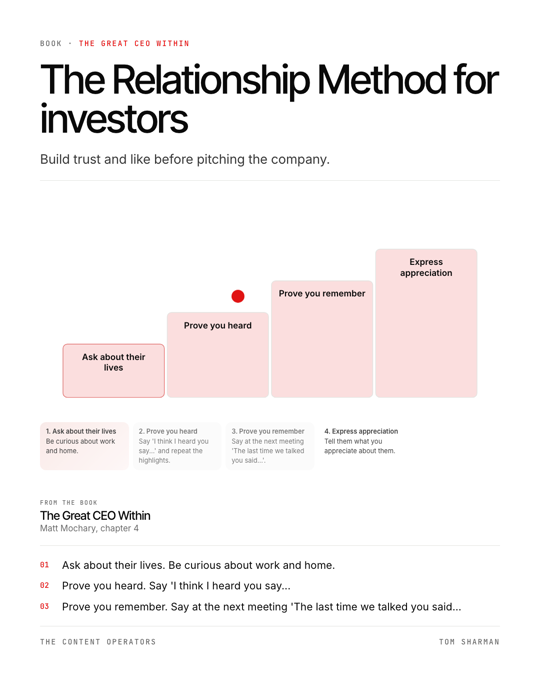
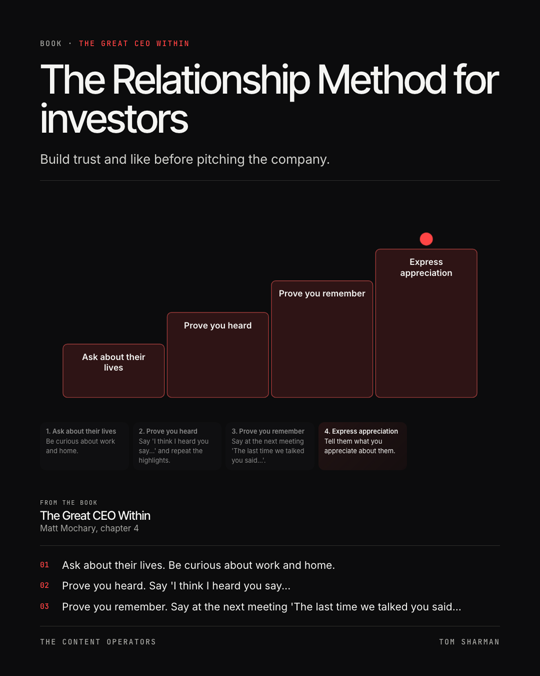
Build trust and like before pitching the company.
- Ask about their lives. Be curious about work and home.
- Prove you heard. Say 'I think I heard you say...' and repeat the highlights.
- Prove you remember. Say at the next meeting 'The last time we talked you said...'.
- Express appreciation. Tell them what you appreciate about them.
From chapter: Chapter 22: Key Performance Indicators (KPIs), pp. 31–103
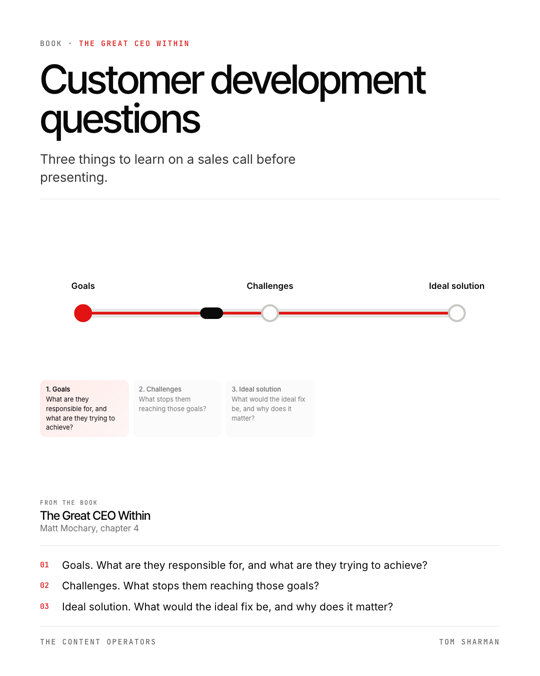
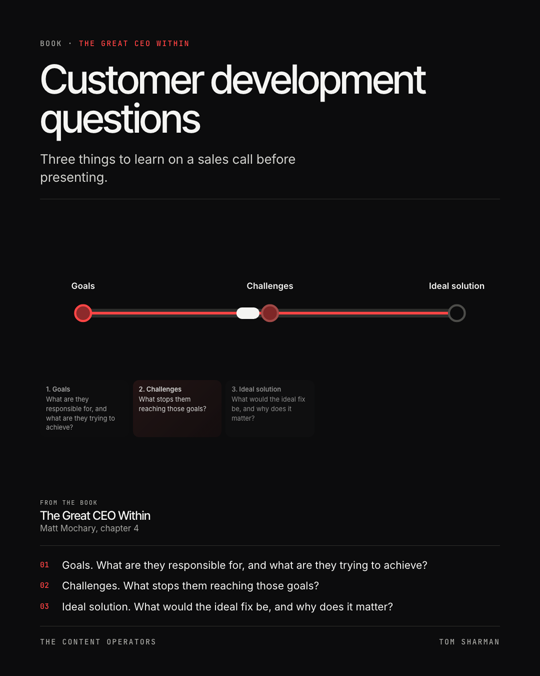
Three things to learn on a sales call before presenting.
- Goals. What are they responsible for, and what are they trying to achieve?
- Challenges. What stops them reaching those goals?
- Ideal solution. What would the ideal fix be, and why does it matter?
From chapter: Chapter 22: Key Performance Indicators (KPIs), pp. 31–103
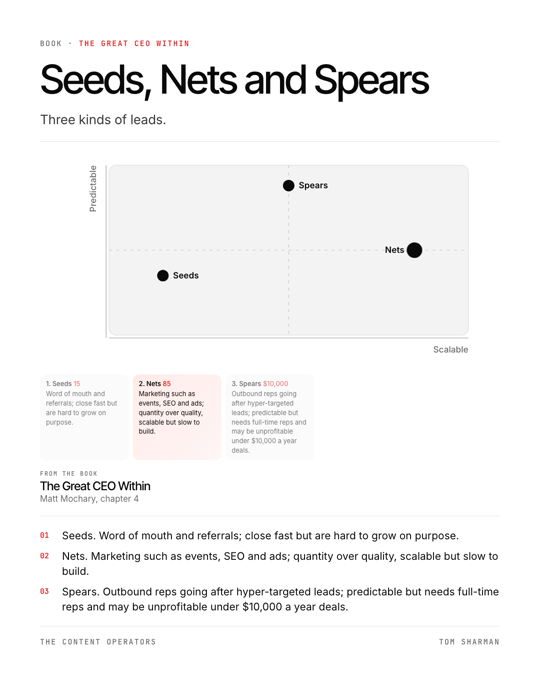
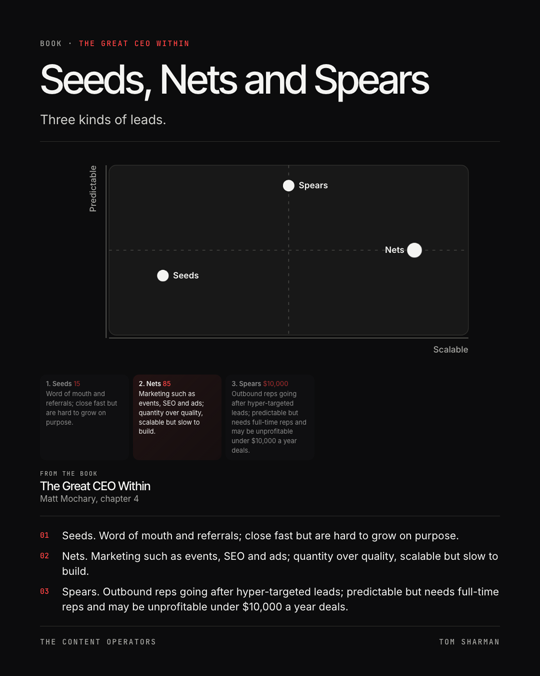
Three kinds of leads.
- Seeds. Word of mouth and referrals; close fast but are hard to grow on purpose.
- Nets. Marketing such as events, SEO and ads; quantity over quality, scalable but slow to build.
- Spears. Outbound reps going after hyper-targeted leads; predictable but needs full-time reps and may be unprofitable under $10,000 a year deals.
From chapter: Chapter 22: Key Performance Indicators (KPIs), pp. 31–103
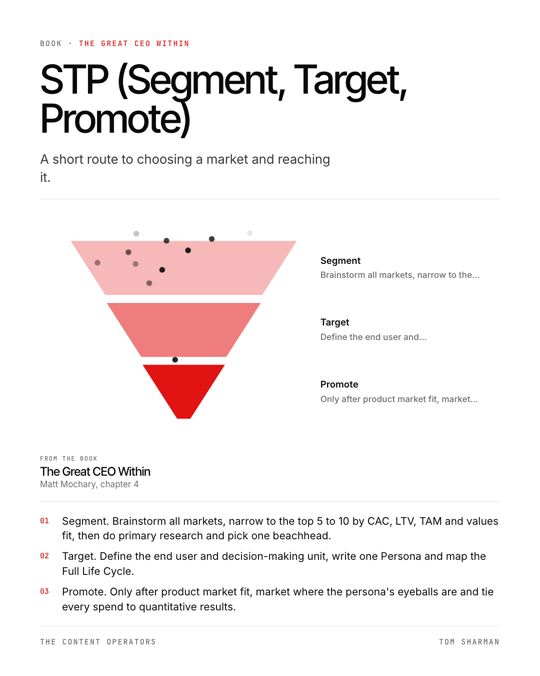
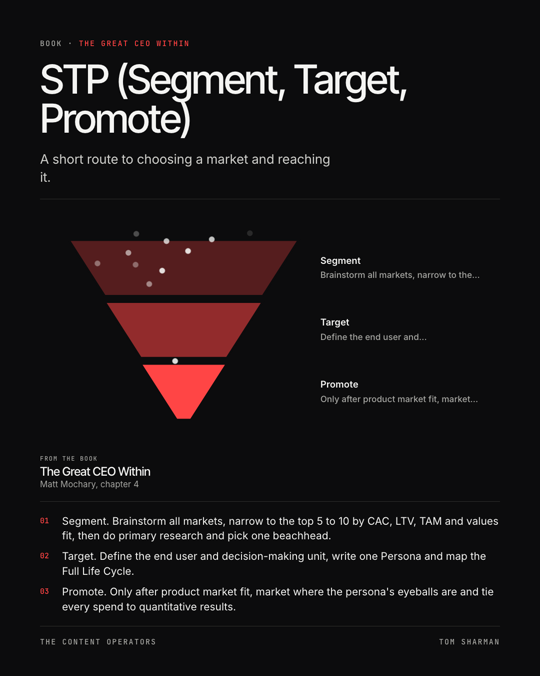
A short route to choosing a market and reaching it.
- Segment. Brainstorm all markets, narrow to the top 5 to 10 by CAC, LTV, TAM and values fit, then do primary research and pick one beachhead.
- Target. Define the end user and decision-making unit, write one Persona and map the Full Life Cycle.
- Promote. Only after product market fit, market where the persona's eyeballs are and tie every spend to quantitative results.
From chapter: Chapter 22: Key Performance Indicators (KPIs), pp. 31–103
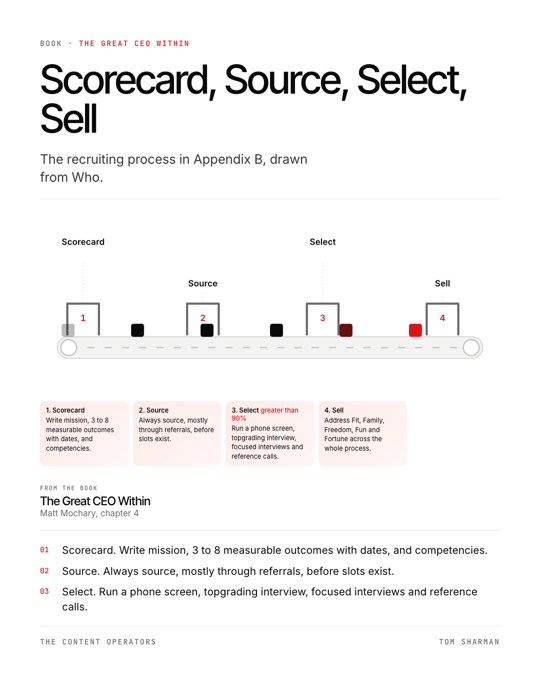
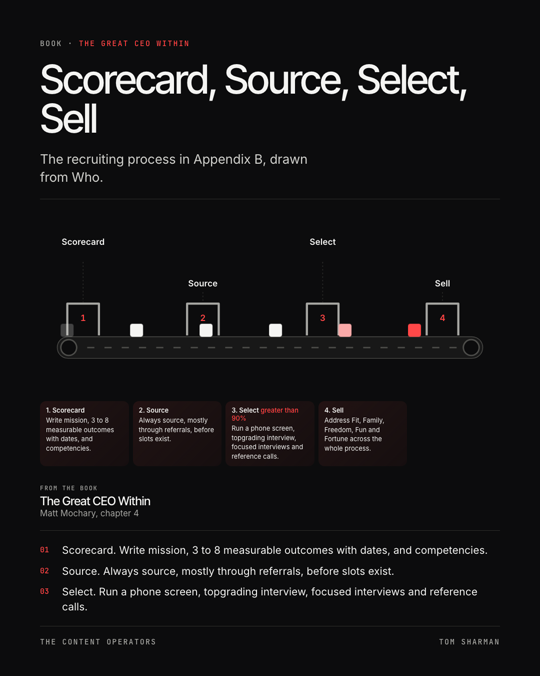
The recruiting process in Appendix B, drawn from Who.
- Scorecard. Write mission, 3 to 8 measurable outcomes with dates, and competencies.
- Source. Always source, mostly through referrals, before slots exist.
- Select. Run a phone screen, topgrading interview, focused interviews and reference calls.
- Sell. Address Fit, Family, Freedom, Fun and Fortune across the whole process.
From chapter: Chapter 22: Key Performance Indicators (KPIs), pp. 31–103
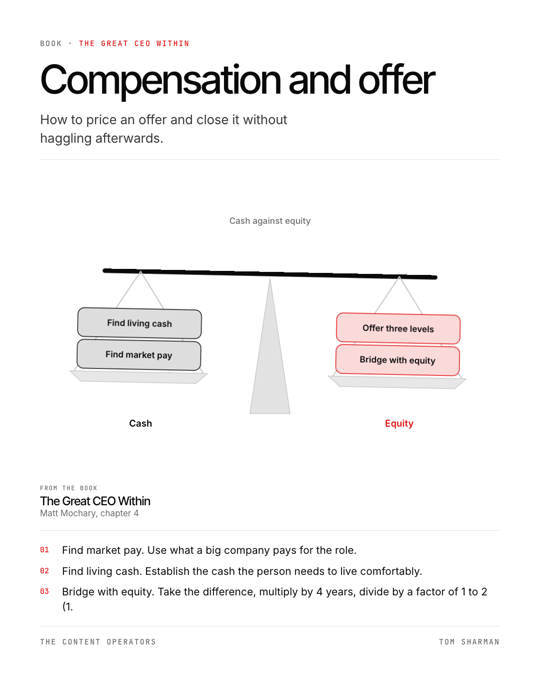
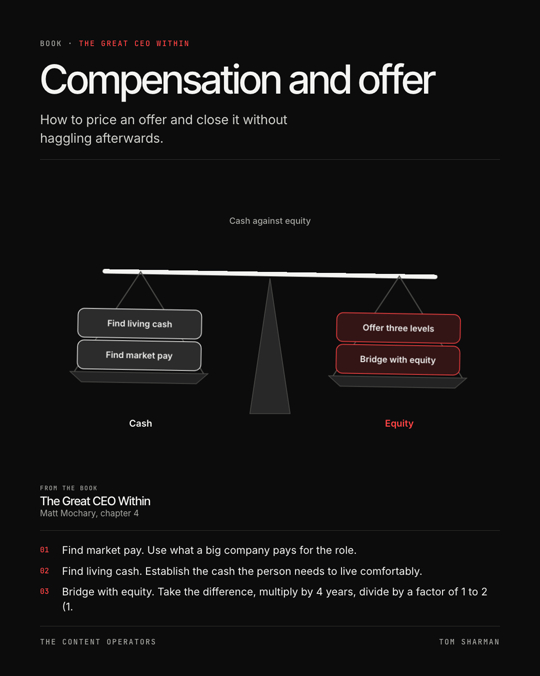
How to price an offer and close it without haggling afterwards.
- Find market pay. Use what a big company pays for the role.
- Find living cash. Establish the cash the person needs to live comfortably.
- Bridge with equity. Take the difference, multiply by 4 years, divide by a factor of 1 to 2 (1.5 is common).
- Offer three levels. Let the recruit choose how much to put into equity.
- Pre-agree. Ask them to finish 'I will join the company as long as...' and 'If we made this offer, would you accept?' before offering.
From chapter: Chapter 22: Key Performance Indicators (KPIs), pp. 31–103