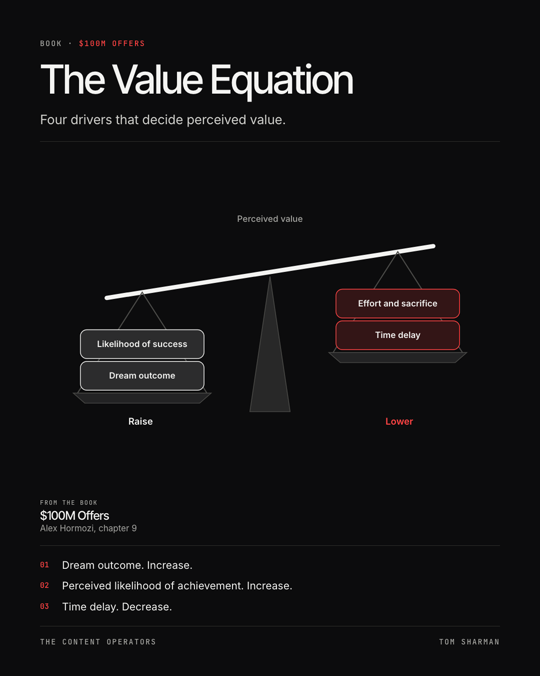
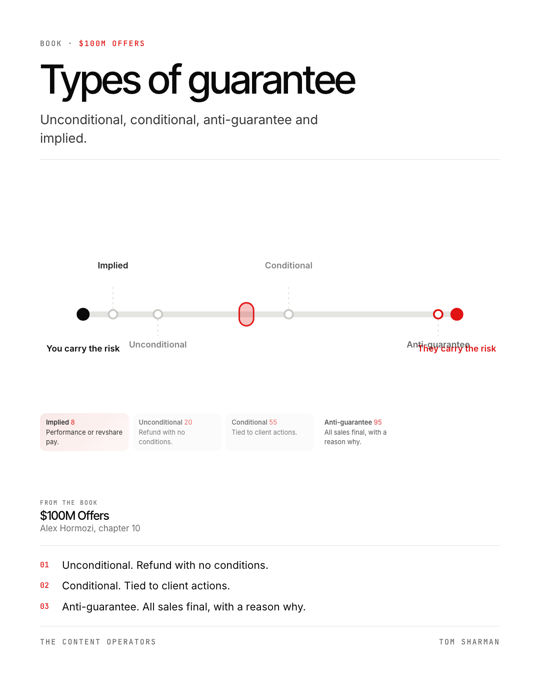
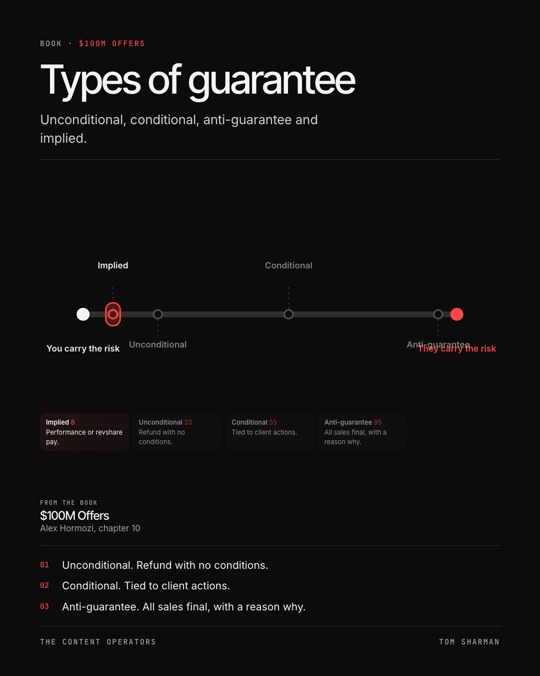
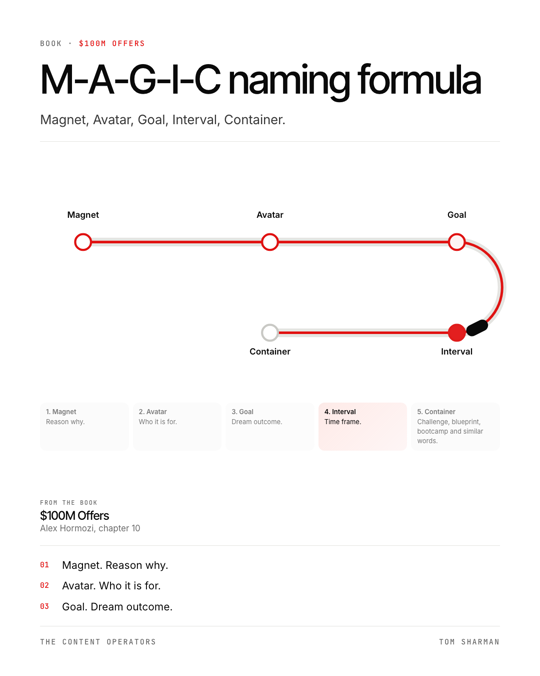
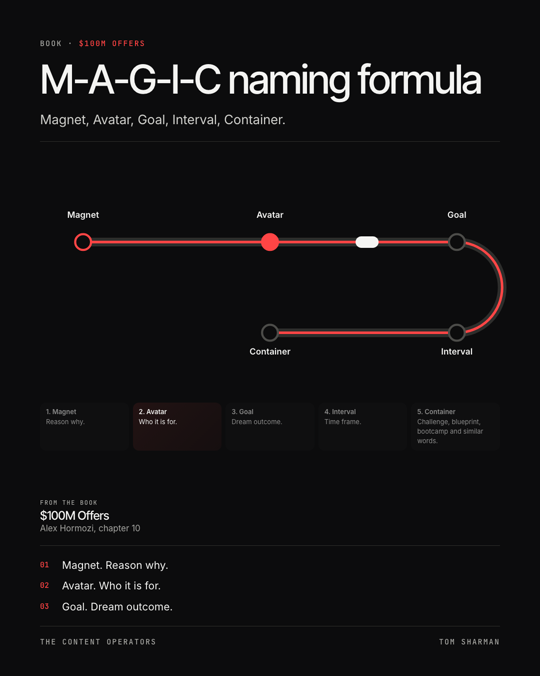
Hormozi's conditional guarantees and anti-guarantee both screen out buyers who will not do the work and reward the committed ones. pp. 171, 173 and 183.In the book:Types of guarantee, M-A-G-I-C naming formula.
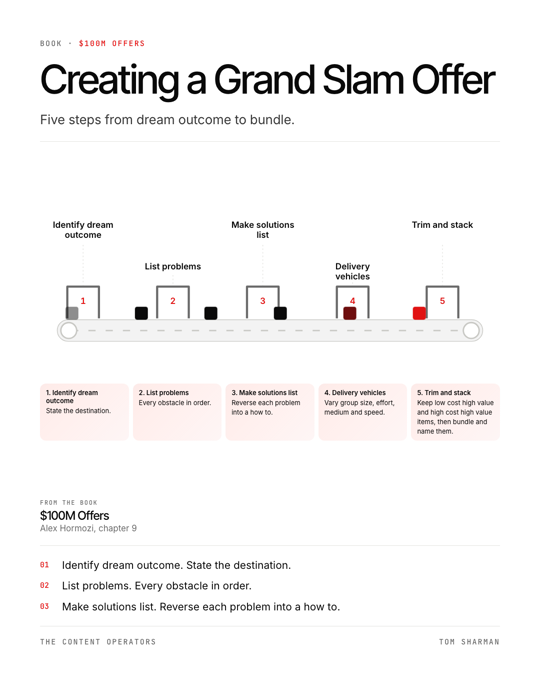
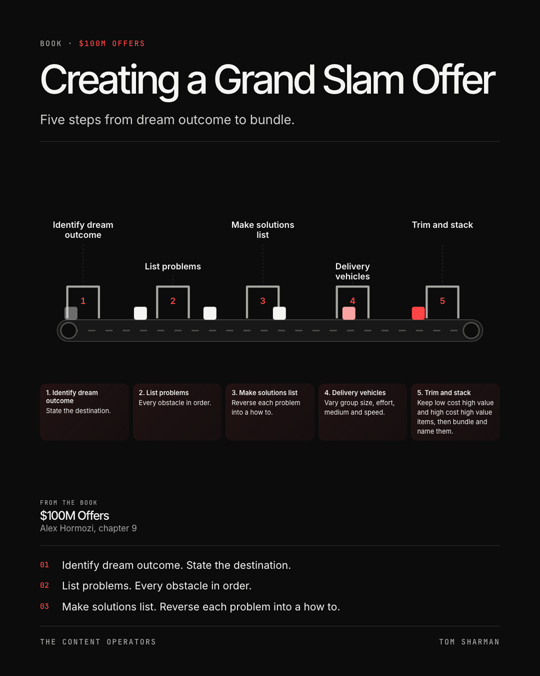
Hormozi says short-term milestones and early emotional wins keep clients going until the long-term outcome arrives. pp. 88 and 89.In the book:The Value Equation, Creating a Grand Slam Offer.
What it argues
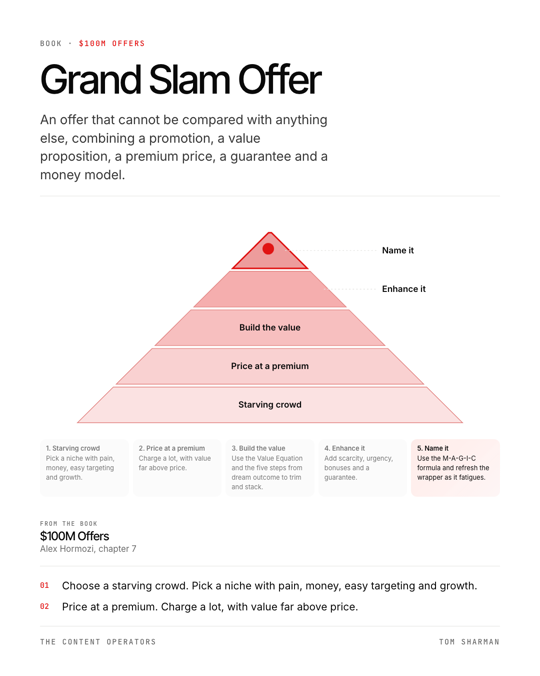
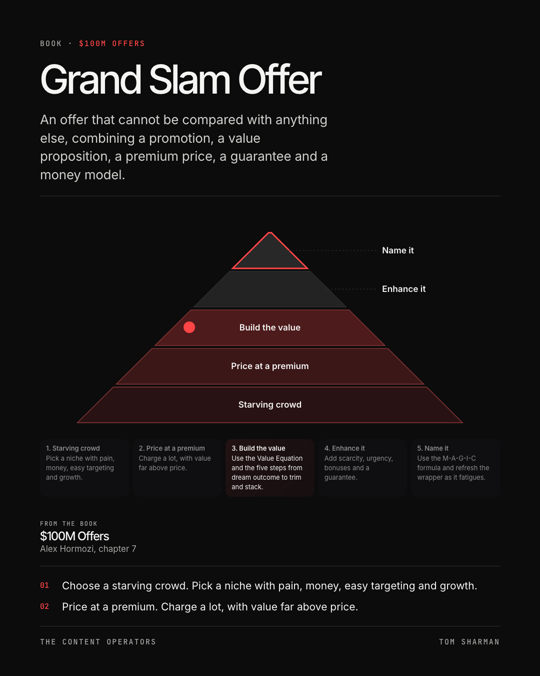
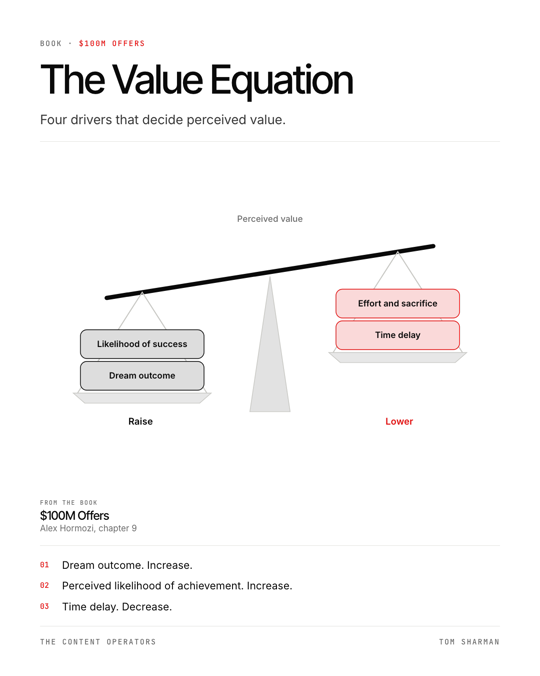
Hormozi argues that the offer is the lever that matters most in acquisition, and that a Grand Slam Offer, one that cannot be compared with anything else, turns a price-driven purchase into a value-driven one. He builds it in order: pick a starving crowd in a niche, price at a premium, raise perceived value through the four drivers of the Value Equation, turn every buyer problem into a solution, trim and bundle the cheap high value items, then enhance with scarcity, urgency, bonuses, guarantees and a name. The proof offered is the author's own run of businesses and the story of rebuilding after losing everything in December 2016. Most of the numbers are illustrative by the author's own disclaimer, so the method is more reliable than the figures. The practical claim is that implementing even one offer component adds clients and revenue faster than anything else a small business can change.
Worth keeping
Pick the market before the offer: a starving crowd beats offer strength, which beats persuasion skill (p. 56).
The Value Equation: raise dream outcome and perceived likelihood, cut time delay and effort, and work hardest on the bottom half (p. 81).
People pay for certainty, which is why track record and guarantees raise value without changing the work (p. 87).
Fast beats free, so if you compete against free, double down on speed (p. 90).
Turn every buyer objection into a solution, because one unanswered obstacle can lose the sale (p. 121).
Trim and stack: cut high cost low value items, and favour one to many assets with a big gap between cost and value (p. 123).
Scarcity limits quantity, urgency limits time, and both must be real (p. 146 and p. 153).
Add bonuses instead of discounting the core offer (p. 161).
Reverse risk with a guarantee, and prefer service or performance guarantees that tie your pay to the client's result (p. 170 and p. 183).
Name the offer with the M-A-G-I-C formula and refresh the wrapper before touching the offer (p. 189 and p. 194).
Which project it moves forward
The Content Operators launch
The offer, pricing, guarantee and naming method gives a direct recipe for the first cohort offer at The Content Operators.
The questions it answers
What is content operations actually worth to a company, in money?
The Value Equation and the price to value gap give a way to price a service from the value it delivers rather than from negotiation.
How do you price and sell a tool you built for yourself?
Niche pricing, premium pricing, bundling and the trim and stack method show how a tool or service becomes an offer people compare with nothing.