Bookshelf
How Tom uses this
$100M Leads, 2 Bonus Chapters backs two of Tom's lessons. Under each of his lessons, what the book says about it, and on which pages.
- People online are selfish, so lead with what they get
Hormozi says free and discount wrappers must answer what's in it for me to move a cold audience, which is the same lead with what they get logic. pp. 5 and 12. In the book: Generate flow, monetize flow, then add friction, Five kinds of friction, The free offer diagnosis.
- Turn down anyone unclear about their commitment
His friction methods filter out low commitment prospects through qualifications, longer forms and forced consumption before they reach a call. pp. 14 and 15. In the book: Generate flow, monetize flow, then add friction, Five kinds of friction, The free offer diagnosis.
What it argues
Hormozi argues that the fastest way to get traction in a cold market is to wrap a strong grand slam offer in a free or heavily discounted front end, because the point is to give people who would not otherwise respond a reason to. Free brings the highest volume at the lowest cost per lead and his split tests found it closed at the same rate as non-free offers. Premium offers have the best maths and quality but need cash, proven selling and great copy. Discounts help where free is unlawful, collect a card, cut no-shows and set up a two-step sale. The order is to generate flow, monetize flow, then add friction. Note this file is two early draft bonus chapters (24 pages), not the full book.
Worth keeping
- Generate flow, monetize flow, then add friction, in that order (p. 4, p. 24).
- Free and discount are wrappers around the core offer and never change it (p. 4).
- A premium offer at $10,000 can be 9.5x more profitable than a $100 one at equal profit (p. 7).
- Free offers cut lead cost five times or more with the same close rate in four split tests (p. 16).
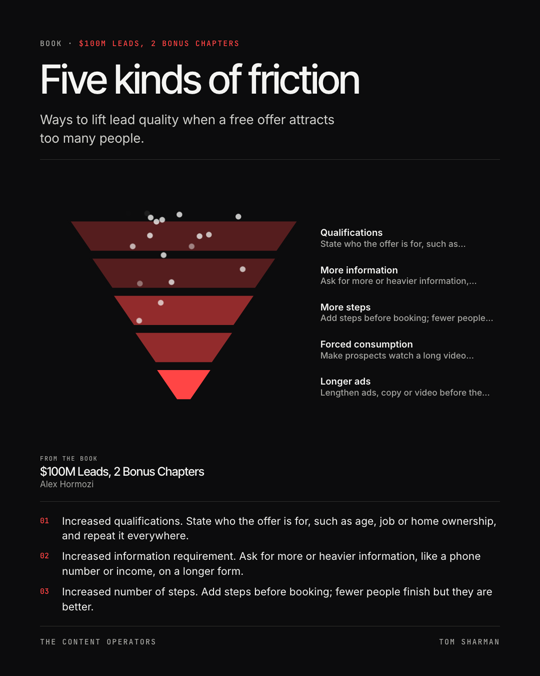
- Five frictions raise lead quality: qualifications, information asked, steps, forced consumption and ad length (pp. 14-15).
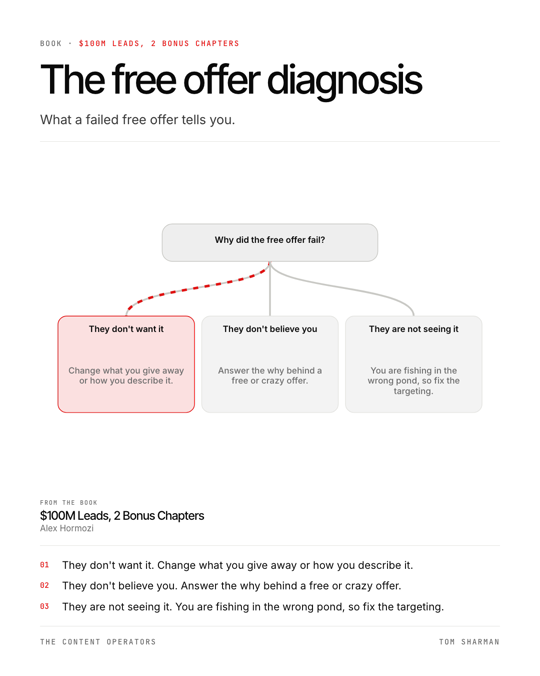
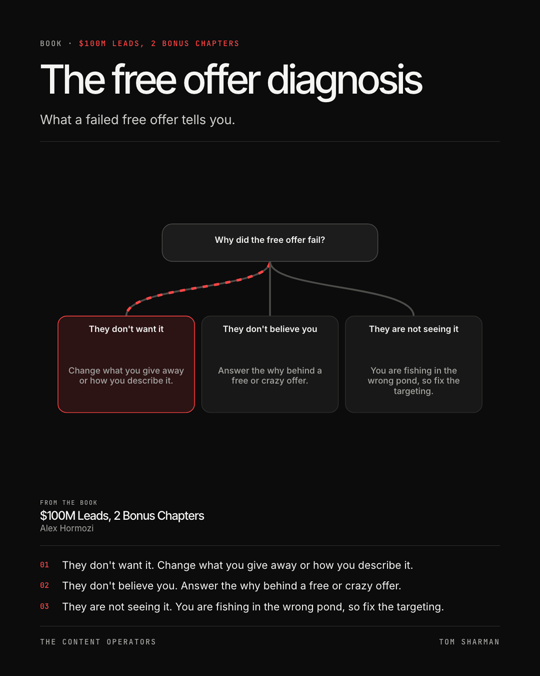
- The free offer diagnosis: they don't want it, don't believe you or aren't seeing it (p. 12).
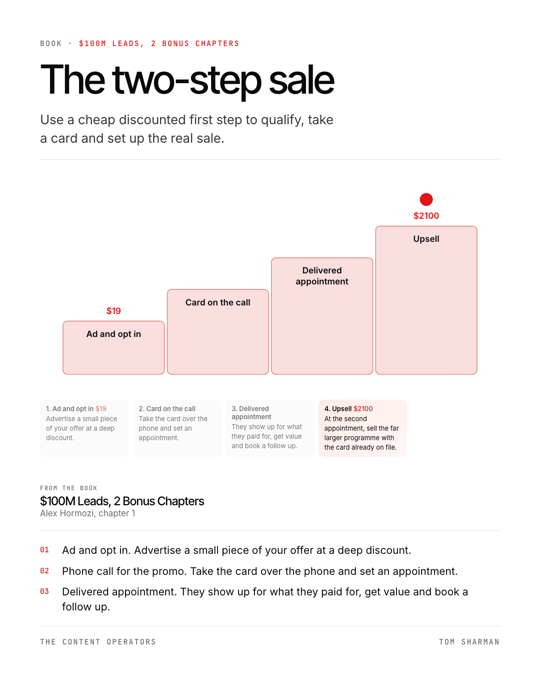
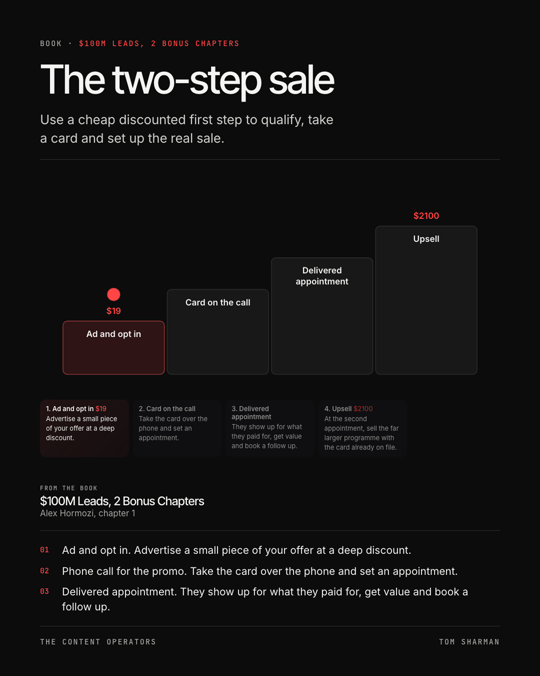
- Use a $19 discount call to take a card, show up and sell the $2,100 programme second (p. 21).
- It is easier to upsell a customer than to make one (p. 22).
- Only discount a sliver of the offer, never the core, or people learn to wait for discounts (p. 23).
The questions it answers
- How do you price and sell a tool you built for yourself?
It argues beginners should start free or discounted to find demand, then move to a premium price once results are proven, and shows the maths for pricing at $10,000 against $100.
- How do you build a personal brand that generates inbound rather than requiring outbound?
It shows how free and value-in-advance offers pull people in so that inbound arrives without cold outreach.
The frameworks
4 frameworks, one animation each Every framework, step by step
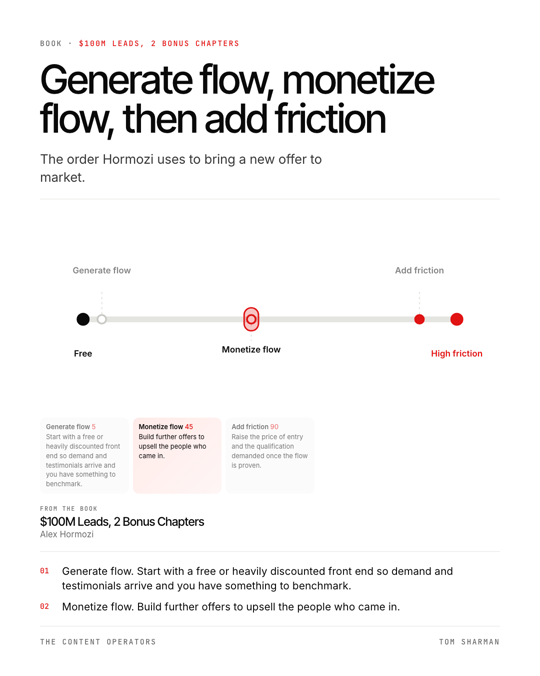
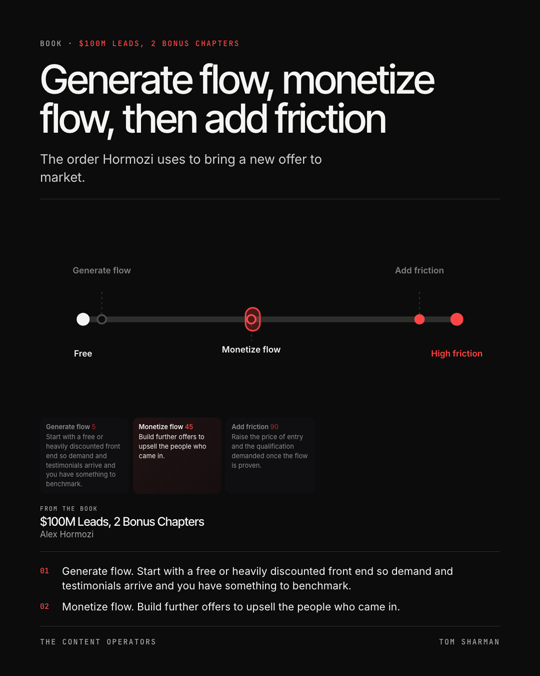
The order Hormozi uses to bring a new offer to market.
- Generate flow. Start with a free or heavily discounted front end so demand and testimonials arrive and you have something to benchmark.
- Monetize flow. Build further offers to upsell the people who came in.
- Add friction. Raise the price of entry and the qualification demanded once the flow is proven.
From pp. 1–20
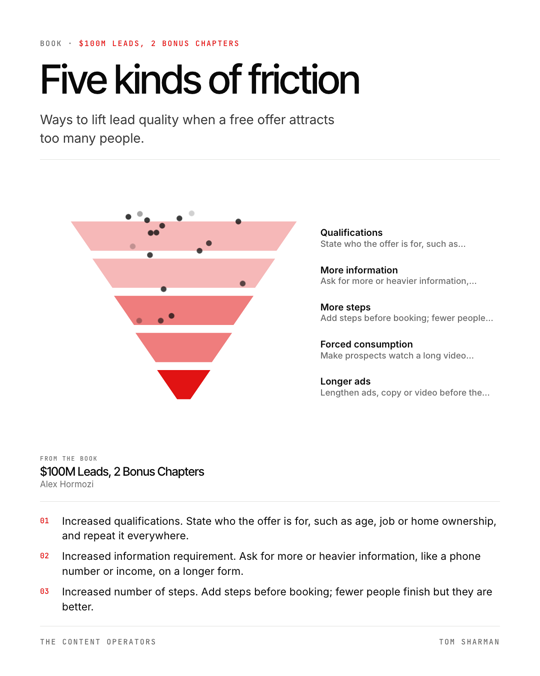
Ways to lift lead quality when a free offer attracts too many people.
- Increased qualifications. State who the offer is for, such as age, job or home ownership, and repeat it everywhere.
- Increased information requirement. Ask for more or heavier information, like a phone number or income, on a longer form.
- Increased number of steps. Add steps before booking; fewer people finish but they are better.
- Forced consumption. Make prospects watch a long video before any call to action appears.
- Advertisement length. Lengthen ads, copy or video before the call to action to raise the cost of a click and its worth.
From pp. 1–20
What a failed free offer tells you.
- They don't want it. Change what you give away or how you describe it.
- They don't believe you. Answer the why behind a free or crazy offer.
- They are not seeing it. You are fishing in the wrong pond, so fix the targeting.
From pp. 1–20
Use a cheap discounted first step to qualify, take a card and set up the real sale.
- Ad and opt in. Advertise a small piece of your offer at a deep discount.
- Phone call for the promo. Take the card over the phone and set an appointment.
- Delivered appointment. They show up for what they paid for, get value and book a follow up.
- Upsell. At the second appointment, sell the far larger programme with the card already on file.
From pp. 21–24
Working with Tom on this
Tom works with creators and founders one to one, from a single session to a fractional role. Work with Tom
Back to the bookshelf