What it argues
A business grows fastest when a customer pays back the cost of winning and serving them, and more, within 30 days. Hormozi calls the way to get there a money model, a deliberate sequence of attraction, upsell, downsell and continuity offers. Each offer type has a job, from turning strangers into customers to keeping them paying, and the book supplies about fifteen named plays for those jobs. Every play comes from a story of a business he saw or ran, mostly gyms. His build order is one stage at a time, perfecting one offer until it is reliable, because a full model installed at once breaks the business. Price is moved by changing how and when people pay or what they get, and cutting the price on the same product is ruled out.
Every framework, step by step
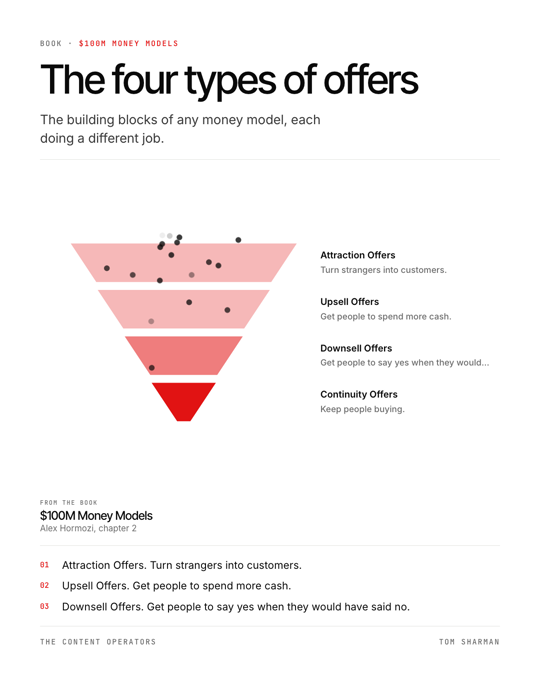
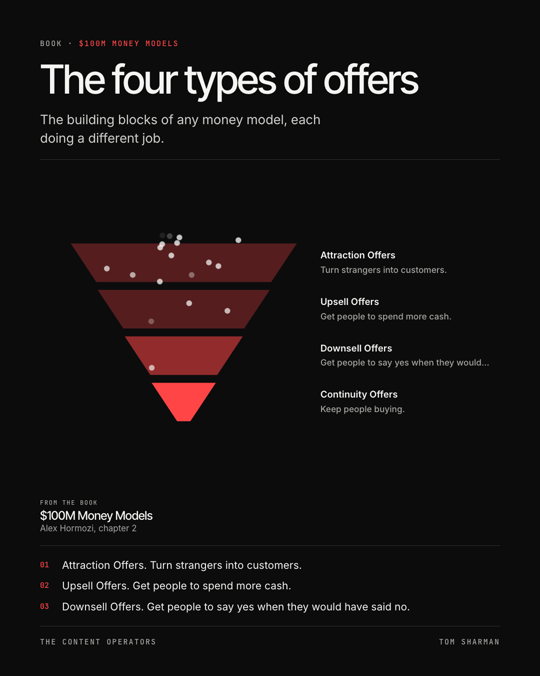
The building blocks of any money model, each doing a different job.
- Attraction Offers. Turn strangers into customers.
- Upsell Offers. Get people to spend more cash.
- Downsell Offers. Get people to say yes when they would have said no.
- Continuity Offers. Keep people buying.
From chapter: Section I: What’s A Money Model?, pp. 20–29
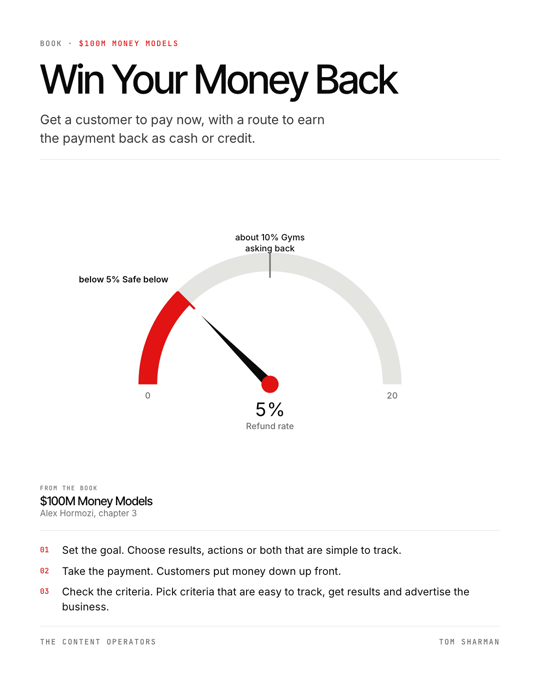
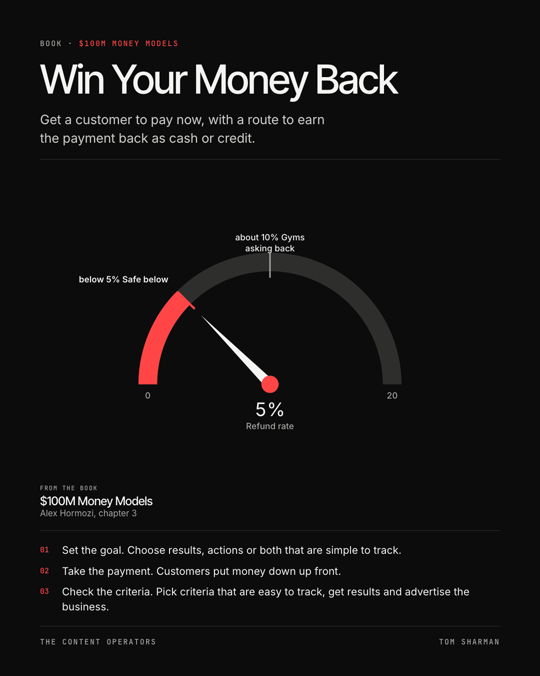
Get a customer to pay now, with a route to earn the payment back as cash or credit.
- Set the goal. Choose results, actions or both that are simple to track.
- Take the payment. Customers put money down up front.
- Check the criteria. Pick criteria that are easy to track, get results and advertise the business.
- Apply the winnings. Offer the credit against something larger, spread over a longer term.
- Upsell at check-ins. Use each required meeting to make the next offer.
From chapter: Section II: Attraction Offers, pp. 30–75
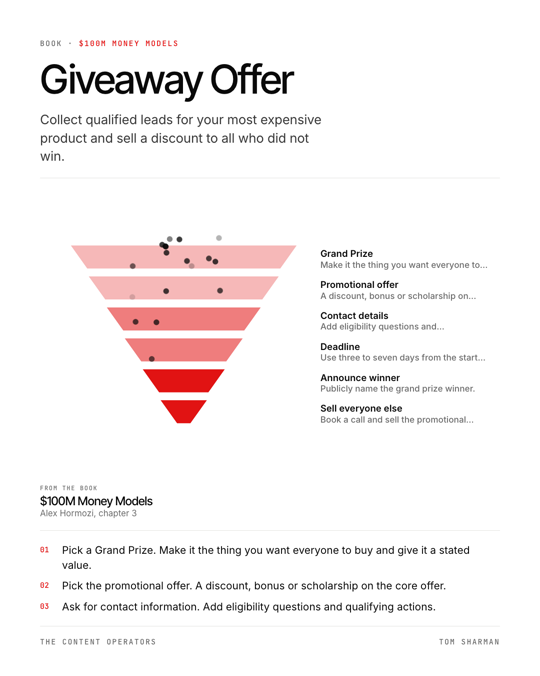
Collect qualified leads for your most expensive product and sell a discount to all who did not win.
- Pick a Grand Prize. Make it the thing you want everyone to buy and give it a stated value.
- Pick the promotional offer. A discount, bonus or scholarship on the core offer.
- Ask for contact information. Add eligibility questions and qualifying actions.
- Set a deadline. Use three to seven days from the start of promotion.
- Announce the winner. Publicly name the grand prize winner.
- Contact everyone else. Book a call and sell the promotional offer with a seven day claim window.
From chapter: Section II: Attraction Offers, pp. 30–75
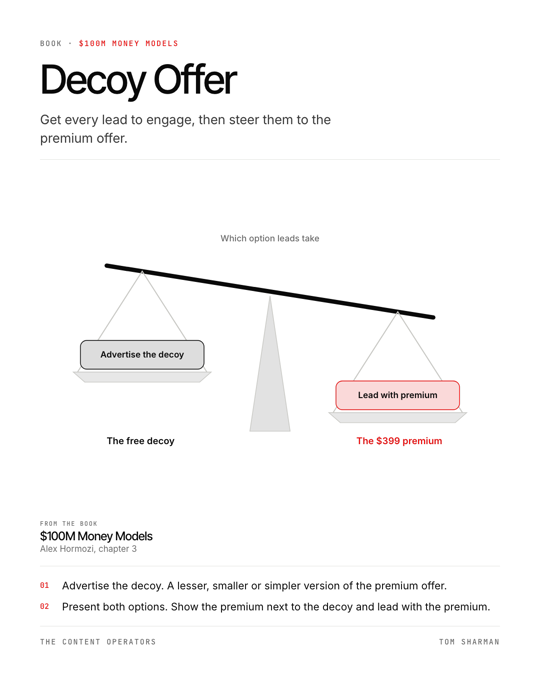
Get every lead to engage, then steer them to the premium offer.
- Advertise the decoy. A lesser, smaller or simpler version of the premium offer.
- Present both options. Show the premium next to the decoy and lead with the premium.
From chapter: Section II: Attraction Offers, pp. 30–75
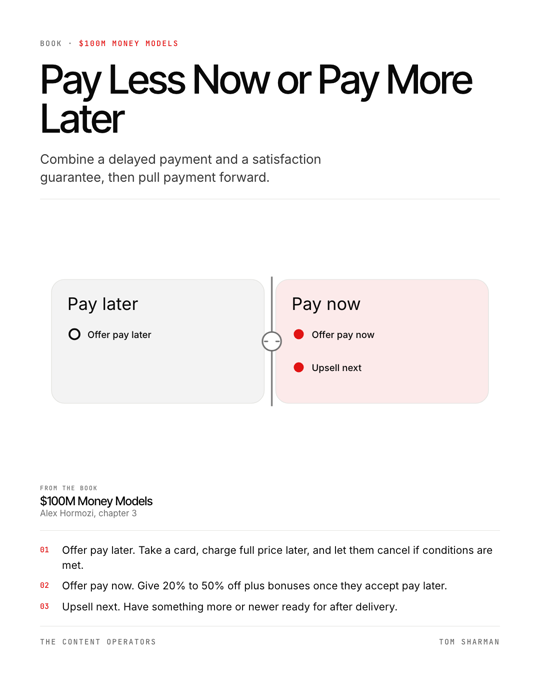
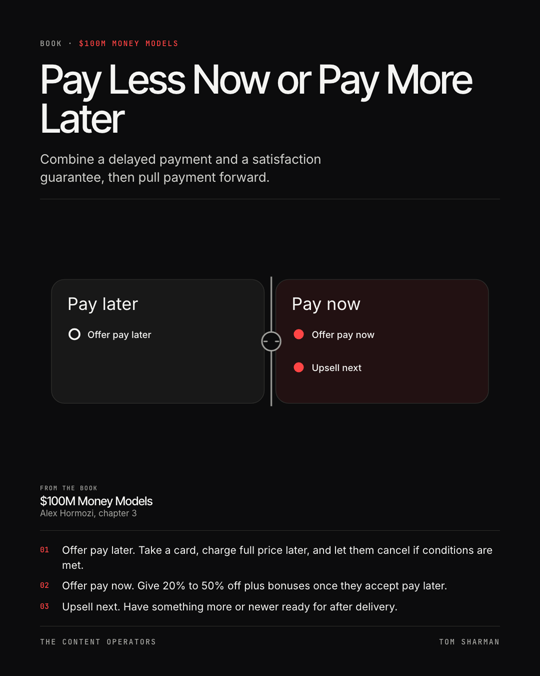
Combine a delayed payment and a satisfaction guarantee, then pull payment forward.
- Offer pay later. Take a card, charge full price later, and let them cancel if conditions are met.
- Offer pay now. Give 20% to 50% off plus bonuses once they accept pay later.
- Upsell next. Have something more or newer ready for after delivery.
From chapter: Section II: Attraction Offers, pp. 30–75
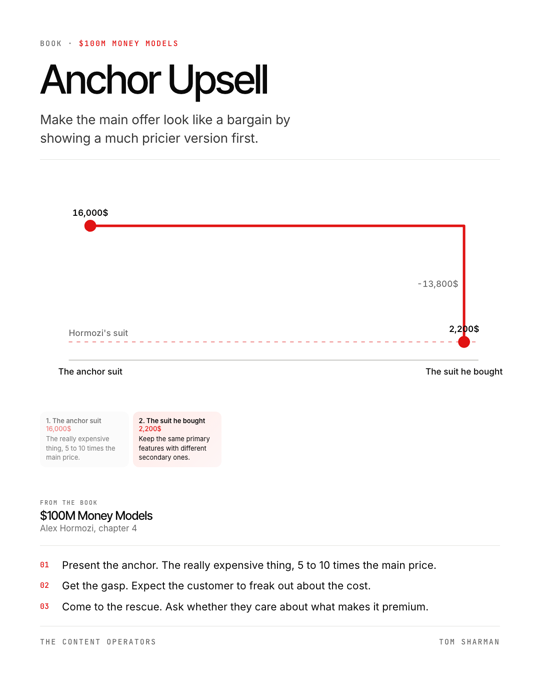
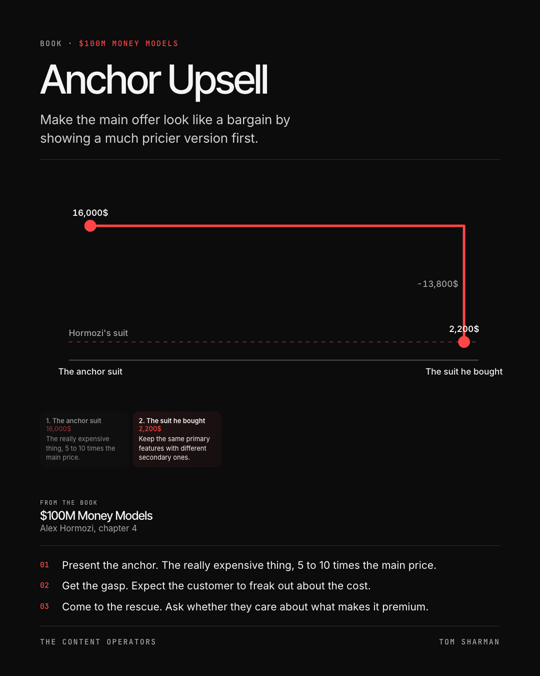
Make the main offer look like a bargain by showing a much pricier version first.
- Present the anchor. The really expensive thing, 5 to 10 times the main price.
- Get the gasp. Expect the customer to freak out about the cost.
- Come to the rescue. Ask whether they care about what makes it premium.
- Present the main offer. Keep the same primary features with different secondary ones.
- Ask how they want to pay. Which card do you prefer?
From chapter: Section III: Upsell Offers, pp. 76–110
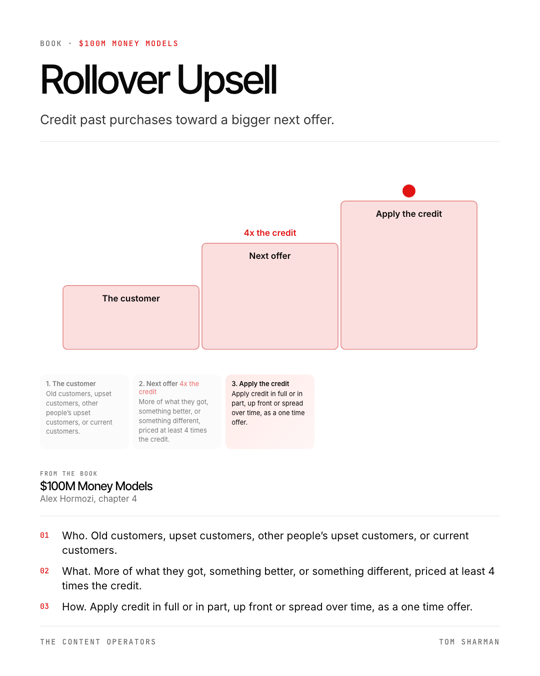
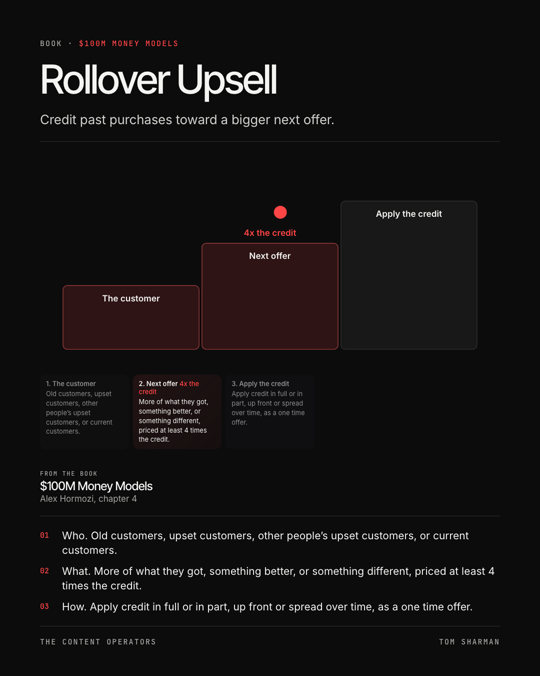
Credit past purchases toward a bigger next offer.
- Who. Old customers, upset customers, other people’s upset customers, or current customers.
- What. More of what they got, something better, or something different, priced at least 4 times the credit.
- How. Apply credit in full or in part, up front or spread over time, as a one time offer.
From chapter: Section III: Upsell Offers, pp. 76–110
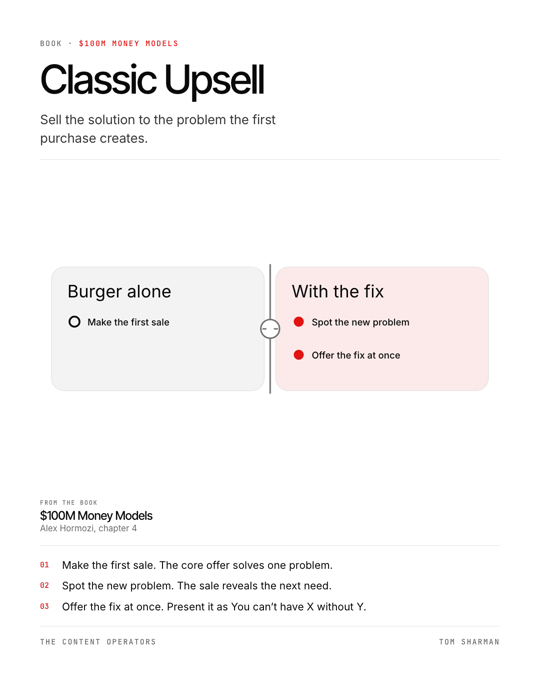
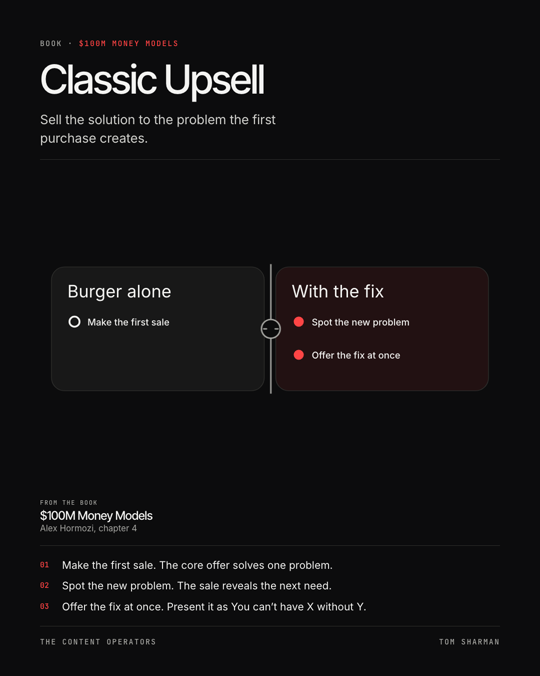
Sell the solution to the problem the first purchase creates.
- Make the first sale. The core offer solves one problem.
- Spot the new problem. The sale reveals the next need.
- Offer the fix at once. Present it as You can’t have X without Y.
From chapter: Section III: Upsell Offers, pp. 76–110
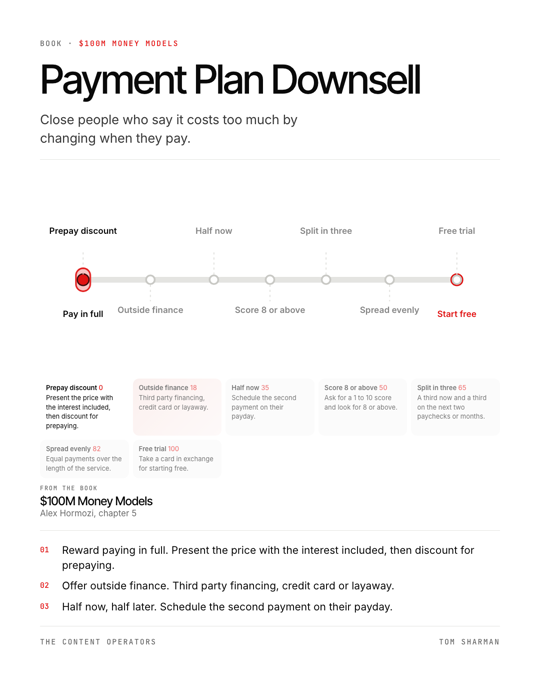
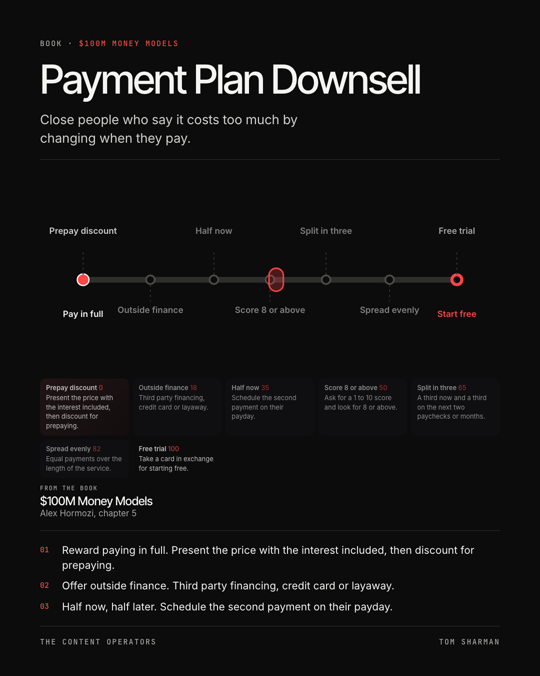
Close people who say it costs too much by changing when they pay.
- Reward paying in full. Present the price with the interest included, then discount for prepaying.
- Offer outside finance. Third party financing, credit card or layaway.
- Half now, half later. Schedule the second payment on their payday.
- Check they still want it. Ask for a 1 to 10 score and look for 8 or above.
- Split into three. A third now and a third on the next two paychecks or months.
- Spread evenly. Equal payments over the length of the service.
- Offer a free trial. Take a card in exchange for starting free.
From chapter: Section IV: Downsell Offers, pp. 111–142
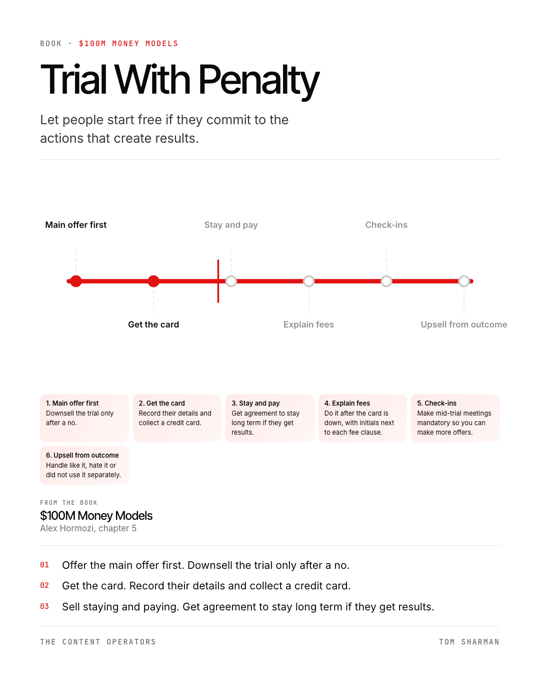
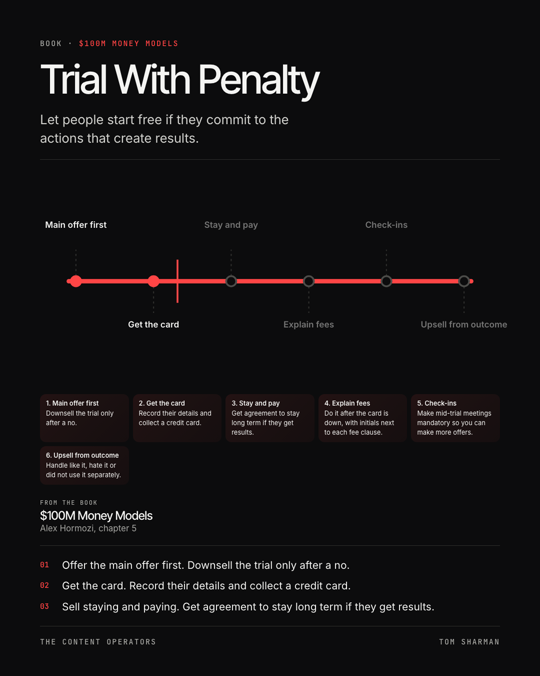
Let people start free if they commit to the actions that create results.
- Offer the main offer first. Downsell the trial only after a no.
- Get the card. Record their details and collect a credit card.
- Sell staying and paying. Get agreement to stay long term if they get results.
- Explain the fees. Do it after the card is down, with initials next to each fee clause.
- Require check-ins. Make mid-trial meetings mandatory so you can make more offers.
- Upsell from the outcome. Handle like it, hate it or did not use it separately.
From chapter: Section IV: Downsell Offers, pp. 111–142
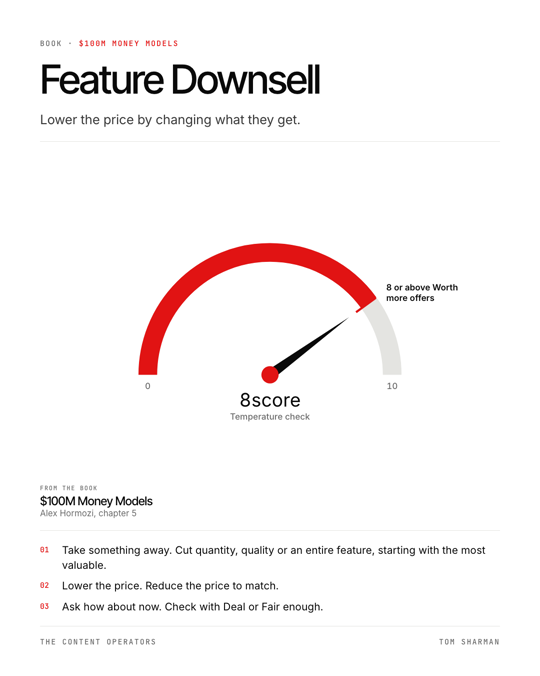
Lower the price by changing what they get.
- Take something away. Cut quantity, quality or an entire feature, starting with the most valuable.
- Lower the price. Reduce the price to match.
- Ask how about now. Check with Deal or Fair enough.
- Temperature check. After two downsells, ask for a 1 to 10 score.
- Switch to payment plans. If they like the features but not the price, use payment plan downsells.
From chapter: Section IV: Downsell Offers, pp. 111–142
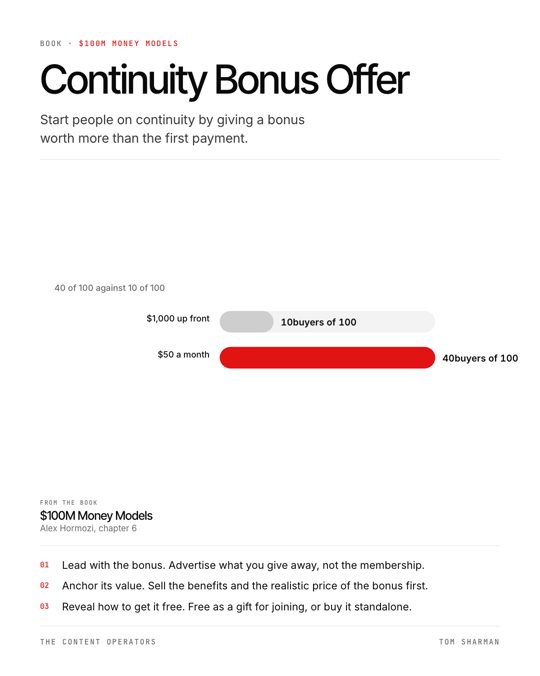
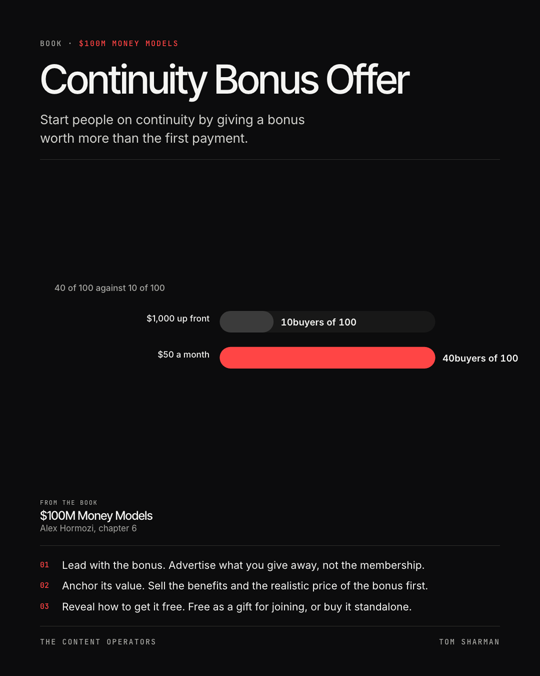
Start people on continuity by giving a bonus worth more than the first payment.
- Lead with the bonus. Advertise what you give away, not the membership.
- Anchor its value. Sell the benefits and the realistic price of the bonus first.
- Reveal how to get it free. Free as a gift for joining, or buy it standalone.
- Stack more bonuses. Add more with named values.
- Price the standalone higher. Use 1.33x to 2.66x to steer who takes continuity.
- Offer bulk prepay. Discount several months paid at once.
From chapter: Section V: Continuity Offers, pp. 143–169
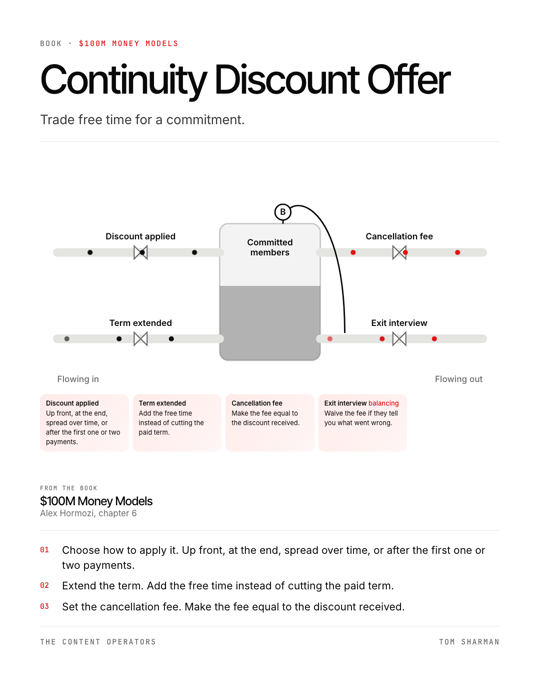
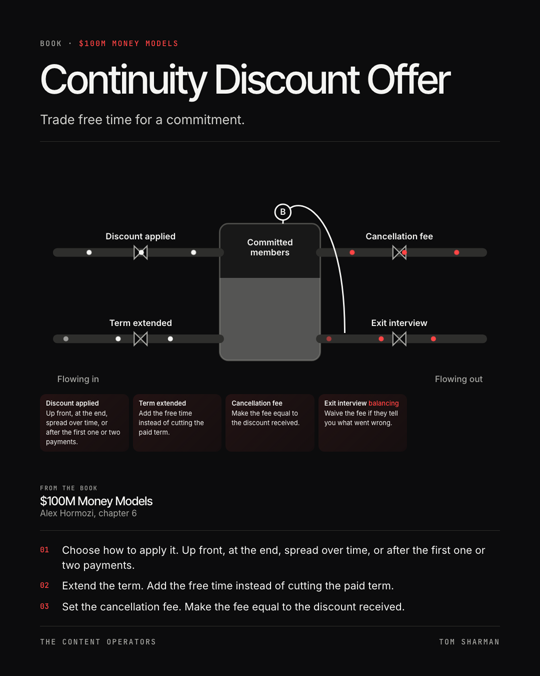
Trade free time for a commitment.
- Choose how to apply it. Up front, at the end, spread over time, or after the first one or two payments.
- Extend the term. Add the free time instead of cutting the paid term.
- Set the cancellation fee. Make the fee equal to the discount received.
- Make cancelling easy. Give customers a way to complain inside the business.
- Run an exit interview. Waive the fee if they tell you what went wrong.
From chapter: Section V: Continuity Offers, pp. 143–169
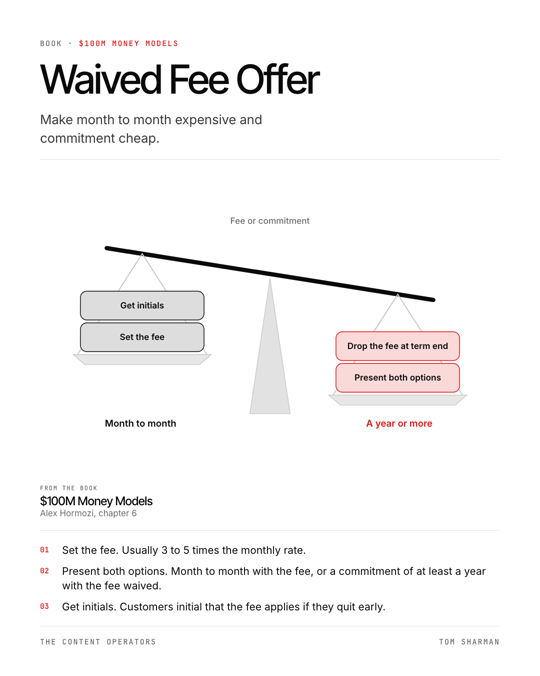
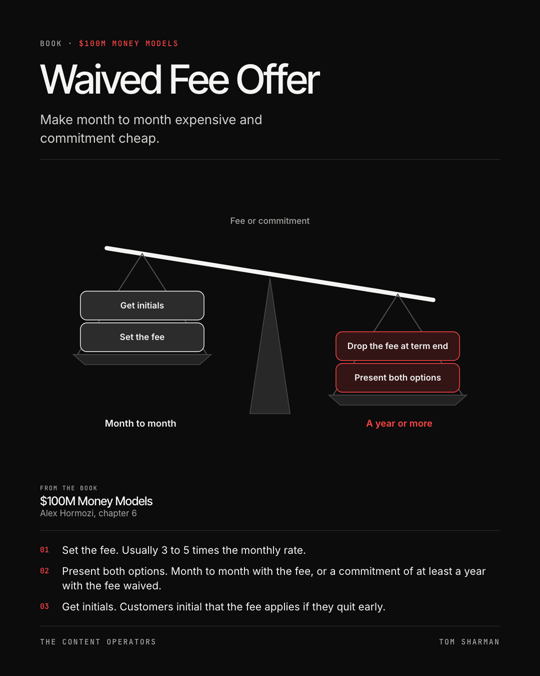
Make month to month expensive and commitment cheap.
- Set the fee. Usually 3 to 5 times the monthly rate.
- Present both options. Month to month with the fee, or a commitment of at least a year with the fee waived.
- Get initials. Customers initial that the fee applies if they quit early.
- Drop the fee at term end. Cancelling is free once the commitment is met.
From chapter: Section V: Continuity Offers, pp. 143–169
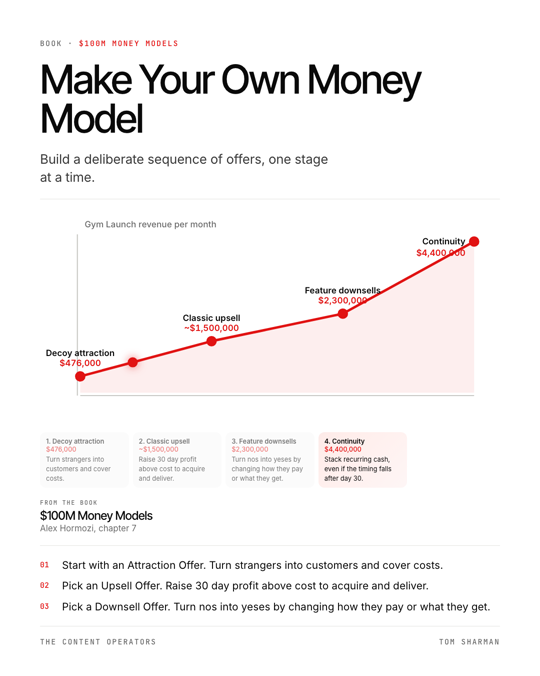
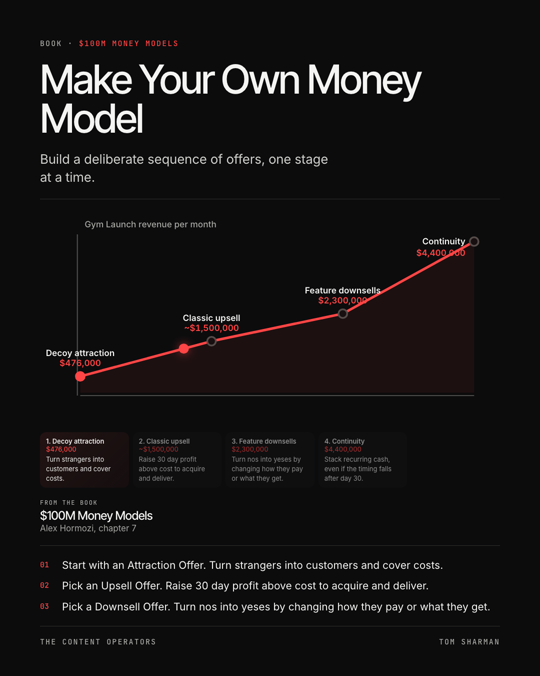
Build a deliberate sequence of offers, one stage at a time.
- Start with an Attraction Offer. Turn strangers into customers and cover costs.
- Pick an Upsell Offer. Raise 30 day profit above cost to acquire and deliver.
- Pick a Downsell Offer. Turn nos into yeses by changing how they pay or what they get.
- Pick a Continuity Offer. Stack recurring cash, even if the timing falls after day 30.
From chapter: Section VI: Make Your Money Model, pp. 170–188
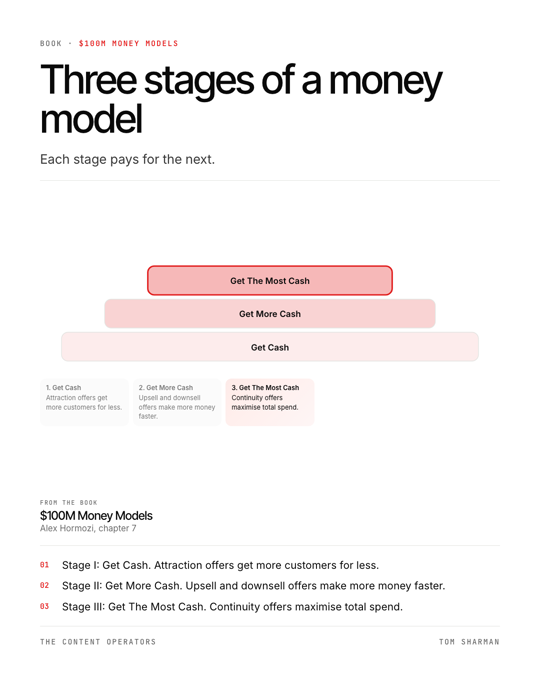
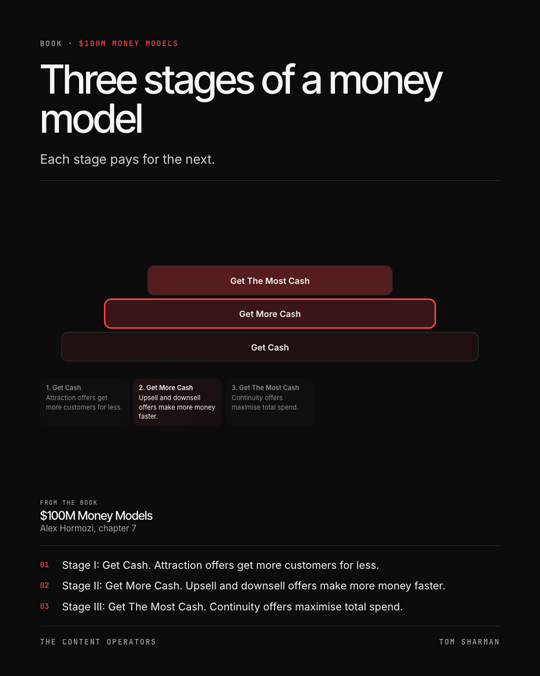
Each stage pays for the next.
- Stage I: Get Cash. Attraction offers get more customers for less.
- Stage II: Get More Cash. Upsell and downsell offers make more money faster.
- Stage III: Get The Most Cash. Continuity offers maximise total spend.
From chapter: Section VI: Make Your Money Model, pp. 170–188