Bookshelf
How Tom uses this
The Lost Chapter backs three of Tom's lessons. Under each of his lessons, what the book says about it, and on which pages.
What it argues
Hormozi argues that choosing your avatar is the highest leverage move in lead generation. A minority of customers, roughly the top 20 percent, supply most of the revenue and stay longest, so the job is to find who they are and stop selling to everyone else. He gives a four-step process of survey, sort, find the shared qualifiers and execute, and then reverse-engineers how those best customers actually bought. At Gym Launch the result was a lifetime value above $45,000 against $6000 to $8000 for competitors, and he says a rival in the same vertical made 70 times less profit by taking anyone with a card. Quality beats quantity: every time he removed qualification steps volume rose and money fell.
Worth keeping
- Survey customers, sort the top 20 percent, find the three to five qualifiers they share, then speak only to that avatar (p. 3).
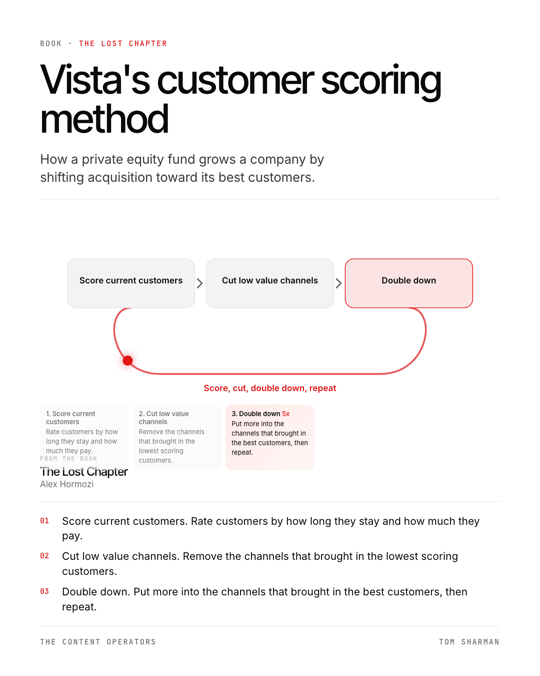
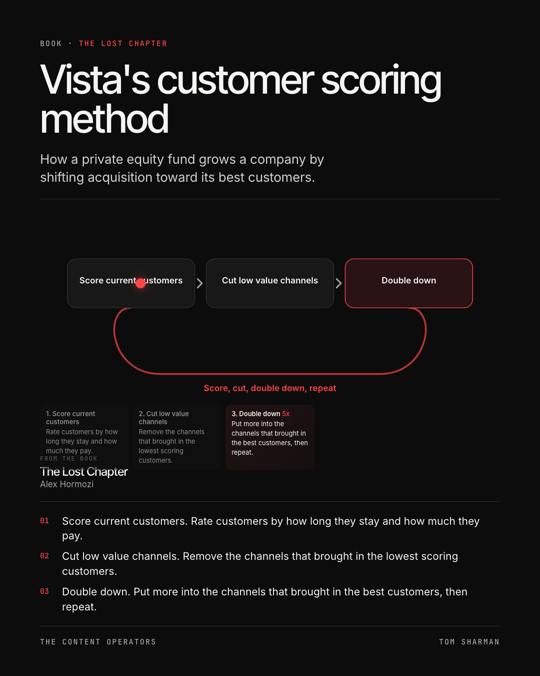
- Replacing the weakest 80 percent of customers with high spenders can grow a business 5x (p. 2).
- Find what your best customers consumed before buying and make it happen on purpose: 78% had read at least two long form pieces (p. 5).
- Send value-in-advance content that is genuinely useful, not a disguised pitch (p. 6).
- Do not cut qualification steps for volume: lead count rose and profit fell every time (p. 6).
- A same-vertical rival made 70x less profit by accepting anyone (p. 6).
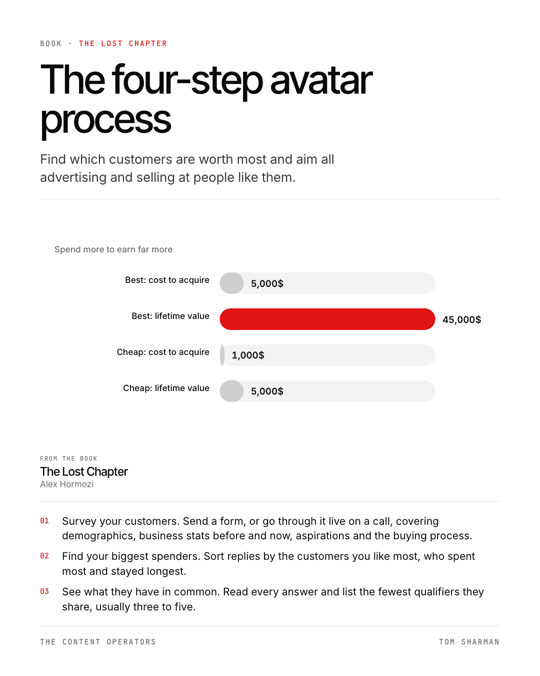
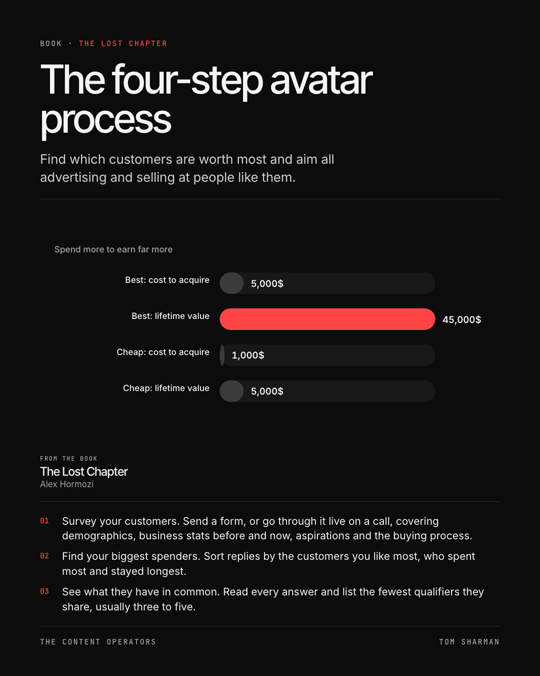
- Willing to pay $5000 to acquire $45,000 rather than $1000 to acquire $5000 (p. 7).
- Merge marketing and sales into one acquisition department (p. 6).
Which project it moves forward
The Content Operators launch
The launch needs a first cohort, and this gives a concrete method to pick who the cohort should be and what content they should see before they buy.
The questions it answers
- How do you build a personal brand that generates inbound rather than requiring outbound?
It shows reverse-engineering the content best customers consumed before buying, and putting two long form pieces into every buyer journey so leads arrive pre-sold.
- How do you price and sell a tool you built for yourself?
It argues for narrowing to the highest value customers and pricing for them, since lifetime value above $45,000 against $6000 to $8000 changes margins sharply.
The frameworks
2 frameworks, one animation each Every framework, step by step
Find which customers are worth most and aim all advertising and selling at people like them.
- Survey your customers. Send a form, or go through it live on a call, covering demographics, business stats before and now, aspirations and the buying process.
- Find your biggest spenders. Sort replies by the customers you like most, who spent most and stayed longest. Focus on the top 20 percent and ignore the rest.
- See what they have in common. Read every answer and list the fewest qualifiers they share, usually three to five.
- Execute. Speak to the new avatar in all advertising and stop selling to anyone outside it, then reverse-engineer the buying process your best customers went through and make it happen on purpose.
From pp. 1–8
How a private equity fund grows a company by shifting acquisition toward its best customers.
- Score current customers. Rate customers by how long they stay and how much they pay.
- Cut low value channels. Remove the channels that brought in the lowest scoring customers.
- Double down. Put more into the channels that brought in the best customers, then repeat.
From pp. 1–8
Working with Tom on this
Tom works with creators and founders one to one, from a single session to a fractional role. Work with Tom
Back to the bookshelf