Every framework, step by step
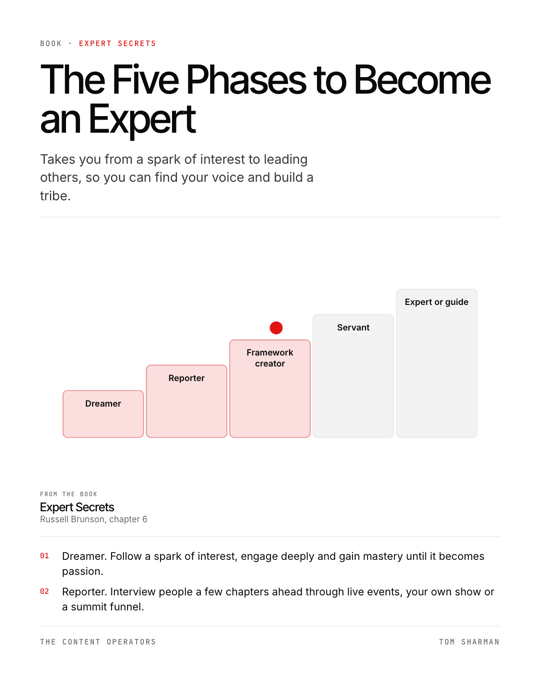
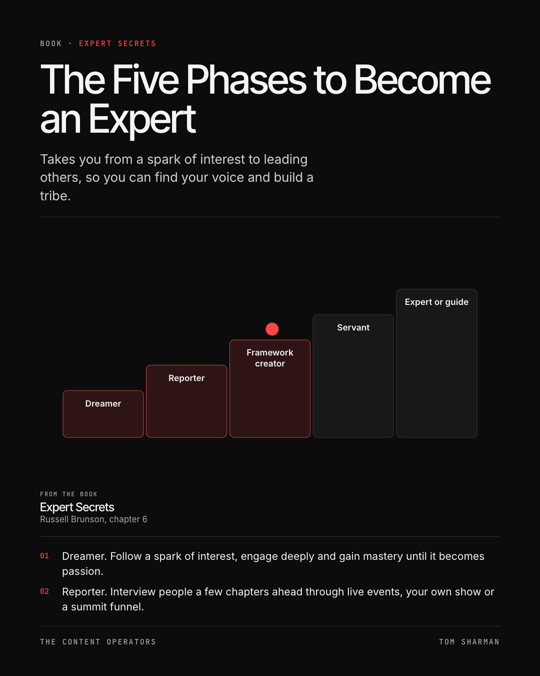
Takes you from a spark of interest to leading others, so you can find your voice and build a tribe.
- Dreamer. Follow a spark of interest, engage deeply and gain mastery until it becomes passion.
- Reporter. Interview people a few chapters ahead through live events, your own show or a summit funnel.
- Framework creator. Turn what you learn into your own named framework and test it on yourself.
- Servant. Work for free with a beta group to prove the framework works for other people.
- Expert or guide. Lead people with your results as your certification, staying one chapter ahead of them.
From chapter: SECTION ONE: Creating Your Movement, pp. 24–179
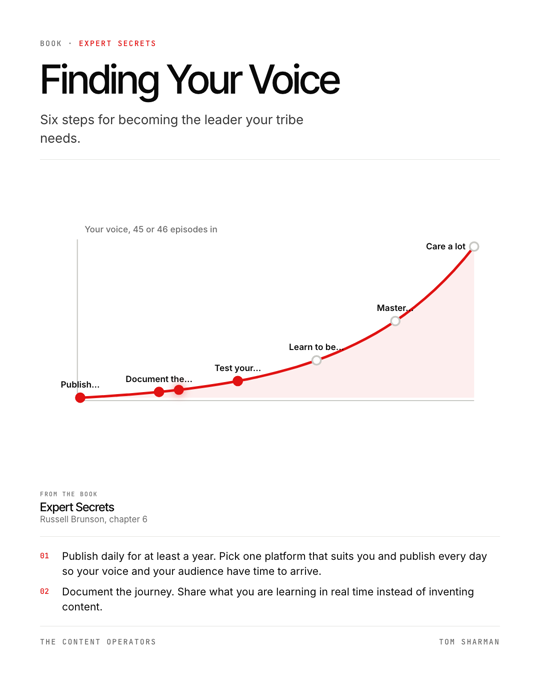
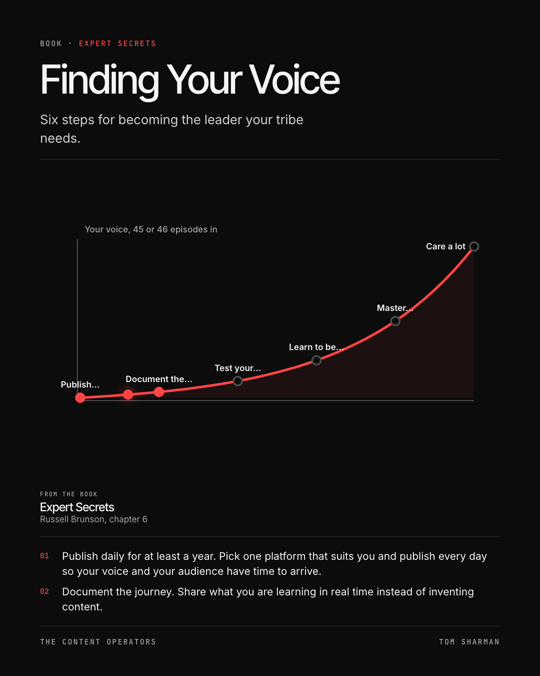
Six steps for becoming the leader your tribe needs.
- Publish daily for at least a year. Pick one platform that suits you and publish every day so your voice and your audience have time to arrive.
- Document the journey. Share what you are learning in real time instead of inventing content.
- Test your material. Watch which messages get shared and commented on, and refine like a comedian reworking jokes.
- Learn to be prolific. Sit in the Prolific Zone between mainstream advice and the crazy zone, where ideas are new enough to polarise.
- Master persuasion. Encourage dreams, justify failures, allay fears, confirm suspicions and help people throw rocks at their enemies.
- Care a lot. Charge properly, protect your time and show the audience you want them to succeed.
From chapter: SECTION ONE: Creating Your Movement, pp. 24–179
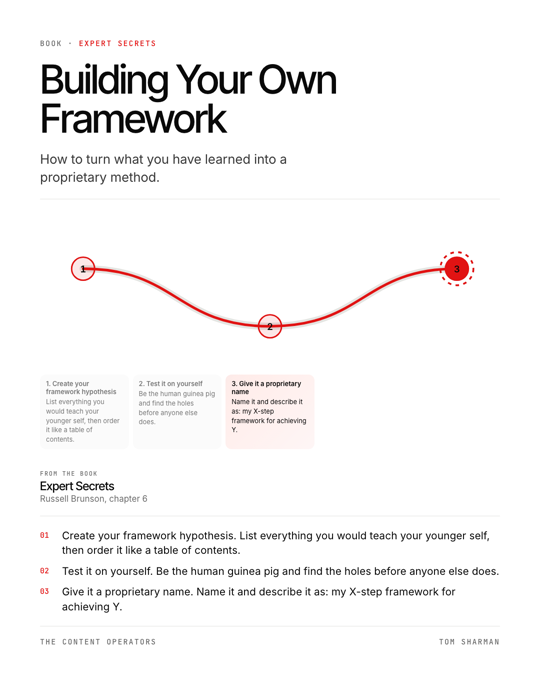
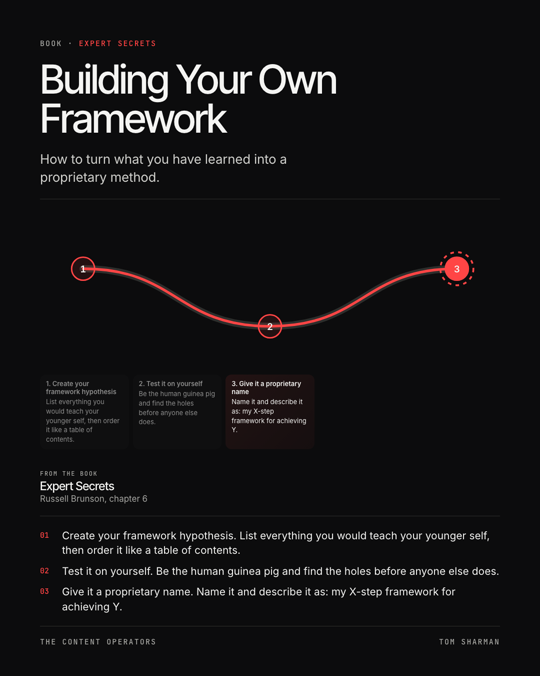
How to turn what you have learned into a proprietary method.
- Create your framework hypothesis. List everything you would teach your younger self, then order it like a table of contents.
- Test it on yourself. Be the human guinea pig and find the holes before anyone else does.
- Give it a proprietary name. Name it and describe it as: my X-step framework for achieving Y.
From chapter: SECTION ONE: Creating Your Movement, pp. 24–179
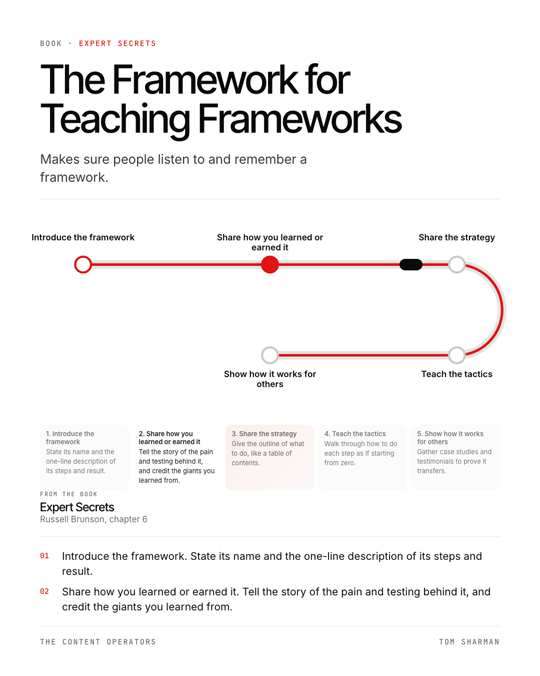
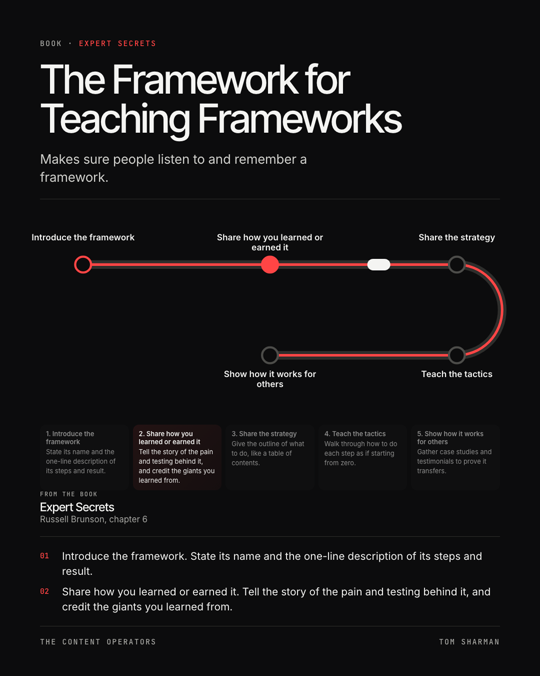
Makes sure people listen to and remember a framework.
- Introduce the framework. State its name and the one-line description of its steps and result.
- Share how you learned or earned it. Tell the story of the pain and testing behind it, and credit the giants you learned from.
- Share the strategy. Give the outline of what to do, like a table of contents.
- Teach the tactics. Walk through how to do each step as if starting from zero.
- Show how it works for others. Gather case studies and testimonials to prove it transfers.
From chapter: SECTION ONE: Creating Your Movement, pp. 24–179
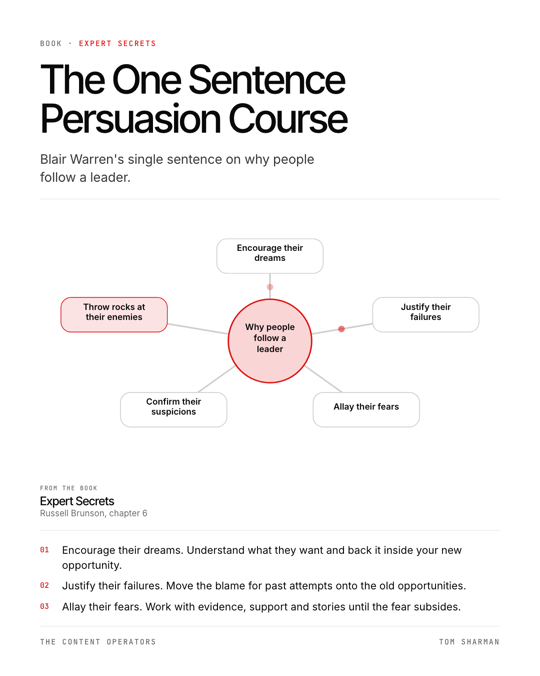
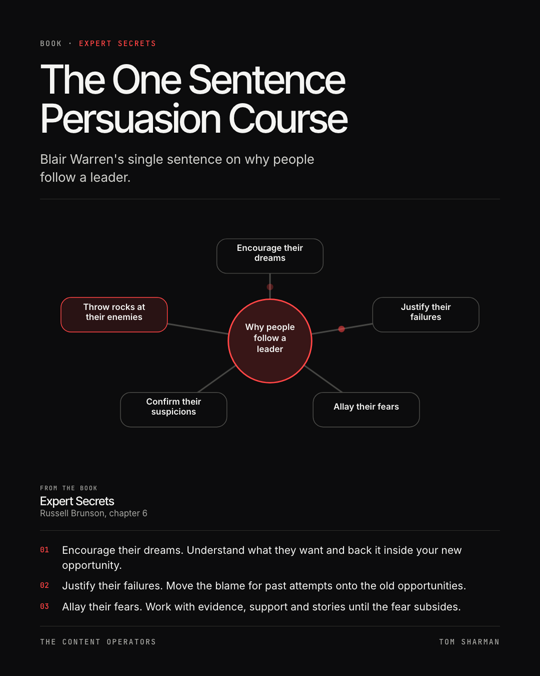
Blair Warren's single sentence on why people follow a leader.
- Encourage their dreams. Understand what they want and back it inside your new opportunity.
- Justify their failures. Move the blame for past attempts onto the old opportunities.
- Allay their fears. Work with evidence, support and stories until the fear subsides.
- Confirm their suspicions. Tell the story of the same suspicion you had and how you got past it.
- Throw rocks at their enemies. Name a common enemy so the community has an us and a them.
From chapter: SECTION ONE: Creating Your Movement, pp. 24–179
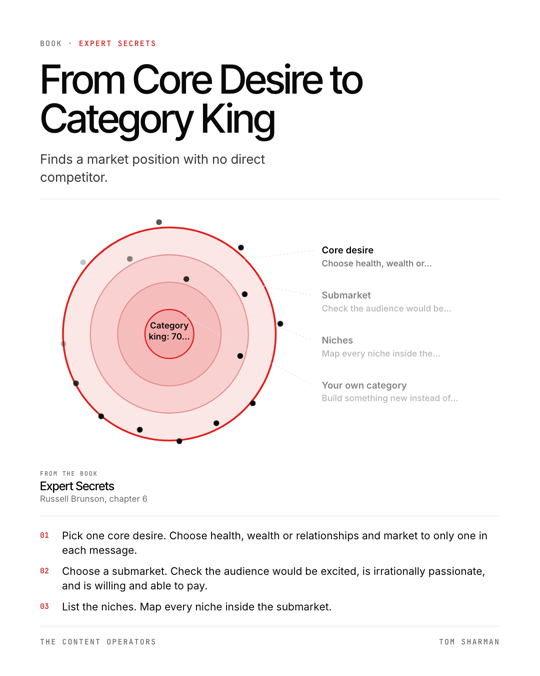
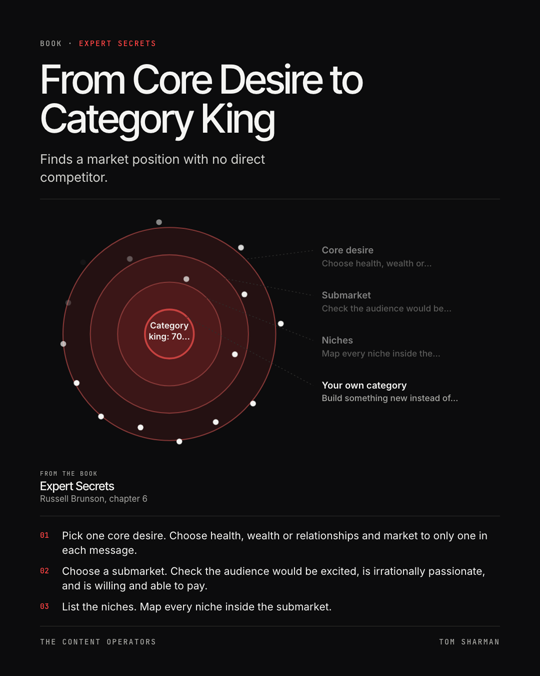
Finds a market position with no direct competitor.
- Pick one core desire. Choose health, wealth or relationships and market to only one in each message.
- Choose a submarket. Check the audience would be excited, is irrationally passionate, and is willing and able to pay.
- List the niches. Map every niche inside the submarket.
- Create your own category. Build something new instead of joining someone else's niche, so you can become the category king.
From chapter: SECTION ONE: Creating Your Movement, pp. 24–179
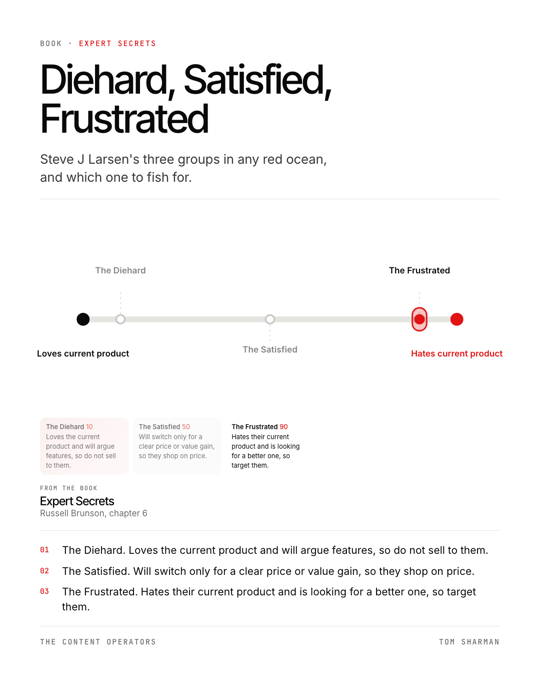
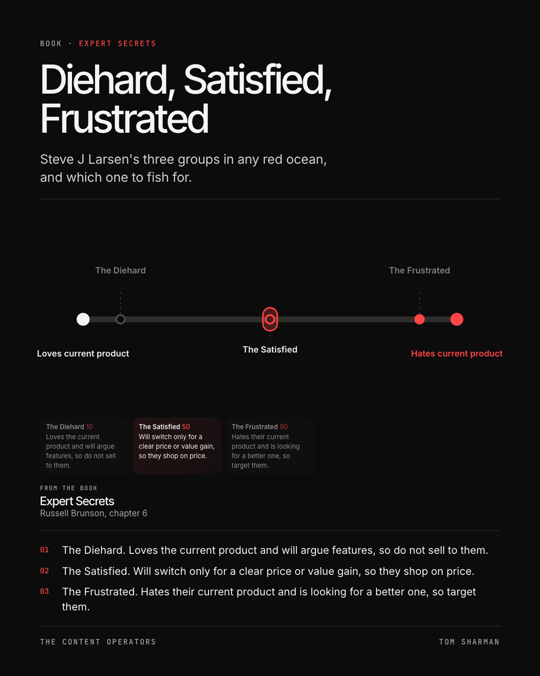
Steve J Larsen's three groups in any red ocean, and which one to fish for.
- The Diehard. Loves the current product and will argue features, so do not sell to them.
- The Satisfied. Will switch only for a clear price or value gain, so they shop on price.
- The Frustrated. Hates their current product and is looking for a better one, so target them.
From chapter: SECTION ONE: Creating Your Movement, pp. 24–179
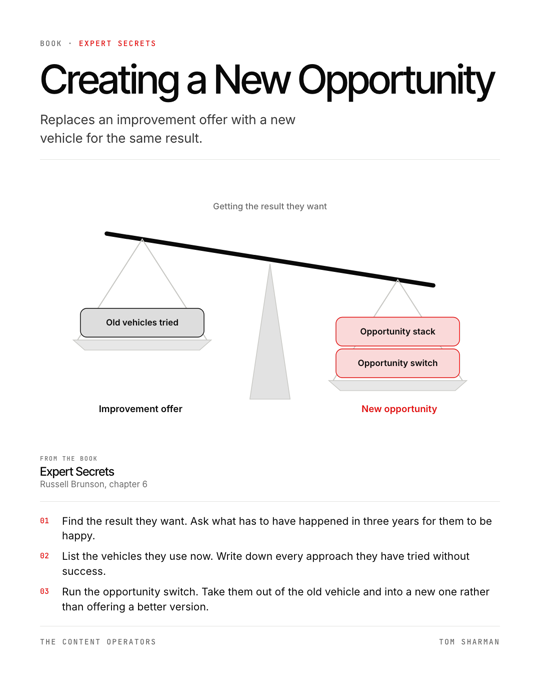
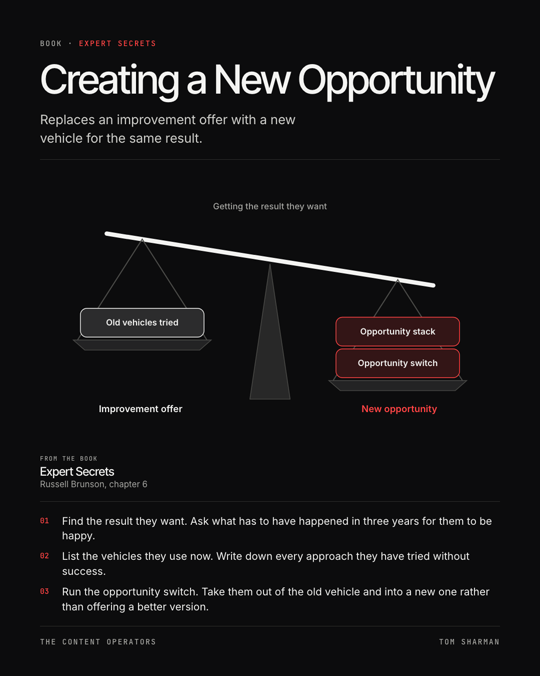
Replaces an improvement offer with a new vehicle for the same result.
- Find the result they want. Ask what has to have happened in three years for them to be happy.
- List the vehicles they use now. Write down every approach they have tried without success.
- Run the opportunity switch. Take them out of the old vehicle and into a new one rather than offering a better version.
- Build the opportunity stack. Keep one switch and package it in many ways: software, challenge, event, membership, coaching.
From chapter: SECTION ONE: Creating Your Movement, pp. 24–179
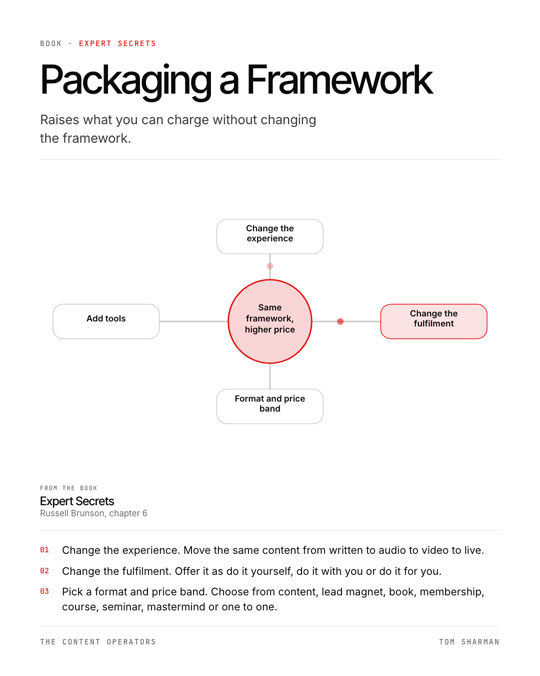
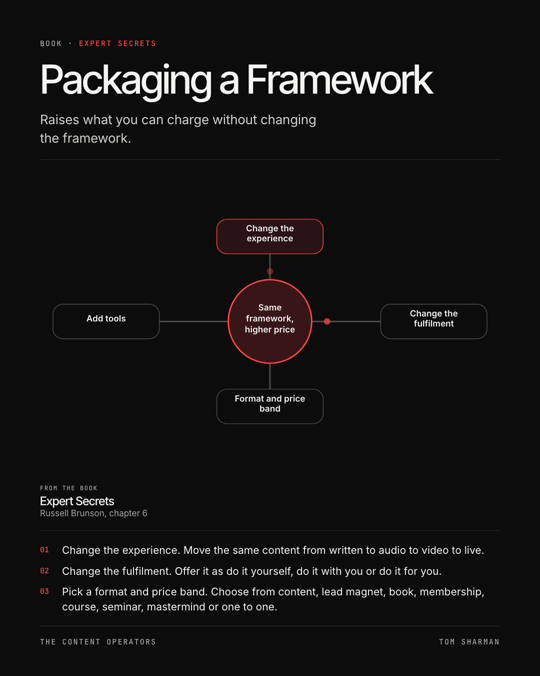
Raises what you can charge without changing the framework.
- Change the experience. Move the same content from written to audio to video to live.
- Change the fulfilment. Offer it as do it yourself, do it with you or do it for you.
- Pick a format and price band. Choose from content, lead magnet, book, membership, course, seminar, mastermind or one to one.
- Add tools. Turn parts of the framework into software, supplements, physical products or by-products like scripts and contracts.
From chapter: SECTION ONE: Creating Your Movement, pp. 24–179
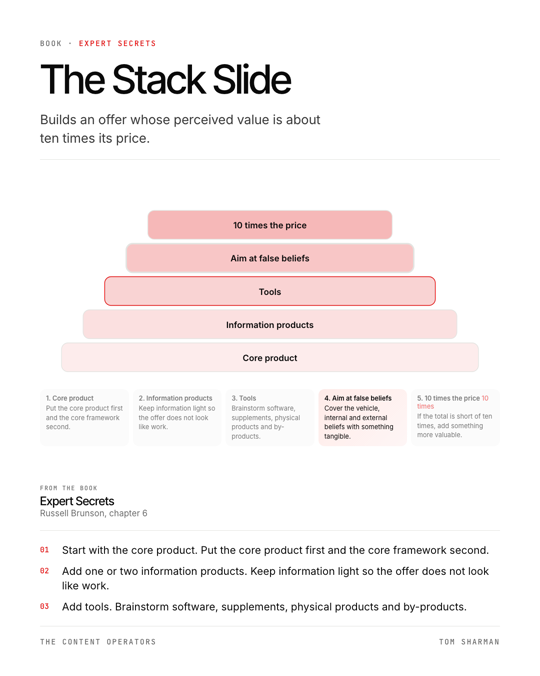
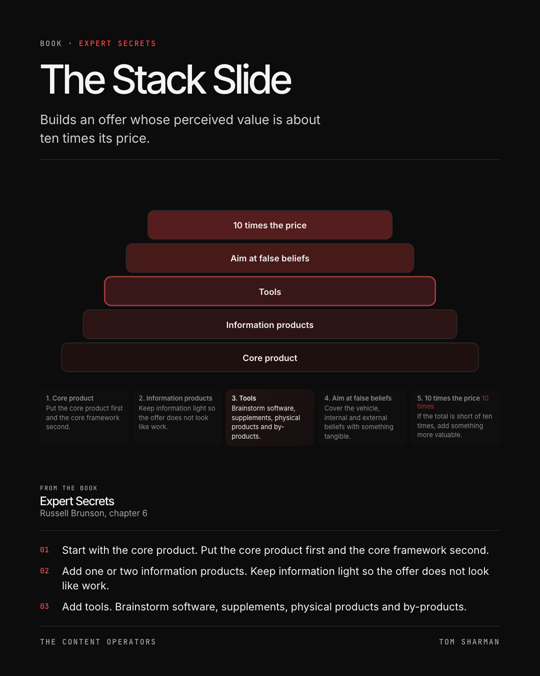
Builds an offer whose perceived value is about ten times its price.
- Start with the core product. Put the core product first and the core framework second.
- Add one or two information products. Keep information light so the offer does not look like work.
- Add tools. Brainstorm software, supplements, physical products and by-products.
- Aim each item at a false belief. Cover the vehicle, internal and external beliefs with something tangible.
- Value it at ten times the price. If the total is short of ten times, add something more valuable.
From chapter: SECTION ONE: Creating Your Movement, pp. 24–179
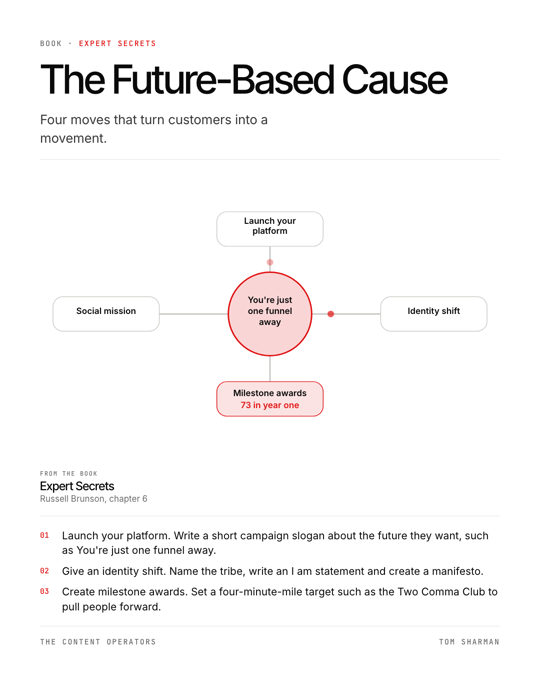
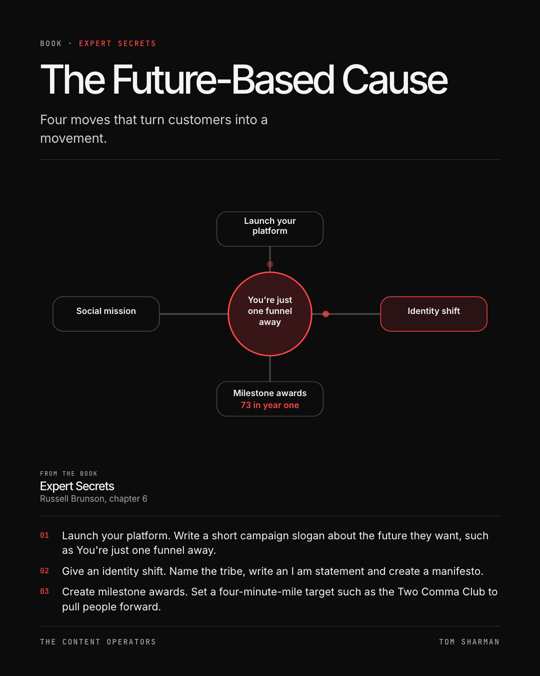
Four moves that turn customers into a movement.
- Launch your platform. Write a short campaign slogan about the future they want, such as You're just one funnel away.
- Give an identity shift. Name the tribe, write an I am statement and create a manifesto.
- Create milestone awards. Set a four-minute-mile target such as the Two Comma Club to pull people forward.
- Unite with a social mission. Add a journey of transformation through giving, such as Liberate and Educate.
From chapter: SECTION ONE: Creating Your Movement, pp. 24–179
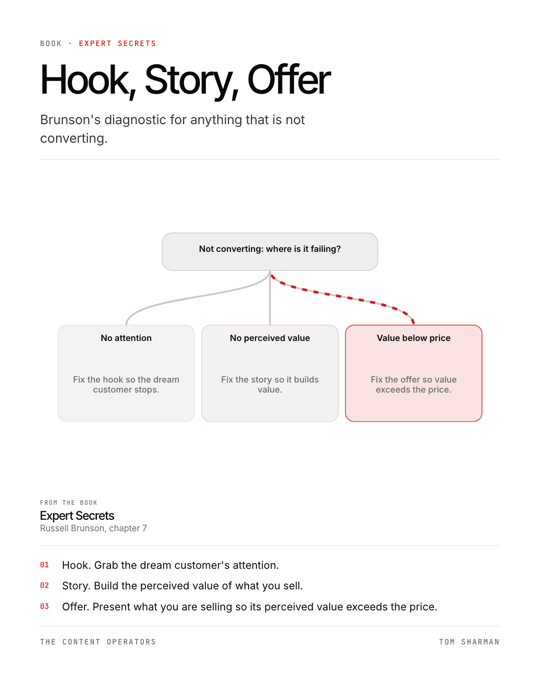
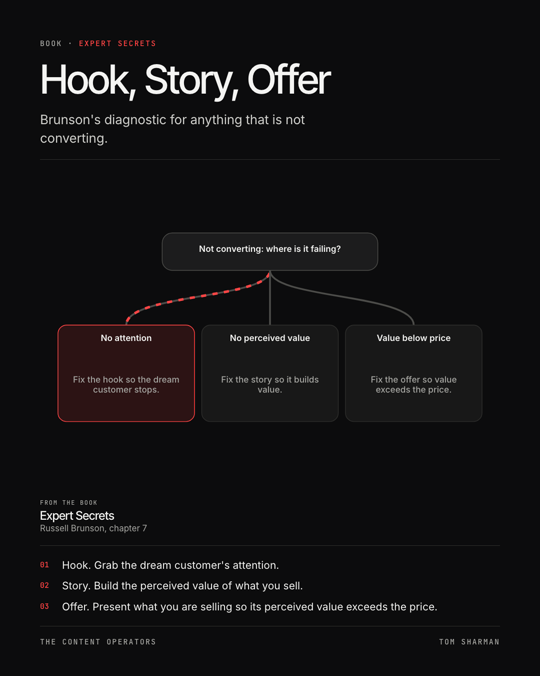
Brunson's diagnostic for anything that is not converting.
- Hook. Grab the dream customer's attention.
- Story. Build the perceived value of what you sell.
- Offer. Present what you are selling so its perceived value exceeds the price.
From chapter: SECTION TWO: Creating Belief, pp. 180–239
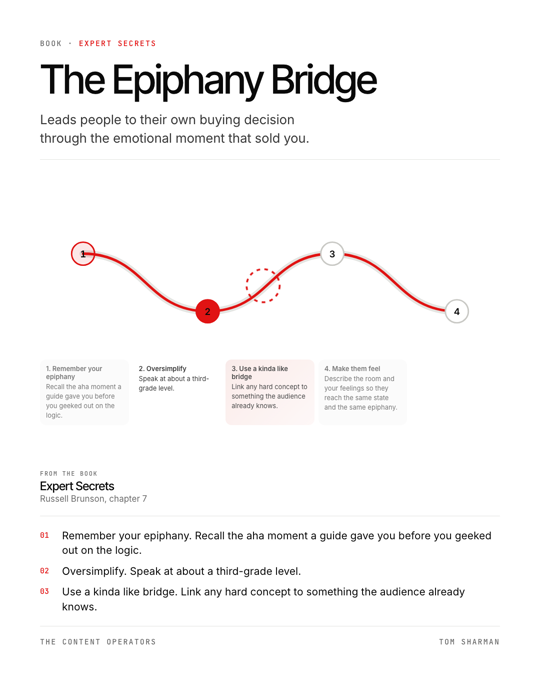
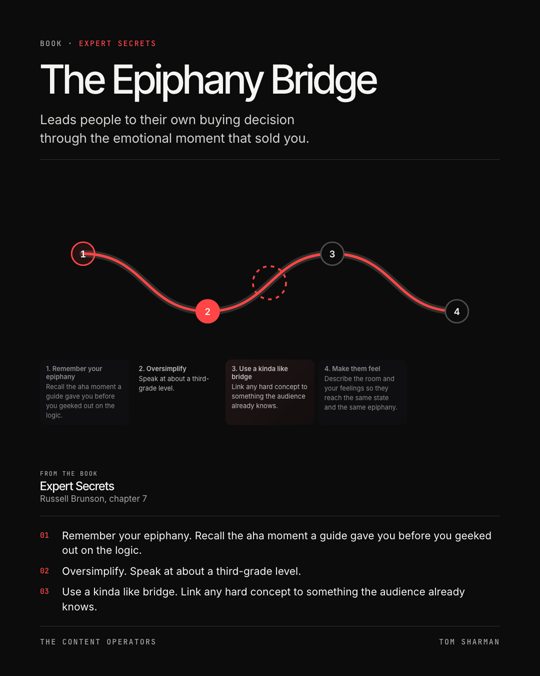
Leads people to their own buying decision through the emotional moment that sold you.
- Remember your epiphany. Recall the aha moment a guide gave you before you geeked out on the logic.
- Oversimplify. Speak at about a third-grade level.
- Use a kinda like bridge. Link any hard concept to something the audience already knows.
- Make them feel. Describe the room and your feelings so they reach the same state and the same epiphany.
From chapter: SECTION TWO: Creating Belief, pp. 180–239
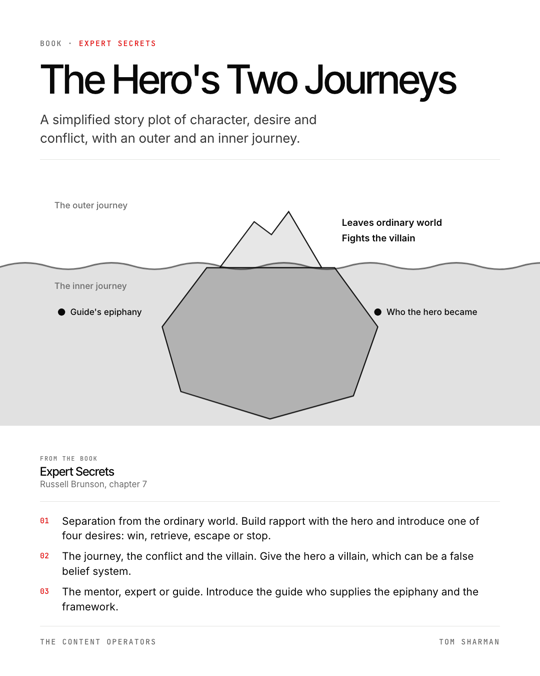
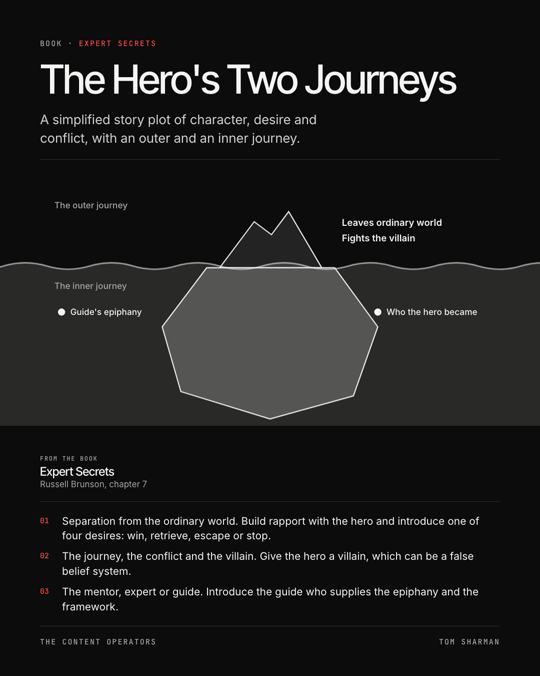
A simplified story plot of character, desire and conflict, with an outer and an inner journey.
- Separation from the ordinary world. Build rapport with the hero and introduce one of four desires: win, retrieve, escape or stop.
- The journey, the conflict and the villain. Give the hero a villain, which can be a false belief system.
- The mentor, expert or guide. Introduce the guide who supplies the epiphany and the framework.
- The achievement. Show the result and the second journey, who the hero became.
From chapter: SECTION TWO: Creating Belief, pp. 180–239
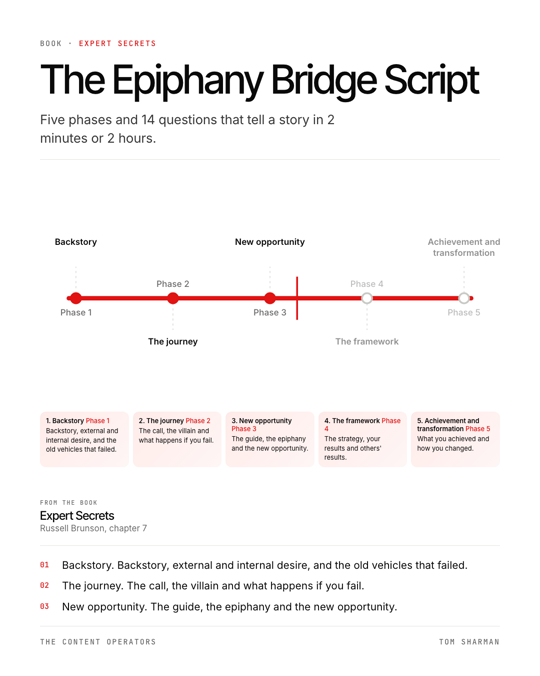
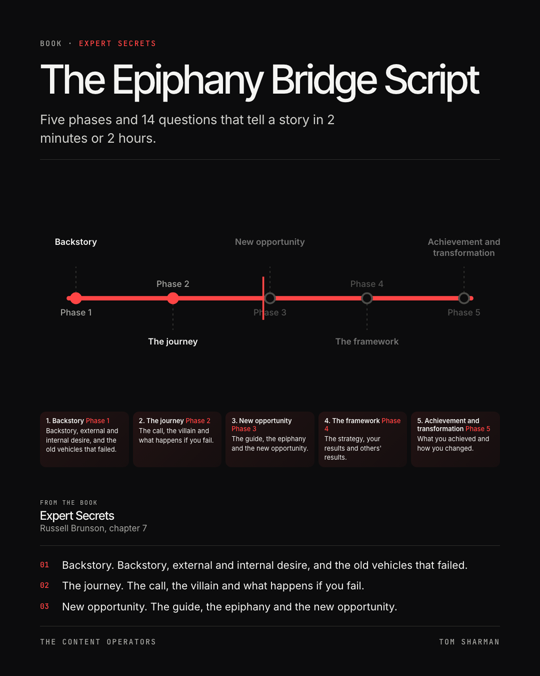
Five phases and 14 questions that tell a story in 2 minutes or 2 hours.
- Backstory. Backstory, external and internal desire, and the old vehicles that failed.
- The journey. The call, the villain and what happens if you fail.
- New opportunity. The guide, the epiphany and the new opportunity.
- The framework. The strategy, your results and others' results.
- Achievement and transformation. What you achieved and how you changed.
From chapter: SECTION TWO: Creating Belief, pp. 180–239
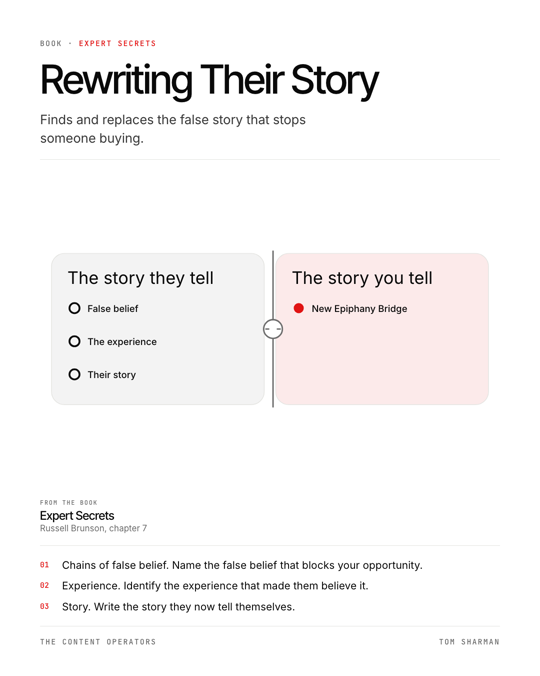
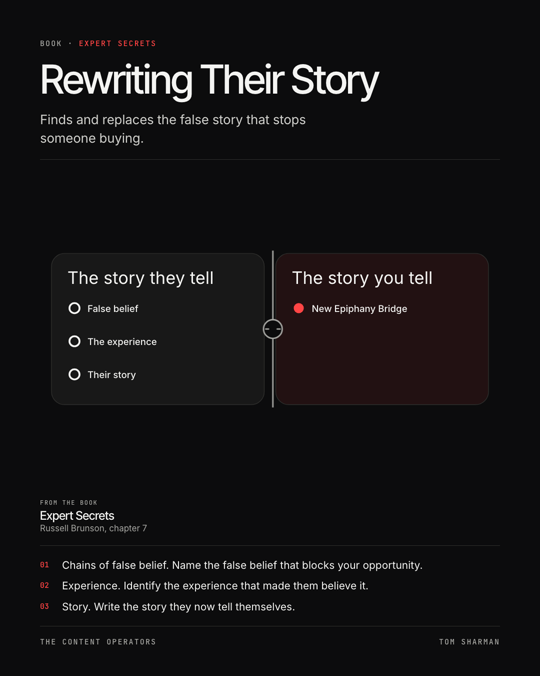
Finds and replaces the false story that stops someone buying.
- Chains of false belief. Name the false belief that blocks your opportunity.
- Experience. Identify the experience that made them believe it.
- Story. Write the story they now tell themselves.
- New Epiphany Bridge. Share your own story that broke the same belief.
From chapter: SECTION TWO: Creating Belief, pp. 180–239
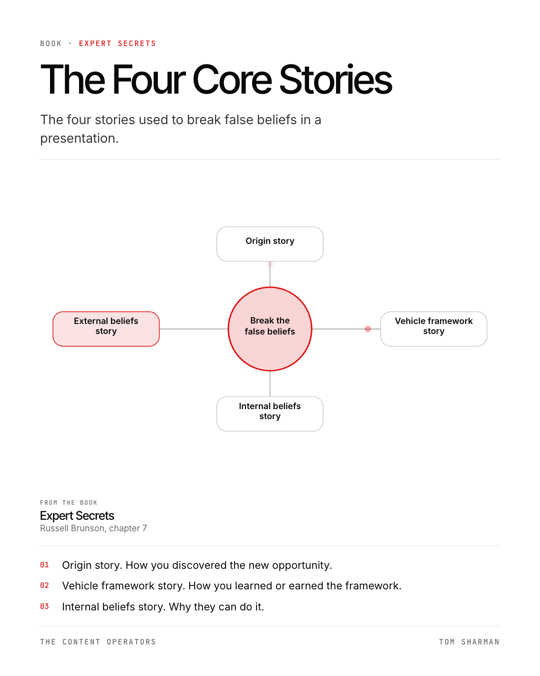
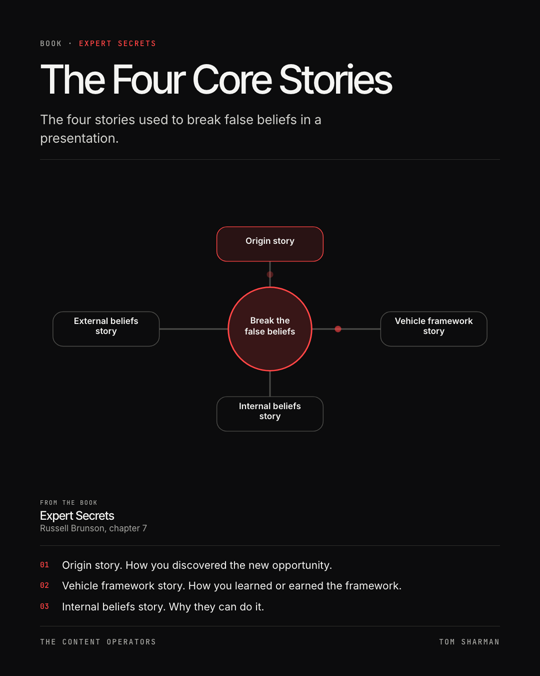
The four stories used to break false beliefs in a presentation.
- Origin story. How you discovered the new opportunity.
- Vehicle framework story. How you learned or earned the framework.
- Internal beliefs story. Why they can do it.
- External beliefs story. Why outside forces will not stop them.
From chapter: SECTION TWO: Creating Belief, pp. 180–239
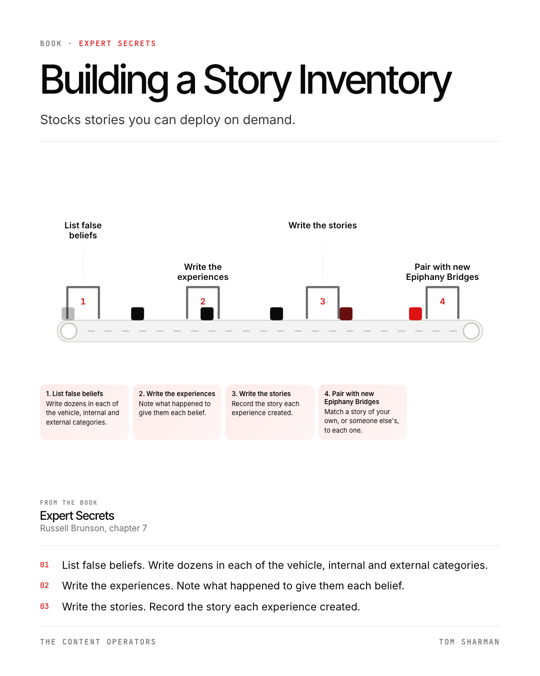
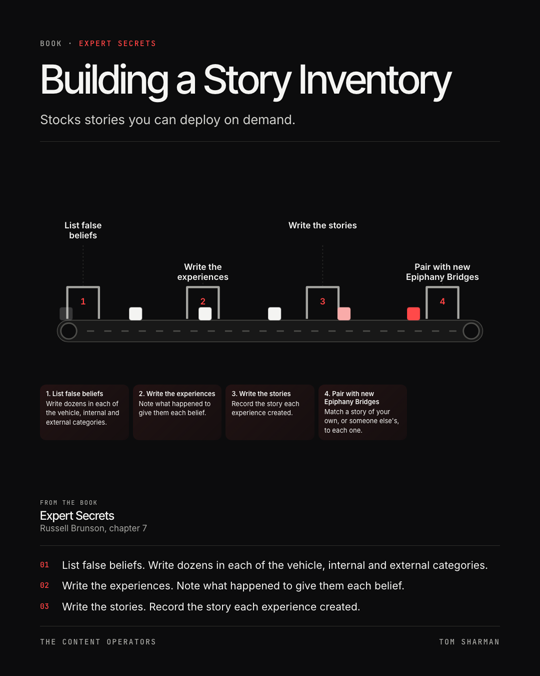
Stocks stories you can deploy on demand.
- List false beliefs. Write dozens in each of the vehicle, internal and external categories.
- Write the experiences. Note what happened to give them each belief.
- Write the stories. Record the story each experience created.
- Pair with new Epiphany Bridges. Match a story of your own, or someone else's, to each one.
From chapter: SECTION TWO: Creating Belief, pp. 180–239
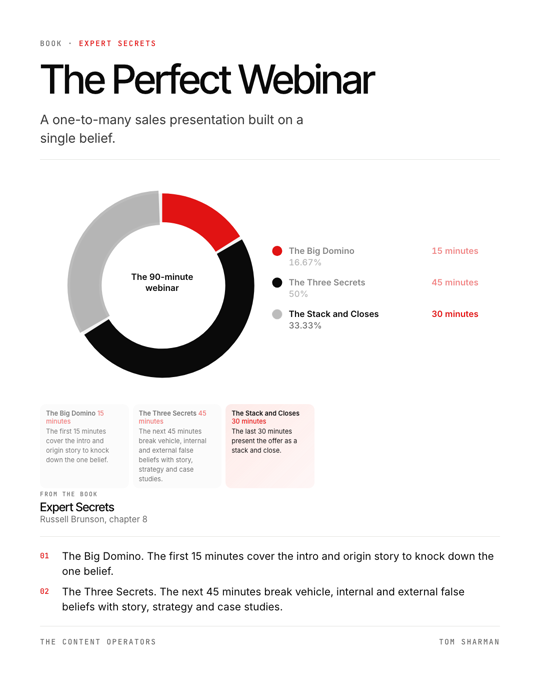
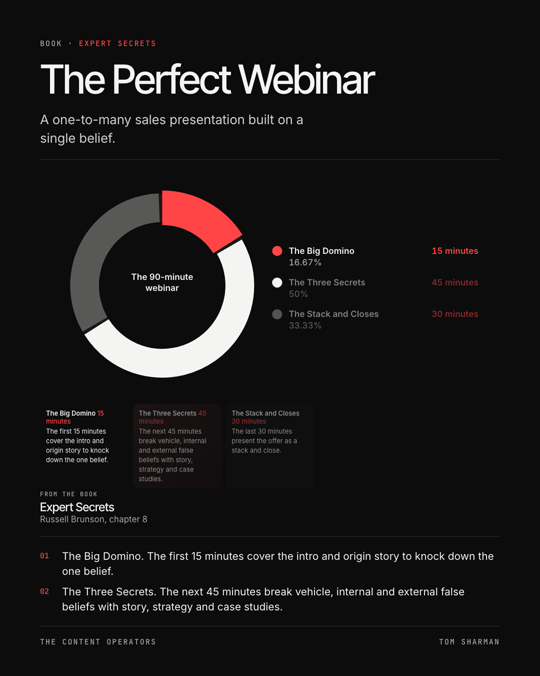
A one-to-many sales presentation built on a single belief.
- The Big Domino. The first 15 minutes cover the intro and origin story to knock down the one belief.
- The Three Secrets. The next 45 minutes break vehicle, internal and external false beliefs with story, strategy and case studies.
- The Stack and Closes. The last 30 minutes present the offer as a stack and close.
From chapter: SECTION THREE: “10X Secrets”: One-to-Many Selling, pp. 240–347
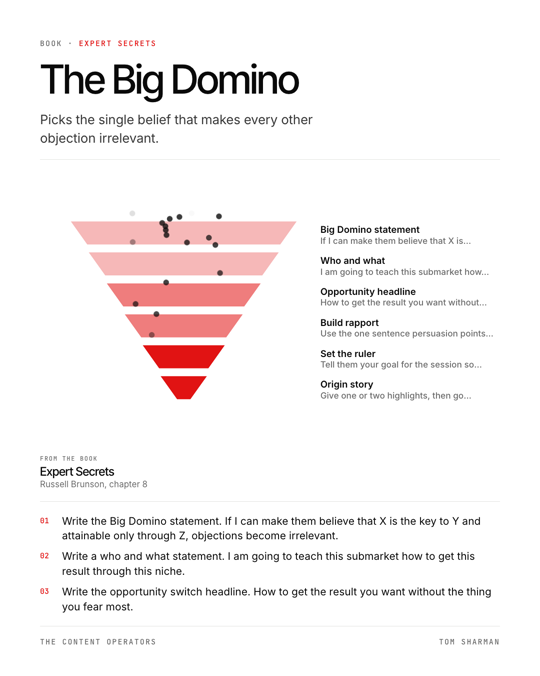
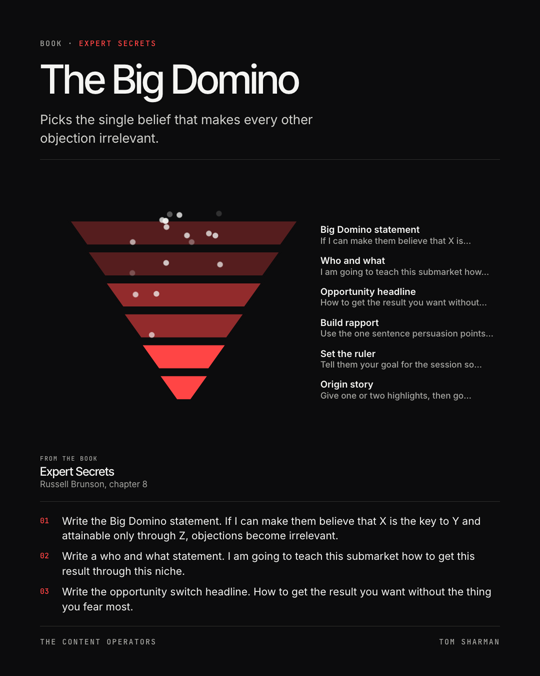
Picks the single belief that makes every other objection irrelevant.
- Write the Big Domino statement. If I can make them believe that X is the key to Y and attainable only through Z, objections become irrelevant.
- Write a who and what statement. I am going to teach this submarket how to get this result through this niche.
- Write the opportunity switch headline. How to get the result you want without the thing you fear most.
- Build rapport. Use the one sentence persuasion points at the start.
- Set the ruler. Tell them your goal for the session so they judge it fairly.
- Qualify yourself and tell your origin story. Give one or two highlights, then go straight into the Epiphany Bridge origin story.
From chapter: SECTION THREE: “10X Secrets”: One-to-Many Selling, pp. 240–347
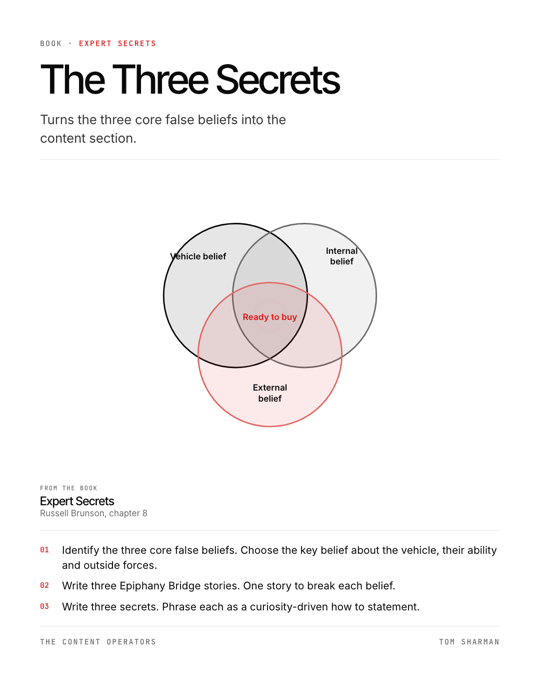
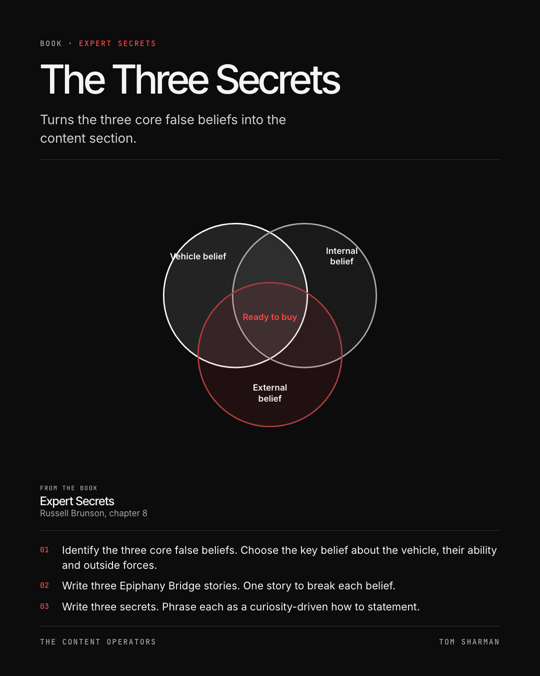
Turns the three core false beliefs into the content section.
- Identify the three core false beliefs. Choose the key belief about the vehicle, their ability and outside forces.
- Write three Epiphany Bridge stories. One story to break each belief.
- Write three secrets. Phrase each as a curiosity-driven how to statement.
From chapter: SECTION THREE: “10X Secrets”: One-to-Many Selling, pp. 240–347
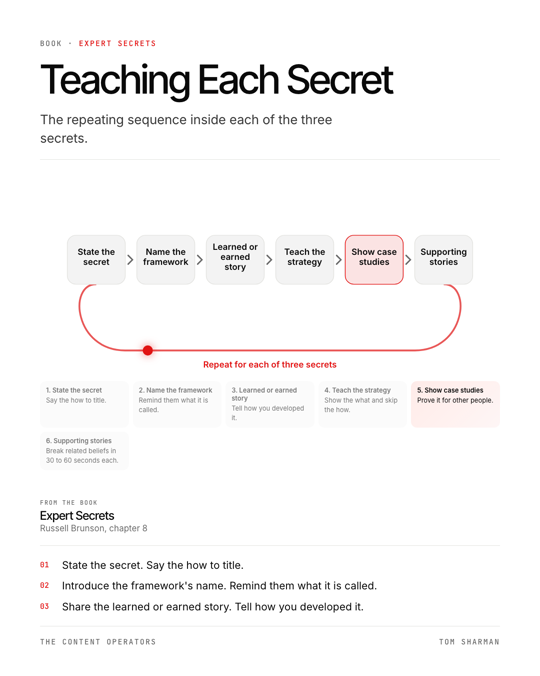
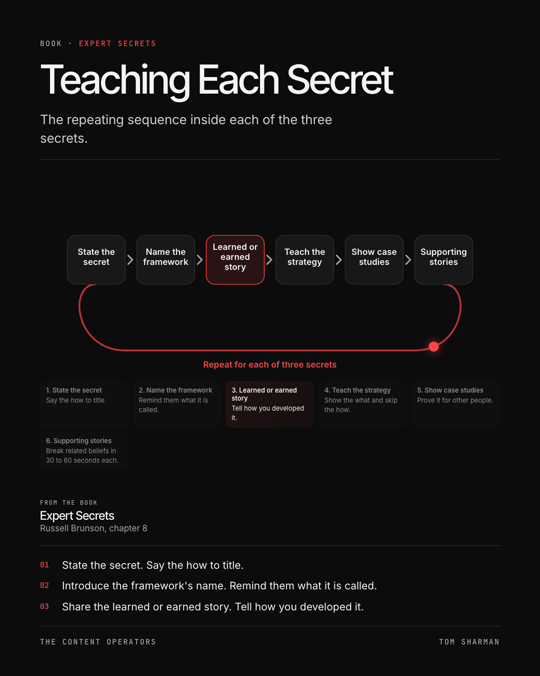
The repeating sequence inside each of the three secrets.
- State the secret. Say the how to title.
- Introduce the framework's name. Remind them what it is called.
- Share the learned or earned story. Tell how you developed it.
- Teach the strategy. Show the what and skip the how.
- Show case studies. Prove it for other people.
- Share supporting Epiphany Bridge stories. Break related beliefs in 30 to 60 seconds each.
From chapter: SECTION THREE: “10X Secrets”: One-to-Many Selling, pp. 240–347
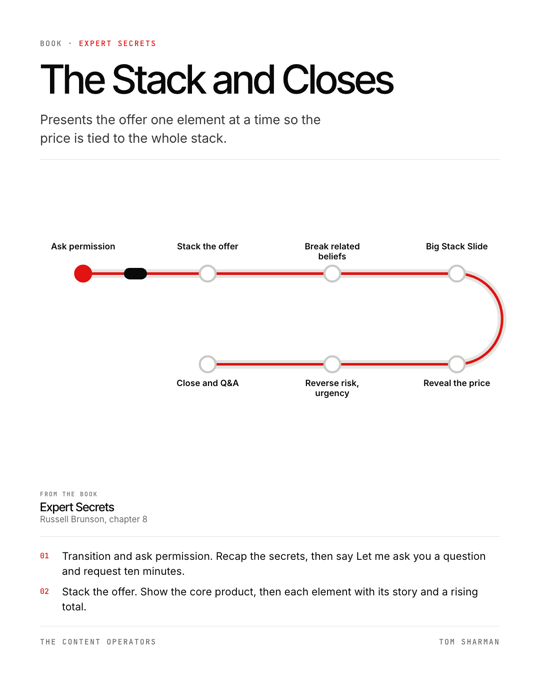
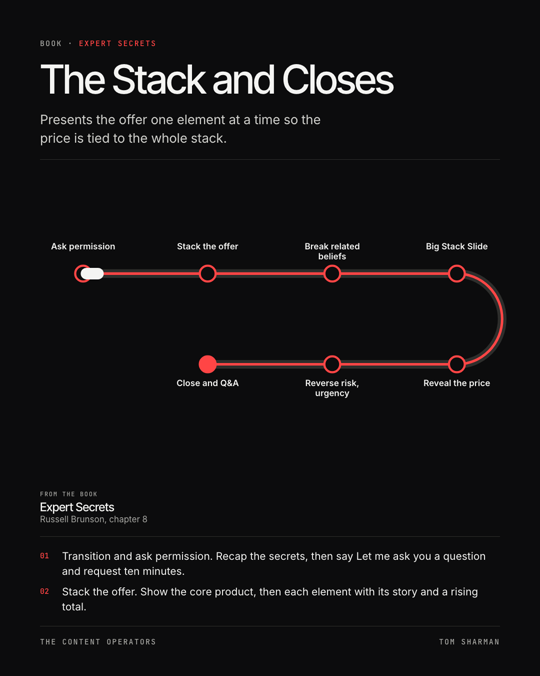
Presents the offer one element at a time so the price is tied to the whole stack.
- Transition and ask permission. Recap the secrets, then say Let me ask you a question and request ten minutes.
- Stack the offer. Show the core product, then each element with its story and a rising total.
- Break related beliefs. Cover false beliefs about the product itself.
- Show the Big Stack Slide and If all statements. Total the value at ten times the price and get three yeses.
- Reveal and justify the price. Use two choices, what the result is worth, then the price drop and reveal.
- Reverse risk and add urgency. Give a 30-day guarantee and a limited bonus with a countdown.
- Close and take questions. Leave the closing slide up with a call to action after every answer.
From chapter: SECTION THREE: “10X Secrets”: One-to-Many Selling, pp. 240–347
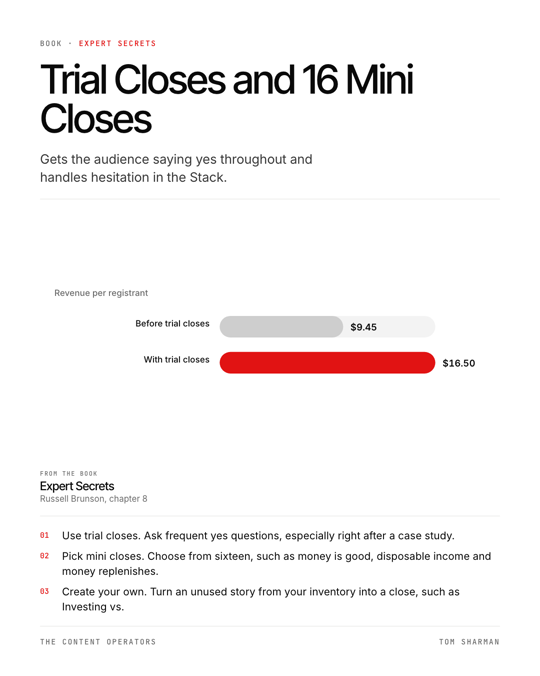
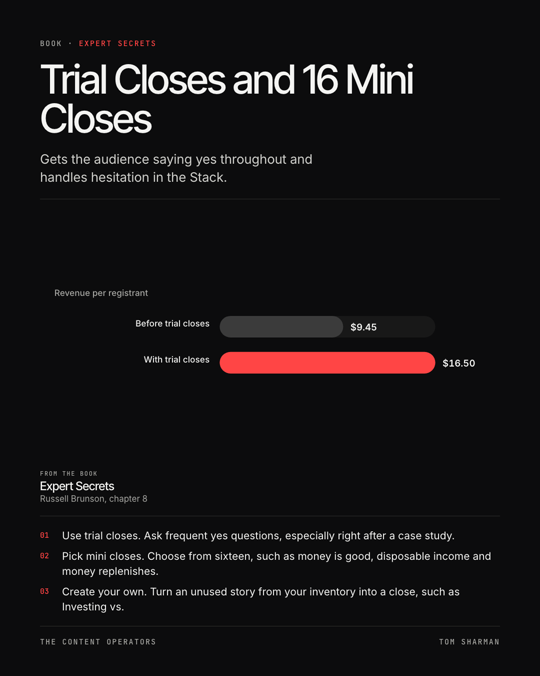
Gets the audience saying yes throughout and handles hesitation in the Stack.
- Use trial closes. Ask frequent yes questions, especially right after a case study.
- Pick mini closes. Choose from sixteen, such as money is good, disposable income and money replenishes.
- Create your own. Turn an unused story from your inventory into a close, such as Investing vs. Buying.
From chapter: SECTION THREE: “10X Secrets”: One-to-Many Selling, pp. 240–347
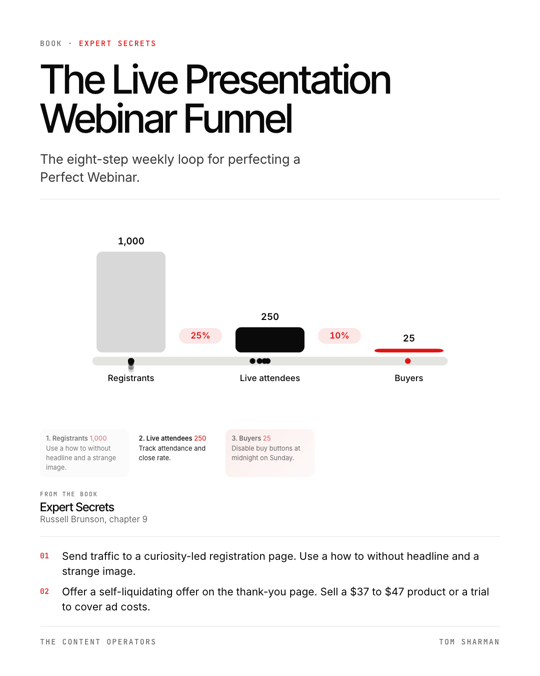
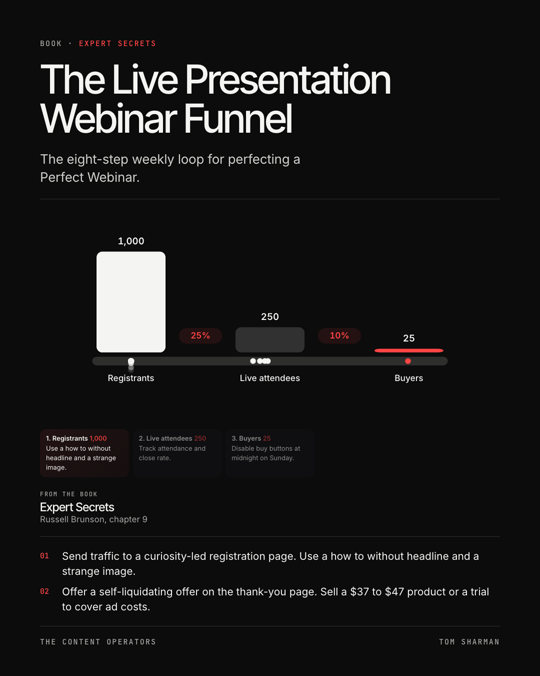
The eight-step weekly loop for perfecting a Perfect Webinar.
- Send traffic to a curiosity-led registration page. Use a how to without headline and a strange image.
- Offer a self-liquidating offer on the thank-you page. Sell a $37 to $47 product or a trial to cover ad costs.
- Send indoctrination emails. Presell each of the three secrets.
- Send reminders. Email and text from Wednesday through the hour before.
- Present live on Thursday. Track attendance and close rate.
- Send follow-ups. Replay emails with urgency and scarcity.
- Close the cart. Disable buy buttons at midnight on Sunday.
- Repeat. Run it weekly for a year or until it reaches the Two Comma Club.
From chapter: SECTION FOUR: Becoming Your Dream Customer’s Guide, pp. 348–404
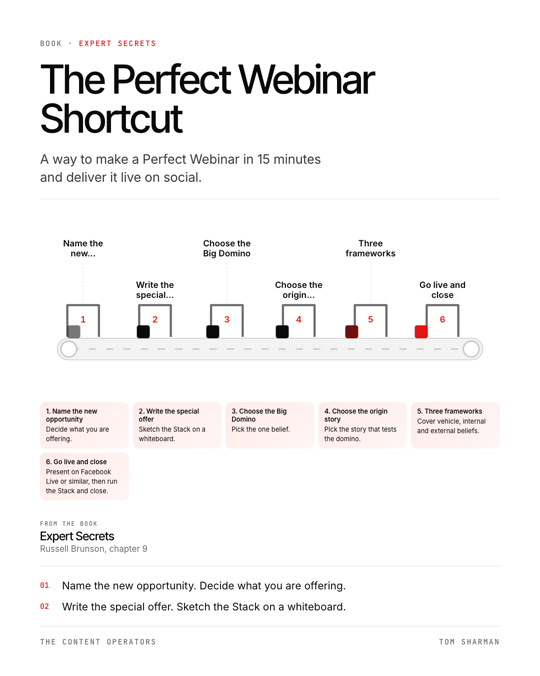
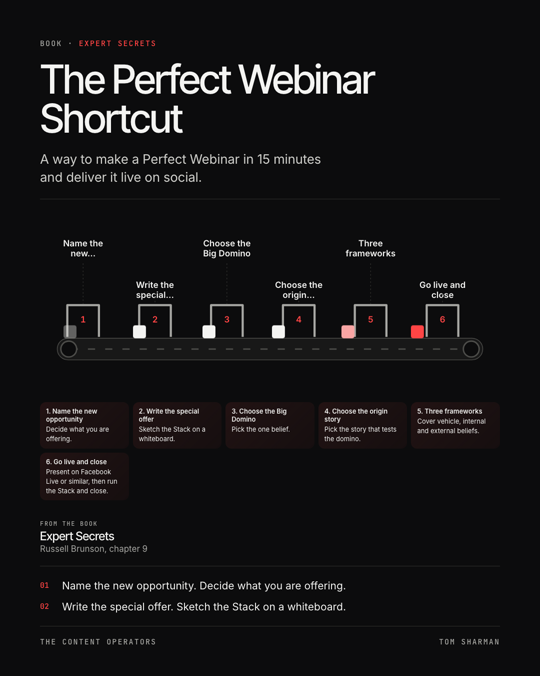
A way to make a Perfect Webinar in 15 minutes and deliver it live on social.
- Name the new opportunity. Decide what you are offering.
- Write the special offer. Sketch the Stack on a whiteboard.
- Choose the Big Domino. Pick the one belief.
- Choose the origin story. Pick the story that tests the domino.
- Write three frameworks and false beliefs. Cover vehicle, internal and external beliefs.
- Go live and close. Present on Facebook Live or similar, then run the Stack and close.
From chapter: SECTION FOUR: Becoming Your Dream Customer’s Guide, pp. 348–404
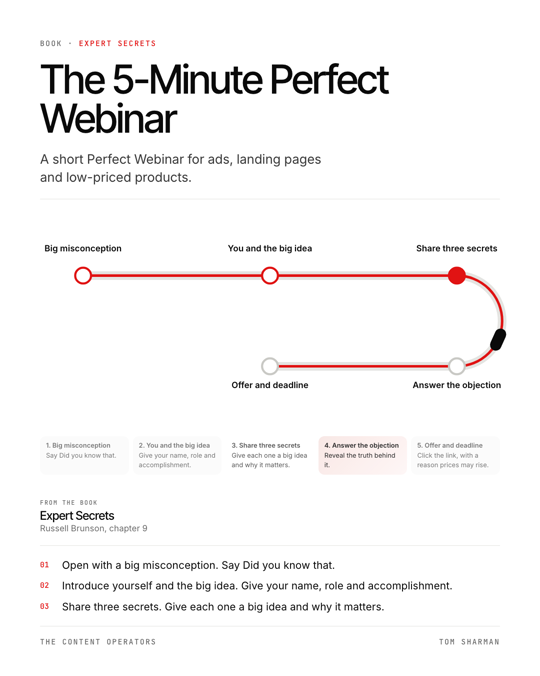
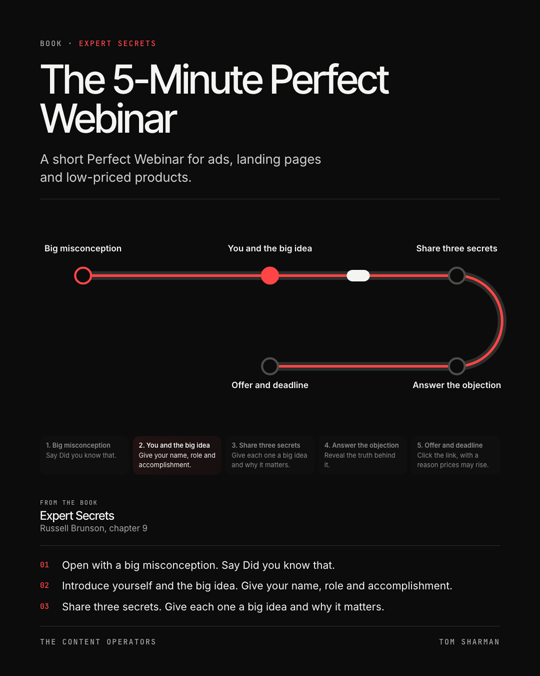
A short Perfect Webinar for ads, landing pages and low-priced products.
- Open with a big misconception. Say Did you know that.
- Introduce yourself and the big idea. Give your name, role and accomplishment.
- Share three secrets. Give each one a big idea and why it matters.
- Answer the objection. Reveal the truth behind it.
- Present the offer and a deadline. Click the link, with a reason prices may rise.
From chapter: SECTION FOUR: Becoming Your Dream Customer’s Guide, pp. 348–404
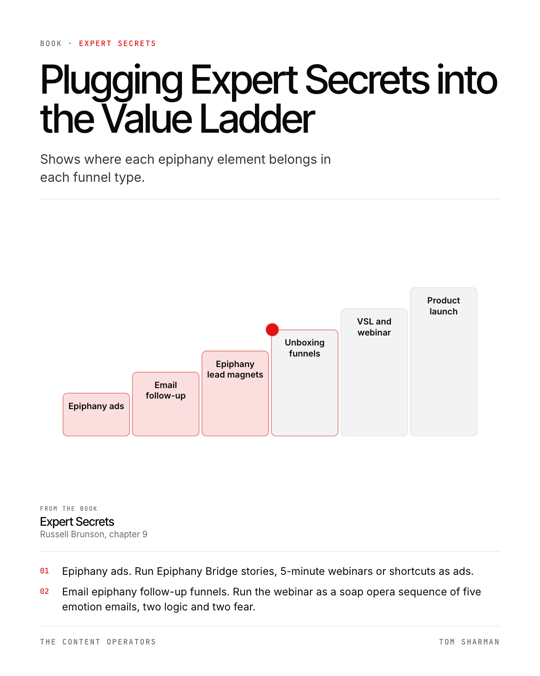
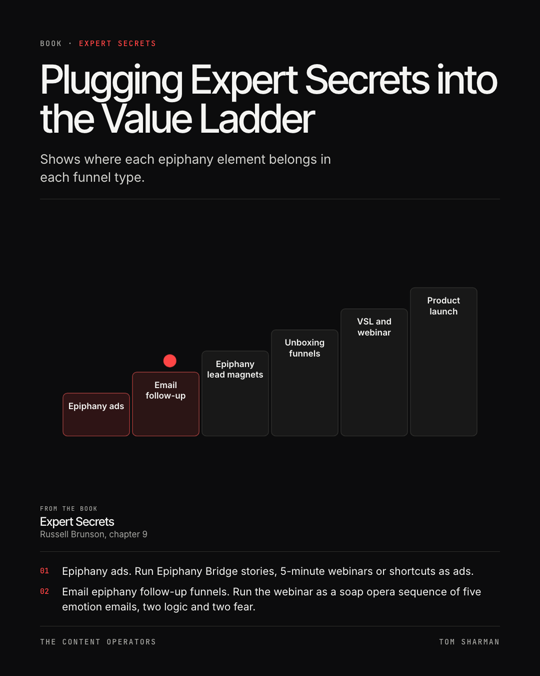
Shows where each epiphany element belongs in each funnel type.
- Epiphany ads. Run Epiphany Bridge stories, 5-minute webinars or shortcuts as ads.
- Email epiphany follow-up funnels. Run the webinar as a soap opera sequence of five emotion emails, two logic and two fear.
- Epiphany lead magnets. Retell the Epiphany Bridge story on the lead page.
- Epiphany unboxing funnels. Use the 5-minute webinar as the sales video.
- Epiphany VSL and webinar funnels. Record the full webinar or a 30-minute version.
- Epiphany product launch funnels. Split the webinar across a sequence of launch videos.
From chapter: SECTION FOUR: Becoming Your Dream Customer’s Guide, pp. 348–404