What it argues
Priestley argues that technology has shifted the advantage from big firms to small, focused teams, and that fortunes are made in revolutionary times. The first job is a mindset shift. You calm the reptile brain, see money as a placeholder for value, and start before you have clarity. Then you find an opportunity through four experiments (concept, audience, offer, sales), build a ladder of products that fit together, and organise a small team that implements. AI makes functional skills worth less, so vitality, context and creating are what keep you valuable. Success then comes down to luck, reputation and leverage, and the new game is love.
Every framework, step by step
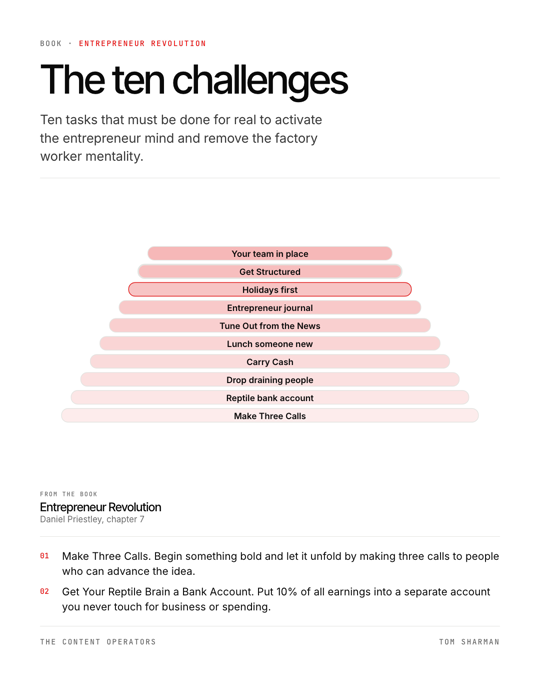
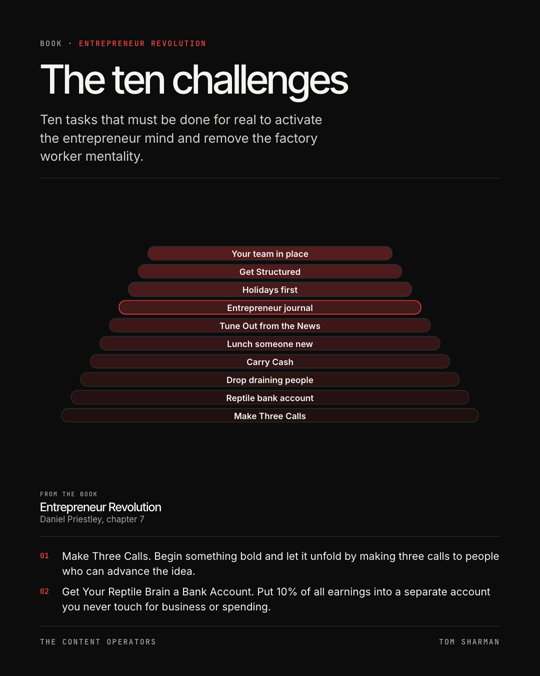
Ten tasks that must be done for real to activate the entrepreneur mind and remove the factory worker mentality.
- Make Three Calls. Begin something bold and let it unfold by making three calls to people who can advance the idea.
- Get Your Reptile Brain a Bank Account. Put 10% of all earnings into a separate account you never touch for business or spending.
- Stop Spending Time with People who Bring You Down. List the people you spend time with and decide who stays and who goes.
- Carry Cash. Carry $1000, or the amount you would love to earn in a day, to recalibrate what feels like a lot.
- Take Someone New Out to Lunch. Pay for lunch with a new person each week to build your network.
- Tune Out from the News. Drop all news and feeds for at least 90 days.
- Keep an Entrepreneur Journal. Write lists, goals, diagrams, copy and milestones to explore ideas on paper.
- Plan Inspiring Holidays First. Block out at least 8 weeks of holiday on a yearly planner, then fit work around it.
- Get Structured. Meet an accountant and a lawyer about tax planning, wealth protection and attracting investment.
- Get Your Entrepreneurial Team in Place. Build a small team to implement your ideas and reach your big goals.
From chapter: CHAPTER 3: TEN CHALLENGES TO SPARK YOUR ENTREPRENEURIAL TALENTS, pp. 58–83
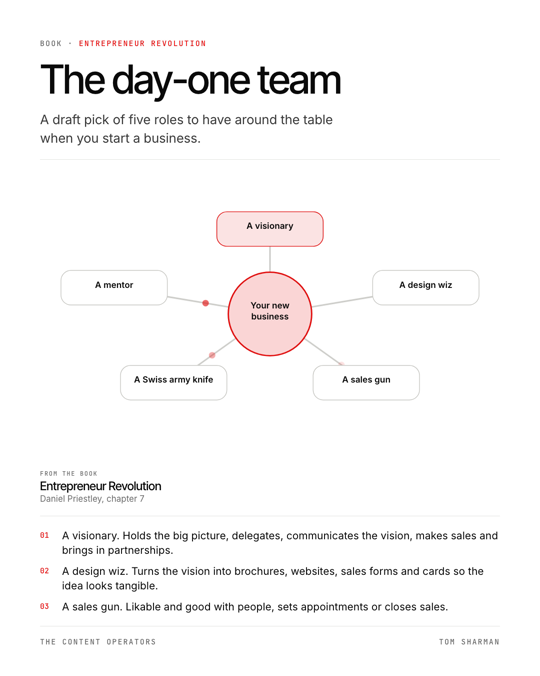
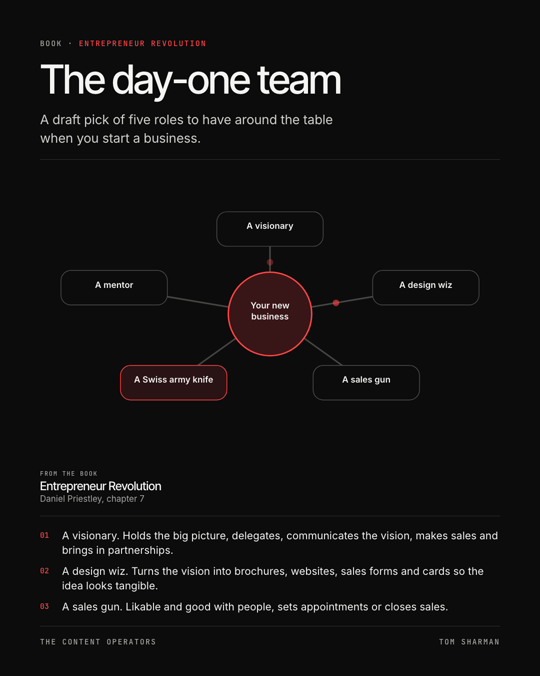
A draft pick of five roles to have around the table when you start a business.
- A visionary. Holds the big picture, delegates, communicates the vision, makes sales and brings in partnerships.
- A design wiz. Turns the vision into brochures, websites, sales forms and cards so the idea looks tangible.
- A sales gun. Likable and good with people, sets appointments or closes sales.
- A Swiss army knife. Organised, flexible and frugal, gets most things done well enough.
- A mentor. Wise outsider, or a mastermind group, available for late-night chats.
From chapter: CHAPTER 3: TEN CHALLENGES TO SPARK YOUR ENTREPRENEURIAL TALENTS, pp. 58–83
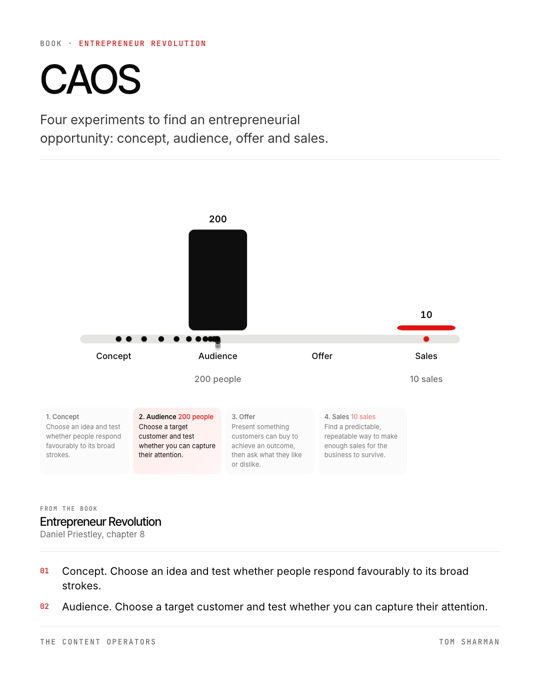
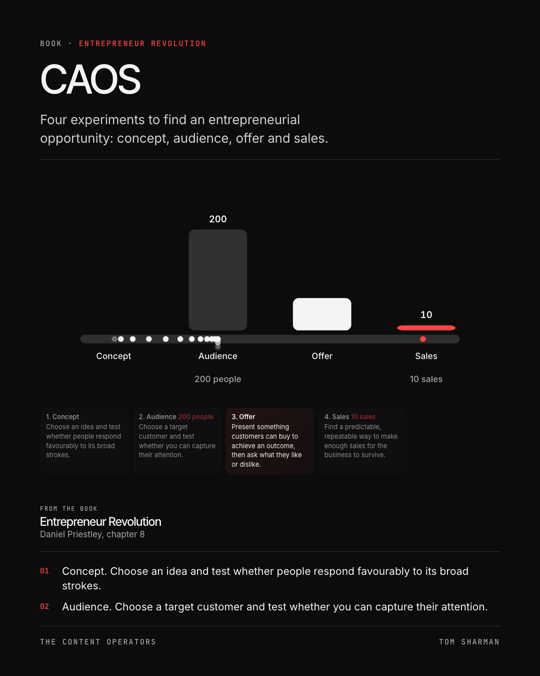
Four experiments to find an entrepreneurial opportunity: concept, audience, offer and sales.
- Concept. Choose an idea and test whether people respond favourably to its broad strokes.
- Audience. Choose a target customer and test whether you can capture their attention.
- Offer. Present something customers can buy to achieve an outcome, then ask what they like or dislike.
- Sales. Find a predictable, repeatable way to make enough sales for the business to survive.
From chapter: CHAPTER 4: FINDING YOUR OPPORTUNITY, pp. 84–106
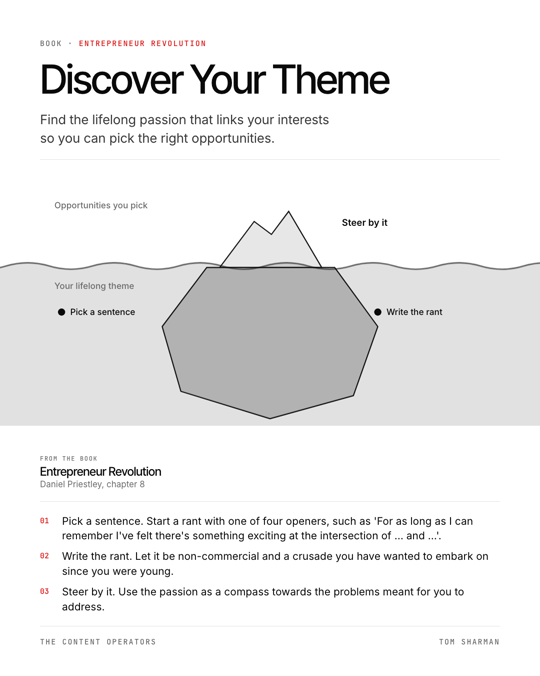
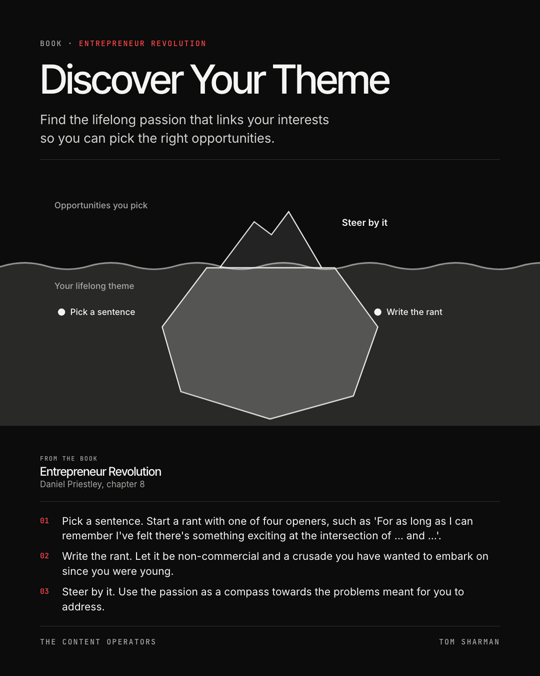
Find the lifelong passion that links your interests so you can pick the right opportunities.
- Pick a sentence. Start a rant with one of four openers, such as 'For as long as I can remember I've felt there's something exciting at the intersection of … and …'.
- Write the rant. Let it be non-commercial and a crusade you have wanted to embark on since you were young.
- Steer by it. Use the passion as a compass towards the problems meant for you to address.
From chapter: CHAPTER 4: FINDING YOUR OPPORTUNITY, pp. 84–106
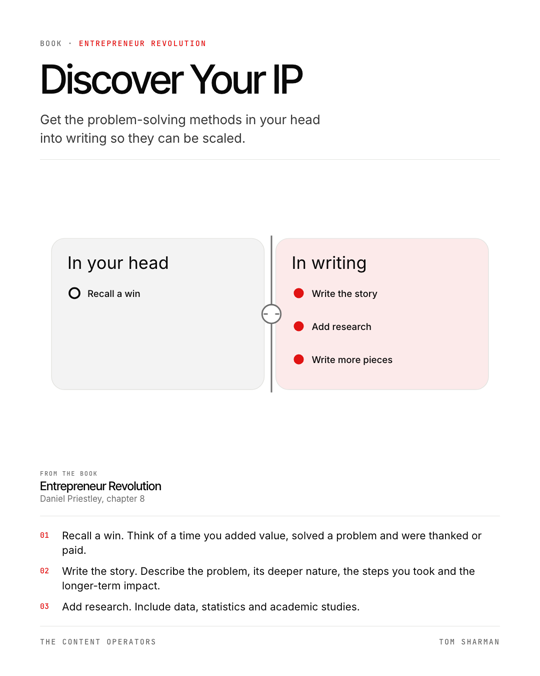
Get the problem-solving methods in your head into writing so they can be scaled.
- Recall a win. Think of a time you added value, solved a problem and were thanked or paid.
- Write the story. Describe the problem, its deeper nature, the steps you took and the longer-term impact.
- Add research. Include data, statistics and academic studies.
- Write more pieces. Produce articles such as mistakes, valuable ideas, maxims, obstacles and case studies.
From chapter: CHAPTER 4: FINDING YOUR OPPORTUNITY, pp. 84–106
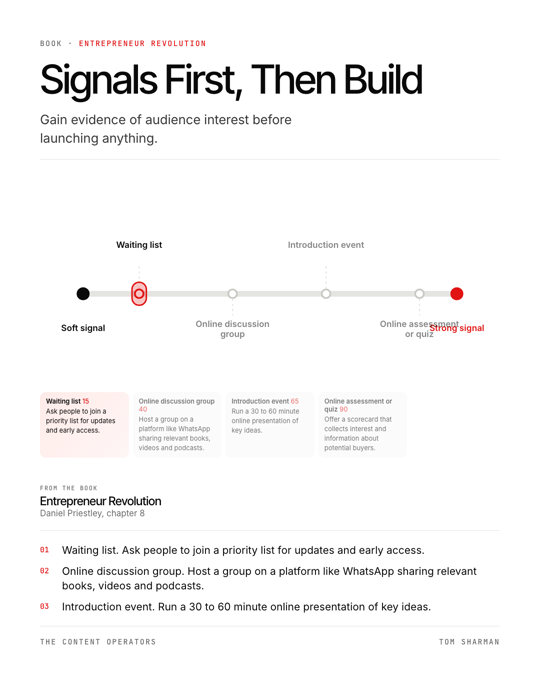
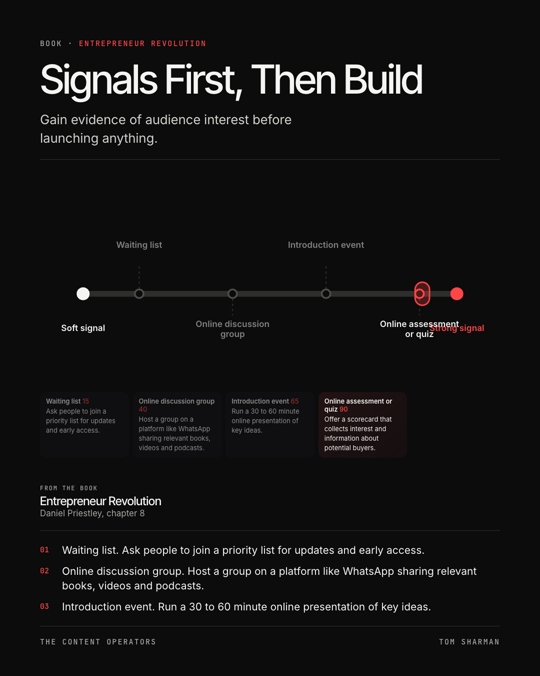
Gain evidence of audience interest before launching anything.
- Waiting list. Ask people to join a priority list for updates and early access.
- Online discussion group. Host a group on a platform like WhatsApp sharing relevant books, videos and podcasts.
- Introduction event. Run a 30 to 60 minute online presentation of key ideas.
- Online assessment or quiz. Offer a scorecard that collects interest and information about potential buyers.
From chapter: CHAPTER 4: FINDING YOUR OPPORTUNITY, pp. 84–106
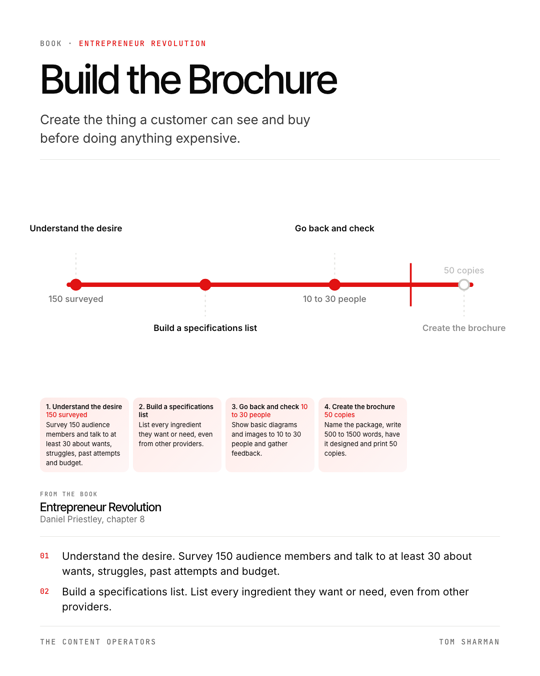
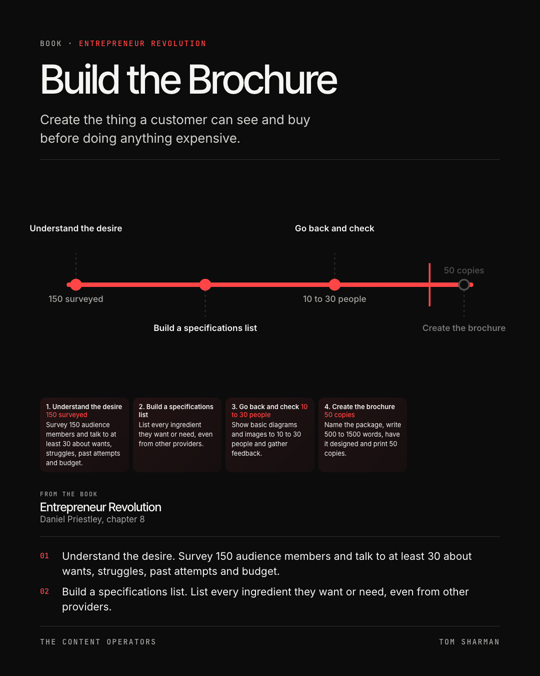
Create the thing a customer can see and buy before doing anything expensive.
- Understand the desire. Survey 150 audience members and talk to at least 30 about wants, struggles, past attempts and budget.
- Build a specifications list. List every ingredient they want or need, even from other providers.
- Go back and check. Show basic diagrams and images to 10 to 30 people and gather feedback.
- Create the brochure. Name the package, write 500 to 1500 words, have it designed and print 50 copies.
From chapter: CHAPTER 4: FINDING YOUR OPPORTUNITY, pp. 84–106
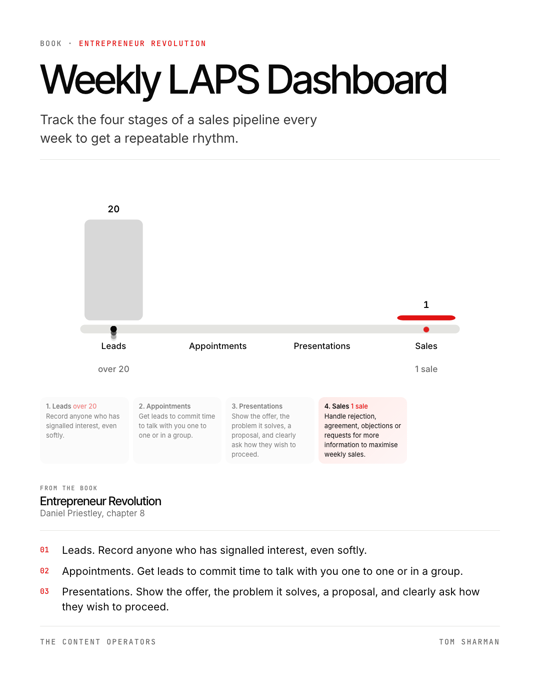
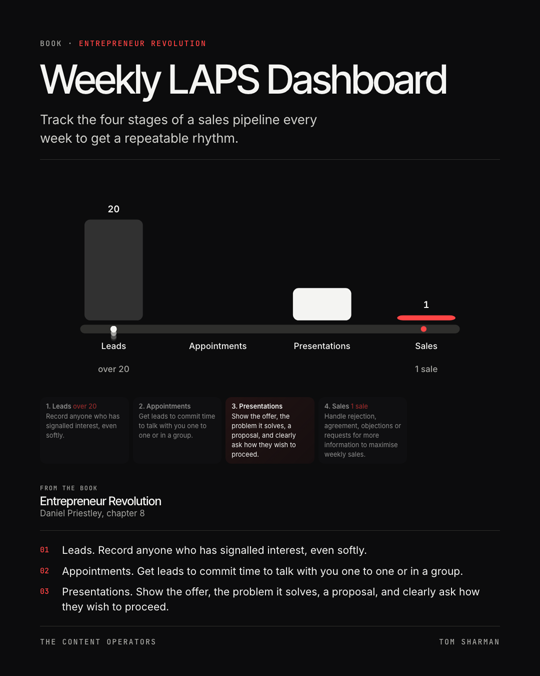
Track the four stages of a sales pipeline every week to get a repeatable rhythm.
- Leads. Record anyone who has signalled interest, even softly.
- Appointments. Get leads to commit time to talk with you one to one or in a group.
- Presentations. Show the offer, the problem it solves, a proposal, and clearly ask how they wish to proceed.
- Sales. Handle rejection, agreement, objections or requests for more information to maximise weekly sales.
From chapter: CHAPTER 4: FINDING YOUR OPPORTUNITY, pp. 84–106
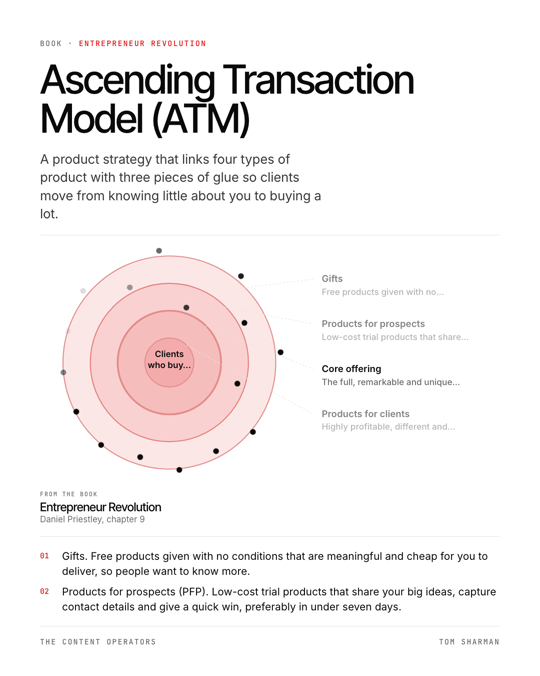
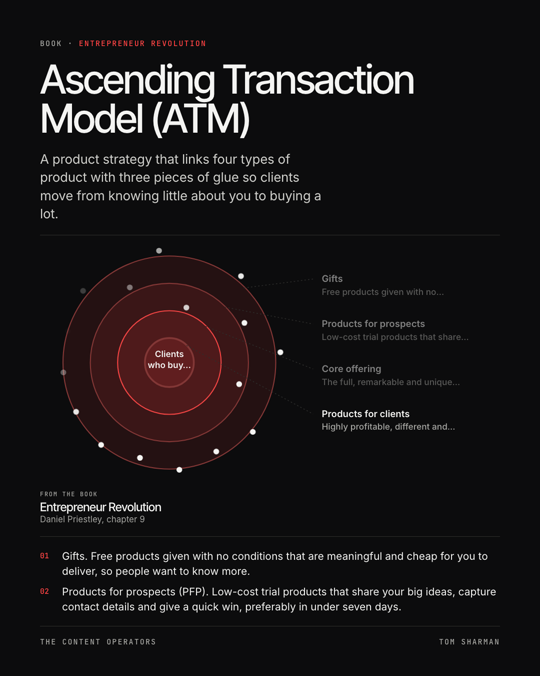
A product strategy that links four types of product with three pieces of glue so clients move from knowing little about you to buying a lot.
- Gifts. Free products given with no conditions that are meaningful and cheap for you to deliver, so people want to know more.
- Products for prospects (PFP). Low-cost trial products that share your big ideas, capture contact details and give a quick win, preferably in under seven days.
- Core offering. The full, remarkable and unique solution you are known for, priced to be profitable and focused on implementation, not ideas.
- Products for clients (PFC). Highly profitable, different and logical next products sold to existing clients, ideally subscriptions, aiming to double profit.
- Lead capture process. Collects contact details between your gift and your PFP, through several routes.
- Sales conversations. Structured conversations with people who have already tried a gift or PFP, so they are pre-sold.
- Servicing process. Looks after clients above expectations after they buy, by underselling and surprising them, so they buy your PFC.
From chapter: CHAPTER 5: BUILDING YOUR GLOBAL SMALL BUSINESS, pp. 107–130
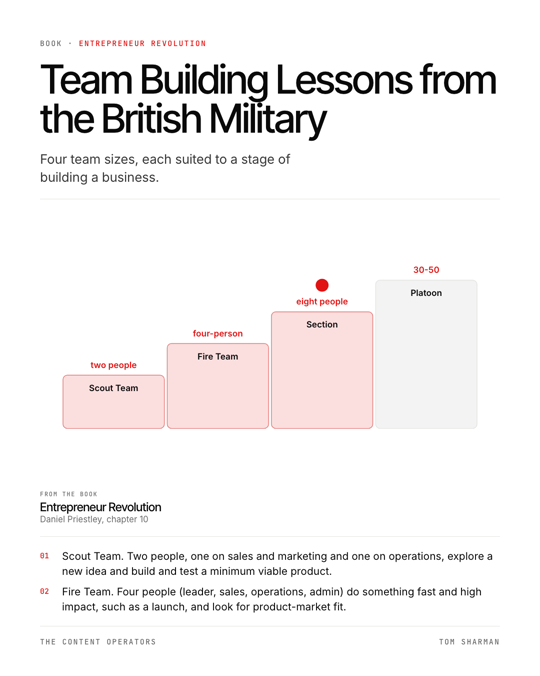
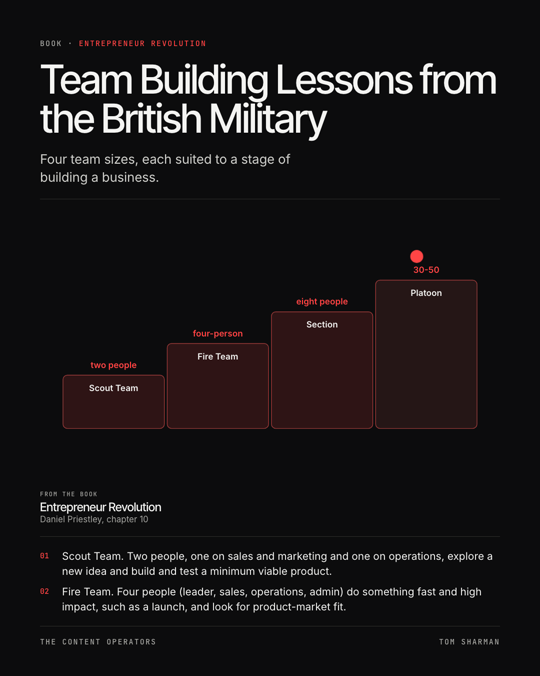
Four team sizes, each suited to a stage of building a business.
- Scout Team. Two people, one on sales and marketing and one on operations, explore a new idea and build and test a minimum viable product.
- Fire Team. Four people (leader, sales, operations, admin) do something fast and high impact, such as a launch, and look for product-market fit.
- Section. About eight people, led by one market facing senior and one task focused senior, prepare the go-to-market approach.
- Platoon. A team of teams of 30-50 people, led by a leadership team, executes the go-to-market strategy and becomes dominant in its market.
From chapter: CHAPTER 6: YOUR CORE TEAM, pp. 131–156
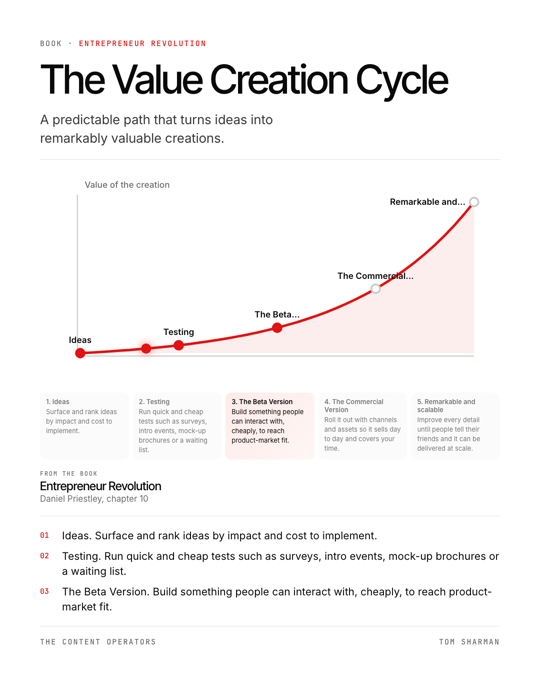
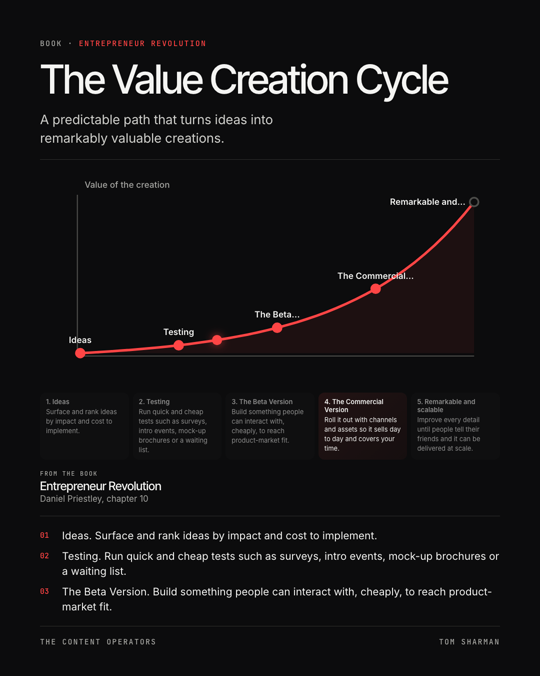
A predictable path that turns ideas into remarkably valuable creations.
- Ideas. Surface and rank ideas by impact and cost to implement.
- Testing. Run quick and cheap tests such as surveys, intro events, mock-up brochures or a waiting list.
- The Beta Version. Build something people can interact with, cheaply, to reach product-market fit.
- The Commercial Version. Roll it out with channels and assets so it sells day to day and covers your time.
- The remarkable and scalable version. Improve every detail until people tell their friends and it can be delivered at scale.
From chapter: CHAPTER 6: YOUR CORE TEAM, pp. 131–156
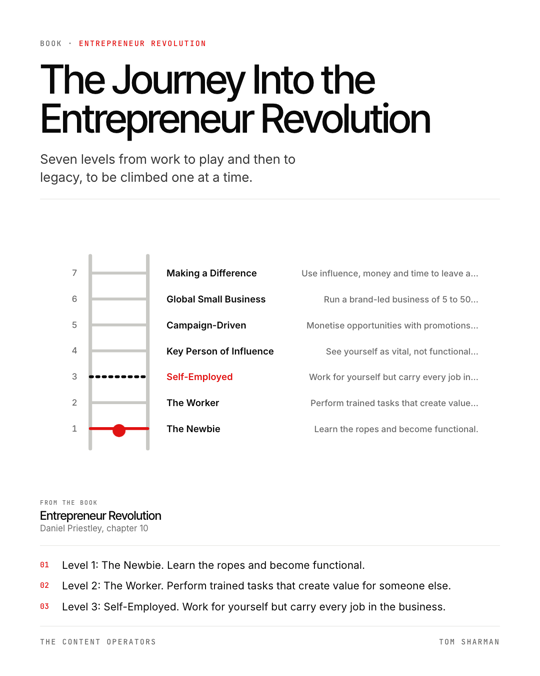
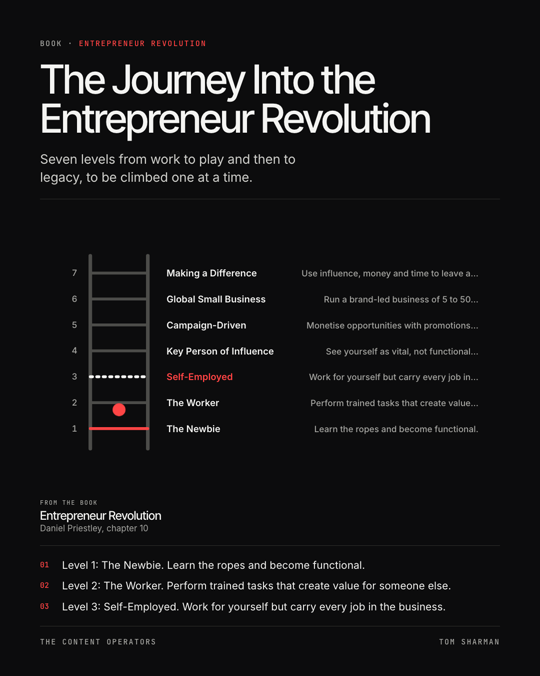
Seven levels from work to play and then to legacy, to be climbed one at a time.
- Level 1: The Newbie. Learn the ropes and become functional.
- Level 2: The Worker. Perform trained tasks that create value for someone else.
- Level 3: Self-Employed. Work for yourself but carry every job in the business.
- Level 4: Key Person of Influence. See yourself as vital, not functional, and attract a team, investors and customers.
- Level 5: Campaign-Driven Enterprise. Monetise opportunities with promotions, events and launches.
- Level 6: The Global Small Business. Run a brand-led business of 5 to 50 people with strong assets, systems and culture.
- Level 7: Making a Difference Enterprise (Made). Use influence, money and time to leave a meaningful legacy.
From chapter: CHAPTER 6: YOUR CORE TEAM, pp. 131–156
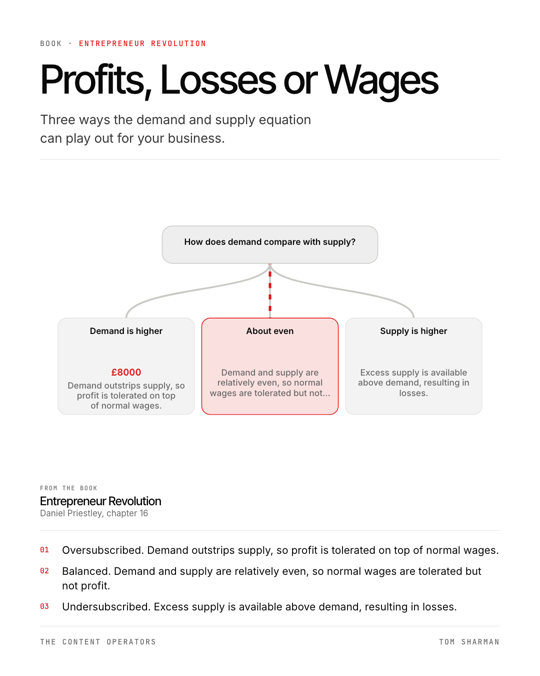
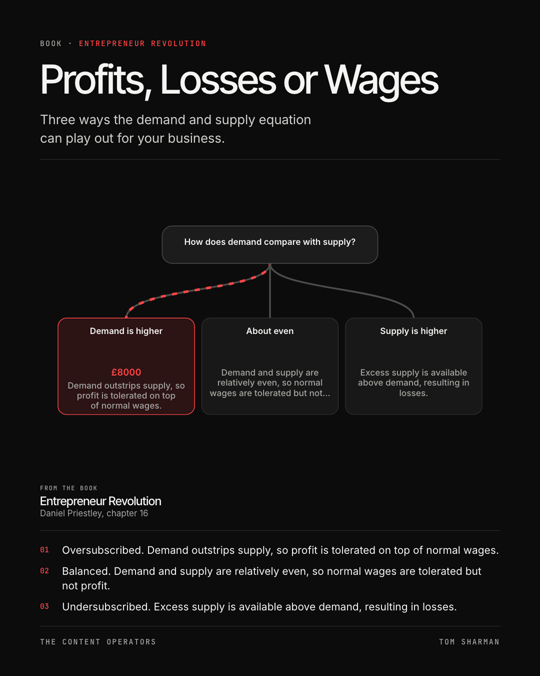
Three ways the demand and supply equation can play out for your business.
- Oversubscribed. Demand outstrips supply, so profit is tolerated on top of normal wages.
- Balanced. Demand and supply are relatively even, so normal wages are tolerated but not profit.
- Undersubscribed. Excess supply is available above demand, resulting in losses.
From chapter: WHAT NEXT?, pp. 196–203