Bookshelf
How Tom uses this
Extreme Ownership backs five of Tom's lessons. Under each of his lessons, what the book says about it, and on which pages.
- Macro and micro at the same time
Willink says the right place for a leader is in the middle of the force, with enough involvement to know what is happening and stopping short of the depth where they lose the bigger picture. pp. 163, 176, 177 and 202. In the book: Prioritize and Execute, Decentralized Command, The leader's planning checklist, Post-operational debrief, Leading up and down the chain, Search procedure with room owners.
- Assumptions made too fast, and risk avoided
The book says waiting for a 100 percent certain answer causes delay and that leaders should decide on the best information available and adjust. pp. 236 and 240. In the book: The leader's planning checklist, Post-operational debrief, Leading up and down the chain, Search procedure with room owners.
- Sam Stoffel: rebuild the team, then find the formats
Willink says that when training and mentoring fail the leader must make the tough call to replace underperformers and bring in people who can get the job done. pp. 41, 143 and 242. In the book: Prioritize and Execute, Decentralized Command, The leader's planning checklist, Post-operational debrief, Leading up and down the chain, Search procedure with room owners.
- The intake question is why, and what it is costing them
Willink makes asking why the first move before committing to any mission, and says a leader who does not know why cannot lead others in it. pp. 76, 83 and 89.
- Move the people you have before you hire
Babin's Hell Week example shows that changing where a leader sits turned the same people from worst to best, which backs moving and developing existing people before replacing them. pp. 56, 57 and 58.
What it argues
Willink and Babin argue that leadership is the single greatest factor in any team's performance, and that the foundation of it is Extreme Ownership: the leader owns every outcome and has no one else to blame. From that mind-set they build four Laws of Combat: Cover and Move, Simple, Prioritize and Execute, and Decentralized Command. They show that leaders must believe in the mission, check their egos, explain the why down the chain and push information up it. They close on the need to decide amid incomplete information and to balance opposing traits through discipline. Every principle is told first as a SEAL story from the Battle of Ramadi and then as a business case from their consulting work.
Worth keeping
- Extreme Ownership: all responsibility for success and failure rests with the leader, and there is no one else to blame (p. 41).
- There are no bad teams, only bad leaders; swapping only the boat crew leaders turned the worst crew into the best (p. 57 to 58).
- The real standard is what you tolerate, so leaders must enforce it (p. 62).
- A leader must believe in the mission, and if they do not they must keep asking up the chain until they understand why (p. 82 to 90).
- Keep plans and incentive schemes simple enough that the lowest common denominator understands them; the enemy gets a vote (p. 136, 141).
- Prioritize and Execute: relax, look around, make a call, and take problems one at a time, highest first (p. 152 to 159).
- Decentralized Command: teams of four to six with a leader who knows the Commander's Intent and tells the boss what they will do (p. 165, 175).
- The test of a brief is whether the people executing it understand it, and the leader delegates the detail so they can stand back and be the tactical genius (p. 194, 201).
- Lead up the chain as well as down: if the boss is not supporting you, work on your own communication first (p. 221).
- Act decisively on an incomplete picture, because waiting for a 100 percent right answer leads to delay (p. 236).
- Discipline equals freedom; the Dichotomy of Leadership is about balancing opposing traits, with the goal of working yourself out of a job (p. 250, 256, 265).
The frameworks
6 frameworks, one animation each Every framework, step by step
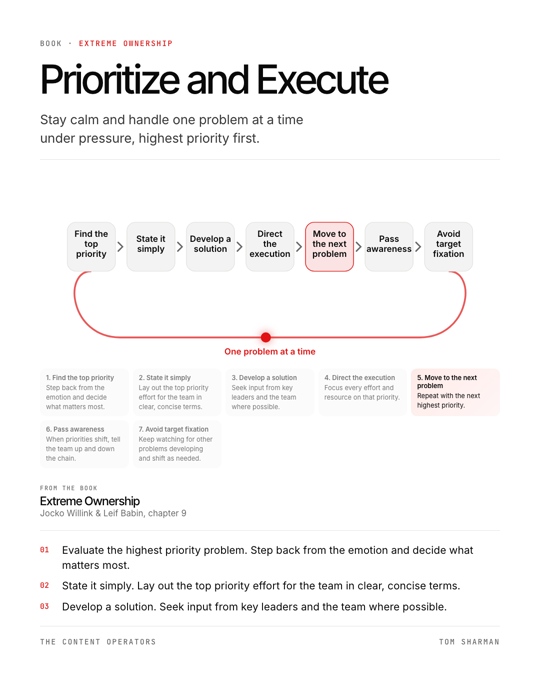
Stay calm and handle one problem at a time under pressure, highest priority first.
- Evaluate the highest priority problem. Step back from the emotion and decide what matters most.
- State it simply. Lay out the top priority effort for the team in clear, concise terms.
- Develop a solution. Seek input from key leaders and the team where possible.
- Direct the execution. Focus every effort and resource on that priority.
- Move to the next problem. Repeat with the next highest priority.
- Pass situational awareness. When priorities shift, tell the team up and down the chain.
- Avoid target fixation. Keep watching for other problems developing and shift as needed.
From chapter: II. Laws of Combat, pp. 108–182
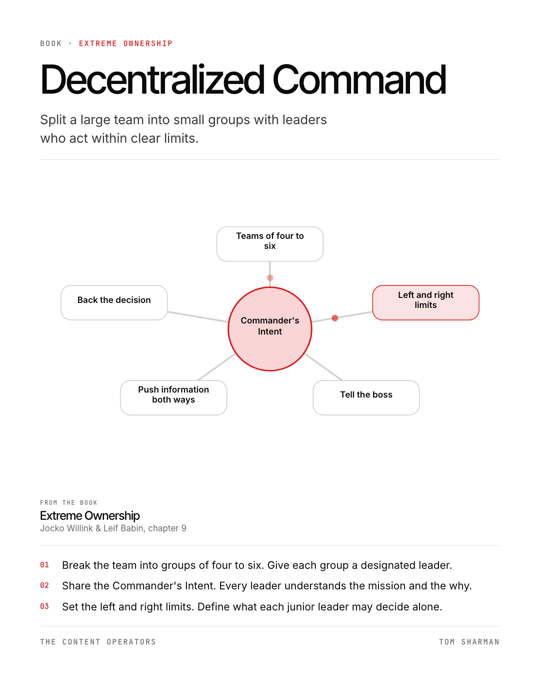
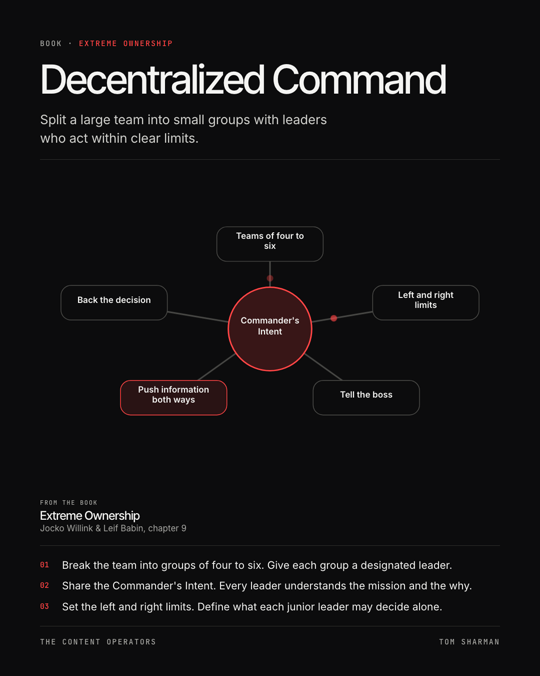
Split a large team into small groups with leaders who act within clear limits.
- Break the team into groups of four to six. Give each group a designated leader.
- Share the Commander's Intent. Every leader understands the mission and the why.
- Set the left and right limits. Define what each junior leader may decide alone.
- Tell the boss what you will do. Juniors state the action they will take and skip asking what to do.
- Push information both ways. Pass situational awareness up and down the chain.
- Build trust and back the decision. Seniors support decisions made in pursuit of the objective.
From chapter: II. Laws of Combat, pp. 108–182
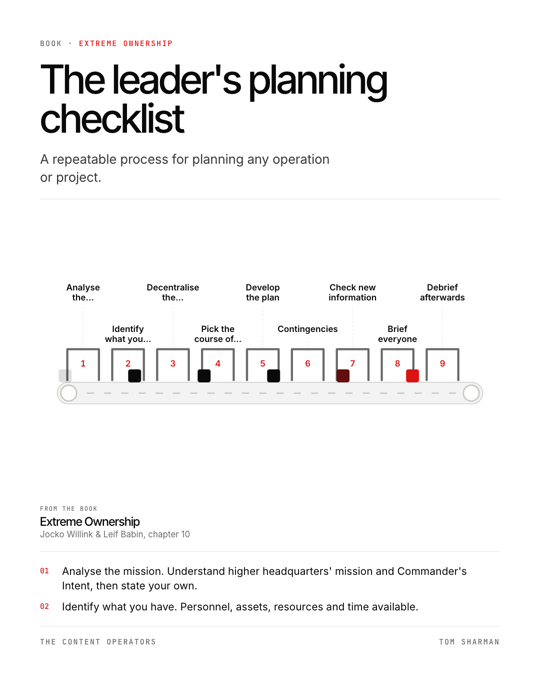
A repeatable process for planning any operation or project.
- Analyse the mission. Understand higher headquarters' mission and Commander's Intent, then state your own.
- Identify what you have. Personnel, assets, resources and time available.
- Decentralise the planning. Empower key leaders to analyse courses of action.
- Pick the course of action. Lean toward the simplest and focus effort on it.
- Develop the plan. Key leaders build the plan, and you stand back and be the tactical genius.
- Plan contingencies and mitigate risk. Cover likely problems in each phase and control the risks that can be controlled.
- Check against new information. Question the plan as the situation evolves.
- Brief everyone. Emphasise Commander's Intent, invite questions and check understanding.
- Debrief afterwards. Analyse lessons learned and feed them into future planning.
From chapter: III. Sustaining Victory, pp. 183–261
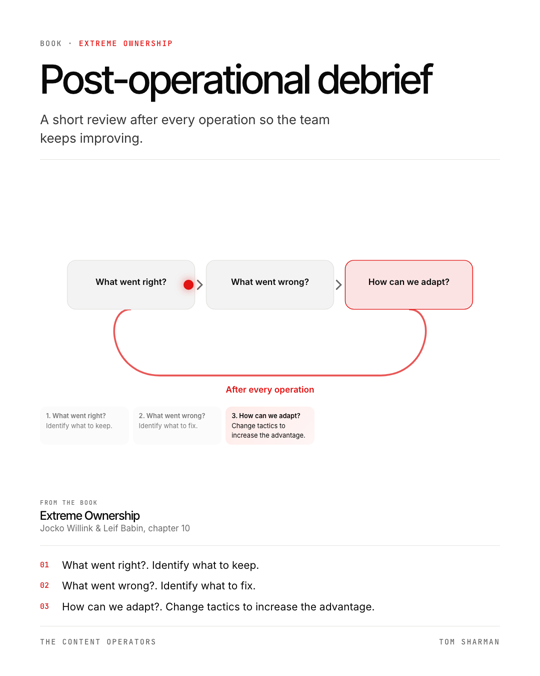
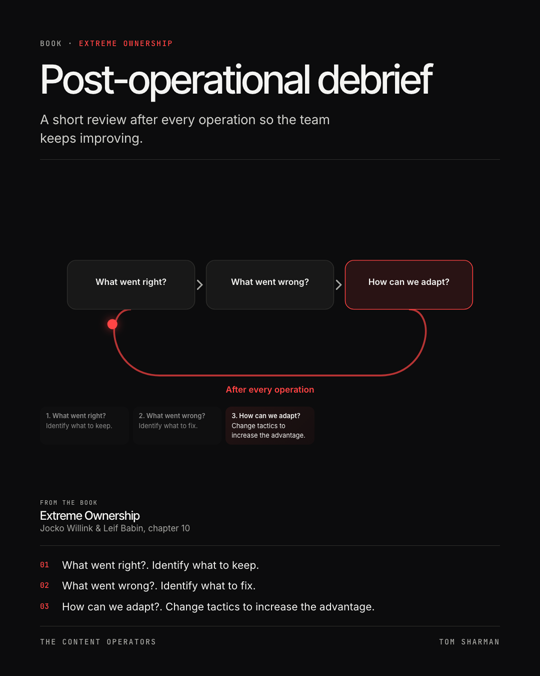
A short review after every operation so the team keeps improving.
- What went right?. Identify what to keep.
- What went wrong?. Identify what to fix.
- How can we adapt?. Change tactics to increase the advantage.
From chapter: III. Sustaining Victory, pp. 183–261
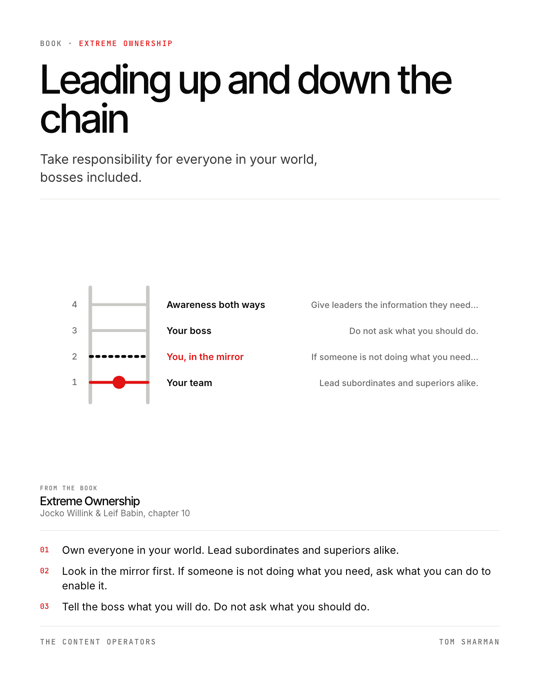
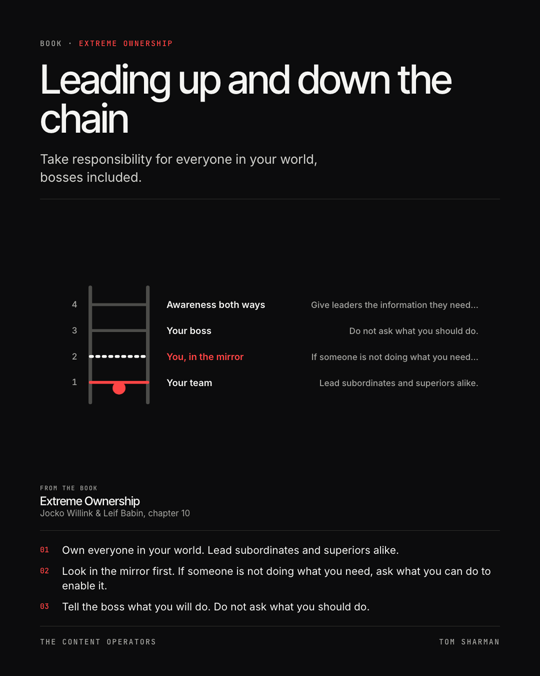
Take responsibility for everyone in your world, bosses included.
- Own everyone in your world. Lead subordinates and superiors alike.
- Look in the mirror first. If someone is not doing what you need, ask what you can do to enable it.
- Tell the boss what you will do. Do not ask what you should do.
- Push situational awareness. Give leaders the information they need to decide and support you.
From chapter: III. Sustaining Victory, pp. 183–261
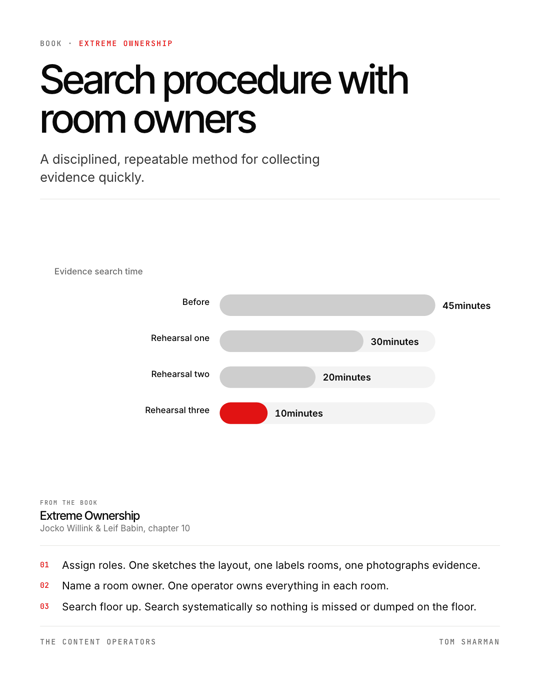
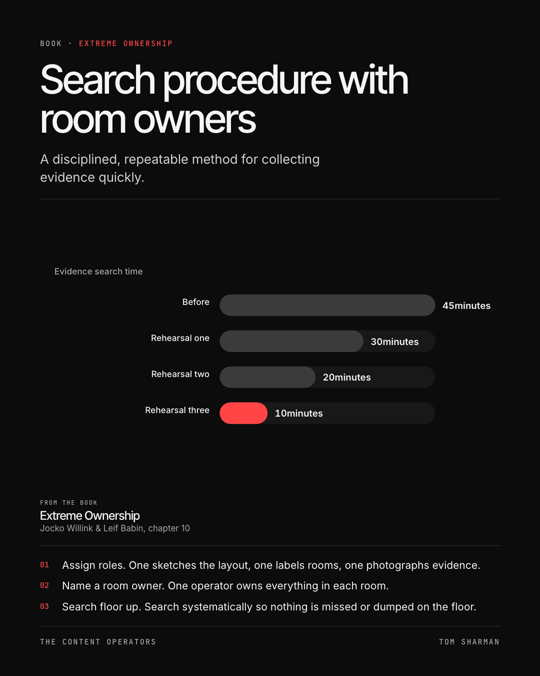
A disciplined, repeatable method for collecting evidence quickly.
- Assign roles. One sketches the layout, one labels rooms, one photographs evidence.
- Name a room owner. One operator owns everything in each room.
- Search floor up. Search systematically so nothing is missed or dumped on the floor.
- Bag and label. Keep evidence by room with the finder's name.
- Mark rooms done. Put an X through each searched room number.
- Hand over with chain of custody. The room owner hands evidence to intelligence back at base.
From chapter: III. Sustaining Victory, pp. 183–261
Working with Tom on this
Tom builds and runs content teams inside creator and founder businesses, as a fractional Head of Content. Fractional Head of Content, UK
Back to the bookshelf