What it argues
Schaefer argues that online the only real source of power is being known, and that anyone can get there by following four steps in order. Find your place, a sustainable interest you can love for years and that helps others. Find your space, an uncontested niche big enough to matter, using a Google saturation test and eight strategies for crowded fields. Fill that space with one form of rich content, published consistently for years, and build an actionable audience, since follower counts mean little without an emotional connection. He insists on a plan over passion, on patience over hustle, and on measuring momentum through awareness, inquiries, money and personal goals so you know when to persist, pivot or stop.
Which project it moves forward
The Content Operators launch
The book gives a four step method and a first cohort audience plan (place, space, content, actionable audience) that the launch of a creator education brand can be built on.
Every framework, step by step
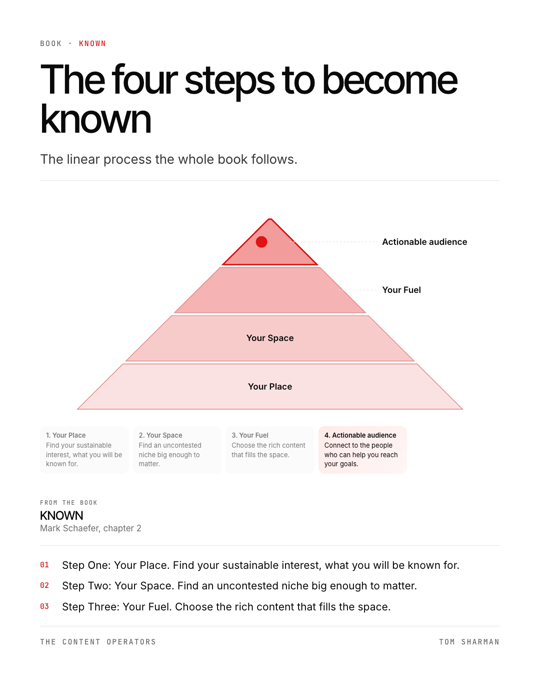
The linear process the whole book follows.
- Step One: Your Place. Find your sustainable interest, what you will be known for.
- Step Two: Your Space. Find an uncontested niche big enough to matter.
- Step Three: Your Fuel. Choose the rich content that fills the space.
- Step Four: An Actionable Audience. Connect to the people who can help you reach your goals.
From chapter: CHAPTER 1 Can Anybody Become Known?, pp. 16–33
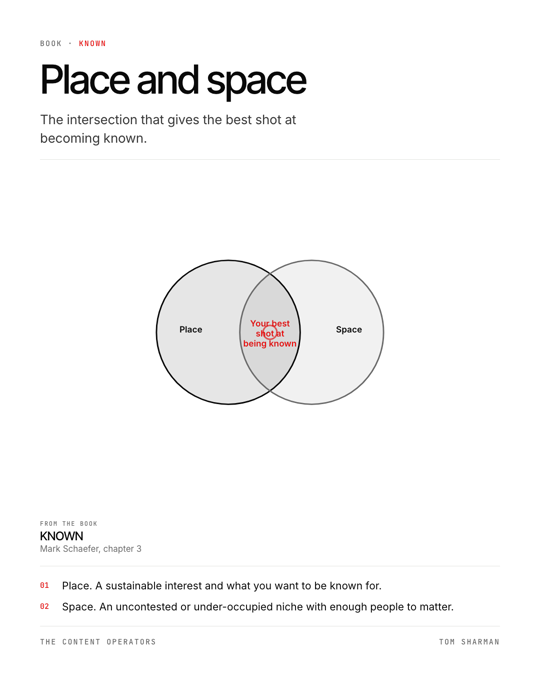
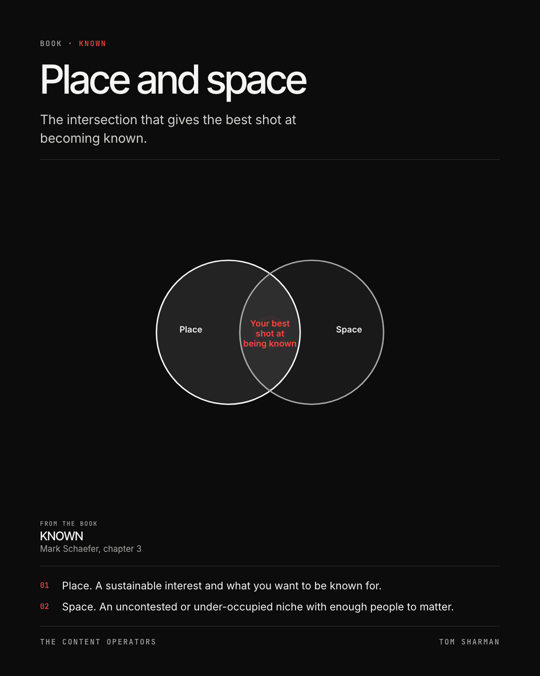
The intersection that gives the best shot at becoming known.
- Place. A sustainable interest and what you want to be known for.
- Space. An uncontested or under-occupied niche with enough people to matter.
From chapter: CHAPTER 2 Step One: Your Place, pp. 34–40
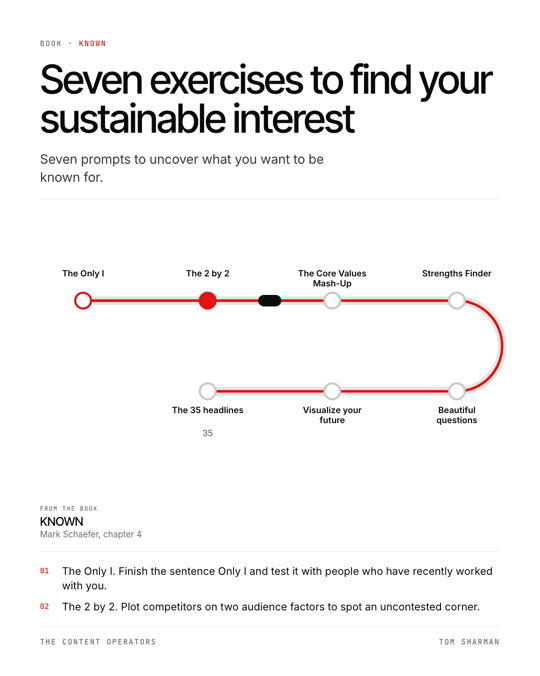
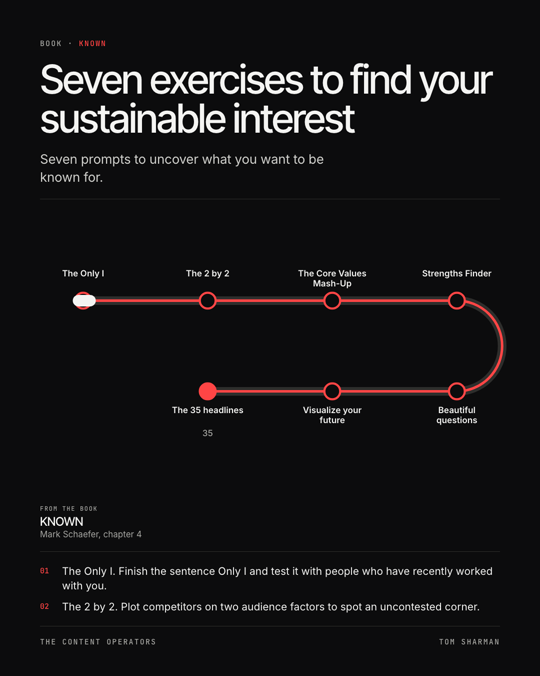
Seven prompts to uncover what you want to be known for.
- The Only I. Finish the sentence Only I and test it with people who have recently worked with you.
- The 2 by 2. Plot competitors on two audience factors to spot an uncontested corner.
- The Core Values Mash-Up. Combine a core value with your topic to make something new.
- Strengths Finder. Take the Gallup test to see what you do at your best.
- The beautiful questions. Answer tennis ball, most alive, what almost nobody agrees with, what you will try now, and your sentence.
- Visualize your future. Imagine the podcast, keynote and book two years out and what you are asked.
- The 35 headlines. List the first 35 topics you would cover to test sustainability.
From chapter: CHAPTER 3 Finding Your Sustainable Interest, pp. 41–57
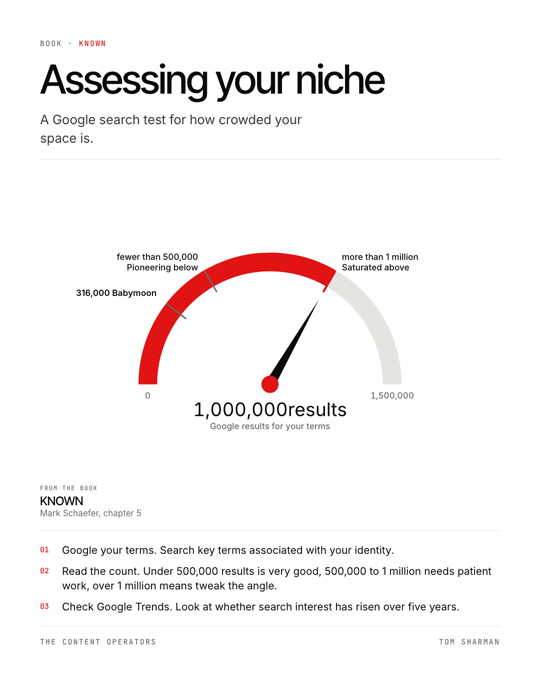
A Google search test for how crowded your space is.
- Google your terms. Search key terms associated with your identity.
- Read the count. Under 500,000 results is very good, 500,000 to 1 million needs patient work, over 1 million means tweak the angle.
- Check Google Trends. Look at whether search interest has risen over five years.
- Check who owns the topic. Look for whether any single person or organisation is known for it.
From chapter: CHAPTER 4 Step Two: Determining Your Space, pp. 58–63
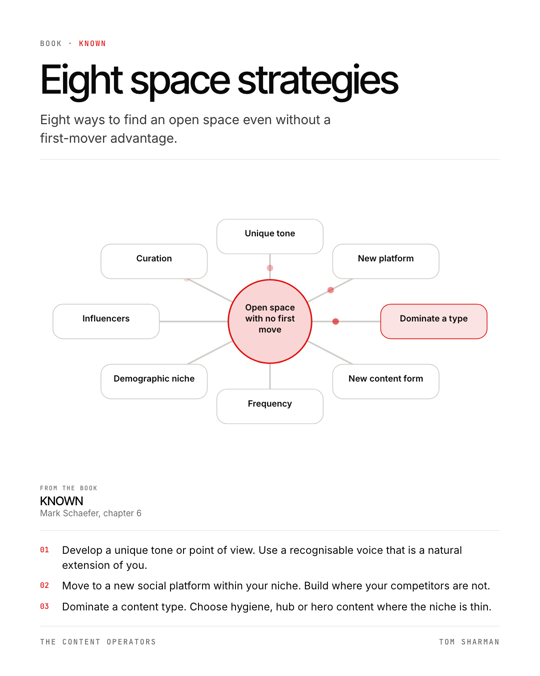
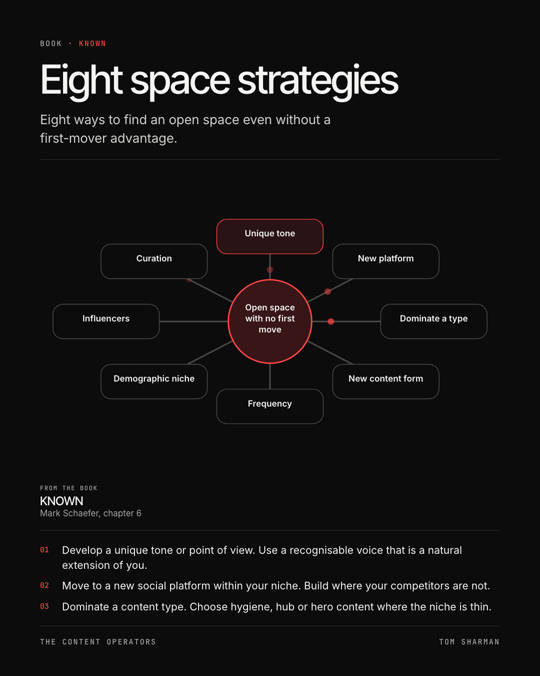
Eight ways to find an open space even without a first-mover advantage.
- Develop a unique tone or point of view. Use a recognisable voice that is a natural extension of you.
- Move to a new social platform within your niche. Build where your competitors are not.
- Dominate a content type. Choose hygiene, hub or hero content where the niche is thin.
- Try a new content form. Use a form such as cartoons that few in your niche use.
- Focus on frequency. Publish daily or rarely and epically to stand out.
- Find a unique demographic or geographic niche. Own a region or group that is underserved.
- Connect with industry influencers. Help influencers first and borrow their audience.
- Use curation as a niche. Summarise the best of your topic regularly with your own comment.
From chapter: CHAPTER 5 Eight Space Strategies, pp. 64–83
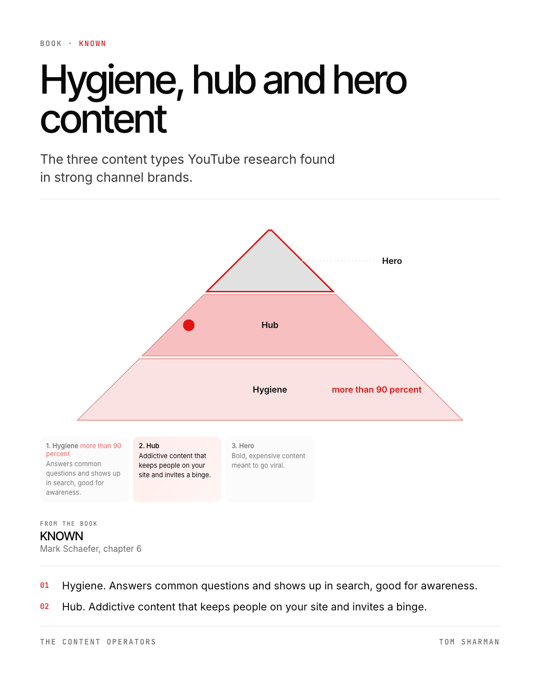
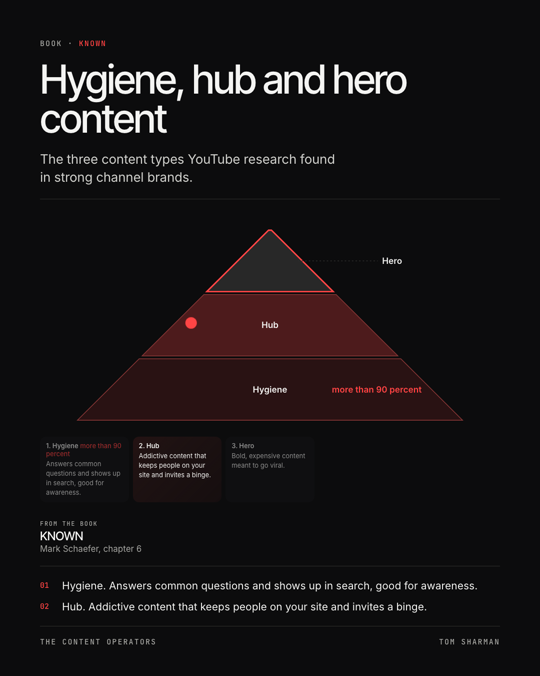
The three content types YouTube research found in strong channel brands.
- Hygiene. Answers common questions and shows up in search, good for awareness.
- Hub. Addictive content that keeps people on your site and invites a binge.
- Hero. Bold, expensive content meant to go viral.
From chapter: CHAPTER 5 Eight Space Strategies, pp. 64–83
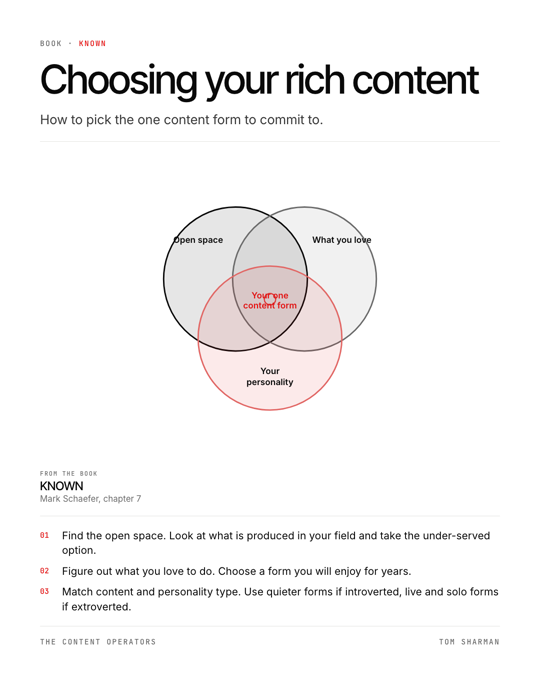
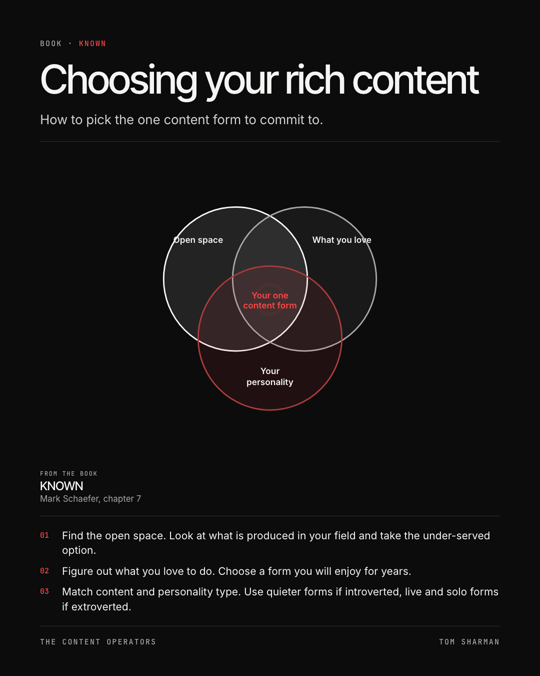
How to pick the one content form to commit to.
- Find the open space. Look at what is produced in your field and take the under-served option.
- Figure out what you love to do. Choose a form you will enjoy for years.
- Match content and personality type. Use quieter forms if introverted, live and solo forms if extroverted.
From chapter: CHAPTER 6 Step Three: Finding Your Fuel, pp. 84–105
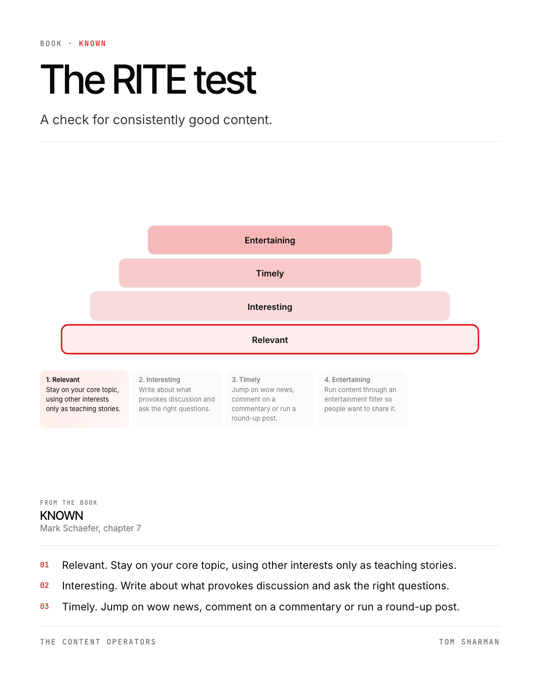
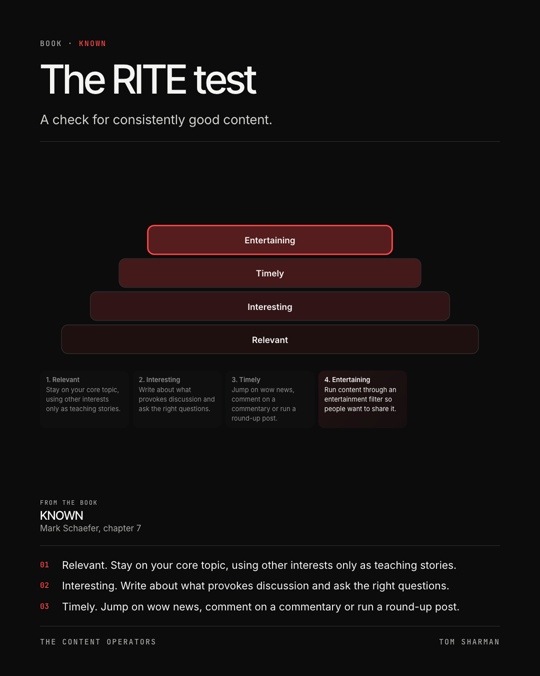
A check for consistently good content.
- Relevant. Stay on your core topic, using other interests only as teaching stories.
- Interesting. Write about what provokes discussion and ask the right questions.
- Timely. Jump on wow news, comment on a commentary or run a round-up post.
- Entertaining. Run content through an entertainment filter so people want to share it.
From chapter: CHAPTER 6 Step Three: Finding Your Fuel, pp. 84–105
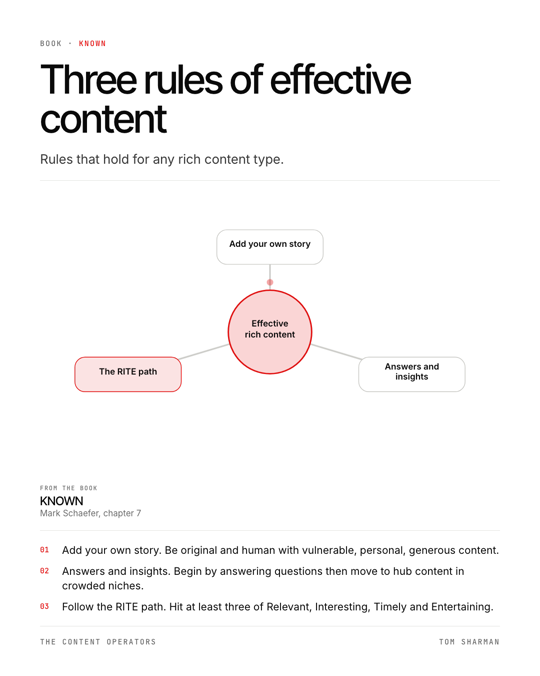
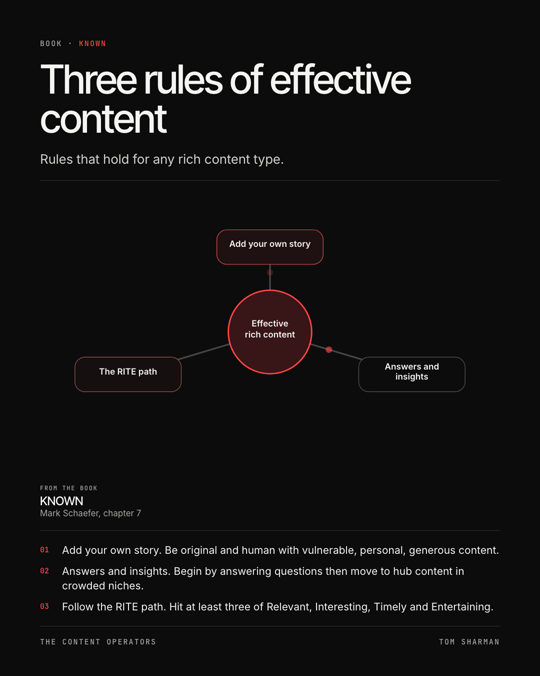
Rules that hold for any rich content type.
- Add your own story. Be original and human with vulnerable, personal, generous content.
- Answers and insights. Begin by answering questions then move to hub content in crowded niches.
- Follow the RITE path. Hit at least three of Relevant, Interesting, Timely and Entertaining.
From chapter: CHAPTER 6 Step Three: Finding Your Fuel, pp. 84–105
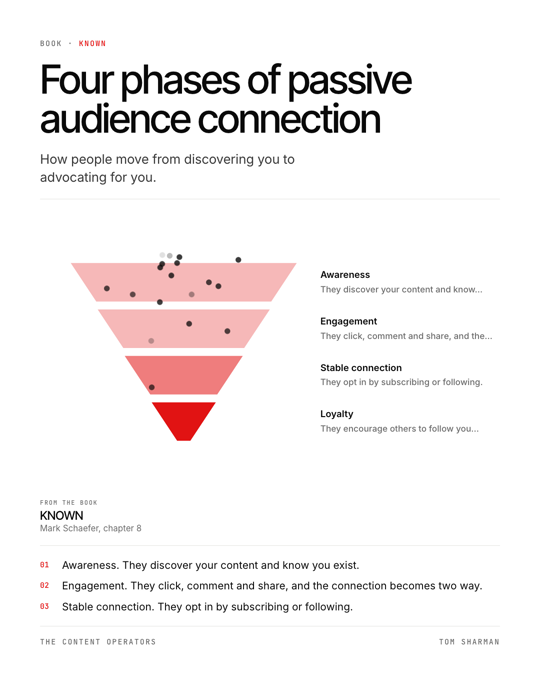
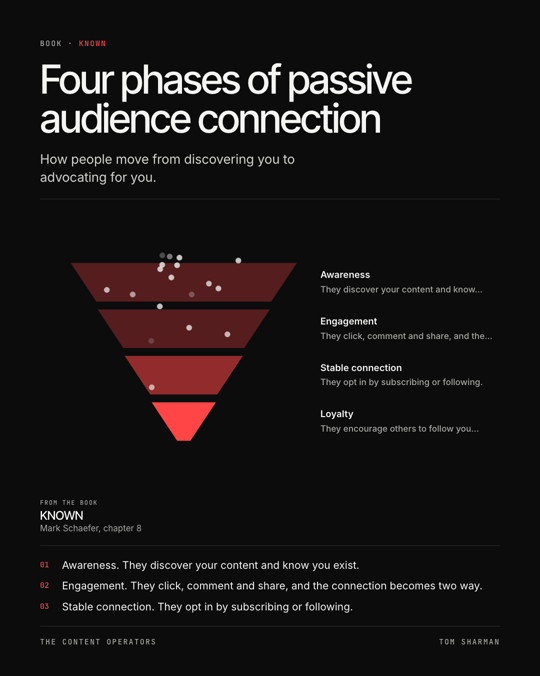
How people move from discovering you to advocating for you.
- Awareness. They discover your content and know you exist.
- Engagement. They click, comment and share, and the connection becomes two way.
- Stable connection. They opt in by subscribing or following.
- Loyalty. They encourage others to follow you and are the most likely to act.
From chapter: CHAPTER 7 Step Four: Creating an Actionable Audience, pp. 106–124
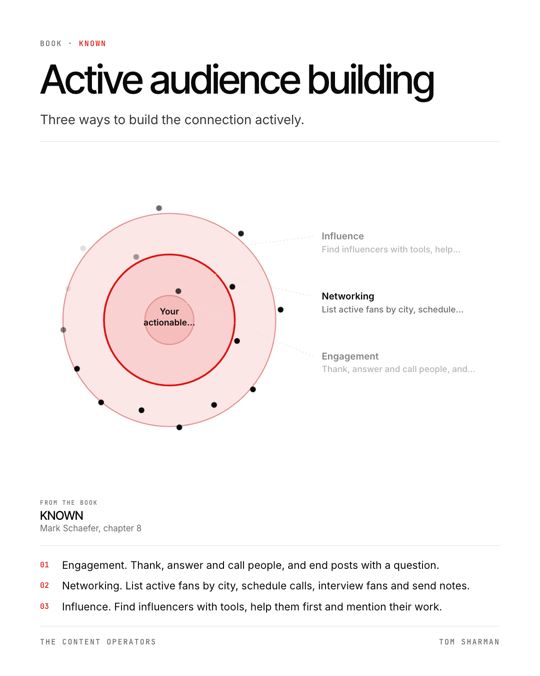
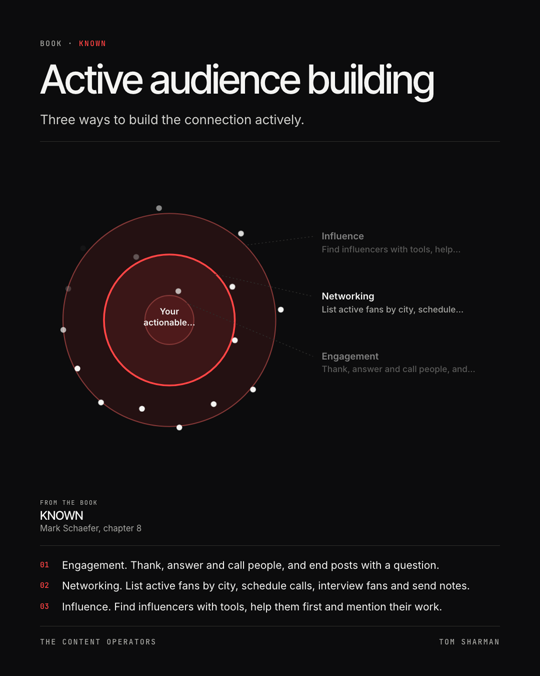
Three ways to build the connection actively.
- Engagement. Thank, answer and call people, and end posts with a question.
- Networking. List active fans by city, schedule calls, interview fans and send notes.
- Influence. Find influencers with tools, help them first and mention their work.
From chapter: CHAPTER 7 Step Four: Creating an Actionable Audience, pp. 106–124
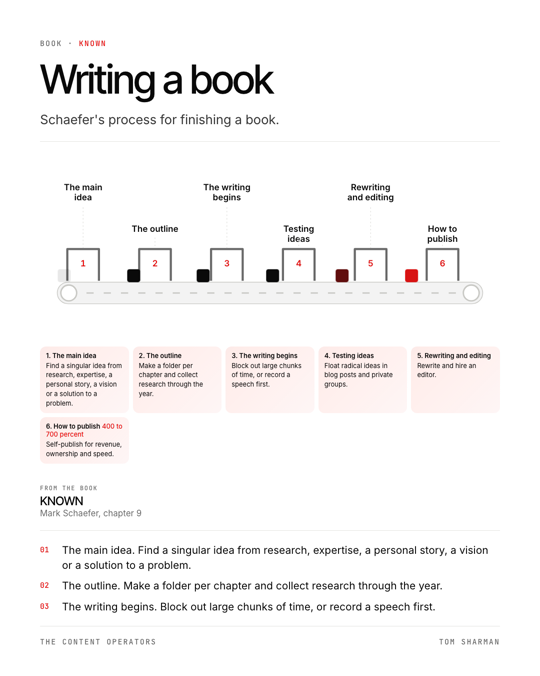
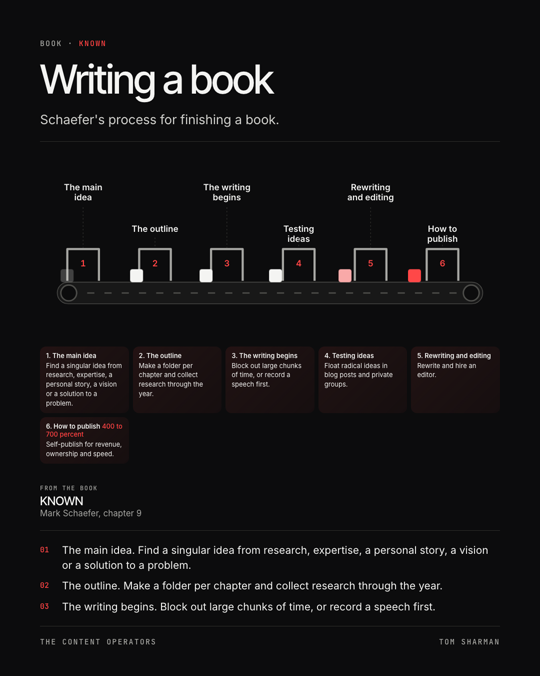
Schaefer's process for finishing a book.
- The main idea. Find a singular idea from research, expertise, a personal story, a vision or a solution to a problem.
- The outline. Make a folder per chapter and collect research through the year.
- The writing begins. Block out large chunks of time, or record a speech first.
- Testing ideas. Float radical ideas in blog posts and private groups.
- Rewriting and editing. Rewrite and hire an editor.
- How to publish. Self-publish for revenue, ownership and speed.
From chapter: CHAPTER 8 Taking Your Brand to the Next Level, pp. 125–142
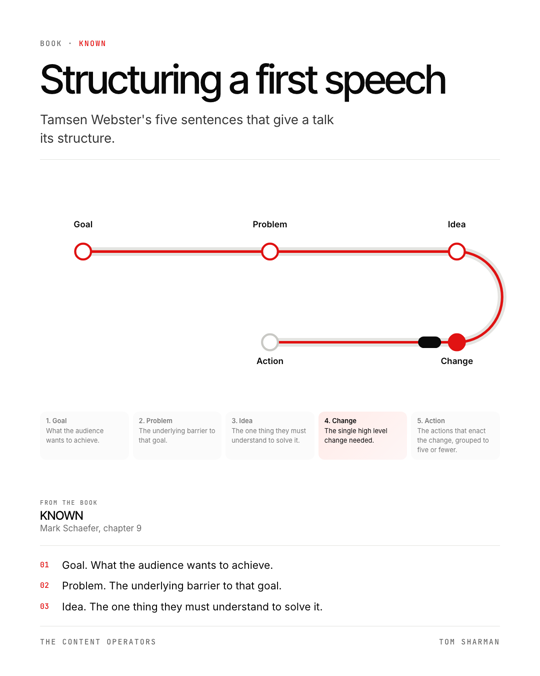
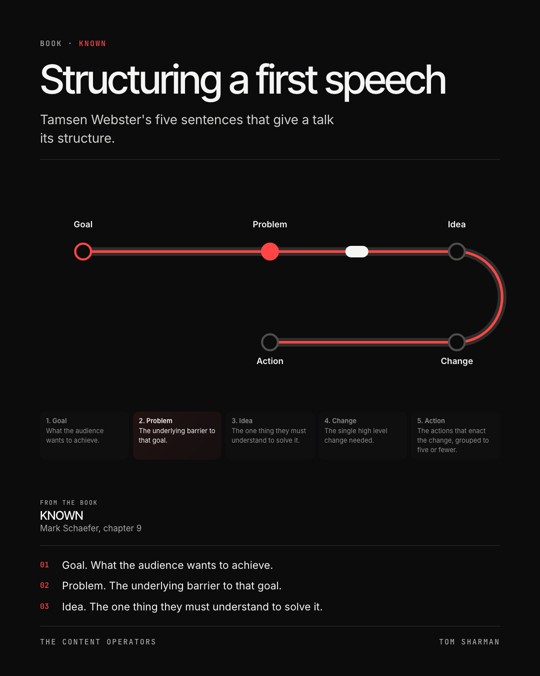
Tamsen Webster's five sentences that give a talk its structure.
- Goal. What the audience wants to achieve.
- Problem. The underlying barrier to that goal.
- Idea. The one thing they must understand to solve it.
- Change. The single high level change needed.
- Action. The actions that enact the change, grouped to five or fewer.
From chapter: CHAPTER 8 Taking Your Brand to the Next Level, pp. 125–142
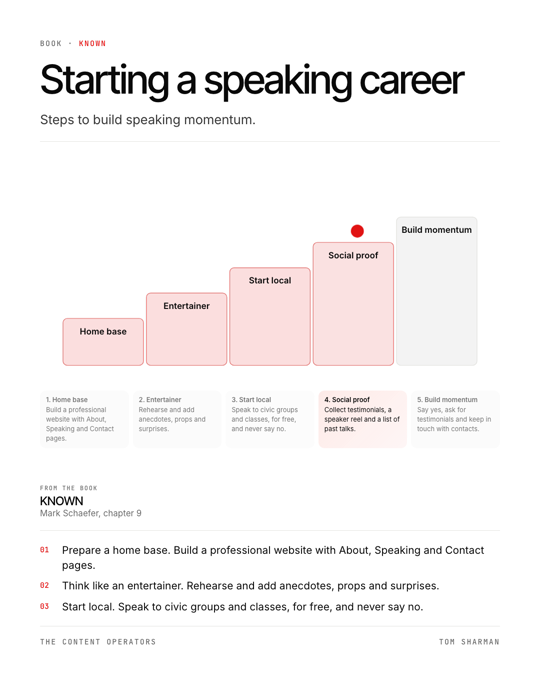
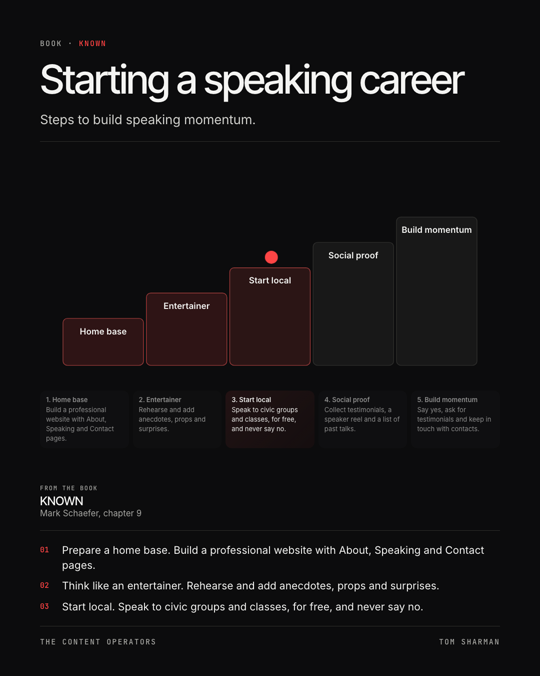
Steps to build speaking momentum.
- Prepare a home base. Build a professional website with About, Speaking and Contact pages.
- Think like an entertainer. Rehearse and add anecdotes, props and surprises.
- Start local. Speak to civic groups and classes, for free, and never say no.
- Establish social proof. Collect testimonials, a speaker reel and a list of past talks.
- Build momentum. Say yes, ask for testimonials and keep in touch with contacts.
From chapter: CHAPTER 8 Taking Your Brand to the Next Level, pp. 125–142
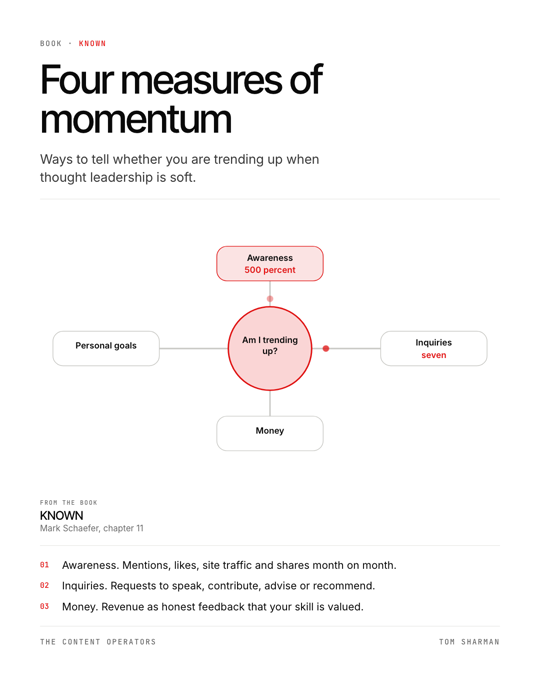
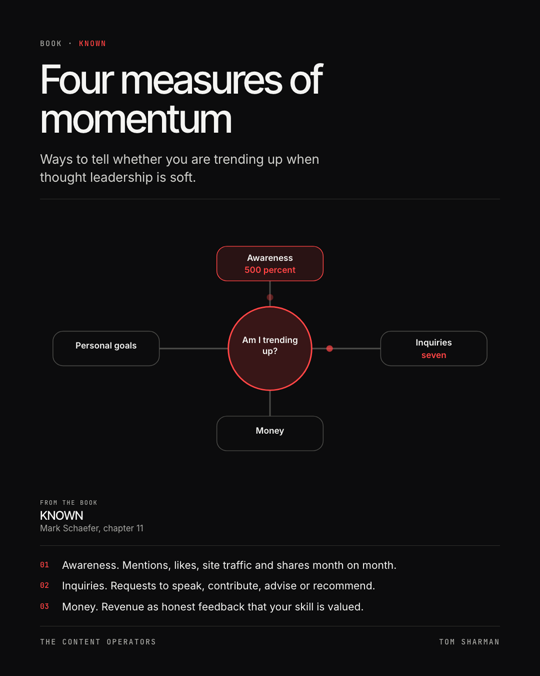
Ways to tell whether you are trending up when thought leadership is soft.
- Awareness. Mentions, likes, site traffic and shares month on month.
- Inquiries. Requests to speak, contribute, advise or recommend.
- Money. Revenue as honest feedback that your skill is valued.
- Personal goals. Whether you are reaching your own reasons for being known.
From chapter: CHAPTER 10 Pivots and Grit, pp. 155–172
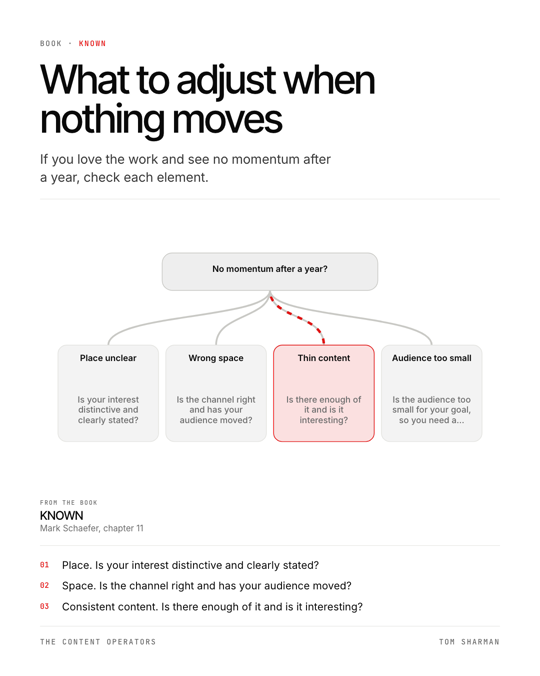
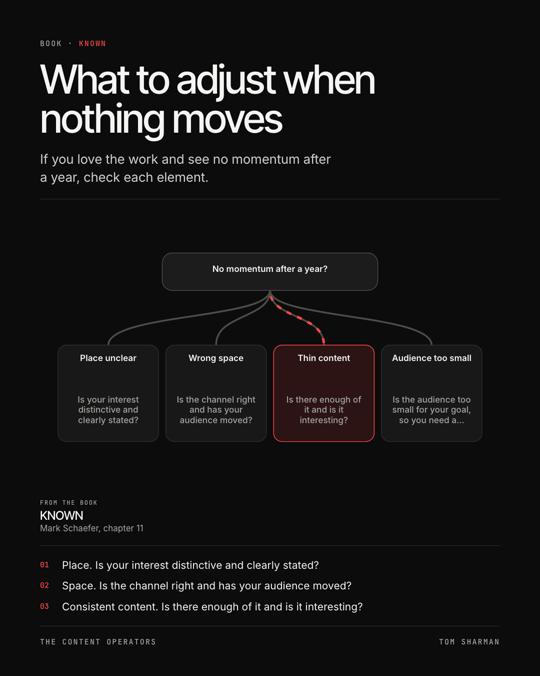
If you love the work and see no momentum after a year, check each element.
- Place. Is your interest distinctive and clearly stated?
- Space. Is the channel right and has your audience moved?
- Consistent content. Is there enough of it and is it interesting?
- Audience. Is the audience too small for your goal, so you need a broader scope?
From chapter: CHAPTER 10 Pivots and Grit, pp. 155–172
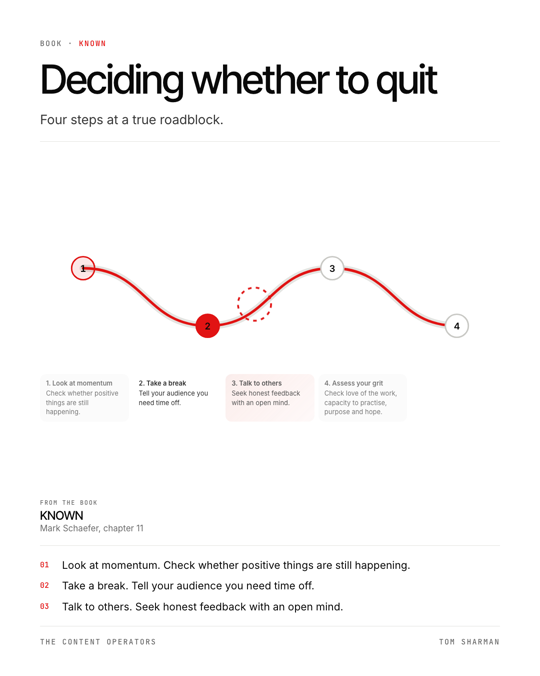
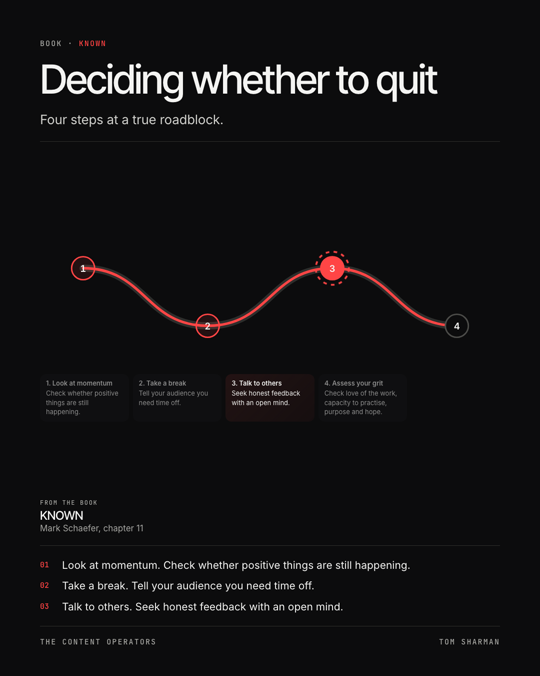
Four steps at a true roadblock.
- Look at momentum. Check whether positive things are still happening.
- Take a break. Tell your audience you need time off.
- Talk to others. Seek honest feedback with an open mind.
- Assess your grit. Check love of the work, capacity to practise, purpose and hope.
From chapter: CHAPTER 10 Pivots and Grit, pp. 155–172
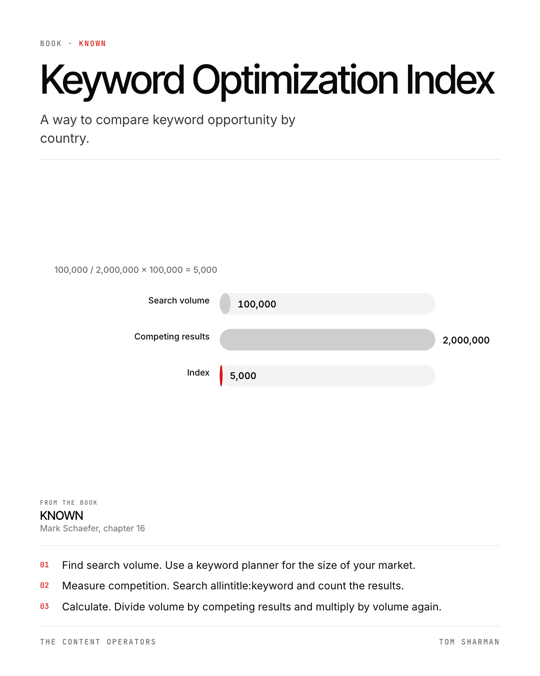
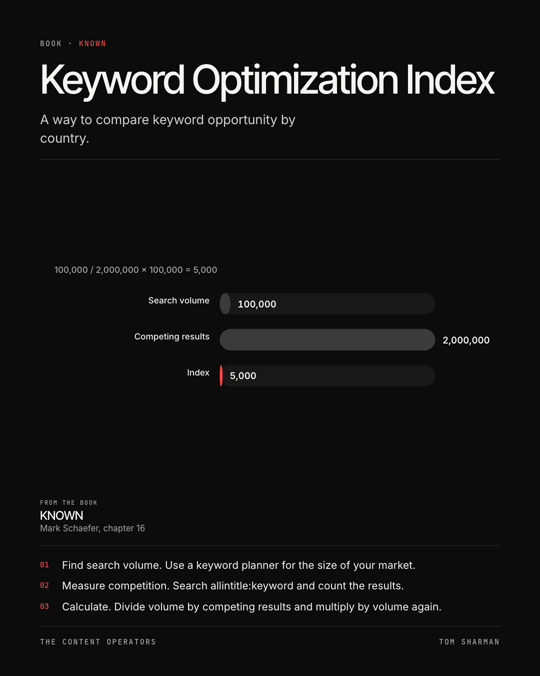
A way to compare keyword opportunity by country.
- Find search volume. Use a keyword planner for the size of your market.
- Measure competition. Search allintitle:keyword and count the results.
- Calculate. Divide volume by competing results and multiply by volume again.
- Narrow by country. Use the country option and the national version of Google.
From chapter: APPENDIX II Determining content density in regions of the world, pp. 193–194