Bookshelf
How Tom uses this
Key Person of Influence backs four of Tom's lessons and argues with one. Under each of his lessons, what the book says about it, and on which pages.
- People online are selfish, so lead with what they get
The book says a pitch must state the payoff for the listener, with three core benefits, and that talking about what you do and are qualified for is irrelevant until translated into a payoff. pp. 69 and 70. In the book: The Key Person of Influence Method, Big Game, Foundations of a presentation pitch, The presentation pitch structure, Planning the book, Ten intangible qualities of a successful product, Five starter partnership deals, Meeting a potential partner, Three calls.
- It is about their business, told as what the audience learns
Priestley says give your ideas away in books, podcasts and webinars and let people hire you for implementation, so the business is told through what the audience learns. pp. 99, 100 and 101. In the book: The Key Person of Influence Method, Big Game, Foundations of a presentation pitch, The presentation pitch structure, Planning the book, Ten intangible qualities of a successful product, Five starter partnership deals, Meeting a potential partner, Three calls.
- Find the voice in what already worked for them
The book tells you that you already stand on a mountain of value and that your voice is found by reflecting back what has already worked in your story. pp. 36, 40, 59 and 60. In the book: The Key Person of Influence Method, Big Game, Foundations of a presentation pitch, The presentation pitch structure, Planning the book, Ten intangible qualities of a successful product, Five starter partnership deals, Meeting a potential partner, Three calls.
- A brand that compounds has a mission and an enemy
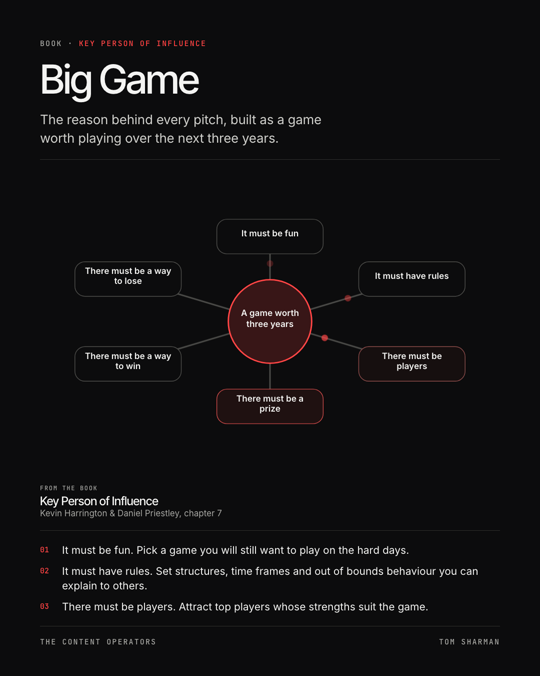
The Big Game is a mission with rules, players, a prize and a way to lose, and the micro-niche focus is the same discipline of choosing a clear territory to defend. pp. 60, 62 and 64. In the book: The Key Person of Influence Method, Big Game, Foundations of a presentation pitch, The presentation pitch structure, Planning the book, Ten intangible qualities of a successful product, Five starter partnership deals, Meeting a potential partner, Three calls.
Where it disagrees with Tom
What it argues
Kevin Harrington and Daniel Priestley argue that the top slice of every industry takes the best opportunities, and that anyone can join it within about twelve months by doing five things in order: Pitch, Publish, Product, Profile and Partnership. The world has gone digital and niche, so the valuable person is vital rather than functional and owns a micro-niche instead of being a generalist. Your own story and skills are already a mountain of value, and the job is to turn them into output: a sharp pitch, a book or articles, a product ecosystem built on implementation, a profile that shows well when Googled, and win/win partnerships. Influence comes from finished output and leverage, so you commit before you feel ready and surround yourself with coaches and peers. The book doubles as the free product that feeds the authors' paid KPI Program.
Worth keeping
- Influence comes from output, not from hard work, and almost finishing a step counts for nothing (p. 53).
- Pick a micro-niche and pitch to it with a sniper rifle, since casting the net wide catches no one (p. 64).
- The Big Game gives a pitch its why, built from fun, rules, players, a prize, a way to win and a way to lose (pp. 60-62).
- A polite response to your pitch is a failure signal, and a strong reaction either way is the target (p. 58).
- Products and services do not make money, ecosystems do, with free products spreading ideas and paid ones selling implementation (pp. 92, 98-102).
- Information has lost its value, so productise implementation and give the ideas away (p. 101).
- The book exists to promote you, and the aim is to be the author rather than a bestseller (pp. 87-89).
- You are who Google says you are, so build a profile that shows well and is targeted at people who care (pp. 51, 108-112).
- Network for partnerships and leverage rather than clients, and make three calls on any idea (pp. 122-123).
- Speak the language of opportunities rather than requests, and commit first because resourcefulness follows commitment (pp. 139, 144).
Which project it moves forward
The Content Operators launch
The book's pitch, free product, productised service and partnership sequence is a ready ladder for launching The Content Operators with a first cohort.
The questions it answers
- How do you build a personal brand that generates inbound rather than requiring outbound?
The whole method is a sequence for becoming the person opportunities come to, with a Googleable profile, a book and partnerships replacing chasing clients (pp. 43, 51, 53).
- How do you price and sell a tool you built for yourself?
It says to give ideas away free, sell implementation as a productised service and sell industry specific products to your competitors (pp. 101, 102).
- Which of my stories travel, and which only feel like they should?
It gives the polite response test, where a strong reaction either way shows a story landing and a nod means it did not (p. 58).
The frameworks
11 frameworks, one animation each Every framework, step by step
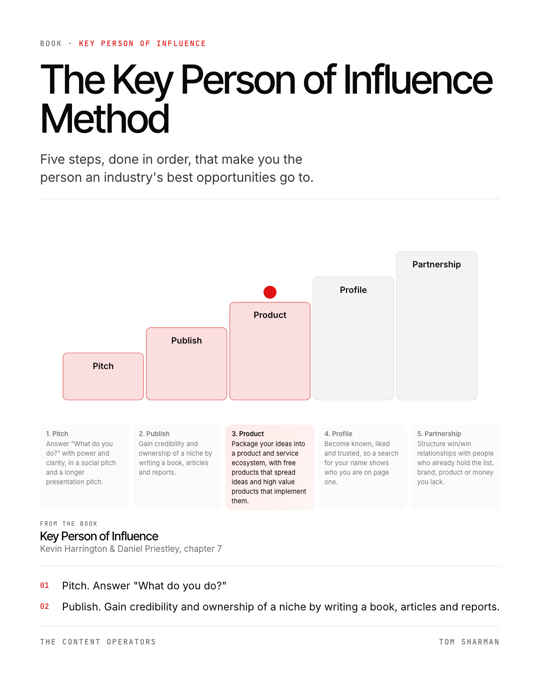
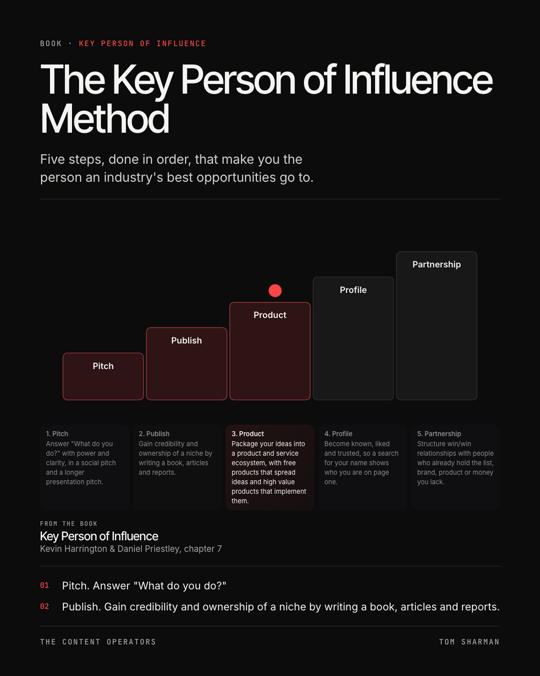
Five steps, done in order, that make you the person an industry's best opportunities go to.
- Pitch. Answer "What do you do?" with power and clarity, in a social pitch and a longer presentation pitch.
- Publish. Gain credibility and ownership of a niche by writing a book, articles and reports.
- Product. Package your ideas into a product and service ecosystem, with free products that spread ideas and high value products that implement them.
- Profile. Become known, liked and trusted, so a search for your name shows who you are on page one.
- Partnership. Structure win/win relationships with people who already hold the list, brand, product or money you lack.
From chapter: 2. The Key Person of Influence Method, pp. 42–128
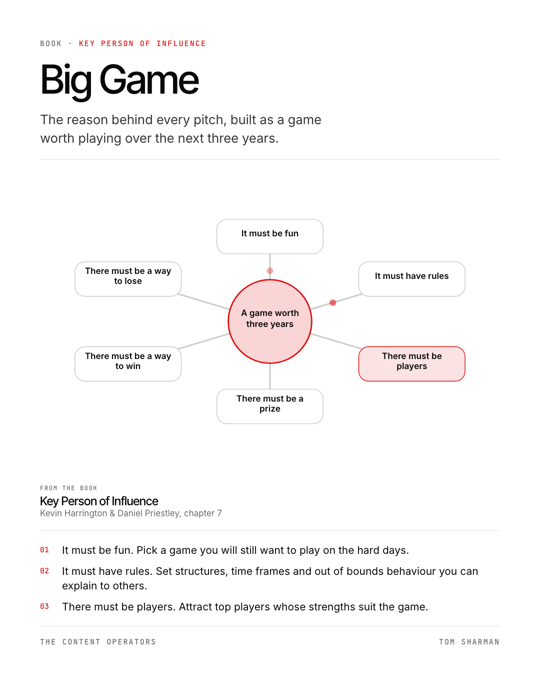
The reason behind every pitch, built as a game worth playing over the next three years.
- It must be fun. Pick a game you will still want to play on the hard days.
- It must have rules. Set structures, time frames and out of bounds behaviour you can explain to others.
- There must be players. Attract top players whose strengths suit the game.
- There must be a prize. Name the reward, whether money, ownership or recognition, that excites the players.
- There must be a way to win. Set short term wins and an overall championship with a clear scoreboard.
- There must be a way to lose. Make losing possible and visible, so there is a point to rethink the strategy.
From chapter: 2. The Key Person of Influence Method, pp. 42–128
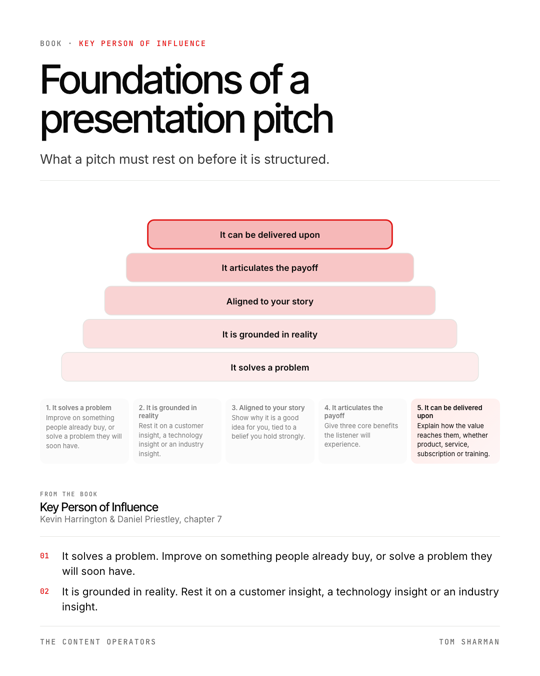
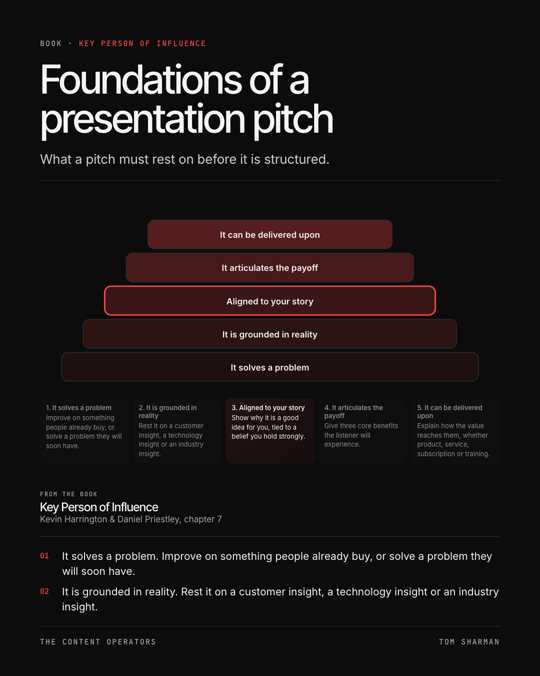
What a pitch must rest on before it is structured.
- It solves a problem. Improve on something people already buy, or solve a problem they will soon have.
- It is grounded in reality. Rest it on a customer insight, a technology insight or an industry insight.
- It is aligned to your story. Show why it is a good idea for you, tied to a belief you hold strongly.
- It articulates the payoff. Give three core benefits the listener will experience.
- It can be delivered upon. Explain how the value reaches them, whether product, service, subscription or training.
From chapter: 2. The Key Person of Influence Method, pp. 42–128
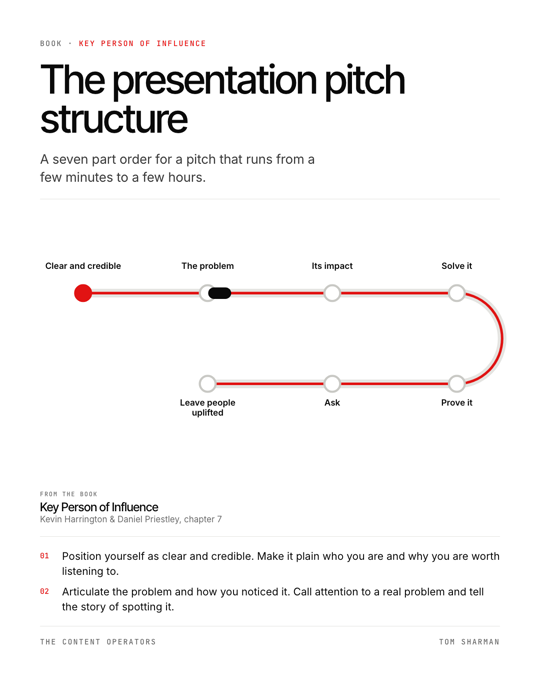
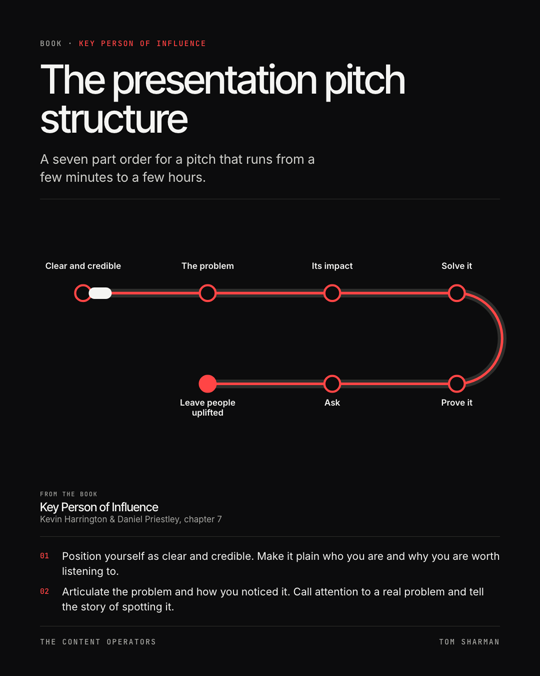
A seven part order for a pitch that runs from a few minutes to a few hours.
- Position yourself as clear and credible. Make it plain who you are and why you are worth listening to.
- Articulate the problem and how you noticed it. Call attention to a real problem and tell the story of spotting it.
- Extrapolate on the impact of the problem. Project forward to what happens if it is left unsolved.
- Solve it. Share the key insight behind your solution freely.
- Prove it. Back the claim with statistics, a case study or a respected voucher.
- Ask for what you want. State specifically and boldly what you need to take the idea forward.
- Leave people uplifted. Finish on a story, idea or vision that leaves people feeling positive.
From chapter: 2. The Key Person of Influence Method, pp. 42–128
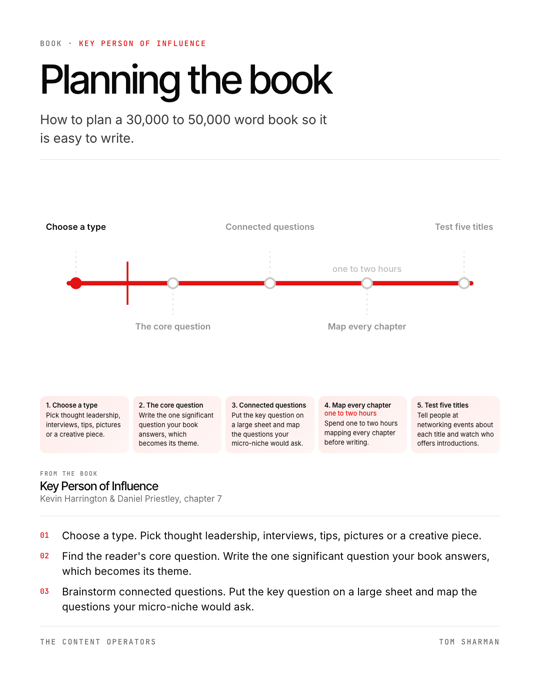
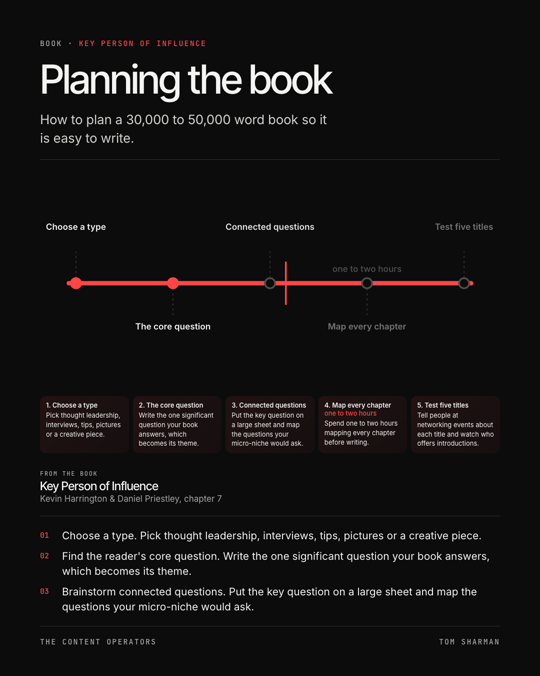
How to plan a 30,000 to 50,000 word book so it is easy to write.
- Choose a type. Pick thought leadership, interviews, tips, pictures or a creative piece.
- Find the reader's core question. Write the one significant question your book answers, which becomes its theme.
- Brainstorm connected questions. Put the key question on a large sheet and map the questions your micro-niche would ask.
- Arrange chapters and map each one. Spend one to two hours mapping every chapter before writing.
- Test five titles. Tell people at networking events about each title and watch who offers introductions.
From chapter: 2. The Key Person of Influence Method, pp. 42–128
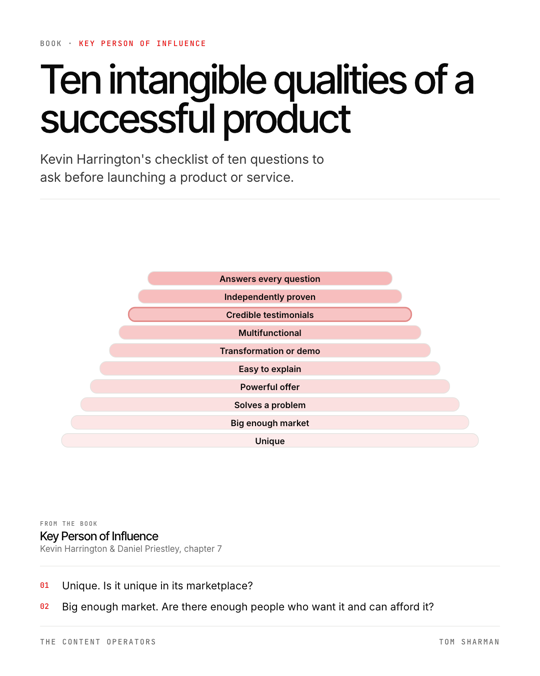
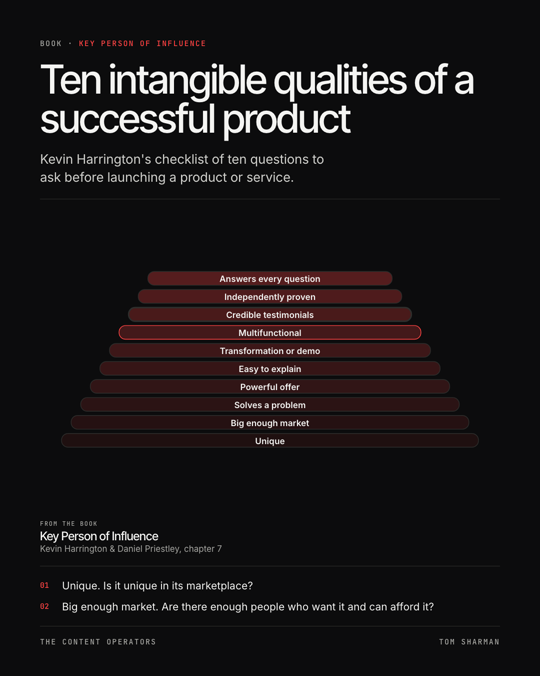
Kevin Harrington's checklist of ten questions to ask before launching a product or service.
- Unique. Is it unique in its marketplace?
- Big enough market. Are there enough people who want it and can afford it?
- Solves a problem. Does it really solve a problem?
- Powerful offer. Is there a powerful offer with a competitive price?
- Easy to explain. Can you explain how it works simply?
- Transformation or demo. Is there a visible before and after?
- Multifunctional. Does it do more than a competitor's copy could?
- Credible testimonials. Are there real customer and expert testimonials?
- Independently proven. Are there third party results or studies?
- Answers the buyer's questions. Can you answer every sceptical question the buyer might ask?
From chapter: 2. The Key Person of Influence Method, pp. 42–128
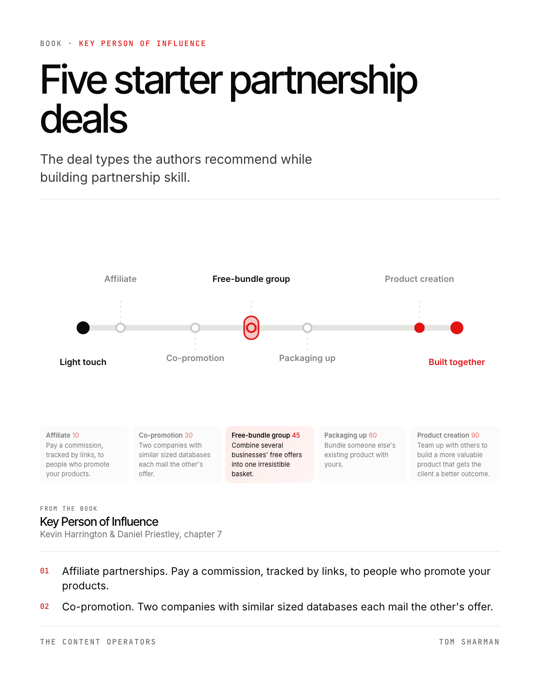
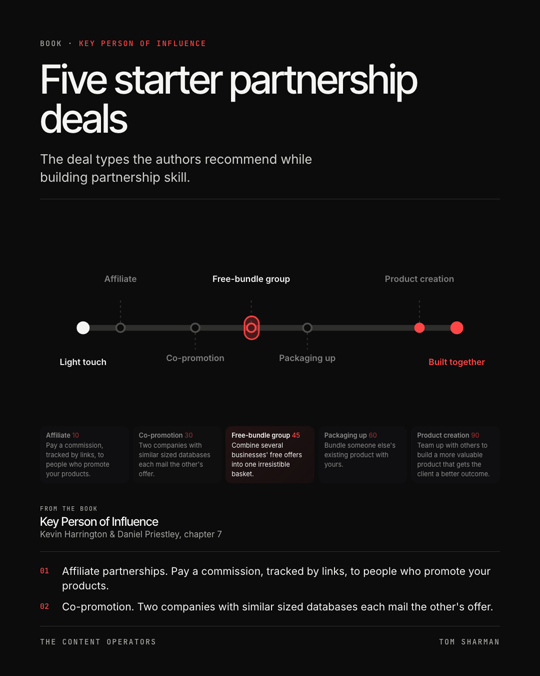
The deal types the authors recommend while building partnership skill.
- Affiliate partnerships. Pay a commission, tracked by links, to people who promote your products.
- Co-promotion. Two companies with similar sized databases each mail the other's offer.
- Product creation partnerships. Team up with others to build a more valuable product that gets the client a better outcome.
- Packaging up. Bundle someone else's existing product with yours.
- Free-bundle group. Combine several businesses' free offers into one irresistible basket.
From chapter: 2. The Key Person of Influence Method, pp. 42–128
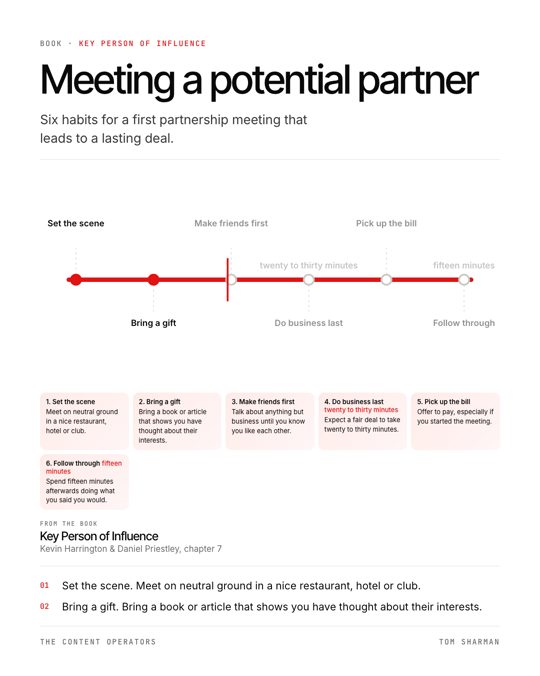
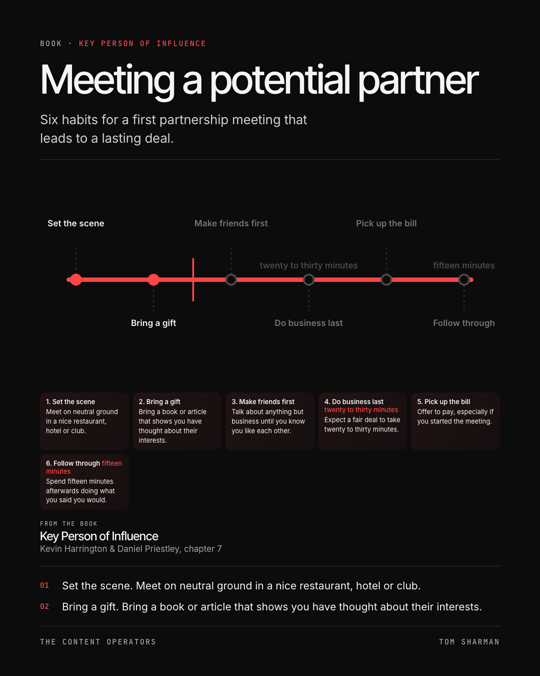
Six habits for a first partnership meeting that leads to a lasting deal.
- Set the scene. Meet on neutral ground in a nice restaurant, hotel or club.
- Bring a gift. Bring a book or article that shows you have thought about their interests.
- Make friends first. Talk about anything but business until you know you like each other.
- Do business last. Expect a fair deal to take twenty to thirty minutes.
- Pick up the bill. Offer to pay, especially if you started the meeting.
- Follow through. Spend fifteen minutes afterwards doing what you said you would.
From chapter: 2. The Key Person of Influence Method, pp. 42–128
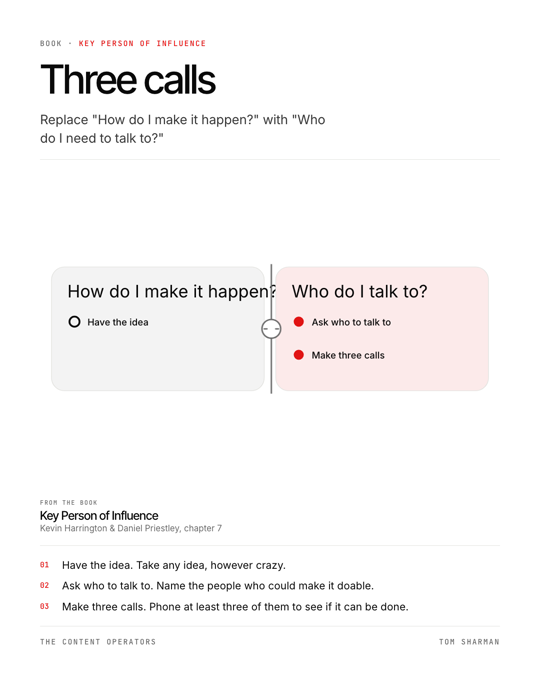
Replace "How do I make it happen?" with "Who do I need to talk to?".
- Have the idea. Take any idea, however crazy.
- Ask who to talk to. Name the people who could make it doable.
- Make three calls. Phone at least three of them to see if it can be done.
From chapter: 2. The Key Person of Influence Method, pp. 42–128
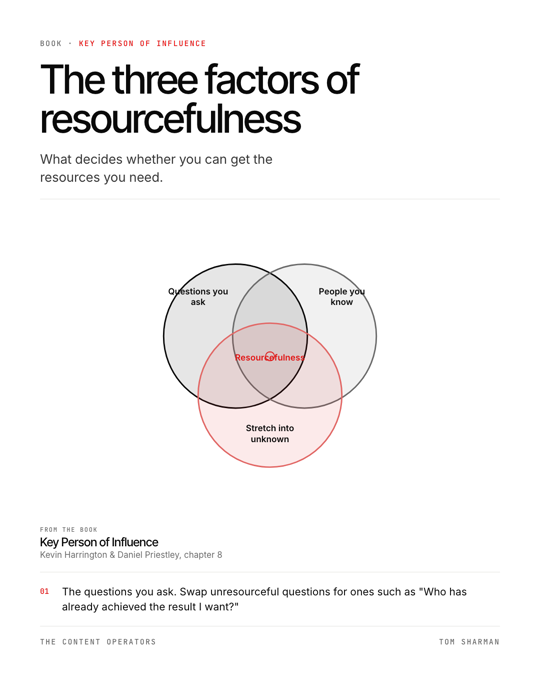
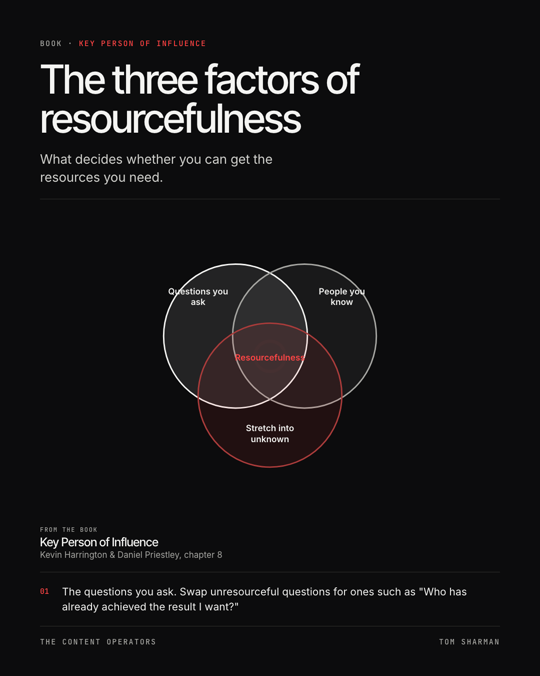
What decides whether you can get the resources you need.
- The questions you ask. Swap unresourceful questions for ones such as "Who has already achieved the result I want?".
- The people you know. Build a network of people who share opportunities, and speak the language of opportunities rather than requests.
- Your willingness to stretch into the unknown. Commit first, then work out how, because resourcefulness shows up after commitment.
From chapter: 3. Making It Happen, pp. 129–150
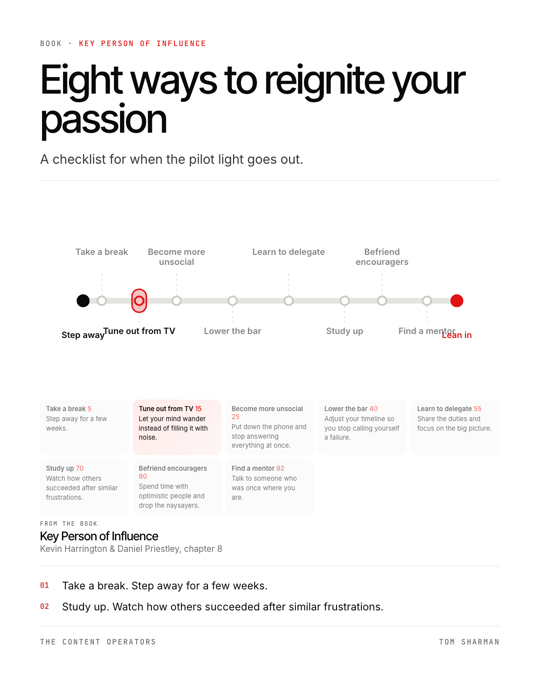
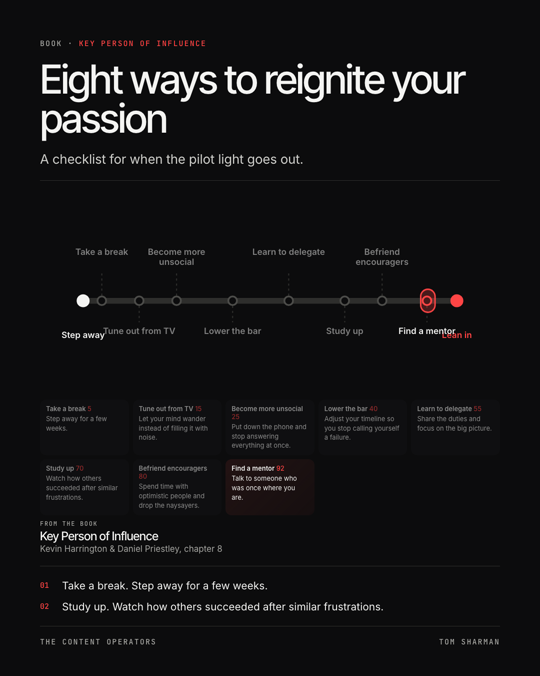
A checklist for when the pilot light goes out.
- Take a break. Step away for a few weeks.
- Study up. Watch how others succeeded after similar frustrations.
- Find a mentor. Talk to someone who was once where you are.
- Lower the bar. Adjust your timeline so you stop calling yourself a failure.
- Learn to delegate. Share the duties and focus on the big picture.
- Become more unsocial. Put down the phone and stop answering everything at once.
- Befriend encouragers. Spend time with optimistic people and drop the naysayers.
- Tune out from TV. Let your mind wander instead of filling it with noise.
From chapter: 3. Making It Happen, pp. 129–150
Working with Tom on this
Tom works with creators and founders one to one, from a single session to a fractional role. Work with Tom
Back to the bookshelf