Bookshelf
How Tom uses this
Leaders Eat Last backs three of Tom's lessons and argues with one. Under each of his lessons, what the book says about it, and on which pages.
Where it disagrees with Tom
What it argues
Sinek argues that people are social animals whose brains reward cooperation, so organisations thrive when leaders build a Circle of Safety and protect their people. He ties this to four chemicals: endorphins and dopamine drive getting things done, while serotonin and oxytocin drive pride, trust and loyalty, and cortisol rises when people feel unsafe. Modern abundance, scale and numbers turn people into abstractions, and Milgram's experiments show how harm follows when we cannot see those we affect. Since the 1980s, layoffs, shareholder primacy and dopamine-driven incentives have produced cultures addicted to performance, with Goldman Sachs, Merrill Lynch and BP as warnings and Barry-Wehmiller, Costco and the USS Santa Fe as models. The fix is leaders who eat last, tell the truth, give control to the people nearest the work, and serve real, knowable humans through small daily changes.
Worth keeping
- Leaders eat last: the perks of rank are repaid by willingness to give up something of your own when it matters (p. 80).
- A Circle of Safety turns energy that would go into politics toward outside threats and opportunities (p. 32).
- Trust, cooperation and ideas are results of safety, so they cannot be demanded (p. 34).
- The E.D.S.O. chemicals explain what motivates people: dopamine for goals, oxytocin and serotonin for belonging, cortisol for threat (pp. 50 to 66).
- Rules cover normal operations, so train people well and let them judge when to break them (p. 89).
- Seeing the human result of your work lifted fundraisers' weekly revenue by more than 400 percent (p. 135).
- Dunbar's number of about 150 caps groups where people can truly know and look after one another (p. 131).
- Marquet's shift from “permission to” to “I intend” moves decisions to the people with the information (p. 165).
- Trust is built by telling the truth, and spin destroys it faster than a poor decision does (p. 174).
- Step Twelve: the cure for performance addiction is service to real people, in person (p. 227).
The questions it answers
- What is the smallest team that can produce at the volume I am used to?
Dunbar's number of about 150 and Gore's practice of capping each plant at 150 give an upper bound for a trusted working group (pp. 131 to 133).
- How do you build a personal brand that generates inbound rather than requiring outbound?
He says online relationships only become real through face-to-face contact and that time and energy build more trust than money (pp. 129, 137).
The frameworks
6 frameworks, one animation each Every framework, step by step
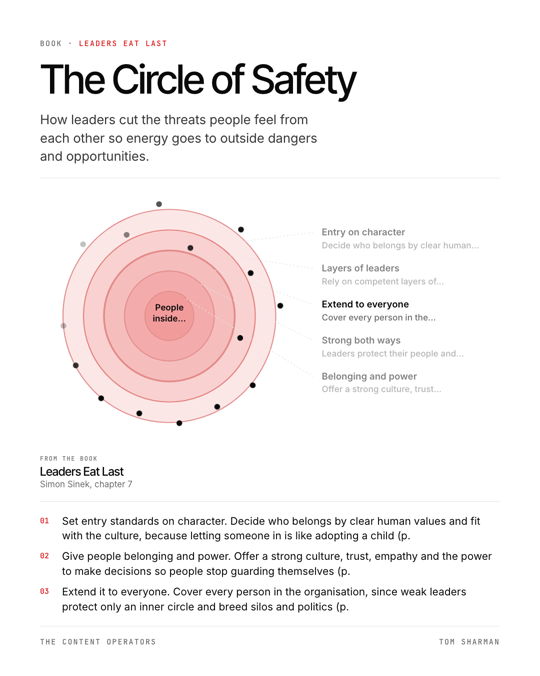
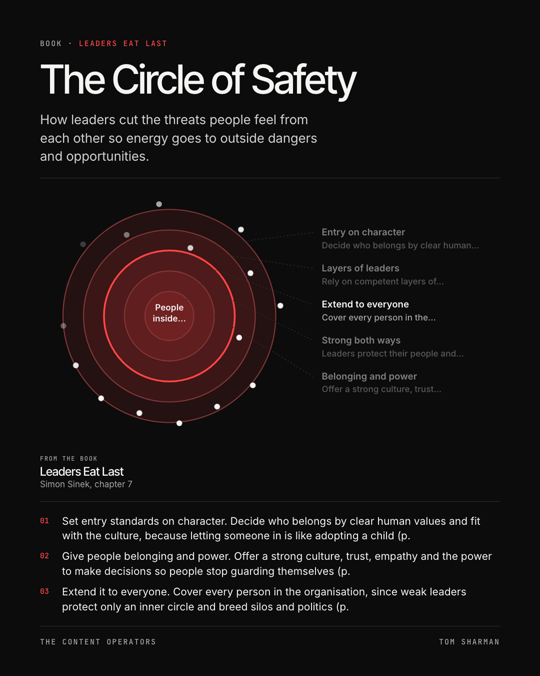
How leaders cut the threats people feel from each other so energy goes to outside dangers and opportunities.
- Set entry standards on character. Decide who belongs by clear human values and fit with the culture, because letting someone in is like adopting a child (p. 33).
- Give people belonging and power. Offer a strong culture, trust, empathy and the power to make decisions so people stop guarding themselves (p. 32).
- Extend it to everyone. Cover every person in the organisation, since weak leaders protect only an inner circle and breed silos and politics (p. 34).
- Train layers of leaders to widen the perimeter. Rely on competent layers of management to look after those in their charge as the organisation grows (p. 33).
- Keep it strong from both directions. Leaders protect their people and members look out for the leader and each other (p. 35).
From chapter: THE FORCE, pp. 11–94
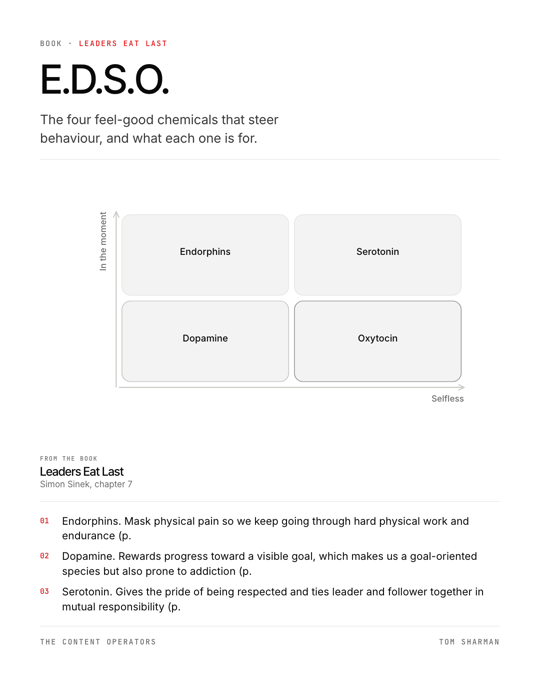
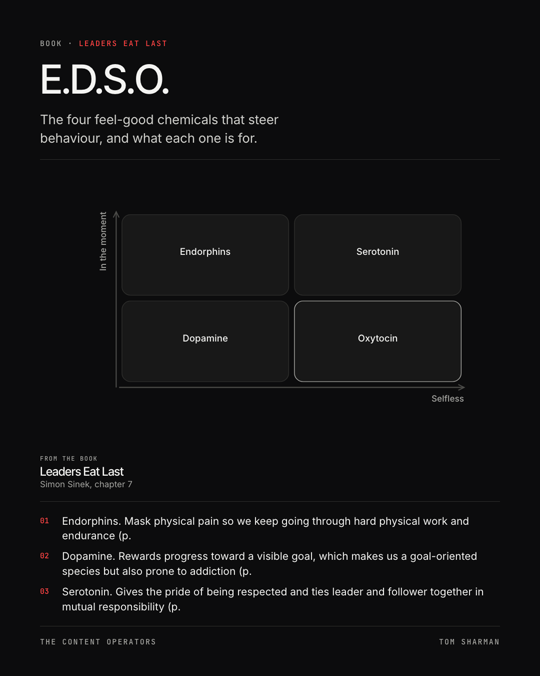
The four feel-good chemicals that steer behaviour, and what each one is for.
- Endorphins. Mask physical pain so we keep going through hard physical work and endurance (p. 50).
- Dopamine. Rewards progress toward a visible goal, which makes us a goal-oriented species but also prone to addiction (p. 52).
- Serotonin. Gives the pride of being respected and ties leader and follower together in mutual responsibility (p. 58).
- Oxytocin. Builds lasting trust, empathy and friendship through generosity, time and physical contact (p. 61).
From chapter: THE FORCE, pp. 11–94
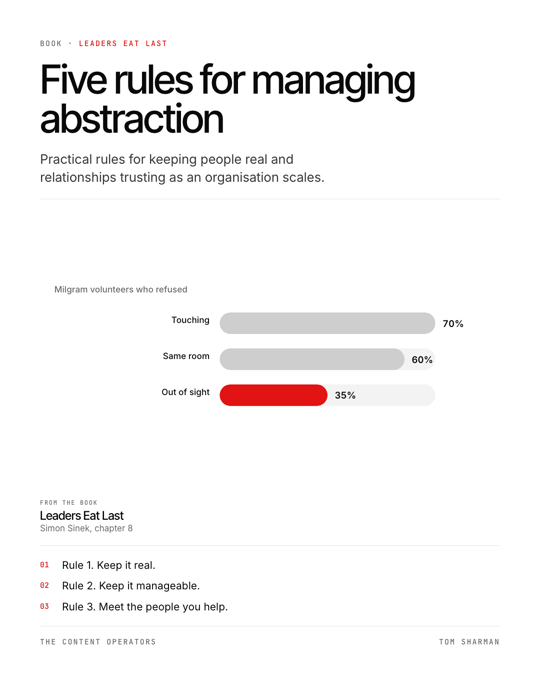
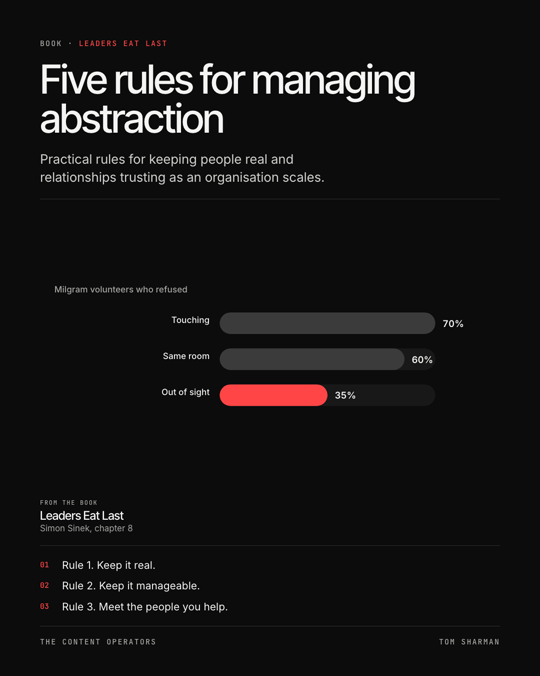
Practical rules for keeping people real and relationships trusting as an organisation scales.
- Rule 1. Keep it real. Bring people together face to face, because trust is formed across a table and not through a screen (p. 129).
- Rule 2. Keep it manageable. Obey Dunbar's number of about 150 and rely on leaders at every level to extend the Circle (p. 131).
- Rule 3. Meet the people you help. Let staff see the human result of their work, as the five-minute scholarship student visits did for fundraisers (p. 134).
- Rule 4. Give them time, not just money. Offer attention and energy, which carry absolute value, rather than relying on gifts or bonuses (p. 137).
- Rule 5. Be patient. Allow more than seven days and fewer than seven years for real trust to form (p. 139).
From chapter: THE PATH WE CHOSE, pp. 95–143
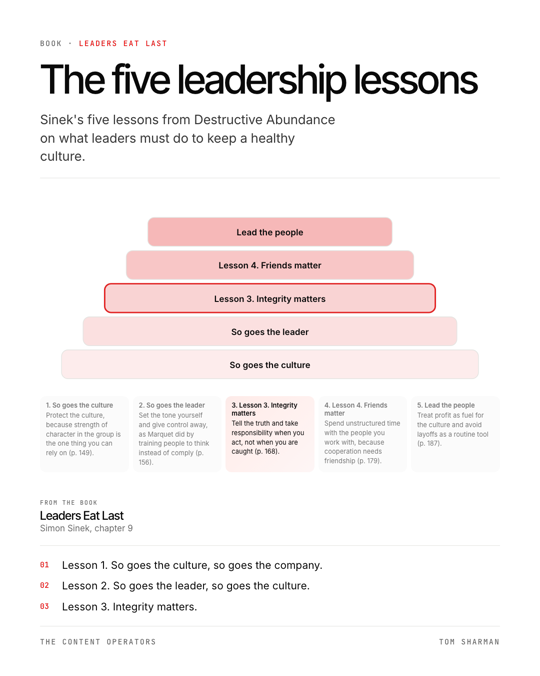
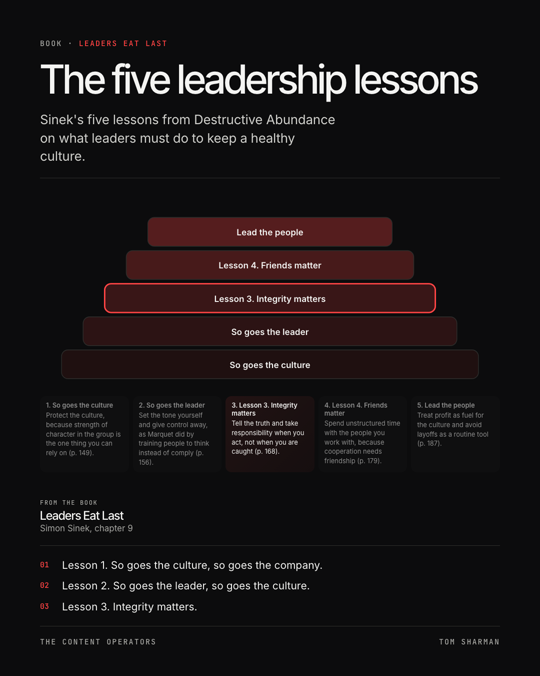
Sinek's five lessons from Destructive Abundance on what leaders must do to keep a healthy culture.
- Lesson 1. So goes the culture, so goes the company. Protect the culture, because strength of character in the group is the one thing you can rely on (p. 149).
- Lesson 2. So goes the leader, so goes the culture. Set the tone yourself and give control away, as Marquet did by training people to think instead of comply (p. 156).
- Lesson 3. Integrity matters. Tell the truth and take responsibility when you act, not when you are caught (p. 168).
- Lesson 4. Friends matter. Spend unstructured time with the people you work with, because cooperation needs friendship (p. 179).
- Lesson 5. Lead the people, not the numbers. Treat profit as fuel for the culture and avoid layoffs as a routine tool (p. 187).
From chapter: CHALLENGES AND TEMPTATION, pp. 144–200
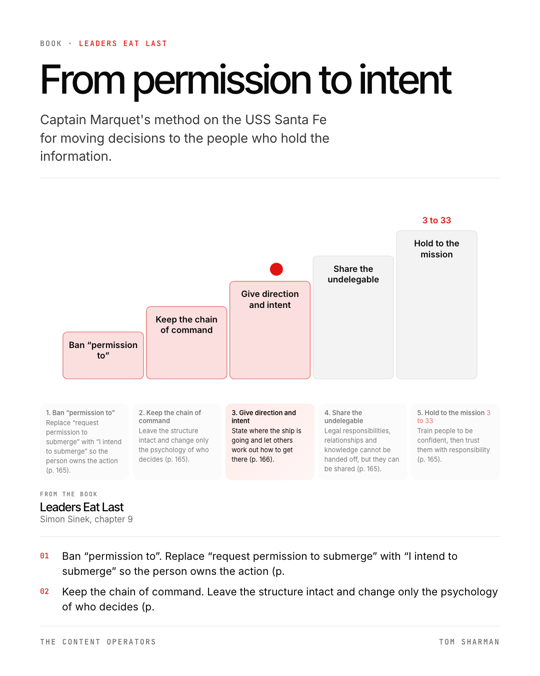
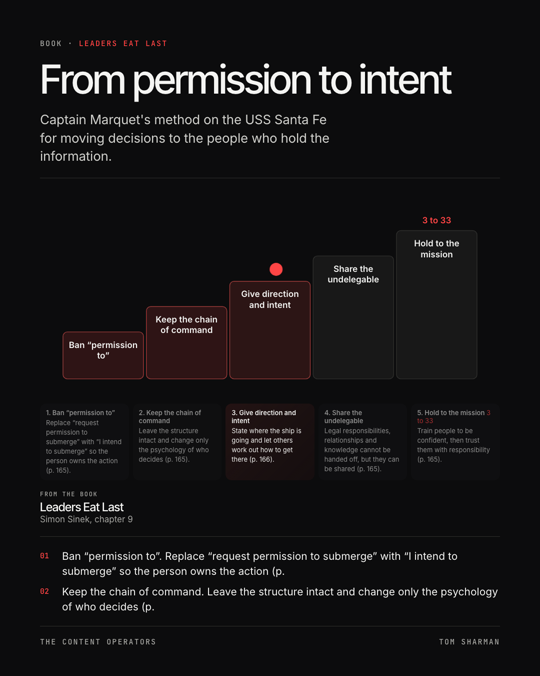
Captain Marquet's method on the USS Santa Fe for moving decisions to the people who hold the information.
- Ban “permission to”. Replace “request permission to submerge” with “I intend to submerge” so the person owns the action (p. 165).
- Keep the chain of command. Leave the structure intact and change only the psychology of who decides (p. 165).
- Give direction and intent. State where the ship is going and let others work out how to get there (p. 166).
- Share the three undelegable things. Legal responsibilities, relationships and knowledge cannot be handed off, but they can be shared (p. 165).
- Hold people accountable for the mission. Train people to be confident, then trust them with responsibility (p. 165).
From chapter: CHALLENGES AND TEMPTATION, pp. 144–200
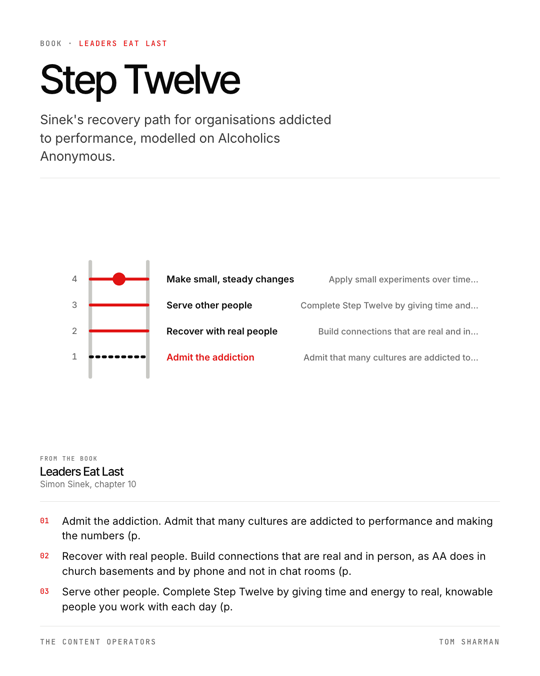
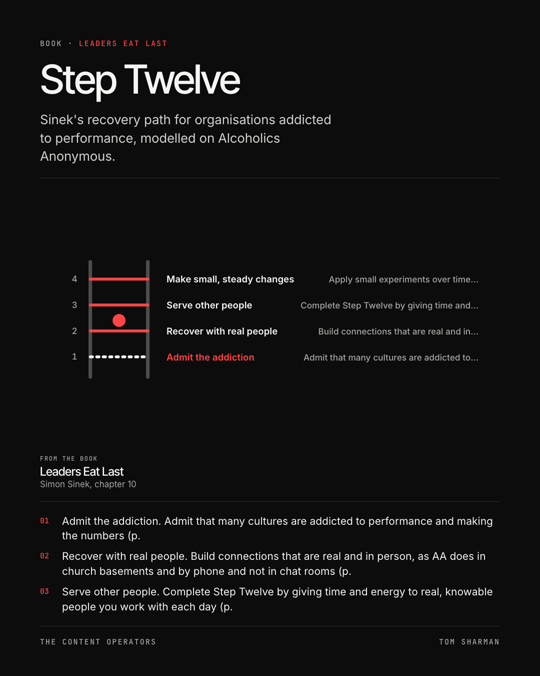
Sinek's recovery path for organisations addicted to performance, modelled on Alcoholics Anonymous.
- Admit the addiction. Admit that many cultures are addicted to performance and making the numbers (p. 226).
- Recover with real people. Build connections that are real and in person, as AA does in church basements and by phone and not in chat rooms (p. 227).
- Serve other people. Complete Step Twelve by giving time and energy to real, knowable people you work with each day (p. 227).
- Make small, steady changes. Apply small experiments over time instead of one large reorganisation, as Chapman, Kim and Marquet did (p. 239).
From chapter: THE ABYSS, pp. 201–240
Working with Tom on this
Tom works with creators and founders one to one, from a single session to a fractional role. Work with Tom
Back to the bookshelf