Bookshelf
How Tom uses this
Scorecard Marketing backs three of Tom's lessons. Under each of his lessons, what the book says about it, and on which pages.
- The intake question is why, and what it is costing them
A scorecard is an automated intake that surfaces the buyer's situation, goals and obstacles before the call, which Tom's intake does by asking why and what it costs them. pp. 69, 88, 108 and 109. In the book: The four-step scorecard, Landing page in four moves, Questionnaire sizing by use, The seesaw technique, Nine ways to promote a scorecard.
- People online are selfish, so lead with what they get
The scorecard leads with value (a personal score and report) before any ask, and the authors say customers think about what improves for them. pp. 19, 26, 45 and 86. In the book: Emotion, logic and urgency, Product-for-prospects, The four-step scorecard, Landing page in four moves, Questionnaire sizing by use, The seesaw technique, Nine ways to promote a scorecard.
- Turn down anyone unclear about their commitment
Scorecard qualifying questions on budget and urgency filter out poor-fit leads, and the Cinderella criteria send only matching people the premium offer. pp. 81, 95 and 96. In the book: The four-step scorecard, Landing page in four moves, Questionnaire sizing by use, The seesaw technique, Nine ways to promote a scorecard.
What it argues
Priestley and Carlson argue that leads are the foundation of every business, and that in an age of endless choice the job is to manufacture demand. People buy to relieve a psychological tension, and the best prospects are those with a dormant tension nobody has yet woken. A scorecard does that work at scale: it is a scored, personalised quiz that qualifies the person, warms them up and hands the sales team data on what each person needs. The playbook has four steps: landing page, questionnaire, results, and marketing and sales. The book finishes by saying generic content is saturating, so the next edge is proprietary data collected through surveys, scorecards and quizzes. Much of the evidence is the authors' own case studies and sells the ScoreApp software, so the results are best read as claims.
Worth keeping
- Everything in business is downstream from lead generation (p. 9). Leads let you solve almost any other problem (p. 12).
- The job today is manufacturing demand, not production (p. 13).
- Sell to dormant tension: active searchers are harder to sell to because they have set budgets and favour established brands (p. 26).
- Ask small indirect questions first, then escalate (p. 27).
- A product-for-prospects must scale and should collect data. A free one-to-one is the worst version (pp. 34 to 36).
- A sale needs emotion, logic and urgency. A one to ten score gets emotion and logic working together (pp. 37 to 40).
- Landing page = clarity, credibility, connection, then one call to action (p. 60). Test conversion, because customers vote with actions (p. 66).
- Size the quiz by lead temperature: 8 to 15 questions for cold, 20 to 50 for warm, 30 to 150 for clients (pp. 77 to 79).
- Design the score so the ideal client sees strong foundations with room to improve (p. 88). Different tiers get different videos, offers and testimonials (p. 89).
- Ring a scorecard lead within a day, using the seesaw technique: overall score, best category, worst category, next step (pp. 105 to 107).
- Repeat what worked, even at capacity, and use a waiting list to become oversubscribed (pp. 109 to 110).
- Any nonfiction book or video channel can be turned into a scorecard with one or two questions per chapter (p. 72). The hottest leads come after someone has consumed a few pieces of your content (p. 101).
Which project it moves forward
The Content Operators launch
The Content Operators needs a first cohort, and a scored scorecard on its site would turn creators and founders into data-rich warm leads and qualify them before a call.
The questions it answers
- How do you build a personal brand that generates inbound rather than requiring outbound?
A scorecard is a product-for-prospects that turns an audience into warm leads who raise their hand, and it can sit on every piece of content as the next step (pp. 36, 101).
- How do you price and sell a tool you built for yourself?
The authors built ScoreApp for themselves first, cobbled it together, then productised it with a free trial and a low monthly fee, and credit simplicity, a referral programme and templates for adoption (pp. 16, 50, 120).
- What does AI actually change about the shape of a content team?
Priestley says generic content is saturating, data-driven personalisation is next, and an appointment-setter-plus-scorecard model replaces cold calling, so teams shift toward data and follow-up (pp. 104, 126 to 128).
The frameworks
7 frameworks, one animation each Every framework, step by step
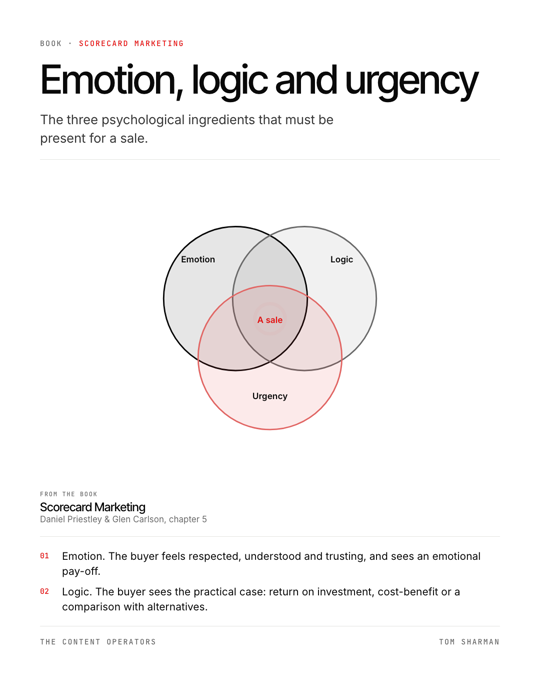
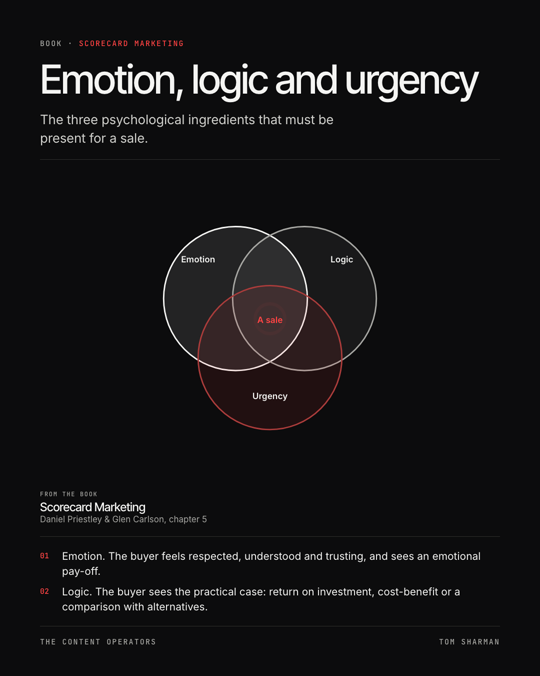
The three psychological ingredients that must be present for a sale.
- Emotion. The buyer feels respected, understood and trusting, and sees an emotional pay-off.
- Logic. The buyer sees the practical case: return on investment, cost-benefit or a comparison with alternatives.
- Urgency. The buyer feels a cost of inaction, such as missing out, a higher price or lost availability.
From chapter: PART ONE The Philosophy Of Generating Warm Leads, pp. 18–46
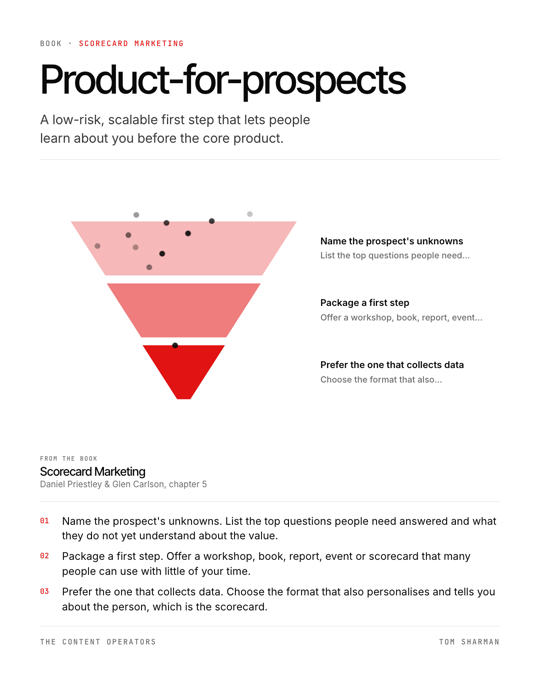
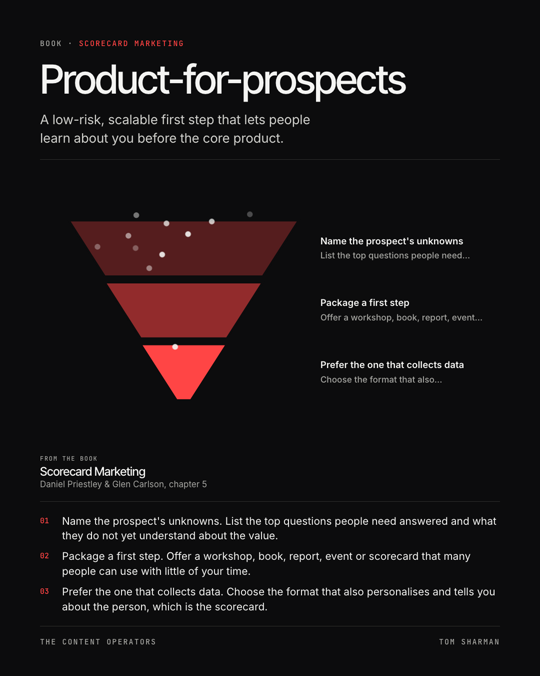
A low-risk, scalable first step that lets people learn about you before the core product.
- Name the prospect's unknowns. List the top questions people need answered and what they do not yet understand about the value.
- Package a first step. Offer a workshop, book, report, event or scorecard that many people can use with little of your time.
- Prefer the one that collects data. Choose the format that also personalises and tells you about the person, which is the scorecard.
From chapter: PART ONE The Philosophy Of Generating Warm Leads, pp. 18–46
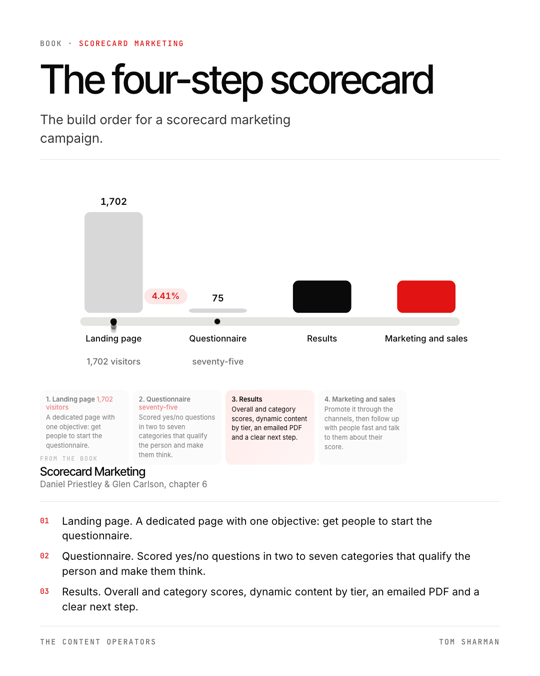
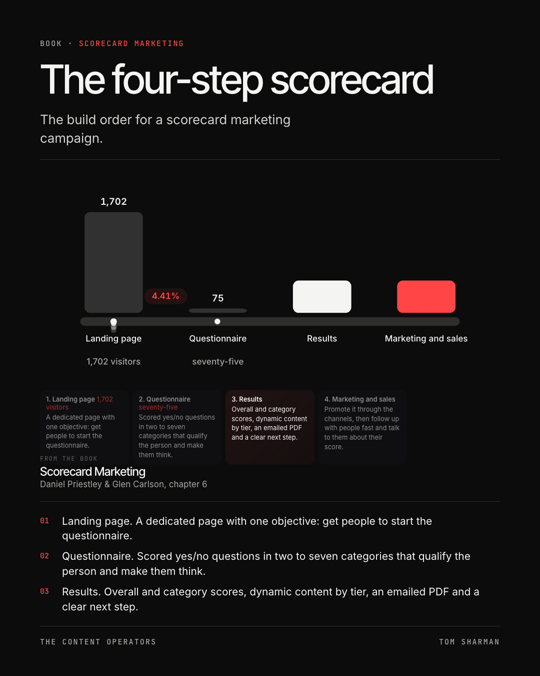
The build order for a scorecard marketing campaign.
- Landing page. A dedicated page with one objective: get people to start the questionnaire.
- Questionnaire. Scored yes/no questions in two to seven categories that qualify the person and make them think.
- Results. Overall and category scores, dynamic content by tier, an emailed PDF and a clear next step.
- Marketing and sales. Promote it through the channels, then follow up with people fast and talk to them about their score.
From chapter: PART TWO SETTING UP A SCORECARD, pp. 47–128
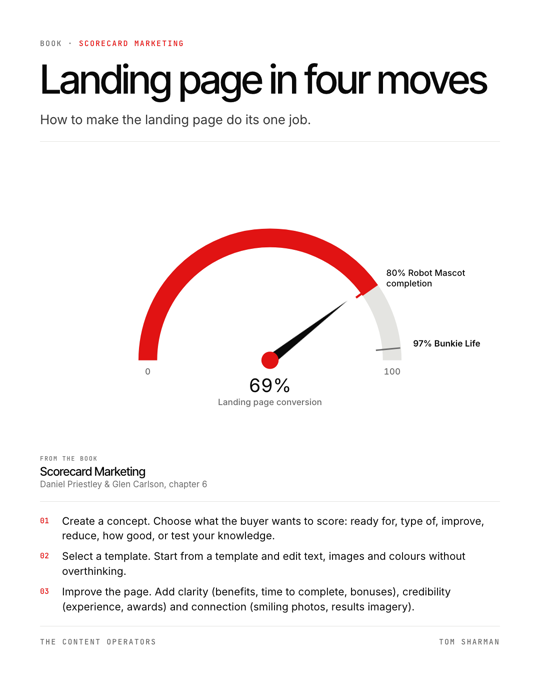
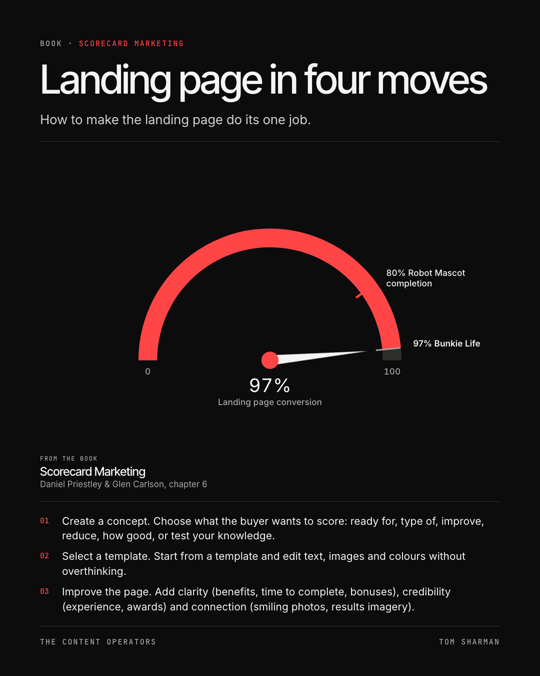
How to make the landing page do its one job.
- Create a concept. Choose what the buyer wants to score: ready for, type of, improve, reduce, how good, or test your knowledge.
- Select a template. Start from a template and edit text, images and colours without overthinking.
- Improve the page. Add clarity (benefits, time to complete, bonuses), credibility (experience, awards) and connection (smiling photos, results imagery).
- Start the quiz. Put a big call-to-action button at top and bottom and measure conversion.
From chapter: PART TWO SETTING UP A SCORECARD, pp. 47–128
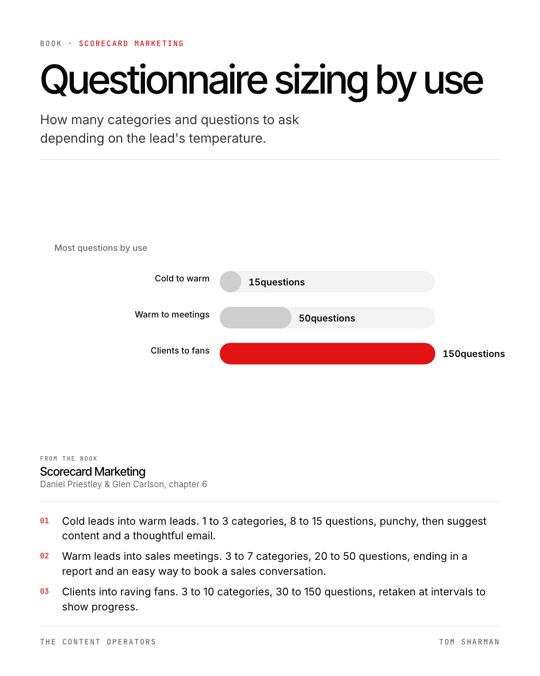
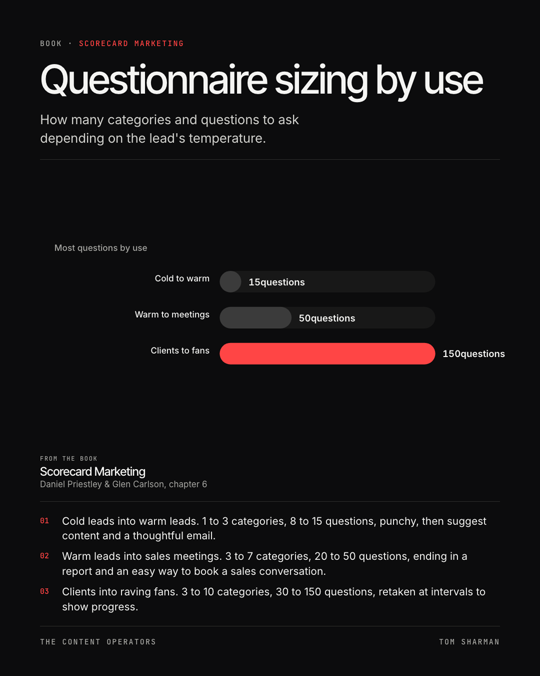
How many categories and questions to ask depending on the lead's temperature.
- Cold leads into warm leads. 1 to 3 categories, 8 to 15 questions, punchy, then suggest content and a thoughtful email.
- Warm leads into sales meetings. 3 to 7 categories, 20 to 50 questions, ending in a report and an easy way to book a sales conversation.
- Clients into raving fans. 3 to 10 categories, 30 to 150 questions, retaken at intervals to show progress.
From chapter: PART TWO SETTING UP A SCORECARD, pp. 47–128
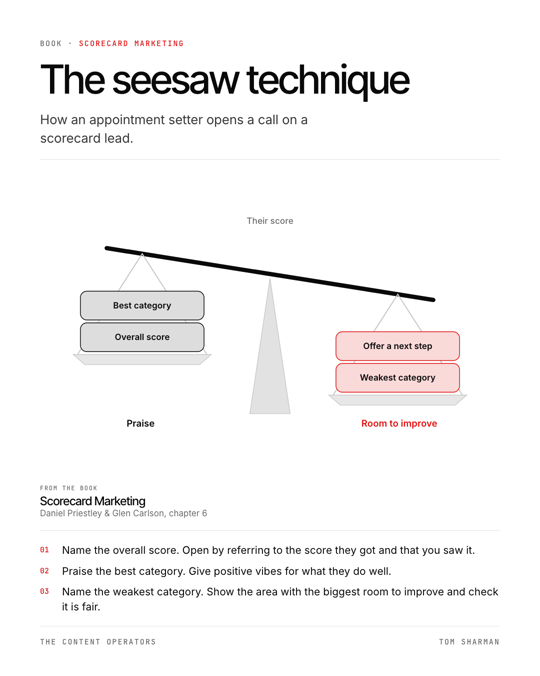
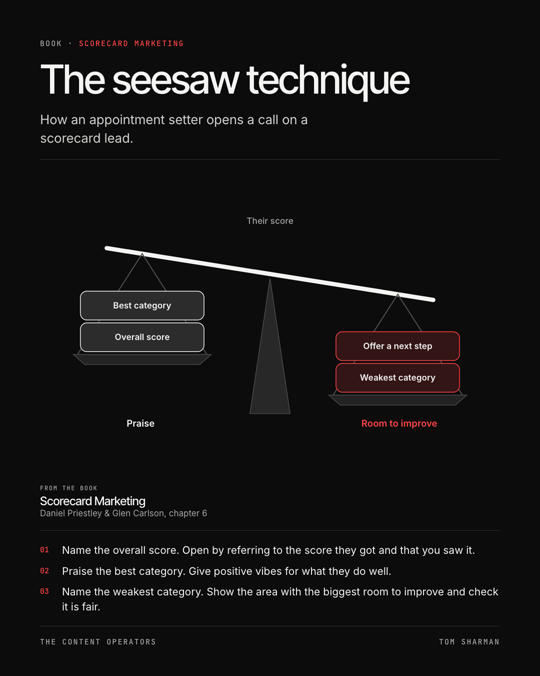
How an appointment setter opens a call on a scorecard lead.
- Name the overall score. Open by referring to the score they got and that you saw it.
- Praise the best category. Give positive vibes for what they do well.
- Name the weakest category. Show the area with the biggest room to improve and check it is fair.
- Offer a next step. Send a book or a workshop pass aimed at the weak area and take their details.
From chapter: PART TWO SETTING UP A SCORECARD, pp. 47–128
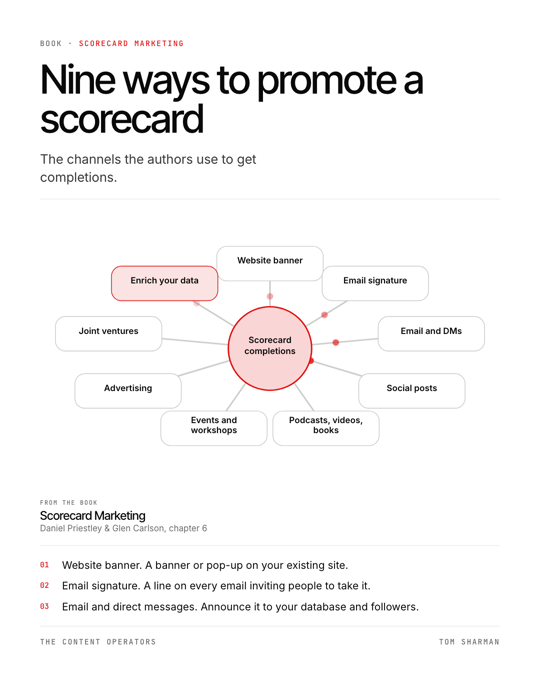
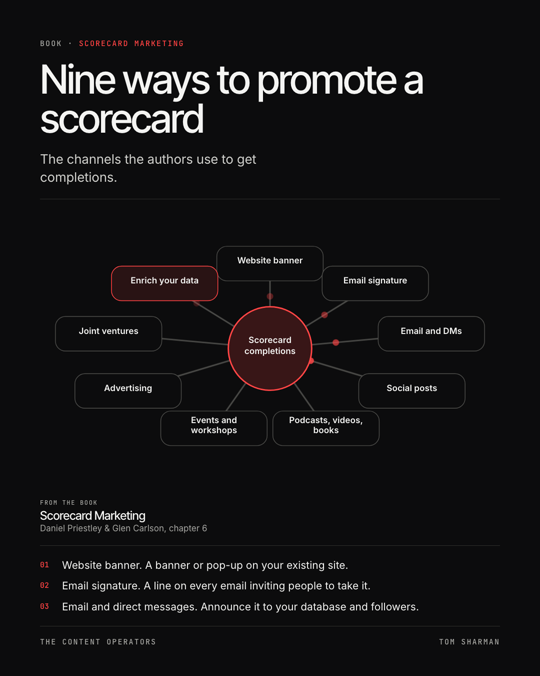
The channels the authors use to get completions.
- Website banner. A banner or pop-up on your existing site.
- Email signature. A line on every email inviting people to take it.
- Email and direct messages. Announce it to your database and followers.
- Social profiles and posts. Post about it, then post the statistics later.
- Podcasts, videos, blogs and books. Make it the next step after your content.
- Events and workshops. Use it before, during or after to learn about attendees.
- Advertising. Work out an allowable cost per lead and per sale first.
- Joint venture partnerships. Cross-promote with non-competitors and pay a fee per completed scorecard.
- Enrich and segment your data. Run your existing list through it to deepen each record.
From chapter: PART TWO SETTING UP A SCORECARD, pp. 47–128
Working with Tom on this
Tom works with creators and founders one to one, from a single session to a fractional role. Work with Tom
Back to the bookshelf