What it argues
Priestley argues that profit only exists where demand exceeds supply, so a business should engineer that imbalance on purpose instead of chasing every buyer. You build your own market of people who have spent seven hours, 11 interactions and four locations with you, then ask them for small signals before you ask for money. His Campaign-Driven Enterprise Method plans the year as weekly, quarterly and annual campaigns that each run through six phases, from capacity planning and build-up to an oversubscribed release, sales follow-through, remarkable delivery and celebration. He says value now sits in implementation and the surrounding ecosystem, so give ideas away and charge for results. The method depends on honest capacity, a trusted personal brand, firm terms and a small aligned team of four roles. The close widens this into a call to campaign for contribution, not only sales.
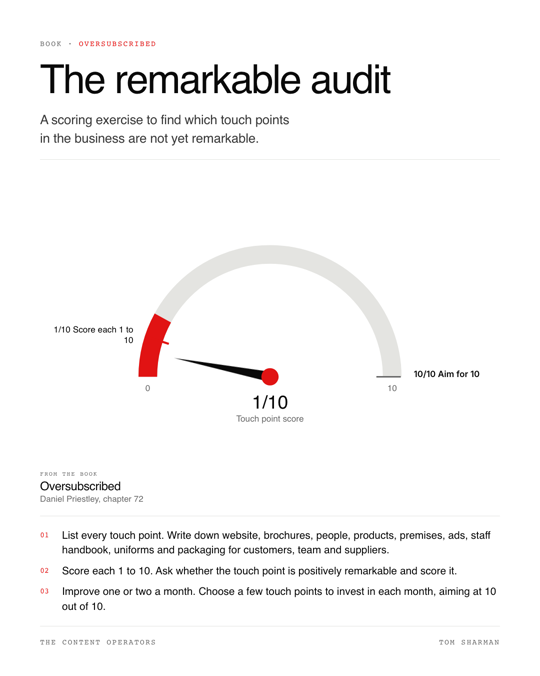
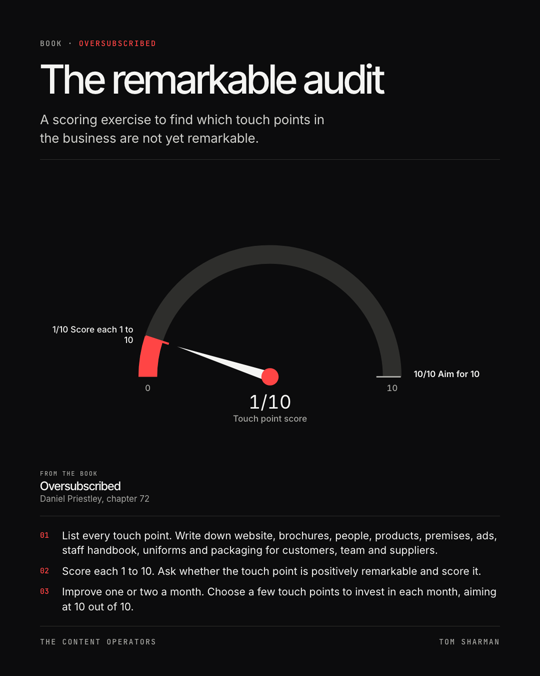
Every framework, step by step
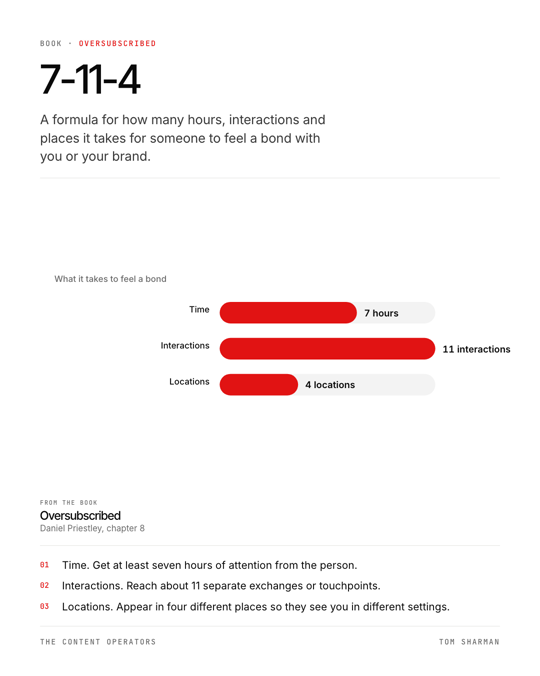
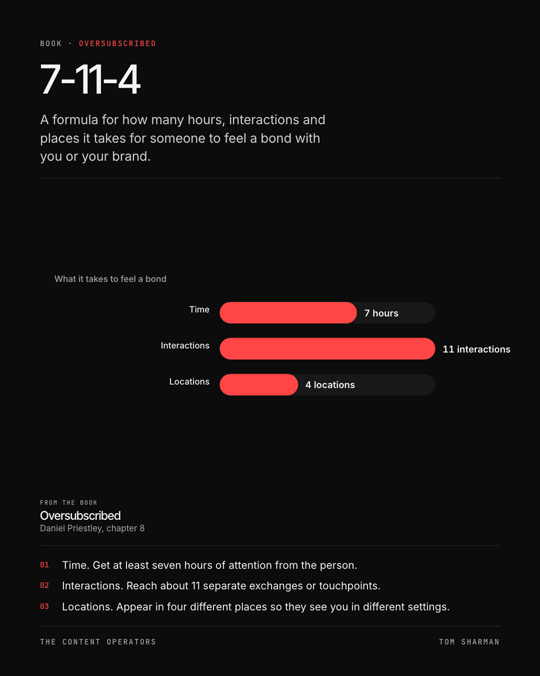
A formula for how many hours, interactions and places it takes for someone to feel a bond with you or your brand.
- Time. Get at least seven hours of attention from the person.
- Interactions. Reach about 11 separate exchanges or touchpoints.
- Locations. Appear in four different places so they see you in different settings.
From chapter: FAMOUS FOR A FEW, pp. 33–37
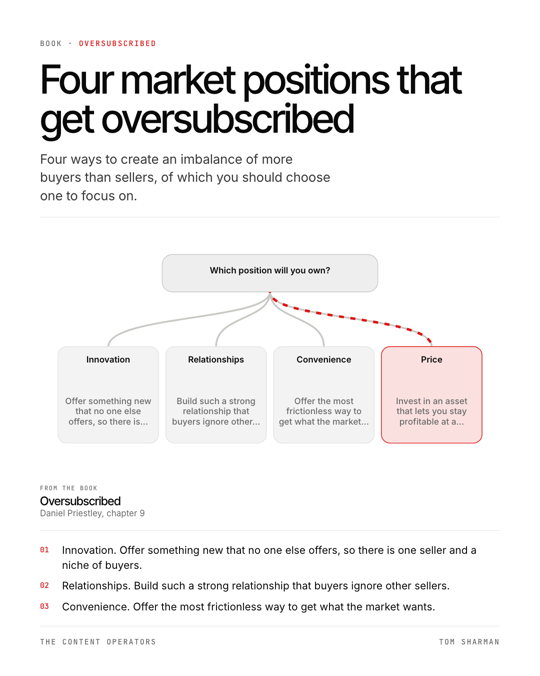
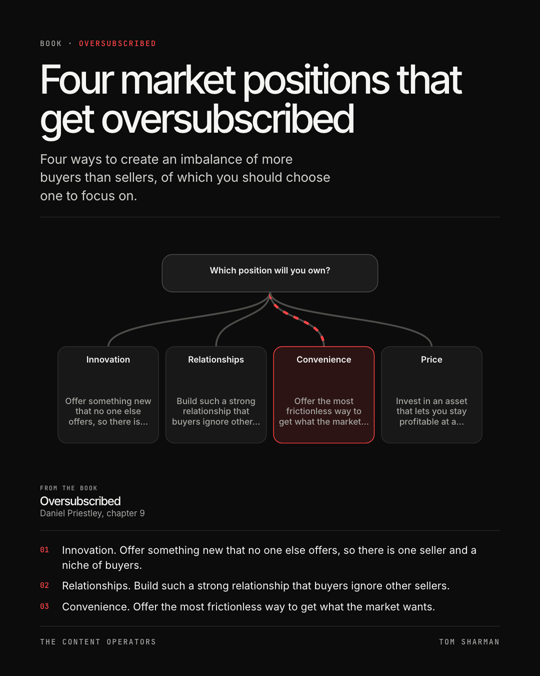
Four ways to create an imbalance of more buyers than sellers, of which you should choose one to focus on.
- Innovation. Offer something new that no one else offers, so there is one seller and a niche of buyers.
- Relationships. Build such a strong relationship that buyers ignore other sellers.
- Convenience. Offer the most frictionless way to get what the market wants.
- Price. Invest in an asset that lets you stay profitable at a lower price than rivals can match.
From chapter: PRINCIPLE 3: FIRST MAKE YOUR MARKET THEN MAKE YOUR SALES, pp. 38–44
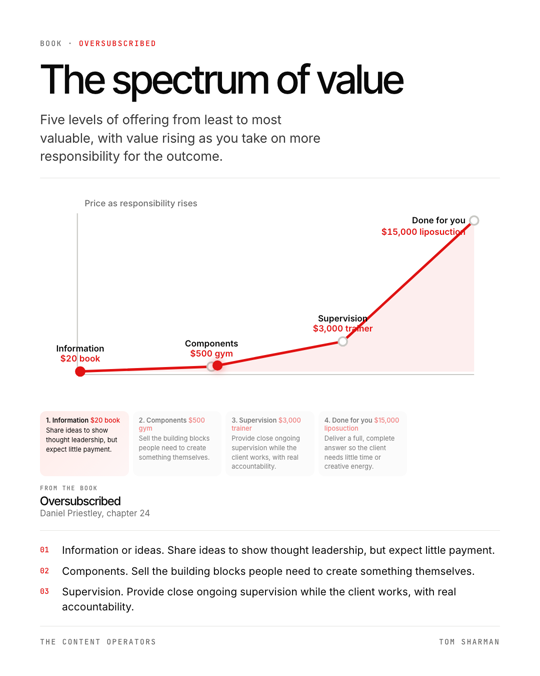
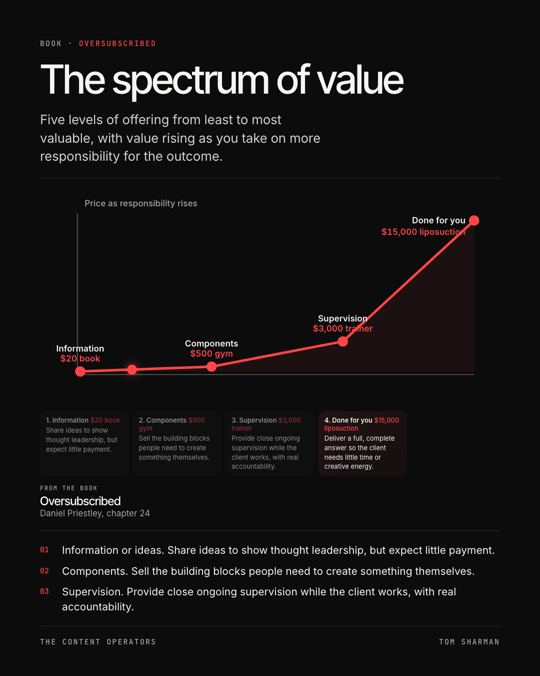
Five levels of offering from least to most valuable, with value rising as you take on more responsibility for the outcome.
- Information or ideas. Share ideas to show thought leadership, but expect little payment.
- Components. Sell the building blocks people need to create something themselves.
- Supervision. Provide close ongoing supervision while the client works, with real accountability.
- Done with you. Work with the client to create the outcome, each providing some of the work.
- Done for you. Deliver a full, complete answer so the client needs little time or creative energy.
From chapter: GIVE AWAY IDEAS, CHARGE FOR IMPLEMENTATION, pp. 76–78
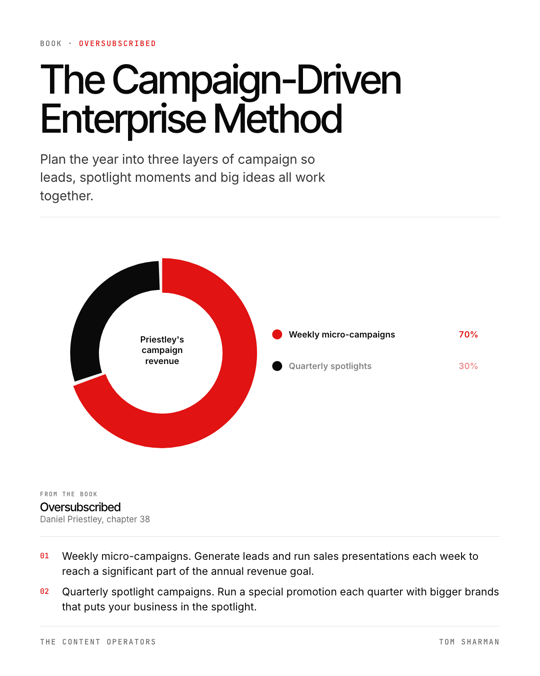
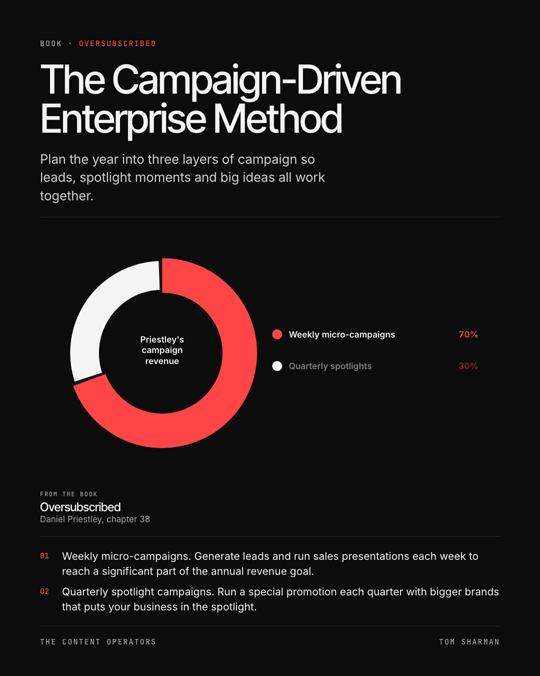
Plan the year into three layers of campaign so leads, spotlight moments and big ideas all work together.
- Weekly micro-campaigns. Generate leads and run sales presentations each week to reach a significant part of the annual revenue goal.
- Quarterly spotlight campaigns. Run a special promotion each quarter with bigger brands that puts your business in the spotlight.
- Annual big message campaign. Share educational and entertaining big ideas through the year to stay relevant and sharable.
From chapter: THE CAMPAIGN‐DRIVEN ENTERPRISE METHOD, pp. 106–109
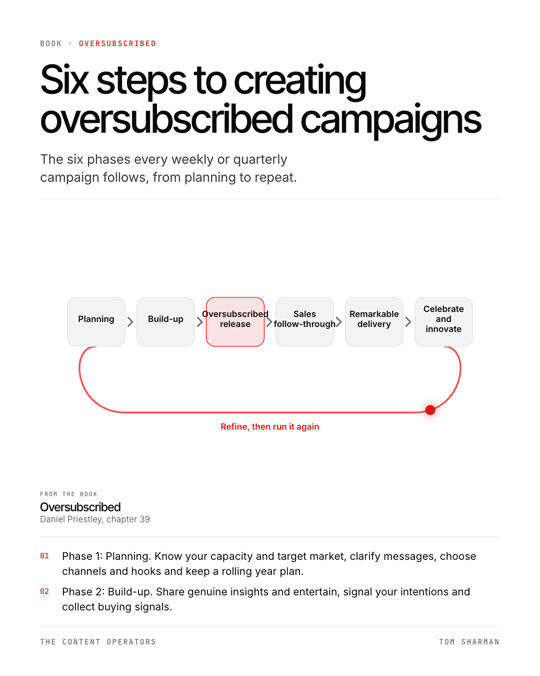
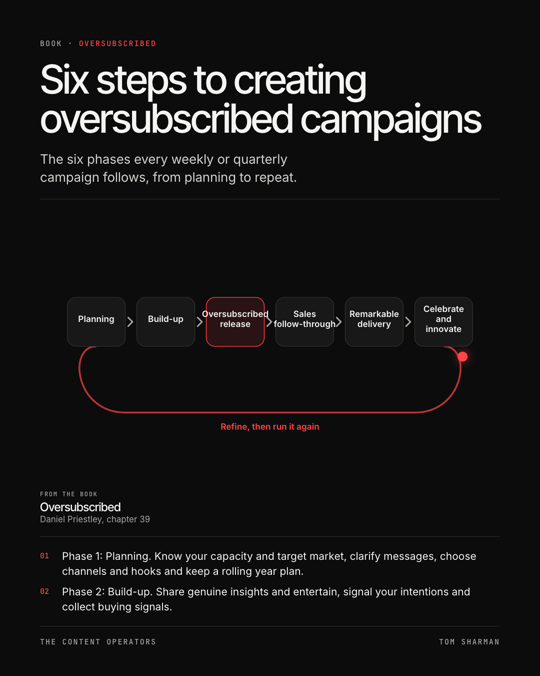
The six phases every weekly or quarterly campaign follows, from planning to repeat.
- Phase 1: Planning. Know your capacity and target market, clarify messages, choose channels and hooks and keep a rolling year plan.
- Phase 2: Build-up. Share genuine insights and entertain, signal your intentions and collect buying signals.
- Phase 3: Oversubscribed release. Highlight the imbalance of signalled interest against limited availability, release, and let some miss out.
- Phase 4: Sales follow-through. Follow up proactively, keep accurate data and encourage referrals.
- Phase 5: Remarkable delivery. Deliver beyond the expectations that were created.
- Phase 6: Celebrate and innovate. Tell the stories, share the numbers, learn the lessons and refine before repeating.
From chapter: SIX STEPS TO CREATING OVERSUBSCRIBED CAMPAIGNS, pp. 110–113
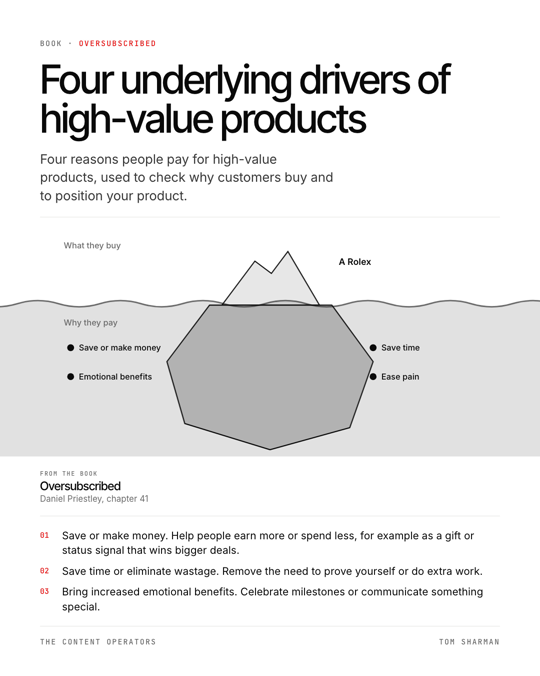
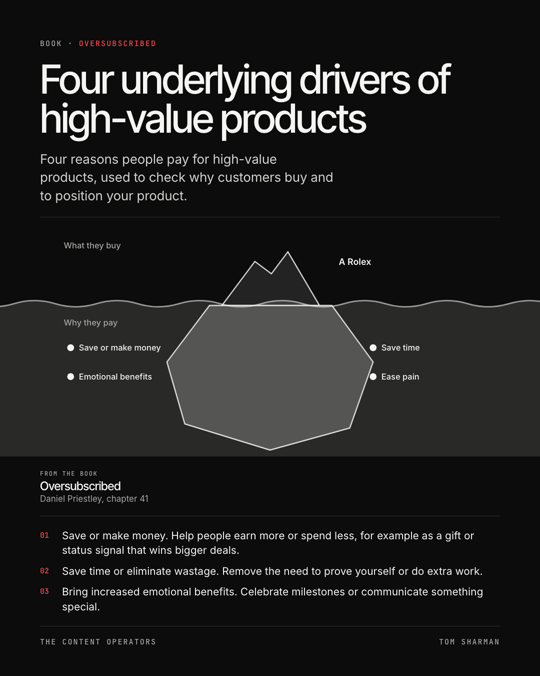
Four reasons people pay for high-value products, used to check why customers buy and to position your product.
- Save or make money. Help people earn more or spend less, for example as a gift or status signal that wins bigger deals.
- Save time or eliminate wastage. Remove the need to prove yourself or do extra work.
- Bring increased emotional benefits. Celebrate milestones or communicate something special.
- Ease pain, suffering or negative emotions. Replace feelings of being unrewarded or unappreciated with positive ones.
From chapter: IT BEGINS WITH A HAPPY CUSTOMER, pp. 115–118
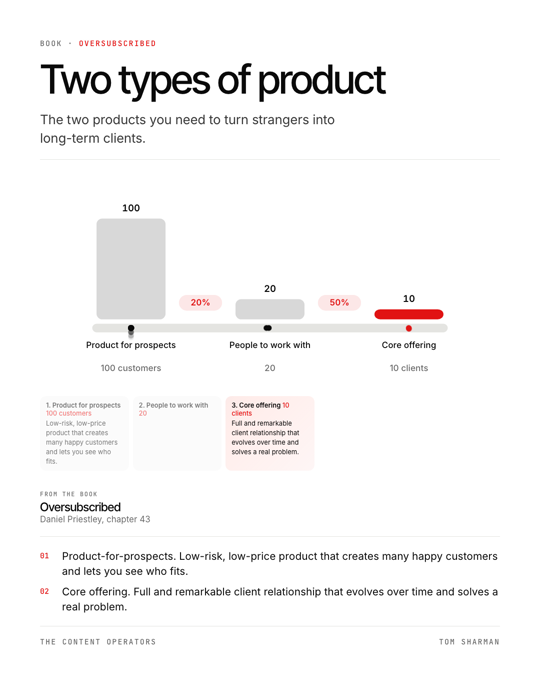
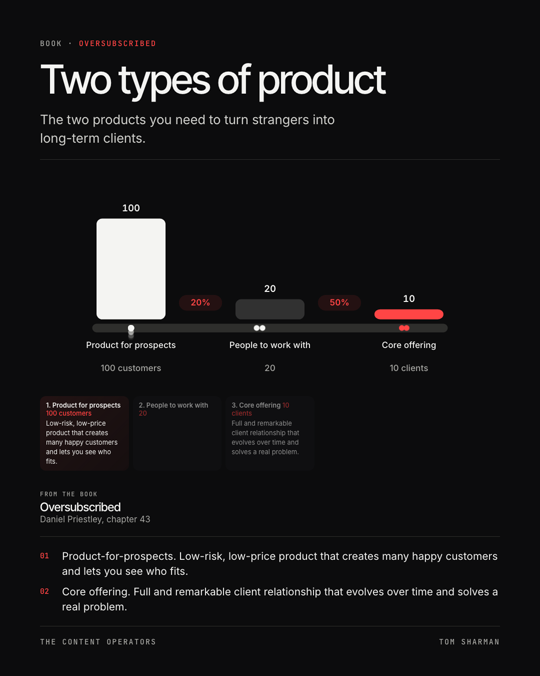
The two products you need to turn strangers into long-term clients.
- Product-for-prospects. Low-risk, low-price product that creates many happy customers and lets you see who fits.
- Core offering. Full and remarkable client relationship that evolves over time and solves a real problem.
From chapter: CLIENTS VERSUS CUSTOMERS, pp. 121–121
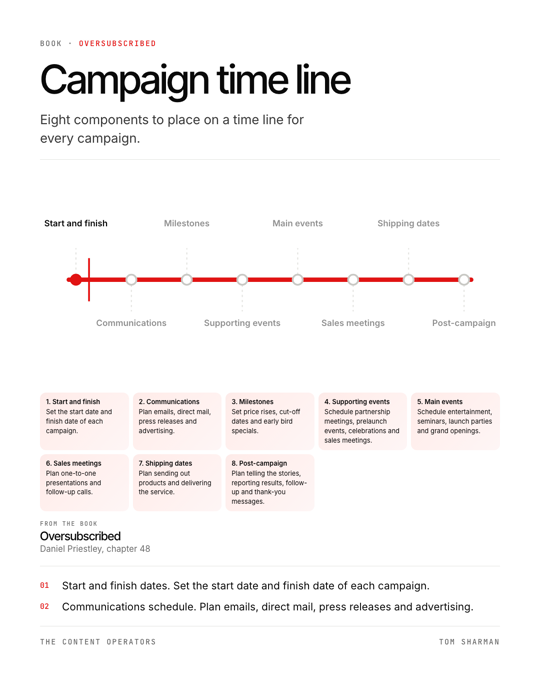
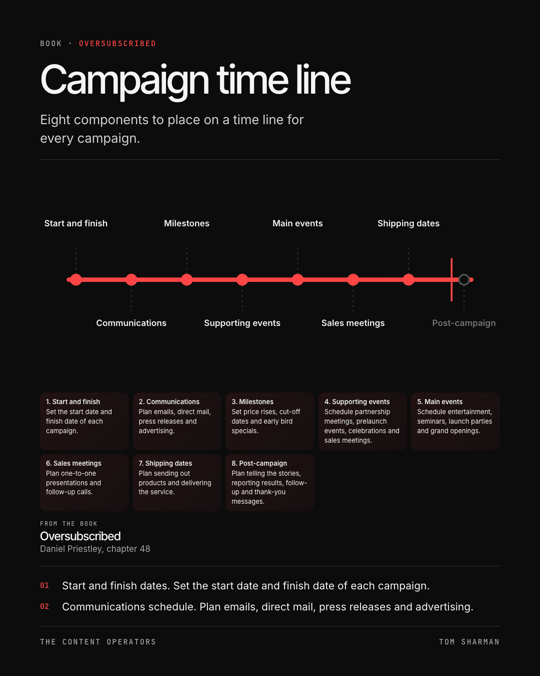
Eight components to place on a time line for every campaign.
- Start and finish dates. Set the start date and finish date of each campaign.
- Communications schedule. Plan emails, direct mail, press releases and advertising.
- Milestones. Set price rises, cut-off dates and early bird specials.
- Supporting events. Schedule partnership meetings, prelaunch events, celebrations and sales meetings.
- Main events. Schedule entertainment, seminars, launch parties and grand openings.
- Sales meetings. Plan one-to-one presentations and follow-up calls.
- Shipping dates. Plan sending out products and delivering the service.
- Post-campaign activity. Plan telling the stories, reporting results, follow-up and thank-you messages.
From chapter: CREATE A CAMPAIGN TIME LINE, pp. 131–133
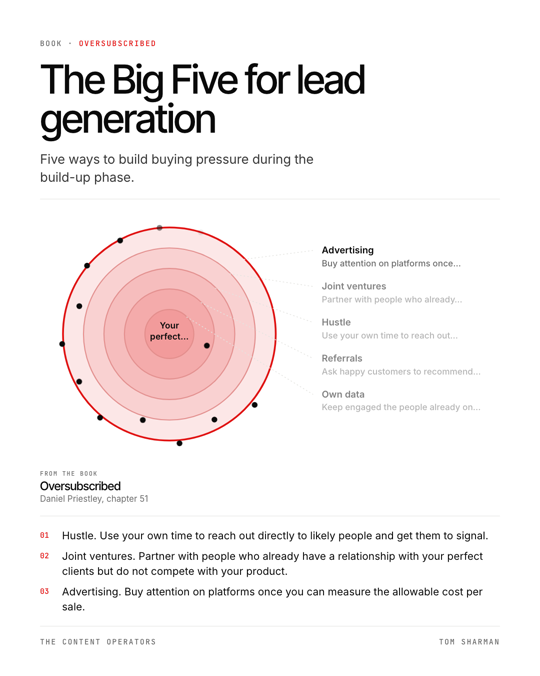
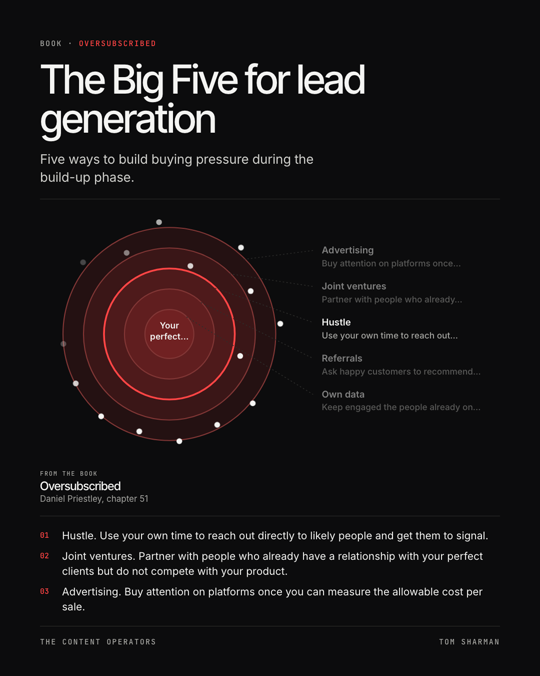
Five ways to build buying pressure during the build-up phase.
- Hustle. Use your own time to reach out directly to likely people and get them to signal.
- Joint ventures. Partner with people who already have a relationship with your perfect clients but do not compete with your product.
- Advertising. Buy attention on platforms once you can measure the allowable cost per sale.
- Referrals. Ask happy customers to recommend you or incentivise them.
- Own data. Keep engaged the people already on your database and followers, since they may buy later.
From chapter: THE BIG FIVE FOR LEAD GENERATION, pp. 137–138
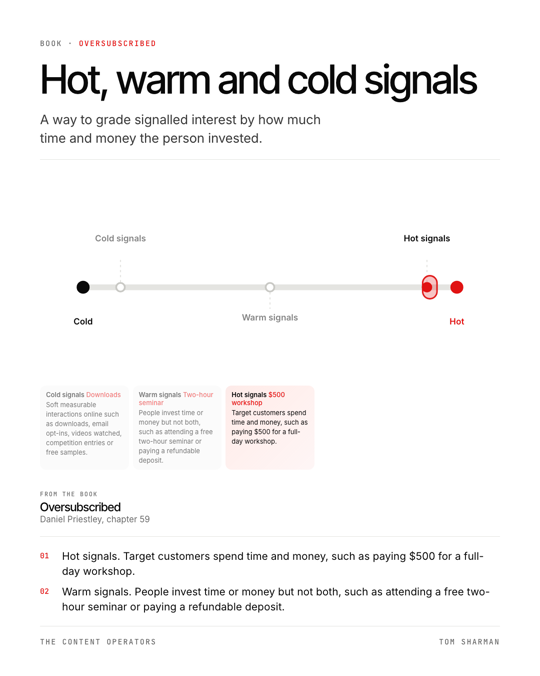
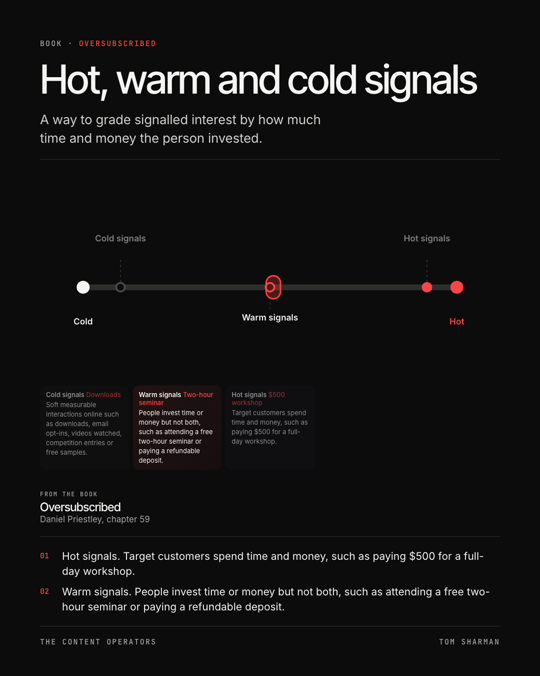
A way to grade signalled interest by how much time and money the person invested.
- Hot signals. Target customers spend time and money, such as paying $500 for a full-day workshop.
- Warm signals. People invest time or money but not both, such as attending a free two-hour seminar or paying a refundable deposit.
- Cold signals. Soft measurable interactions online such as downloads, email opt-ins, videos watched, competition entries or free samples.
From chapter: PHASE 3: OVERSUBSCRIBED RELEASE: COMMUNICATING DEMAND AND SUPPLY TENSION BEFORE ALLOWING PEOPLE TO BUY, pp. 150–152
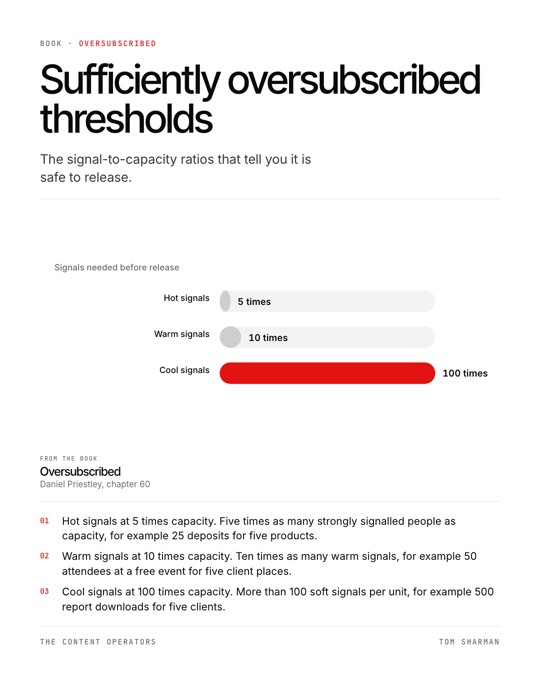
The signal-to-capacity ratios that tell you it is safe to release.
- Hot signals at 5 times capacity. Five times as many strongly signalled people as capacity, for example 25 deposits for five products.
- Warm signals at 10 times capacity. Ten times as many warm signals, for example 50 attendees at a free event for five client places.
- Cool signals at 100 times capacity. More than 100 soft signals per unit, for example 500 report downloads for five clients.
From chapter: SUFFICIENTLY OVERSUBSCRIBE YOUR CAPACITY, pp. 153–153
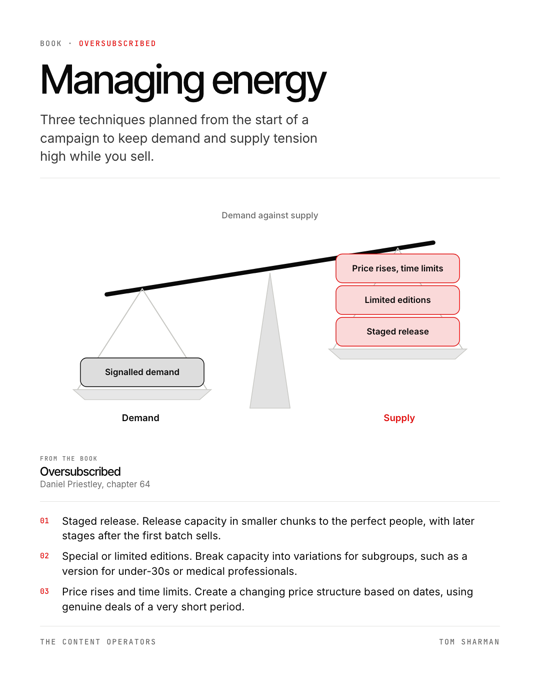
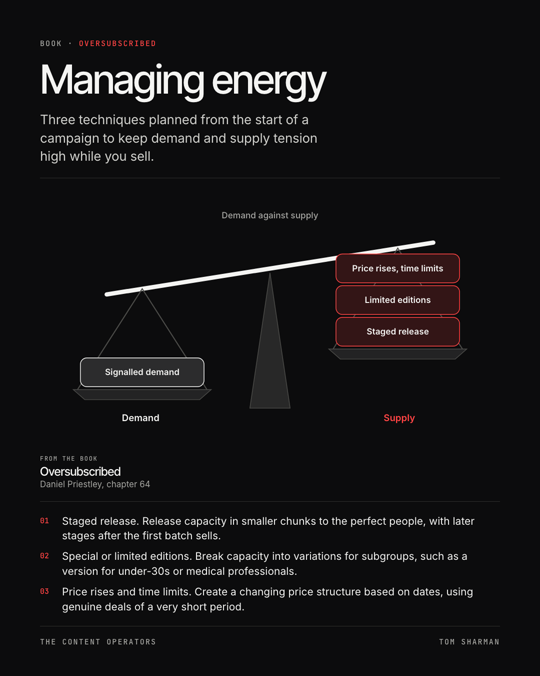
Three techniques planned from the start of a campaign to keep demand and supply tension high while you sell.
- Staged release. Release capacity in smaller chunks to the perfect people, with later stages after the first batch sells.
- Special or limited editions. Break capacity into variations for subgroups, such as a version for under-30s or medical professionals.
- Price rises and time limits. Create a changing price structure based on dates, using genuine deals of a very short period.
From chapter: MANAGING ENERGY, pp. 159–164
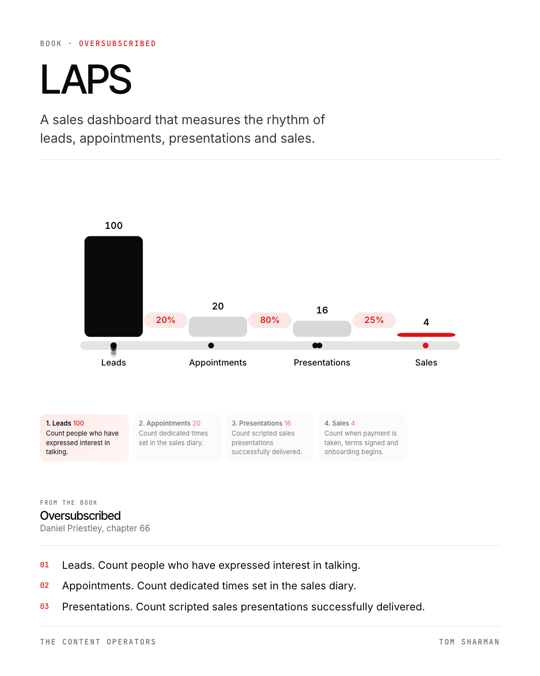
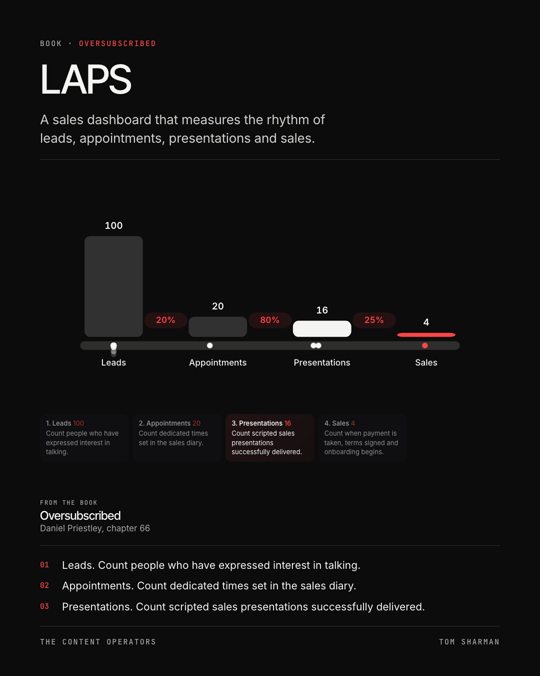
A sales dashboard that measures the rhythm of leads, appointments, presentations and sales.
- Leads. Count people who have expressed interest in talking.
- Appointments. Count dedicated times set in the sales diary.
- Presentations. Count scripted sales presentations successfully delivered.
- Sales. Count when payment is taken, terms signed and onboarding begins.
From chapter: THERE'S A RHYTHM TO SUCCESSFUL SALES, pp. 167–168
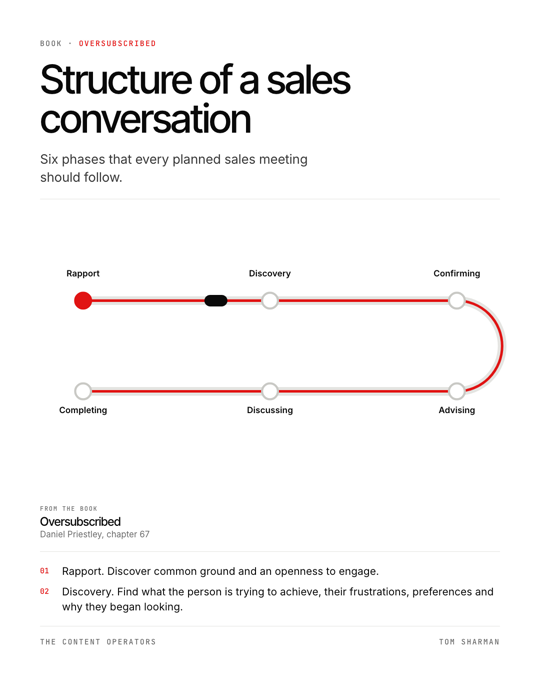
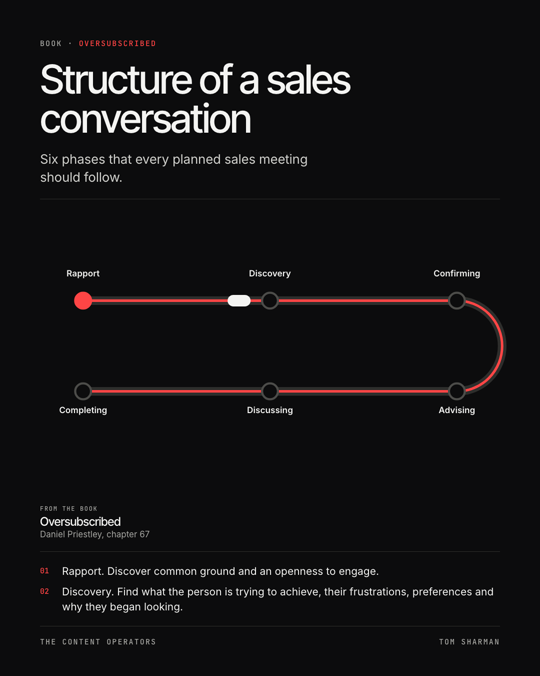
Six phases that every planned sales meeting should follow.
- Rapport. Discover common ground and an openness to engage.
- Discovery. Find what the person is trying to achieve, their frustrations, preferences and why they began looking.
- Confirming. Check the information and be sure you can make a recommendation.
- Advising. Share insights, methods and solutions with the key features, advantages and benefits.
- Discussing. Test fit, tailor the solution and negotiate flexible parts.
- Completing. Confirm the sale, do the admin and update the CRM with next steps.
From chapter: THERE'S A STRUCTURE TO SUCCESSFUL SALES CONVERSATIONS, pp. 169–169
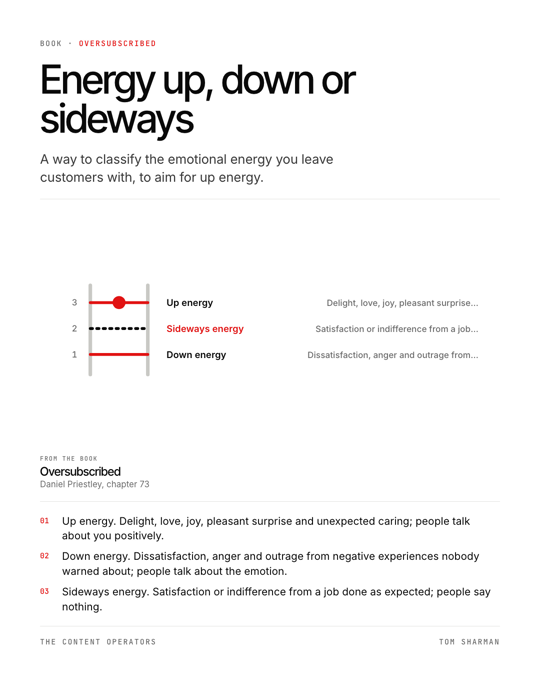
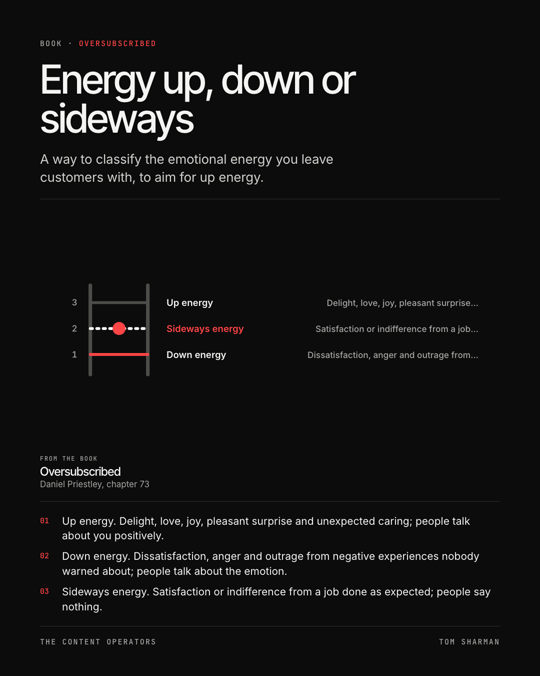
A way to classify the emotional energy you leave customers with, to aim for up energy.
- Up energy. Delight, love, joy, pleasant surprise and unexpected caring; people talk about you positively.
- Down energy. Dissatisfaction, anger and outrage from negative experiences nobody warned about; people talk about the emotion.
- Sideways energy. Satisfaction or indifference from a job done as expected; people say nothing.
From chapter: ENERGY UP, DOWN OR SIDEWAYS, pp. 176–178
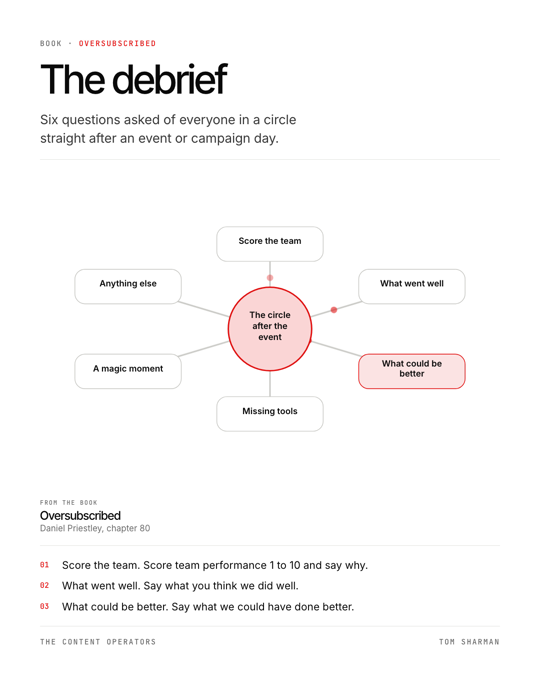
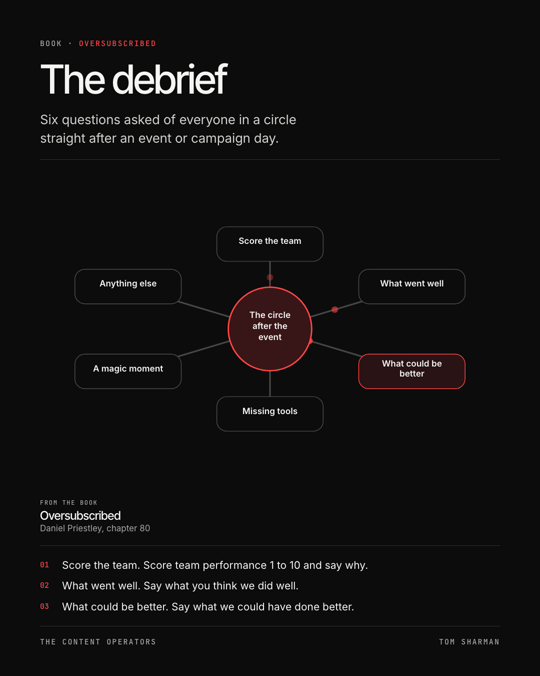
Six questions asked of everyone in a circle straight after an event or campaign day.
- Score the team. Score team performance 1 to 10 and say why.
- What went well. Say what you think we did well.
- What could be better. Say what we could have done better.
- Missing tools or assets. Say what tools or assets we wish we had at the event.
- A magic moment. Share a magic moment you noticed.
- Anything else. Add anything else.
From chapter: THE DEBRIEF, pp. 192–192
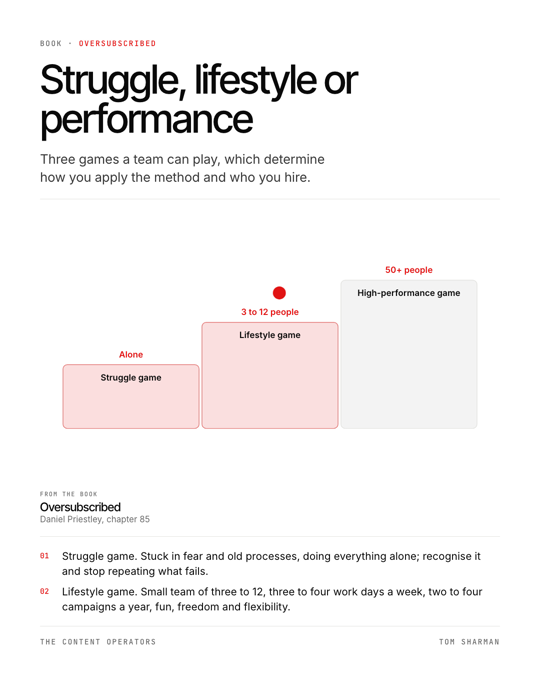
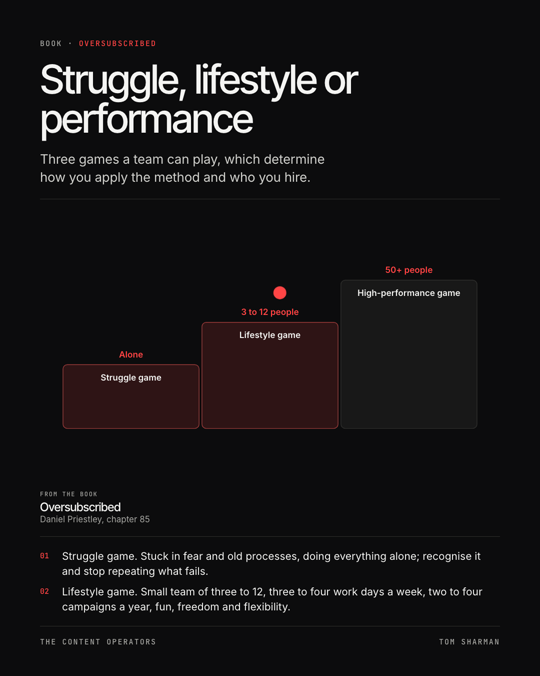
Three games a team can play, which determine how you apply the method and who you hire.
- Struggle game. Stuck in fear and old processes, doing everything alone; recognise it and stop repeating what fails.
- Lifestyle game. Small team of three to 12, three to four work days a week, two to four campaigns a year, fun, freedom and flexibility.
- High-performance game. 50+ hours a week, 50+ people, 50+ cities, use campaigns to fill capacity, raise it and raise funding.
From chapter: STRUGGLE, LIFESTYLE OR PERFORMANCE?, pp. 202–204
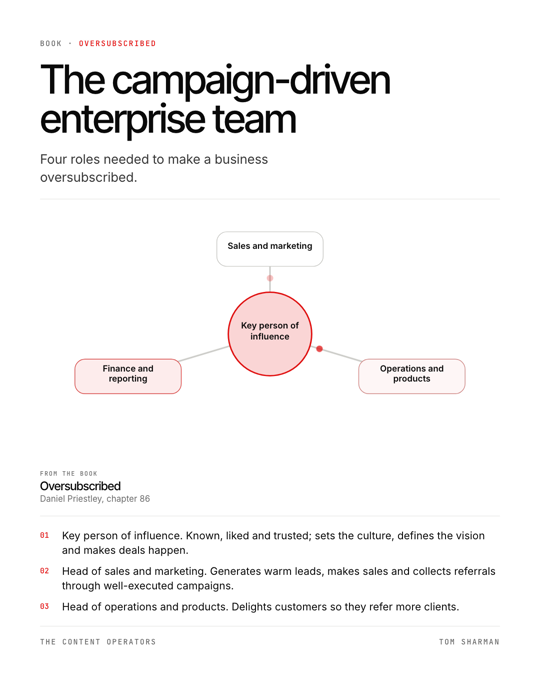
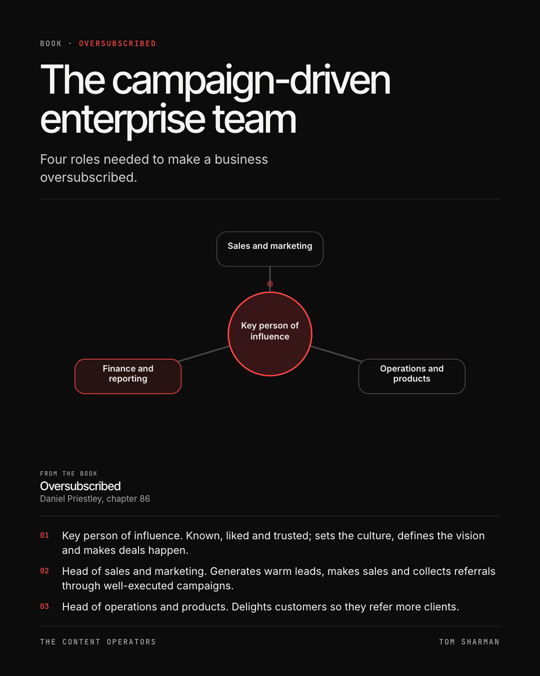
Four roles needed to make a business oversubscribed.
- Key person of influence. Known, liked and trusted; sets the culture, defines the vision and makes deals happen.
- Head of sales and marketing. Generates warm leads, makes sales and collects referrals through well-executed campaigns.
- Head of operations and products. Delights customers so they refer more clients.
- Head of finance, logistics and reporting. Manages money and numbers, efficiencies, reports, compliance, purchasing and payments.
From chapter: THE CAMPAIGN‐DRIVEN ENTERPRISE TEAM, pp. 205–205
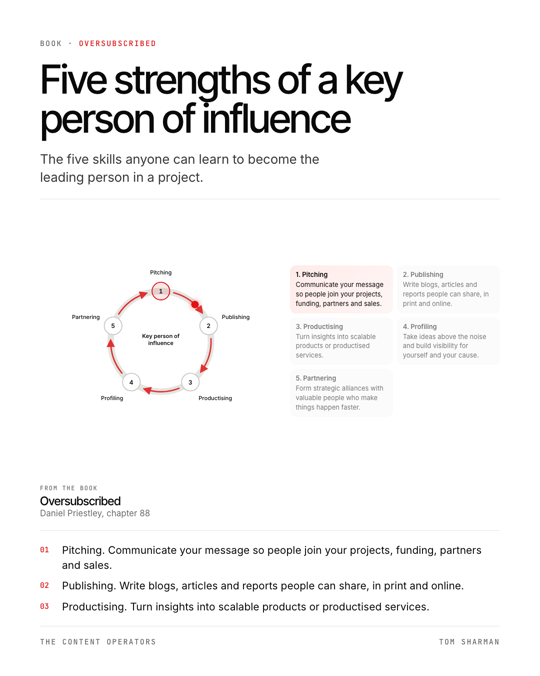
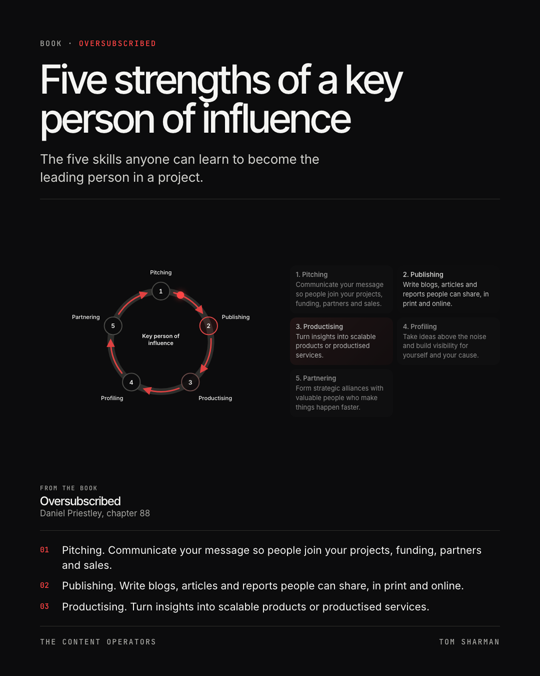
The five skills anyone can learn to become the leading person in a project.
- Pitching. Communicate your message so people join your projects, funding, partners and sales.
- Publishing. Write blogs, articles and reports people can share, in print and online.
- Productising. Turn insights into scalable products or productised services.
- Profiling. Take ideas above the noise and build visibility for yourself and your cause.
- Partnering. Form strategic alliances with valuable people who make things happen faster.
From chapter: THE CORE ROLES OF YOUR CAMPAIGN DRIVEN ENTERPRISE TEAM, pp. 207–218
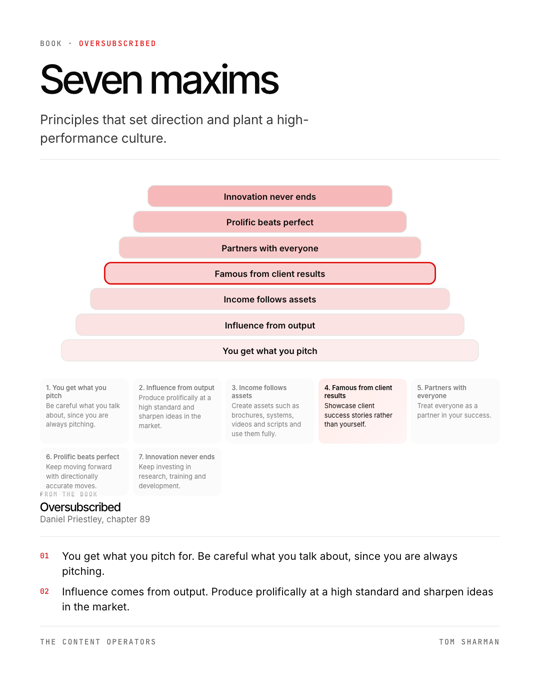
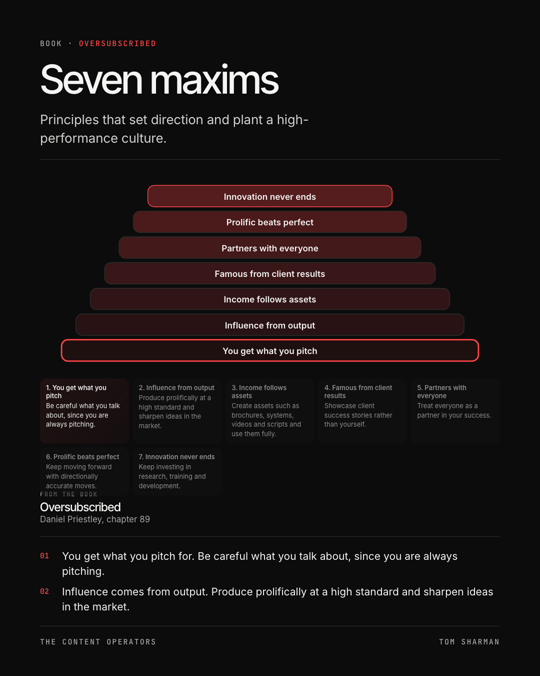
Principles that set direction and plant a high-performance culture.
- You get what you pitch for. Be careful what you talk about, since you are always pitching.
- Influence comes from output. Produce prolifically at a high standard and sharpen ideas in the market.
- Income follows assets. Create assets such as brochures, systems, videos and scripts and use them fully.
- We get famous from the results of our clients. Showcase client success stories rather than yourself.
- We are in partnership with everyone who touches our business. Treat everyone as a partner in your success.
- Prolific beats perfect. Keep moving forward with directionally accurate moves.
- Innovation never ends. Keep investing in research, training and development.
From chapter: CREATING CULTURE FROM THE BEGINNING, pp. 219–220