Bookshelf
How Tom uses this
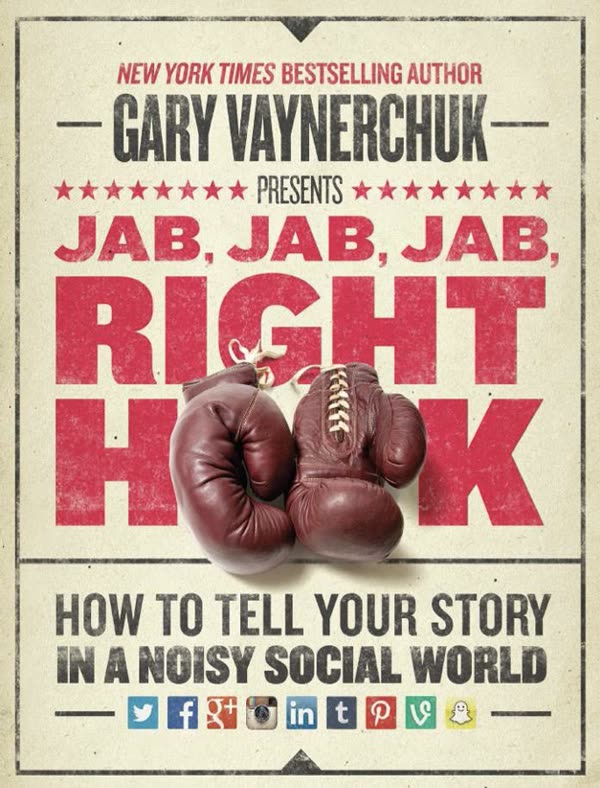
Jab, Jab, Jab, Right Hook backs three of Tom's lessons. Under each of his lessons, what the book says about it, and on which pages.
- People online are selfish, so lead with what they get
The book's give, give, give, ask model says content must serve what the audience values before the brand asks for anything. pp. 35, 63 and 66. In the book: The three characteristics of a perfect right hook, The sweet science loop, The six rules of outstanding content, The three kinds of jab.
- Two to three a day, LinkedIn five times a weekday
The book argues that there is only a 365-day campaign with new content daily, and that social marketing is a 24-7 job. pp. 36, 71 and 72. In the book: The three characteristics of a perfect right hook, The sweet science loop, The six rules of outstanding content, The three kinds of jab.
- Short form first, LinkedIn on winners, YouTube last
The book tests content for free on the cheap platform and pays to push only the winners, and uses the biggest following to feed a new platform. pp. 102 and 207. In the book: The sponsored story filter, Questions to ask when creating Facebook micro-content, Trendjacking.
What it argues
Vaynerchuk argues that social media marketing works only when a brand earns the right to ask. Every platform has its own language, so content has to be native, short and built for the place where it appears, and a brand has to give value again and again (the jabs) before it makes a sales ask (the right hook). Context matters as much as content, and effort decides who wins, because a small team that listens, replies and tests daily can beat a larger and lazier rival. He also expects every company to become a media company that owns its audience instead of renting attention. The case studies show the same few mistakes over and over: no logo, too much text, dead links, bad timing and ignoring the community.
Worth keeping
- Give, give, give, give, give, then ask. Goodwill from jabs makes the right hook land (p. 66).
- Content is king, context is God, and effort completes the trinity (p. 53, p. 343).
- Every platform has its own language, so repurposed content gets ignored (p. 33).
- There is no six-month campaign, only a 365-day campaign with new content daily (p. 36).
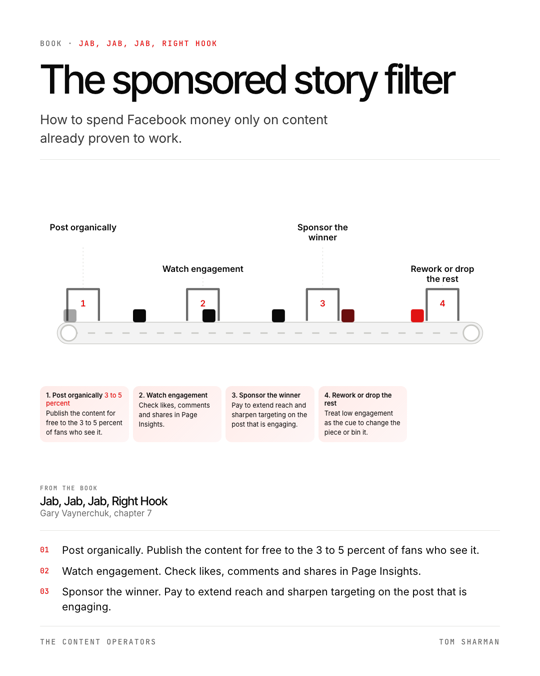
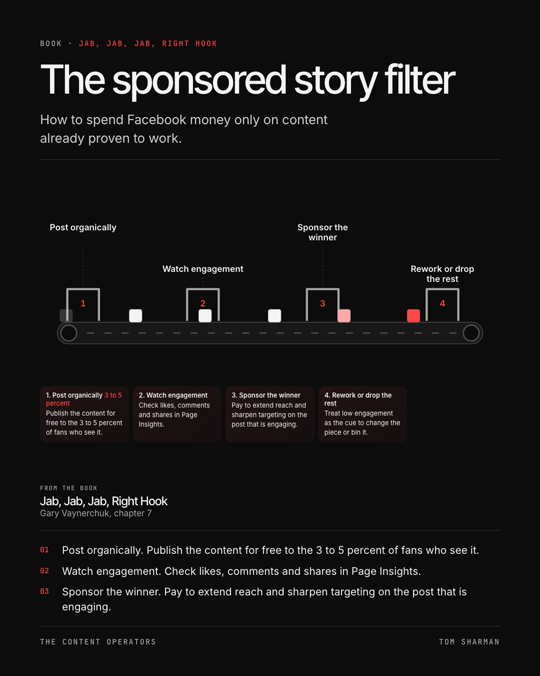
- Use free organic posts as a test, and pay to push only what already engages (p. 102).
- Facebook rewards shares and engagement over sales, so the best content is the most shareable (p. 83).
- Put the logo on the picture, keep copy short, link to the exact page, and mind the time zone of your audience (p. 168, p. 158).
- Deejay the news on Twitter: add your own opinion and context rather than posting a bare link (p. 178).
- Three calls to action in one post is the same as none (p. 215).
- Effort is the great equalizer for a small team against a larger competitor (p. 344).
- Brands can own and remarket their own media instead of renting it (p. 351).
The questions it answers
- What makes a format repeatable, as opposed to a hit that happened once?
He says the only formula that holds on every platform is micro-content plus community management, with a separate tested formula for each platform.
- How do you build a personal brand that generates inbound rather than requiring outbound?
He argues you earn the sale by giving value first, listening on Twitter and keeping the same identity everywhere, so that the ask feels almost rude to refuse.
- Which of my stories travel, and which only feel like they should?
He says to test timing, taglines and formats, read the engagement numbers, and treat content that over-indexes as the sign it travels.
- What is the smallest team that can produce at the volume I am used to?
Oreo's blackout tweet needed a team ready in advance, and he says one or two people cannot be everywhere, so a small team must win on effort and quality of conversation.
- What is content operations actually worth to a company, in money?
He compares the cost of a targeted Facebook post and sponsored story with a $7,000 to $13,000 television flight, and says owned content lowers cost with every share.
The frameworks
9 frameworks, one animation each Every framework, step by step
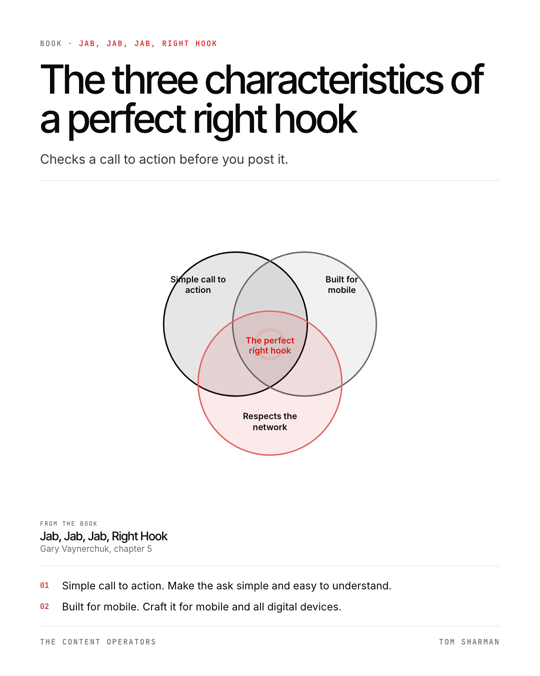
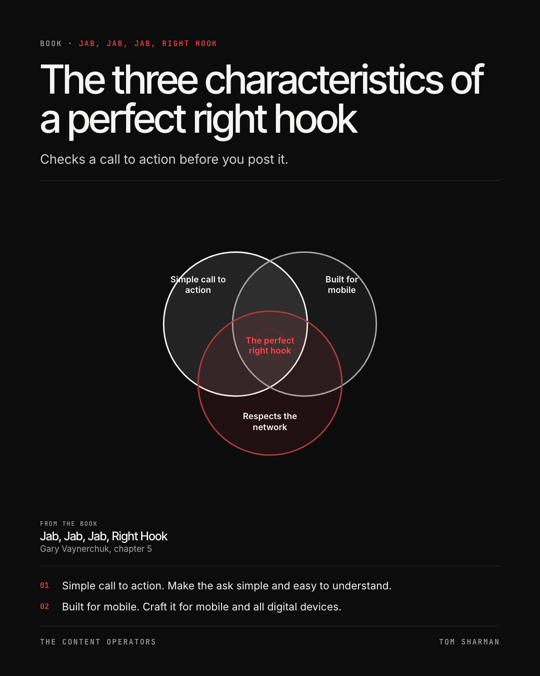
Checks a call to action before you post it.
- Simple call to action. Make the ask simple and easy to understand.
- Built for mobile. Craft it for mobile and all digital devices.
- Respects the network. Honour the nuances of the social network the content is made for.
From chapter: Round 1: The Setup, pp. 23–48
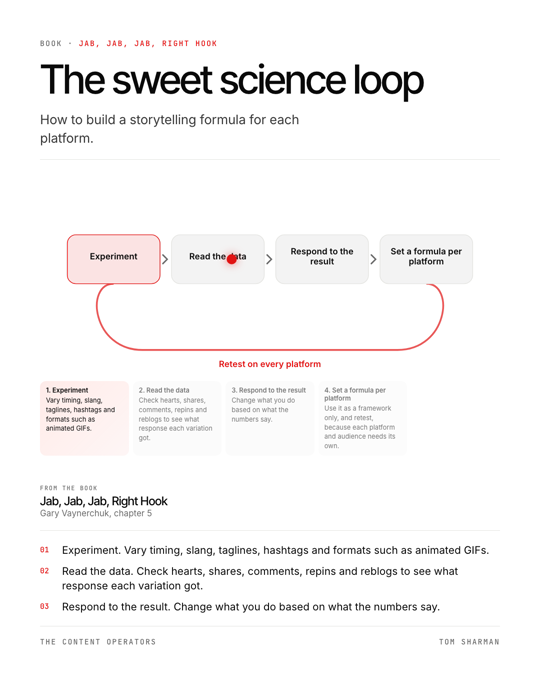
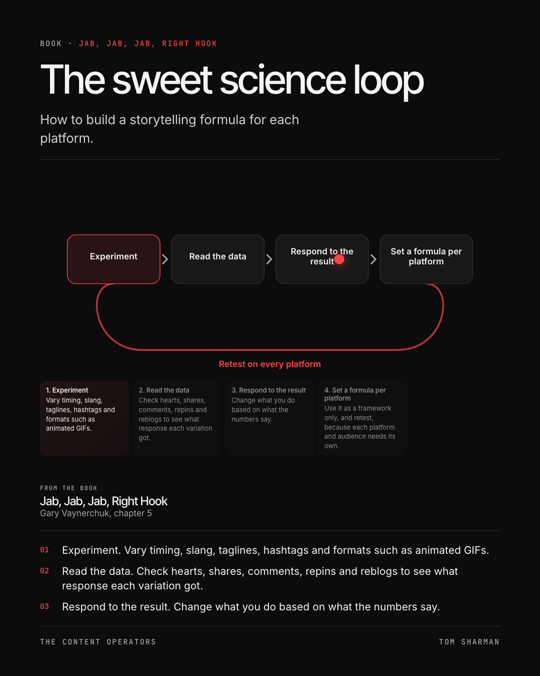
How to build a storytelling formula for each platform.
- Experiment. Vary timing, slang, taglines, hashtags and formats such as animated GIFs.
- Read the data. Check hearts, shares, comments, repins and reblogs to see what response each variation got.
- Respond to the result. Change what you do based on what the numbers say.
- Set a formula per platform. Use it as a framework only, and retest, because each platform and audience needs its own.
From chapter: Round 1: The Setup, pp. 23–48
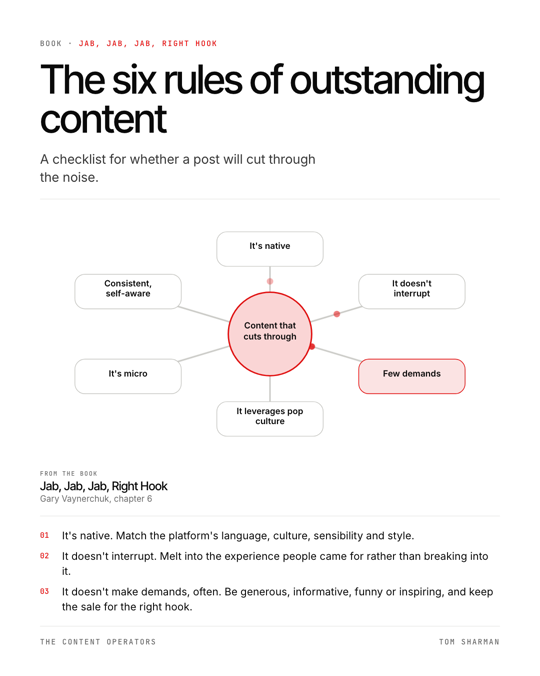
A checklist for whether a post will cut through the noise.
- It's native. Match the platform's language, culture, sensibility and style.
- It doesn't interrupt. Melt into the experience people came for rather than breaking into it.
- It doesn't make demands, often. Be generous, informative, funny or inspiring, and keep the sale for the right hook.
- It leverages pop culture. Show you know the music, gossip and news your audience follows.
- It's micro. Reimagine small pieces of content daily, in real time, in the platform's format.
- It's consistent and self-aware. Answer who we are in every post, whatever the language.
From chapter: Round 2: The Characteristics of Great Content and Compelling Stories, pp. 49–74
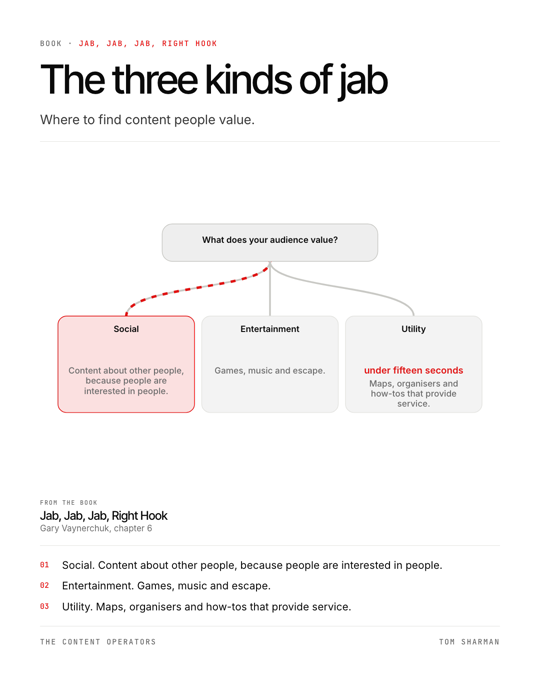
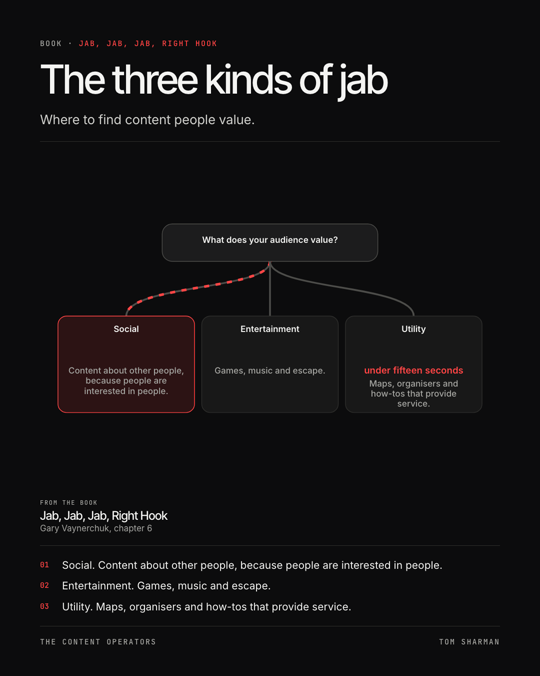
Where to find content people value.
- Social. Content about other people, because people are interested in people.
- Entertainment. Games, music and escape.
- Utility. Maps, organisers and how-tos that provide service.
From chapter: Round 2: The Characteristics of Great Content and Compelling Stories, pp. 49–74
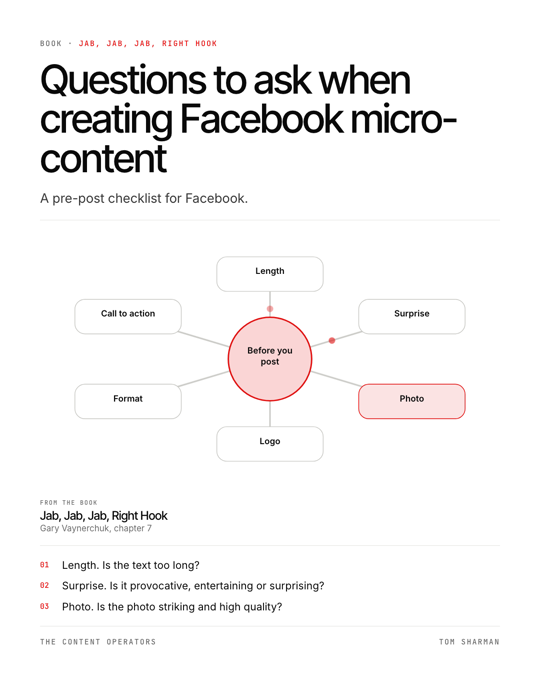
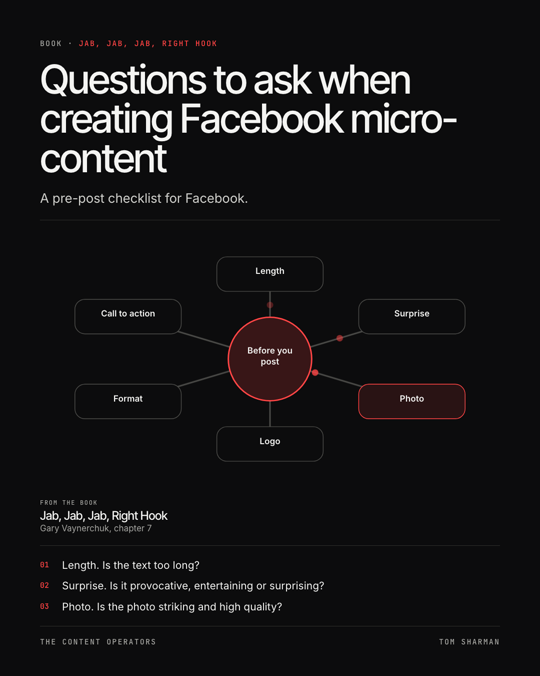
A pre-post checklist for Facebook.
- Length. Is the text too long?
- Surprise. Is it provocative, entertaining or surprising?
- Photo. Is the photo striking and high quality?
- Logo. Is the logo visible?
- Format. Have we chosen the right format for the post?
- Call to action. Is the call to action in the right place, and are we asking too much?
From chapter: Round 3: Storytell on Facebook, pp. 75–172
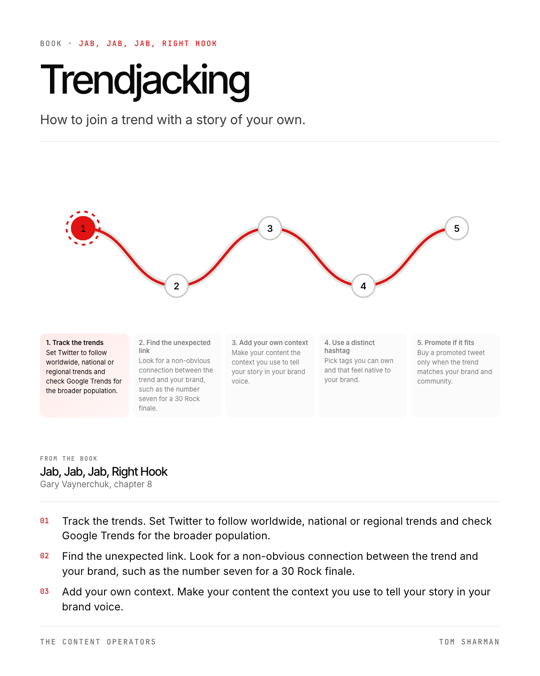
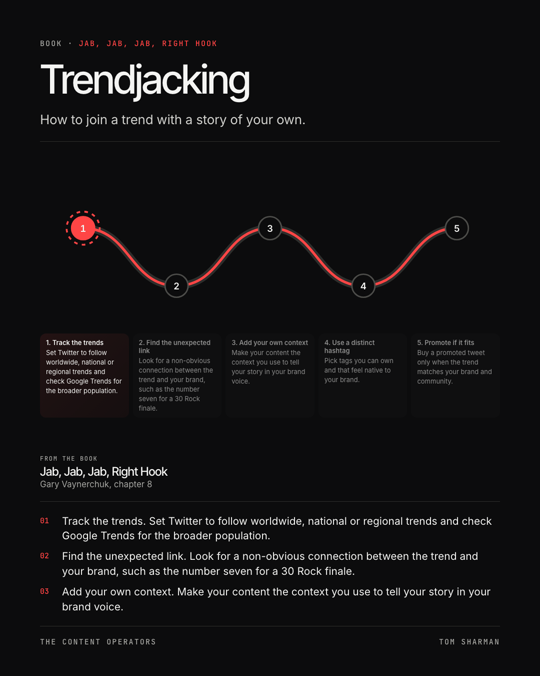
How to join a trend with a story of your own.
- Track the trends. Set Twitter to follow worldwide, national or regional trends and check Google Trends for the broader population.
- Find the unexpected link. Look for a non-obvious connection between the trend and your brand, such as the number seven for a 30 Rock finale.
- Add your own context. Make your content the context you use to tell your story in your brand voice.
- Use a distinct hashtag. Pick tags you can own and that feel native to your brand.
- Promote if it fits. Buy a promoted tweet only when the trend matches your brand and community.
From chapter: Round 4: Listen Well on Twitter, pp. 173–232
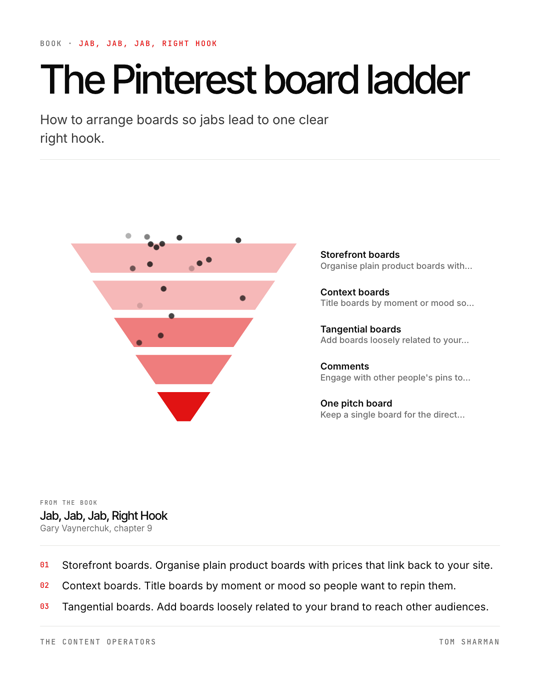
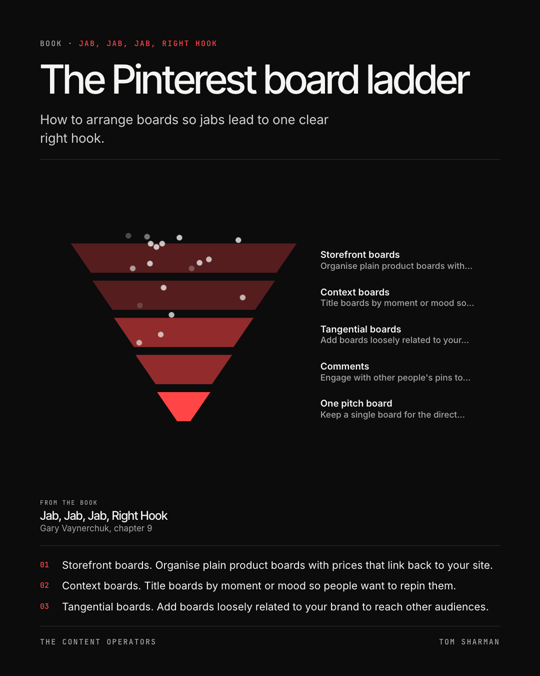
How to arrange boards so jabs lead to one clear right hook.
- Storefront boards. Organise plain product boards with prices that link back to your site.
- Context boards. Title boards by moment or mood so people want to repin them.
- Tangential boards. Add boards loosely related to your brand to reach other audiences.
- Comments. Engage with other people's pins to bring them to your page.
- One pitch board. Keep a single board for the direct sales recommendation.
From chapter: Round 5: Glam It Up on Pinterest, pp. 233–268
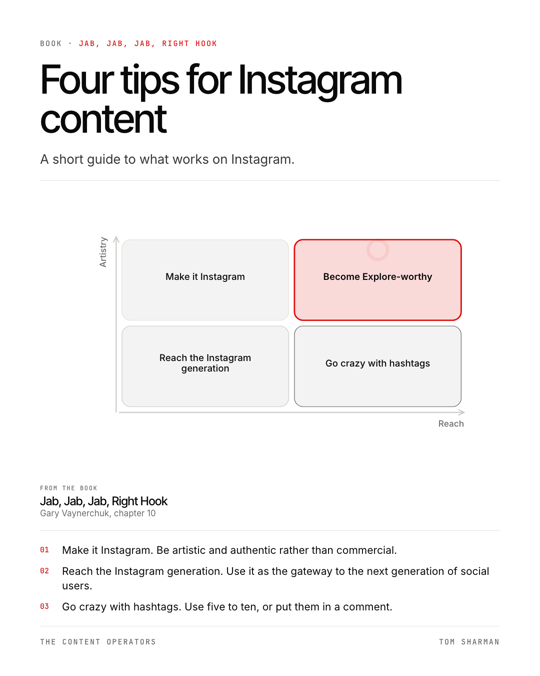
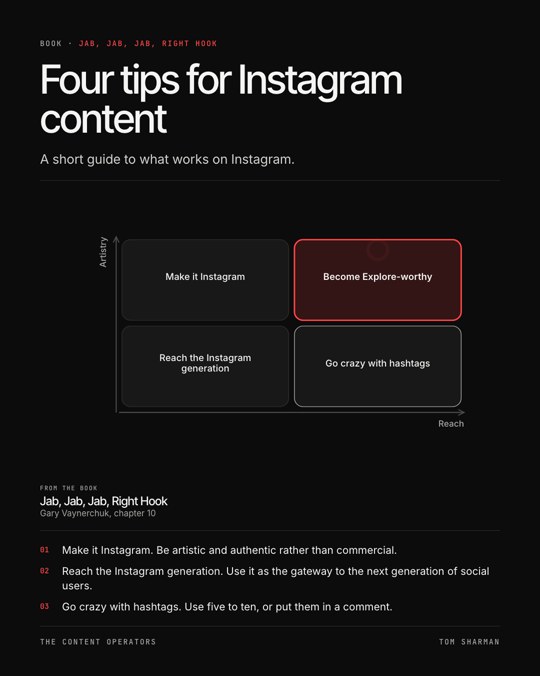
A short guide to what works on Instagram.
- Make it Instagram. Be artistic and authentic rather than commercial.
- Reach the Instagram generation. Use it as the gateway to the next generation of social users.
- Go crazy with hashtags. Use five to ten, or put them in a comment.
- Become Explore-worthy. Make the most gorgeous, evocative content to reach the Explore page.
From chapter: Round 6: Create Art on Instagram, pp. 269–294
Working with Tom on this
Tom works with creators and founders one to one, from a single session to a fractional role. Work with Tom
Back to the bookshelf