Bookshelf
How Tom uses this
Empire of AI backs three of Tom's lessons. Under each of his lessons, what the book says about it, and on which pages.
- A brand that compounds has a mission and an enemy
OpenAI shows the mechanism at industrial scale, with a grand mission and a named rival (Google, DeepMind, later China) pulling in talent, capital and public goodwill. pp. 34, 62 and 413. In the book: Big in scale, tractable, unfairly neglected, The formula for empire, The formula for dissolving empire, Consent, reciprocity and sovereignty.
- Move the people you have before you hire
Altman warned in his own memo that fast headcount growth would dilute talent density and mission fit, and the post-ChatGPT hiring surge produced exactly that culture damage. pp. 272 and 273.
- The brand is the argument
OpenAI's name, nonprofit status and 'open' claims were contradicted by how it behaved, so the claim did all the work until the gap became the story. pp. 23, 24 and 97.
What it argues
Karen Hao argues that OpenAI began as a sincere nonprofit but became an empire, because its mission to build AGI for the benefit of humanity is vague enough to justify centralising talent, capital, data, labour, land and water. Scale was a choice made by a few people in Silicon Valley and was never inevitable, and Sutskever's faith in deep learning, Altman's gift for storytelling and deal-making and Microsoft's money turned it into the industry's doctrine. The costs fall on data labellers in Kenya and Venezuela, on communities facing data centres in Chile and Uruguay, and on artists and writers whose work became training data, while the benefits accrue upward. The 2023 board crisis and the 2024 Omnicrisis show how a handful of fallible people, with no real checks, steer a technology that affects everyone. Hao closes with alternatives, small consent-based models such as Te Hiku's, and with a call to redistribute power over knowledge, resources and influence.
Worth keeping
- Mission as a formula for power: talent, capital and resources get centralised behind a vague goal that can be reinterpreted at will (p. 413).
- Altman's pattern, as reported by Murati, Sutskever and Amodei, of telling each person what they want to hear and avoiding putting things in writing, which ended in a board crisis (pp. 358, 362, 375).
- Storytelling and networks as the real assets: Altman's fundraising skill, one-word intros and small bets at volume built an empire (pp. 43, 50).
- Compute use in AI breakthroughs doubled every 3.4 months, and Hao calls scaling laws a self-fulfilling prophecy that no law of nature requires (pp. 71, 127).
- Generative AI depends on hidden human labour, with moderators paid $1.46 to $3.74 an hour and workers blacklisted when a platform decides they are no longer useful (pp. 203, 233).
- Survey of 2,500 workers: 96 percent of C-suite leaders expected generative AI to boost productivity, while 77 percent of employee users said it added to their workload (p. 28).
- Altman's own warning that growing OpenAI too fast would dilute talent density and mission alignment, which then happened after ChatGPT (pp. 272, 273).
- The employee letter showed founder dependence: over 700 of roughly 770 staff threatened to follow Altman, and Murati's equivocation helped tip the outcome (pp. 20, 379, 380).
- The GPT-2 'too dangerous to release' episode doubled as publicity and policy positioning, a pattern to watch in any AI product claim (pp. 137, 138, 139).
- Te Hiku Media's alternative: consent, reciprocity and sovereignty, a small task-specific model, 310 hours of data and two GPUs (pp. 423, 424, 425).
The questions it answers
- What does AI actually change about the shape of a content team?
The book documents the hidden annotation and moderation labour behind chatbots and a survey in which 77 percent of employee users said AI tools added to their workload.
- How do you build a personal brand that generates inbound rather than requiring outbound?
Altman's rise shows a story people want to be part of plus a dense network of small favours and one-word introductions generating inbound deals, along with the cost of drifting from the truth.
- Which of my stories travel, and which only feel like they should?
Ralston describes Altman telling 'a tale that you want to be part of, that is compelling, and that seems real', which is a reference for what makes a story travel and for how it can mislead.
- What is the smallest team that can produce at the volume I am used to?
Altman's 2020 memo argued OpenAI could fulfil its mission with a surprisingly small number of great people, then headcount grew past the cap and culture suffered.
The frameworks
7 frameworks, one animation each Every framework, step by step
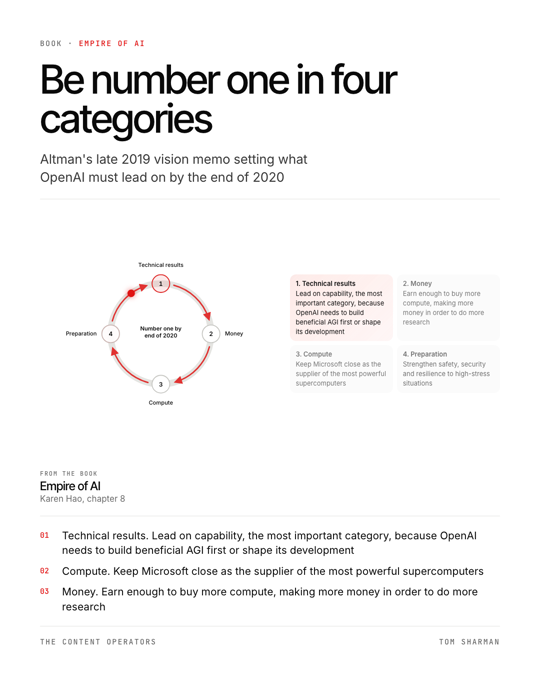
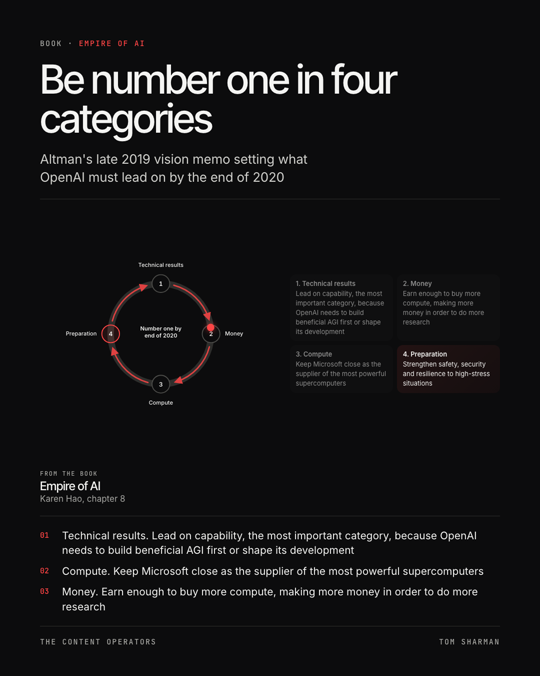
Altman's late 2019 vision memo setting what OpenAI must lead on by the end of 2020
- Technical results. Lead on capability, the most important category, because OpenAI needs to build beneficial AGI first or shape its development
- Compute. Keep Microsoft close as the supplier of the most powerful supercomputers
- Money. Earn enough to buy more compute, making more money in order to do more research
- Preparation. Strengthen safety, security and resilience to high-stress situations
From chapter: Part II, pp. 150–234
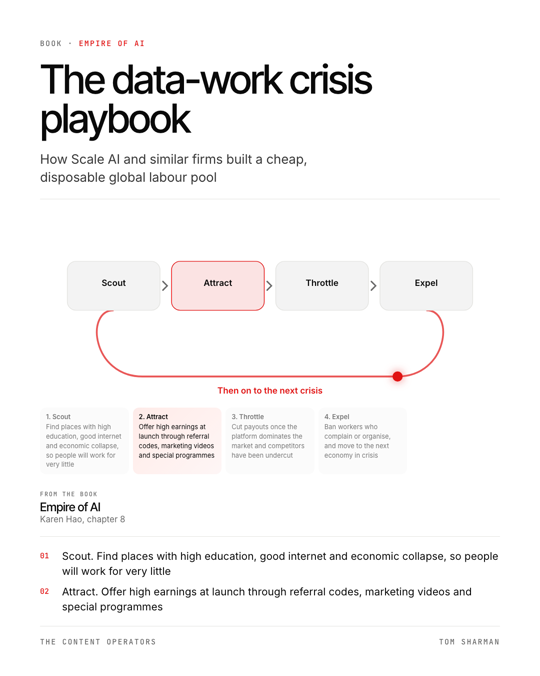
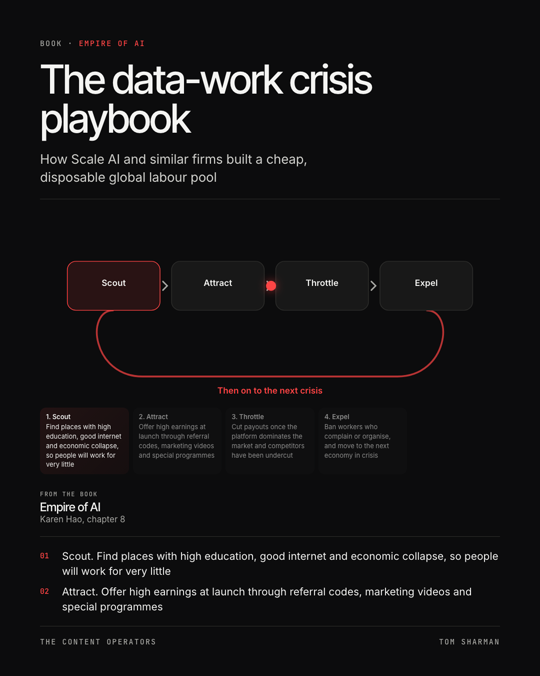
How Scale AI and similar firms built a cheap, disposable global labour pool
- Scout. Find places with high education, good internet and economic collapse, so people will work for very little
- Attract. Offer high earnings at launch through referral codes, marketing videos and special programmes
- Throttle. Cut payouts once the platform dominates the market and competitors have been undercut
- Expel. Ban workers who complain or organise, and move to the next economy in crisis
From chapter: Part II, pp. 150–234
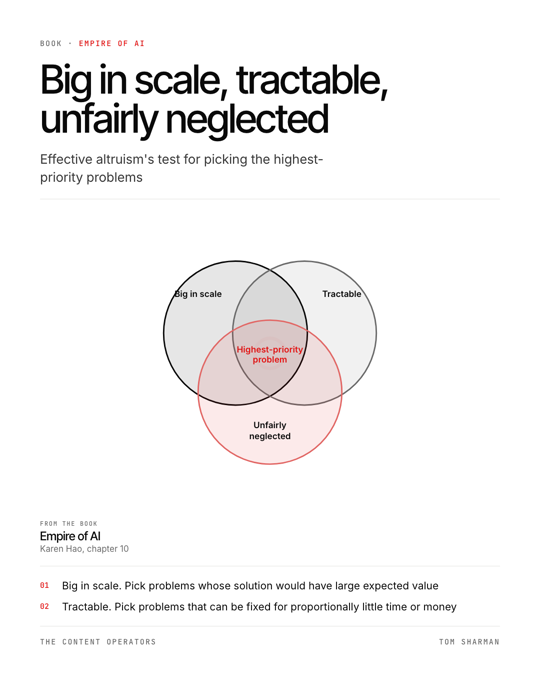
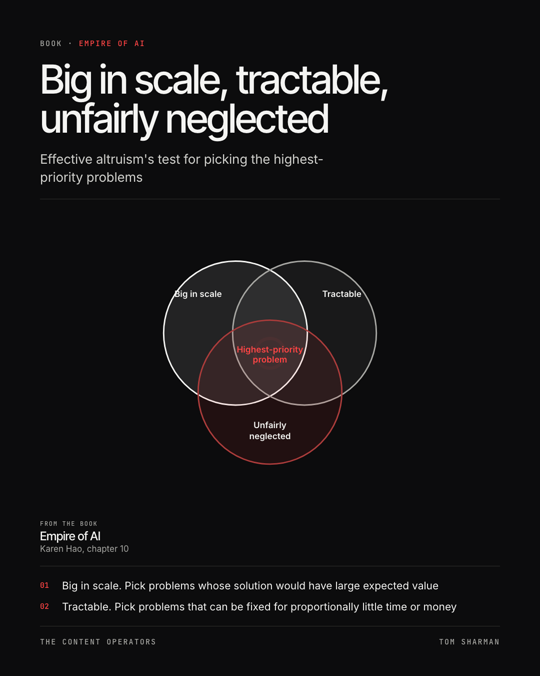
Effective altruism's test for picking the highest-priority problems
- Big in scale. Pick problems whose solution would have large expected value
- Tractable. Pick problems that can be fixed for proportionally little time or money
- Unfairly neglected. Pick problems suffering severe, disproportionate underinvestment
From chapter: Part IV, pp. 354–433
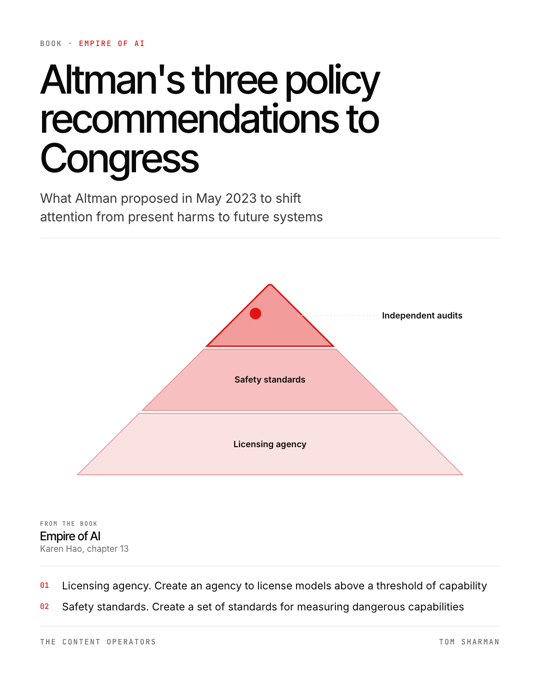
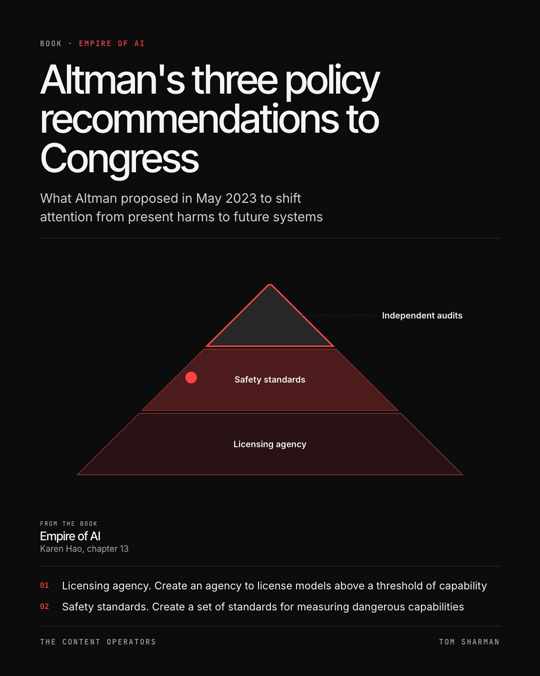
What Altman proposed in May 2023 to shift attention from present harms to future systems
- Licensing agency. Create an agency to license models above a threshold of capability
- Safety standards. Create a set of standards for measuring dangerous capabilities
- Independent audits. Require independent audits to check compliance with those standards
From chapter: Index, pp. 548–619
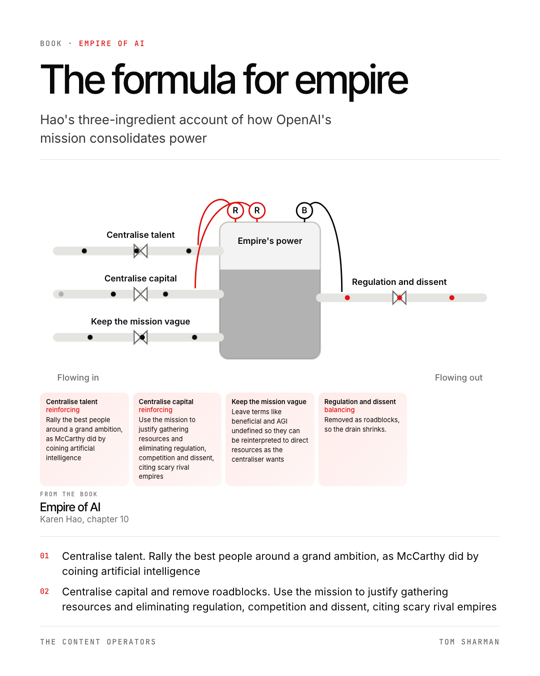
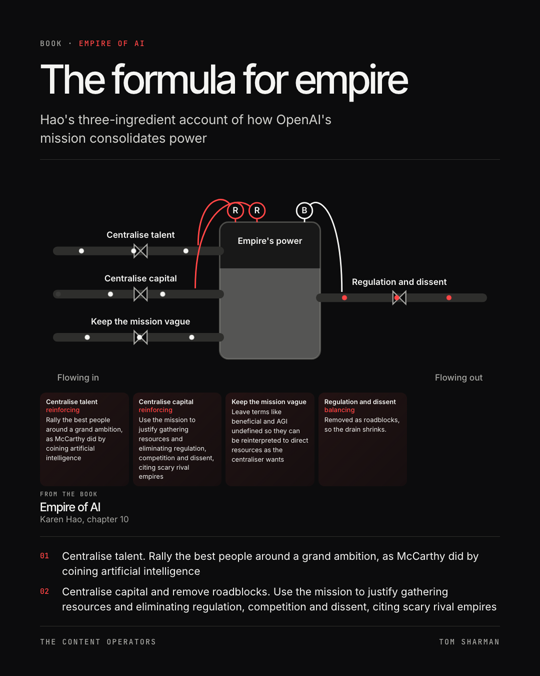
Hao's three-ingredient account of how OpenAI's mission consolidates power
- Centralise talent. Rally the best people around a grand ambition, as McCarthy did by coining artificial intelligence
- Centralise capital and remove roadblocks. Use the mission to justify gathering resources and eliminating regulation, competition and dissent, citing scary rival empires
- Keep the mission vague. Leave terms like beneficial and AGI undefined so they can be reinterpreted to direct resources as the centraliser wants
From chapter: Part IV, pp. 354–433
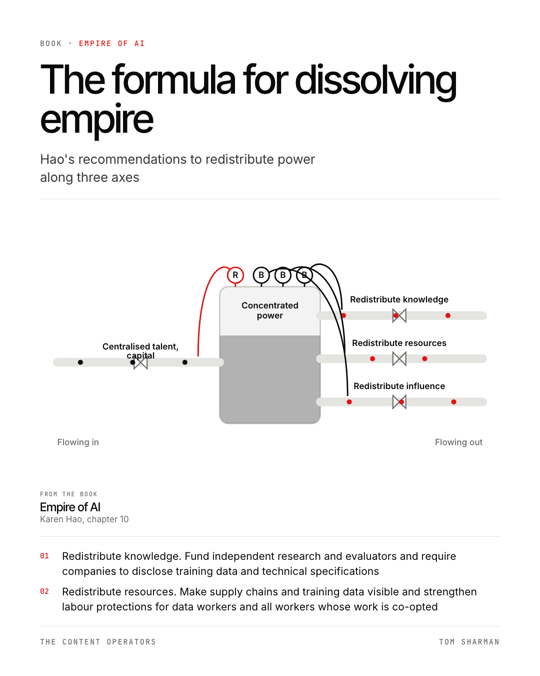
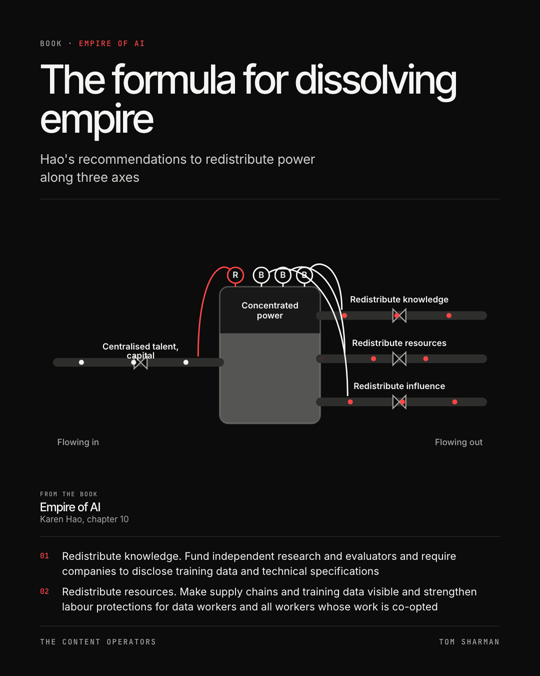
Hao's recommendations to redistribute power along three axes
- Redistribute knowledge. Fund independent research and evaluators and require companies to disclose training data and technical specifications
- Redistribute resources. Make supply chains and training data visible and strengthen labour protections for data workers and all workers whose work is co-opted
- Redistribute influence. Teach people how AI works and the worldviews of its builders to counter hype
From chapter: Part IV, pp. 354–433
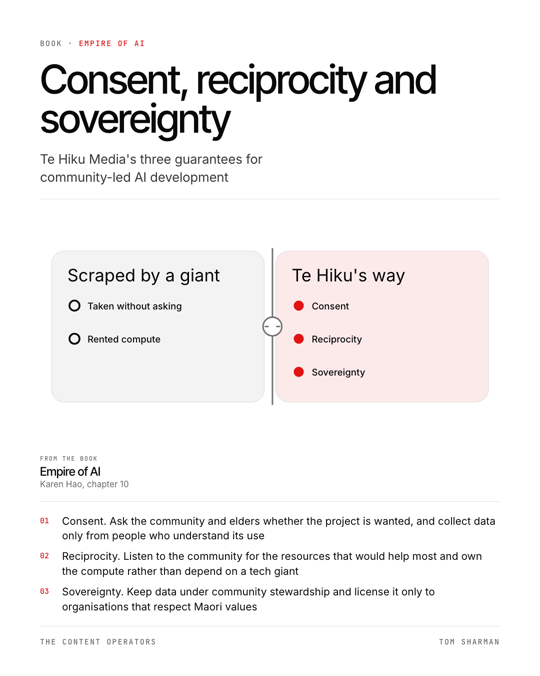
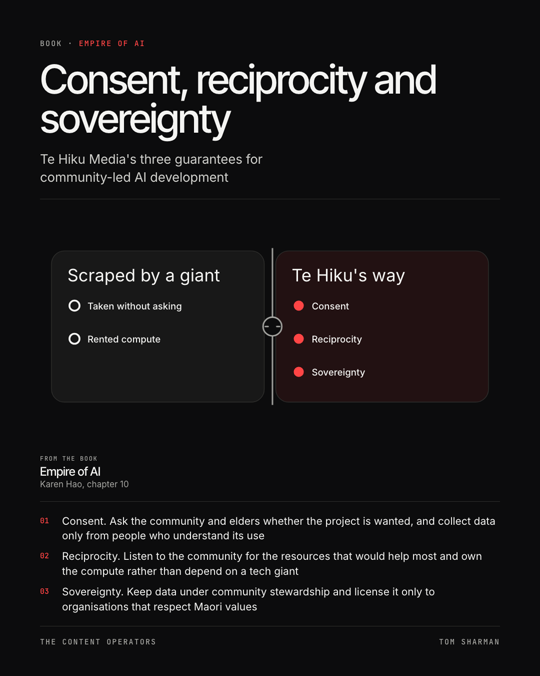
Te Hiku Media's three guarantees for community-led AI development
- Consent. Ask the community and elders whether the project is wanted, and collect data only from people who understand its use
- Reciprocity. Listen to the community for the resources that would help most and own the compute rather than depend on a tech giant
- Sovereignty. Keep data under community stewardship and license it only to organisations that respect Maori values
From chapter: Part IV, pp. 354–433
Working with Tom on this
Tom works with creators and founders one to one, from a single session to a fractional role. Work with Tom
Back to the bookshelf