Bookshelf
How Tom uses this
The Personal Branding Playbook backs five of Tom's lessons and argues with two. Under each of his lessons, what the book says about it, and on which pages.
- People online are selfish, so lead with what they get
Sordell says no one wants to be sold to, and tells you to talk about what your audience cares about and sell outcomes rather than services. pp. 40, 91, 95 and 111. In the book: The ring of influence, The 70/30 content split.
- It is about their business, told as what the audience learns
Her two pillars pair expertise with the founder's story and her filter asks what the point is so the audience takes a lesson away. pp. 104, 105, 111 and 125. In the book: The 70/30 content split, Six rules for creating content with Klowt.
- Two to three a day, LinkedIn five times a weekday
She posts about 150 pieces a month, runs a Monday to Friday cadence and says consistency is 90% of a personal brand. pp. 67, 88, 165 and 171. In the book: The four-part brand strategy, Cornerstone and atomise system, The weekly posting funnel, The 9 x 3 rule, The three metrics that matter.
- Signals show before numbers, and numbers come at month four
She posted for nearly 12 months before real traction and tells you to watch audience profile and inbound DMs over likes. pp. 88, 116 and 178. In the book: The 70/30 content split, Cornerstone and atomise system, The weekly posting funnel, The 9 x 3 rule, The three metrics that matter.
- A brand that compounds has a mission and an enemy
Her mission statement exercise and compound interest analogy both say a brand needs a clear why and sustained deposits, though she names no explicit enemy. pp. 51, 59, 117 and 118. In the book: Mission statement exercise, Six rules for creating content with Klowt.
Where it disagrees with Tom
- Agencies over-index on the founder's journey
Sordell treats the founder's story and failures as the reason people buy, with personal posts on Monday and Friday, where Tom says agencies lean too hard on journey over mission and audience benefit. pp. 105, 110, 171 and 172. In the book: The 70/30 content split, Cornerstone and atomise system, The weekly posting funnel, The 9 x 3 rule, The three metrics that matter.
- Short form first, LinkedIn on winners, YouTube last
She built on LinkedIn alone for around three years because that is where her buyers are, where Tom tests short form first and promotes only winners to LinkedIn. pp. 87 and 122. In the book: Six rules for creating content with Klowt.
What it argues
Sordell argues that a personal brand already exists whether you tend it or not, so the job is to take control of it and scale it, because people buy from people they like and trust. Authenticity does the work: your personality filters in the right audience and filters out the rest, and a clear why and mission statement keep you posting when motivation fails. The method is to start from a goal, pick one thing to be known for, give your knowledge away free, write simply, and repeat the same message for years. A weekly cornerstone piece, atomised into dozens of micro posts, plus daily commenting and a Monday to Friday posting funnel, lets her produce about 150 pieces a month in one to two hours a week. The aim is to become the most referred person in your industry through a community of superfans, and AI should help you ideate but never write in your voice.
Worth keeping
- Building a personal brand is 10% content and 90% consistency in posting it, and every post is a deposit in a high-interest account (pp. 51, 117-118).
- Start from the goal, work out who must see it, and also target the ring of influence around the buyer, such as executive assistants (pp. 63-65, 98-100).
- Choose a niche defined by what your audience cares about, and learn it by asking five clients or adding two questions to every prospect call (pp. 94-96).
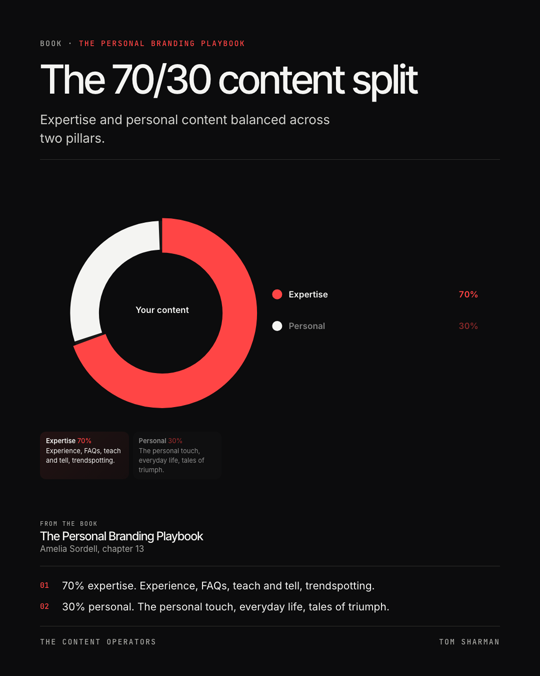
- Two content pillars, what you do and your story, with about 70% expertise and 30% personal content (pp. 103-110).
- Repeat the same message for years: only about 3% of followers see each post, and no one has told her she repeated herself (pp. 114-115).
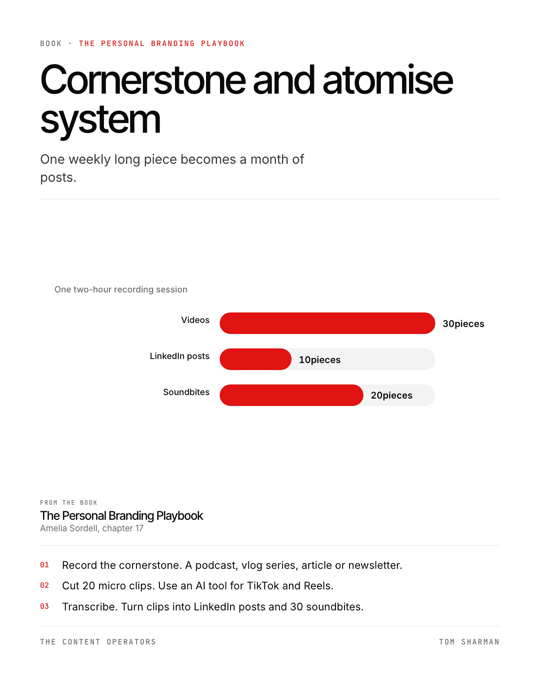
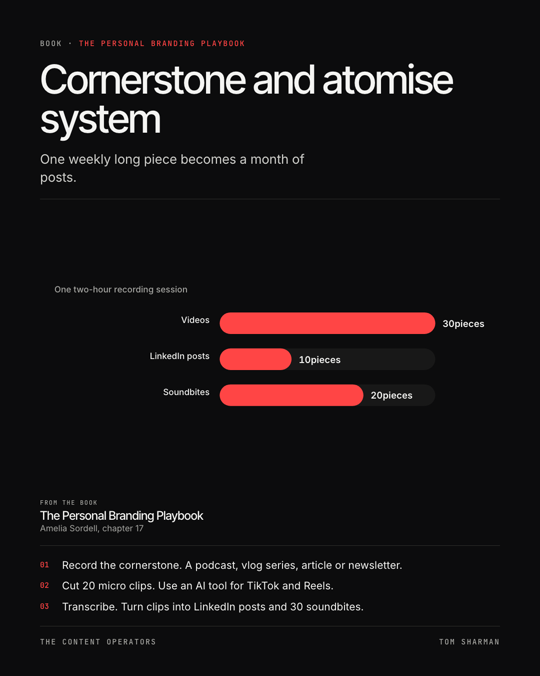
- The cornerstone and atomise system: one weekly long-form piece cut into 20 clips, 30 soundbites, posts and threads, 1 to 2 hours a week for 150 pieces a month (pp. 165-169).
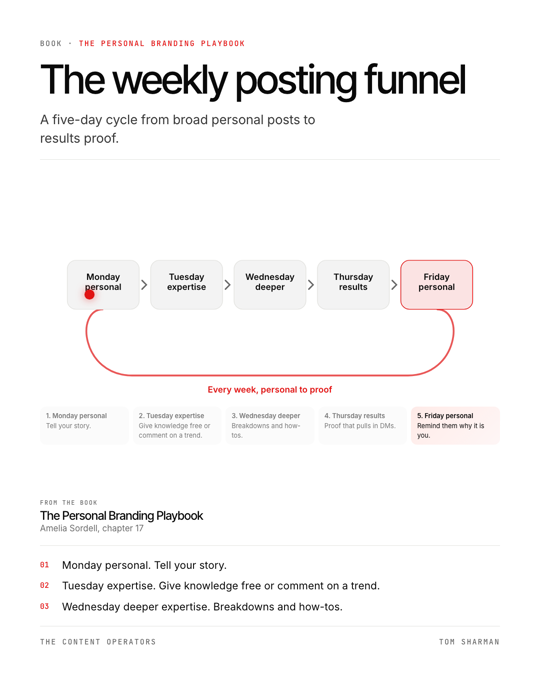
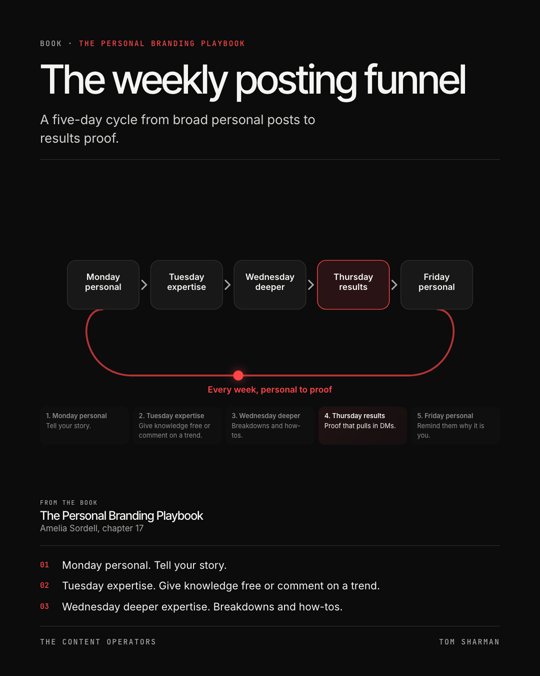
- The weekly funnel: personal Monday, expertise Tuesday and Wednesday, results Thursday, personal Friday, which narrows a broad audience to ideal buyers (pp. 171-172).
- Use calls to conversation rather than calls to action, and share 13 valuable pieces before asking for anything (pp. 126-127).
- Measure impressions, engagement rate and above all audience profile; inbound DMs from the right people are the sign the system works (pp. 176-178).
- Use AI for ideas, trends and search terms and write in your own voice, because you cannot outsource your personality (p. 193).
The questions it answers
- What makes a format repeatable, as opposed to a hit that happened once?
Her Gary Vee Trash Talk and Love Island examples, plus the cornerstone and atomise system, show repeatability comes from a fixed format repeated for years.
- What does AI actually change about the shape of a content team?
She uses AI to chop a podcast into 20 clips and to find trends, but says you cannot outsource your personality to AI.
- How do you build a personal brand that generates inbound rather than requiring outbound?
The whole book is a method for inbound: Klowt is 100% inbound, built on a clear goal, one niche, free knowledge and a community of referrers.
- Which of my stories travel, and which only feel like they should?
She says judge the body of content rather than one post, analyse why posts underperform, and use skyscrapering to rerun winners.
- What is the smallest team that can produce at the volume I am used to?
She makes about 150 pieces a month in one to two hours a week with a system, an EA and a community growth executive.
The frameworks
10 frameworks, one animation each Every framework, step by step
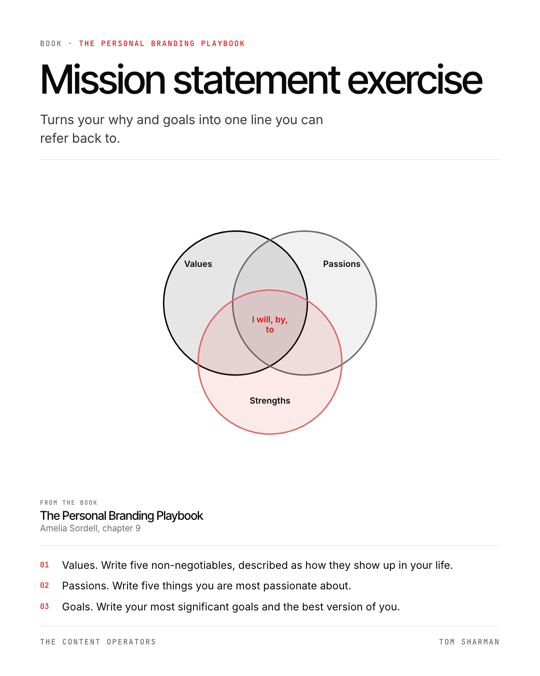
Turns your why and goals into one line you can refer back to.
- Values. Write five non-negotiables, described as how they show up in your life.
- Passions. Write five things you are most passionate about.
- Goals. Write your most significant goals and the best version of you.
- Strengths. Ask others for your top three to five strengths.
- Legacy. Say what you want to be known for.
- Write it. I will [action] by [skills] to [desired result or outcome].
From chapter: 2 Defining your why, pp. 47–61
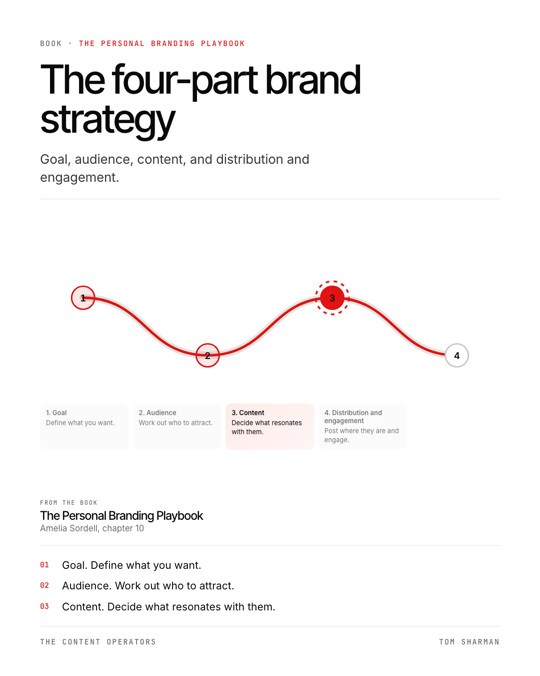
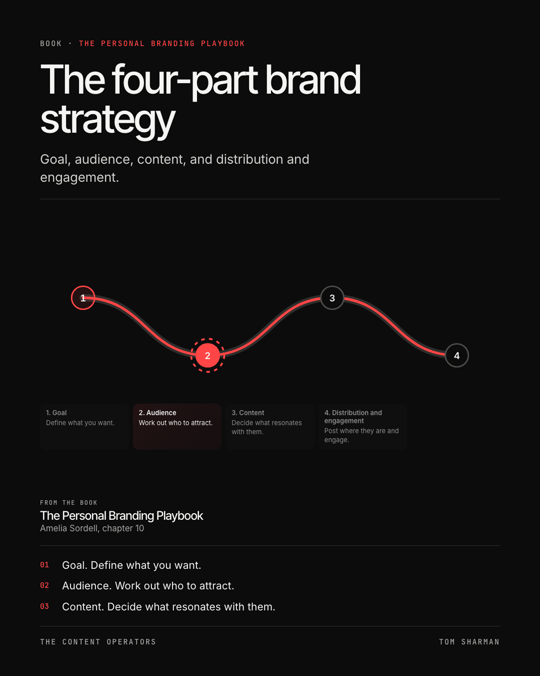
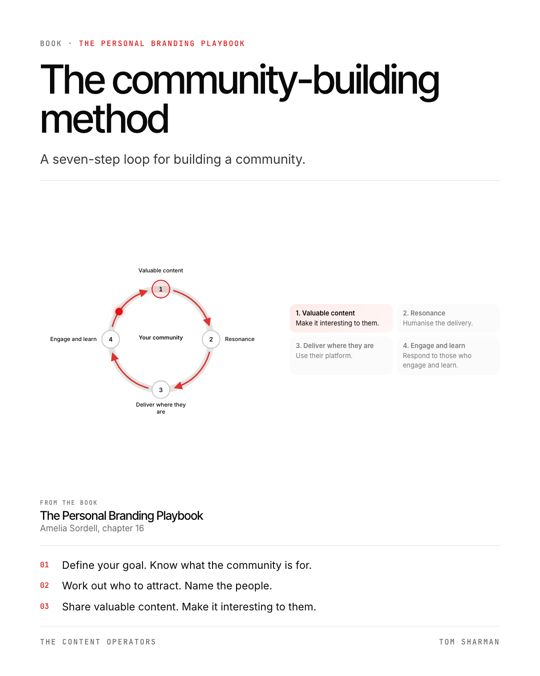
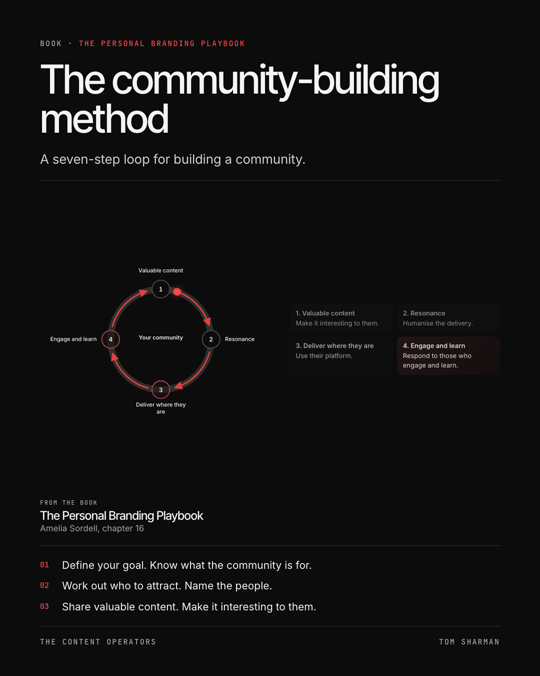
Goal, audience, content, and distribution and engagement.
- Goal. Define what you want.
- Audience. Work out who to attract.
- Content. Decide what resonates with them.
- Distribution and engagement. Post where they are and engage.
From chapter: 3 What is a good brand strategy?, pp. 62–75
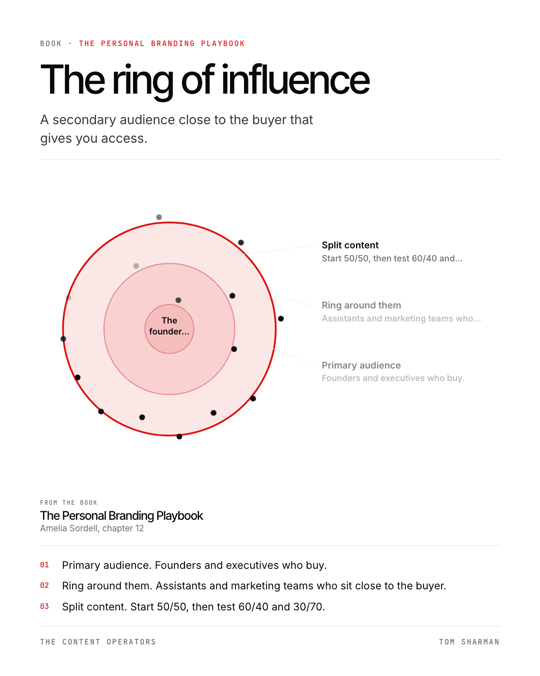
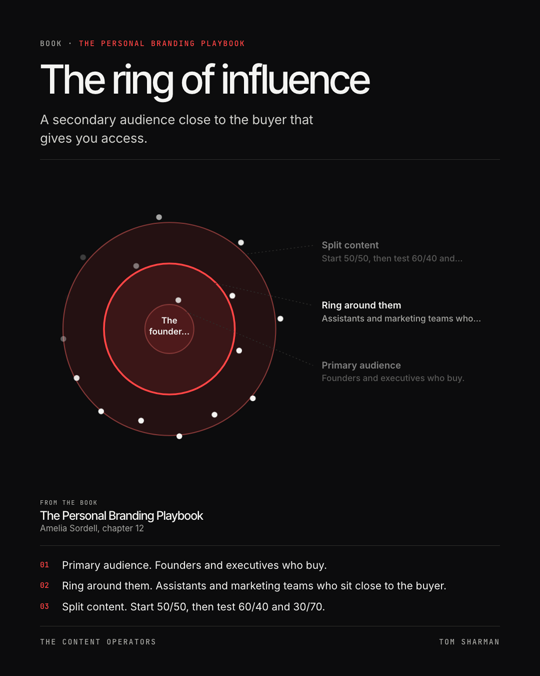
A secondary audience close to the buyer that gives you access.
- Primary audience. Founders and executives who buy.
- Ring around them. Assistants and marketing teams who sit close to the buyer.
- Split content. Start 50/50, then test 60/40 and 30/70.
From chapter: 5 Finding friends not followers, pp. 91–102
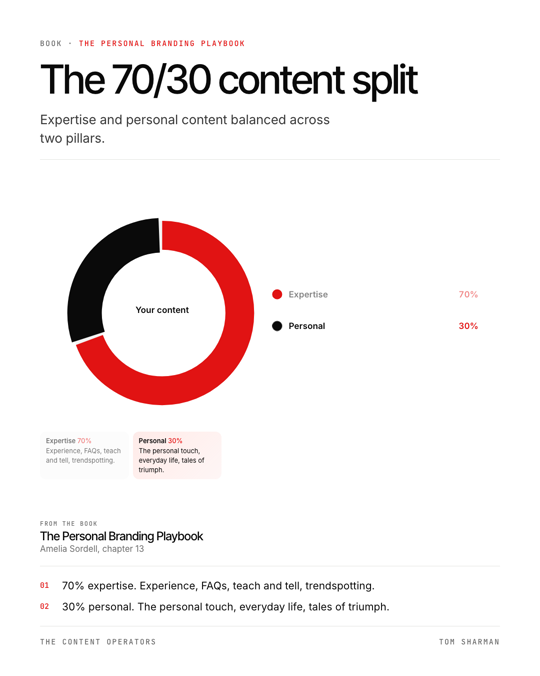
Expertise and personal content balanced across two pillars.
- 70% expertise. Experience, FAQs, teach and tell, trendspotting.
- 30% personal. The personal touch, everyday life, tales of triumph.
From chapter: 6 What are you known for?, pp. 103–116
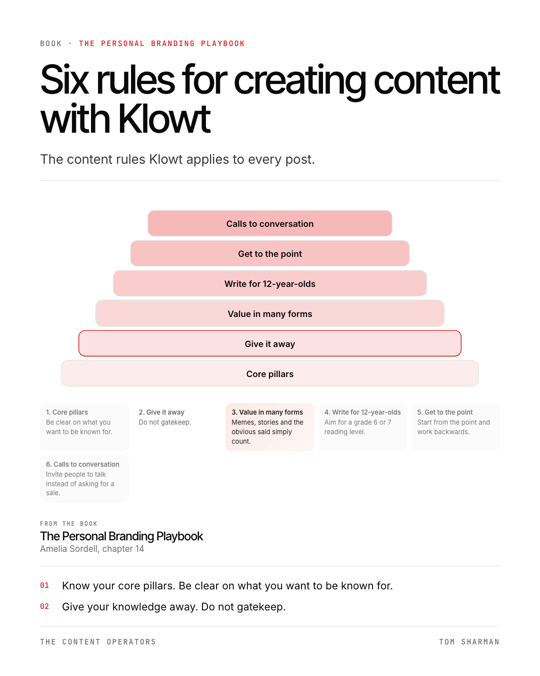
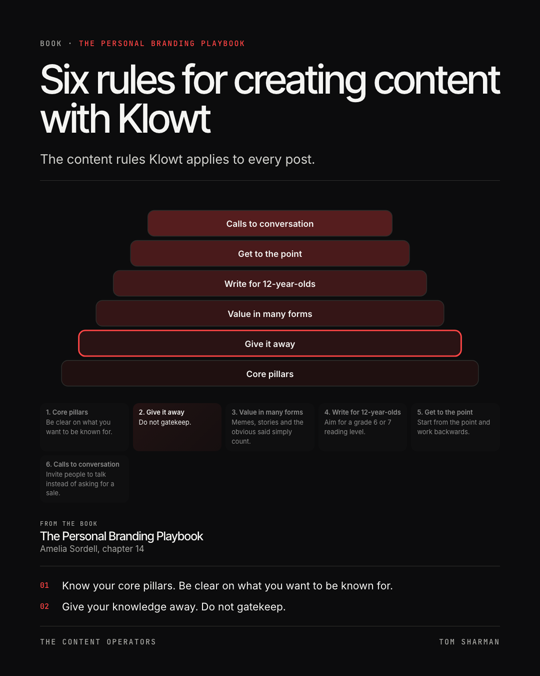
The content rules Klowt applies to every post.
- Know your core pillars. Be clear on what you want to be known for.
- Give your knowledge away. Do not gatekeep.
- Value comes in many forms. Memes, stories and the obvious said simply count.
- Write for 12-year-olds. Aim for a grade 6 or 7 reading level.
- Get to the point. Start from the point and work backwards.
- Calls to conversation. Invite people to talk instead of asking for a sale.
From chapter: 7 Content, pp. 117–133
One weekly long piece becomes a month of posts.
- Record the cornerstone. A podcast, vlog series, article or newsletter.
- Cut 20 micro clips. Use an AI tool for TikTok and Reels.
- Transcribe. Turn clips into LinkedIn posts and 30 soundbites.
- Recycle and remix. Repost winners after a few months.
From chapter: 10 Building systems, pp. 165–180
A five-day cycle from broad personal posts to results proof.
- Monday personal. Tell your story.
- Tuesday expertise. Give knowledge free or comment on a trend.
- Wednesday deeper expertise. Breakdowns and how-tos.
- Thursday results. Proof that pulls in DMs.
- Friday personal. Remind them why it is you.
From chapter: 10 Building systems, pp. 165–180
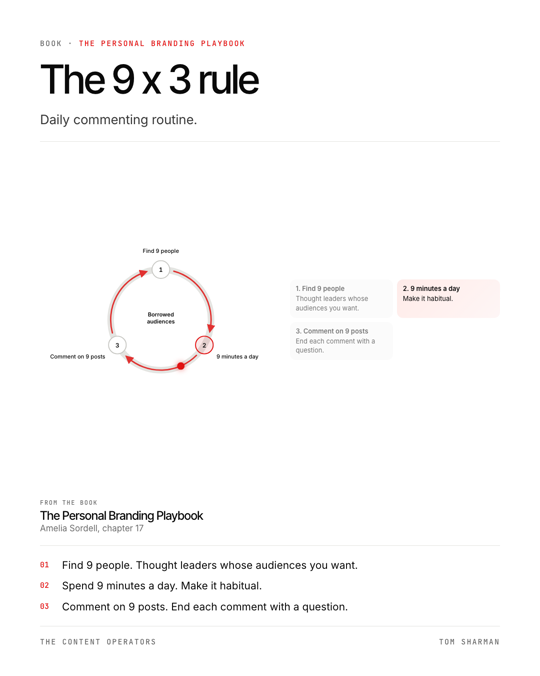
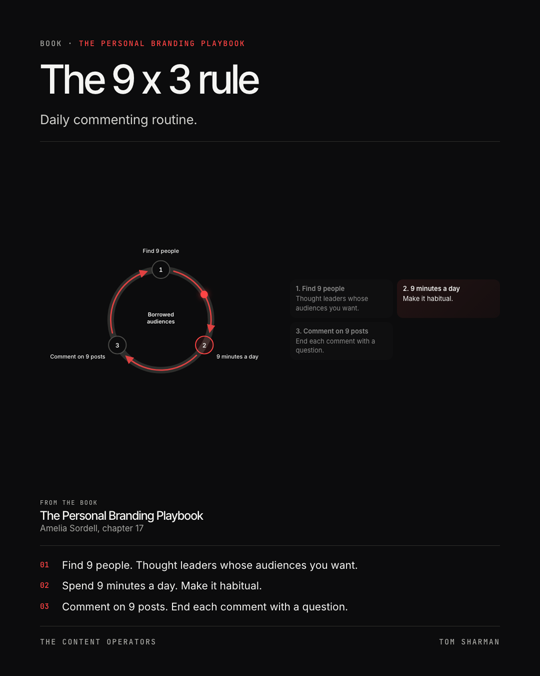
Daily commenting routine.
- Find 9 people. Thought leaders whose audiences you want.
- Spend 9 minutes a day. Make it habitual.
- Comment on 9 posts. End each comment with a question.
From chapter: 10 Building systems, pp. 165–180
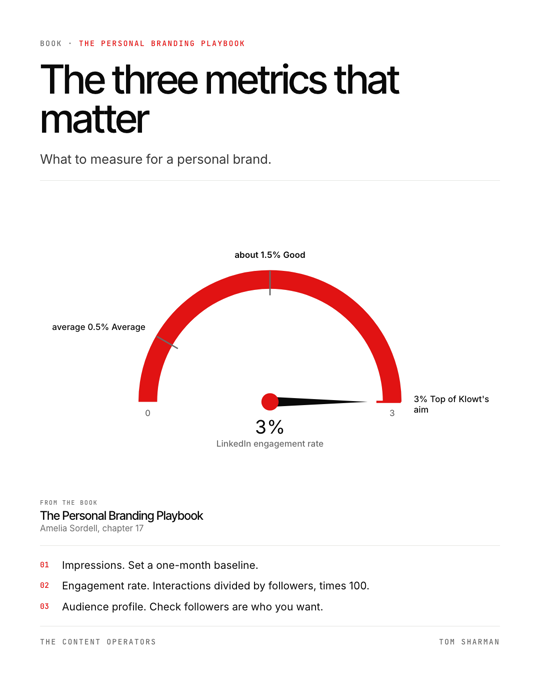
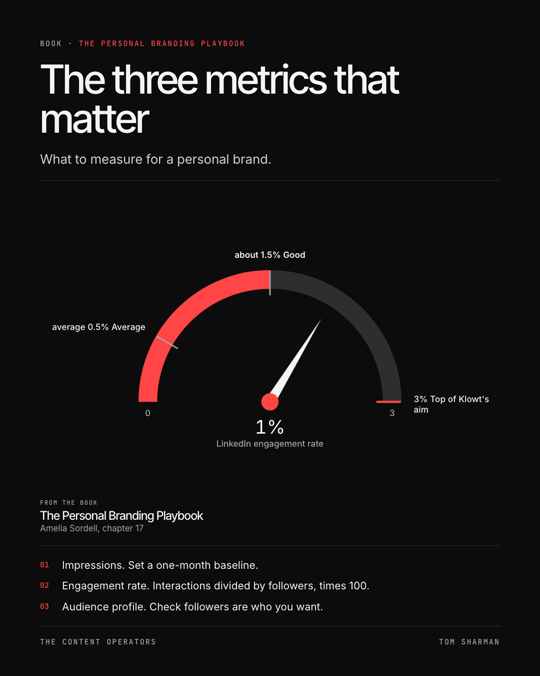
What to measure for a personal brand.
- Impressions. Set a one-month baseline.
- Engagement rate. Interactions divided by followers, times 100.
- Audience profile. Check followers are who you want.
From chapter: 10 Building systems, pp. 165–180
Working with Tom on this
Tom works with creators and founders one to one, from a single session to a fractional role. Work with Tom
Back to the bookshelf