Bookshelf
How Tom uses this
One to Many backs three of Tom's lessons. Under each of his lessons, what the book says about it, and on which pages.
- People online are selfish, so lead with what they get
Fladlien builds the whole webinar around the outcome and relief the attendee gets, and says value comes from the result rather than the process. pp. 78 and 87. In the book: Clearly defined outcome.
- It is about their business, told as what the audience learns
His stories of his own life are told as teaching points about what the audience can do, and he warns that education alone does not convert. pp. 77 and 102. In the book: Context, vision, commitment, strategy, One, two, three commitment formula.
- Turn down anyone unclear about their commitment
He says a webinar can only work for the right fit and that commitment is what turns learning into behaviour. pp. 79 and 271.
What it argues
Fladlien argues that a well-built webinar can compress a sales cycle that takes days into two hours by teaching and selling in one sitting. Every webinar has four sections: an introduction that builds authority, commitment and intrigue, content that teaches one clear path while managing emotion, a transition that primes the audience to hear a pitch, and a formulaic close of offer, price, bonuses, guarantee and objection handling. He says content is the least important section for selling, and that the pitch is mostly technique that can be memorised. Results depend on the funnel around the webinar too, since registration, thank-you, sign-up and replay pages can multiply revenue from an identical presentation. Ship a rough version first, then recalibrate against what a live audience does.
Worth keeping
- Use the four sections: introduction, content, transition, close, and write them in whatever order you have energy for (p. 18).
- Ship the worst webinar that is ready, then polish and recalibrate from live reactions (p. 20, p. 21).
- Cement authority fast with results, positioning, celebrity and testimonials, and use five testimonials in the first five minutes (p. 26, p. 37).
- Get a written mega-commitment in the first five minutes and keep collecting micro-commitments, about 150 before the ask (p. 42, p. 130).
- Give one clear path and tune content for emotion, because real learning needs behaviour change (p. 78, p. 79).
- Define the outcome as audience, feeling and result, and build it in three to five steps with a visible roadmap (p. 89, p. 90).
- Teach each step with context, vision, commitment and strategy (p. 94).
- Spend little time on the offer, reveal price early by linking it to a higher figure, then stair-step down, and pile on the bonuses with the best last (p. 149, p. 157, p. 168).
- Use a guarantee built like an actuary, with the reason why, and test it against the evergreen version (p. 178, p. 181).
- Judge a webinar by money collected at the end of the promotion cycle, and fix registration, thank-you, sign-up and replay pages (p. 238, p. 264).
Which project it moves forward
The Content Operators launch
The launch needs a site and a first cohort, and the webinar funnel, offer, bonus and guarantee mechanics give a tested way to turn an audience into cohort sign-ups.
The questions it answers
- What makes a format repeatable, as opposed to a hit that happened once?
The four-section framework is a repeatable format, and the shippable, polish, recalibrate loop shows how one keeps improving it from live data.
- How do you price and sell a tool you built for yourself?
The price reveal, bonus stacking, guarantee design and the webinar funnel give a concrete way to sell a product to a small audience.
- What is content operations actually worth to a company, in money?
It gives a price for a webinar-creation service ($25,000 plus 10 percent of revenue) and numbers showing funnel pages can quadruple results.
The frameworks
8 frameworks, one animation each Every framework, step by step
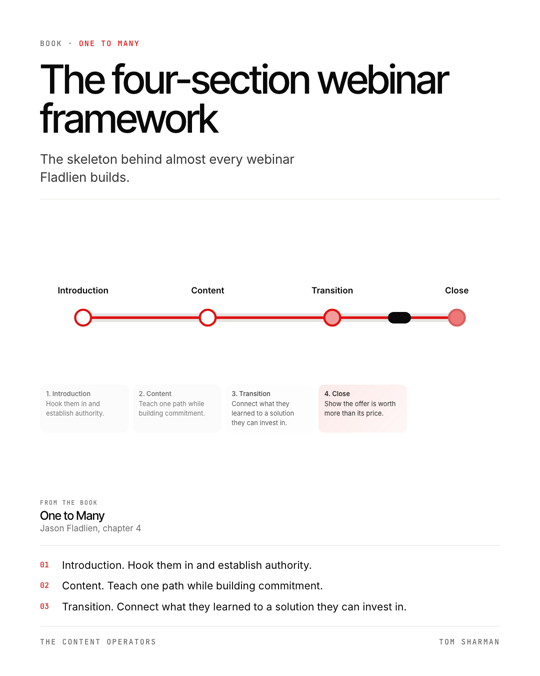
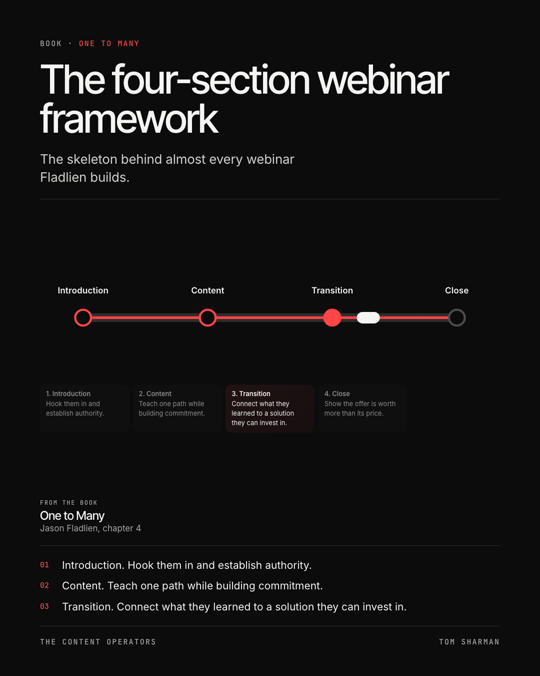
The skeleton behind almost every webinar Fladlien builds.
- Introduction. Hook them in and establish authority.
- Content. Teach one path while building commitment.
- Transition. Connect what they learned to a solution they can invest in.
- Close. Show the offer is worth more than its price.
From chapter: 1. Overview of the Framework, pp. 18–22
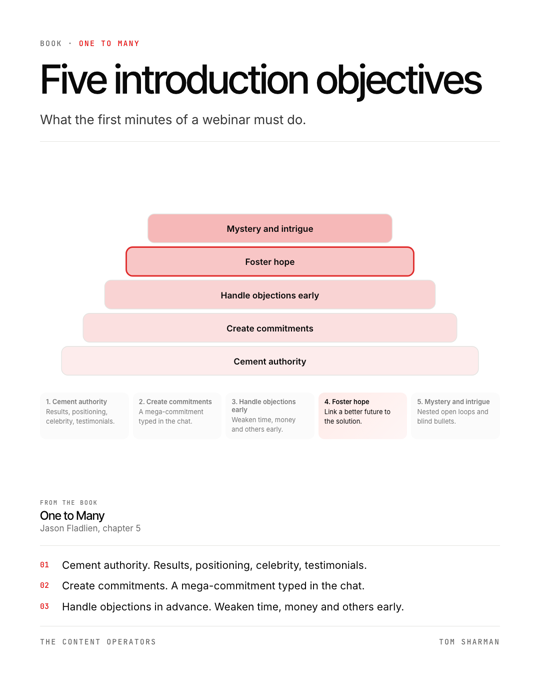
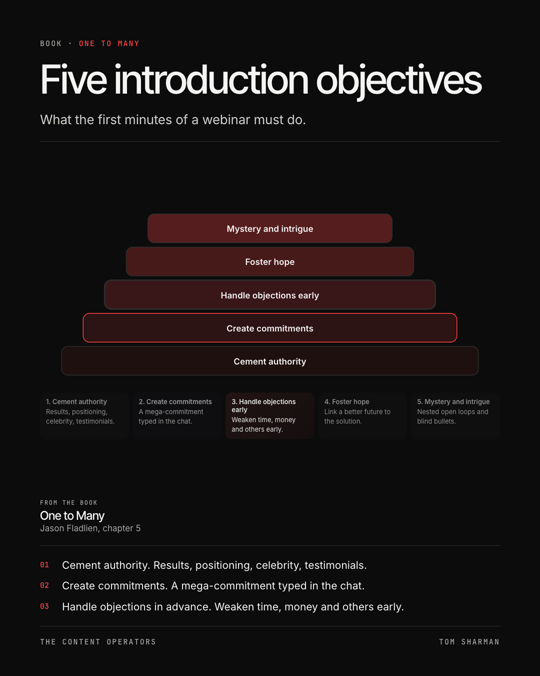
What the first minutes of a webinar must do.
- Cement authority. Results, positioning, celebrity, testimonials.
- Create commitments. A mega-commitment typed in the chat.
- Handle objections in advance. Weaken time, money and others early.
- Foster hope. Link a better future to the solution.
- Create mystery and intrigue. Nested open loops and blind bullets.
From chapter: 2. An Introduction to the Introduction, pp. 23–71
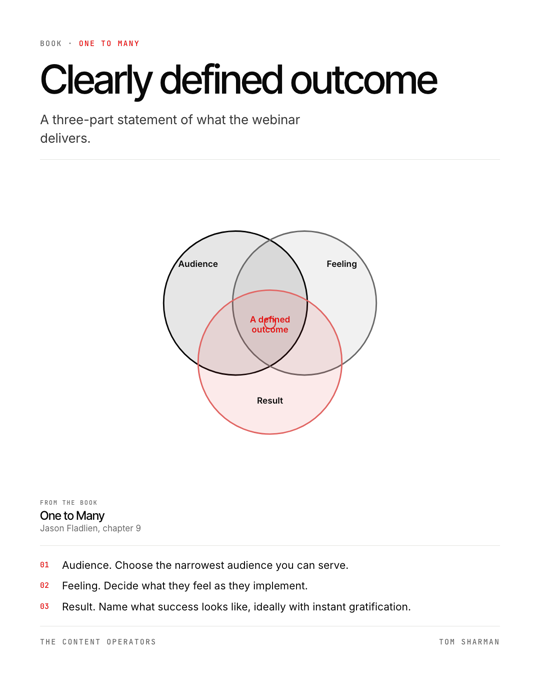
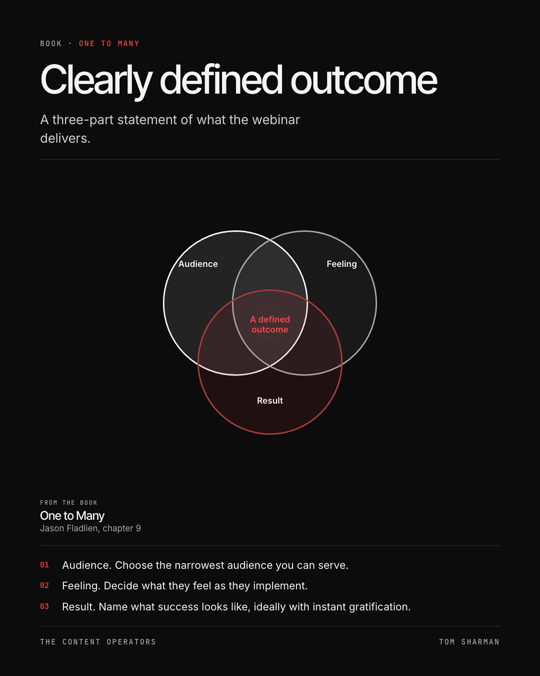
A three-part statement of what the webinar delivers.
- Audience. Choose the narrowest audience you can serve.
- Feeling. Decide what they feel as they implement.
- Result. Name what success looks like, ideally with instant gratification.
From chapter: 5. Clearly Defined Outcomes, pp. 87–89
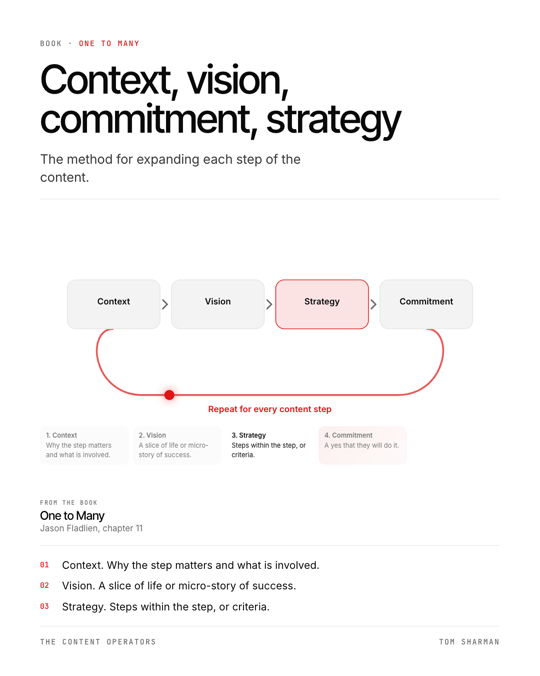
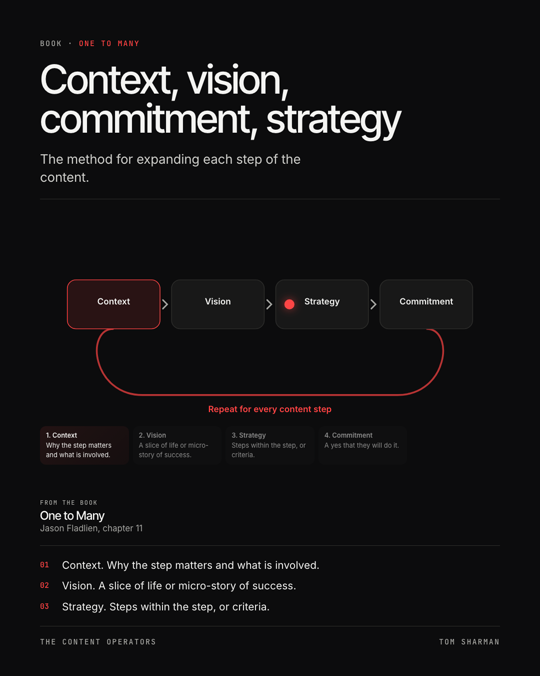
The method for expanding each step of the content.
- Context. Why the step matters and what is involved.
- Vision. A slice of life or micro-story of success.
- Strategy. Steps within the step, or criteria.
- Commitment. A yes that they will do it.
From chapter: 7. Context, Vision, Commitment, Strategy, pp. 94–135
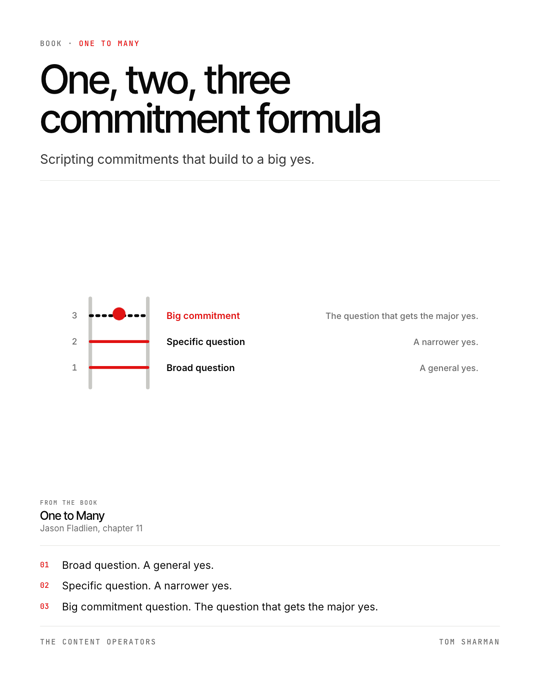
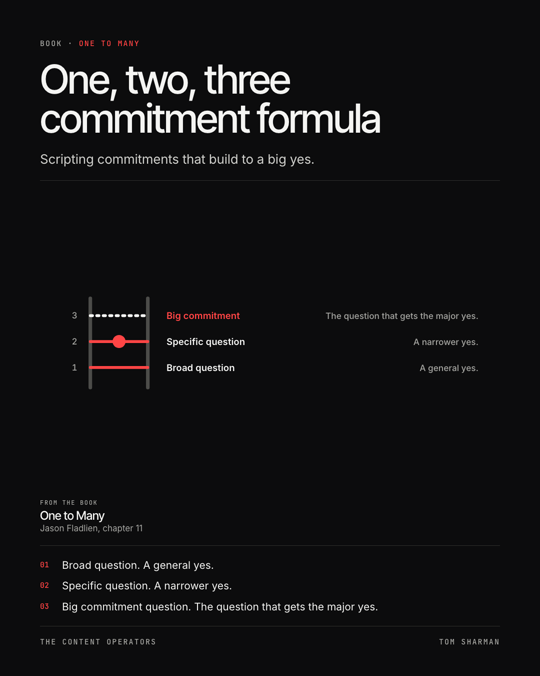
Scripting commitments that build to a big yes.
- Broad question. A general yes.
- Specific question. A narrower yes.
- Big commitment question. The question that gets the major yes.
From chapter: 7. Context, Vision, Commitment, Strategy, pp. 94–135
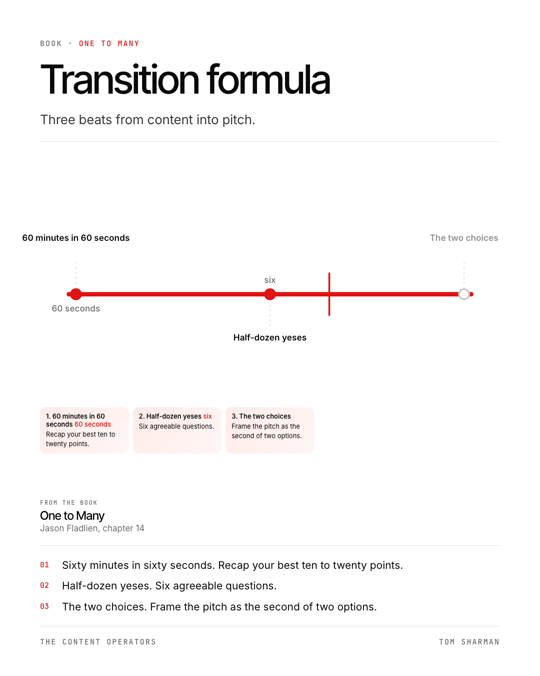
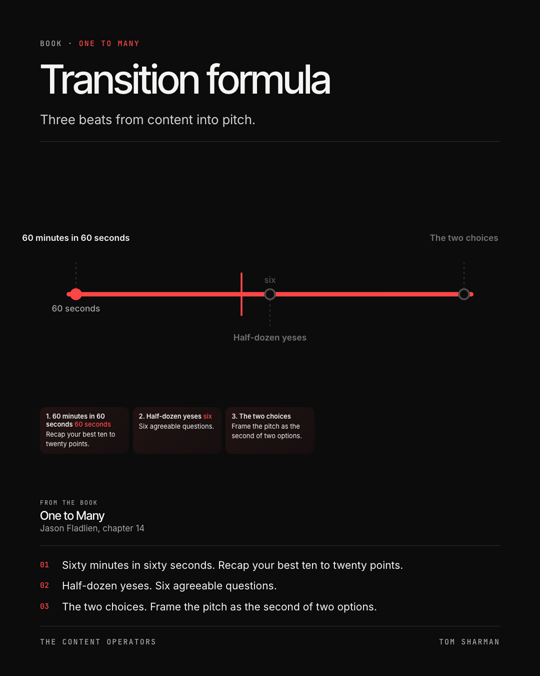
Three beats from content into pitch.
- Sixty minutes in sixty seconds. Recap your best ten to twenty points.
- Half-dozen yeses. Six agreeable questions.
- The two choices. Frame the pitch as the second of two options.
From chapter: 9. The Transition Formula, pp. 139–145
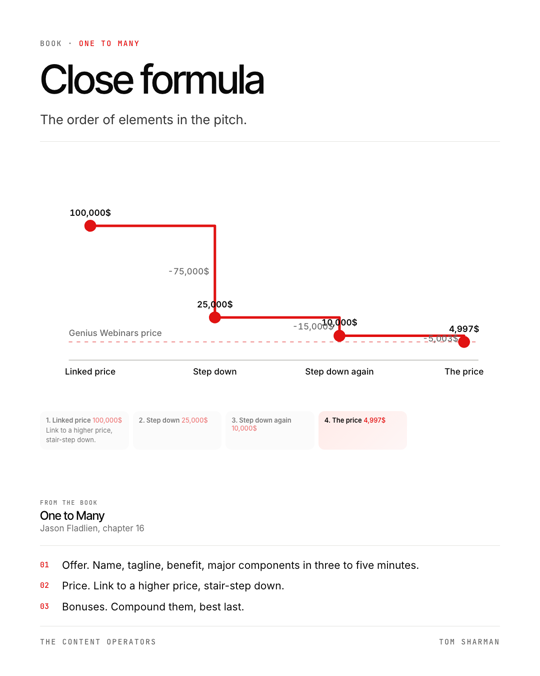
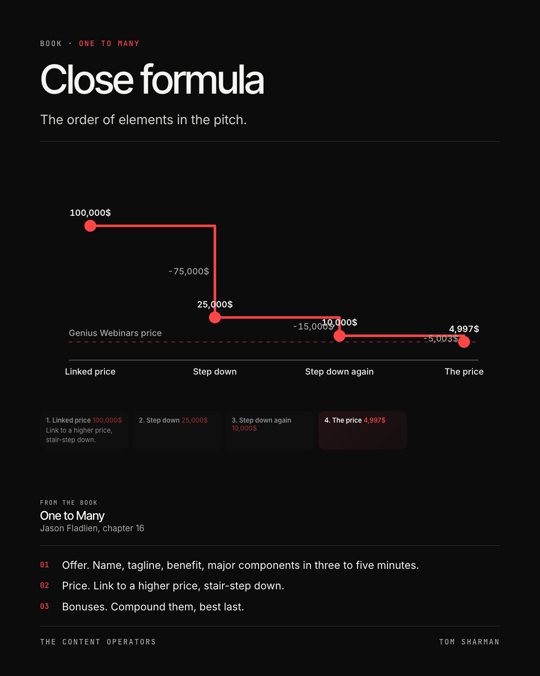
The order of elements in the pitch.
- Offer. Name, tagline, benefit, major components in three to five minutes.
- Price. Link to a higher price, stair-step down.
- Bonuses. Compound them, best last.
- Guarantee. Remove risk.
- Objections. Cycle time, money and product questions.
- Scarcity. Use true scarcity throughout.
From chapter: 10. Close Overview, pp. 147–199
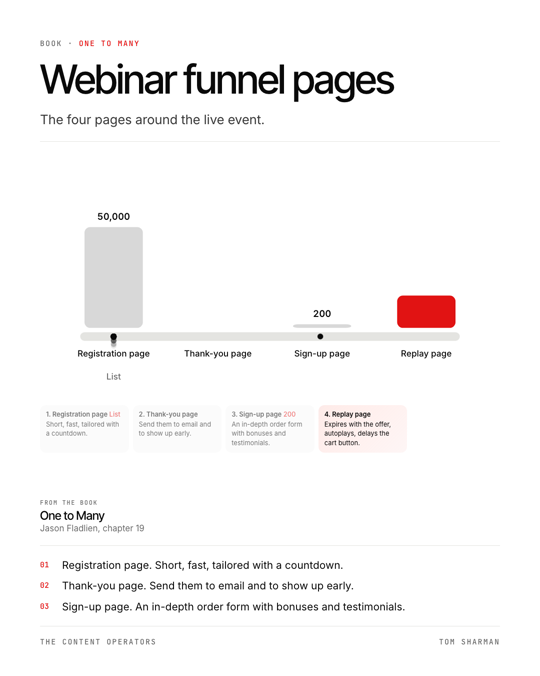
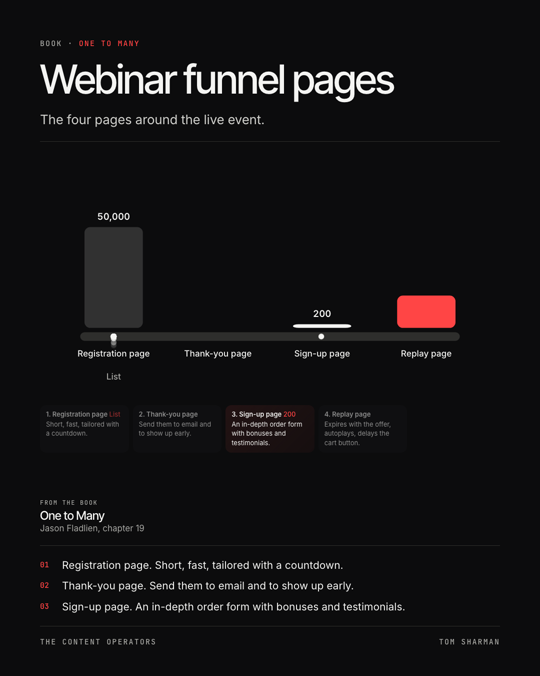
The four pages around the live event.
- Registration page. Short, fast, tailored with a countdown.
- Thank-you page. Send them to email and to show up early.
- Sign-up page. An in-depth order form with bonuses and testimonials.
- Replay page. Expires with the offer, autoplays, delays the cart button.
From chapter: 12. The Webinar Funnel, pp. 237–269
Working with Tom on this
Tom works with creators and founders one to one, from a single session to a fractional role. Work with Tom
Back to the bookshelf