What it argues
Collins and a research team compared eleven companies that made a sustained leap from average to great results with matched companies that did not. The leap came from disciplined people, disciplined thought and disciplined action rather than from visionary celebrity leaders, technology, mergers or pay. Humble but fiercely driven Level 5 leaders got the right people on the bus first. They then faced the brutal facts while keeping faith, found a Hedgehog Concept at the overlap of what they could be best at, what drove their economics and what they were passionate about, and built a culture of discipline around it. Momentum came from turning a flywheel in one consistent direction until breakthrough, where comparison companies lurched through programmes in a doom loop. The book closes by joining the study to Built to Last and arguing that greatness comes from work you care about.
Which project it moves forward
The Content Operators launch
The Hedgehog Concept test of best in the world at, economic engine and passion is the clearest tool in the book for defining one offer for the launch, and first who and the flywheel guide how to staff and sequence it.
Every framework, step by step
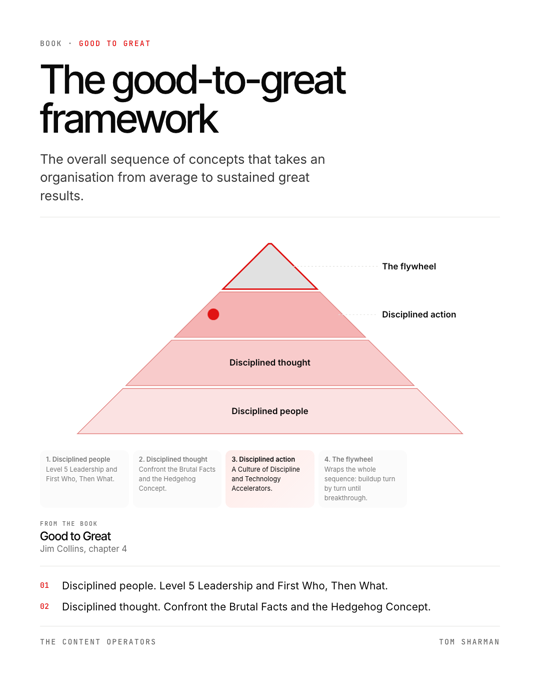
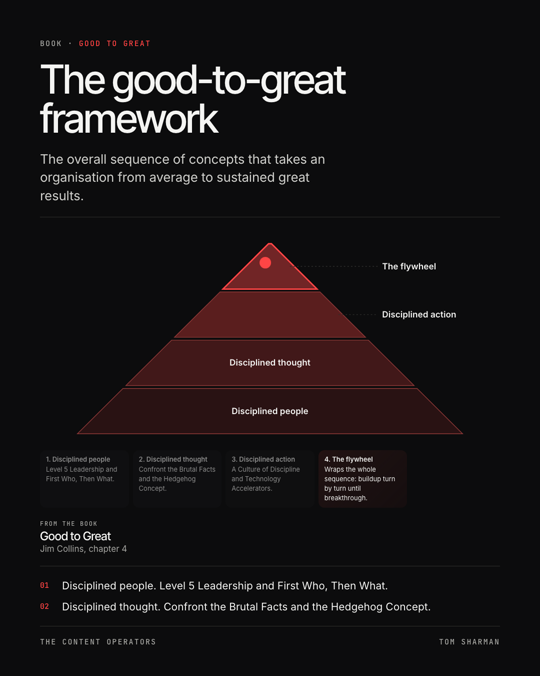
The overall sequence of concepts that takes an organisation from average to sustained great results.
- Disciplined people. Level 5 Leadership and First Who, Then What.
- Disciplined thought. Confront the Brutal Facts and the Hedgehog Concept.
- Disciplined action. A Culture of Discipline and Technology Accelerators.
- The flywheel. Wraps the whole sequence: buildup turn by turn until breakthrough.
From chapter: Chapter 1 - Good is the Enemy of Great, pp. 8–23
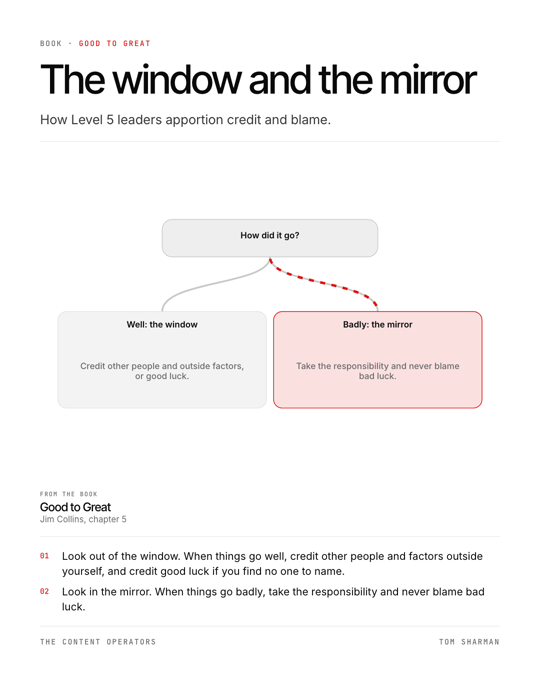
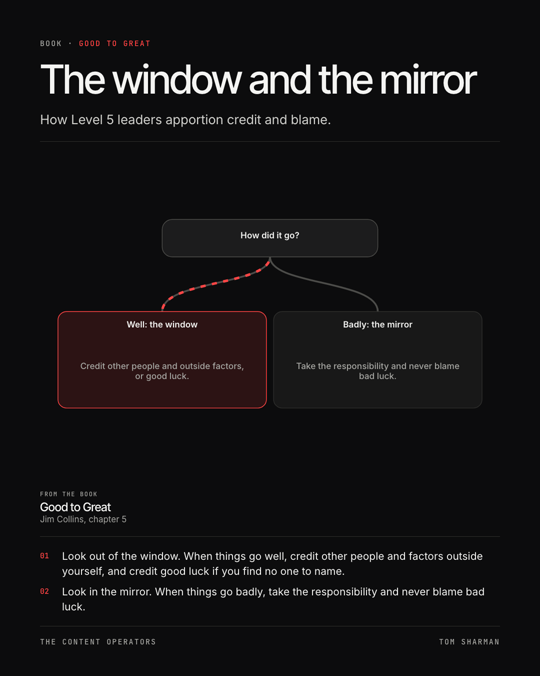
How Level 5 leaders apportion credit and blame.
- Look out of the window. When things go well, credit other people and factors outside yourself, and credit good luck if you find no one to name.
- Look in the mirror. When things go badly, take the responsibility and never blame bad luck.
From chapter: Chapter 2 - Level 5 Leadership, pp. 24–48
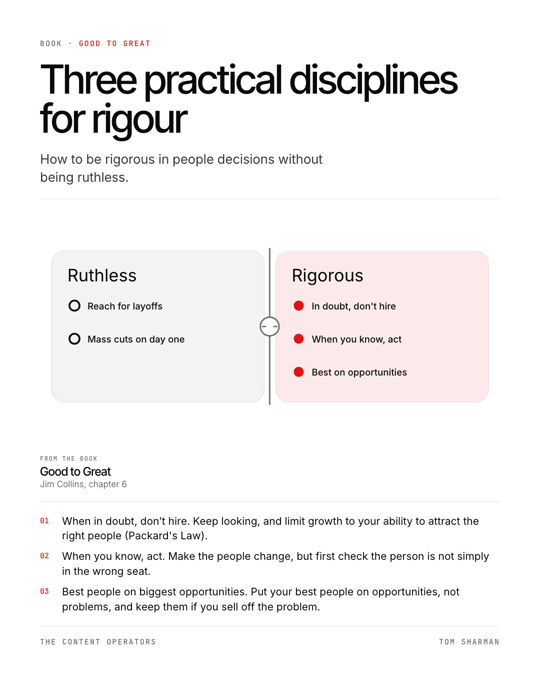
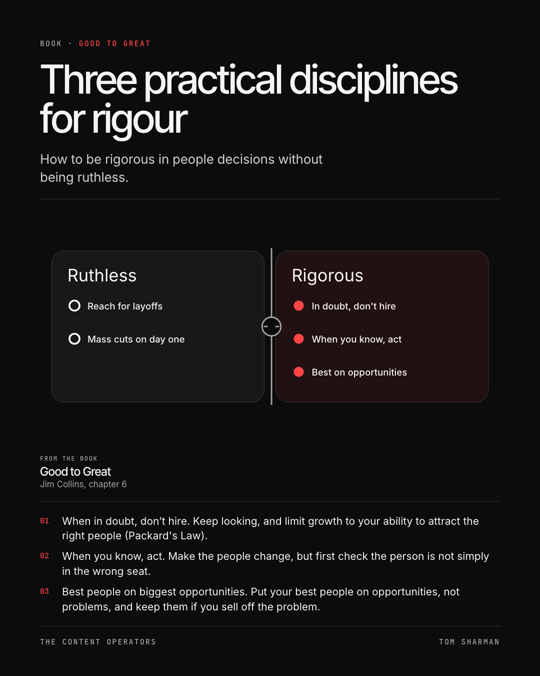
How to be rigorous in people decisions without being ruthless.
- When in doubt, don’t hire. Keep looking, and limit growth to your ability to attract the right people (Packard's Law).
- When you know, act. Make the people change, but first check the person is not simply in the wrong seat.
- Best people on biggest opportunities. Put your best people on opportunities, not problems, and keep them if you sell off the problem.
From chapter: Chapter 3 - First Who . . . Then What, pp. 49–73
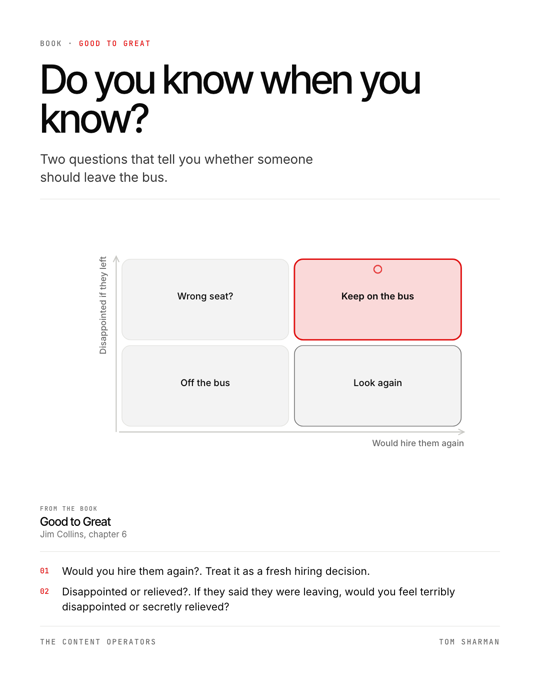
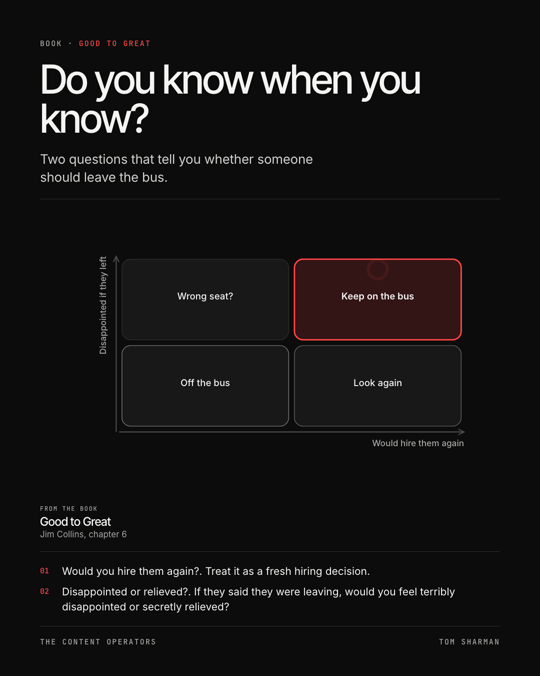
Two questions that tell you whether someone should leave the bus.
- Would you hire them again?. Treat it as a fresh hiring decision.
- Disappointed or relieved?. If they said they were leaving, would you feel terribly disappointed or secretly relieved?
From chapter: Chapter 3 - First Who . . . Then What, pp. 49–73
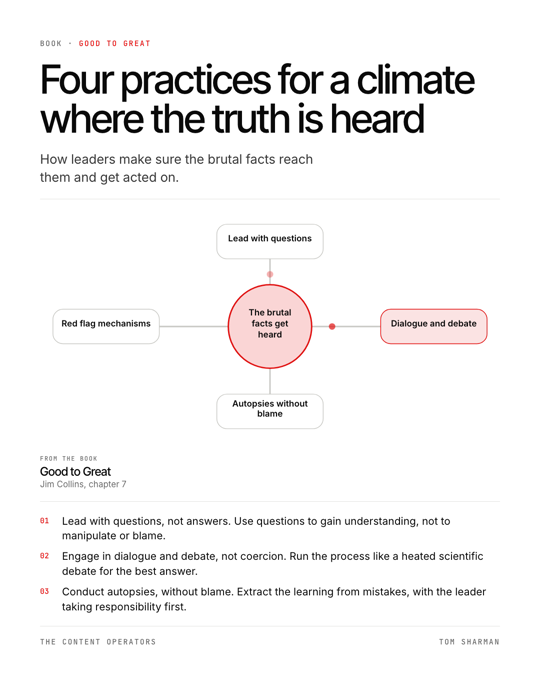
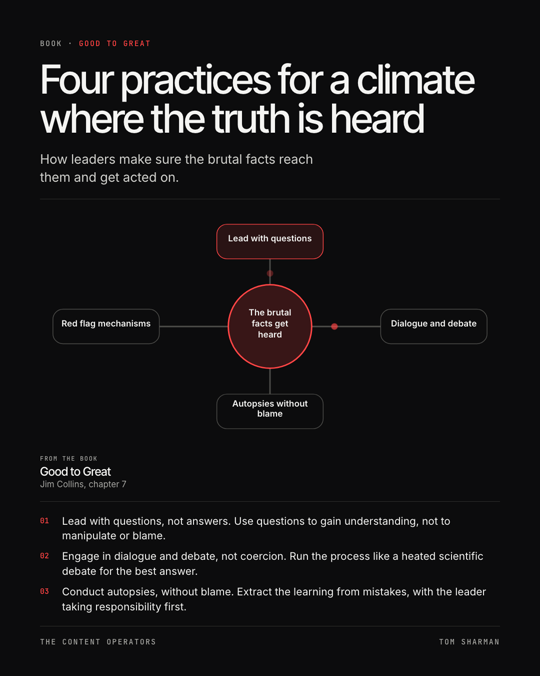
How leaders make sure the brutal facts reach them and get acted on.
- Lead with questions, not answers. Use questions to gain understanding, not to manipulate or blame.
- Engage in dialogue and debate, not coercion. Run the process like a heated scientific debate for the best answer.
- Conduct autopsies, without blame. Extract the learning from mistakes, with the leader taking responsibility first.
- Build red flag mechanisms. Turn information into information that cannot be ignored, such as short pay or a red flag card.
From chapter: Chapter 4 - Confront The Brutal Facts (Yet Never Lose Faith), pp. 74–99
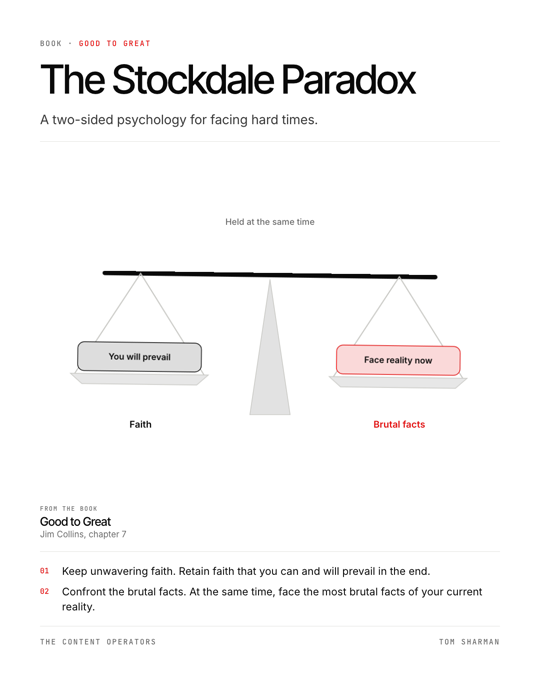
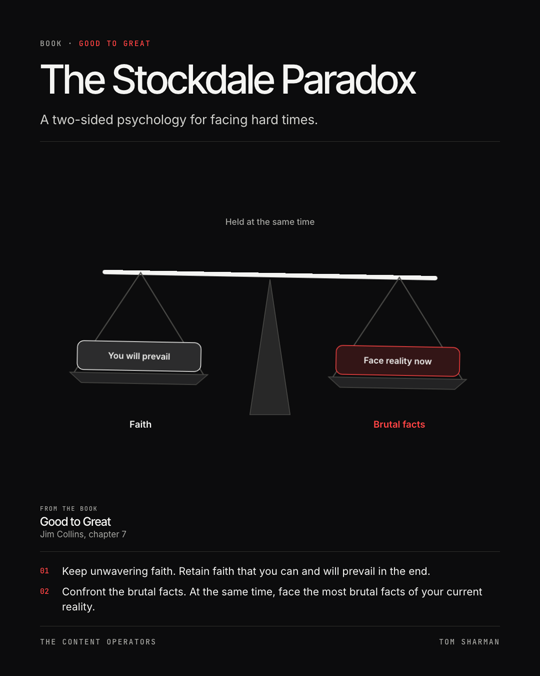
A two-sided psychology for facing hard times.
- Keep unwavering faith. Retain faith that you can and will prevail in the end.
- Confront the brutal facts. At the same time, face the most brutal facts of your current reality.
From chapter: Chapter 4 - Confront The Brutal Facts (Yet Never Lose Faith), pp. 74–99
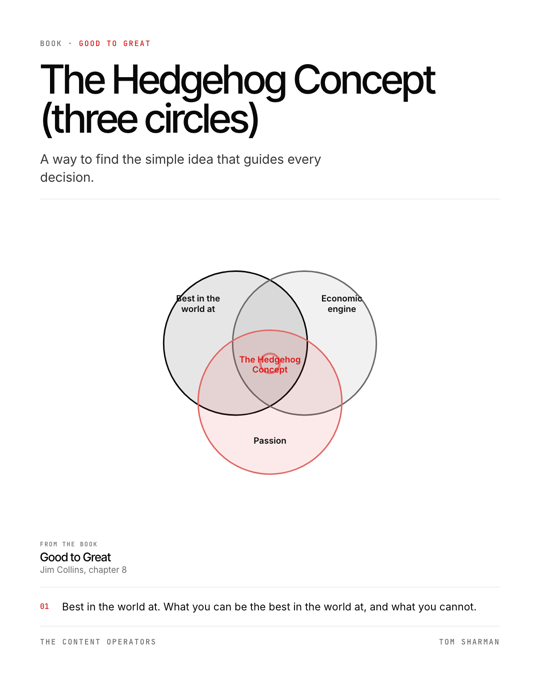
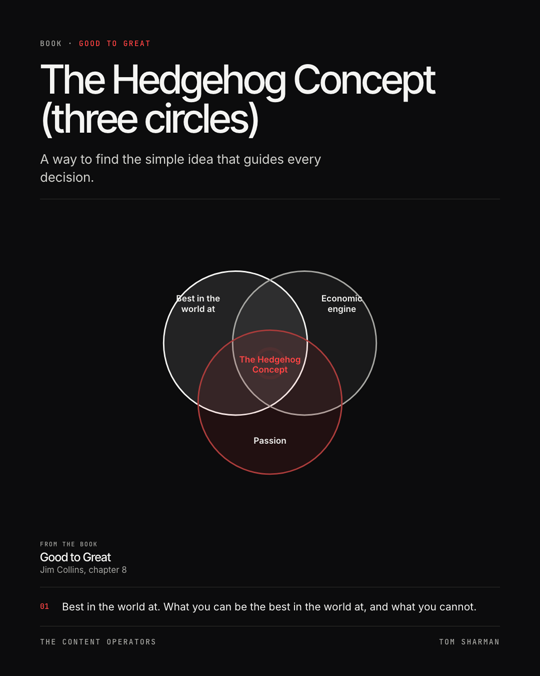
A way to find the simple idea that guides every decision.
- Best in the world at. What you can be the best in the world at, and what you cannot.
- Economic engine. What drives your economics, found by choosing one denominator, profit per x.
- Passion. What you are deeply passionate about.
- Intersect and simplify. Translate the overlap into one crystalline concept that frames all decisions.
From chapter: Chapter 5 - The Hedgehog Concept - (Simplicity within the Three Circles), pp. 100–130
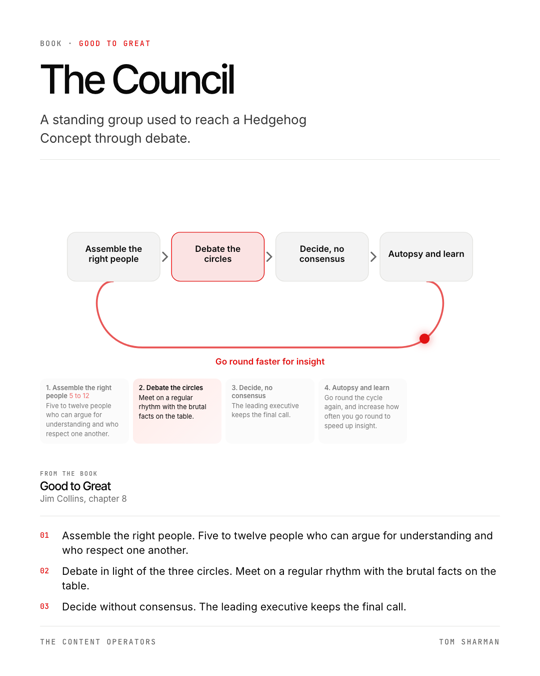
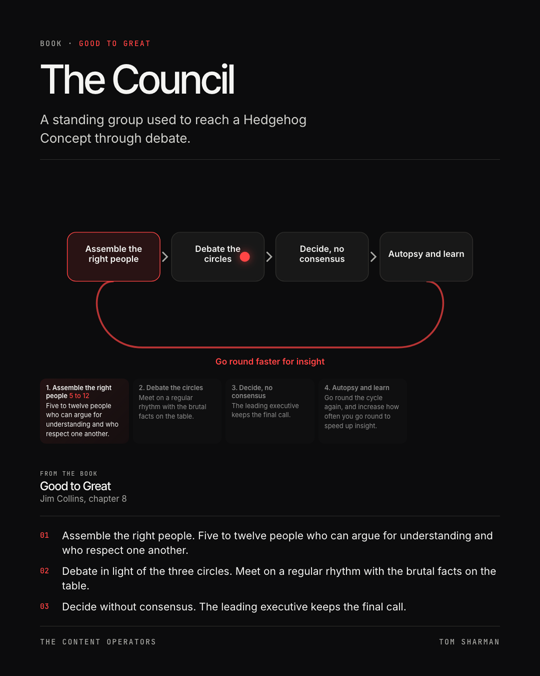
A standing group used to reach a Hedgehog Concept through debate.
- Assemble the right people. Five to twelve people who can argue for understanding and who respect one another.
- Debate in light of the three circles. Meet on a regular rhythm with the brutal facts on the table.
- Decide without consensus. The leading executive keeps the final call.
- Autopsy and learn. Go round the cycle again, and increase how often you go round to speed up insight.
From chapter: Chapter 5 - The Hedgehog Concept - (Simplicity within the Three Circles), pp. 100–130
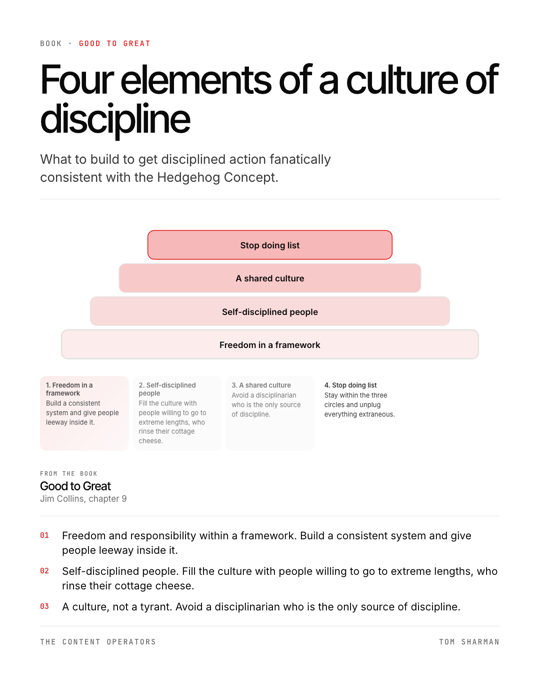
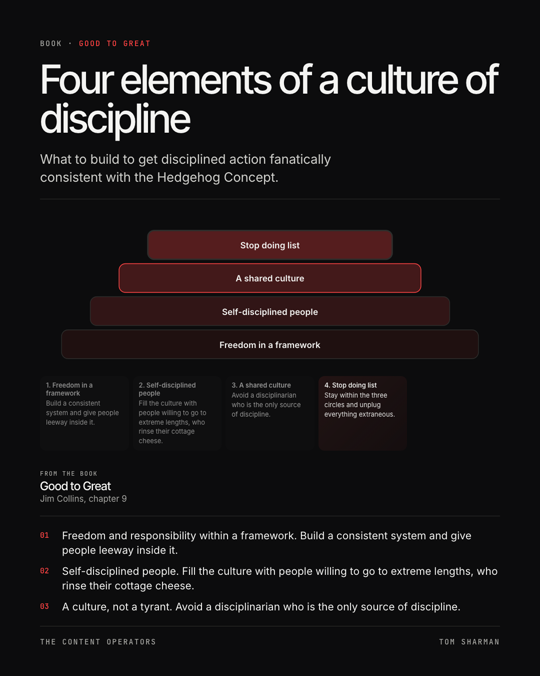
What to build to get disciplined action fanatically consistent with the Hedgehog Concept.
- Freedom and responsibility within a framework. Build a consistent system and give people leeway inside it.
- Self-disciplined people. Fill the culture with people willing to go to extreme lengths, who rinse their cottage cheese.
- A culture, not a tyrant. Avoid a disciplinarian who is the only source of discipline.
- Fanatical consistency and a stop doing list. Stay within the three circles and unplug everything extraneous.
From chapter: Chapter 6 - A Culture of Discipline, pp. 131–156
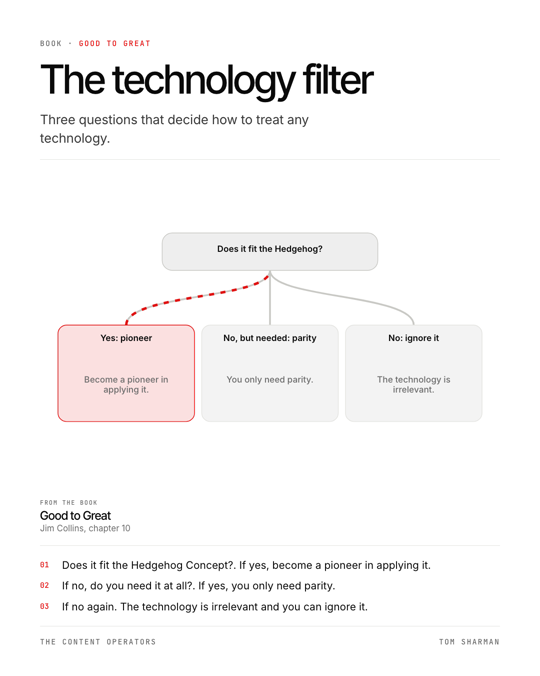
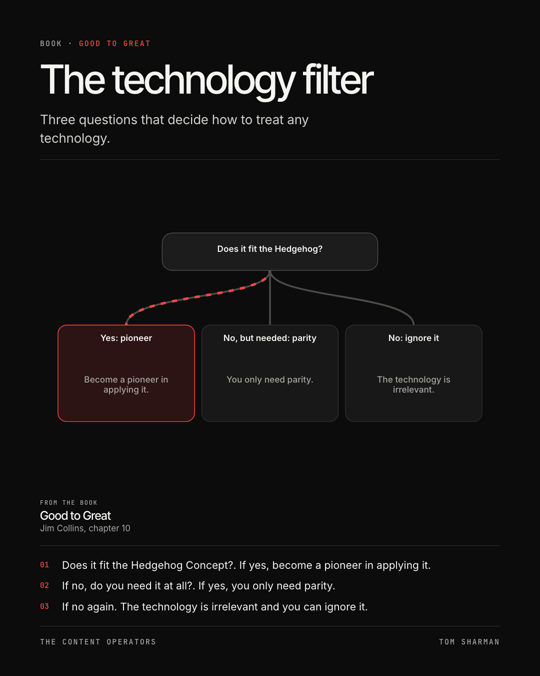
Three questions that decide how to treat any technology.
- Does it fit the Hedgehog Concept?. If yes, become a pioneer in applying it.
- If no, do you need it at all?. If yes, you only need parity.
- If no again. The technology is irrelevant and you can ignore it.
From chapter: Chapter 7 - Technology Accelerators, pp. 157–176
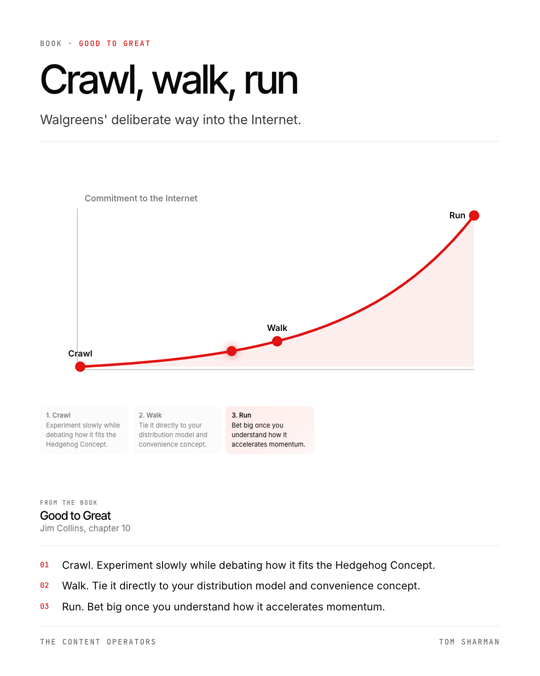
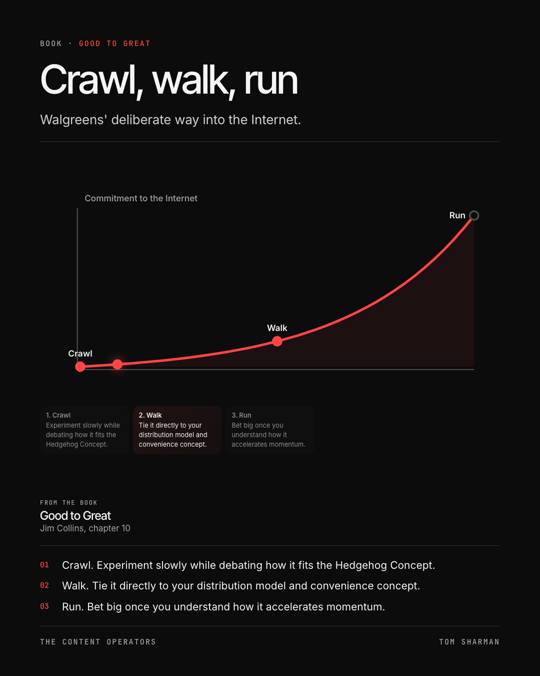
Walgreens' deliberate way into the Internet.
- Crawl. Experiment slowly while debating how it fits the Hedgehog Concept.
- Walk. Tie it directly to your distribution model and convenience concept.
- Run. Bet big once you understand how it accelerates momentum.
From chapter: Chapter 7 - Technology Accelerators, pp. 157–176
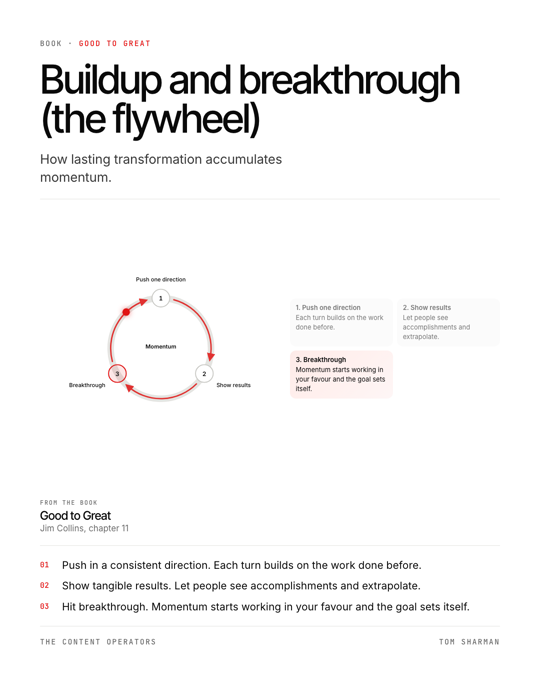
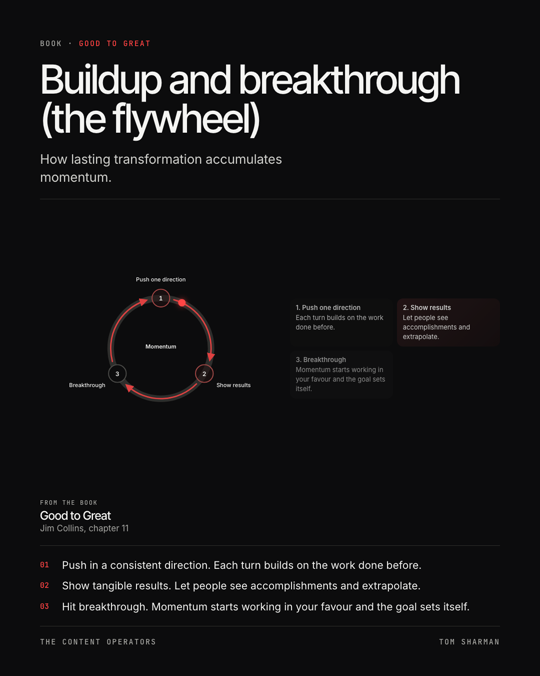
How lasting transformation accumulates momentum.
- Push in a consistent direction. Each turn builds on the work done before.
- Show tangible results. Let people see accomplishments and extrapolate.
- Hit breakthrough. Momentum starts working in your favour and the goal sets itself.
- Avoid the doom loop. Do not stop, change course and relaunch with a new programme.
From chapter: Chapter 8 - The Flywheel and The Doom Loop, pp. 177–198
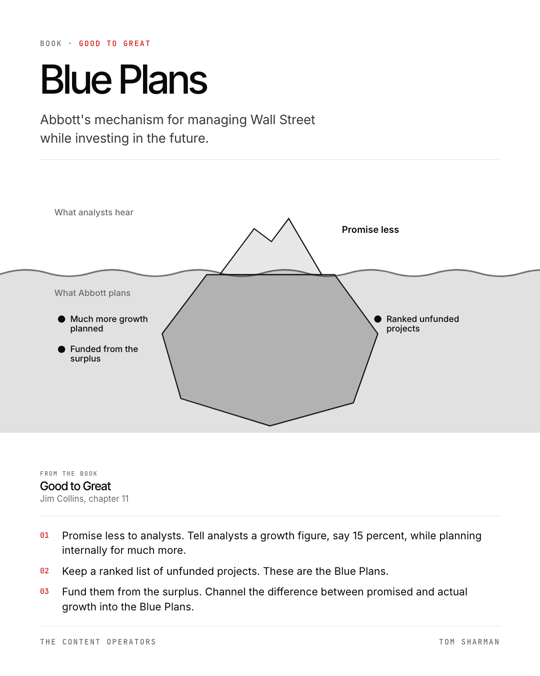
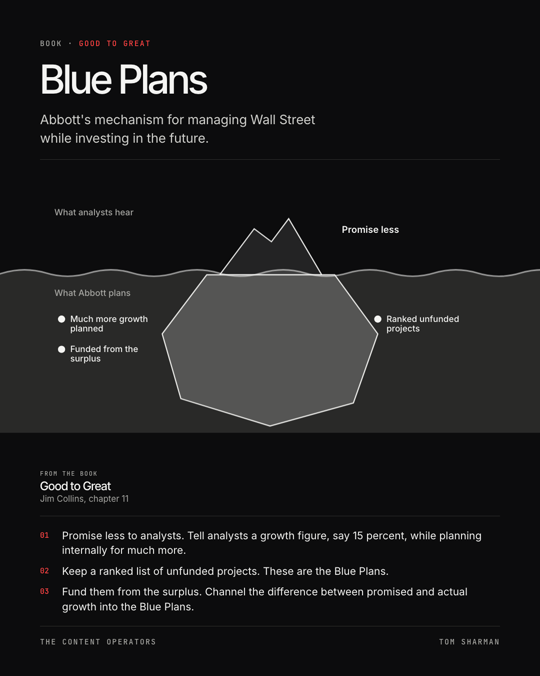
Abbott's mechanism for managing Wall Street while investing in the future.
- Promise less to analysts. Tell analysts a growth figure, say 15 percent, while planning internally for much more.
- Keep a ranked list of unfunded projects. These are the Blue Plans.
- Fund them from the surplus. Channel the difference between promised and actual growth into the Blue Plans.
From chapter: Chapter 8 - The Flywheel and The Doom Loop, pp. 177–198
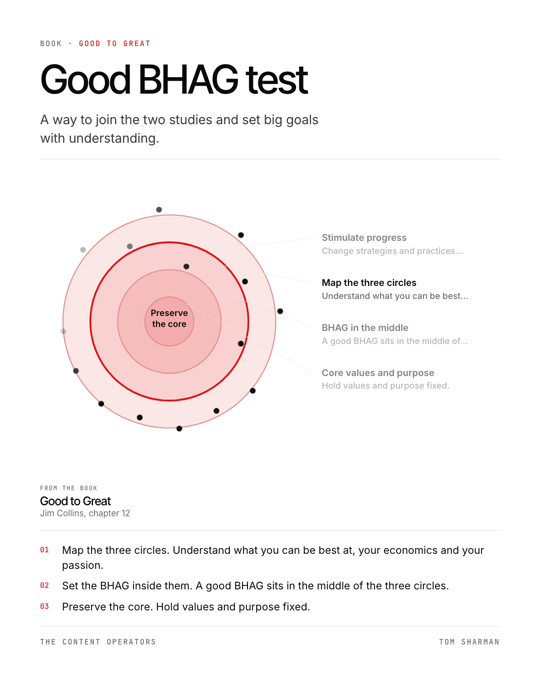
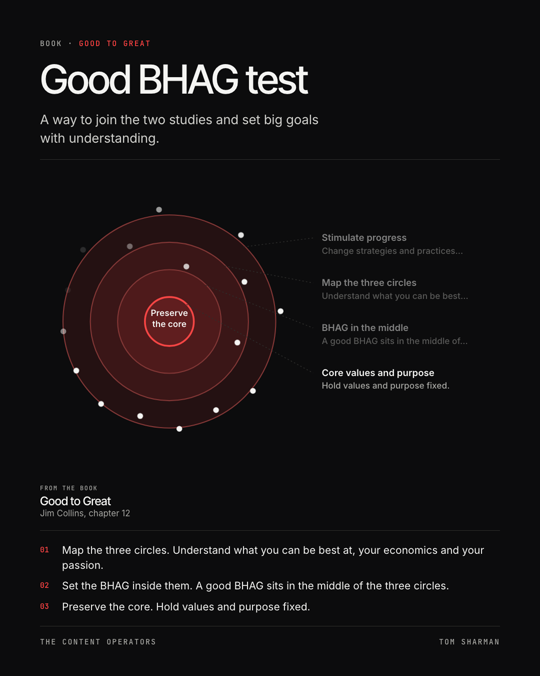
A way to join the two studies and set big goals with understanding.
- Map the three circles. Understand what you can be best at, your economics and your passion.
- Set the BHAG inside them. A good BHAG sits in the middle of the three circles.
- Preserve the core. Hold values and purpose fixed.
- Stimulate progress. Change strategies and practices endlessly around that core.
From chapter: Chapter 9 - From Good To Great To Built To Last, pp. 199–221
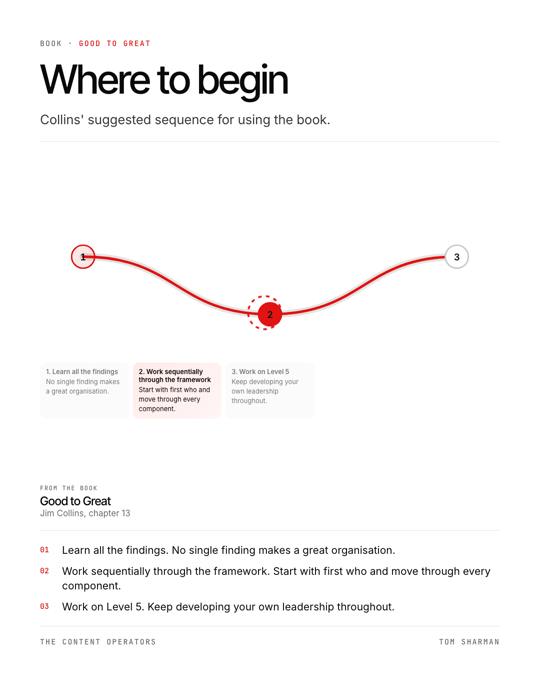
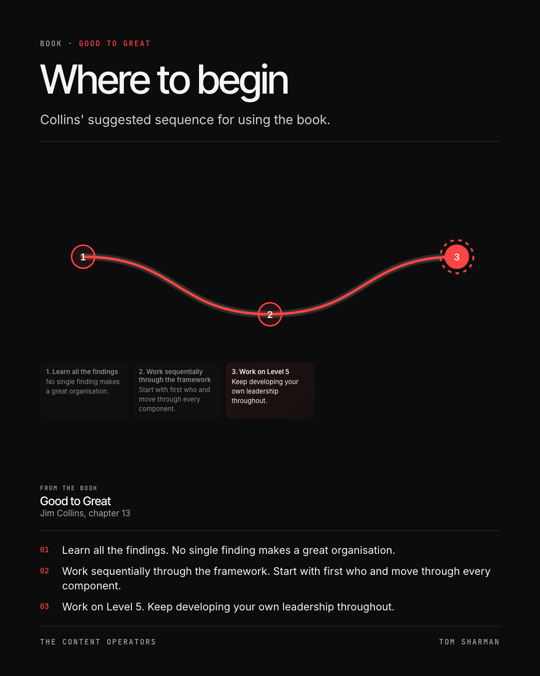
Collins' suggested sequence for using the book.
- Learn all the findings. No single finding makes a great organisation.
- Work sequentially through the framework. Start with first who and move through every component.
- Work on Level 5. Keep developing your own leadership throughout.
From chapter: Epilogue - Frequently Asked Questions, pp. 222–230