What it argues
Greene argues that power is a game played through appearances, indirection and control of other people's emotions, and that refusing to play only leaves you powerless. Across 48 laws, each backed by stories from courts, wars and con artists, he claims that people are moved by self-interest, fantasy, mystery, image and the illusion of choice more than by honesty or argument. The book teaches concealing your intentions and your effort, keeping the initiative, building and guarding a reputation, using scarcity and attention, and staging symbols, spectacle and belief. It also warns about envy, overreach, rigidity and isolation, and says to stop at the mark you aimed for and stay adaptable like water. Every law comes with a reversal, which tells the reader that judgement about the situation counts for more than any rule.
Every framework, step by step
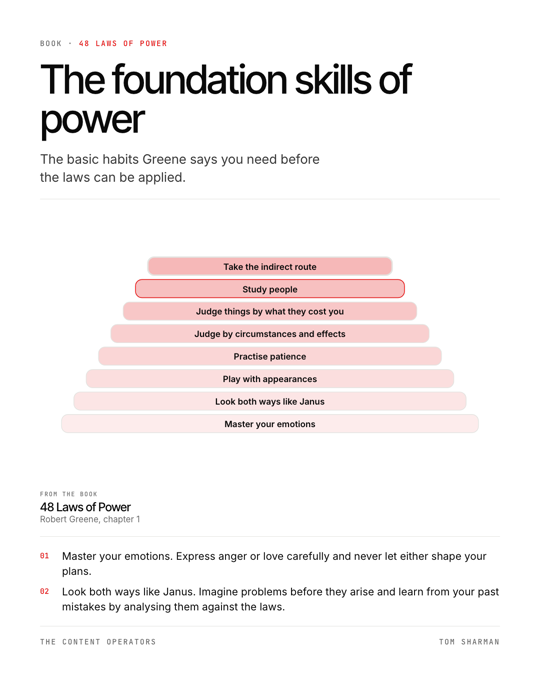
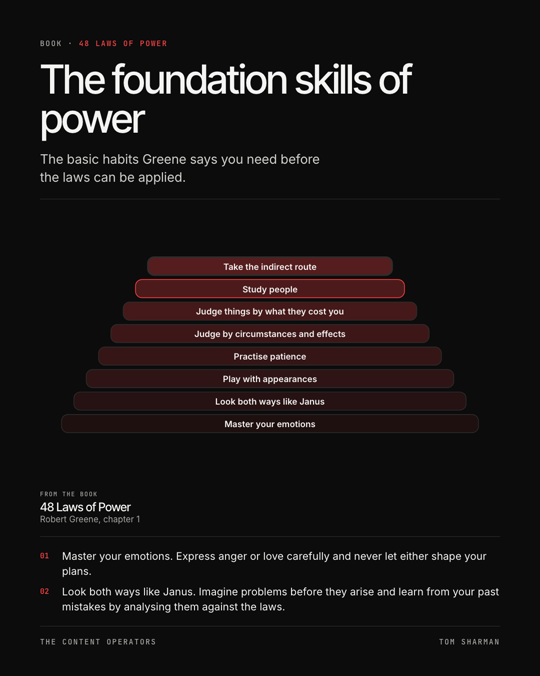
The basic habits Greene says you need before the laws can be applied.
- Master your emotions. Express anger or love carefully and never let either shape your plans.
- Look both ways like Janus. Imagine problems before they arise and learn from your past mistakes by analysing them against the laws.
- Play with appearances. Wear many masks and keep a bag of deceptive tricks so you stay flexible.
- Practise patience. Give time and see several steps ahead so you avoid moronic blunders.
- Judge by circumstances and effects. Judge opponents by the effect of their moves.
- Judge things by what they cost you. Weigh time, energy and peace of mind before taking part in anything.
- Study people. Recognise hidden motives, because that knowledge opens up persuasion and influence.
- Take the indirect route. Plan moves in the least obvious way and disguise your cunning.
From chapter: PREFACE, pp. 14–23
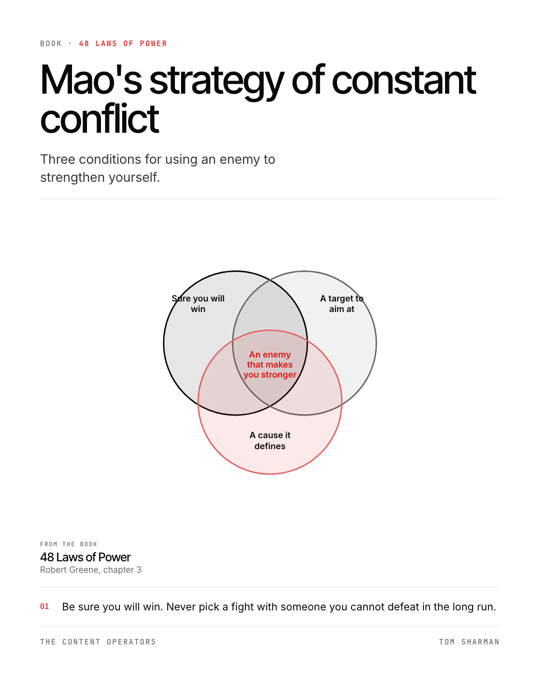
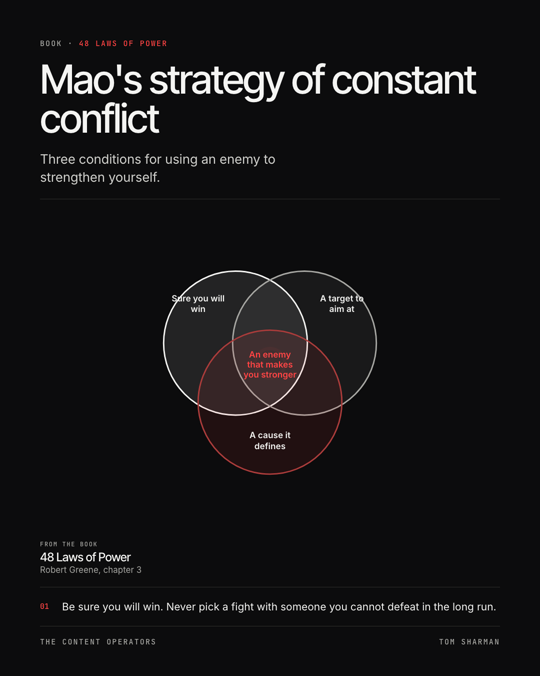
Three conditions for using an enemy to strengthen yourself.
- Be sure you will win. Never pick a fight with someone you cannot defeat in the long run.
- Set up a target if needed. If you have no apparent enemies, create a convenient one, even turning a friend into one.
- Use the enemy to define your cause. Frame your cause as a struggle against a clearly defined opponent so the public understands it.
From chapter: LAW 2, pp. 32–43
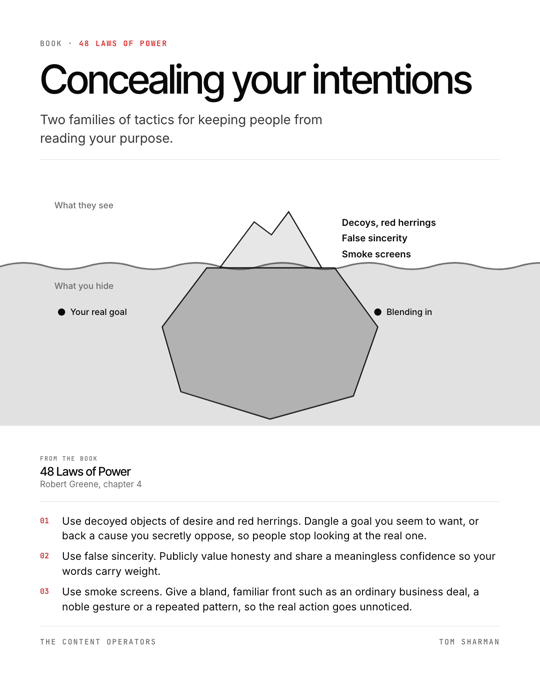
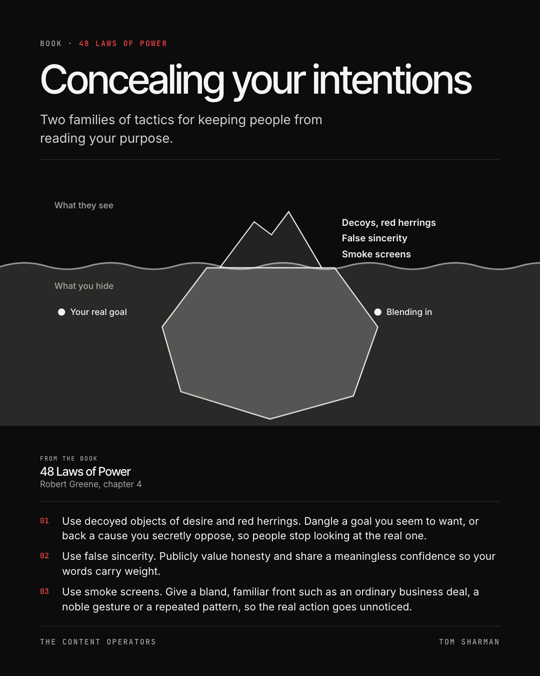
Two families of tactics for keeping people from reading your purpose.
- Use decoyed objects of desire and red herrings. Dangle a goal you seem to want, or back a cause you secretly oppose, so people stop looking at the real one.
- Use false sincerity. Publicly value honesty and share a meaningless confidence so your words carry weight.
- Use smoke screens. Give a bland, familiar front such as an ordinary business deal, a noble gesture or a repeated pattern, so the real action goes unnoticed.
- Blend in. Look like you belong to the group so suspicion never starts.
From chapter: LAW 3, pp. 44–64
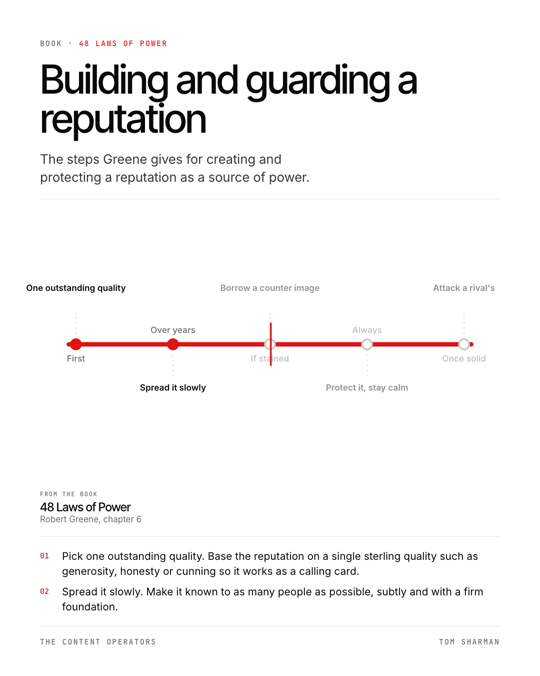
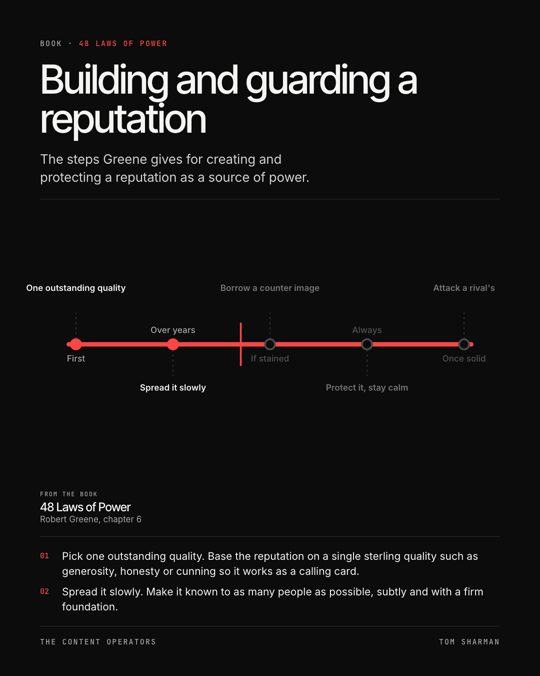
The steps Greene gives for creating and protecting a reputation as a source of power.
- Pick one outstanding quality. Base the reputation on a single sterling quality such as generosity, honesty or cunning so it works as a calling card.
- Spread it slowly. Make it known to as many people as possible, subtly and with a firm foundation.
- Borrow a counter image if stained. Associate with someone whose good name offsets yours.
- Protect it and stay calm. Anticipate attacks and avoid defensive anger at slander.
- Attack a rival's reputation with skill. Sow doubt when you are small, then use satire and ridicule once your own reputation is solid.
From chapter: LAW 5, pp. 74–84
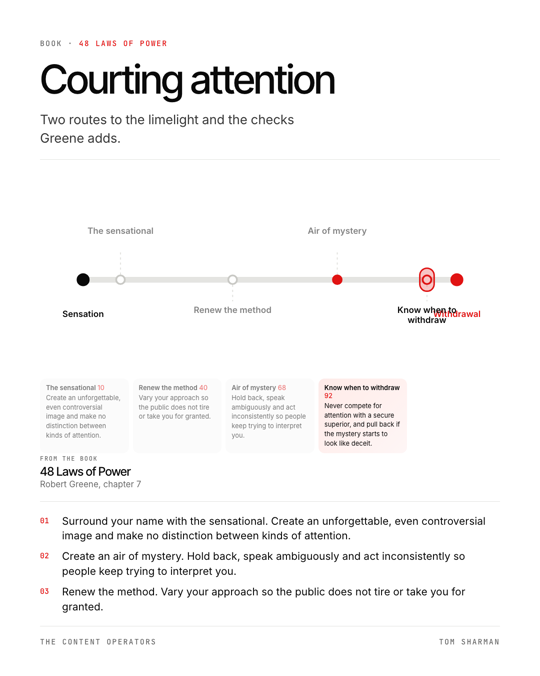
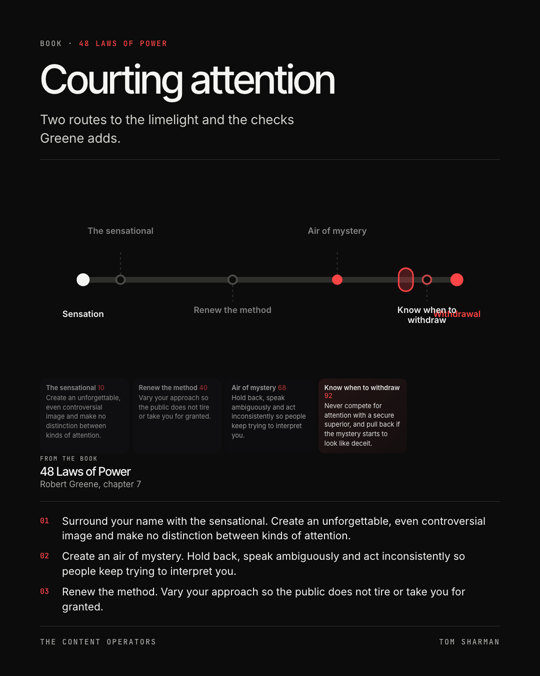
Two routes to the limelight and the checks Greene adds.
- Surround your name with the sensational. Create an unforgettable, even controversial image and make no distinction between kinds of attention.
- Create an air of mystery. Hold back, speak ambiguously and act inconsistently so people keep trying to interpret you.
- Renew the method. Vary your approach so the public does not tire or take you for granted.
- Know when to withdraw. Never compete for attention with a secure superior, and pull back if the mystery starts to look like deceit.
From chapter: LAW 6, pp. 85–100
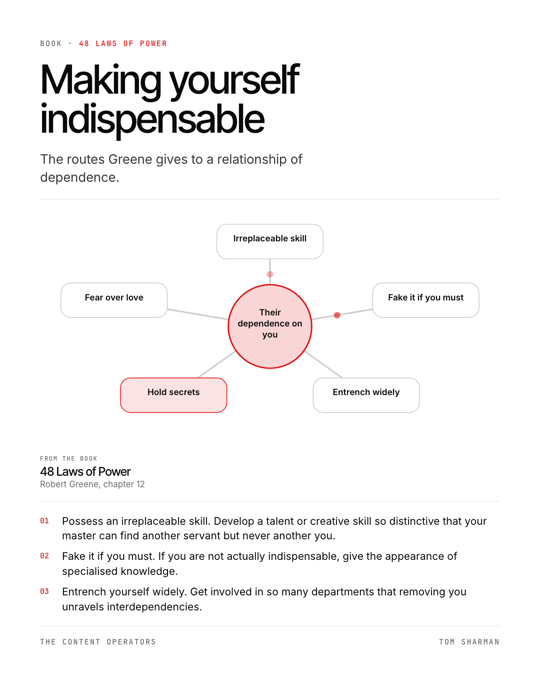
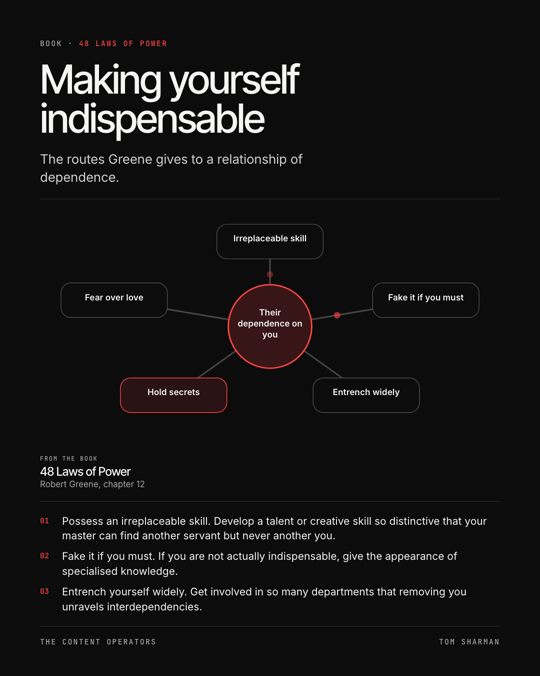
The routes Greene gives to a relationship of dependence.
- Possess an irreplaceable skill. Develop a talent or creative skill so distinctive that your master can find another servant but never another you.
- Fake it if you must. If you are not actually indispensable, give the appearance of specialised knowledge.
- Entrench yourself widely. Get involved in so many departments that removing you unravels interdependencies.
- Hold secrets. Seal your fate with theirs by knowing what they would not want broadcast.
- Accept fear over love. Let them depend on you out of fear of the consequences of losing you, since you can control that.
From chapter: LAW 11, pp. 136–145
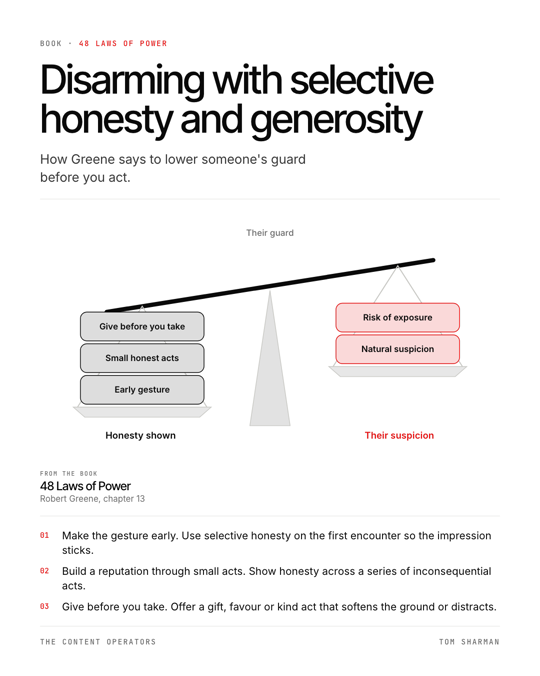
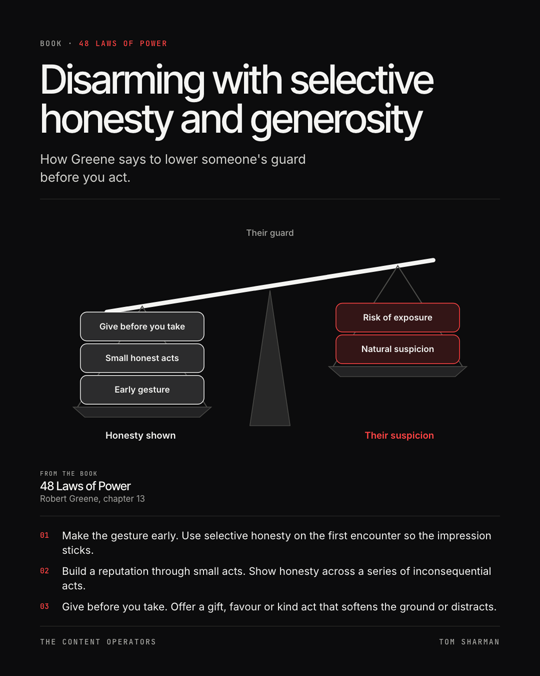
How Greene says to lower someone's guard before you act.
- Make the gesture early. Use selective honesty on the first encounter so the impression sticks.
- Build a reputation through small acts. Show honesty across a series of inconsequential acts.
- Give before you take. Offer a gift, favour or kind act that softens the ground or distracts.
- Make it sincere. Only use the tactic if the gesture seems heartfelt, because exposure turns warmth into hatred.
From chapter: LAW 12, pp. 146–153
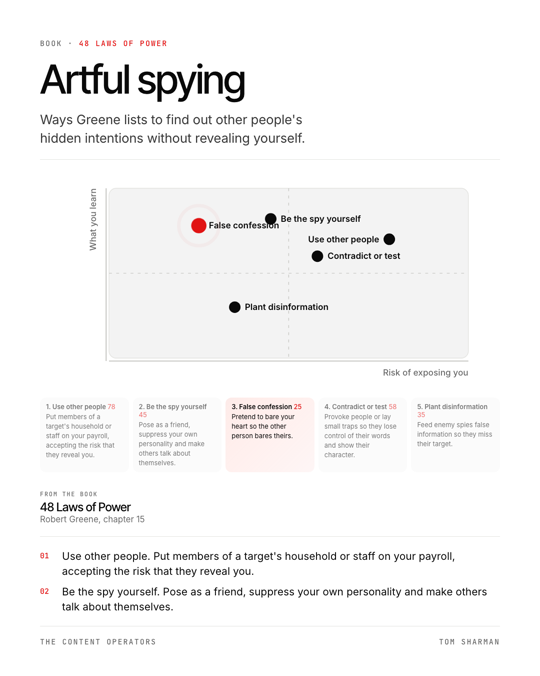
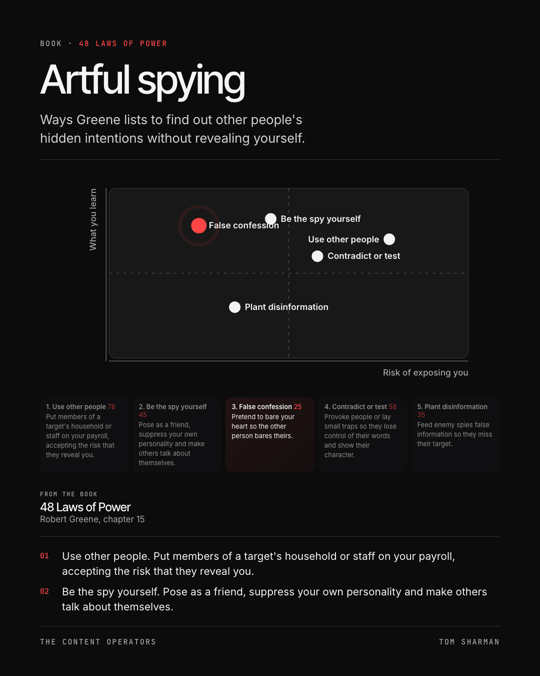
Ways Greene lists to find out other people's hidden intentions without revealing yourself.
- Use other people. Put members of a target's household or staff on your payroll, accepting the risk that they reveal you.
- Be the spy yourself. Pose as a friend, suppress your own personality and make others talk about themselves.
- Offer a false confession. Pretend to bare your heart so the other person bares theirs.
- Contradict or test. Provoke people or lay small traps so they lose control of their words and show their character.
- Plant disinformation. Feed enemy spies false information so they miss their target.
From chapter: LAW 14, pp. 162–168
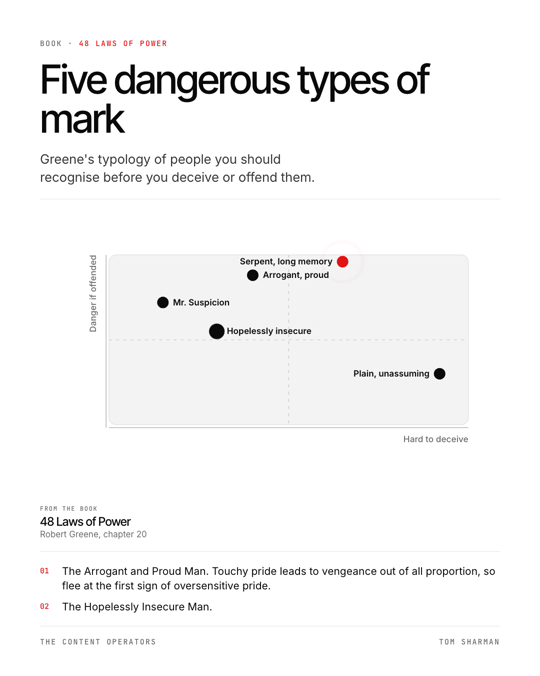
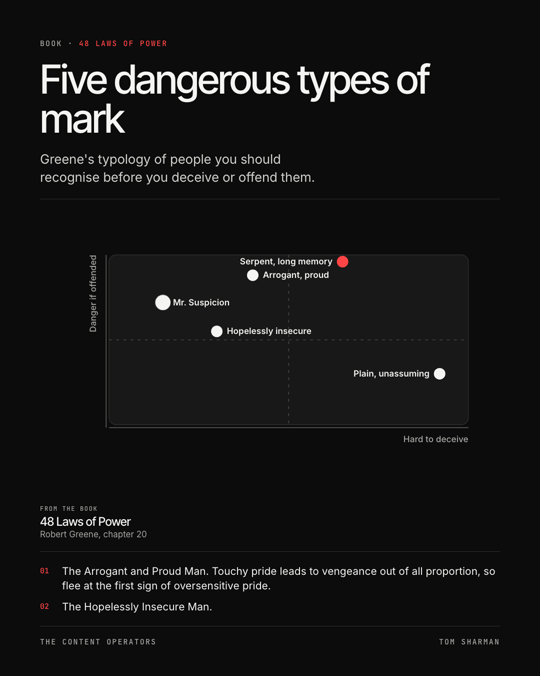
Greene's typology of people you should recognise before you deceive or offend them.
- The Arrogant and Proud Man. Touchy pride leads to vengeance out of all proportion, so flee at the first sign of oversensitive pride.
- The Hopelessly Insecure Man. A fragile ego nurses hurt and attacks in small bites, so disappear for a long time if you have harmed him.
- Mr. Suspicion. He sees the worst in everyone and is easy to deceive and turn against others, but dangerous if you become his target.
- The Serpent with a Long Memory. He shows no anger, calculates and waits to take revenge, so crush him completely or get him out of your sight.
- The Plain, Unassuming and Often Unintelligent Man. He is hard to deceive because he does not recognise the bait, so test him with a joke and, if his reaction is literal, proceed at your own risk.
From chapter: LAW 19, pp. 207–218
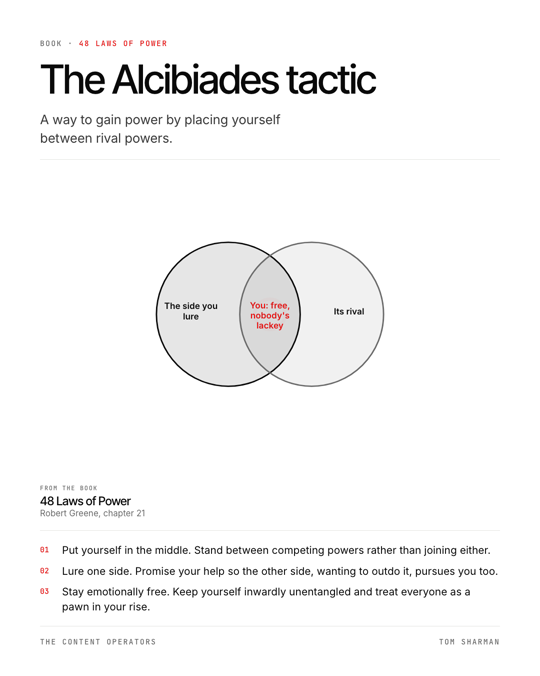
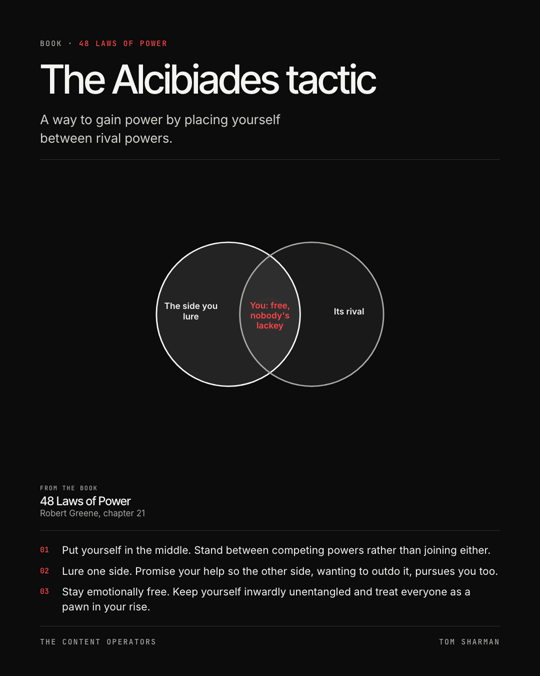
A way to gain power by placing yourself between rival powers.
- Put yourself in the middle. Stand between competing powers rather than joining either.
- Lure one side. Promise your help so the other side, wanting to outdo it, pursues you too.
- Stay emotionally free. Keep yourself inwardly unentangled and treat everyone as a pawn in your rise.
- Never become the lackey. Refuse to become the servant of any cause.
From chapter: LAW 20, pp. 219–234
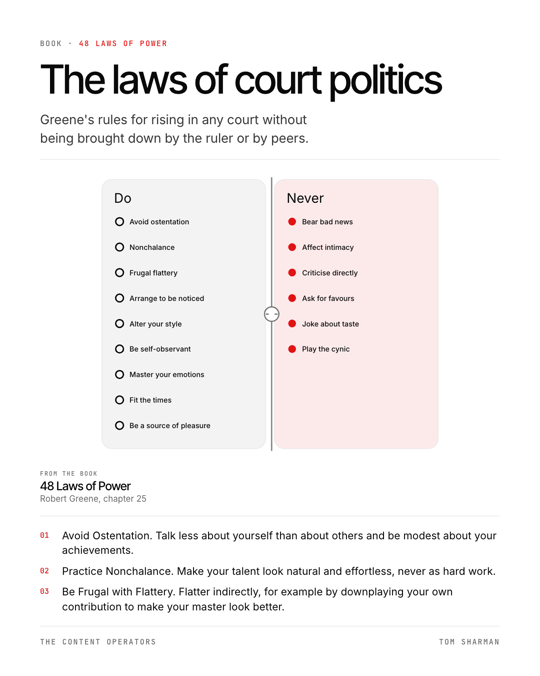
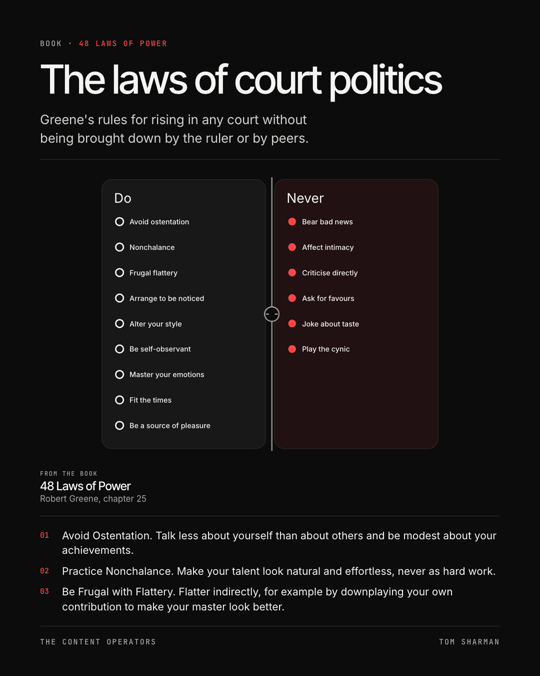
Greene's rules for rising in any court without being brought down by the ruler or by peers.
- Avoid Ostentation. Talk less about yourself than about others and be modest about your achievements.
- Practice Nonchalance. Make your talent look natural and effortless, never as hard work.
- Be Frugal with Flattery. Flatter indirectly, for example by downplaying your own contribution to make your master look better.
- Arrange to Be Noticed. Create a subtly distinctive style and image so the ruler picks you out.
- Alter Your Style and Language According to the Person You Are Dealing With. Adapt how you speak and act to each person's rank and culture.
- Never Be the Bearer of Bad News. Make sure the bad news falls to someone else and bring only good news.
- Never Affect Friendliness and Intimacy with Your Master. Keep the distance a subordinate should keep.
- Never Criticize Those Above You Directly. Couch advice as indirectly and politely as possible.
- Be Frugal in Asking Those Above You for Favors. Earn favours rather than asking, and never ask on a friend's behalf.
- Never Joke About Appearances or Taste. Avoid jokes about looks or taste, especially with superiors.
- Do Not Be the Court Cynic. Admire the good work of others sincerely and avoid constant criticism.
- Be Self-observant. Be your own mirror and watch whether you seem obsequious or desperate.
- Master Your Emotions. Disguise anger and frustration and fake contentment when needed.
- Fit the Spirit of the Times. Keep up with the times without standing out too much.
- Be a Source of Pleasure. Control your unpleasant qualities and make yourself the flame people are drawn to.
From chapter: LAW 24, pp. 264–281
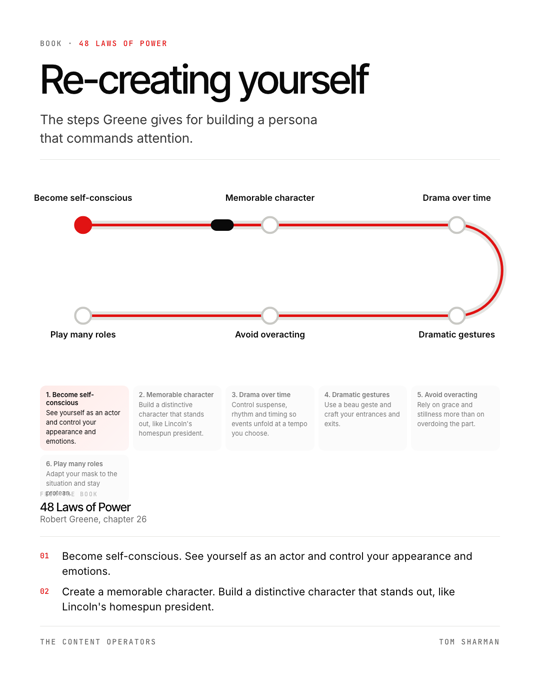
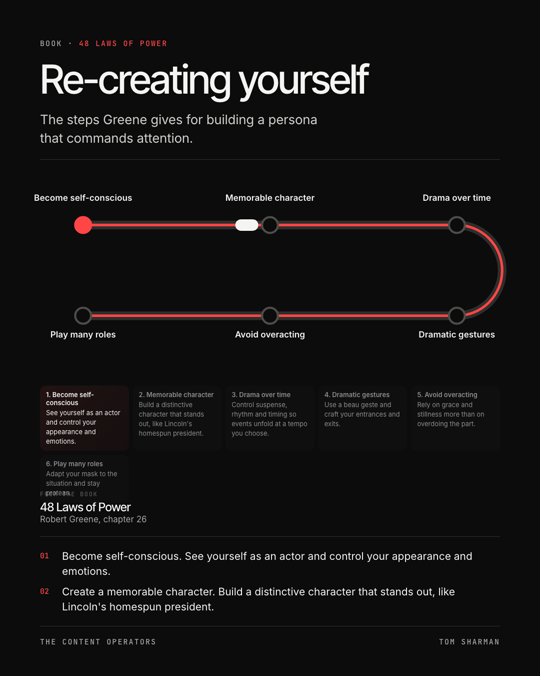
The steps Greene gives for building a persona that commands attention.
- Become self-conscious. See yourself as an actor and control your appearance and emotions.
- Create a memorable character. Build a distinctive character that stands out, like Lincoln's homespun president.
- Use drama over time. Control suspense, rhythm and timing so events unfold at a tempo you choose.
- Add dramatic gestures. Use a beau geste and craft your entrances and exits.
- Avoid overacting. Rely on grace and stillness more than on overdoing the part.
- Play many roles. Adapt your mask to the situation and stay protean.
From chapter: LAW 25, pp. 282–292
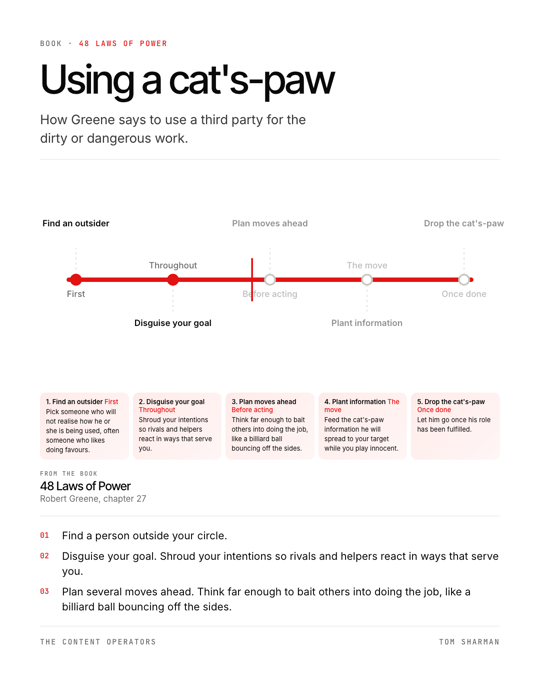
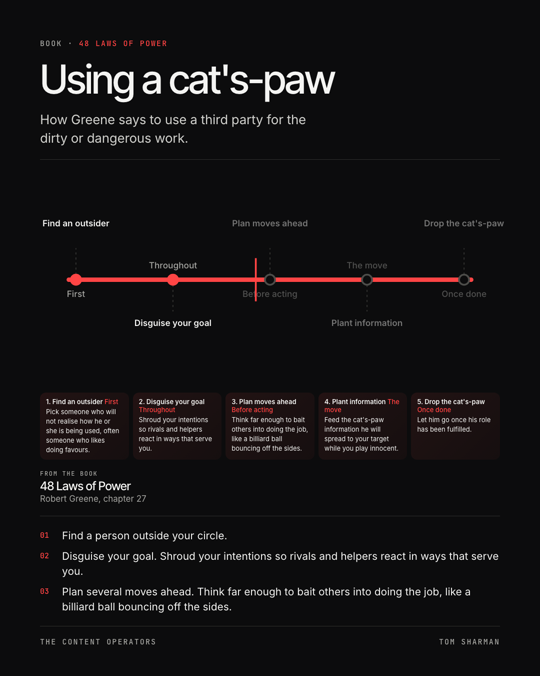
How Greene says to use a third party for the dirty or dangerous work.
- Find a person outside your circle. Pick someone who will not realise how he or she is being used, often someone who likes doing favours.
- Disguise your goal. Shroud your intentions so rivals and helpers react in ways that serve you.
- Plan several moves ahead. Think far enough to bait others into doing the job, like a billiard ball bouncing off the sides.
- Plant information. Feed the cat's-paw information he will spread to your target while you play innocent.
- Get rid of the cat's-paw in time. Let him go once his role has been fulfilled.
From chapter: LAW 26, pp. 293–317
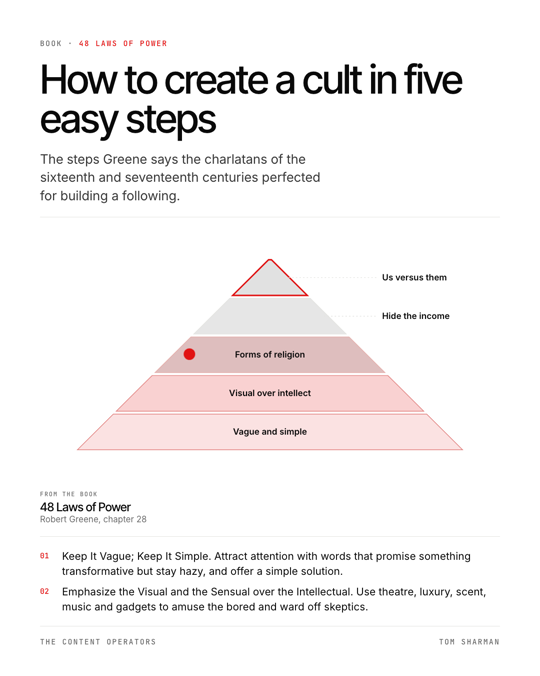
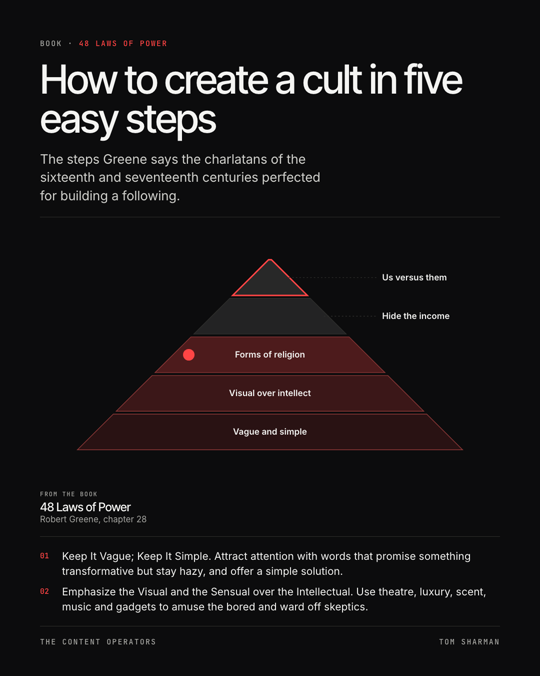
The steps Greene says the charlatans of the sixteenth and seventeenth centuries perfected for building a following.
- Keep It Vague; Keep It Simple. Attract attention with words that promise something transformative but stay hazy, and offer a simple solution.
- Emphasize the Visual and the Sensual over the Intellectual. Use theatre, luxury, scent, music and gadgets to amuse the bored and ward off skeptics.
- Borrow the Forms of Organized Religion to Structure the Group. Create rituals, ranks, religious titles and sacrifices, and act like a prophet or guru.
- Disguise Your Source of Income. Surround yourself with luxury and let it seem to come from the truth of your methods and hide the followers' pockets that fill it.
- Set Up an Us-Versus-Them Dynamic. Make followers feel part of an exclusive club and invent a devious enemy to keep the group cohesive.
From chapter: LAW 27, pp. 318–337
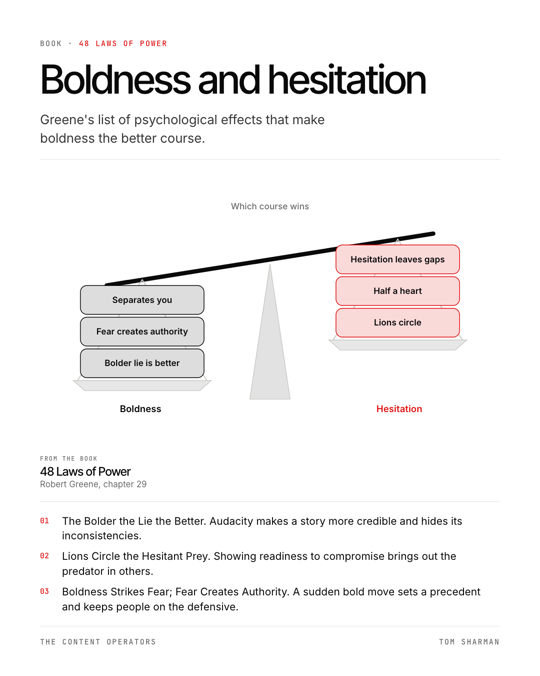
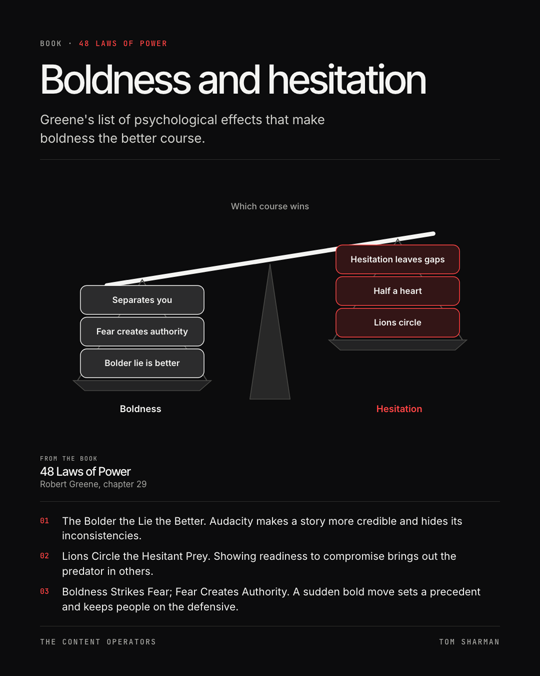
Greene's list of psychological effects that make boldness the better course.
- The Bolder the Lie the Better. Audacity makes a story more credible and hides its inconsistencies.
- Lions Circle the Hesitant Prey. Showing readiness to compromise brings out the predator in others.
- Boldness Strikes Fear; Fear Creates Authority. A sudden bold move sets a precedent and keeps people on the defensive.
- Going Halfway with Half a Heart Digs the Deeper Grave. Entering an action with less than total confidence puts obstacles in your own path.
- Hesitation Creates Gaps, Boldness Obliterates Them. Swiftness leaves no space for doubt and worry.
- Audacity Separates You from the Herd. Boldness gives you presence, and what draws attention draws power.
From chapter: LAW 28, pp. 338–351
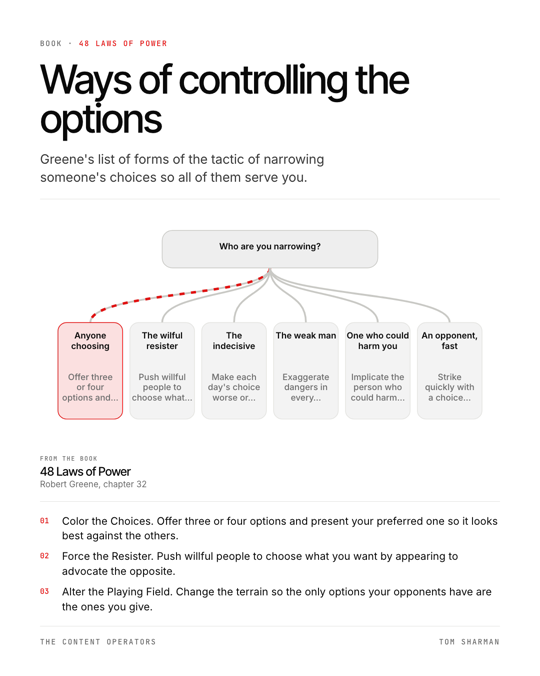
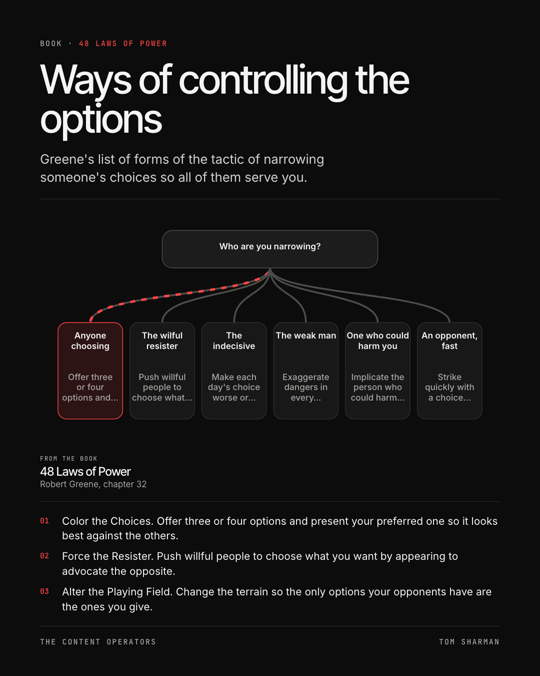
Greene's list of forms of the tactic of narrowing someone's choices so all of them serve you.
- Color the Choices. Offer three or four options and present your preferred one so it looks best against the others.
- Force the Resister. Push willful people to choose what you want by appearing to advocate the opposite.
- Alter the Playing Field. Change the terrain so the only options your opponents have are the ones you give.
- The Shrinking Options. Make each day's choice worse or dearer so the indecisive buy now.
- The Weak Man on the Precipice. Exaggerate dangers in every direction except the one you want the weak person to take.
- Brothers in Crime. Implicate the person who could harm you in your scheme so their options narrow.
- The Horns of a Dilemma. Strike quickly with a choice between two options that both hurt the victim.
From chapter: LAW 31, pp. 377–389
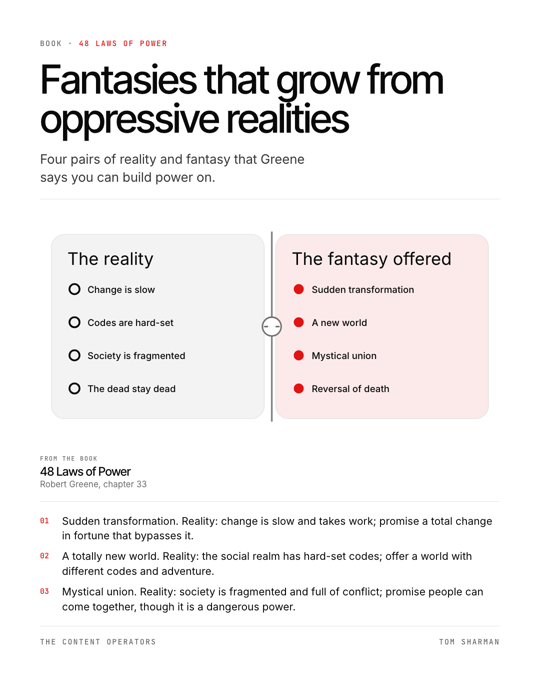
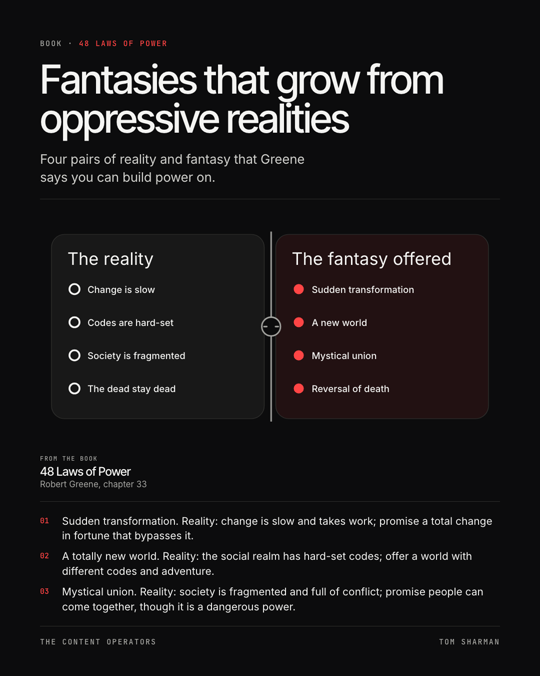
Four pairs of reality and fantasy that Greene says you can build power on.
- Sudden transformation. Reality: change is slow and takes work; promise a total change in fortune that bypasses it.
- A totally new world. Reality: the social realm has hard-set codes; offer a world with different codes and adventure.
- Mystical union. Reality: society is fragmented and full of conflict; promise people can come together, though it is a dangerous power.
- Reversal of death and the past. Reality: the dead cannot be brought back; offer a sudden reversal, as the forged Vermeers did.
From chapter: LAW 32, pp. 390–400
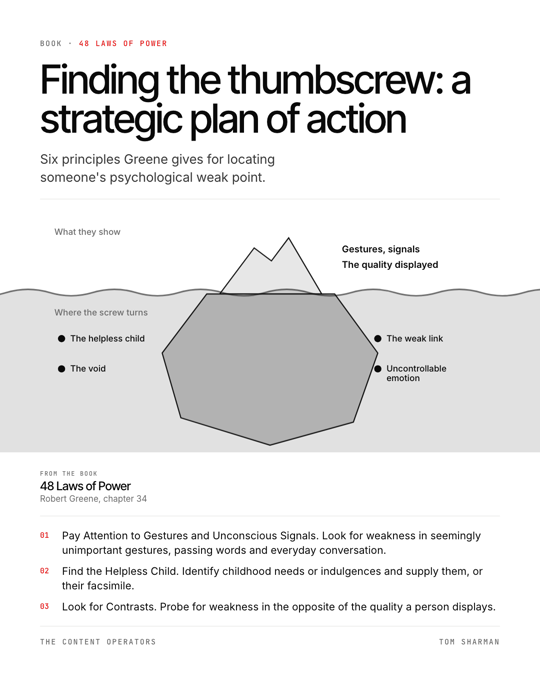
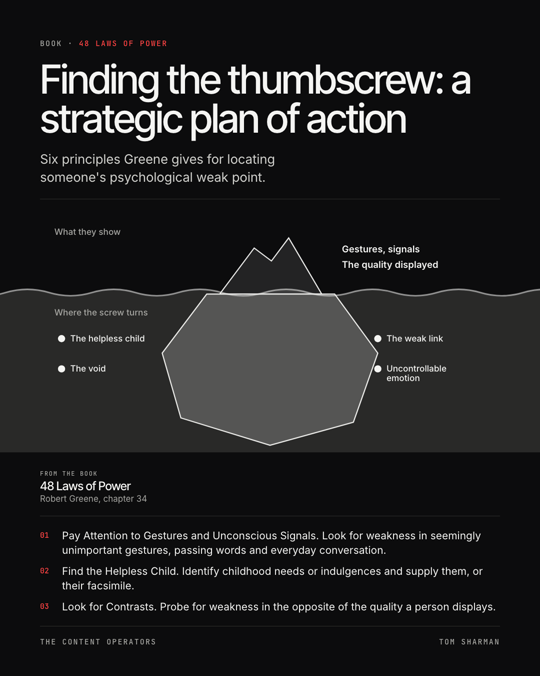
Six principles Greene gives for locating someone's psychological weak point.
- Pay Attention to Gestures and Unconscious Signals. Look for weakness in seemingly unimportant gestures, passing words and everyday conversation.
- Find the Helpless Child. Identify childhood needs or indulgences and supply them, or their facsimile.
- Look for Contrasts. Probe for weakness in the opposite of the quality a person displays.
- Find the Weak Link. Win over the person behind the scenes who influences the one on top, or the member of a group who will bend.
- Fill the Void. Meet insecurity and unhappiness with social validation or by addressing the root of the unhappiness.
- Feed on Uncontrollable Emotions. Use fear, lust, greed, vanity or hatred that people cannot control to control them.
From chapter: LAW 33, pp. 401–418
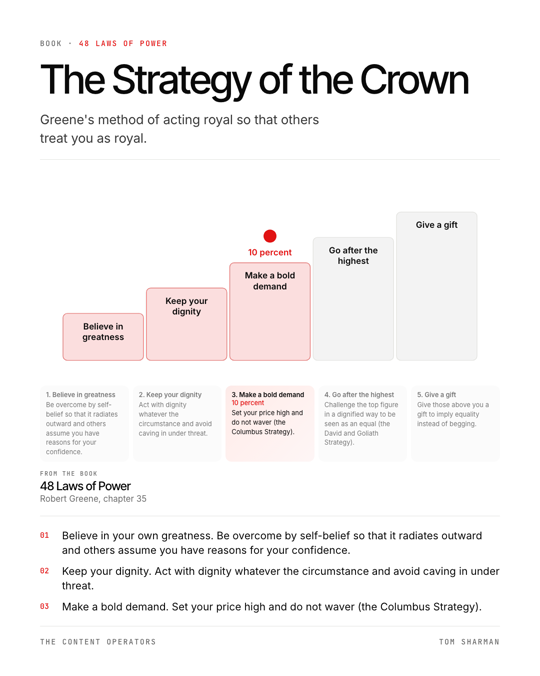
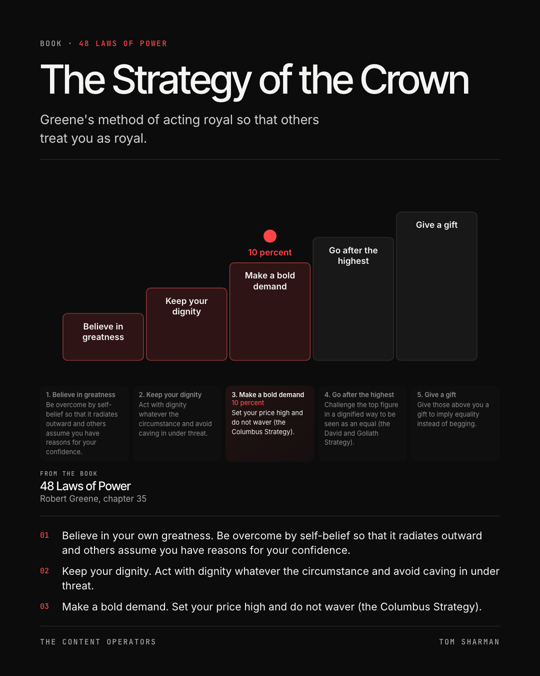
Greene's method of acting royal so that others treat you as royal.
- Believe in your own greatness. Be overcome by self-belief so that it radiates outward and others assume you have reasons for your confidence.
- Keep your dignity. Act with dignity whatever the circumstance and avoid caving in under threat.
- Make a bold demand. Set your price high and do not waver (the Columbus Strategy).
- Go after the highest person. Challenge the top figure in a dignified way to be seen as an equal (the David and Goliath Strategy).
- Give a gift. Give those above you a gift to imply equality instead of begging.
From chapter: LAW 34, pp. 419–431
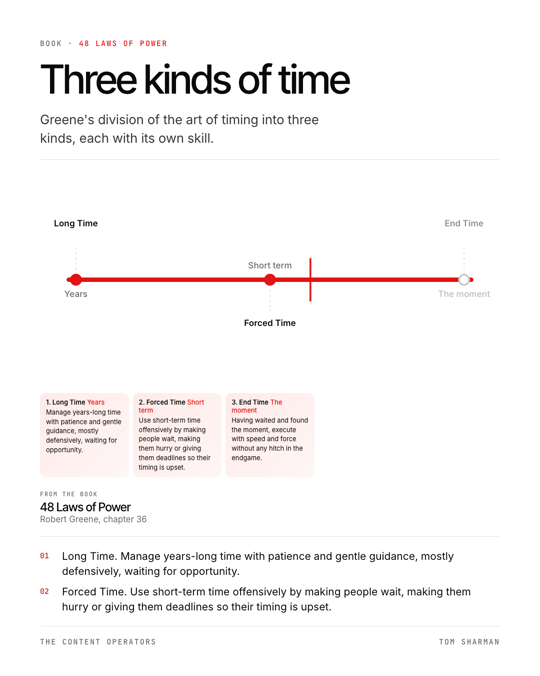
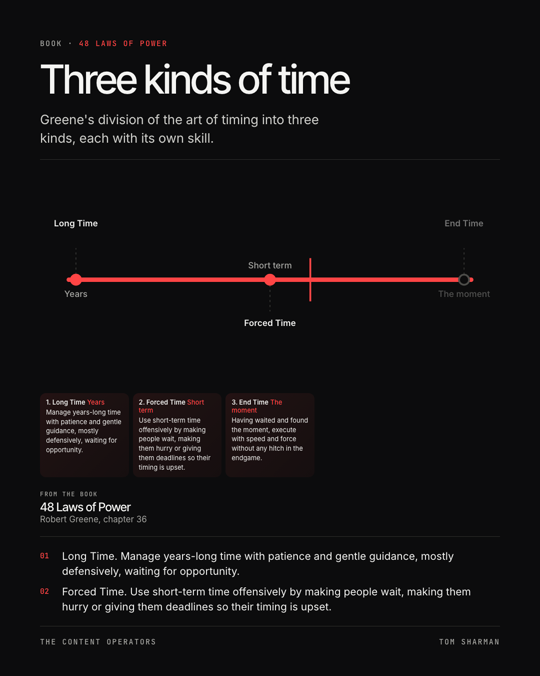
Greene's division of the art of timing into three kinds, each with its own skill.
- Long Time. Manage years-long time with patience and gentle guidance, mostly defensively, waiting for opportunity.
- Forced Time. Use short-term time offensively by making people wait, making them hurry or giving them deadlines so their timing is upset.
- End Time. Having waited and found the moment, execute with speed and force without any hitch in the endgame.
From chapter: LAW 35, pp. 432–446
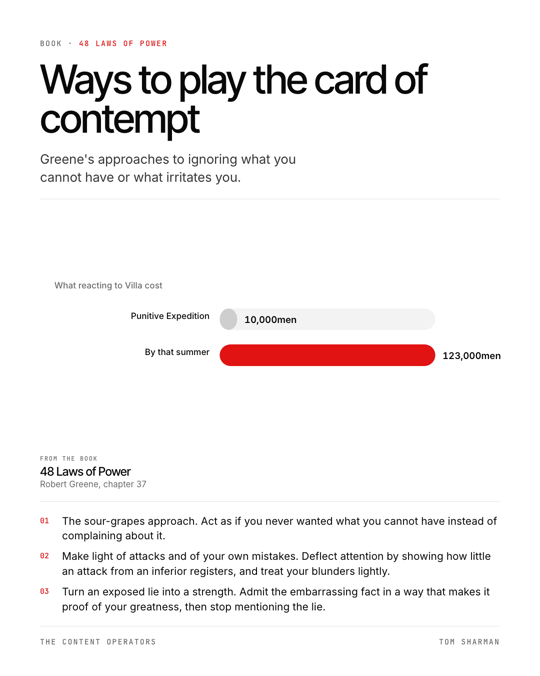
Greene's approaches to ignoring what you cannot have or what irritates you.
- The sour-grapes approach. Act as if you never wanted what you cannot have instead of complaining about it.
- Make light of attacks and of your own mistakes. Deflect attention by showing how little an attack from an inferior registers, and treat your blunders lightly.
- Turn an exposed lie into a strength. Admit the embarrassing fact in a way that makes it proof of your greatness, then stop mentioning the lie.
From chapter: LAW 36, pp. 447–461
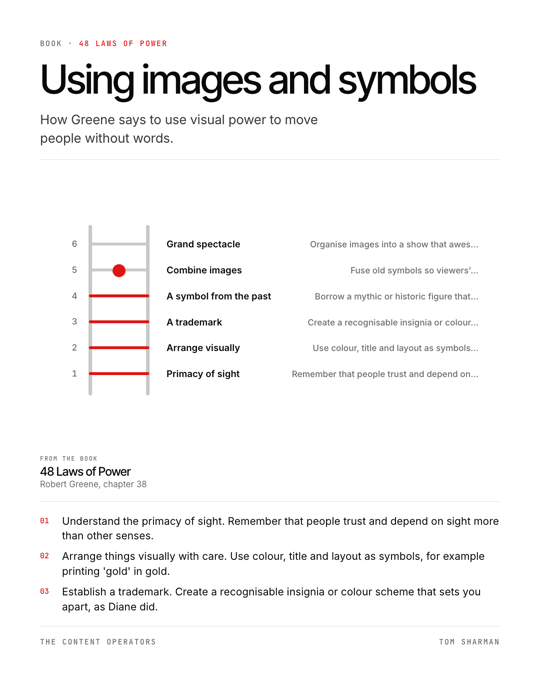
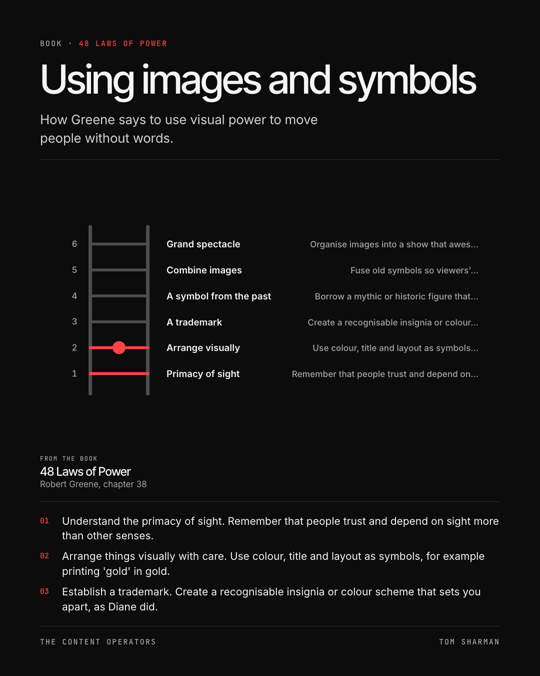
How Greene says to use visual power to move people without words.
- Understand the primacy of sight. Remember that people trust and depend on sight more than other senses.
- Arrange things visually with care. Use colour, title and layout as symbols, for example printing 'gold' in gold.
- Establish a trademark. Create a recognisable insignia or colour scheme that sets you apart, as Diane did.
- Attach a symbol from the past. Borrow a mythic or historic figure that fits your situation and wear it like a cape.
- Combine images in a new way. Fuse old symbols so viewers' associations run rampant and they feel part of it.
- Stage a grand spectacle. Organise images into a show that awes people and distracts them from unpleasant realities.
From chapter: LAW 37, pp. 462–473
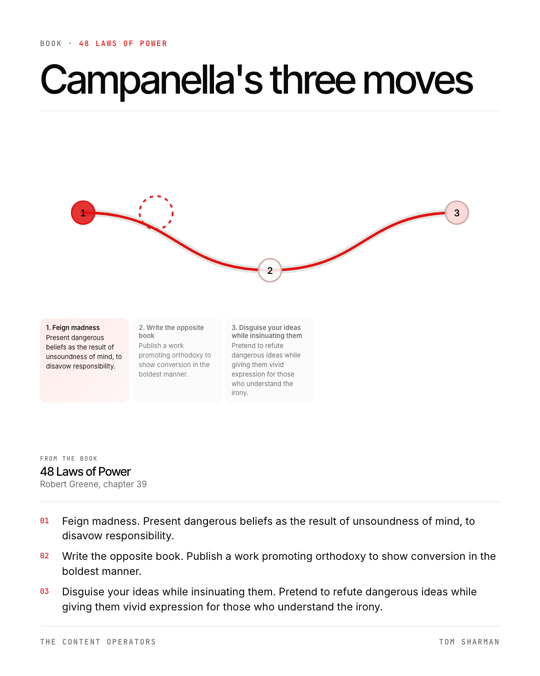
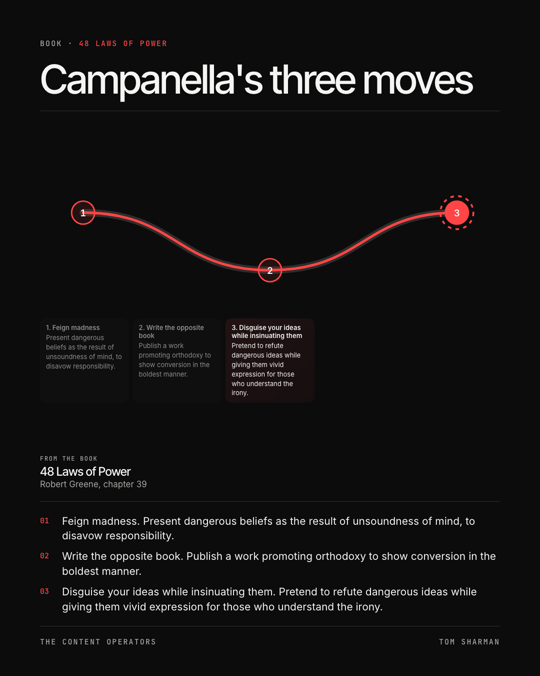
How Tommaso Campanella kept his life and his ideas under the Inquisition, as Greene reads it.
- Feign madness. Present dangerous beliefs as the result of unsoundness of mind, to disavow responsibility.
- Write the opposite book. Publish a work promoting orthodoxy to show conversion in the boldest manner.
- Disguise your ideas while insinuating them. Pretend to refute dangerous ideas while giving them vivid expression for those who understand the irony.
From chapter: LAW 38, pp. 474–486
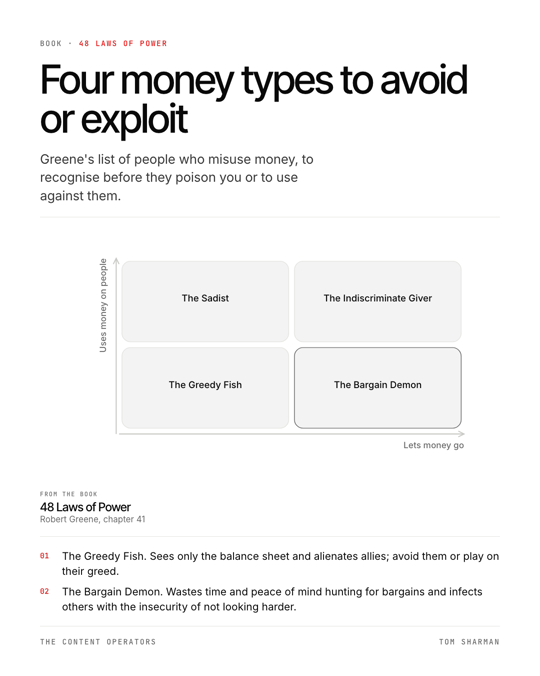
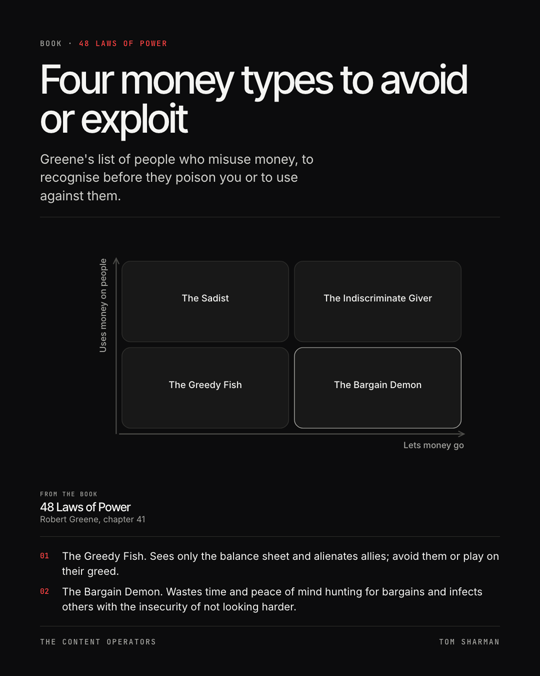
Greene's list of people who misuse money, to recognise before they poison you or to use against them.
- The Greedy Fish. Sees only the balance sheet and alienates allies; avoid them or play on their greed.
- The Bargain Demon. Wastes time and peace of mind hunting for bargains and infects others with the insecurity of not looking harder.
- The Sadist. Plays vicious power games with money, such as late payment and meddling, so accept a loss rather than get entangled.
- The Indiscriminate Giver. Gives to everyone out of a need to be loved, so the generosity has no effect and you feel burdened by their needs.
From chapter: LAW 40, pp. 498–521
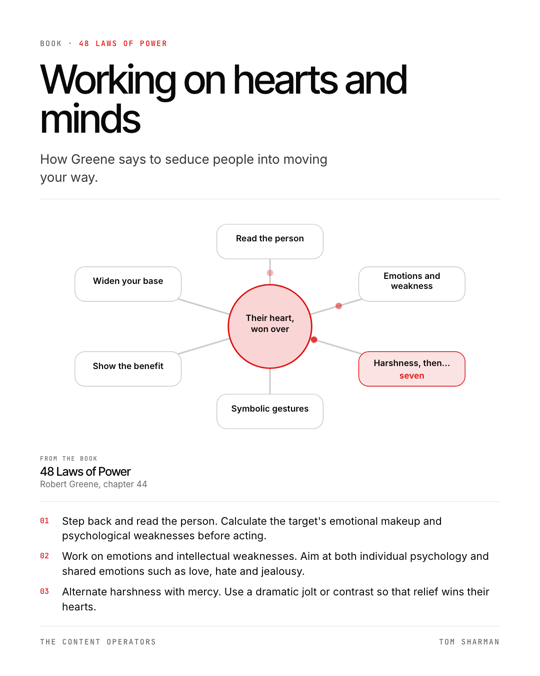
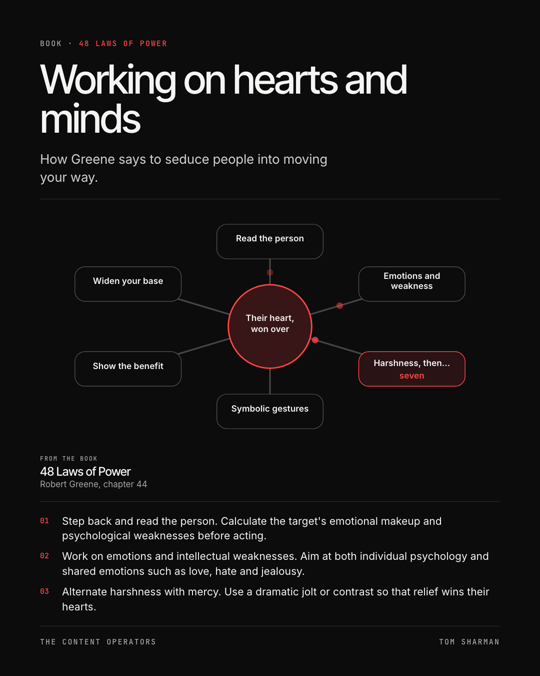
How Greene says to seduce people into moving your way.
- Step back and read the person. Calculate the target's emotional makeup and psychological weaknesses before acting.
- Work on emotions and intellectual weaknesses. Aim at both individual psychology and shared emotions such as love, hate and jealousy.
- Alternate harshness with mercy. Use a dramatic jolt or contrast so that relief wins their hearts.
- Use symbolic gestures. Show goodwill or shared suffering to make people identify with you.
- Show how it benefits them. Cover a blatant appeal to self-interest with a noble cause.
- Enlist expressive people and widen your base. Keep an artist or intellectual close and win allies on all levels.
From chapter: LAW 43, pp. 551–563
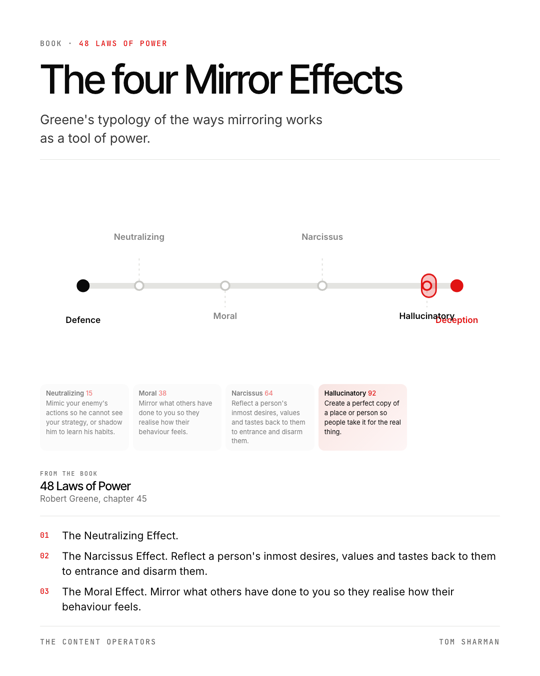
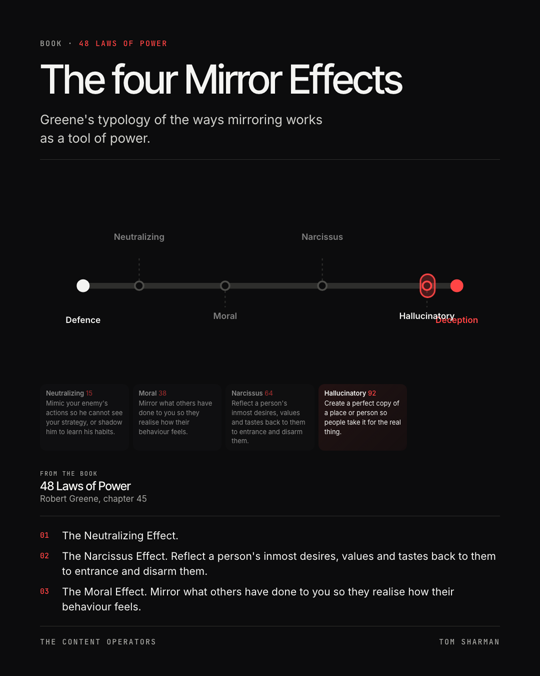
Greene's typology of the ways mirroring works as a tool of power.
- The Neutralizing Effect. Mimic your enemy's actions so he cannot see your strategy, or shadow him to learn his habits.
- The Narcissus Effect. Reflect a person's inmost desires, values and tastes back to them to entrance and disarm them.
- The Moral Effect. Mirror what others have done to you so they realise how their behaviour feels.
- The Hallucinatory Effect. Create a perfect copy of a place or person so people take it for the real thing.
From chapter: LAW 44, pp. 564–587
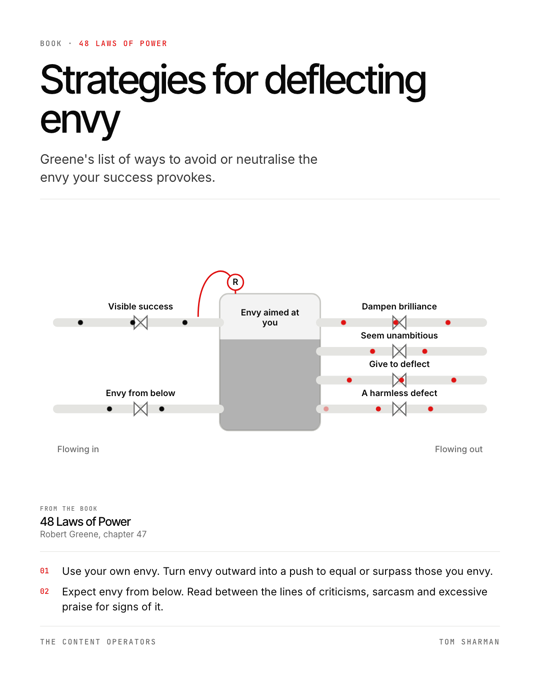
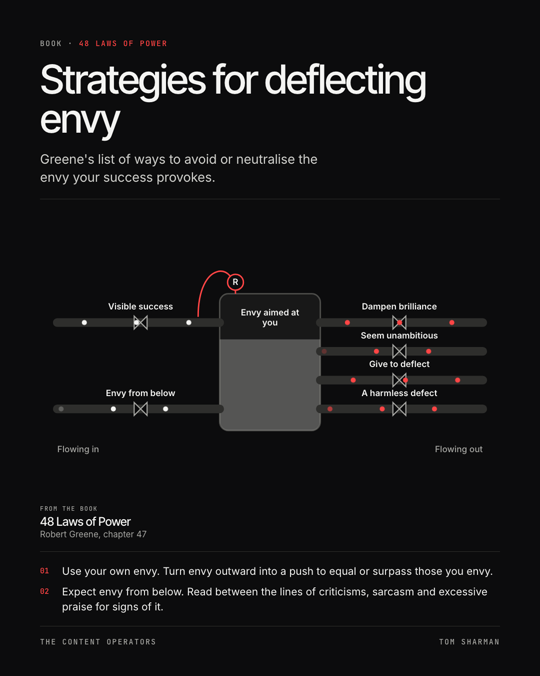
Greene's list of ways to avoid or neutralise the envy your success provokes.
- Use your own envy. Turn envy outward into a push to equal or surpass those you envy.
- Expect envy from below. Read between the lines of criticisms, sarcasm and excessive praise for signs of it.
- Dampen your brilliance. Reveal a weakness, credit luck, or find new friends instead of flaunting your gifts.
- Seem unambitious. Refuse power several times, as Godunov and Washington did, so it appears given to you.
- Disguise your power as self-sacrifice. Emphasise your burdens to turn potential envy into pity.
- Give to deflect. Spend or share your gains so others benefit from your good fortune.
- Display a harmless defect. Give the envious something to feed on that distracts from your more important sins.
From chapter: LAW 46, pp. 600–617