Bookshelf
How Tom uses this
Gambling Man backs two of Tom's lessons and argues with two. Under each of his lessons, what the book says about it, and on which pages.
- A brand that compounds has a mission and an enemy
Masa chose NTT as the biggest enemy to make it a fair fight and framed SoftBank's 30-Year Vision as happiness for everyone, which shows a mission plus an enemy rallying people. pp. 150, 196 and 198. In the book: The Vodafone Japan turnaround, Whole-company securitisation, The 30-Year Vision brainstorm, The Sprint turnaround under Claure.
- Assumptions made too fast, and risk avoided
Masa's let's do it instinct and his willingness to jump into the pool back the idea that fast action beats over-worrying, although WeWork shows the cost when the stakes are large. pp. 62, 78 and 110. In the book: Masa's market filter, The Yahoo! formula, Kitao's bond liberalisation play.
Where it disagrees with Tom
- Move the people you have before you hire
Masa kept hiring outside stars such as Omori, Arora, Misra and Claure at high prices, and the results included feuds, exits and a failed succession. pp. 69, 72, 217, 220 and 261. In the book: The Yahoo! formula, Kitao's bond liberalisation play, The 30-Year Vision brainstorm, The Sprint turnaround under Claure, Elliott's SoftBank playbook.
- Macro and micro at the same time
The book shows a leader who stayed at the macro, became the bottleneck and was told he was being asked to do too much, so the team never became self sufficient. pp. 236, 285 and 295. In the book: Elliott's SoftBank playbook.
What it argues
Barber argues that Masayoshi Son is a gambler by inheritance and temperament, the son of a pachinko king who learnt that outsiders win by betting big when the odds are bad. Son built SoftBank as a conjurer of capital with a single repeatable formula: find the leading American business, take control of the Japanese version, list it and recycle the cash. His fortune comes from a few huge calls, notably Yahoo!, Alibaba and the Sprint and T-Mobile merger, and his losses come from the same trait, with leverage, private vehicles and a refusal to take advice. The record of WeWork, the Vision Fund and Northstar shows how a founder with no check on him can mistake vision for evidence. Barber's conclusion is that Son has been right about the direction of technology and wrong about timing, and that SoftBank has never been about profits, only growth and the moonshot.
Worth keeping
- Pick a market where you can be number one, find the bottleneck, and pitch as the specialist with no evidence except belief (pp. 59-62).
- Borrowed credibility opens doors: Sasaki putting up his own house as collateral won the first bank loan (pp. 63-64).
- Put it in writing. Handshake deals with Mozer, National Semiconductor, Jobs and Goldman produced rows or luck, and Masa learnt the lesson once and forgot it (pp. 54, 182, 186).
- The Yahoo! formula is a repeatable deal format: find the US leader, own the Japanese version, list it and recycle the proceeds (p. 108).
- Overpaying for position is a strategy with a cost: Comdex $842m, Ziff $2.1bn and Kingston $1.5bn were bought for access and cash flow, and Kingston was sold back for $450m (pp. 97, 102, 111).
- Leverage is addictive and structures that blur the founder's personal interest, like MAC and Northstar, are where the trouble starts (pp. 122, 176, 249, 282).
- Pick the biggest rival and the price war that grows the whole market, but know you need cash to fund it (pp. 150, 153).
- Growth stories beat profit and loss accounts until the market turns, so track the number the market watches, not the one you like (pp. 129, 304).
- A one-man show without a succession plan or a strong board is the central risk, and the best board interventions came from Yanai, Kimiwada, Kawamoto and Elliott (pp. 185, 203, 270, 292).
- Fast hires of stars with vague titles breed feuding barons, and Masa's refusal to intervene made it worse (pp. 218, 261, 287).
The questions it answers
- What makes a format repeatable, as opposed to a hit that happened once?
Masa spent twenty years chasing a second Alibaba (p. 144) while the Yahoo! formula (p. 108) was the repeatable part of his model, which is the same gap between a one-off hit and a format that can be run again.
- How do you build a personal brand that generates inbound rather than requiring outbound?
Masa built his reputation as the gateway to Japan by cold calling Fujita (p. 37), earning a press profile through an Asahi reporter (p. 64) and repeating a signature story dozens of times (p. 60), so that famous people sought him out.
- Which of my stories travel, and which only feel like they should?
The tangerine box speech was reproduced dozens of times (p. 60) while parts of the pocket translator story are contested by Mozer (p. 55), which shows how a story can travel because it is told, whatever the evidence behind it.
- How do you price and sell a tool you built for yourself?
Masa sold the pocket translator prototype to Sharp for a package worth about $1m (p. 51), and later said he should have charged a higher price (p. 114), which is a lesson in pricing a tool built for yourself.
- What is the smallest team that can produce at the volume I am used to?
Small teams can carry huge amounts of money: SoftBank had 75 people and 75 per cent of the market in two years (p. 67), Buffett manages $110bn with twelve people (p. 249) and Sprint's zero baseline budget cut 800 lawyers to 200 (p. 213).
The frameworks
8 frameworks, one animation each Every framework, step by step
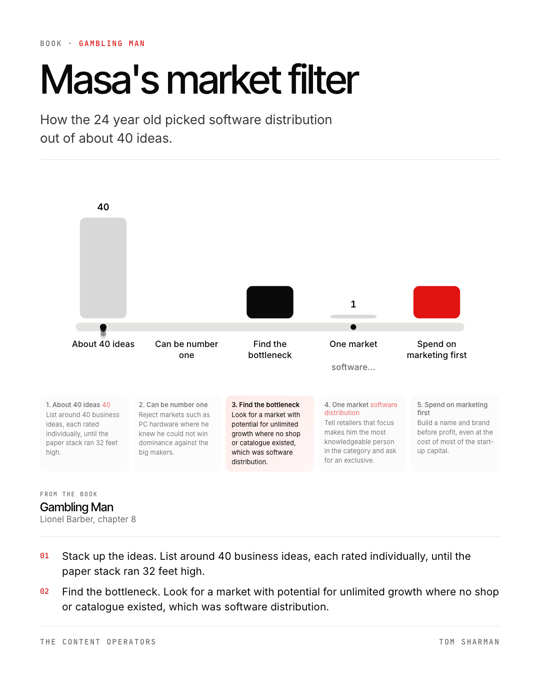
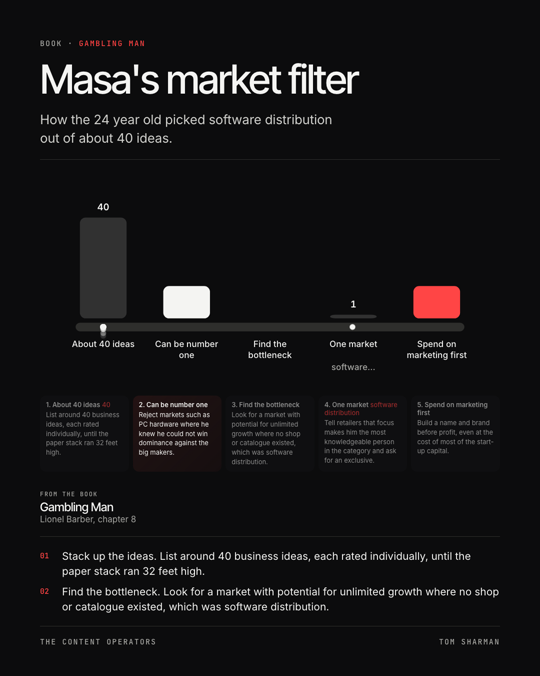
How the 24 year old picked software distribution out of about 40 ideas.
- Stack up the ideas. List around 40 business ideas, each rated individually, until the paper stack ran 32 feet high.
- Ask where he can be number one. Reject markets such as PC hardware where he knew he could not win dominance against the big makers.
- Find the bottleneck. Look for a market with potential for unlimited growth where no shop or catalogue existed, which was software distribution.
- Pitch as the specialist. Tell retailers that focus makes him the most knowledgeable person in the category and ask for an exclusive.
- Spend on marketing first. Build a name and brand before profit, even at the cost of most of the start-up capital.
From chapter: PART ONE: BOY GENIUS, pp. 22–65
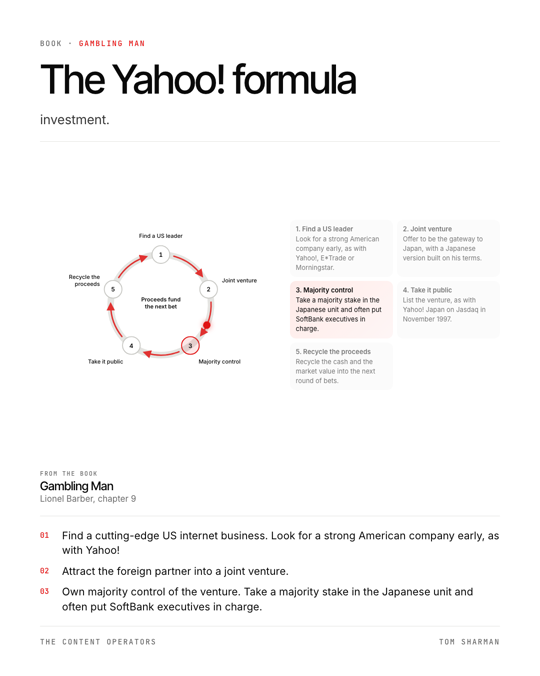
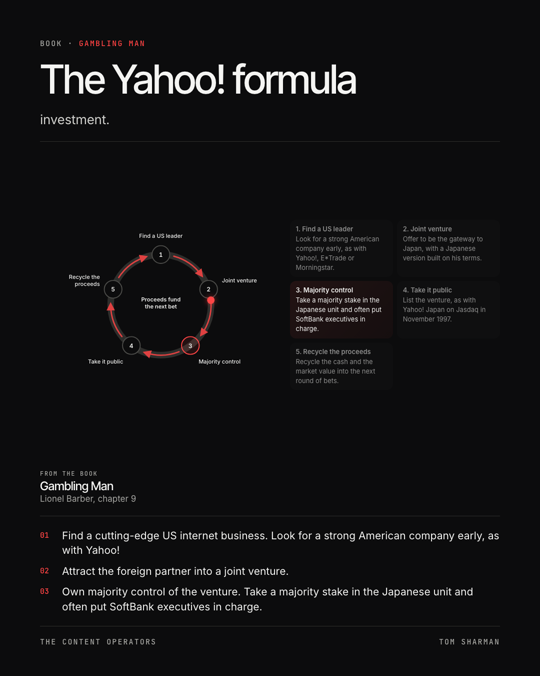
The repeatable cycle Masa built from his Yahoo! investment.
- Find a cutting-edge US internet business. Look for a strong American company early, as with Yahoo!, E*Trade or Morningstar.
- Attract the foreign partner into a joint venture. Offer to be the gateway to Japan, with a Japanese version built on his terms.
- Own majority control of the venture. Take a majority stake in the Japanese unit and often put SoftBank executives in charge.
- Take the units public. List the venture, as with Yahoo! Japan on Jasdaq in November 1997.
- Use the proceeds for more deals. Recycle the cash and the market value into the next round of bets.
From chapter: PART TWO: RISE AND FALL, pp. 66–147
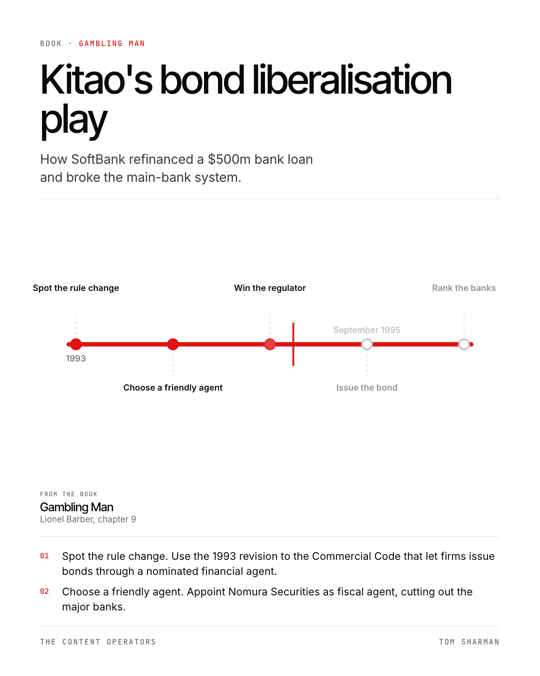
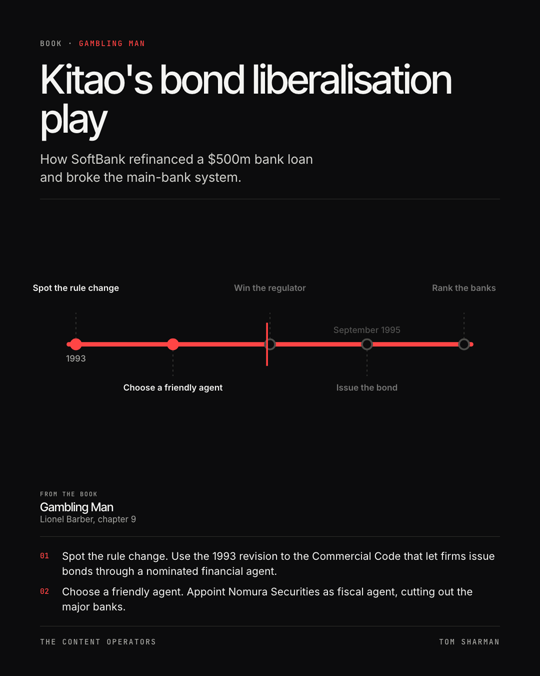
How SoftBank refinanced a $500m bank loan and broke the main-bank system.
- Spot the rule change. Use the 1993 revision to the Commercial Code that let firms issue bonds through a nominated financial agent.
- Choose a friendly agent. Appoint Nomura Securities as fiscal agent, cutting out the major banks.
- Win the regulator. Lobby the Ministry of Finance until it sided with liberalisation, which cut fees by 90 per cent.
- Issue the bond. Sell 12-year debentures at 3.9 per cent in September 1995 to raise $500m and repay the syndicated loan.
- Rank the banks. Replace a main bank with a core bank system and score each bank on willingness to accommodate SoftBank.
From chapter: PART TWO: RISE AND FALL, pp. 66–147
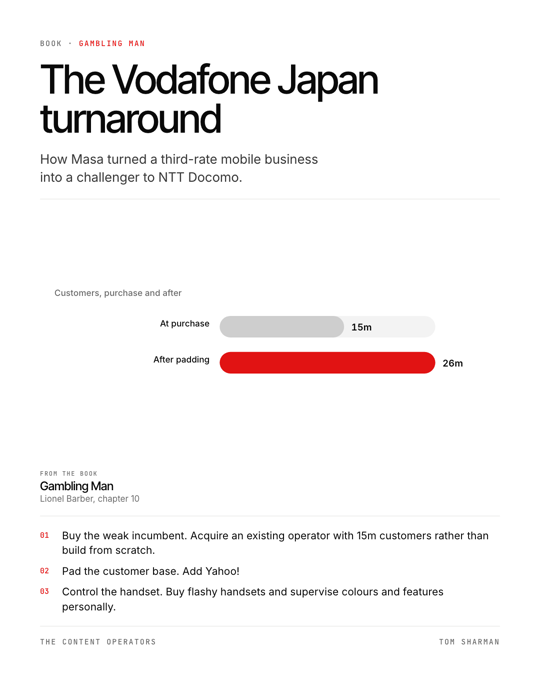
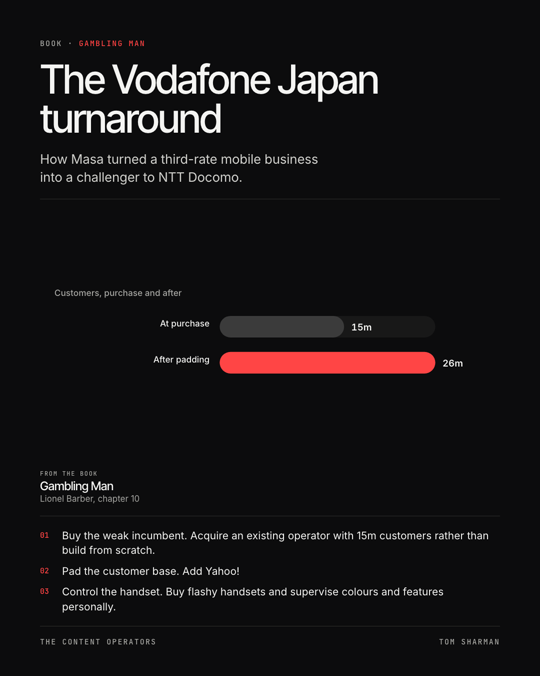
How Masa turned a third-rate mobile business into a challenger to NTT Docomo.
- Buy the weak incumbent. Acquire an existing operator with 15m customers rather than build from scratch.
- Pad the customer base. Add Yahoo! BB and fixed-line subscribers to turn 15m customers into 26m.
- Control the handset. Buy flashy handsets and supervise colours and features personally.
- Force instalment payments. Oblige customers to pay the full handset cost over 12 to 24 months.
- Securitise the receivable. Sell the right to the instalment debt to raise cash today from promises to pay tomorrow.
- Cut price hard. Launch the Gold Plan and then the White Plan at ¥980 a month, a quarter of rivals' price.
- Build a warm brand. Use a talking white Hokkaido dog, Otosan, as the face of SoftBank Mobile.
From chapter: PART THREE: THE OPERATOR, pp. 148–187
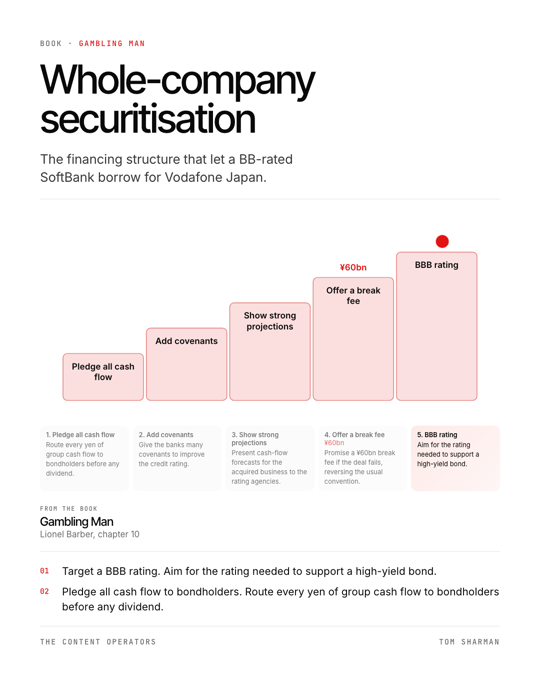
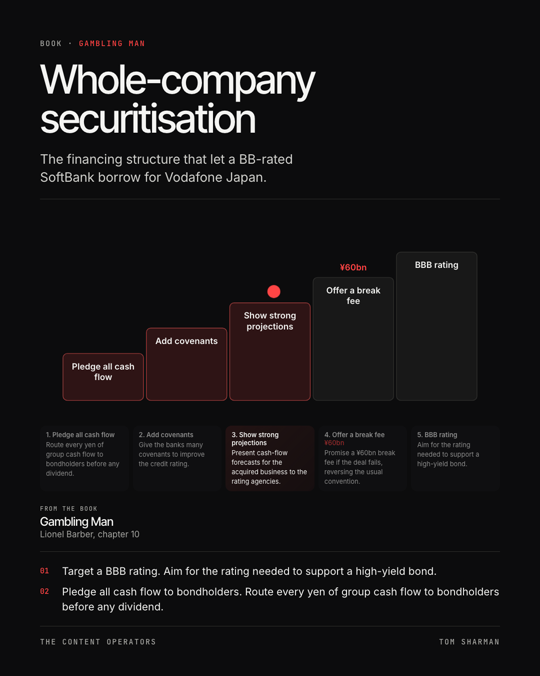
The financing structure that let a BB-rated SoftBank borrow for Vodafone Japan.
- Target a BBB rating. Aim for the rating needed to support a high-yield bond.
- Pledge all cash flow to bondholders. Route every yen of group cash flow to bondholders before any dividend.
- Add covenants. Give the banks many covenants to improve the credit rating.
- Show strong projections. Present cash-flow forecasts for the acquired business to the rating agencies.
- Offer a break fee. Promise a ¥60bn break fee if the deal fails, reversing the usual convention.
From chapter: PART THREE: THE OPERATOR, pp. 148–187
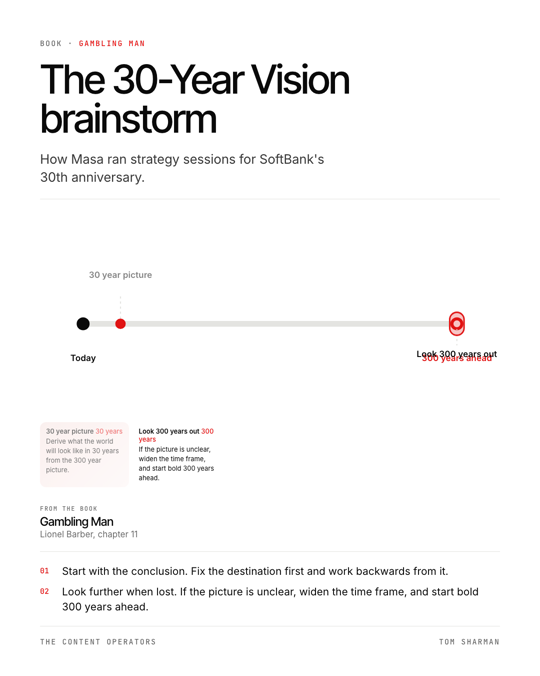
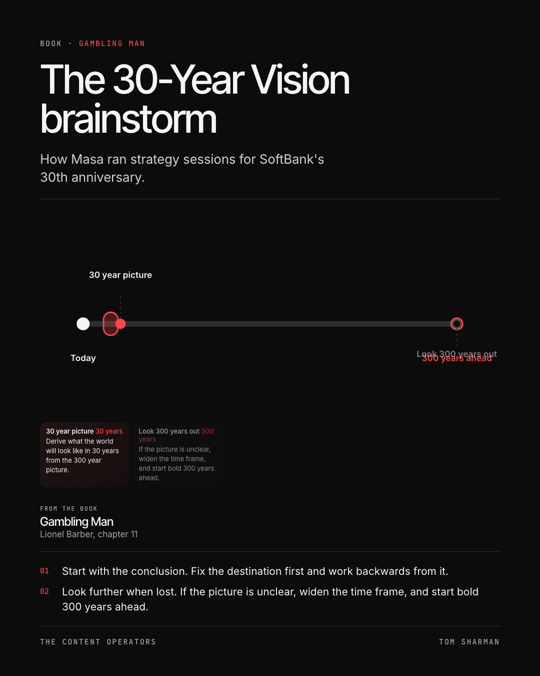
How Masa ran strategy sessions for SoftBank's 30th anniversary.
- Start with the conclusion. Fix the destination first and work backwards from it.
- Look further when lost. If the picture is unclear, widen the time frame, and start bold 300 years ahead.
- Work backwards to 30 years. Derive what the world will look like in 30 years from the 300 year picture.
- Ask four technology questions. Ask what future chips look like, which applications they enable, how lifestyles change and what the competitive outlook is.
- Open it to the wider group. Consult employees and canvass outsiders, including through Twitter.
From chapter: PART FOUR: THE EMPIRE BUILDER, pp. 188–234
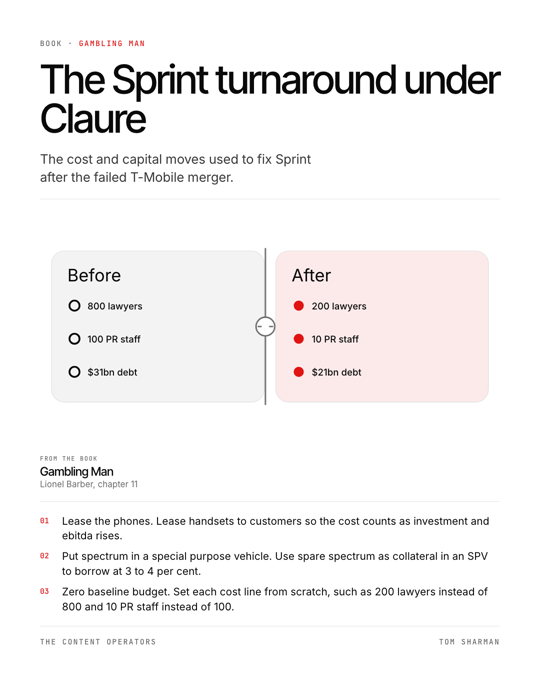
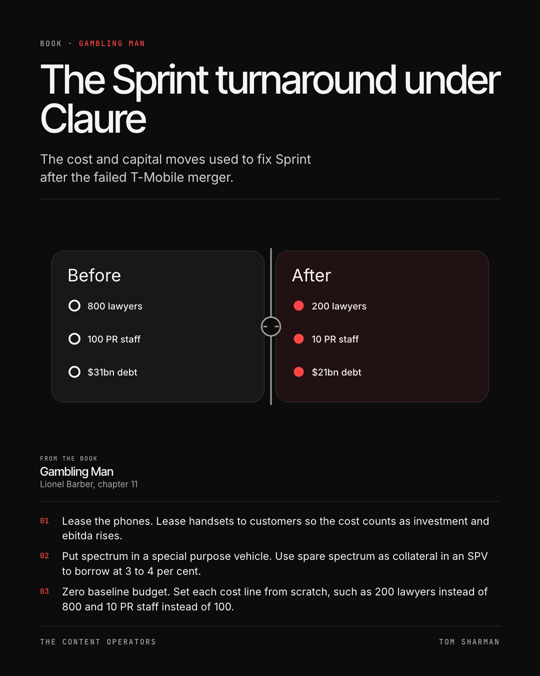
The cost and capital moves used to fix Sprint after the failed T-Mobile merger.
- Lease the phones. Lease handsets to customers so the cost counts as investment and ebitda rises.
- Put spectrum in a special purpose vehicle. Use spare spectrum as collateral in an SPV to borrow at 3 to 4 per cent.
- Zero baseline budget. Set each cost line from scratch, such as 200 lawyers instead of 800 and 10 PR staff instead of 100.
- Spend Fridays in a store. Study customer and employee behaviour first hand.
- Rebrand the culture. Build a Silicon Valley base with Japanese touches and push a no loser mentality.
From chapter: PART FOUR: THE EMPIRE BUILDER, pp. 188–234
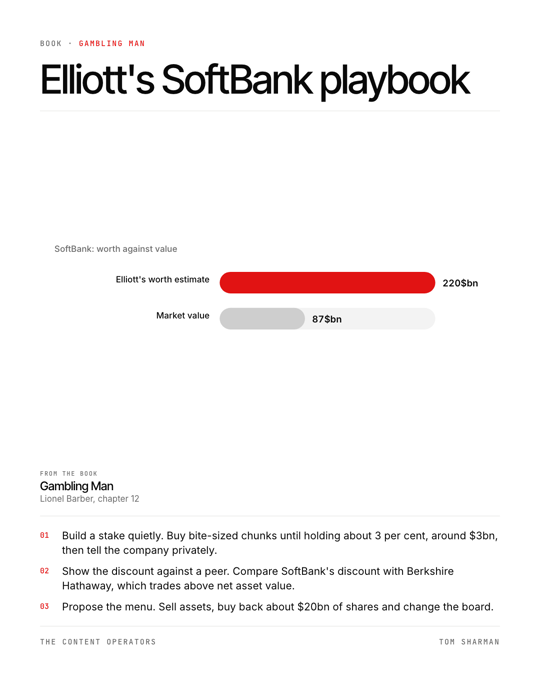
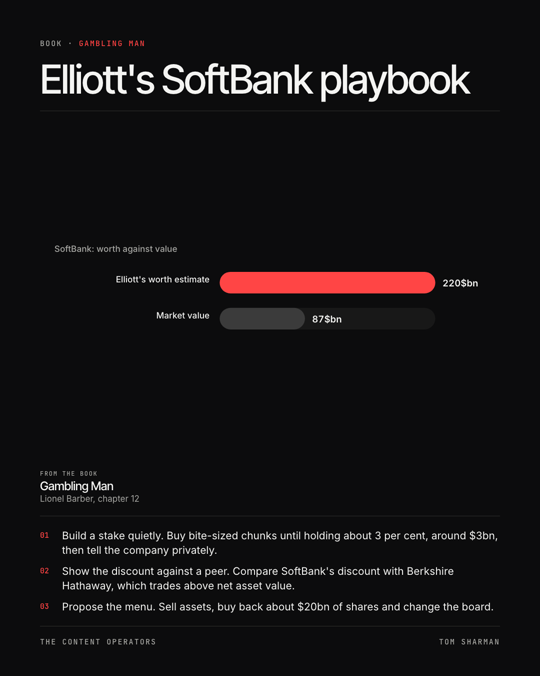
How the activist fund approached Masa and what it asked him to do.
- Build a stake quietly. Buy bite-sized chunks until holding about 3 per cent, around $3bn, then tell the company privately.
- Show the discount against a peer. Compare SoftBank's discount with Berkshire Hathaway, which trades above net asset value.
- Speak to his vanity and sense of injustice. Frame the gap as unfair and the buy-back as a way to prove he is right.
- Propose the menu. Sell assets, buy back about $20bn of shares and change the board.
- Step back as the board acts. Let Masa announce $40bn of asset sales and $24bn of buy-backs on his own terms.
From chapter: PART FIVE: HUBRIS, pp. 235–296
Working with Tom on this
Tom works with creators and founders one to one, from a single session to a fractional role. Work with Tom
Back to the bookshelf