What it argues
Schreier argues that Blizzard rose because a small group of players made polished games, shipped them when ready, and were shielded from a string of corporate owners by founders who promised hits in return for autonomy. World of Warcraft then turned a product studio into a company of thousands whose money attracted Activision, whose chief Bobby Kotick prized predictability, annual franchises and finance led control. Over the decade after 2013 the player first culture lost out to quotas, monetisation targets, stack ranking and pay below market, while the Titan failure removed the trust that had protected autonomy. A long record of crunch, a boys' club and weak HR then surfaced in the 2021 California lawsuit, which cost Kotick's lieutenants their jobs and helped drive the sale to Microsoft. The book closes on a company still making acclaimed games but with its founders gone, 1,900 more staff laid off and its identity unsettled.
Every framework, step by step
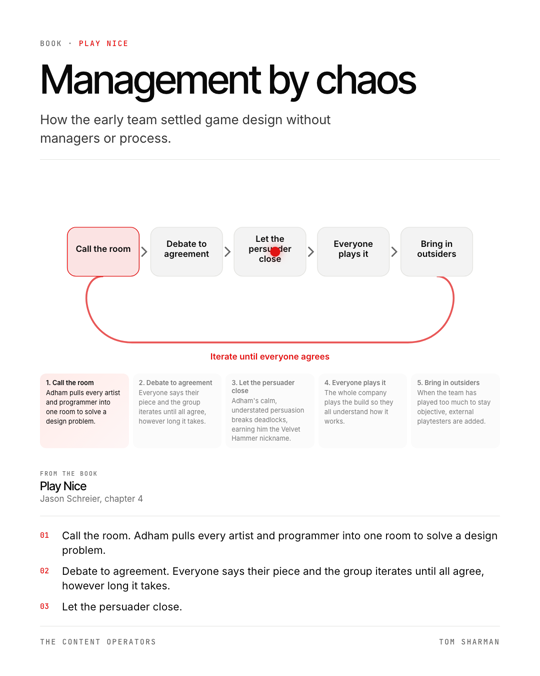
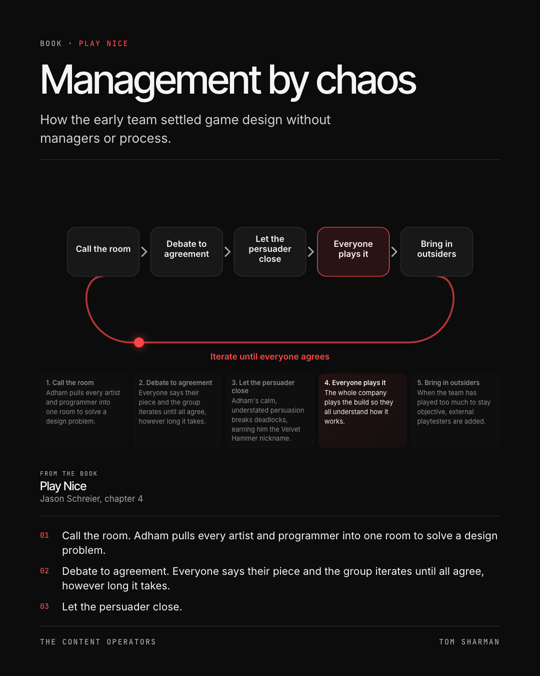
How the early team settled game design without managers or process.
- Call the room. Adham pulls every artist and programmer into one room to solve a design problem.
- Debate to agreement. Everyone says their piece and the group iterates until all agree, however long it takes.
- Let the persuader close. Adham's calm, understated persuasion breaks deadlocks, earning him the Velvet Hammer nickname.
- Everyone plays it. The whole company plays the build so they all understand how it works.
- Bring in outsiders. When the team has played too much to stay objective, external playtesters are added.
From chapter: PART ONE: RISE, pp. 13–109
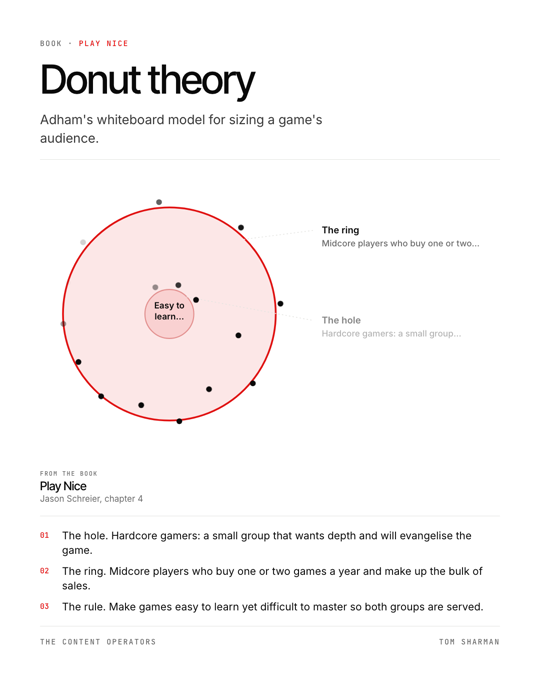
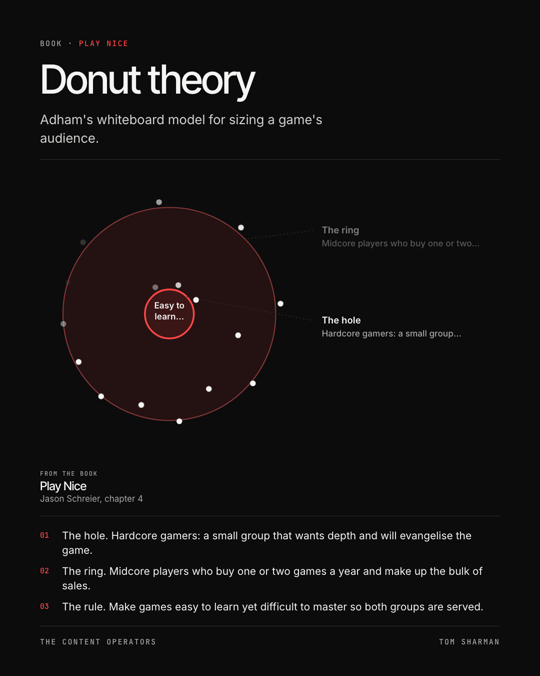
Adham's whiteboard model for sizing a game's audience.
- The hole. Hardcore gamers: a small group that wants depth and will evangelise the game.
- The ring. Midcore players who buy one or two games a year and make up the bulk of sales.
- The rule. Make games easy to learn yet difficult to master so both groups are served.
From chapter: PART ONE: RISE, pp. 13–109
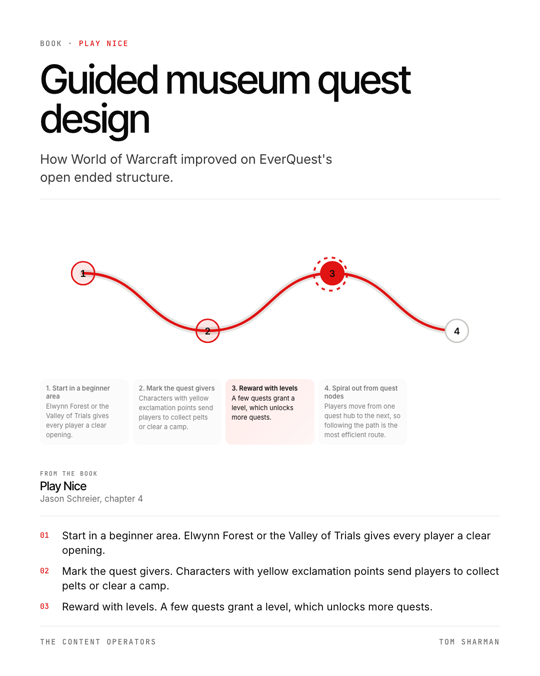
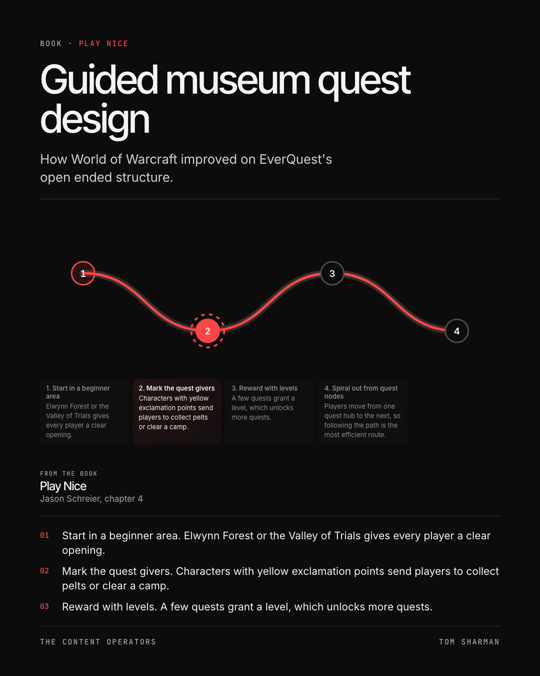
How World of Warcraft improved on EverQuest's open ended structure.
- Start in a beginner area. Elwynn Forest or the Valley of Trials gives every player a clear opening.
- Mark the quest givers. Characters with yellow exclamation points send players to collect pelts or clear a camp.
- Reward with levels. A few quests grant a level, which unlocks more quests.
- Spiral out from quest nodes. Players move from one quest hub to the next, so following the path is the most efficient route.
From chapter: PART ONE: RISE, pp. 13–109
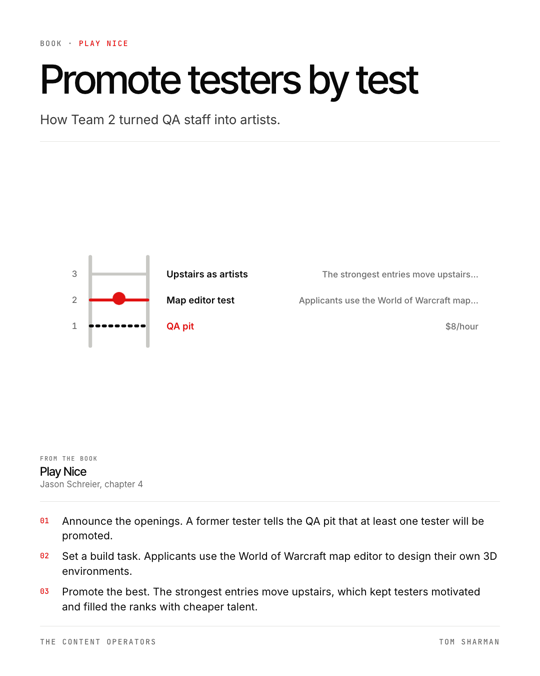
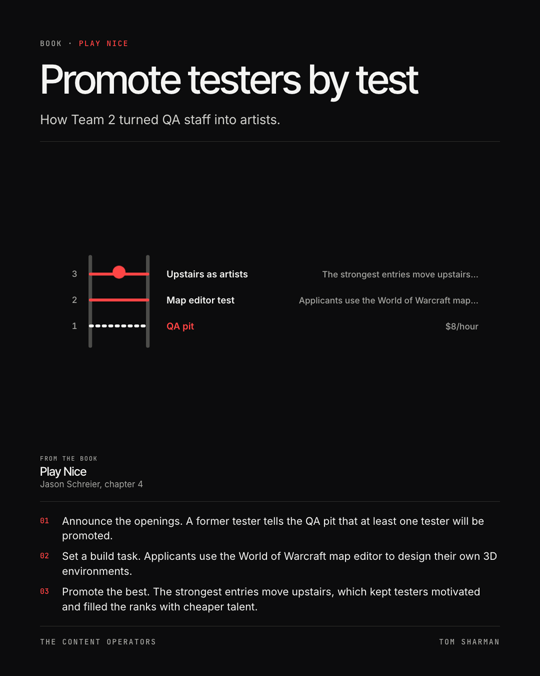
How Team 2 turned QA staff into artists.
- Announce the openings. A former tester tells the QA pit that at least one tester will be promoted.
- Set a build task. Applicants use the World of Warcraft map editor to design their own 3D environments.
- Promote the best. The strongest entries move upstairs, which kept testers motivated and filled the ranks with cheaper talent.
From chapter: PART ONE: RISE, pp. 13–109
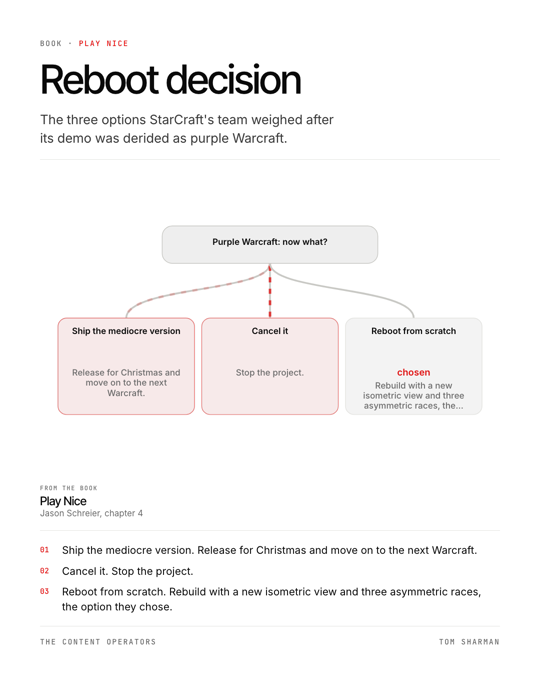
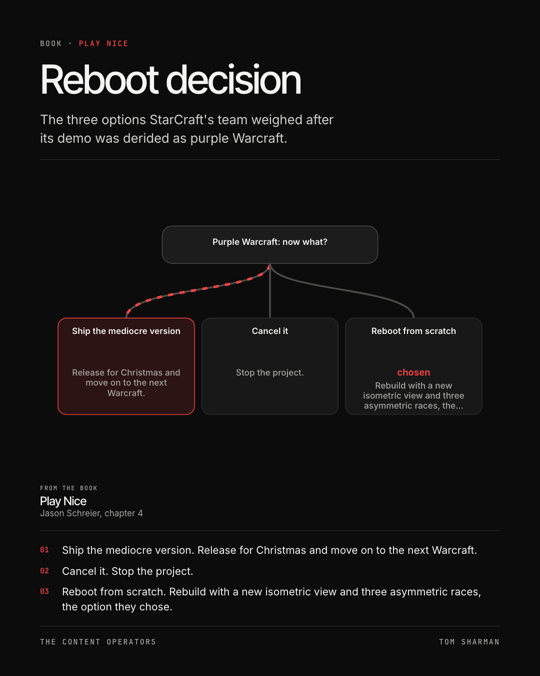
The three options StarCraft's team weighed after its demo was derided as purple Warcraft.
- Ship the mediocre version. Release for Christmas and move on to the next Warcraft.
- Cancel it. Stop the project.
- Reboot from scratch. Rebuild with a new isometric view and three asymmetric races, the option they chose.
From chapter: PART ONE: RISE, pp. 13–109
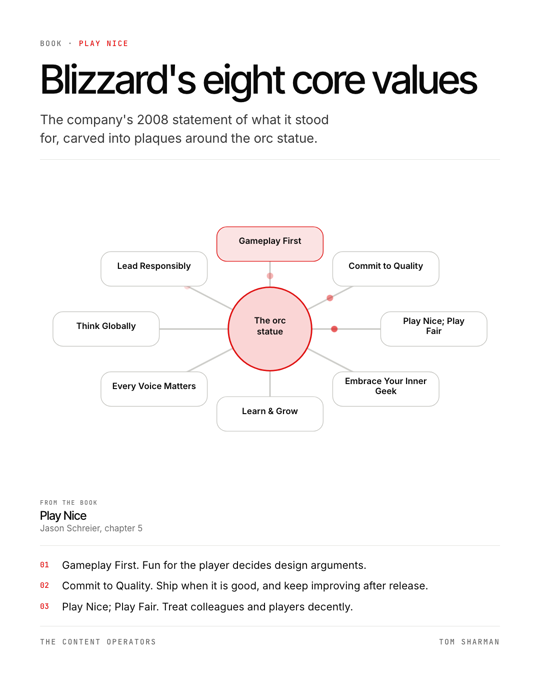
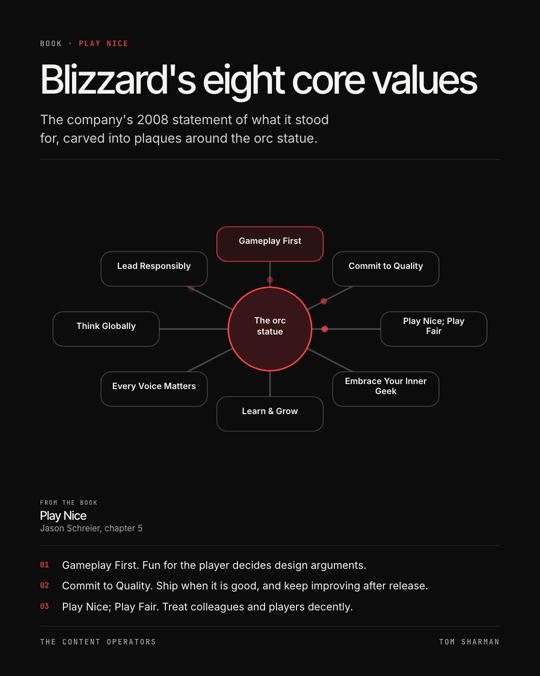
The company's 2008 statement of what it stood for, carved into plaques around the orc statue.
- Gameplay First. Fun for the player decides design arguments.
- Commit to Quality. Ship when it is good, and keep improving after release.
- Play Nice; Play Fair. Treat colleagues and players decently.
- Embrace Your Inner Geek. Be open about being a fan.
- Learn & Grow. Develop skills over time.
- Every Voice Matters. Anyone can raise an idea.
- Think Globally. Serve a worldwide audience.
- Lead Responsibly. Own the consequences of leadership.
From chapter: PART TWO: FALL, pp. 110–199
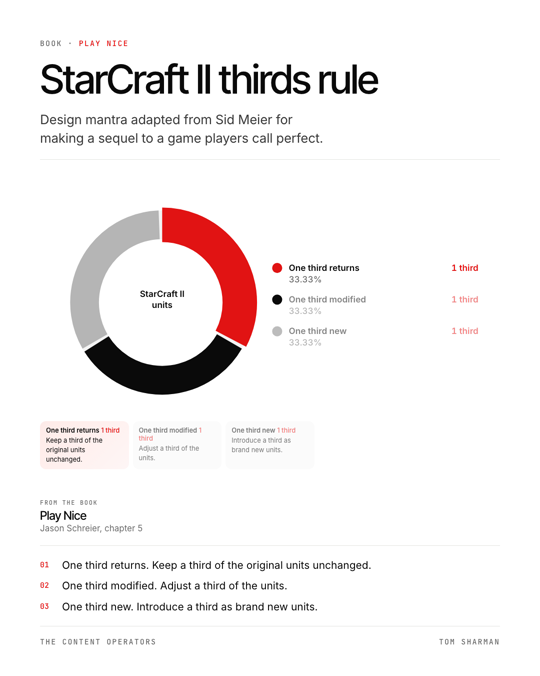
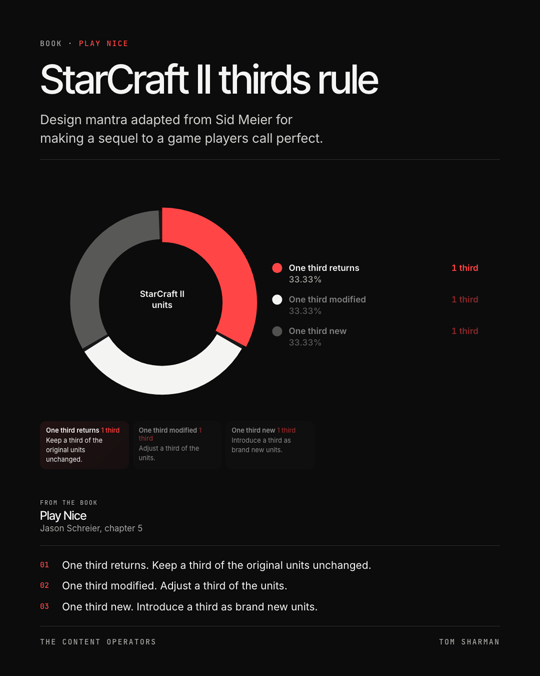
Design mantra adapted from Sid Meier for making a sequel to a game players call perfect.
- One third returns. Keep a third of the original units unchanged.
- One third modified. Adjust a third of the units.
- One third new. Introduce a third as brand new units.
From chapter: PART TWO: FALL, pp. 110–199
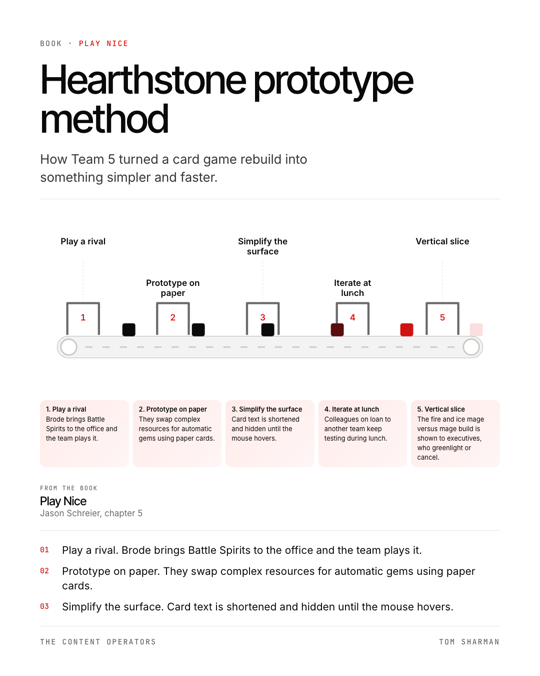
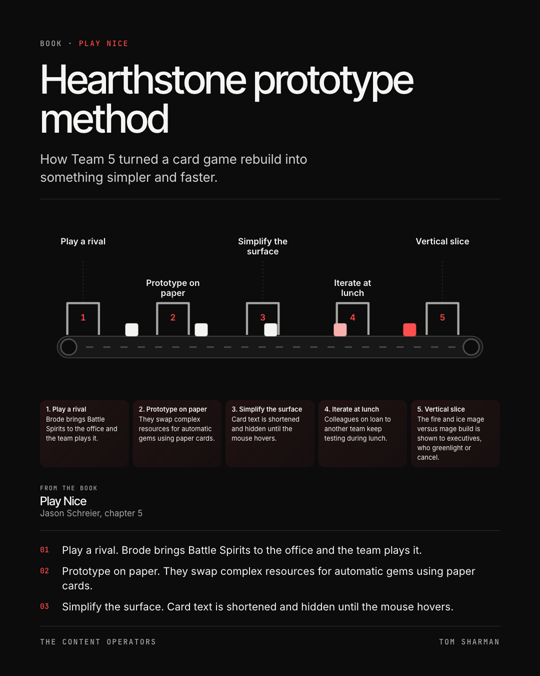
How Team 5 turned a card game rebuild into something simpler and faster.
- Play a rival. Brode brings Battle Spirits to the office and the team plays it.
- Prototype on paper. They swap complex resources for automatic gems using paper cards.
- Simplify the surface. Card text is shortened and hidden until the mouse hovers.
- Iterate at lunch. Colleagues on loan to another team keep testing during lunch.
- Build a vertical slice. The fire and ice mage versus mage build is shown to executives, who greenlight or cancel.
From chapter: PART TWO: FALL, pp. 110–199
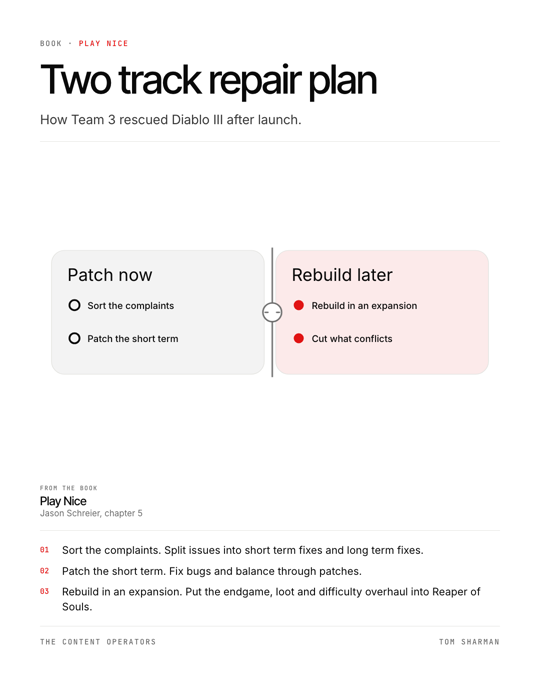
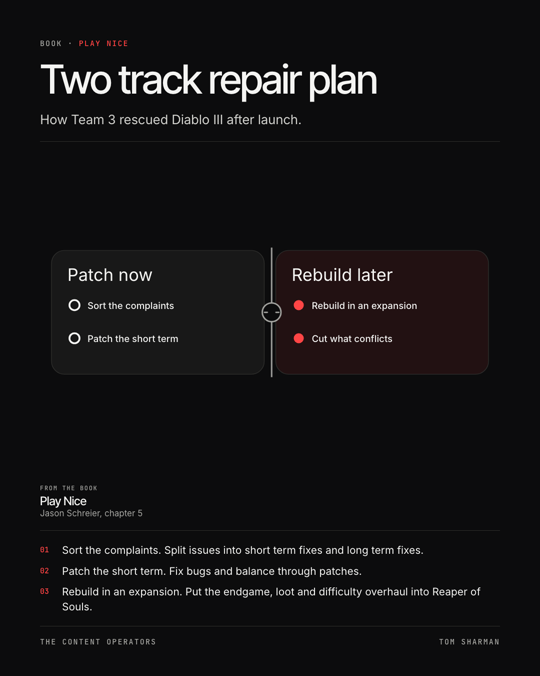
How Team 3 rescued Diablo III after launch.
- Sort the complaints. Split issues into short term fixes and long term fixes.
- Patch the short term. Fix bugs and balance through patches.
- Rebuild in an expansion. Put the endgame, loot and difficulty overhaul into Reaper of Souls.
- Cut what conflicts. Shut off the real money auction house because it eroded the loot hunt.
From chapter: PART TWO: FALL, pp. 110–199
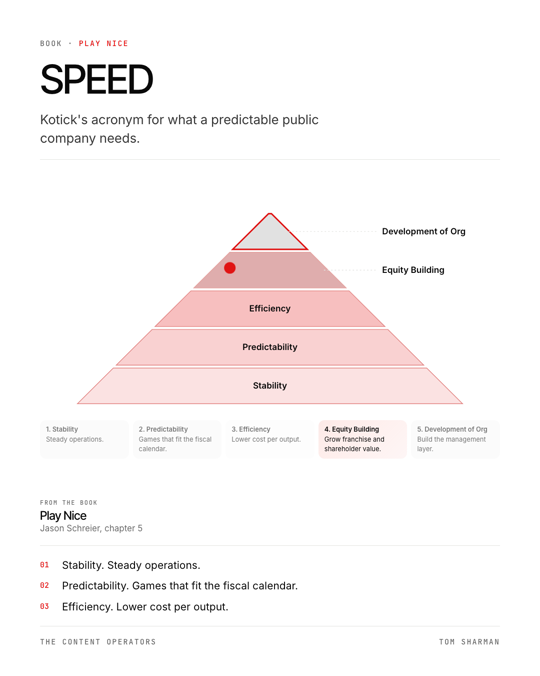
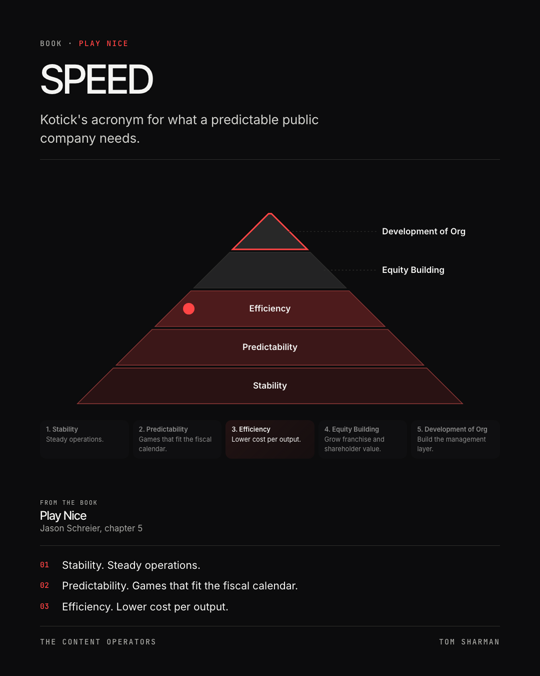
Kotick's acronym for what a predictable public company needs.
- Stability. Steady operations.
- Predictability. Games that fit the fiscal calendar.
- Efficiency. Lower cost per output.
- Equity Building. Grow franchise and shareholder value.
- Development of Organization. Build the management layer.
From chapter: PART TWO: FALL, pp. 110–199
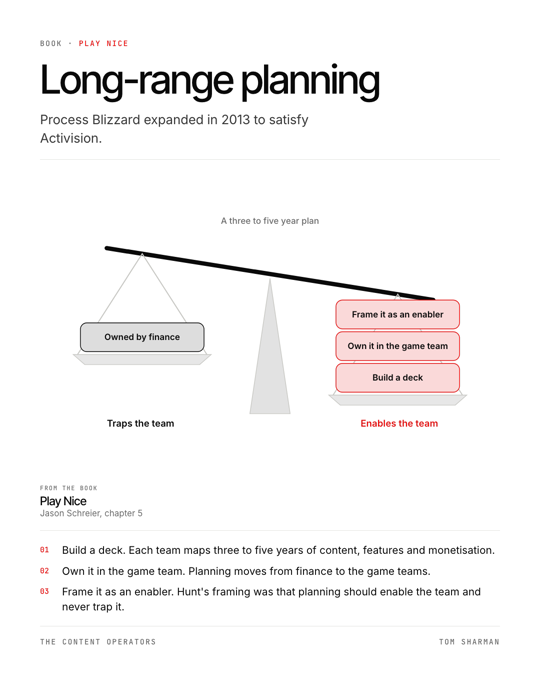
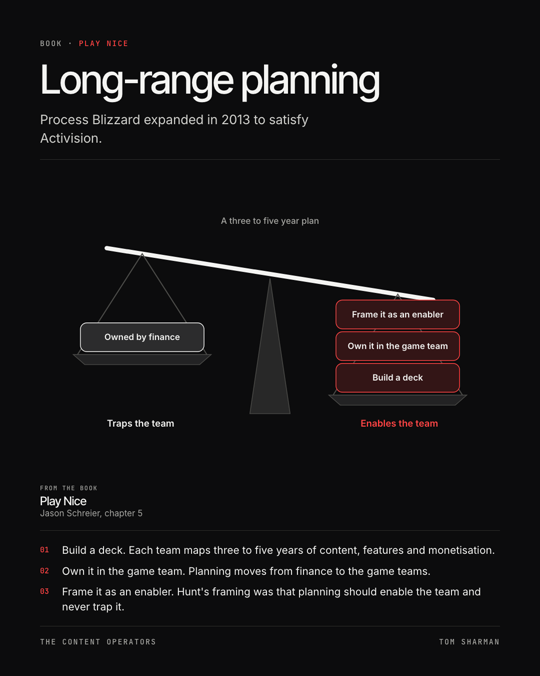
Process Blizzard expanded in 2013 to satisfy Activision.
- Build a deck. Each team maps three to five years of content, features and monetisation.
- Own it in the game team. Planning moves from finance to the game teams.
- Frame it as an enabler. Hunt's framing was that planning should enable the team and never trap it.
From chapter: PART TWO: FALL, pp. 110–199
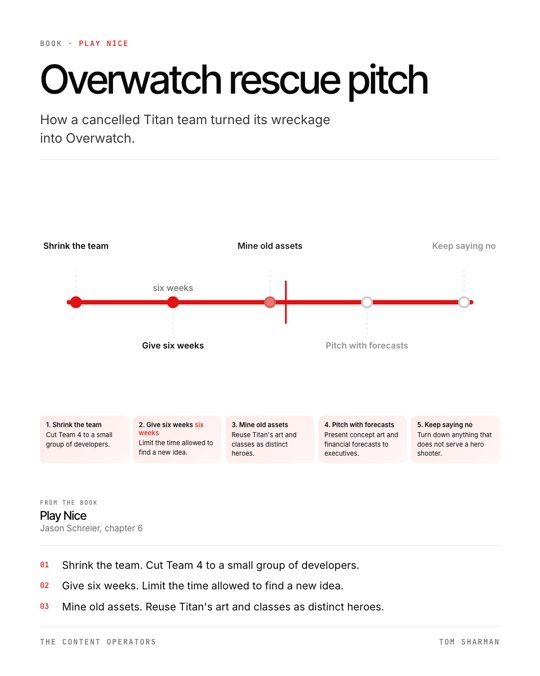
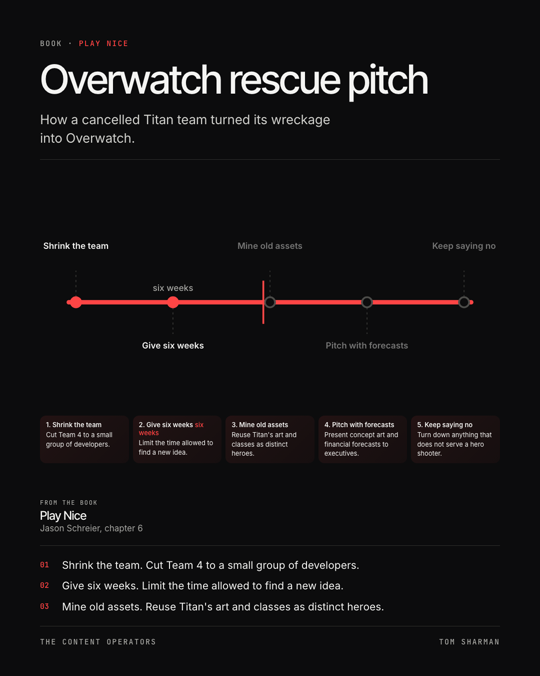
How a cancelled Titan team turned its wreckage into Overwatch.
- Shrink the team. Cut Team 4 to a small group of developers.
- Give six weeks. Limit the time allowed to find a new idea.
- Mine old assets. Reuse Titan's art and classes as distinct heroes.
- Pitch with forecasts. Present concept art and financial forecasts to executives.
- Keep saying no. Turn down anything that does not serve a hero shooter.
From chapter: PART THREE: FUTURE, pp. 200–303
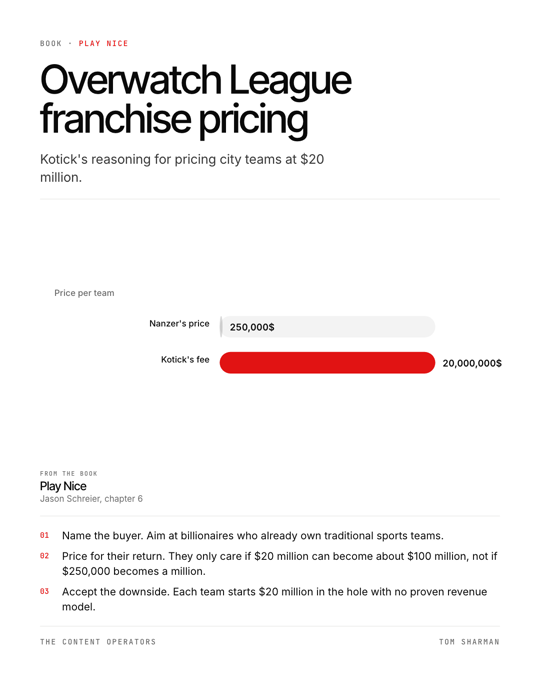
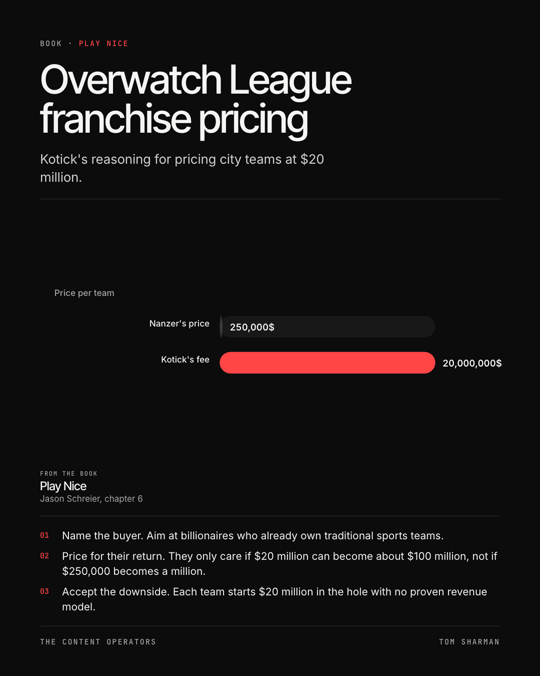
Kotick's reasoning for pricing city teams at $20 million.
- Name the buyer. Aim at billionaires who already own traditional sports teams.
- Price for their return. They only care if $20 million can become about $100 million, not if $250,000 becomes a million.
- Accept the downside. Each team starts $20 million in the hole with no proven revenue model.
From chapter: PART THREE: FUTURE, pp. 200–303
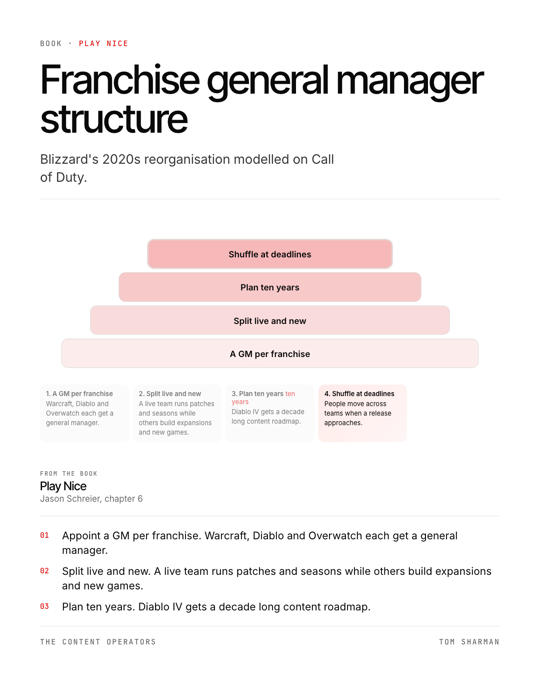
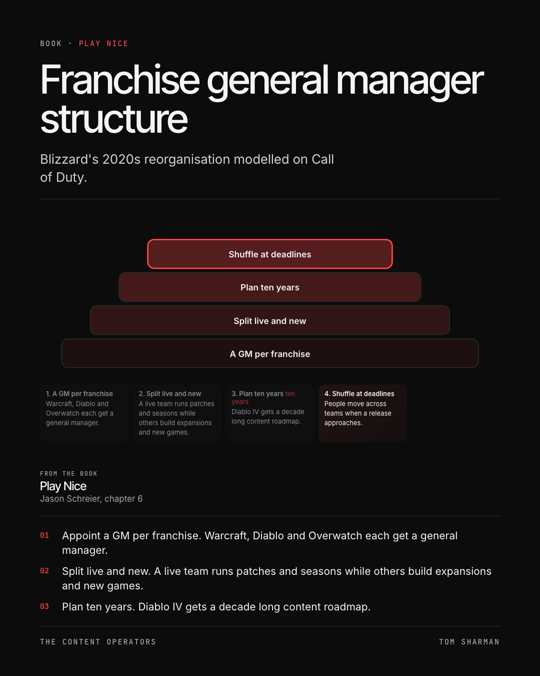
Blizzard's 2020s reorganisation modelled on Call of Duty.
- Appoint a GM per franchise. Warcraft, Diablo and Overwatch each get a general manager.
- Split live and new. A live team runs patches and seasons while others build expansions and new games.
- Plan ten years. Diablo IV gets a decade long content roadmap.
- Shuffle at deadlines. People move across teams when a release approaches.
From chapter: PART THREE: FUTURE, pp. 200–303
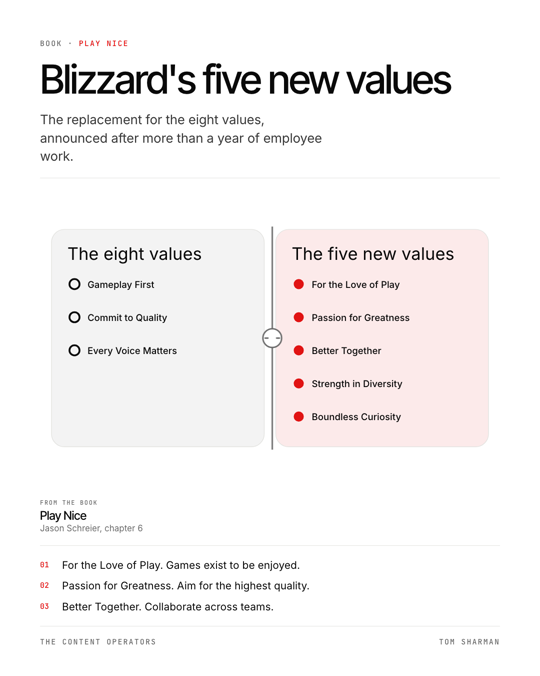
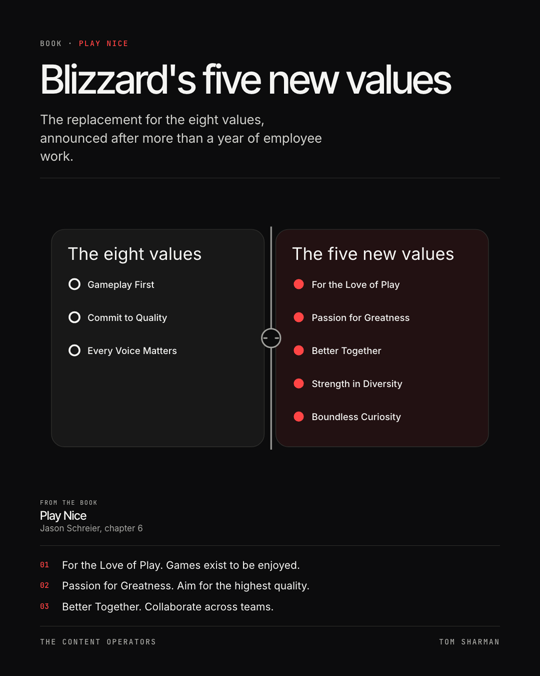
The replacement for the eight values, announced after more than a year of employee work.
- For the Love of Play. Games exist to be enjoyed.
- Passion for Greatness. Aim for the highest quality.
- Better Together. Collaborate across teams.
- Strength in Diversity. Draw on different people.
- Boundless Curiosity. Keep exploring.
From chapter: PART THREE: FUTURE, pp. 200–303