What it argues
Guidara argues that service is black and white while hospitality is colour, and that the way you make people feel is what they never forget. He claims the people who serve must be treated with the same unreasonable care as the guests, so culture is built first inside the team through daily meetings, clear and private feedback, ownership programmes and a shared language. Excellence and hospitality are held in deliberate tension, with details executed perfectly and a bright rule that being right is irrelevant. The Rule of 95/5 funds delight: manage 95 percent of spend to the penny and spend the last 5 percent foolishly on gifts that give people a story to tell. The path to number one in the world at Eleven Madison Park runs through setbacks, a recession and his own mistakes over control and trust, and ends with a return to a mission simple enough to filter every decision.
Every framework, step by step
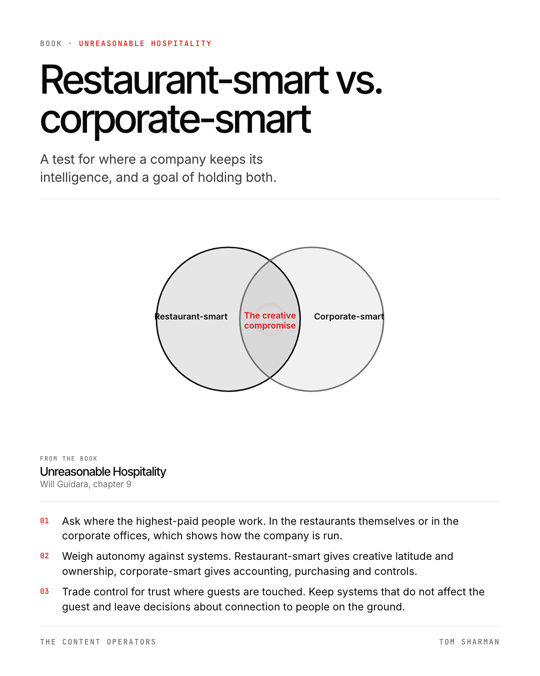
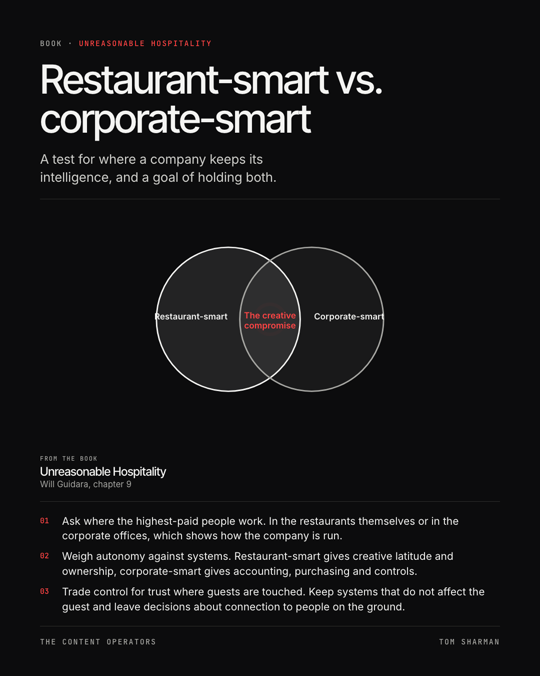
A test for where a company keeps its intelligence, and a goal of holding both.
- Ask where the highest-paid people work. In the restaurants themselves or in the corporate offices, which shows how the company is run.
- Weigh autonomy against systems. Restaurant-smart gives creative latitude and ownership, corporate-smart gives accounting, purchasing and controls.
- Trade control for trust where guests are touched. Keep systems that do not affect the guest and leave decisions about connection to people on the ground.
- Find the creative compromise. Solve each tension with a new option that serves both the guest and the business.
From chapter: Chapter 5: Restaurant-Smart vs. Corporate-Smart, pp. 38–52
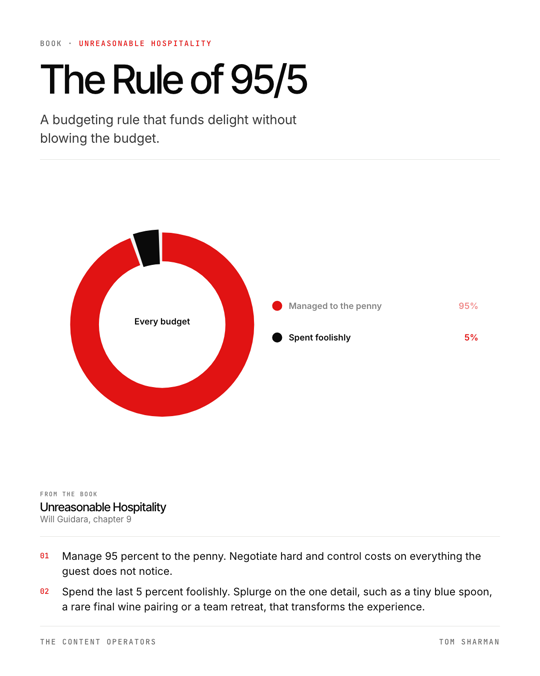
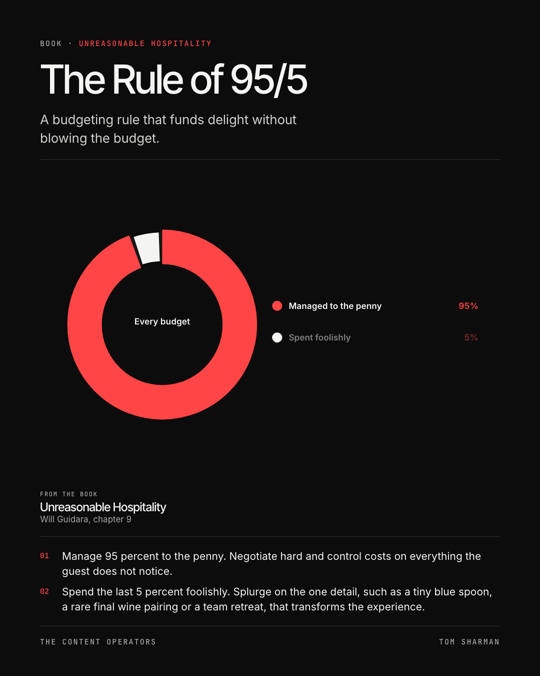
A budgeting rule that funds delight without blowing the budget.
- Manage 95 percent to the penny. Negotiate hard and control costs on everything the guest does not notice.
- Spend the last 5 percent foolishly. Splurge on the one detail, such as a tiny blue spoon, a rare final wine pairing or a team retreat, that transforms the experience.
From chapter: Chapter 5: Restaurant-Smart vs. Corporate-Smart, pp. 38–52
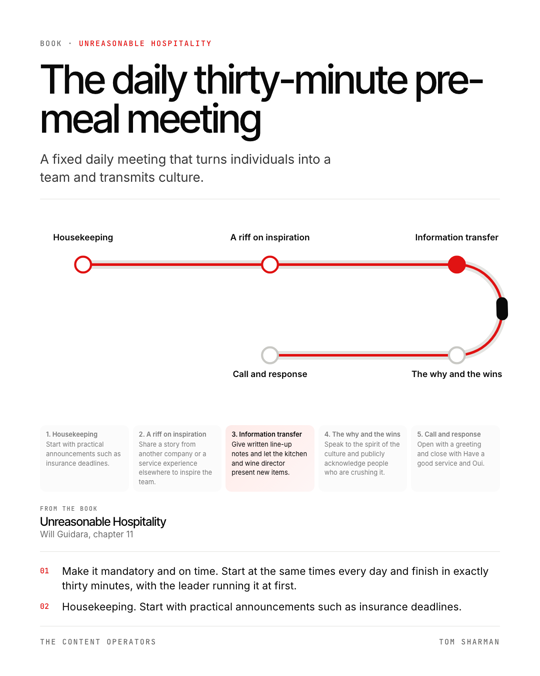
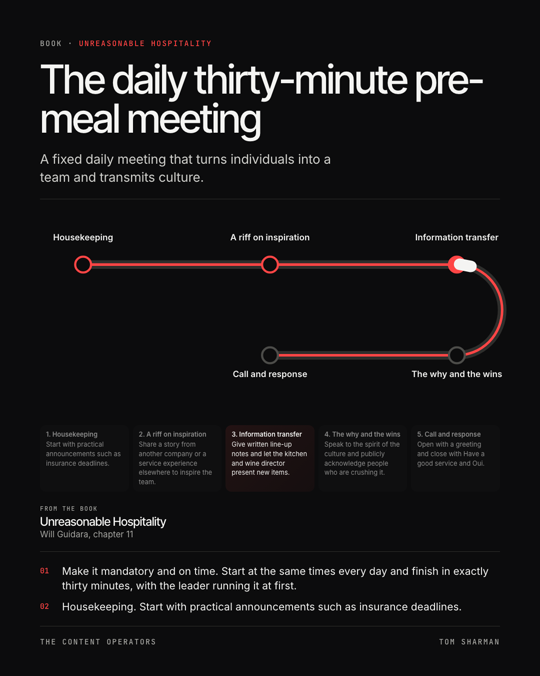
A fixed daily meeting that turns individuals into a team and transmits culture.
- Make it mandatory and on time. Start at the same times every day and finish in exactly thirty minutes, with the leader running it at first.
- Housekeeping. Start with practical announcements such as insurance deadlines.
- A riff on inspiration. Share a story from another company or a service experience elsewhere to inspire the team.
- Information transfer. Give written line-up notes and let the kitchen and wine director present new items.
- Explain the why and celebrate wins. Speak to the spirit of the culture and publicly acknowledge people who are crushing it.
- Call and response. Open with a greeting and close with Have a good service and Oui.
From chapter: Chapter 7: Setting Expectations, pp. 60–78
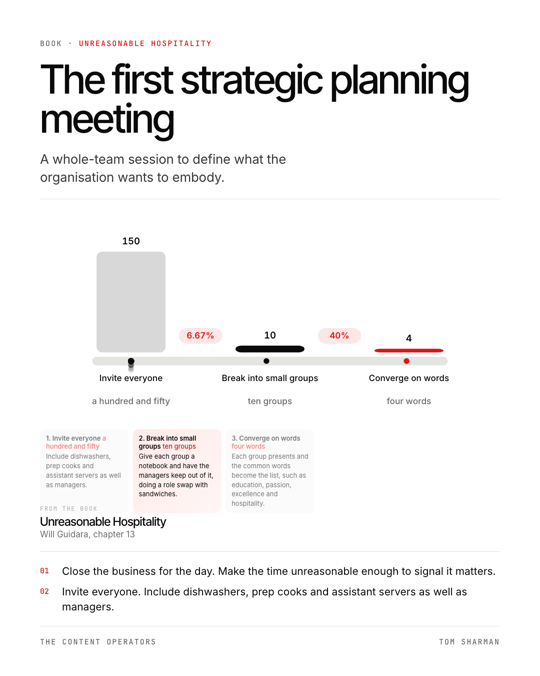
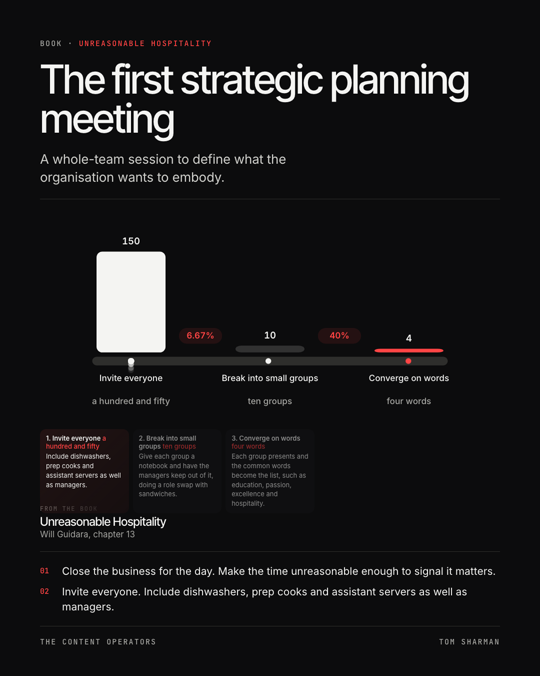
A whole-team session to define what the organisation wants to embody.
- Close the business for the day. Make the time unreasonable enough to signal it matters.
- Invite everyone. Include dishwashers, prep cooks and assistant servers as well as managers.
- Pose one question. Ask what do we want to embody, then step out of the way.
- Break into small groups. Give each group a notebook and have the managers keep out of it, doing a role swap with sandwiches.
- Present and converge. Each group presents and the common words become the list, such as education, passion, excellence and hospitality.
From chapter: Chapter 9: Working with Purpose, on Purpose, pp. 90–99
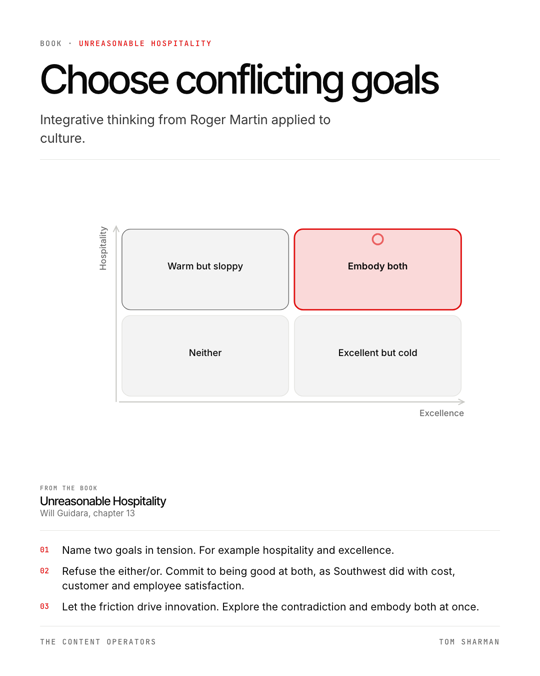
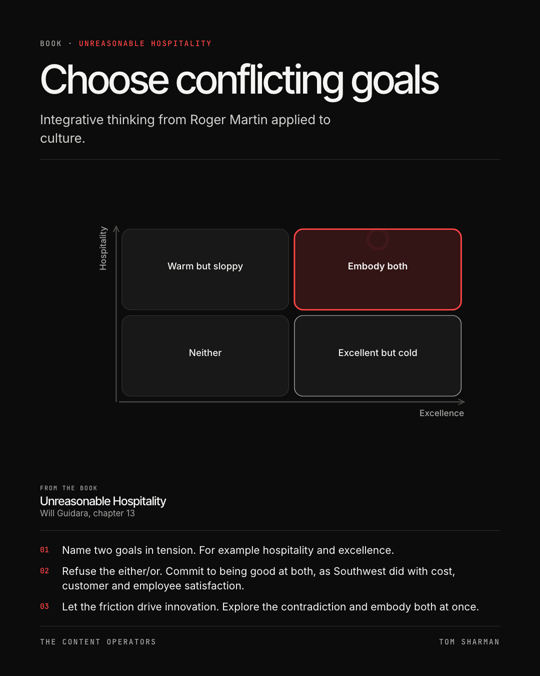
Integrative thinking from Roger Martin applied to culture.
- Name two goals in tension. For example hospitality and excellence.
- Refuse the either/or. Commit to being good at both, as Southwest did with cost, customer and employee satisfaction.
- Let the friction drive innovation. Explore the contradiction and embody both at once.
From chapter: Chapter 9: Working with Purpose, on Purpose, pp. 90–99
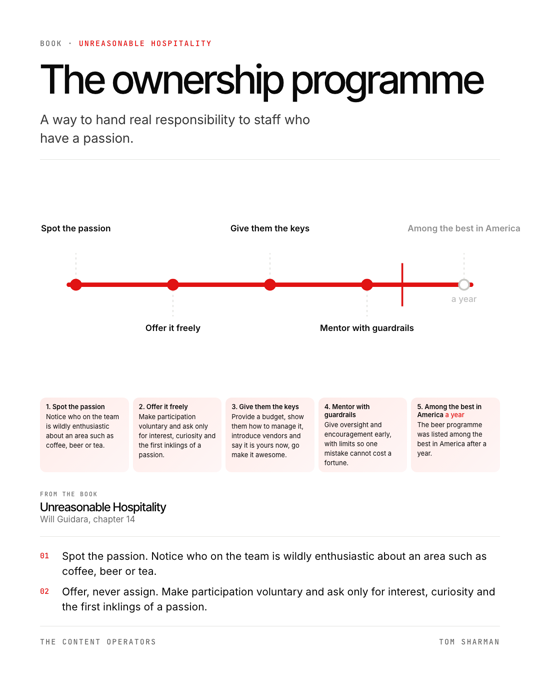
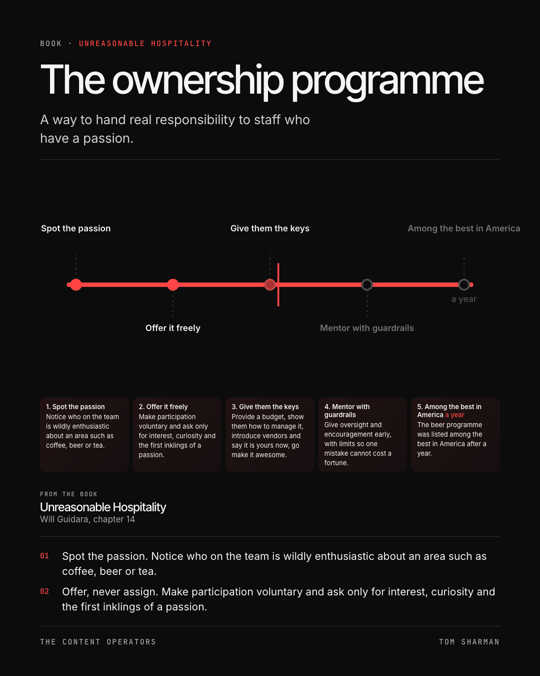
A way to hand real responsibility to staff who have a passion.
- Spot the passion. Notice who on the team is wildly enthusiastic about an area such as coffee, beer or tea.
- Offer, never assign. Make participation voluntary and ask only for interest, curiosity and the first inklings of a passion.
- Give them the keys. Provide a budget, show them how to manage it, introduce vendors and say it is yours now, go make it awesome.
- Mentor and set guardrails. Give oversight and encouragement early, with limits so one mistake cannot cost a fortune.
- Move on if it fails. Do not penalise a miss, simply find another area where they can invest their time.
From chapter: Chapter 10: Creating a Culture of Collaboration, pp. 100–116
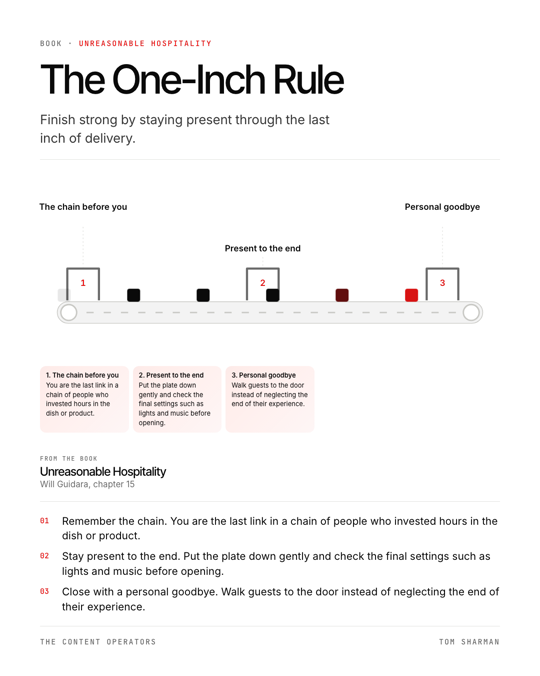
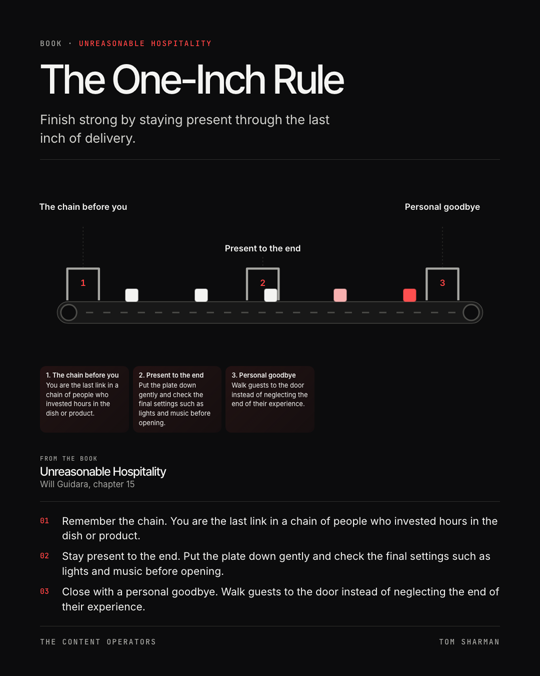
Finish strong by staying present through the last inch of delivery.
- Remember the chain. You are the last link in a chain of people who invested hours in the dish or product.
- Stay present to the end. Put the plate down gently and check the final settings such as lights and music before opening.
- Close with a personal goodbye. Walk guests to the door instead of neglecting the end of their experience.
From chapter: Chapter 11: Pushing Toward Excellence, pp. 117–128
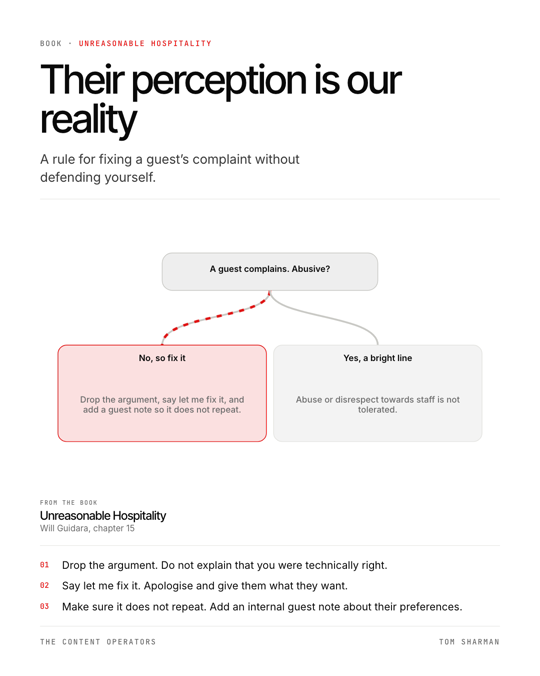
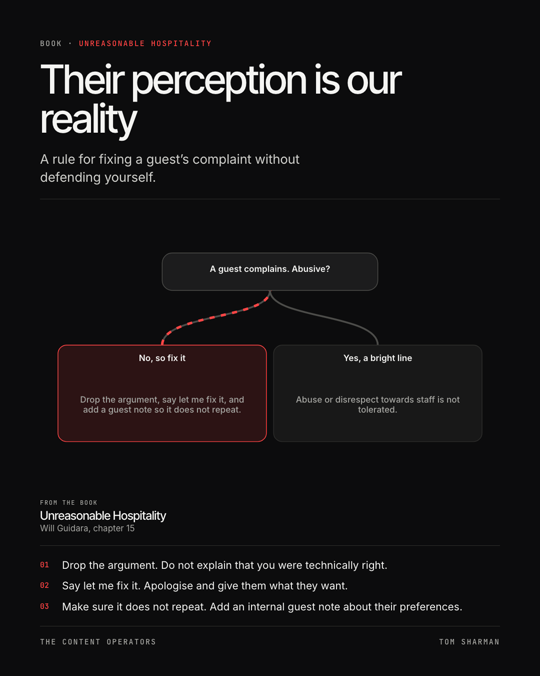
A rule for fixing a guest’s complaint without defending yourself.
- Drop the argument. Do not explain that you were technically right.
- Say let me fix it. Apologise and give them what they want.
- Make sure it does not repeat. Add an internal guest note about their preferences.
- Hold a bright line. Abuse or disrespect towards staff is not tolerated.
From chapter: Chapter 11: Pushing Toward Excellence, pp. 117–128
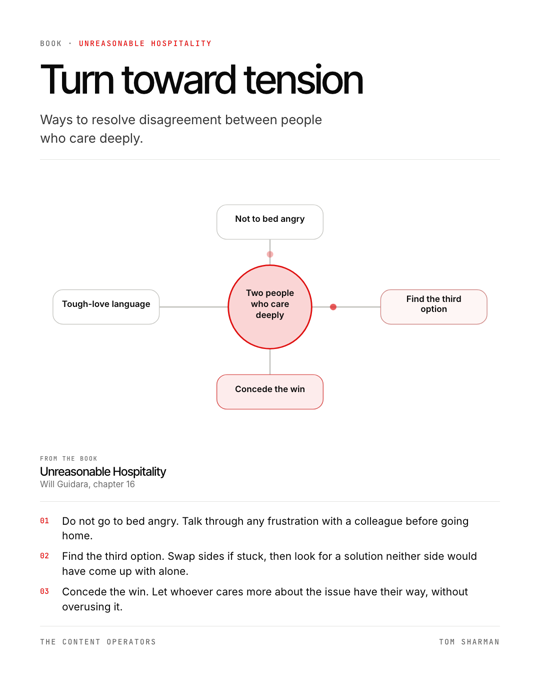
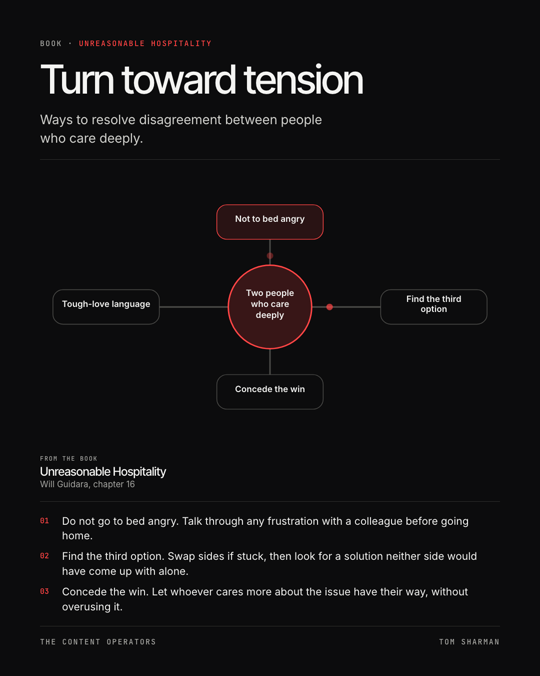
Ways to resolve disagreement between people who care deeply.
- Do not go to bed angry. Talk through any frustration with a colleague before going home.
- Find the third option. Swap sides if stuck, then look for a solution neither side would have come up with alone.
- Concede the win. Let whoever cares more about the issue have their way, without overusing it.
- Learn their tough-love language. Match the delivery of criticism to the person, without sarcasm, privately and without emotion.
From chapter: Chapter 12: Relationships Are Simple. Simple Is Hard., pp. 129–143
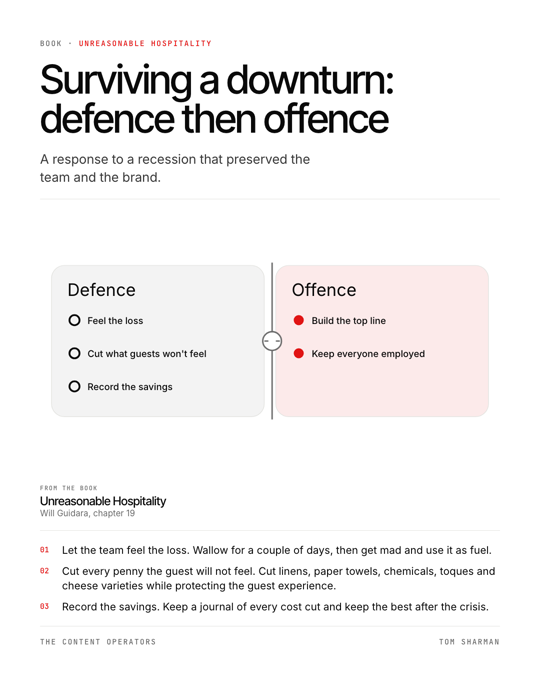
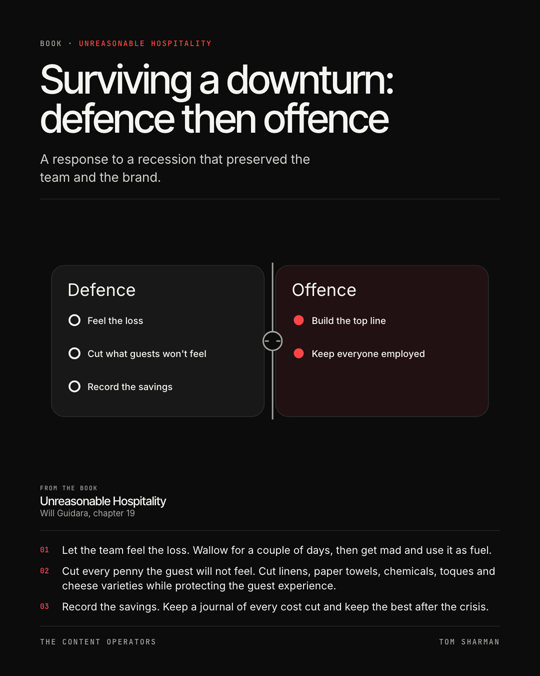
A response to a recession that preserved the team and the brand.
- Let the team feel the loss. Wallow for a couple of days, then get mad and use it as fuel.
- Cut every penny the guest will not feel. Cut linens, paper towels, chemicals, toques and cheese varieties while protecting the guest experience.
- Record the savings. Keep a journal of every cost cut and keep the best after the crisis.
- Build the top line. Offer a cheaper lunch, add a dessert trolley and hold a high-risk event like the Kentucky Derby.
- Keep the whole team employed. Use extra business to give more hours rather than laying anyone off.
From chapter: Chapter 15: The Best Offense Is Offense, pp. 158–173
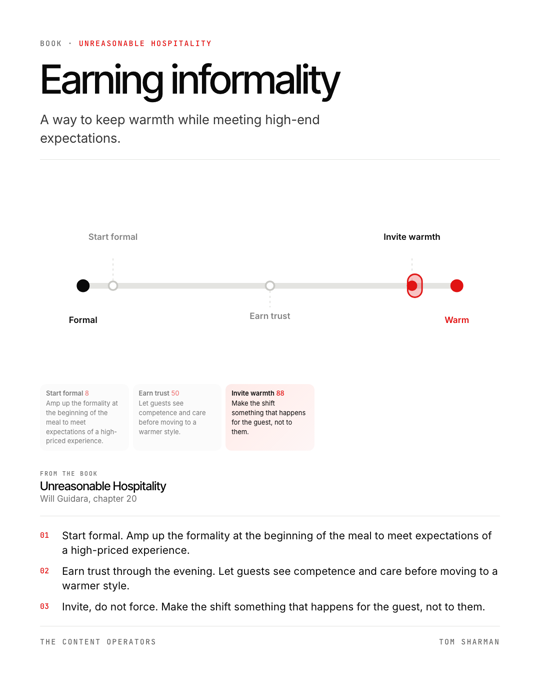
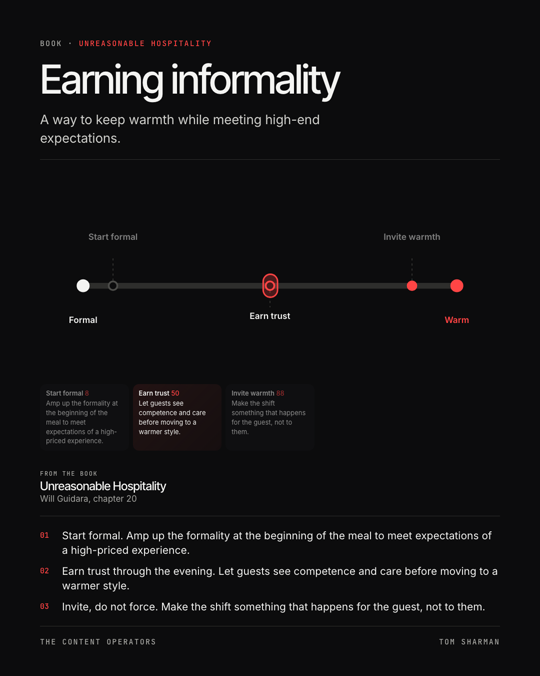
A way to keep warmth while meeting high-end expectations.
- Start formal. Amp up the formality at the beginning of the meal to meet expectations of a high-priced experience.
- Earn trust through the evening. Let guests see competence and care before moving to a warmer style.
- Invite, do not force. Make the shift something that happens for the guest, not to them.
From chapter: Chapter 16: Earning Informality, pp. 174–177
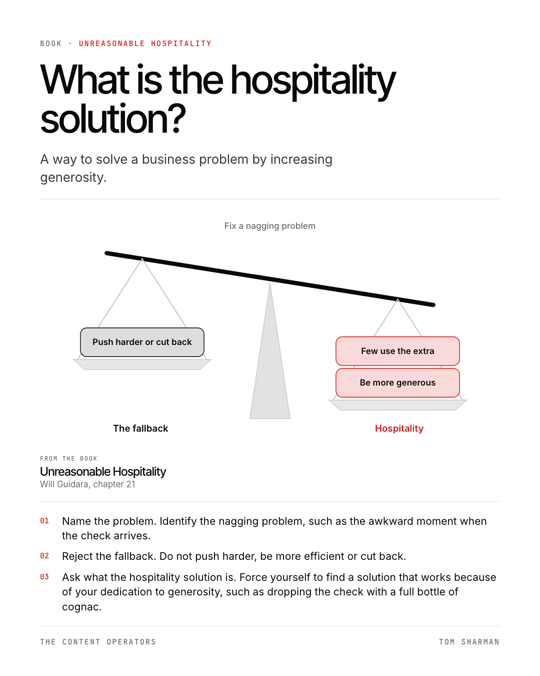
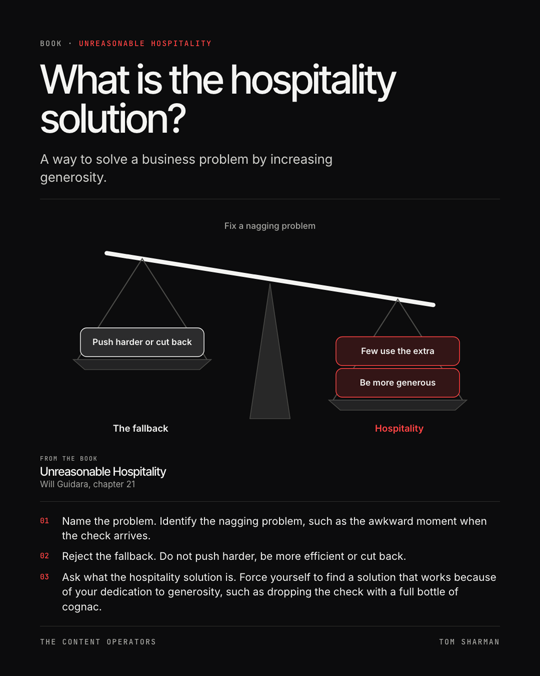
A way to solve a business problem by increasing generosity.
- Name the problem. Identify the nagging problem, such as the awkward moment when the check arrives.
- Reject the fallback. Do not push harder, be more efficient or cut back.
- Ask what the hospitality solution is. Force yourself to find a solution that works because of your dedication to generosity, such as dropping the check with a full bottle of cognac.
- Check the cost. These solutions are often cost-effective because few guests use the extra, yet the feeling of abundance remains.
From chapter: Chapter 17: Learning to Be Unreasonable, pp. 178–191
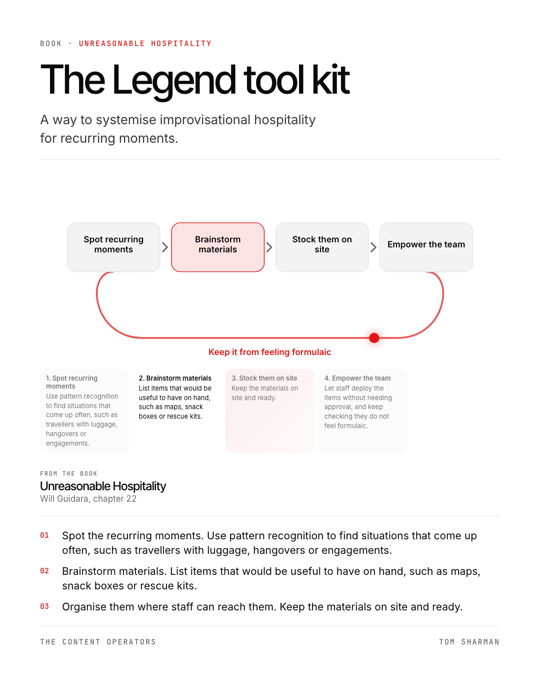
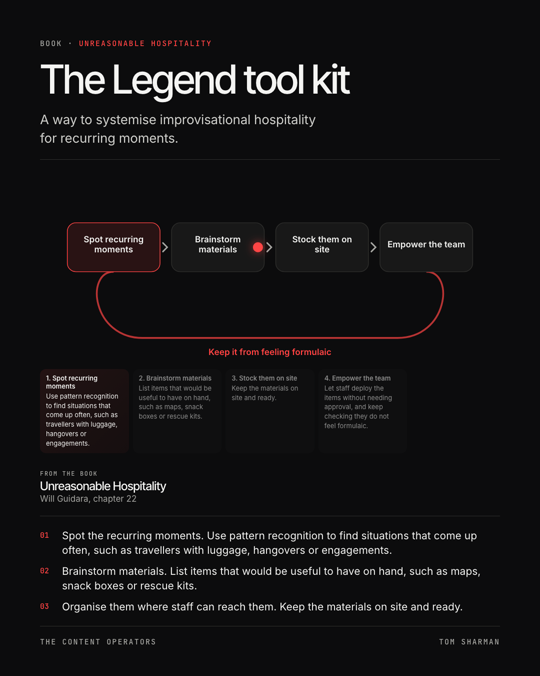
A way to systemise improvisational hospitality for recurring moments.
- Spot the recurring moments. Use pattern recognition to find situations that come up often, such as travellers with luggage, hangovers or engagements.
- Brainstorm materials. List items that would be useful to have on hand, such as maps, snack boxes or rescue kits.
- Organise them where staff can reach them. Keep the materials on site and ready.
- Empower the team to use them. Let staff deploy the items without needing approval, and keep checking they do not feel formulaic.
From chapter: Chapter 18: Improvisational Hospitality, pp. 192–209
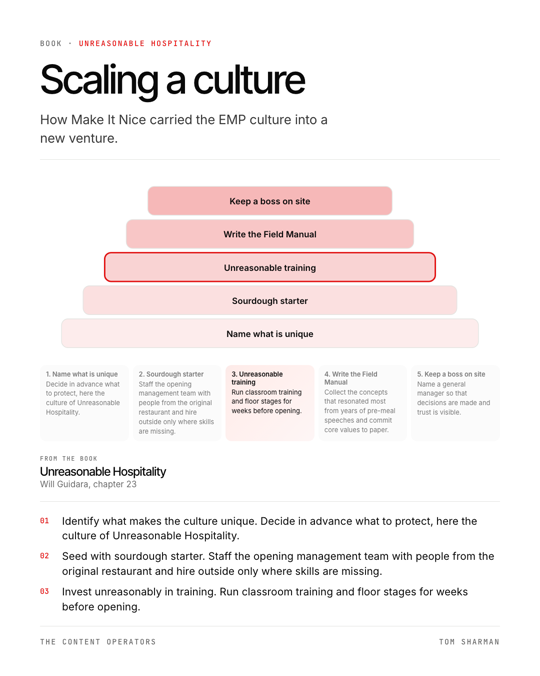
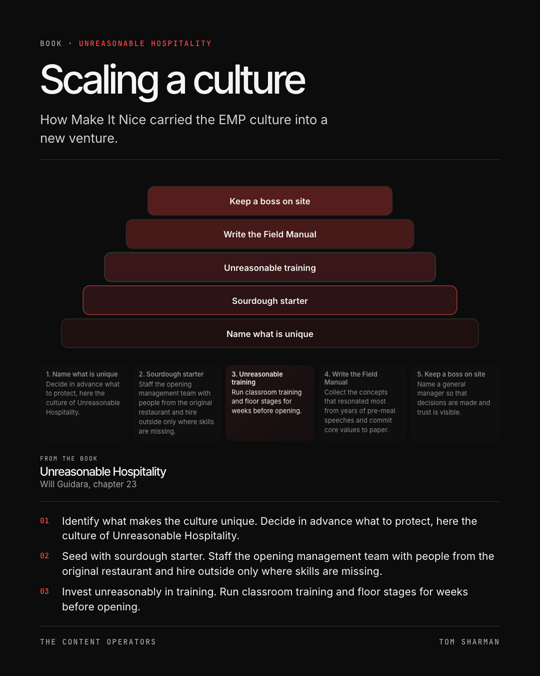
How Make It Nice carried the EMP culture into a new venture.
- Identify what makes the culture unique. Decide in advance what to protect, here the culture of Unreasonable Hospitality.
- Seed with sourdough starter. Staff the opening management team with people from the original restaurant and hire outside only where skills are missing.
- Invest unreasonably in training. Run classroom training and floor stages for weeks before opening.
- Write the Field Manual. Collect the concepts that resonated most from years of pre-meal speeches and commit core values to paper.
- Keep a boss on site. Name a general manager so that decisions are made and trust is visible.
From chapter: Chapter 19: Scaling a Culture, pp. 210–225
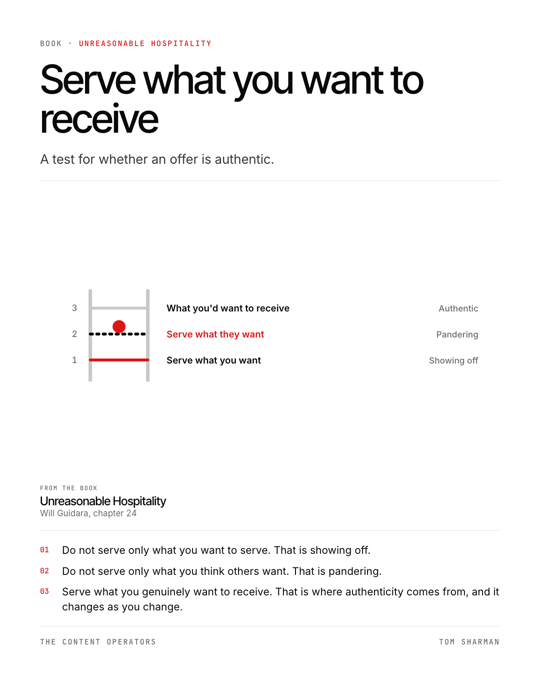
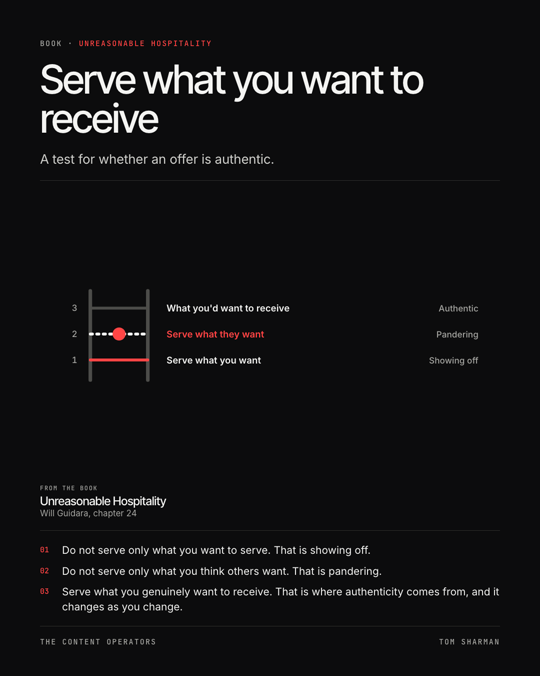
A test for whether an offer is authentic.
- Do not serve only what you want to serve. That is showing off.
- Do not serve only what you think others want. That is pandering.
- Serve what you genuinely want to receive. That is where authenticity comes from, and it changes as you change.
From chapter: Chapter 20: Back to Basics, pp. 226–240