Bookshelf
How Tom uses this
Trust Me, I'm Lying backs two of Tom's lessons. Under each of his lessons, what the book says about it, and on which pages.
- People online are selfish, so lead with what they get
Holiday's evidence is that what spreads serves the reader's own emotional payoff (anger, awe, amusement), and that sharing is driven by what the sharer gets from it. pp. 69, 70 and 78. In the book: Trading up the chain, The nine tactics, The cycle of manufactured coverage.
- A brand that compounds has a mission and an enemy
He shows that outrage views are transitory (96 percent of Most E-mailed articles appeared once), that critics made angry spread your message, and that chasing attention without purpose brings blowback. pp. 73, 142 and 237. In the book: Trading up the chain, The nine tactics, The cycle of manufactured coverage, The news funnel, How to read a blog.
What it argues
Holiday argues that online media is built on incentives that reward traffic over truth: blogs earn money by the pageview, are built to be sold, and sell every story one-off, so they need content that spreads, which means anger, scandal and simple narratives. Those incentives make blogs easy to steer, and he spent years doing it through trading up the chain and nine tactics, from paying bloggers indirectly to writing their headlines. The same system then turns on its users, because stories cannot be corrected, links stand in for verification, and fakes become real behaviour. He concludes the result is unreality, offers no solution, and says readers and publishers must change the incentives by demanding and paying for quality. The book is both a manual and a confession, and he warns that using the tactics brings blowback.
Worth keeping
- Revenue is advertising times traffic, so every publisher decision follows traffic by any means; predict the incentive and you predict the behaviour (p. 39).
- Trading up the chain: a story placed on a small blog is cited by legacy-media blogs and then by national outlets, so each level legitimises the next (pp. 26 to 33).
- The strongest predictor of sharing is anger, then other high-arousal emotions, and sadness and practical utility spread poorly (pp. 68 to 70, 78).
- Selling each article one-off forces sensational headlines, while a subscription aligns incentives with the reader, so trust and a returning audience are the durable model (pp. 86 to 92, 236).
- Write the headline into the pitch and let the blogger take it, because the blogger's real job is the headline (p. 99).
- The first version of a story wins, corrections reach a fraction of readers and can backfire, so prevention beats correction (pp. 133 to 134, 190).
- A link looks like a citation but is not, and delegating trust to other outlets lets errors compound (pp. 159 to 162).
- The decoder of stock blog phrases (tipster, leaked, breaking, updated, exclusive) shows how to read coverage sceptically (pp. 228 to 229).
- Ask what you plan to do with any piece of information; most of it has no practical use beyond distraction (pp. 236 to 237).
- Manufactured attention brings blowback, so weigh the costs in dignity and trust before using the tactics (pp. 15, 237).
The questions it answers
- What makes a format repeatable, as opposed to a hit that happened once?
The Wharton study shows 96 percent of Most E-mailed articles hit once and vanished, and the subscription history (pp. 86 to 90) shows a series with a returning audience is the repeatable alternative to a one-off spike.
- How do you build a personal brand that generates inbound rather than requiring outbound?
Trading up the chain and HARO (pp. 26 to 33, 61) show how a source becomes the person journalists come to, though the conclusion warns that manufactured reputation brings blowback.
- Which of my stories travel, and which only feel like they should?
The Detroit slideshows (pp. 66 to 68) and the anger finding (p. 69) show stories travel when they arouse, and importance alone does not make them travel, which is a test to run on the fifty stories.
- What does AI actually change about the shape of a content team?
Demand Media's algorithm-led production line (pp. 148 to 149) shows what an automated content team looks like and what it drops, which is a contrast case for a team with human judgement.
The frameworks
5 frameworks, one animation each Every framework, step by step
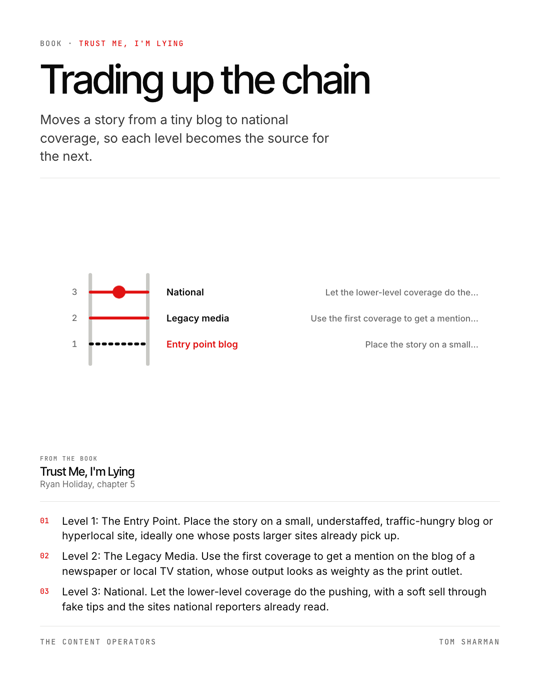
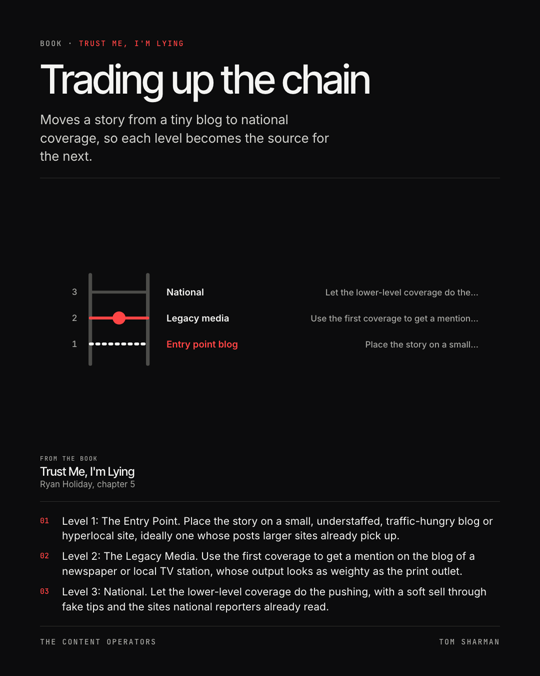
Moves a story from a tiny blog to national coverage, so each level becomes the source for the next.
- Level 1: The Entry Point. Place the story on a small, understaffed, traffic-hungry blog or hyperlocal site, ideally one whose posts larger sites already pick up.
- Level 2: The Legacy Media. Use the first coverage to get a mention on the blog of a newspaper or local TV station, whose output looks as weighty as the print outlet.
- Level 3: National. Let the lower-level coverage do the pushing, with a soft sell through fake tips and the sites national reporters already read.
From chapter: Book One: Feeding The Monster: How Blogs Work, pp. 18–125
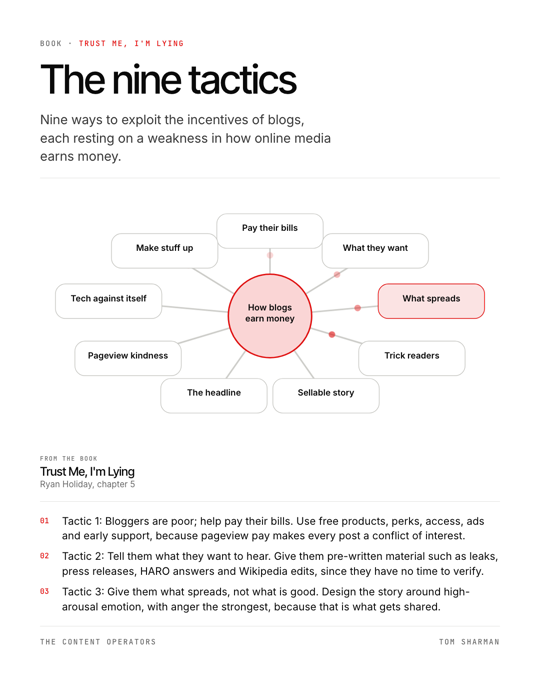
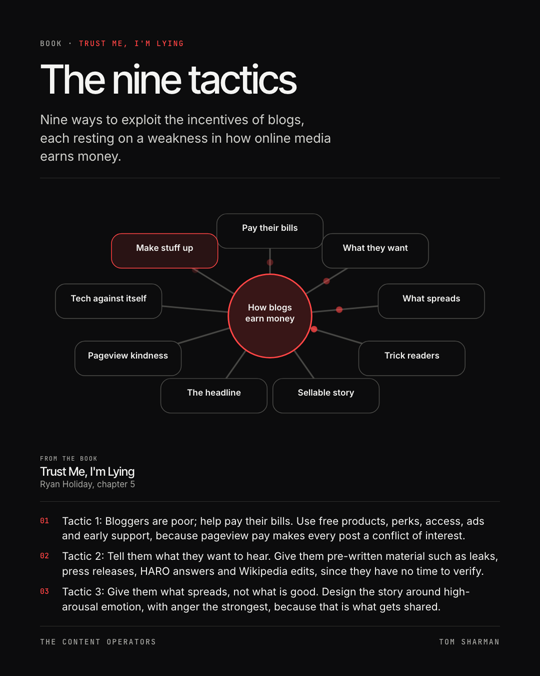
Nine ways to exploit the incentives of blogs, each resting on a weakness in how online media earns money.
- Tactic 1: Bloggers are poor; help pay their bills. Use free products, perks, access, ads and early support, because pageview pay makes every post a conflict of interest.
- Tactic 2: Tell them what they want to hear. Give them pre-written material such as leaks, press releases, HARO answers and Wikipedia edits, since they have no time to verify.
- Tactic 3: Give them what spreads, not what is good. Design the story around high-arousal emotion, with anger the strongest, because that is what gets shared.
- Tactic 4: Help them trick their readers. Hand them a click-friendly question or mystery for the headline, and tee up a story that will draw comments.
- Tactic 5: Sell them something they can sell. Supply a story that works as a one-off sale on its own, since blogs have to sell every article afresh like the yellow press.
- Tactic 6: Make it all about the headline. Write or hint at the headline in your pitch and let the blogger take it.
- Tactic 7: Kill them with pageview kindness. Show a story is a traffic draw, link it to a popular topic, buy a little traffic and leave fake comments to fill the silence.
- Tactic 8: Use the technology against itself. Package material in the short, fresh, simple form the medium demands, and come to bloggers with the story already written.
- Tactic 9: Just make stuff up. Offer an exclusive on a small or nonexistent story with an arbitrary deadline and let the blogger find the angle.
From chapter: Book One: Feeding The Monster: How Blogs Work, pp. 18–125
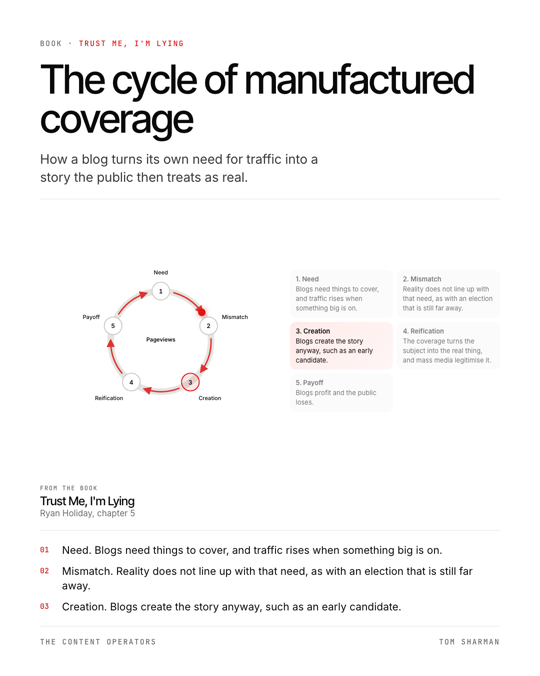
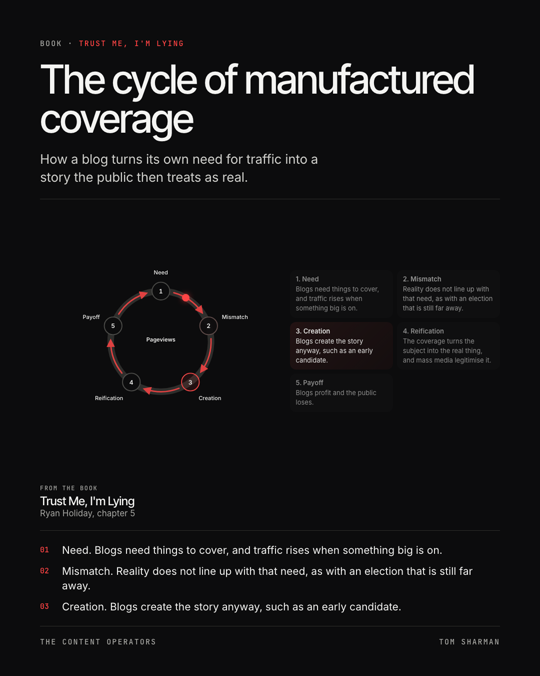
How a blog turns its own need for traffic into a story the public then treats as real.
- Need. Blogs need things to cover, and traffic rises when something big is on.
- Mismatch. Reality does not line up with that need, as with an election that is still far away.
- Creation. Blogs create the story anyway, such as an early candidate.
- Reification. The coverage turns the subject into the real thing, and mass media legitimise it.
- Payoff. Blogs profit and the public loses.
From chapter: Book One: Feeding The Monster: How Blogs Work, pp. 18–125
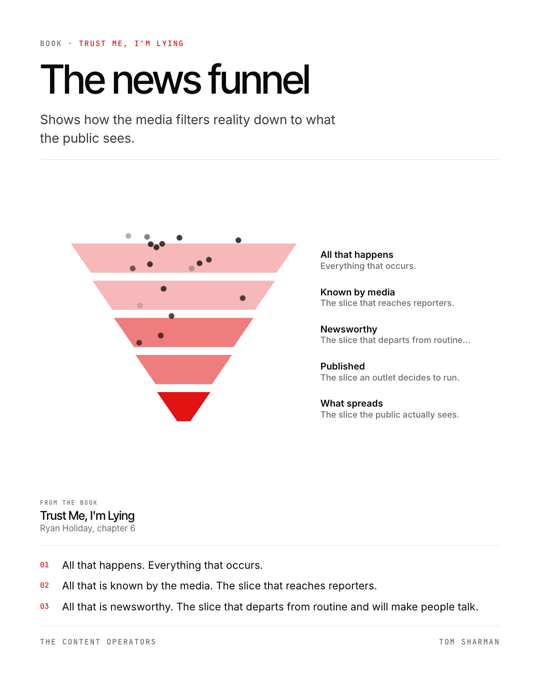
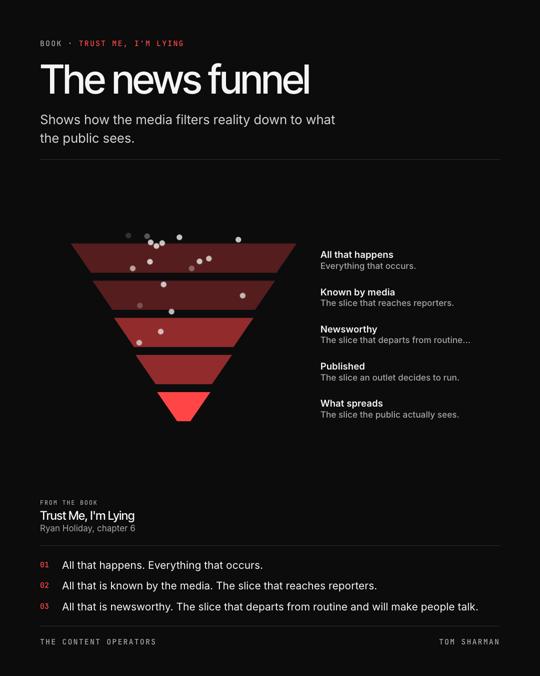
Shows how the media filters reality down to what the public sees.
- All that happens. Everything that occurs.
- All that is known by the media. The slice that reaches reporters.
- All that is newsworthy. The slice that departs from routine and will make people talk.
- All that is published as news. The slice an outlet decides to run.
- All that spreads. The slice the public actually sees.
From chapter: Book Two: The Monster Attacks: What Blogs Mean, pp. 126–231
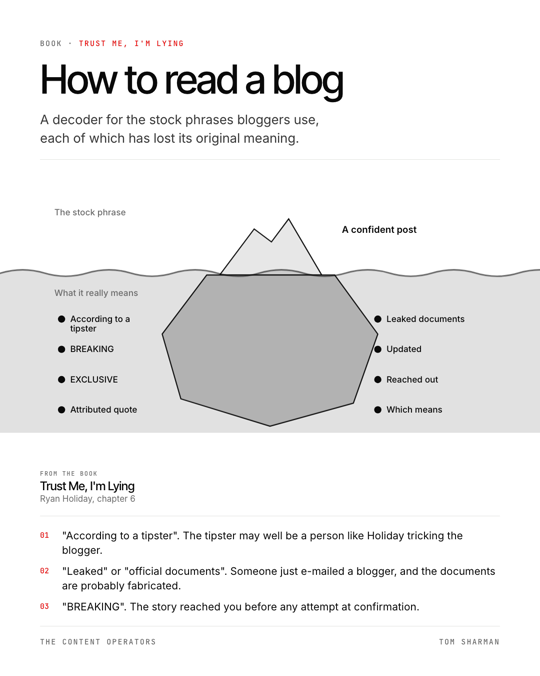
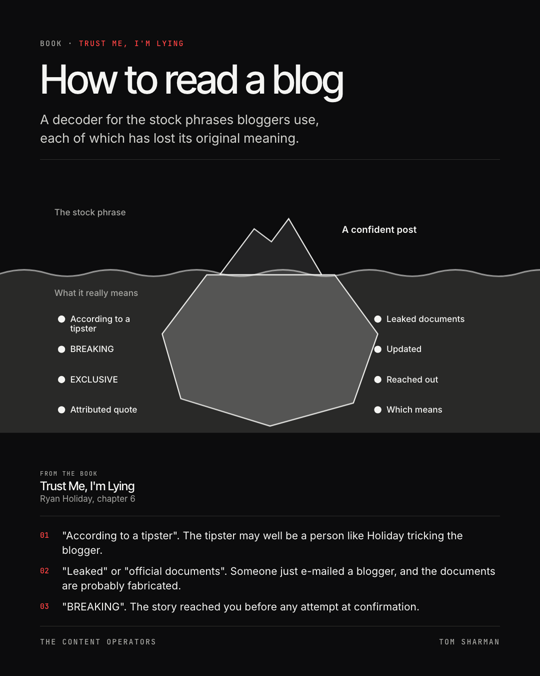
A decoder for the stock phrases bloggers use, each of which has lost its original meaning.
- "According to a tipster". The tipster may well be a person like Holiday tricking the blogger.
- "Leaked" or "official documents". Someone just e-mailed a blogger, and the documents are probably fabricated.
- "BREAKING". The story reached you before any attempt at confirmation.
- "Updated". Nobody reworked the story, they pasted a note at the bottom.
- "EXCLUSIVE". The site and source struck a deal, or the site took a story from a smaller site.
- "We've reached out for comment". An e-mail was sent minutes before publishing, after the story was already written.
- An attributed quote. The blogger probably took it from elsewhere and buried a link.
- "Which means" or "will result in". The writer likely has no training in the field and no consequence for being wrong.
From chapter: Book Two: The Monster Attacks: What Blogs Mean, pp. 126–231
Working with Tom on this
Tom works with creators and founders one to one, from a single session to a fractional role. Work with Tom
Back to the bookshelf