Bookshelf
How Tom uses this
The Third Door backs four of Tom's lessons. Under each of his lessons, what the book says about it, and on which pages.
- Assumptions made too fast, and risk avoided
Alex's worst case and best case lists and Elliott's 'bite off more than you can chew' both favour cheap, fast risks over waiting for certainty. pp. 22, 89, 94 and 98. In the book: The Three Doors, Elliott's five rules, The Avoidance List, Gold, silver and bronze packages.
- Find the voice in what already worked for them
Chapter fifteen shows copying another person's playbook fails and the way through is to lean on what already makes you distinct, and Larry King says the same of interview styles. pp. 119, 120 and 177. In the book: Elliott's five rules, The Avoidance List, Gold, silver and bronze packages, Frog kissing, Cal Fussman's interview practice.
- Signals show before numbers, and numbers come at month four
Elliott says there is no tipping point, only little steps, and that a tipping point only appears in hindsight, which fits waiting for lagging results. pp. 77 and 207. In the book: Elliott's five rules, The Avoidance List, Gold, silver and bronze packages, Bill Gates on closing big deals, Elliott's pipeline rules.
- People online are selfish, so lead with what they get
Buffett got meetings by offering to save businessmen tax, and Alex's summary is to work out what they need and use it as the way in. p. 143. In the book: Frog kissing, Cal Fussman's interview practice.
What it argues
Banayan argues that careers launch through a Third Door that you create by jumping out of the queue, because the main entrance is crowded and the VIP entrance is closed to most people. The working method is the Spielberg Game: jump off the tour bus, find an Inside Man who will put their reputation behind you, and ask for help. Getting in takes Borrowed Credibility, a short specific cold email, a story that commands attention and a pipeline of many attempts, so that no single no matters. He also shows the failure modes at length: copying someone else's playbook, persisting until you are blacklisted, and acting from desperation until you miss red flags. The interviews with Gates, Wozniak, Pitbull, Angelou and Quincy Jones end up redefining success as humility, learning and growth, with mistakes as the best teacher.
Worth keeping
- The Spielberg Game: jump off the tour bus, find an Inside Man, ask for their help (p. 44).
- Borrowed Credibility: volunteer, write or interview your way into a credible association (pp. 54 and 55).
- Ferriss' cold email template: sixty seconds, credibility in a line or two, one specific question, an easy out and no 'thanks in advance' (pp. 55 and 56).
- Tell your own story, since 'Some choose to make them into stories', and repeating it wears down the Flinch (pp. 81 and 97).
- The Avoidance List: choose five of twenty five goals and avoid the other twenty (p. 112).
- You can't out-Amazon Amazon: lean on what makes you different and avoid copying a successful person's playbook (pp. 119 and 120).
- Business is not target practice, so build a pipeline and treat bullshit no's as noise (pp. 153 and 207).
- Over-persistence has a cost: letters, flowers, a shoe and weekly calls ended with a blacklisting (pp. 151, 152 and 205).
- Choose long term positioning over short term profit, and build a genuine relationship before you negotiate (pp. 200 and 202).
- Mistakes are the greatest gift, so attach to trying and growing (pp. 254 and 255).
The questions it answers
- How do you build a personal brand that generates inbound rather than requiring outbound?
The book is mostly an outbound manual, but Elliott's point that a vivid origin story commands attention (p. 81) and the Borrowed Credibility tactics (p. 55) show what makes people open the door to you.
- Which of my stories travel, and which only feel like they should?
Elliott tells Alex his Price Is Right story is what commands attention and has him repeat it to strangers until it lands, a live test of which story travels (pp. 81 and 97).
- How do you price and sell a tool you built for yourself?
Elliott's gold, silver and bronze packages made the middle option the likely pick, with a price that 'just sounded right' (p. 93), and Gates advises taking a fair deal now that sets up bigger deals (p. 200).
The frameworks
11 frameworks, one animation each Every framework, step by step
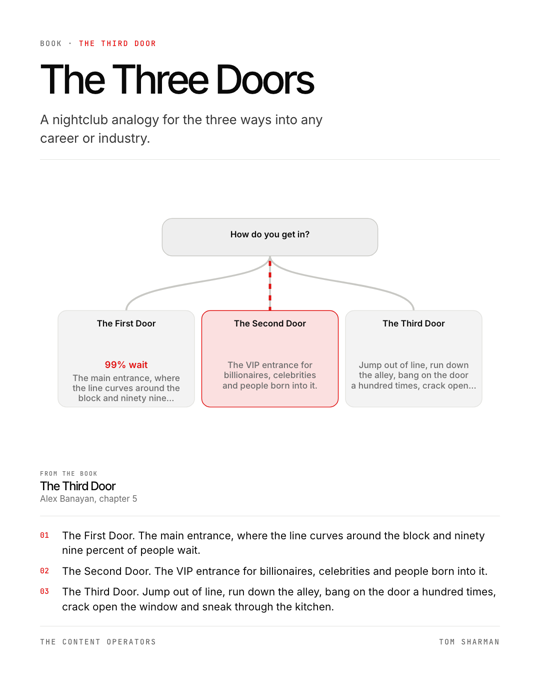
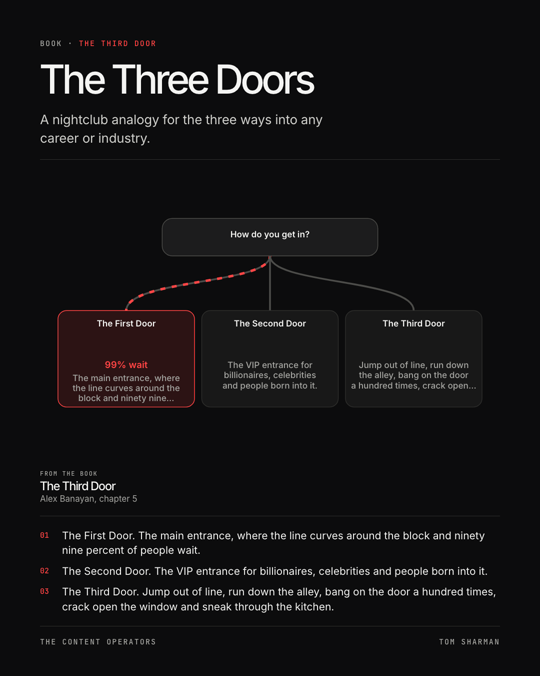
A nightclub analogy for the three ways into any career or industry.
- The First Door. The main entrance, where the line curves around the block and ninety nine percent of people wait.
- The Second Door. The VIP entrance for billionaires, celebrities and people born into it.
- The Third Door. Jump out of line, run down the alley, bang on the door a hundred times, crack open the window and sneak through the kitchen.
From chapter: Step 1: Ditch the Line, pp. 15–38
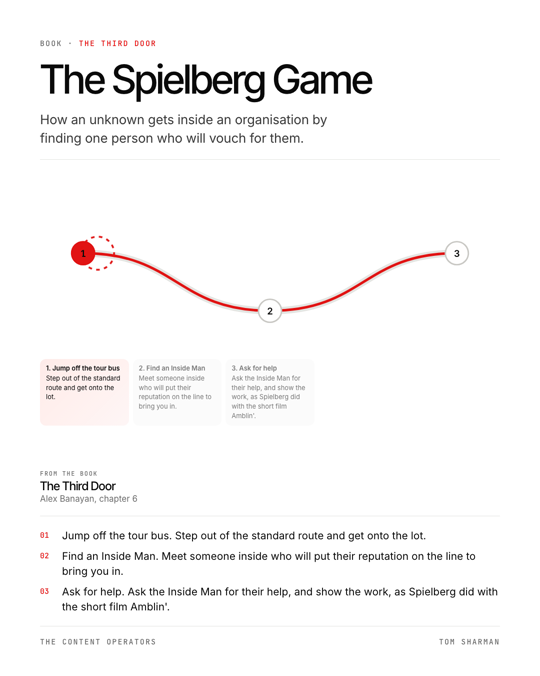
How an unknown gets inside an organisation by finding one person who will vouch for them.
- Jump off the tour bus. Step out of the standard route and get onto the lot.
- Find an Inside Man. Meet someone inside who will put their reputation on the line to bring you in.
- Ask for help. Ask the Inside Man for their help, and show the work, as Spielberg did with the short film Amblin'.
From chapter: Step 2: Run Down the Alley, pp. 39–68
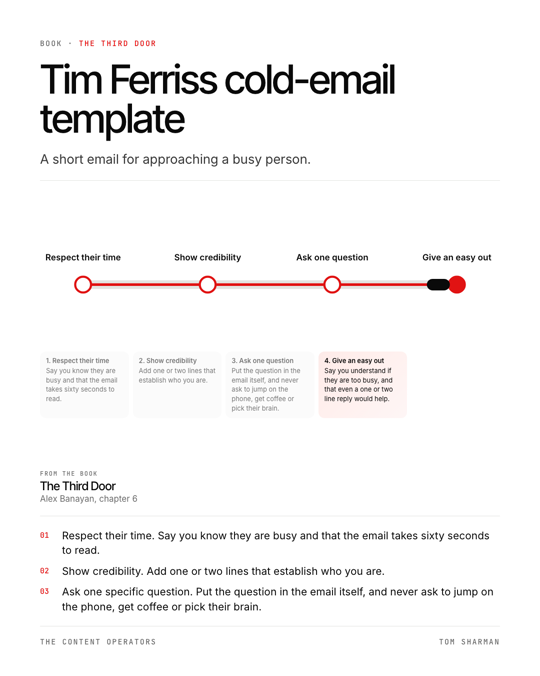
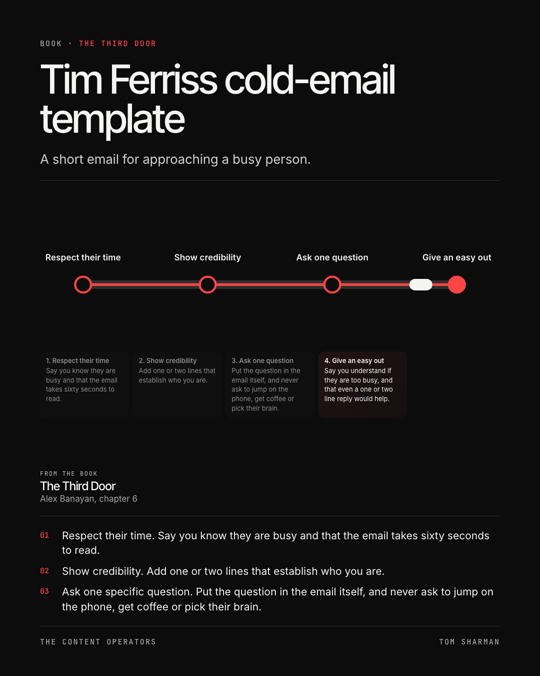
A short email for approaching a busy person.
- Respect their time. Say you know they are busy and that the email takes sixty seconds to read.
- Show credibility. Add one or two lines that establish who you are.
- Ask one specific question. Put the question in the email itself, and never ask to jump on the phone, get coffee or pick their brain.
- Give an easy out. Say you understand if they are too busy, and that even a one or two line reply would help.
From chapter: Step 2: Run Down the Alley, pp. 39–68
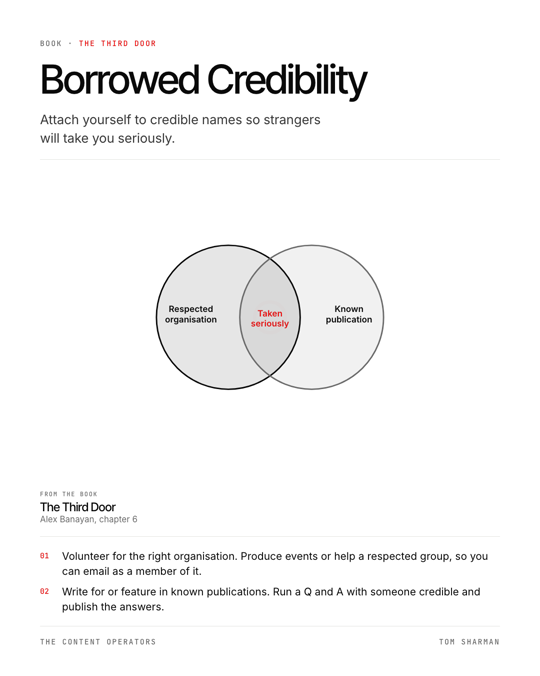
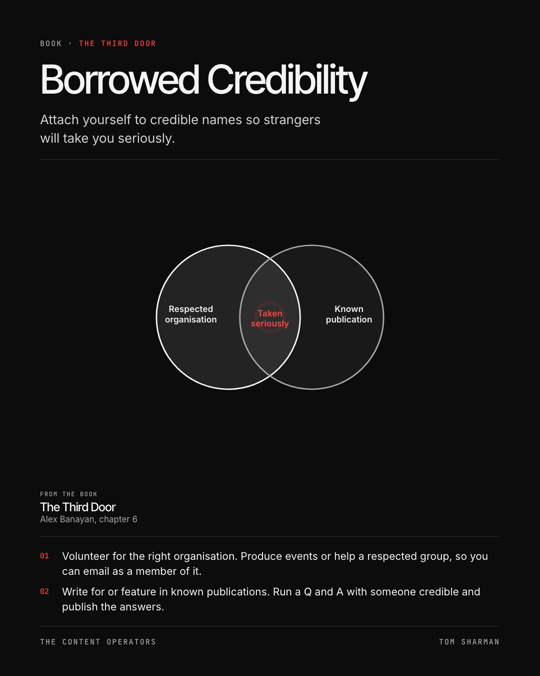
Attach yourself to credible names so strangers will take you seriously.
- Volunteer for the right organisation. Produce events or help a respected group, so you can email as a member of it.
- Write for or feature in known publications. Run a Q and A with someone credible and publish the answers.
From chapter: Step 2: Run Down the Alley, pp. 39–68
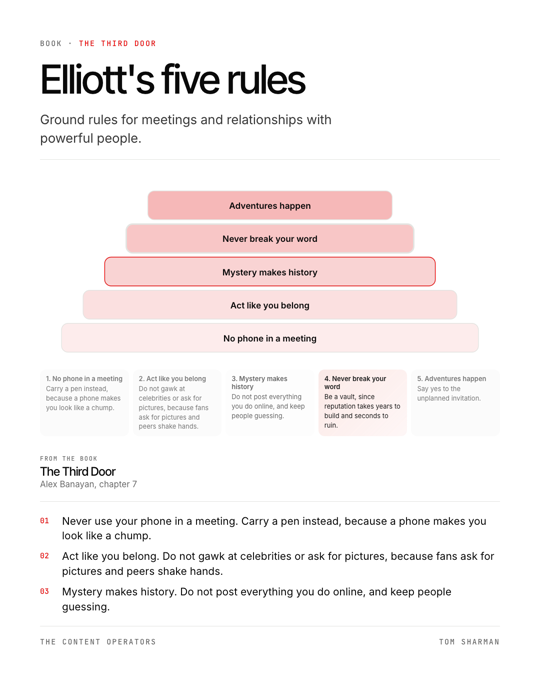
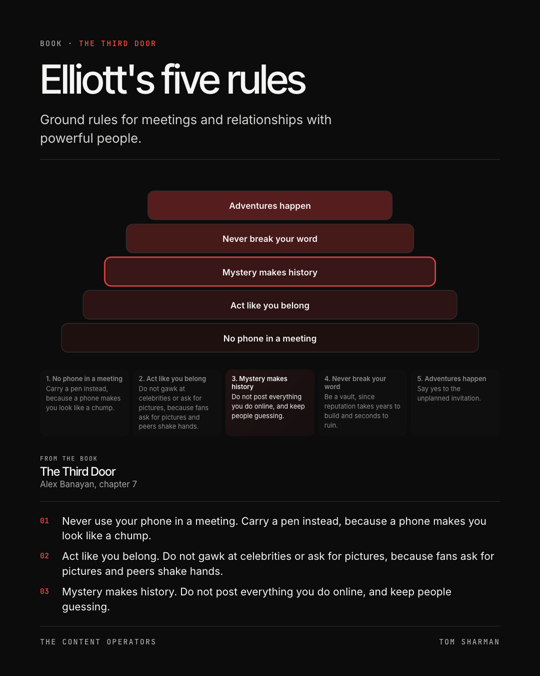
Ground rules for meetings and relationships with powerful people.
- Never use your phone in a meeting. Carry a pen instead, because a phone makes you look like a chump.
- Act like you belong. Do not gawk at celebrities or ask for pictures, because fans ask for pictures and peers shake hands.
- Mystery makes history. Do not post everything you do online, and keep people guessing.
- Never break your word. Be a vault, since reputation takes years to build and seconds to ruin.
- Adventures only happen to the adventurous. Say yes to the unplanned invitation.
From chapter: Step 3: Find Your Inside Man, pp. 69–133
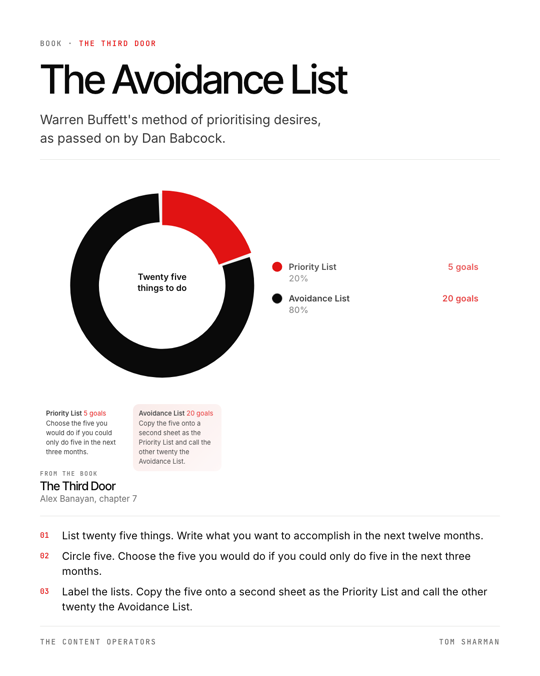
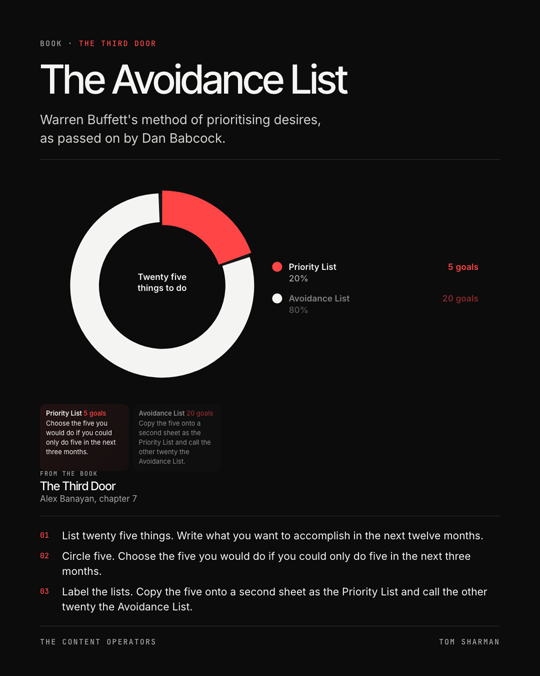
Warren Buffett's method of prioritising desires, as passed on by Dan Babcock.
- List twenty five things. Write what you want to accomplish in the next twelve months.
- Circle five. Choose the five you would do if you could only do five in the next three months.
- Label the lists. Copy the five onto a second sheet as the Priority List and call the other twenty the Avoidance List.
- Avoid the twenty. Stay away from the Avoidance List until the top five are done.
From chapter: Step 3: Find Your Inside Man, pp. 69–133
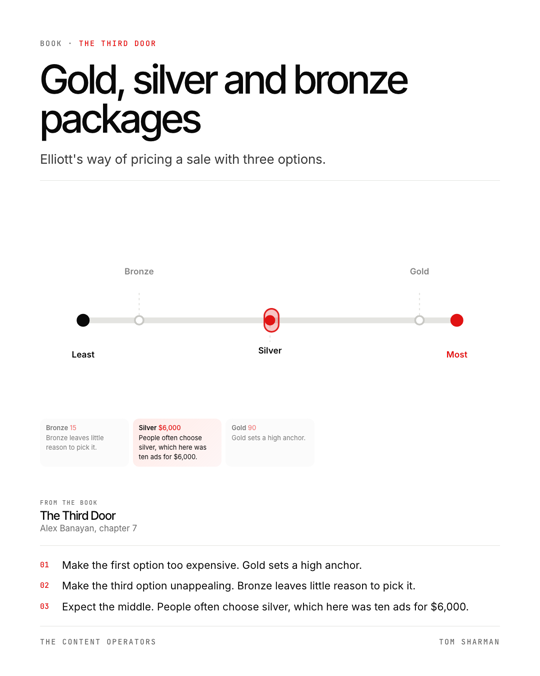
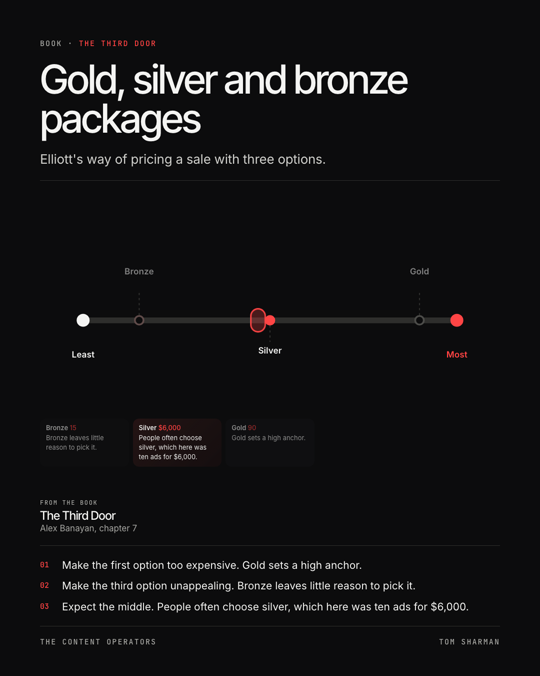
Elliott's way of pricing a sale with three options.
- Make the first option too expensive. Gold sets a high anchor.
- Make the third option unappealing. Bronze leaves little reason to pick it.
- Expect the middle. People often choose silver, which here was ten ads for $6,000.
From chapter: Step 3: Find Your Inside Man, pp. 69–133
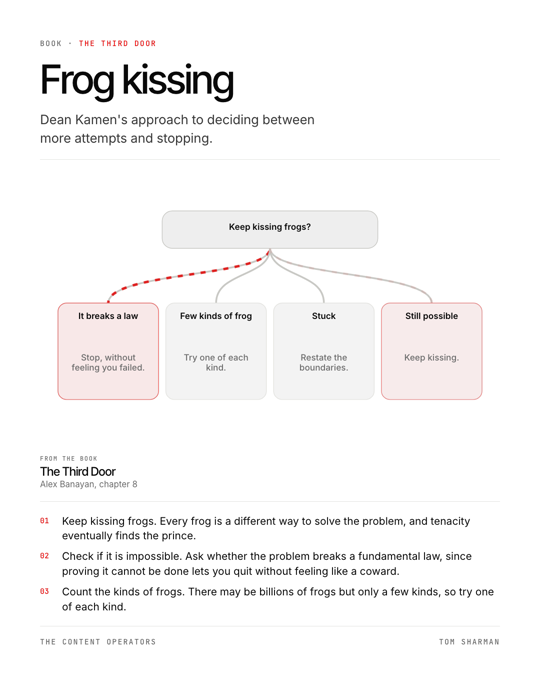
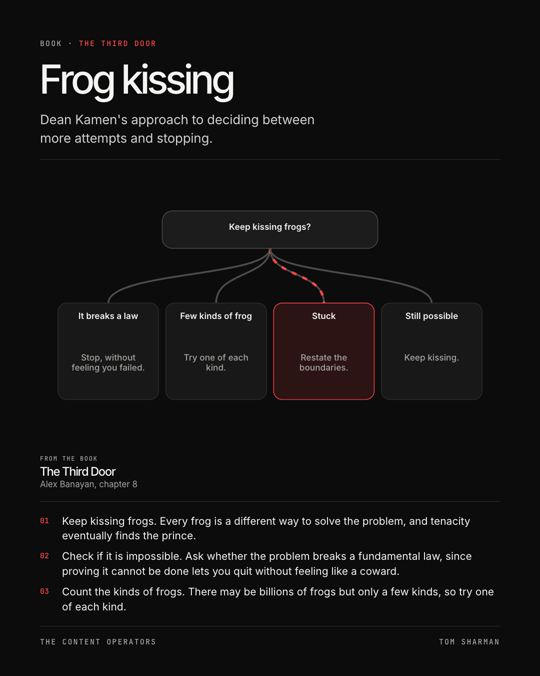
Dean Kamen's approach to deciding between more attempts and stopping.
- Keep kissing frogs. Every frog is a different way to solve the problem, and tenacity eventually finds the prince.
- Check if it is impossible. Ask whether the problem breaks a fundamental law, since proving it cannot be done lets you quit without feeling like a coward.
- Count the kinds of frogs. There may be billions of frogs but only a few kinds, so try one of each kind.
- Restate the boundaries. Reframe the question so a different kind of solution appears.
From chapter: Step 4: Trudge Through the Mud, pp. 134–186
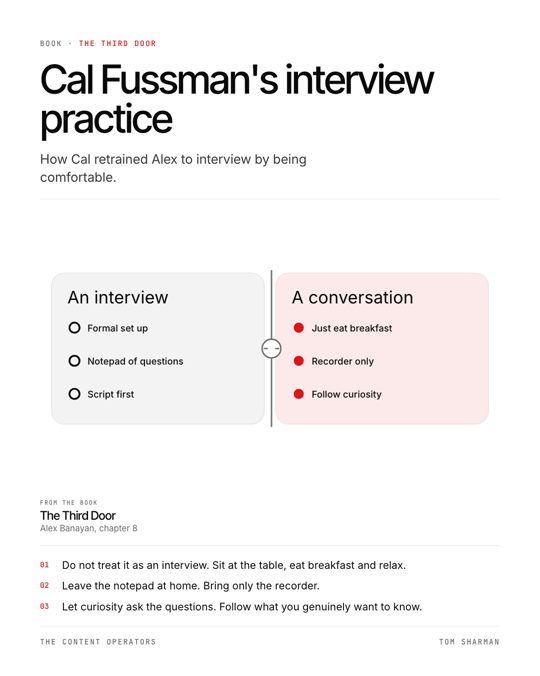
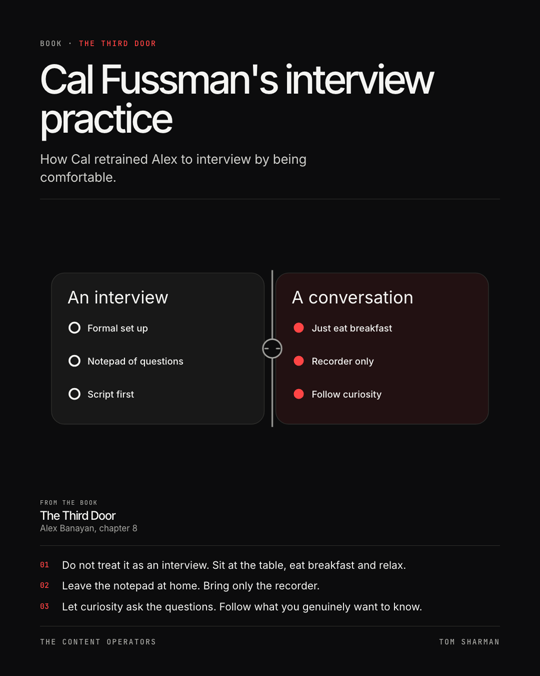
How Cal retrained Alex to interview by being comfortable.
- Do not treat it as an interview. Sit at the table, eat breakfast and relax.
- Leave the notepad at home. Bring only the recorder.
- Let curiosity ask the questions. Follow what you genuinely want to know.
From chapter: Step 4: Trudge Through the Mud, pp. 134–186
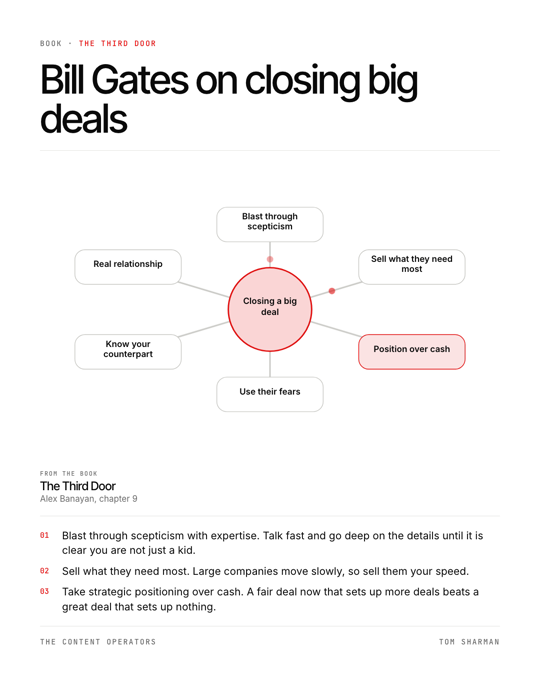
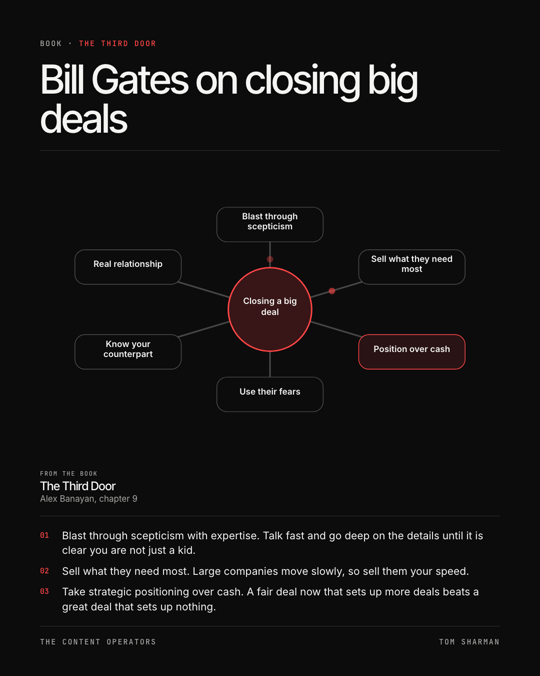
The sales and negotiation lessons Gates gave Alex in his office.
- Blast through scepticism with expertise. Talk fast and go deep on the details until it is clear you are not just a kid.
- Sell what they need most. Large companies move slowly, so sell them your speed.
- Take strategic positioning over cash. A fair deal now that sets up more deals beats a great deal that sets up nothing.
- Find their fears and use them. IBM feared a lawsuit, so Gates insisted on unlimited liability and IBM chose not to take the source code.
- Know your counterpart. Learn their background, personality, business model and cash flow.
- Build a genuine relationship. If the person is your mentor or friend, you may not need to negotiate.
From chapter: Step 5: Take the Third Door, pp. 187–265
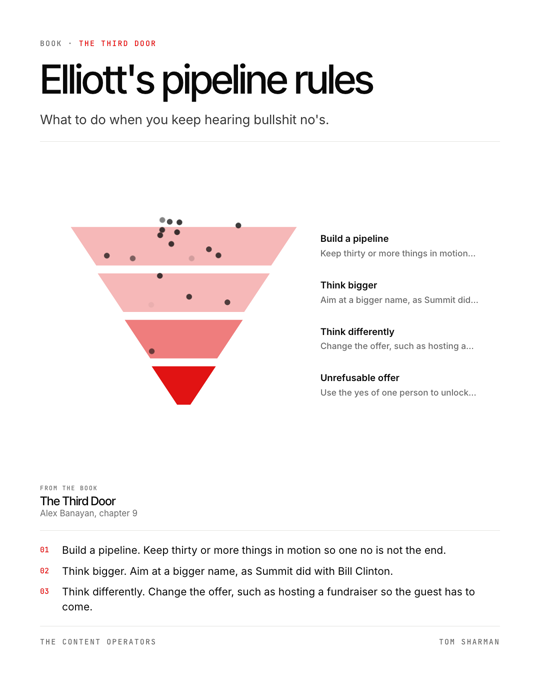
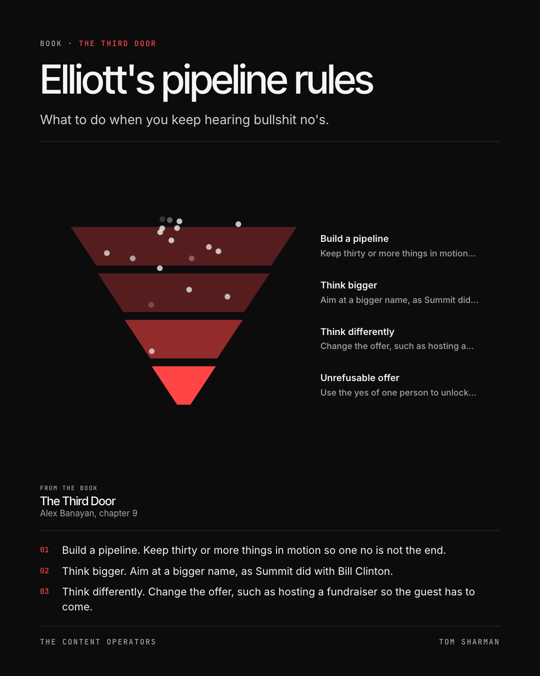
What to do when you keep hearing bullshit no's.
- Build a pipeline. Keep thirty or more things in motion so one no is not the end.
- Think bigger. Aim at a bigger name, as Summit did with Bill Clinton.
- Think differently. Change the offer, such as hosting a fundraiser so the guest has to come.
- Make an offer they can't refuse. Use the yes of one person to unlock the next.
From chapter: Step 5: Take the Third Door, pp. 187–265
Working with Tom on this
Tom works with creators and founders one to one, from a single session to a fractional role. Work with Tom
Back to the bookshelf