Bookshelf
How Tom uses this
Thinking in Systems backs five of Tom's lessons. Under each of his lessons, what the book says about it, and on which pages.
- Signals show before numbers, and numbers come at month four
Stocks change slowly and delays hide results, so early signals matter and patience before month four fits the book's warning against giving up too soon. pp. 37, 38, 125 and 126. In the book: Is it a system or a bunch of stuff, Questions for testing the value of a model, The eight system traps, Three ways to avoid the tragedy of the commons, Helping a system help itself.
- Macro and micro at the same time
Meadows says a hierarchy needs enough central control for coordination and enough autonomy for the parts, and that you must watch the short and long term together. pp. 105, 206 and 207. In the book: The eight system traps, Three ways to avoid the tragedy of the commons, Helping a system help itself, Places to intervene in a system, Guidelines for living in a world of systems.
- Move the people you have before you hire
The book shows a workforce grows by cutting outflow as well as adding inflow, and urges backing the capacities a system already has before bringing in outsiders. pp. 36, 37 and 202. In the book: Is it a system or a bunch of stuff, Questions for testing the value of a model, Places to intervene in a system, Guidelines for living in a world of systems.
- Week one is an audit, and two formats are never up for testing
The first guideline is to get the beat of the system by studying its behaviour and history before disturbing it, which is what a week-one audit does. pp. 194 and 195. In the book: Places to intervene in a system, Guidelines for living in a world of systems.
- Assumptions made too fast, and risk avoided
Meadows urges small experimental steps, exposed mental models and error-embracing, and leaning on both intuition and analysis, which matches data plus gut and backing yourself. pp. 195, 196 and 204. In the book: Places to intervene in a system, Guidelines for living in a world of systems.
What it argues
Meadows argues that a system produces its own behaviour through its stocks, flows, feedback loops and delays, so outside events and individual players are rarely the real cause of a problem. Because our mental models are partial and we attend to events instead of structure, systems keep surprising us: delays cause oscillation, growth meets limits, and bounded rationality turns reasonable local choices into results nobody wants. Recurring structures, the eight traps, explain why fixes fail, and each has a way out through changed goals, rules or information. Her ranked list puts parameters at the bottom of the leverage scale and information flows, rules, goals and paradigms near the top. She closes by saying that systems cannot be controlled or predicted but can be designed and danced with, which takes humility, visible models and constant learning.
Worth keeping
- Look to structure for the cause: a system largely causes its own behaviour, and replacing the person in a role rarely changes the result (p. 16, p. 130).
- A purpose is read from what a system does, not from what it says (p. 28).
- You can fill a stock by cutting the outflow as well as raising the inflow (p. 36).
- A delay in a balancing loop makes oscillation likely, and reacting faster can make it worse (p. 72, p. 75).
- Systems deliver exactly what you measure, so do not confuse effort with result (p. 162, p. 217).
- Escape traps by changing goals, feedback or rules; pushing the same lever harder fails (p. 134 to 165).
- Numbers and parameters are the weakest leverage points; information flows, rules and goals are far stronger (p. 170, p. 179, p. 181).
- Missing, late or biased information causes most system malfunction (p. 196).
- Manage for resilience, not only for productivity or stability (p. 98).
- Watch the system's behaviour and history before you disturb it, and put your mental model on paper where others can challenge it (p. 194, p. 196).
The questions it answers
- What makes a format repeatable, as opposed to a hit that happened once?
Events are one-offs, while repeatable behaviour comes from underlying structure, so a repeatable format is a structure with feedback and not a lucky output (p. 108 to 110).
- What does AI actually change about the shape of a content team?
New information flows are a high leverage point, so AI matters where it adds or restores feedback to the people making decisions (p. 179).
- What is the smallest team that can produce at the volume I am used to?
The watchmaker fable shows stable subassemblies of about ten elements survive interruption, which suggests small autonomous units under light coordination (p. 102 to 103).
The frameworks
7 frameworks, one animation each Every framework, step by step
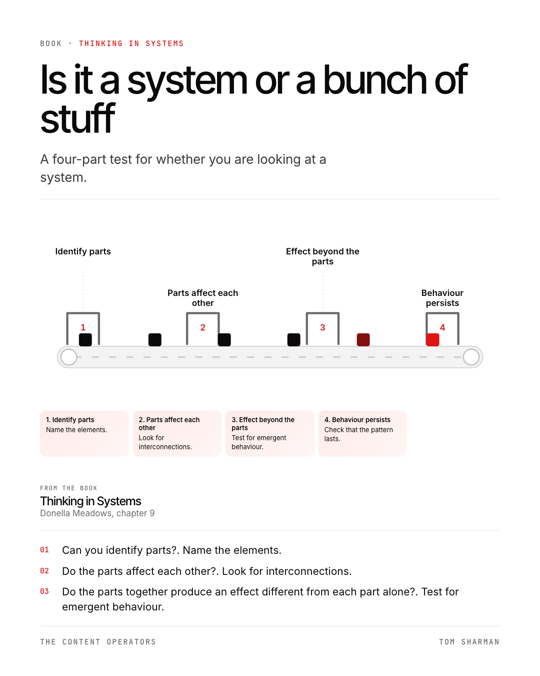
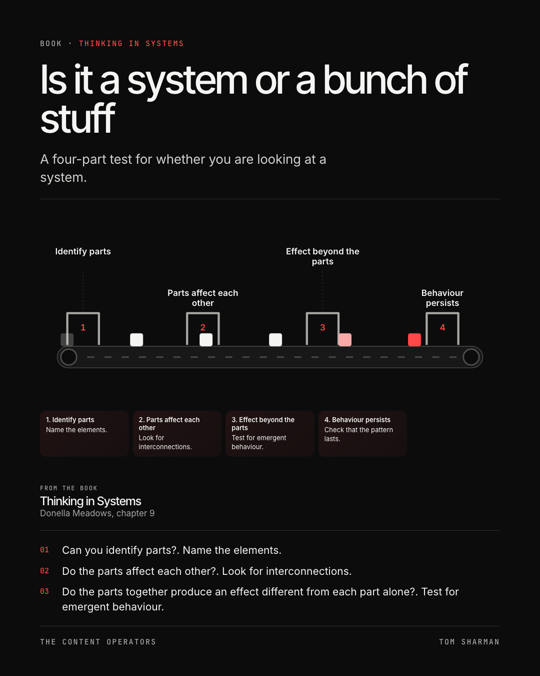
A four-part test for whether you are looking at a system.
- Can you identify parts?. Name the elements.
- Do the parts affect each other?. Look for interconnections.
- Do the parts together produce an effect different from each part alone?. Test for emergent behaviour.
- Does the behaviour persist in a variety of circumstances?. Check that the pattern lasts.
From chapter: Part One: System Structure and Behavior, pp. 23–92
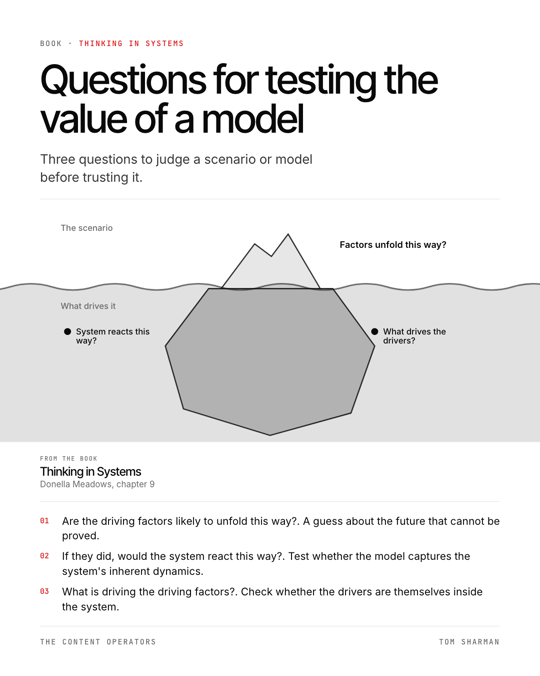
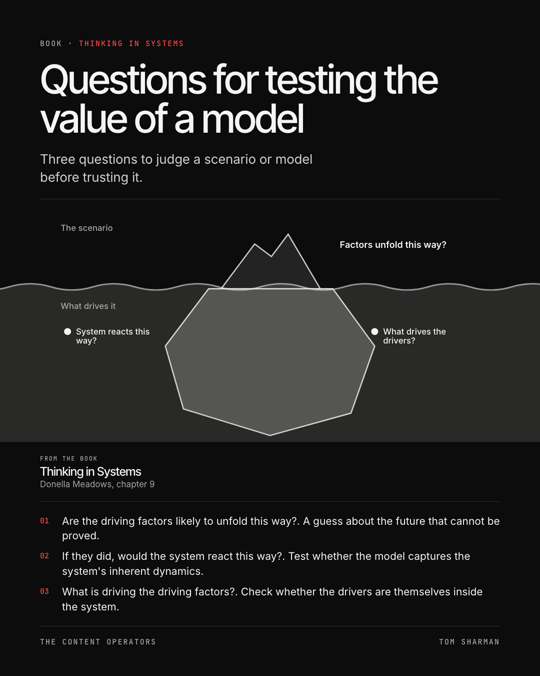
Three questions to judge a scenario or model before trusting it.
- Are the driving factors likely to unfold this way?. A guess about the future that cannot be proved.
- If they did, would the system react this way?. Test whether the model captures the system's inherent dynamics.
- What is driving the driving factors?. Check whether the drivers are themselves inside the system.
From chapter: Part One: System Structure and Behavior, pp. 23–92
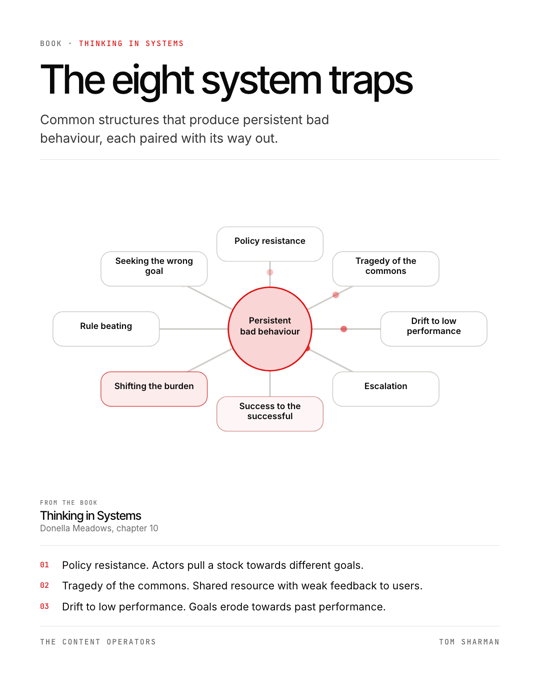
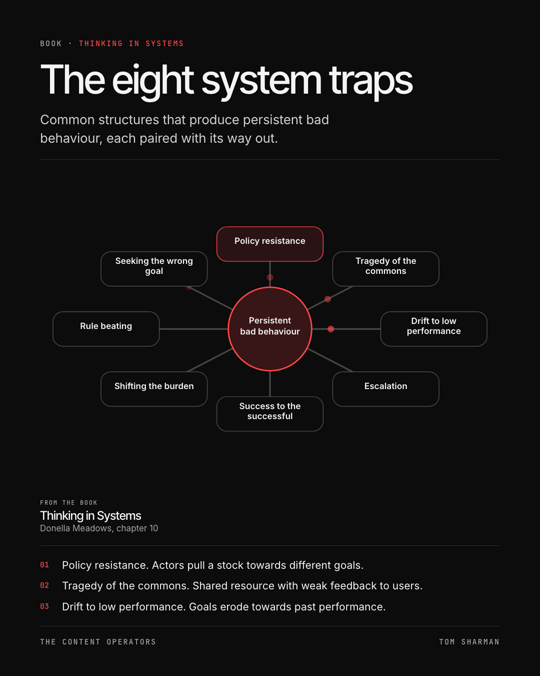
Common structures that produce persistent bad behaviour, each paired with its way out.
- Policy resistance. Actors pull a stock towards different goals. Way out: let go, bring in all actors, and find an overarching goal.
- Tragedy of the commons. Shared resource with weak feedback to users. Way out: educate and exhort, then privatise or regulate to restore the feedback.
- Drift to low performance. Goals erode towards past performance. Way out: keep standards absolute or anchor them to the best results.
- Escalation. Each side tries to out-do the other. Way out: refuse to compete or negotiate balancing loops.
- Success to the successful. Winners get the means to win again. Way out: diversify, limit winners' share, level the field.
- Shifting the burden to the intervenor. A symptom fix weakens the system's own capacity. Way out: avoid it, strengthen the system, then remove yourself.
- Rule beating. Letter of the rule is met and the spirit is dodged. Way out: redesign rules so creativity serves their purpose.
- Seeking the wrong goal. The system delivers exactly the indicator you set. Way out: specify goals that reflect real welfare, and do not confuse effort with result.
From chapter: Part Two: Systems and Us, pp. 93–165
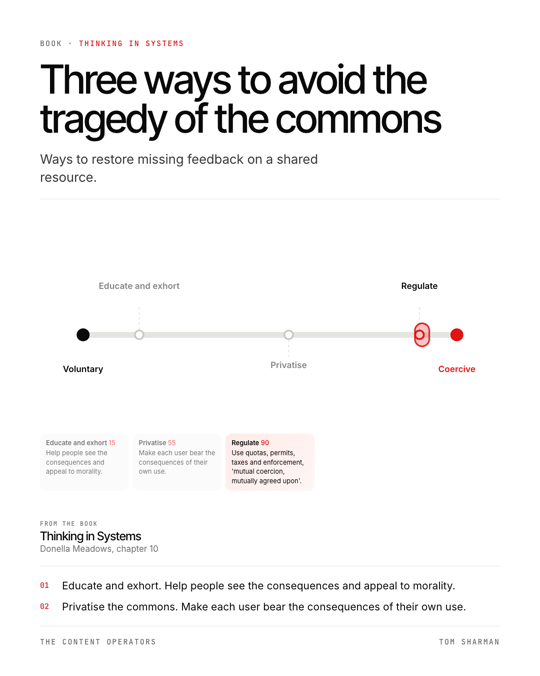
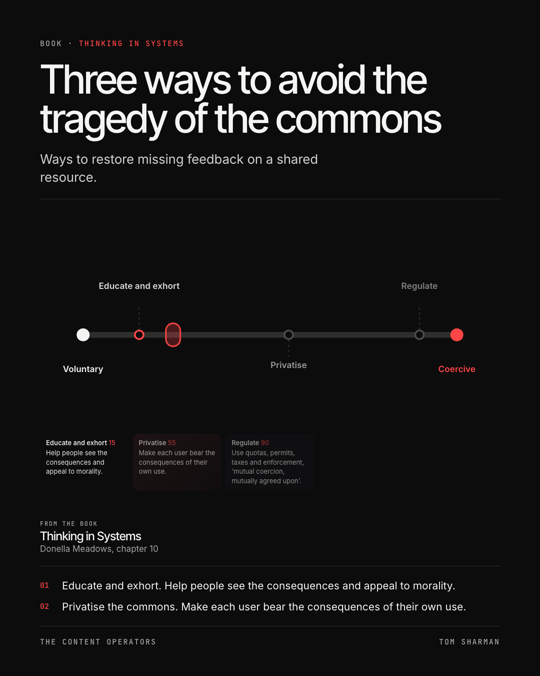
Ways to restore missing feedback on a shared resource.
- Educate and exhort. Help people see the consequences and appeal to morality.
- Privatise the commons. Make each user bear the consequences of their own use.
- Regulate the commons. Use quotas, permits, taxes and enforcement, 'mutual coercion, mutually agreed upon'.
From chapter: Part Two: Systems and Us, pp. 93–165
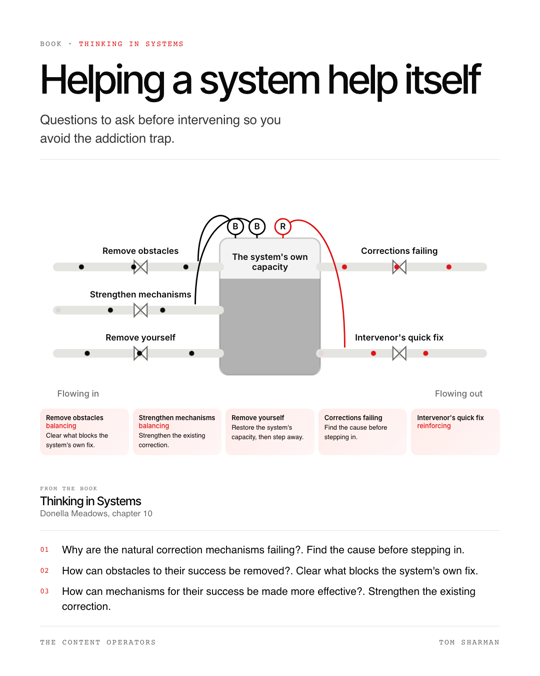
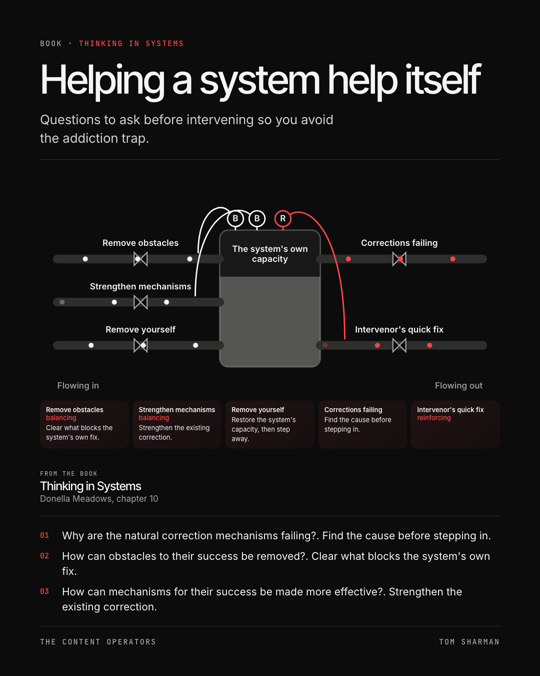
Questions to ask before intervening so you avoid the addiction trap.
- Why are the natural correction mechanisms failing?. Find the cause before stepping in.
- How can obstacles to their success be removed?. Clear what blocks the system's own fix.
- How can mechanisms for their success be made more effective?. Strengthen the existing correction.
- Remove yourself. Restore the system's capacity, then step away.
From chapter: Part Two: Systems and Us, pp. 93–165
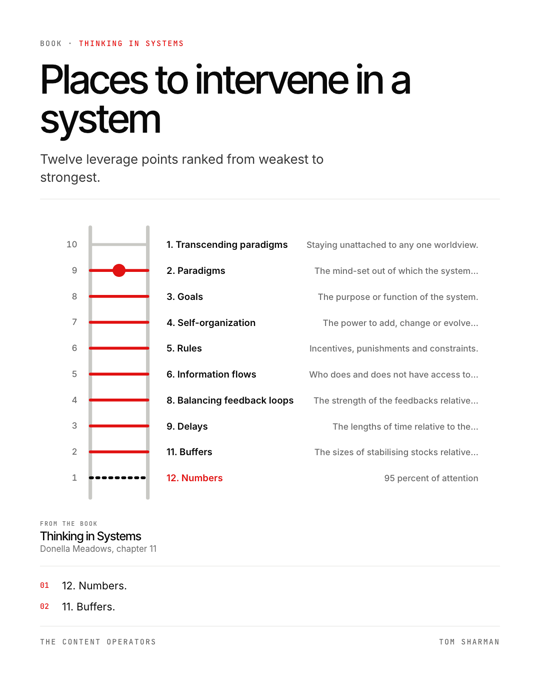
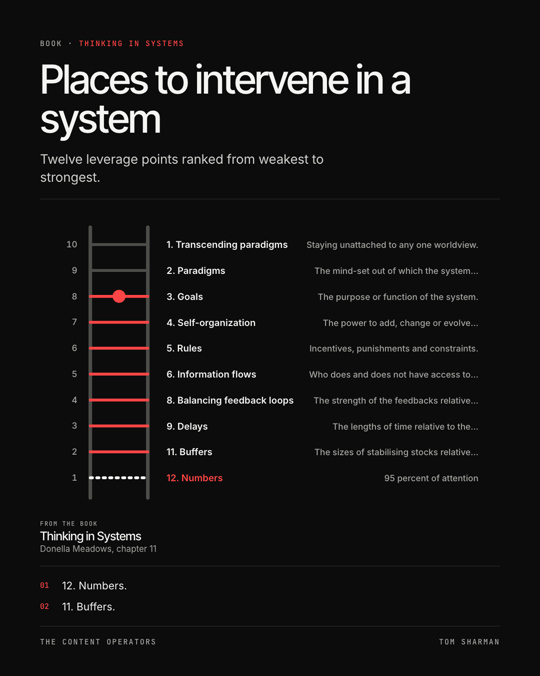
Twelve leverage points ranked from weakest to strongest.
- 12. Numbers. Constants and parameters such as subsidies, taxes and standards.
- 11. Buffers. The sizes of stabilising stocks relative to their flows.
- 10. Stock-and-flow structures. Physical systems and their nodes of intersection.
- 9. Delays. The lengths of time relative to the rates of system change.
- 8. Balancing feedback loops. The strength of the feedbacks relative to the impacts they correct.
- 7. Reinforcing feedback loops. The strength of the gain of driving loops.
- 6. Information flows. Who does and does not have access to information.
- 5. Rules. Incentives, punishments and constraints.
- 4. Self-organization. The power to add, change or evolve system structure.
- 3. Goals. The purpose or function of the system.
- 2. Paradigms. The mind-set out of which the system arises.
- 1. Transcending paradigms. Staying unattached to any one worldview.
From chapter: Part Three: Creating Change - in Systems and in Our Philosophy, pp. 166–209
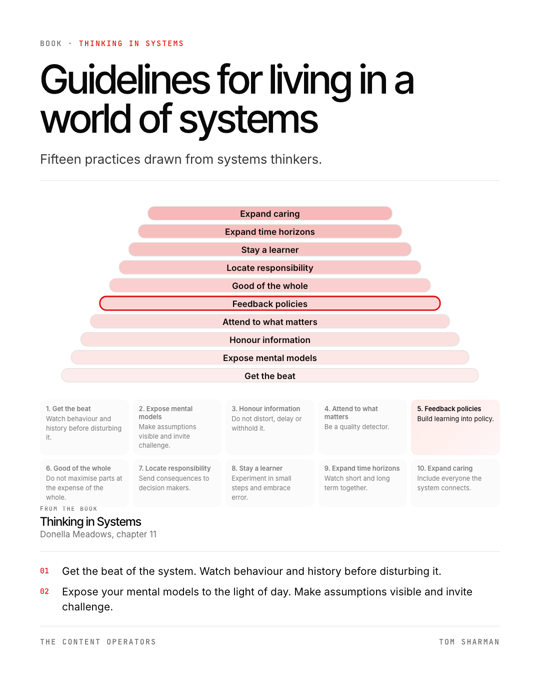
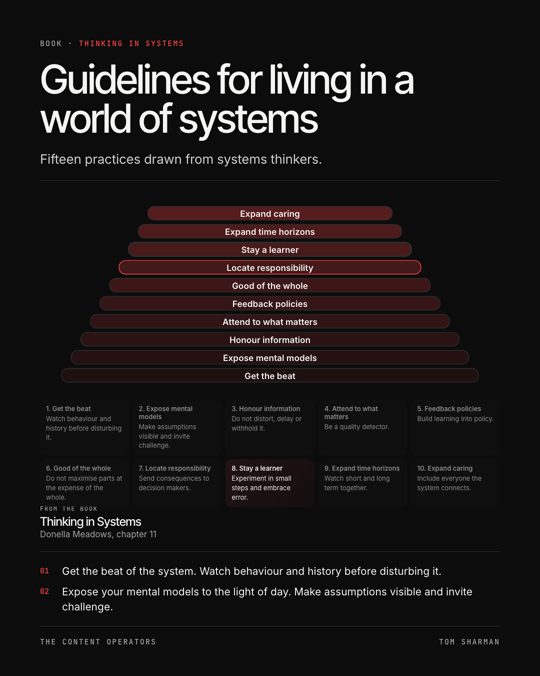
Fifteen practices drawn from systems thinkers.
- Get the beat of the system. Watch behaviour and history before disturbing it.
- Expose your mental models to the light of day. Make assumptions visible and invite challenge.
- Honor, respect, and distribute information. Do not distort, delay or withhold it.
- Use language with care and enrich it with systems concepts. Keep language concrete and expand its vocabulary.
- Pay attention to what is important, not just what is quantifiable. Be a quality detector.
- Make feedback policies for feedback systems. Build learning into policy.
- Go for the good of the whole. Do not maximise parts at the expense of the whole.
- Listen to the wisdom of the system. Support the system's own self-maintenance.
- Locate responsibility within the system. Send consequences to decision makers.
- Stay humble, stay a learner. Experiment in small steps and embrace error.
- Celebrate complexity. Value disorder, variety and diversity.
- Expand time horizons. Watch short and long term together.
- Defy the disciplines. Follow the system across fields.
- Expand the boundary of caring. Include everyone the system connects.
- Don't erode the goal of goodness. Keep standards absolute and weigh good news fairly.
From chapter: Part Three: Creating Change - in Systems and in Our Philosophy, pp. 166–209
Working with Tom on this
Tom works with creators and founders one to one, from a single session to a fractional role. Work with Tom
Back to the bookshelf