Bookshelf
How Tom uses this
The Ride of a Lifetime backs four of Tom's lessons. Under each of his lessons, what the book says about it, and on which pages.
- Move the people you have before you hire
Tom Murphy and Dan Burke bet on ability over experience and moved Iger through roles he had never done, the same logic as moving Tom's existing team into new roles. pp. 47, 49 and 50. In the book: Three strategic priorities, The campaign playbook, Clarifying questions for a deal you hope will work.
- Assumptions made too fast, and risk avoided
Iger backs Twin Peaks and Cop Rock on instinct against test audiences and says you must give permission to fail, which matches backing yourself on gut plus data. pp. 54, 59 and 147. In the book: Three strategic priorities, The campaign playbook, Clarifying questions for a deal you hope will work, Buying a creative company without breaking it, Disrupting your own working business, Iger's rules for firing someone.
- Macro and micro at the same time
Iger watched Eisner hold the big picture and the granular detail together and says sweating details shows how much you care, up to the point where it signals distrust. pp. 93, 94 and 226. In the book: Three strategic priorities, The campaign playbook, Clarifying questions for a deal you hope will work.
- Content is how a company wins talent
Iger says to tell great stories you need great talent and that in a creative business the value of a company lies in its people. pp. 32, 148 and 228. In the book: Three strategic priorities, The campaign playbook, Clarifying questions for a deal you hope will work, Buying a creative company without breaking it, Disrupting your own working business, Iger's rules for firing someone.
What it argues
Iger argues that leadership comes from a short set of principles you can state and repeat, because something unexpected will always come up. The principles he names are optimism, courage, focus, decisiveness, curiosity, fairness, thoughtfulness, authenticity, the relentless pursuit of perfection and integrity. He builds the case from forty-five years at one company, with mentors who modelled the good (Tom Murphy and Dan Burke on decency and decentralisation) and the harm (Roone Arledge's capriciousness, Michael Eisner's pessimism and micromanagement). He says growth came from betting on creative talent, taking big risks that analysis alone could not justify, and buying Pixar, Marvel, Lucasfilm and 21st Century Fox by earning the trust of the single person who controlled each. Disrupting your own working business, in his account, takes courage, new incentives and visible presence with your people. He closes by crediting luck and warning that the moment you see a title on your forehead you have lost your way.
Worth keeping
- Relentless pursuit of perfection: refuse 'good enough' and do what you need to do to make it better (pp. 33-34).
- Name three strategic priorities and repeat them, because past three they stop being priorities (pp. 110-111).
- Win a contest for the top job by talking only about the future, never defending or attacking the past (p. 110).
- Never fake knowledge you do not have; ask, admit and learn fast (p. 51).
- Give permission to fail and stand beside the failure instead of distancing yourself from it (p. 59).
- Give creative notes without starting negatively or small (p. 57).
- Optimism is a leadership duty, since pessimism runs from paranoia to defensiveness to risk aversion (p. 98).
- When you buy a creative company you are buying its people, so protect the culture in writing (pp. 148, 150).
- Be clear where you stand from the start of a negotiation (p. 180).
- Push decisions to the people who run the businesses and cut the central analysis layer (pp. 132-133).
Which project it moves forward
The Content Operators launch
The launch needs a few stated priorities, a brand that is authentic about what it is, and a willingness to take a visible risk, all of which the book argues for with examples.
The questions it answers
- What is the smallest team that can produce at the volume I am used to?
He cut Strategic Planning from sixty-five people to fifteen and pushed decisions to the business heads, then ran the big acquisitions with a handful of advisers (pp. 132, 209).
- What makes a format repeatable, as opposed to a hit that happened once?
Marvel's quarterly slate meetings plan interlocking releases years ahead, while leaning on Millionaire five nights a week burned a one-off hit (pp. 86, 166, 171).
- What does AI actually change about the shape of a content team?
The book has no AI, but Iger's answer to technology disruption was to redraw the company on a whiteboard as separate content and technology groups (pp. 112, 209).
The frameworks
7 frameworks, one animation each Every framework, step by step
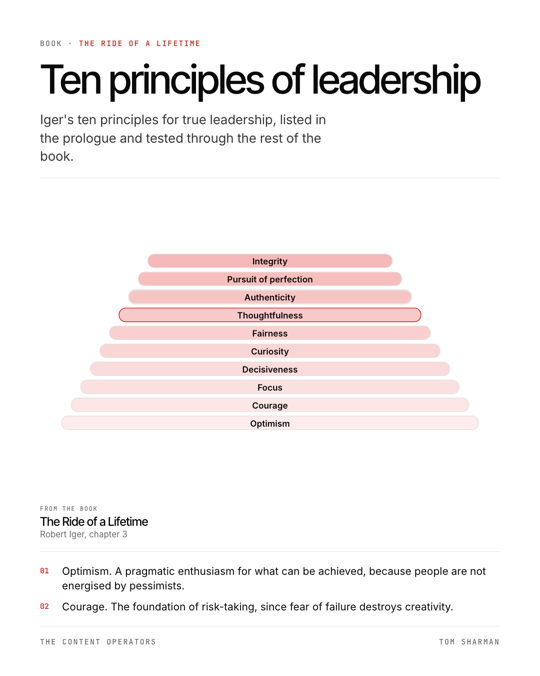
Iger's ten principles for true leadership, listed in the prologue and tested through the rest of the book.
- Optimism. A pragmatic enthusiasm for what can be achieved, because people are not energised by pessimists.
- Courage. The foundation of risk-taking, since fear of failure destroys creativity.
- Focus. Put time, energy and resources into the few things of highest value and communicate them clearly and often.
- Decisiveness. Make every decision in a timely way, balancing diverse opinion against the need to decide.
- Curiosity. A deep and abiding curiosity finds new people, places and ideas and starts innovation.
- Fairness. Treat people decently, give second chances for honest mistakes and avoid a culture of fear.
- Thoughtfulness. Take the time to gain knowledge so opinions and decisions are informed.
- Authenticity. Be genuine and honest, and do not fake anything.
- The Relentless Pursuit of Perfection. Refuse mediocrity and 'good enough' without sliding into perfectionism at all costs.
- Integrity. Set high ethical standards for people and product, because the way you do anything is the way you do everything.
From chapter: Prologue, pp. 6–19
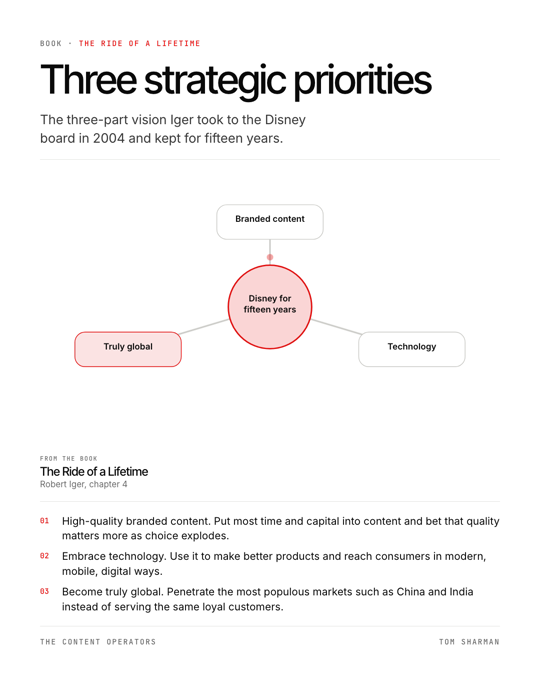
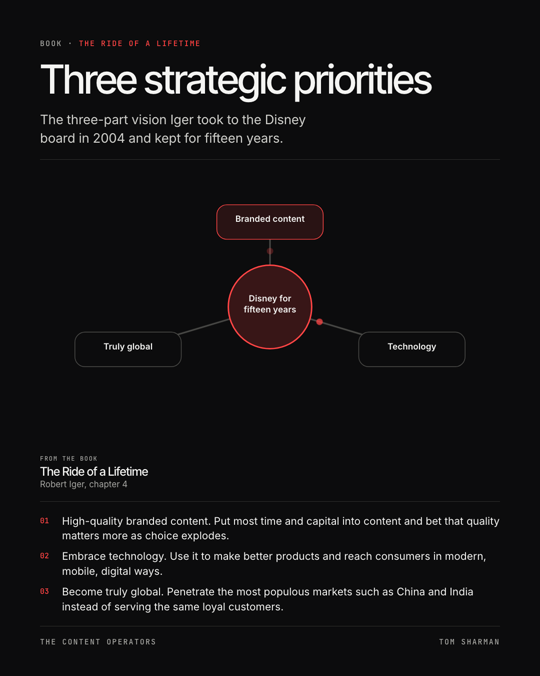
The three-part vision Iger took to the Disney board in 2004 and kept for fifteen years.
- High-quality branded content. Put most time and capital into content and bet that quality matters more as choice explodes.
- Embrace technology. Use it to make better products and reach consumers in modern, mobile, digital ways.
- Become truly global. Penetrate the most populous markets such as China and India instead of serving the same loyal customers.
From chapter: Part One: Learning, pp. 20–121
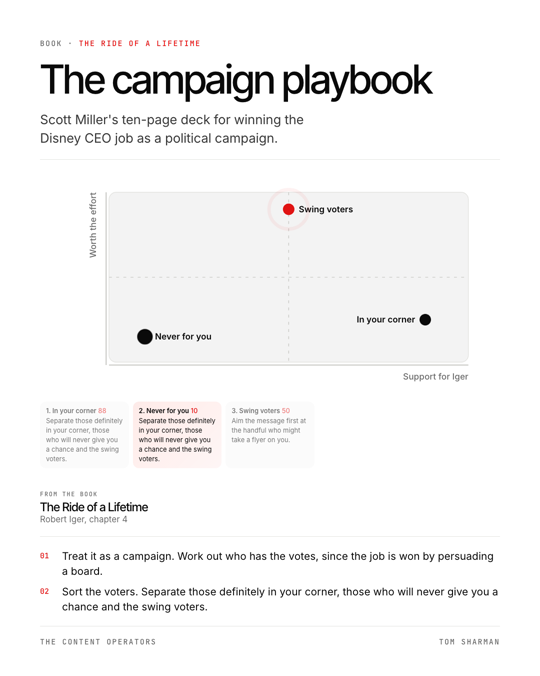
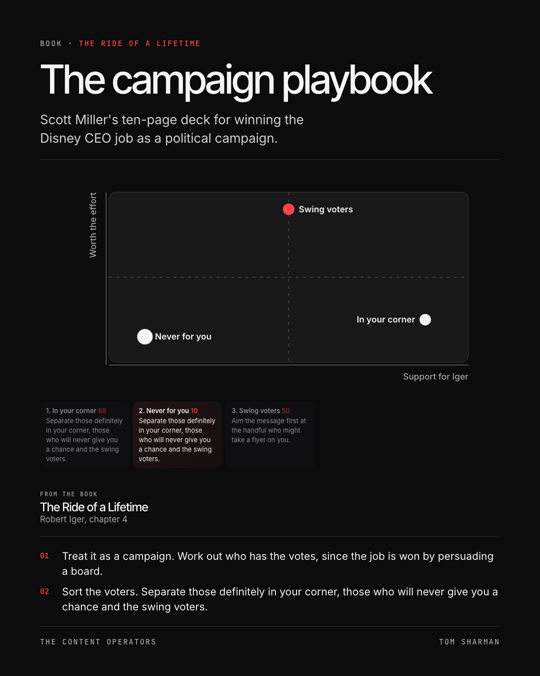
Scott Miller's ten-page deck for winning the Disney CEO job as a political campaign.
- Treat it as a campaign. Work out who has the votes, since the job is won by persuading a board.
- Sort the voters. Separate those definitely in your corner, those who will never give you a chance and the swing voters.
- Focus on the swing voters. Aim the message first at the handful who might take a flyer on you.
- Talk only about the future. An incumbent cannot win on the defensive, so never rehash or defend the past.
- Act like an insurgent. Frame it as a battle for the soul of the brand and talk about how to grow and protect its value.
- Pick only three priorities. More than three and they stop being priorities and you seem unfocused.
From chapter: Part One: Learning, pp. 20–121
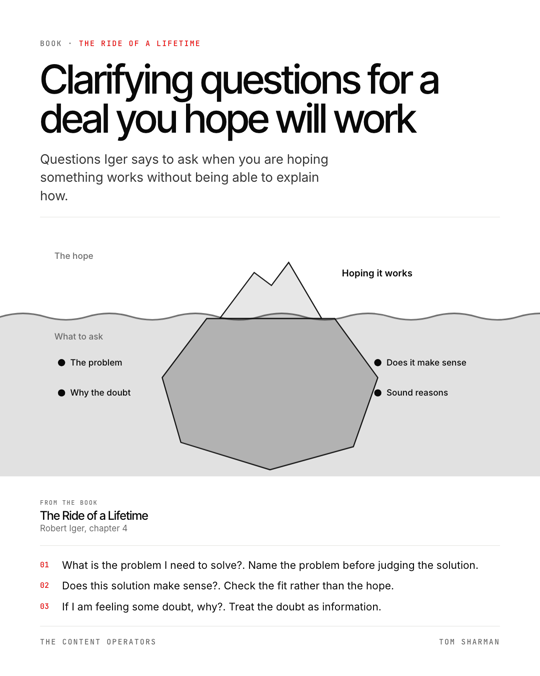
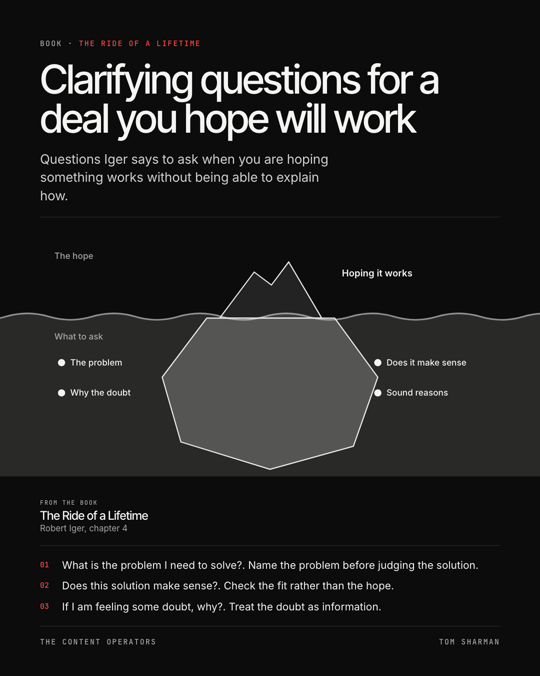
Questions Iger says to ask when you are hoping something works without being able to explain how.
- What is the problem I need to solve?. Name the problem before judging the solution.
- Does this solution make sense?. Check the fit rather than the hope.
- If I am feeling some doubt, why?. Treat the doubt as information.
- Am I doing this for sound reasons?. Test whether something personal is driving the choice.
From chapter: Part One: Learning, pp. 20–121
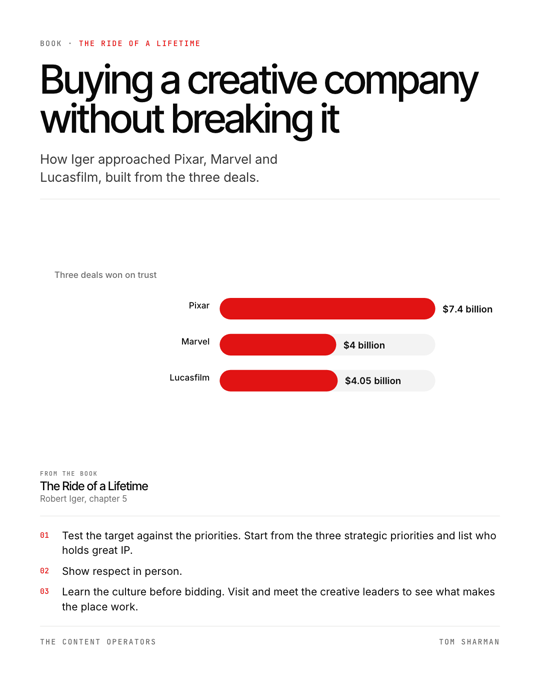
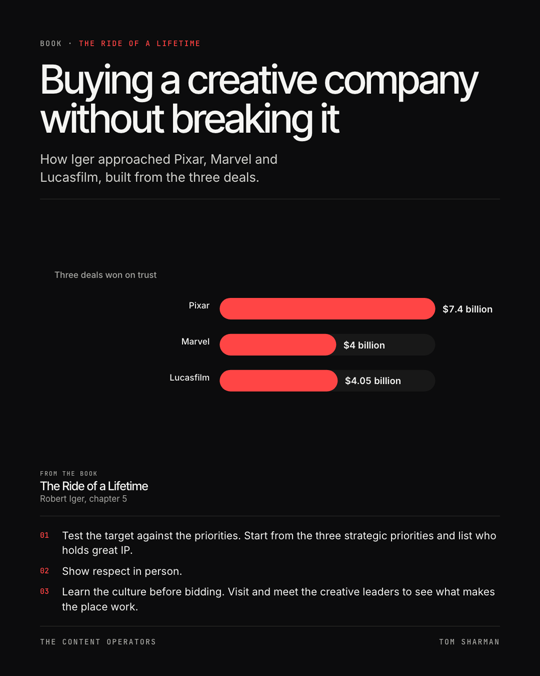
How Iger approached Pixar, Marvel and Lucasfilm, built from the three deals.
- Test the target against the priorities. Start from the three strategic priorities and list who holds great IP.
- Show respect in person. Go to the owner alone, as he did with Ike Perlmutter and John Lasseter, and let them lead where the owner is sensitive, as with George Lucas.
- Learn the culture before bidding. Visit and meet the creative leaders to see what makes the place work.
- Promise to protect the culture, in writing. Pixar's two-page social compact kept email addresses, signs and rituals.
- Be clear about where you stand. Do not suggest or promise what the other side wants to hear only to reverse later.
- Arrive at a fair number and hold it. Do not open low and negotiate to the middle, and be willing to walk away, as at $28 a share for Fox.
- Get someone trusted to vouch. Steve Jobs's call to Ike Perlmutter helped win Marvel.
- Win the trust of the single controlling person. Each deal depended on personal trust and authenticity.
From chapter: Part Two: Leading, pp. 122–222
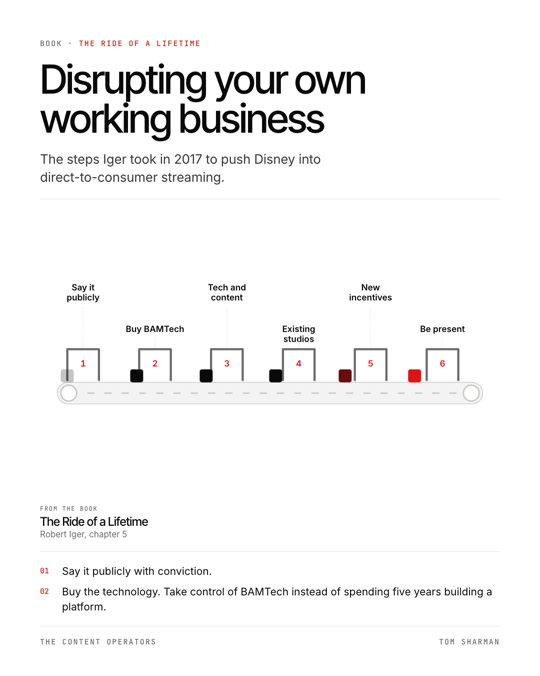
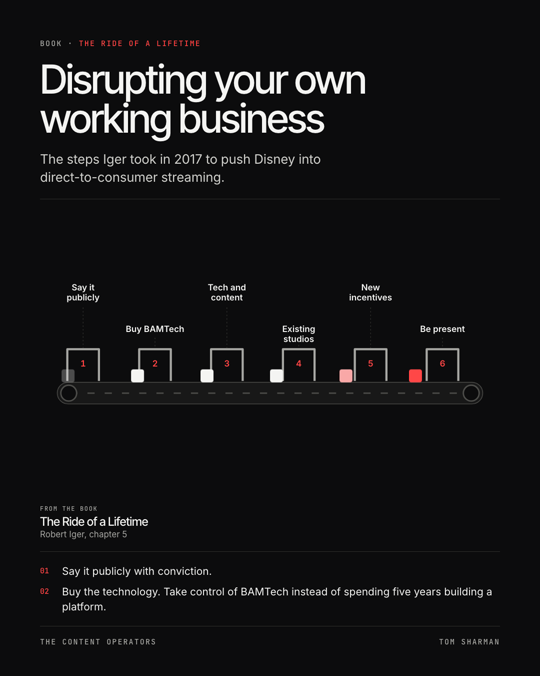
The steps Iger took in 2017 to push Disney into direct-to-consumer streaming.
- Say it publicly with conviction. He called this 'management by press release', where candour outside the company motivates people inside.
- Buy the technology. Take control of BAMTech instead of spending five years building a platform.
- Run technology and content in parallel. Build the apps while a content team develops originals.
- Ask existing studios to do the work. No separate Disney+ studio; executives were told to pay attention to the new thing.
- Redesign incentives. Stock grants vesting on Iger's own assessment of how well executives worked together.
- Be present for your people. Hold town halls and return calls and emails in a timely way.
From chapter: Part Two: Leading, pp. 122–222
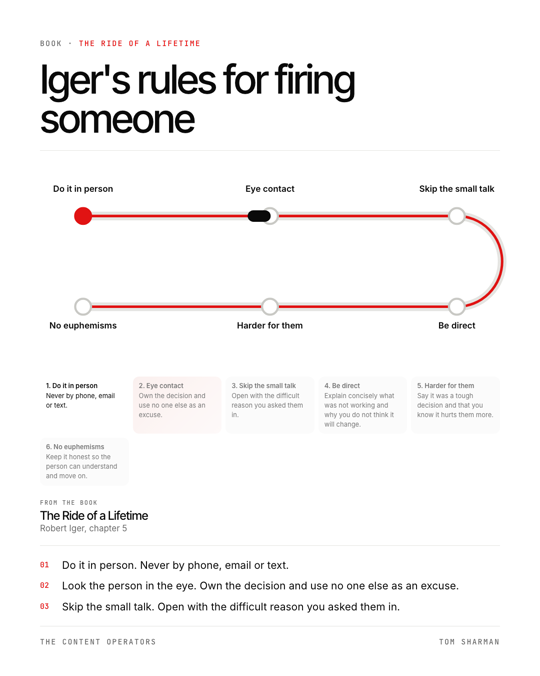
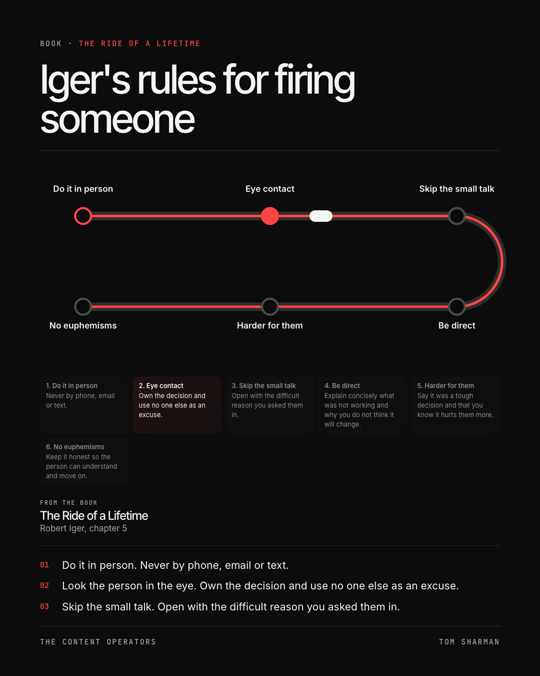
His internal set of rules for taking responsibility away from a person.
- Do it in person. Never by phone, email or text.
- Look the person in the eye. Own the decision and use no one else as an excuse.
- Skip the small talk. Open with the difficult reason you asked them in.
- Be direct about the issue. Explain concisely what was not working and why you do not think it will change.
- Acknowledge it is harder for them. Say it was a tough decision and that you know it hurts them more.
- Avoid euphemistic corporate language. Keep it honest so the person can understand and move on.
From chapter: Part Two: Leading, pp. 122–222
Working with Tom on this
Tom sets the formats, the cadence and the team for short-form content, as a short-form content strategist. Short-form content strategist, UK
Back to the bookshelf