Bookshelf
How Tom uses this
Love, Pain & Money backs four of Tom's lessons. Under each of his lessons, what the book says about it, and on which pages.
- Assumptions made too fast, and risk avoided
Caudwell weighs every factor and then backs his own judgement against advisers, matching the concept's call to combine data with backing yourself instead of avoiding risk. pp. 48, 62 and 225. In the book: Preparing the Caudwell Group for sale.
- Signals show before numbers, and numbers come at month four
He acts on a tiny plume of smoke on the horizon and on small signs such as a limp handshake long before the numbers move. pp. 212 and 225. In the book: Selling a business with desire and fear, Preparing the Caudwell Group for sale.
- A brand that compounds has a mission and an enemy
His childhood Rolls-Royce dream gave the business a mission, and Motorola gave him a named enemy that put him in war mode. pp. 27, 113 and 169. In the book: The phone business turnaround, The Transportable arbitrage.
- Move the people you have before you hire
He puts the right person in the right job, splits roles with Brian when senior staff leave and builds the team around people's strengths. pp. 66, 69 and 109. In the book: The phone business turnaround, The Transportable arbitrage.
What it argues
John Caudwell argues that his fortune grew out of a frightened, bullied childhood in Stoke-on-Trent that taught him to prepare hard, accept every dare and never back down. He built his first fortune by seeing the mobile phone early, hunting for margin with price and commission graphs, and surviving the betrayals of Belstaff and Motorola by never again letting one supplier hold more than 10 percent of his business. He sold the Singlepoint network for £405 million in 2003 and the whole Caudwell Group for £1.46 billion in 2006 by building desire and fear in buyers and trusting small signals over the advice of his bankers. He is equally frank about what it cost: the postnatal and prenatal depression that broke his marriage to Kate, an affair, five years of refusing to see his daughter Scarlett, and a decade of helplessness over his son Rufus's illness. Money, he says, matters as a way to change other people's lives, so he pays the overheads of his charity, Caudwell Children, and has pledged 70 percent of his wealth to charity.
Worth keeping
- Weigh every factor, good and bad, and take the option where the good outweighs the bad, so what looks like risk to others is a calculated decision (p. 48).
- Know your staff inside out and put the right person in the right job, because putting his wife Kate in a corner shop she hated cost him a year and a lot of debt (p. 66, p. 69).
- Be completely honest with customers and explain every negative before the positives, because it makes them trust you and come back (p. 112).
- Reputation behaves like a brand, so a car that has sat unsold for a few weeks goes back to auction even at a loss (p. 80, p. 84).
- Plot supplier prices, volumes and commissions on graphs to find where the hidden margin is, then use arbitrage so both sides win (p. 112, p. 114).
- Never rely on any one company for more than 10 percent of business, a rule born when Motorola, 95 percent of his supply, cut him off (p. 134, p. 137).
- To sell a business, plan A, B and C, build desire and fear in the buyer, use stalking horses, and tell a price chipper in advance that you will walk (p. 213 to p. 218).
- Get on the ground: a manager who sells nothing and answers four hours of email is a symptom, and banning group email lifted profit by £100 million in a year (p. 222, p. 223).
- Pay the overheads yourself so 100 percent of donations reach the cause, and give your children enough to be safe without making them rich (p. 169, p. 258).
- Relentless work has a bill at home: he missed Kate's postnatal depression, and anger kept him from his daughter Scarlett for five years (p. 90, p. 182).
The questions it answers
- How do you build a personal brand that generates inbound rather than requiring outbound?
Reputation did the approaching: the local Conservative Association asked him to host Margaret Thatcher (p. 156) and journalists kept asking who John Caudwell was (p. 166).
- Which of my stories travel, and which only feel like they should?
The details that travelled were the Marks & Spencer suits and cutting his own hair, the rags to riches shape that reporters seized on (p. 166).
- What is the smallest team that can produce at the volume I am used to?
Two brothers and a few staff sold sixty cars a month (p. 79), and a small phone team sold 150 phones a month (p. 106), with bar charts and bonuses driving output per head (p. 110).
The frameworks
7 frameworks, one animation each Every framework, step by step
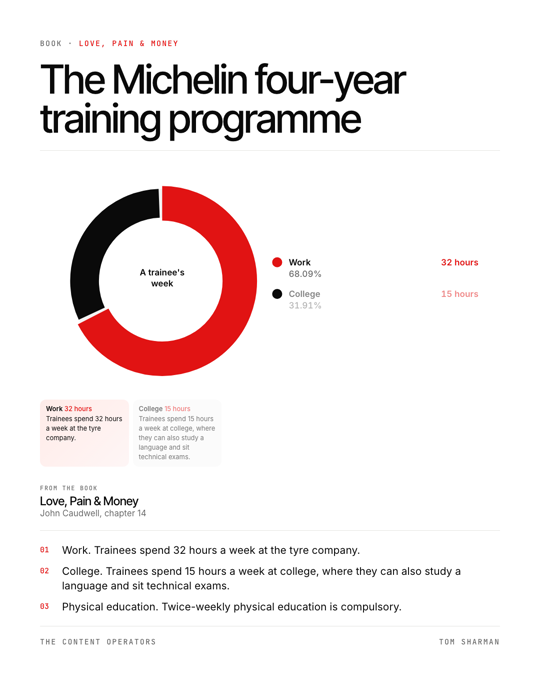
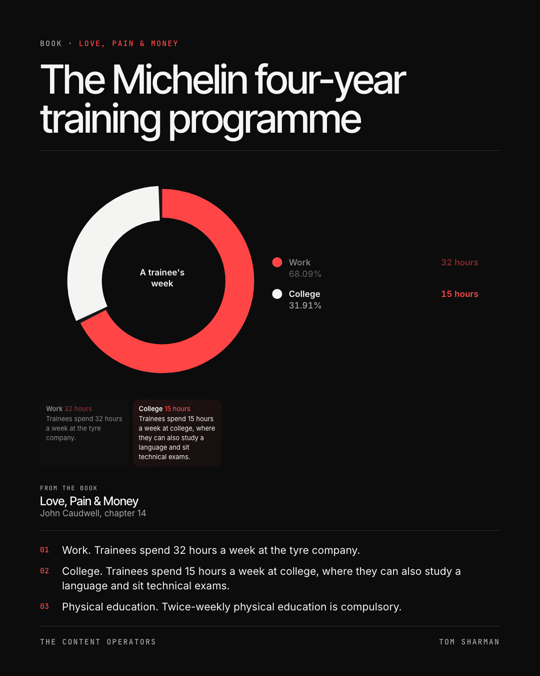
A progressive apprenticeship model that Caudwell credits for his outlook on business and wellbeing.
- Work. Trainees spend 32 hours a week at the tyre company.
- College. Trainees spend 15 hours a week at college, where they can also study a language and sit technical exams.
- Physical education. Twice-weekly physical education is compulsory.
- Placement. Trainees are sent to help out in local psychiatric hospitals, such as Stallington Hall in Stoke.
From chapter: Chapter 10_BUMP, pp. 89–95
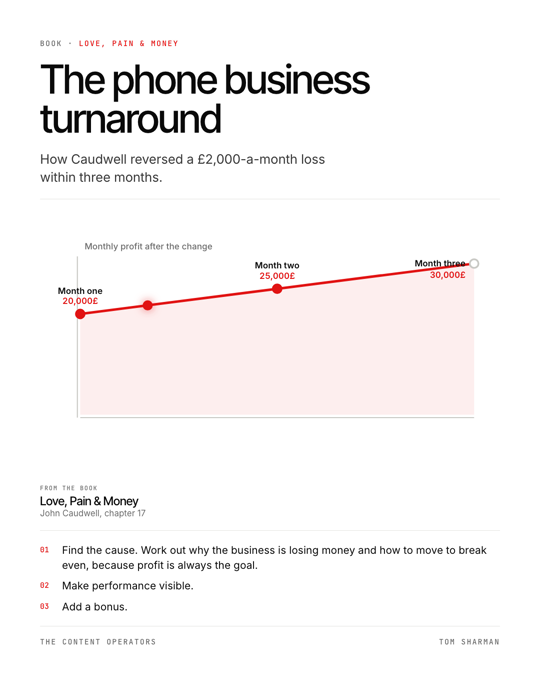
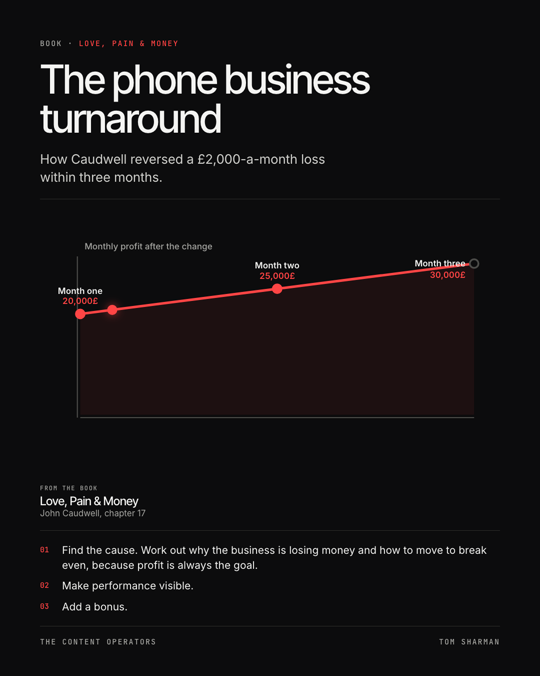
How Caudwell reversed a £2,000-a-month loss within three months.
- Find the cause. Work out why the business is losing money and how to move to break even, because profit is always the goal.
- Make performance visible. Put a bar chart of each person's monthly phone sales on the wall, including his own name.
- Add a bonus. Pay a cash reward to the top seller, awarded to the next best when he himself topped the board.
- Lead by example. Stay late, sell, coach tough and recruit only winners.
- Set the price point. Push airtime commission up and cost price down to reach £999, £200 under any competitor.
- Graph the margins. Plot supplier prices, volumes and commissions to find where more margin exists.
From chapter: Chapter 13_GIANT, pp. 106–116
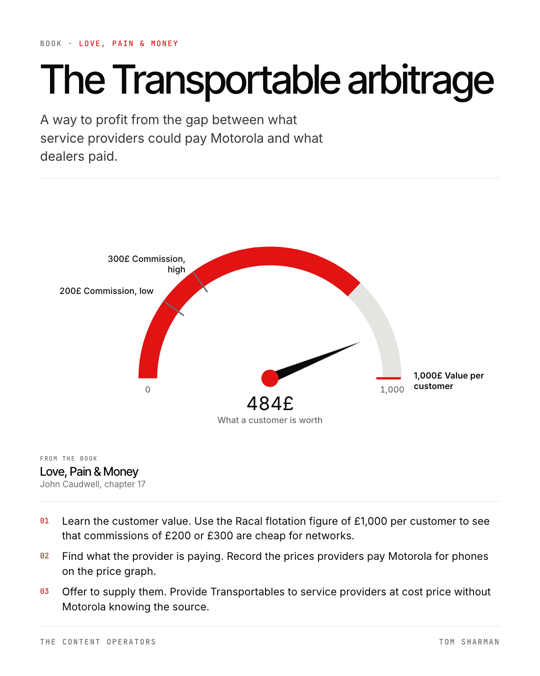
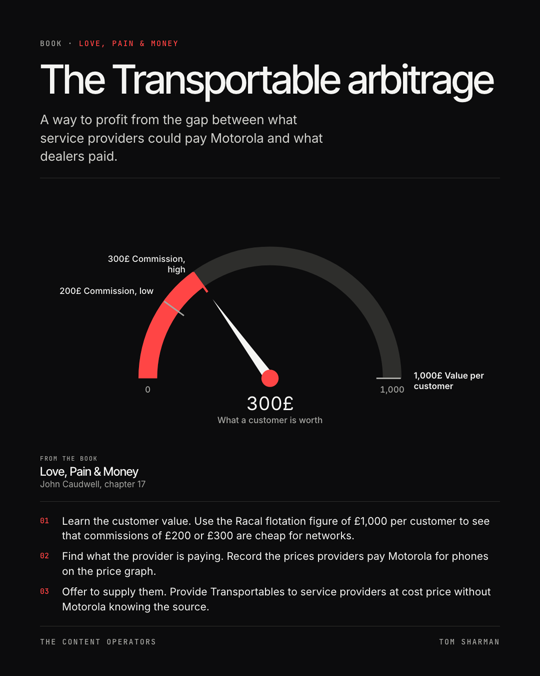
A way to profit from the gap between what service providers could pay Motorola and what dealers paid.
- Learn the customer value. Use the Racal flotation figure of £1,000 per customer to see that commissions of £200 or £300 are cheap for networks.
- Find what the provider is paying. Record the prices providers pay Motorola for phones on the price graph.
- Offer to supply them. Provide Transportables to service providers at cost price without Motorola knowing the source.
- Take the rebate. Charge only the retrospective commission, a four percent volume rebate on a bulk order.
From chapter: Chapter 13_GIANT, pp. 106–116
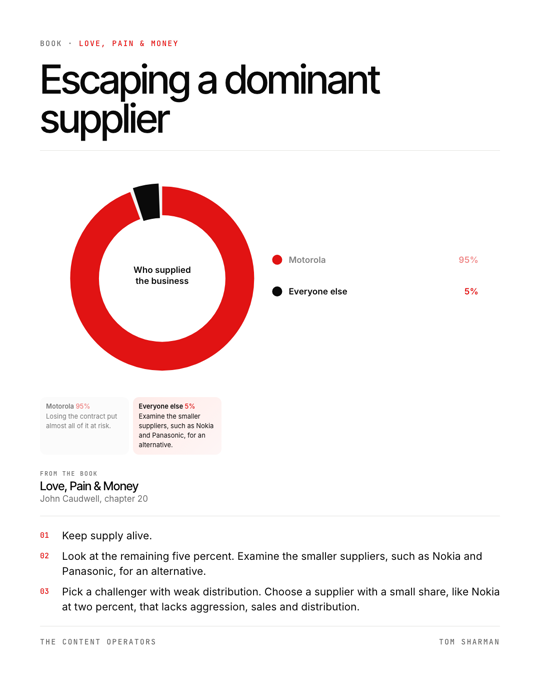
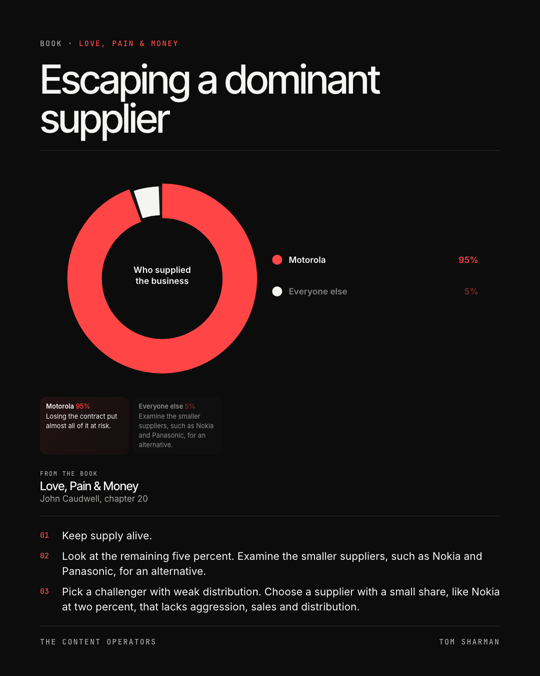
The sequence Caudwell used to survive the loss of his Motorola contract and de-risk the business.
- Keep supply alive. Reverse the earlier deal by getting service providers to buy Motorola phones for him, with a guarantee of confidentiality.
- Look at the remaining five percent. Examine the smaller suppliers, such as Nokia and Panasonic, for an alternative.
- Pick a challenger with weak distribution. Choose a supplier with a small share, like Nokia at two percent, that lacks aggression, sales and distribution.
- Pull the decision maker onto your ground. Invite the boss to see your operation so you control the setting and show your distribution power.
- Negotiate for volume. Agree a low unit price, such as £50, with creative cash and short term credit terms.
- Cap dependence. Never rely on any one company for more than 10 percent of business.
From chapter: Chapter 16_SNAKES IN THE GRASS, pp. 132–139
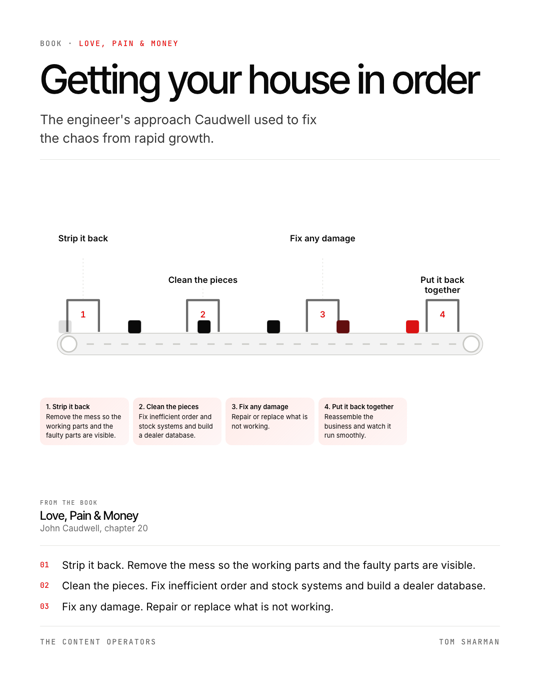
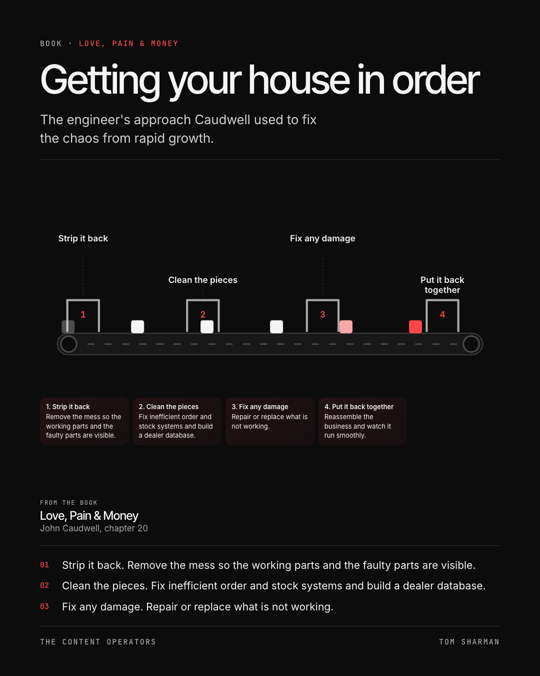
The engineer's approach Caudwell used to fix the chaos from rapid growth.
- Strip it back. Remove the mess so the working parts and the faulty parts are visible.
- Clean the pieces. Fix inefficient order and stock systems and build a dealer database.
- Fix any damage. Repair or replace what is not working.
- Put it back together. Reassemble the business and watch it run smoothly.
From chapter: Chapter 16_SNAKES IN THE GRASS, pp. 132–139
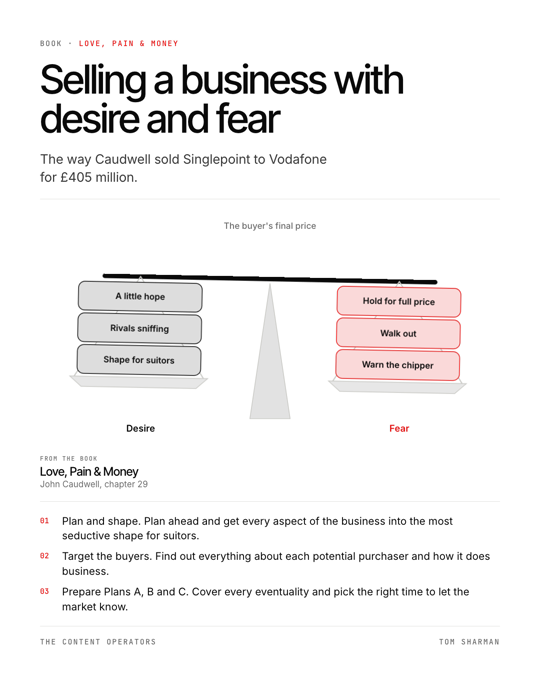
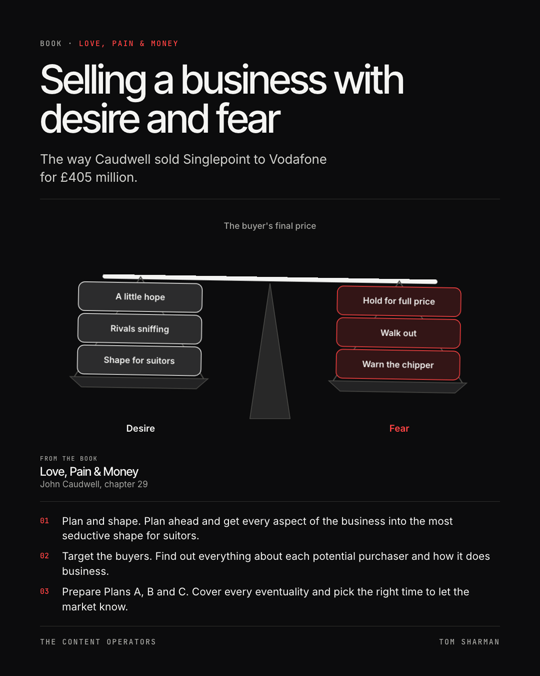
The way Caudwell sold Singlepoint to Vodafone for £405 million.
- Plan and shape. Plan ahead and get every aspect of the business into the most seductive shape for suitors.
- Target the buyers. Find out everything about each potential purchaser and how it does business.
- Prepare Plans A, B and C. Cover every eventuality and pick the right time to let the market know.
- Build desire. Let it be known that rival networks are sniffing round, so the buyer wants what you have.
- Warn the chipper. Tell the buyer in advance that you will not accept a price chipped after the offer.
- Add fear. When the chip arrives, walk out and open talks with stalking horses such as Orange and 121.
- Control management. Keep your team loyal, even letting them think you may be irrational.
- Leave a little hope. Reject the buyer's return each time but leave a foot in the door.
- Wait for a solid offer. Refuse to talk and hold out until the full price is guaranteed.
From chapter: Chapter 25_MADNESS – A BUSINESS LESSON (PART I), pp. 211–218
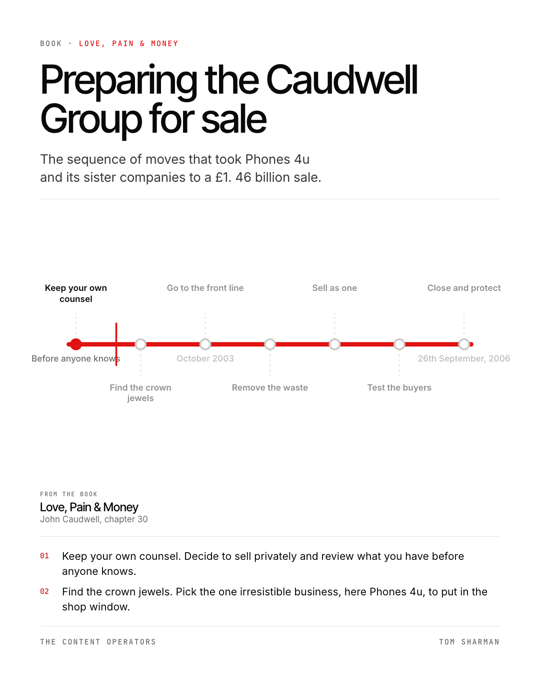
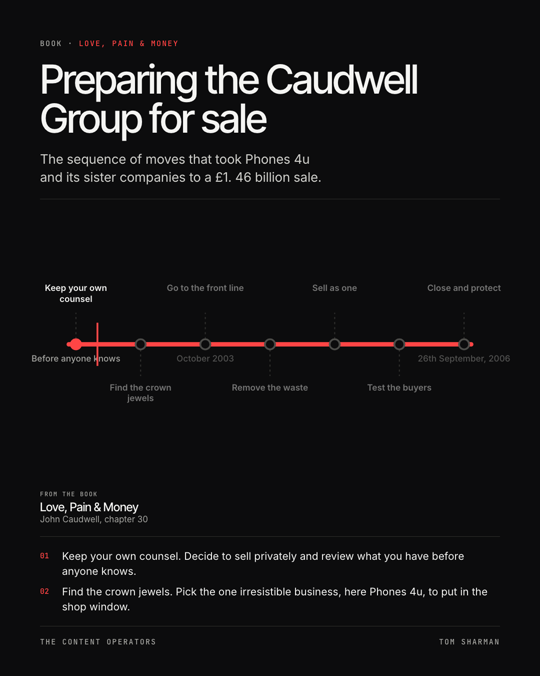
The sequence of moves that took Phones 4u and its sister companies to a £1.46 billion sale.
- Keep your own counsel. Decide to sell privately and review what you have before anyone knows.
- Find the crown jewels. Pick the one irresistible business, here Phones 4u, to put in the shop window.
- Go to the front line. Visit the shops yourself, ask questions and see what staff really do.
- Remove the waste. Ban group emails, send a nightly bulletin and give every manager a sales target.
- Sell as one. Sell the whole group to a single buyer to avoid tax problems from splitting.
- Test the buyers. Watch small signals, throw out a doubtful bidder and bring in new ones.
- Close and protect. Complete the deal, split the cash across banks and reward long serving staff.
From chapter: Chapter 26_MY WAY – A BUSINESS LESSON (PART II), pp. 219–229
Working with Tom on this
Tom works with creators and founders one to one, from a single session to a fractional role. Work with Tom
Back to the bookshelf