Bookshelf
How Tom uses this
Let It Go backs two of Tom's lessons. Under each of his lessons, what the book says about it, and on which pages.
What it argues
Shirley argues that the most powerful move in building anything is to let go of it: of trauma, of control of a company, of money, and of the institutions you create. She built Freelance Programmers from £6 and a dining room table by using a talent pool that conventional firms wasted, paying for work done and trusting people to manage their own time. She then handed ownership and control to her staff, which made far more wealth for everyone than holding on would have done. She applies the same discipline to philanthropy, favouring leveraged, strategic gifts that fund infrastructure and use expertise as well as cash. Her personal story, from Kindertransport refugee to the mother of an autistic son she could not keep at home, shows that survival, resilience and faith in other people are what carry the work.
Worth keeping
- Pay for work done, not hours, and trust people to manage their own time as long as the work gets done (p. 87, p. 251).
- Divide every project into phases, check at each phase end, and you can say how far through a job you are and quote a fixed price (p. 80).
- A founder who is the personality holding a firm together makes a fragile organism, so hand day to day running to someone who enjoys it and keep strategy (p. 103, p. 136).
- When work is scarce, network or die: keep contacts, ring existing clients, and show confidence because desperation repels customers (p. 109, p. 114).
- Transfer ownership in one dramatic move if you want staff to think of the company as theirs, because piecemeal gifts leave it feeling like yours (p. 182).
- A written charter of mission, strategy and values is a company's real selling point, and rivals who read it will rarely copy it (p. 157, p. 159).
- Growth can be a survival decision: Cropper's argument that a firm must expand or decline, and that spending more can beat minimum cost (p. 175).
- Be an outsider who commissions the missing literature review or other groundwork, because a generalist can add to specialists (p. 236).
- Choose philanthropic recipients who multiply the gift: her £4m through the WCIT was leveraged at least ten to one (p. 211, p. 212).
- Putting your own oxygen mask on first is how you keep being useful to people who depend on you (p. 133).
- Letting go works best when the people receiving power have been painstakingly selected and nurtured (p. 251).
The questions it answers
- What is the smallest team that can produce at the volume I am used to?
In 1966 the firm served big clients with three managers, a secretary and about 75 freelancers hired only as projects needed them (pp. 82, 85).
- How do you price and sell a tool you built for yourself?
She priced early work below her old salary, later called the result profitless prosperity, and turned the written standards she built for a client into a selling point (pp. 69, 71, 147).
- How do you build a personal brand that generates inbound rather than requiring outbound?
A Guardian feature produced a flurry of enquiries from both programmers and clients, though most early work still came from former colleagues and her own relentless outreach (pp. 72, 102, 103).
The frameworks
7 frameworks, one animation each Every framework, step by step
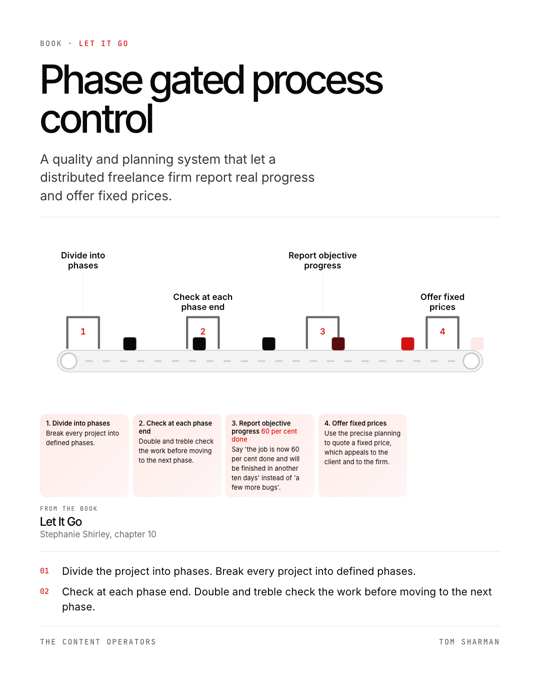
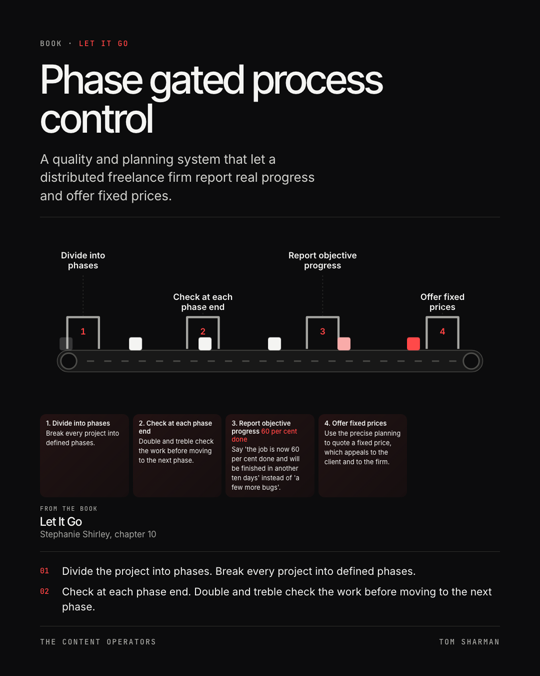
A quality and planning system that let a distributed freelance firm report real progress and offer fixed prices.
- Divide the project into phases. Break every project into defined phases.
- Check at each phase end. Double and treble check the work before moving to the next phase.
- Report objective progress. Say 'the job is now 60 per cent done and will be finished in another ten days' instead of 'a few more bugs'.
- Offer fixed prices. Use the precise planning to quote a fixed price, which appeals to the client and to the firm.
From chapter: 8. Growing Pains, pp. 77–90
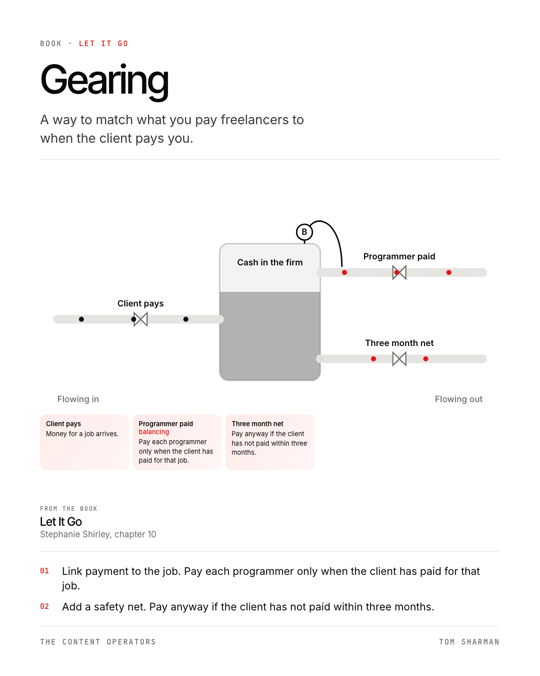
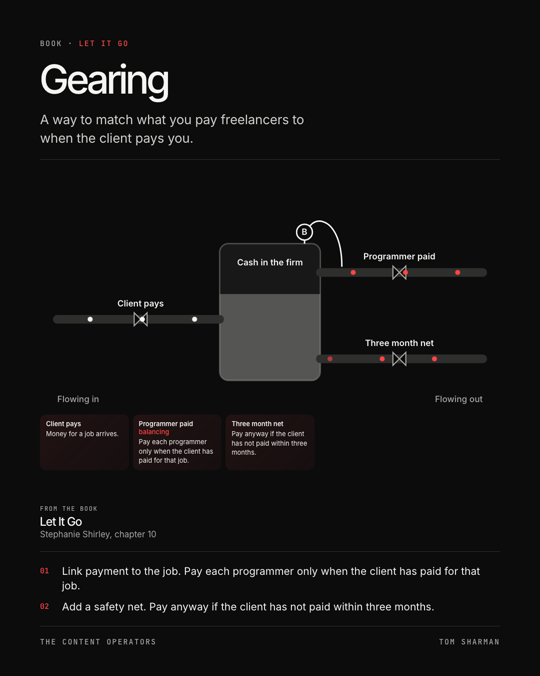
A way to match what you pay freelancers to when the client pays you.
- Link payment to the job. Pay each programmer only when the client has paid for that job.
- Add a safety net. Pay anyway if the client has not paid within three months.
From chapter: 8. Growing Pains, pp. 77–90
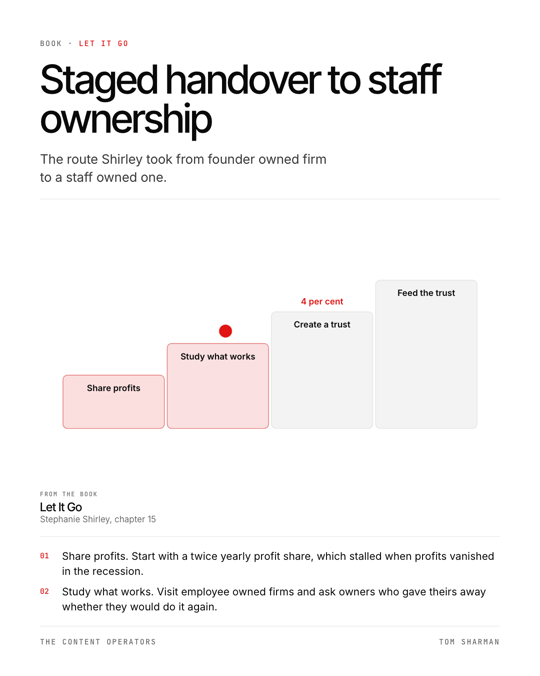
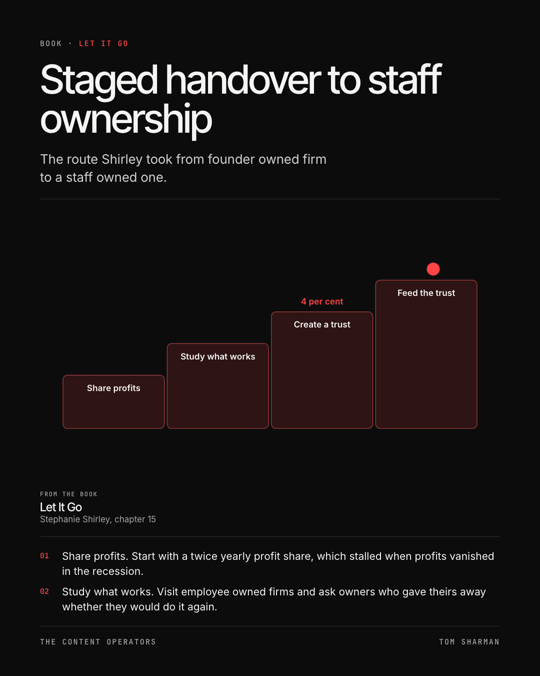
The route Shirley took from founder owned firm to a staff owned one.
- Share profits. Start with a twice yearly profit share, which stalled when profits vanished in the recession.
- Study what works. Visit employee owned firms and ask owners who gave theirs away whether they would do it again.
- Create a trust. Establish a shareholders' trust to hold shares on behalf of staff, seeded with 4 per cent of her shares.
- Feed the trust. Transfer shares annually and have the company make grants for it to buy more.
From chapter: 13. Common Ground, pp. 134–146
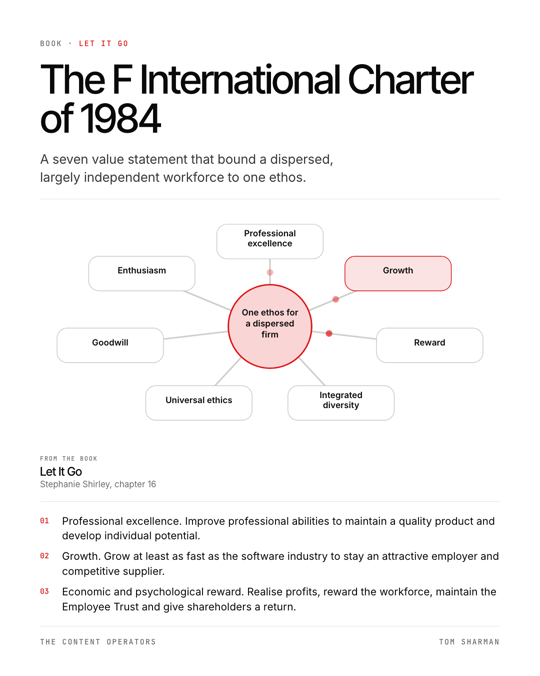
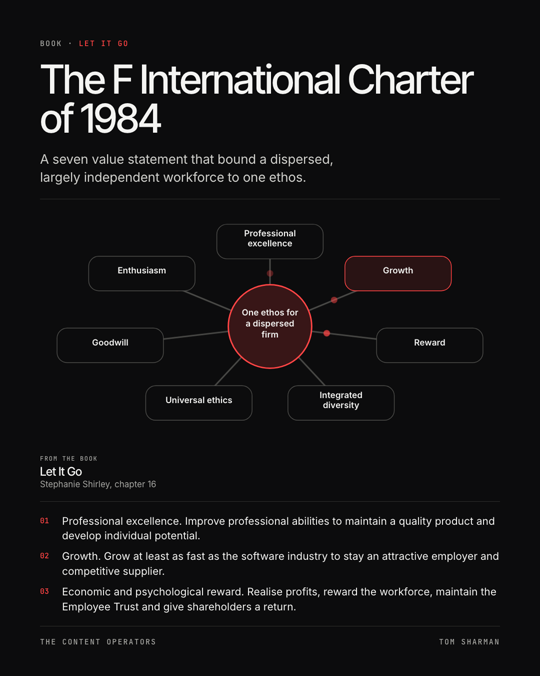
A seven value statement that bound a dispersed, largely independent workforce to one ethos.
- Professional excellence. Improve professional abilities to maintain a quality product and develop individual potential.
- Growth. Grow at least as fast as the software industry to stay an attractive employer and competitive supplier.
- Economic and psychological reward. Realise profits, reward the workforce, maintain the Employee Trust and give shareholders a return.
- Integrated diversity. Use consistent procedures worldwide to lower cost while acting as a national of each country.
- Universal ethics. Respect local customs and laws, and hold human dignity and ethical conduct beyond the profit motive.
- Goodwill. Believe in the goodwill of colleagues, clients and vendors, which yields long term relationships.
- Enthusiasm. Treat the ability to engender enthusiasm as the essential leadership quality.
From chapter: 14. Slings and Arrows, pp. 147–159
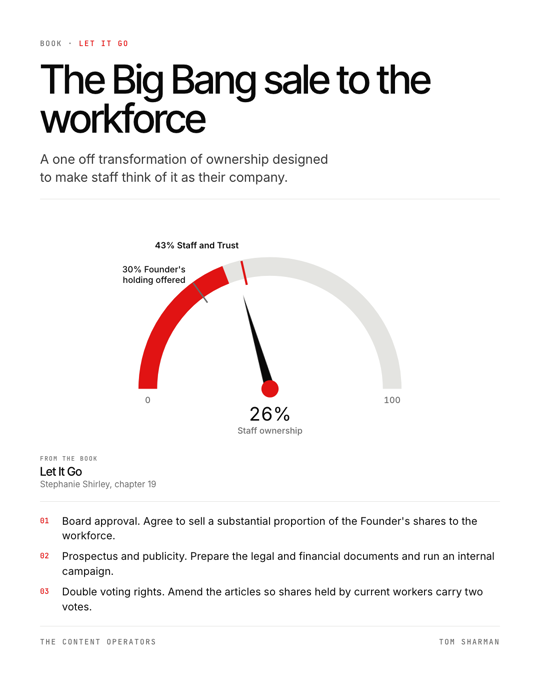
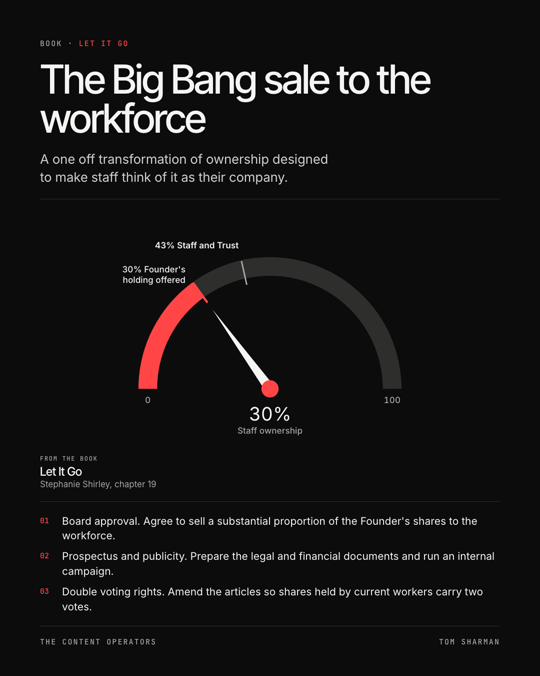
A one off transformation of ownership designed to make staff think of it as their company.
- Board approval. Agree to sell a substantial proportion of the Founder's shares to the workforce.
- Prospectus and publicity. Prepare the legal and financial documents and run an internal campaign.
- Double voting rights. Amend the articles so shares held by current workers carry two votes.
- Offer to all. Offer 30 per cent of the founder's remaining holding at £2.70 a share, with a 50 share minimum, to over 1,000 staff.
- Set a floor. Require the workforce to invest at least £1m between them for the sale to go ahead.
From chapter: 17. Losing My Grip, pp. 179–183
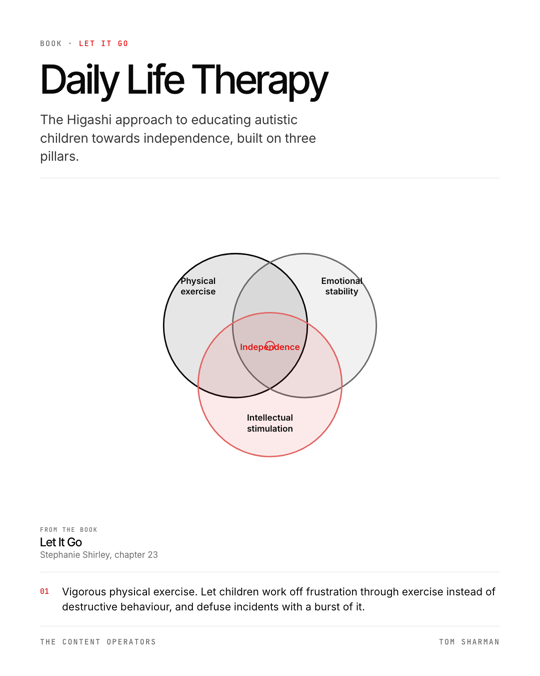
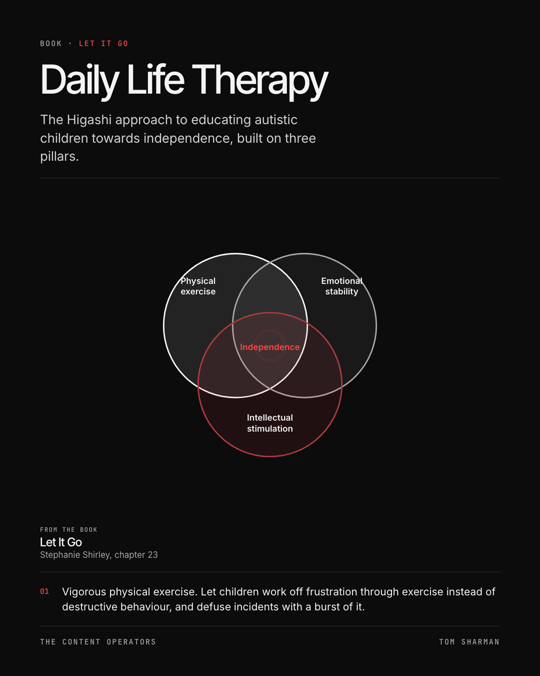
The Higashi approach to educating autistic children towards independence, built on three pillars.
- Vigorous physical exercise. Let children work off frustration through exercise instead of destructive behaviour, and defuse incidents with a burst of it.
- Emotional stability. Provide it through many highly trained staff, usually one for every three pupils.
- Intellectual stimulation. Teach through repetitive, ritualistic group tuition that exploits a love of routine, keeping unused materials out of sight.
From chapter: 21. The Bitterest Pill, pp. 208–218
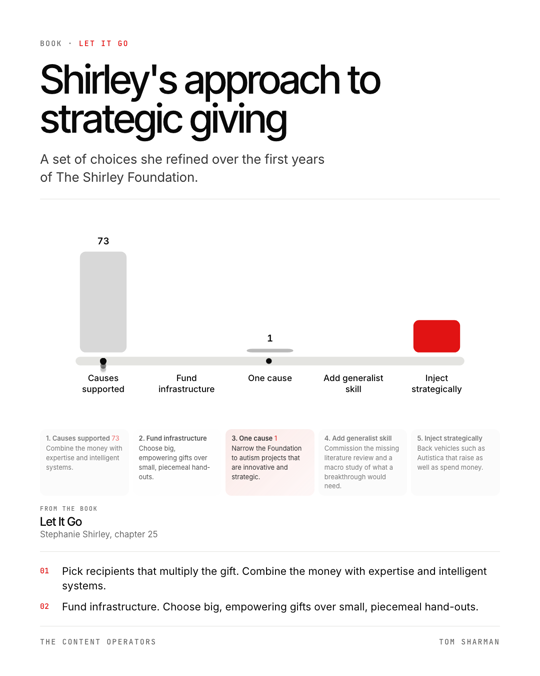
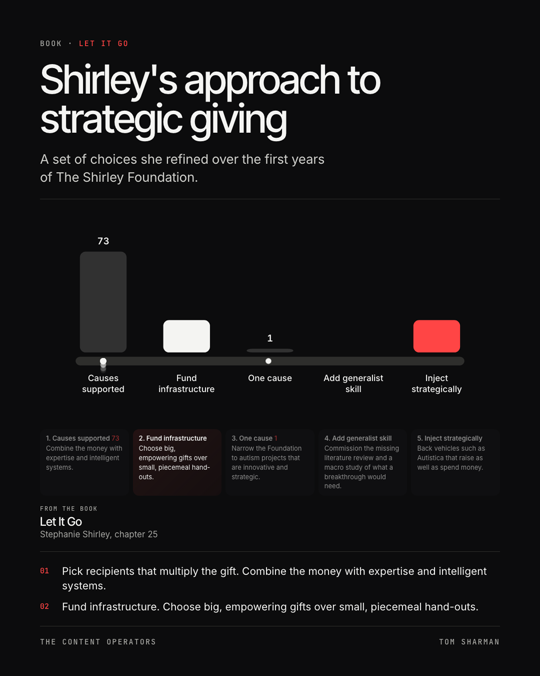
A set of choices she refined over the first years of The Shirley Foundation.
- Pick recipients that multiply the gift. Combine the money with expertise and intelligent systems.
- Fund infrastructure. Choose big, empowering gifts over small, piecemeal hand-outs.
- Focus on one cause. Narrow the Foundation to autism projects that are innovative and strategic.
- Add generalist skill. Commission the missing literature review and a macro study of what a breakthrough would need.
- Inject at the strategic point. Back vehicles such as Autistica that raise as well as spend money.
From chapter: 23. Fighting Back, pp. 230–238
Working with Tom on this
Tom works with creators and founders one to one, from a single session to a fractional role. Work with Tom
Back to the bookshelf