Bookshelf
How Tom uses this
The Courage To Be Disliked backs five of Tom's lessons. Under each of his lessons, what the book says about it, and on which pages.
- They quit when there is an easier route to the same revenue
The philosopher says people keep their current lifestyle because the familiar is easier and more predictable, even when they complain about it. pp. 52 and 78. In the book: The three life tasks, Stepping out of a power struggle.
- Turn down anyone unclear about their commitment
The would-be novelist who never submits keeps the possibility open to avoid risking rejection, which is the unclear commitment Tom screens for. pp. 54 and 64. In the book: The three life tasks, Stepping out of a power struggle.
- The intake question is why, and what it is costing them
Adler's teleology asks what goal a behaviour serves and not what caused it, which is the same move as asking a founder why they are investing. pp. 29 and 30.
- People online are selfish, so lead with what they get
The book says people seeking recognition are looking at themselves while appearing to look at others, so an audience asks what a person will give it. pp. 166 and 168. In the book: The encouragement approach.
- Assumptions made too fast, and risk avoided
Excessive self-consciousness and the fear of being ridiculed or rejected keep people from acting, and the cure offered is to move without waiting for approval. pp. 54 and 203. In the book: Self-acceptance, confidence in others, contribution to others, Living energeially.
What it argues
Kishimi and Koga set out Adlerian psychology as a conversation between a sceptical young man and a philosopher. The central claim is that people are not driven by past trauma but by present goals, so an unhappy person has chosen a lifestyle and can choose another. All problems are interpersonal relationship problems, and the way through is to separate your tasks from other people's, give up the craving for recognition and accept being disliked. Real belonging comes from seeing others as equals and comrades, accepting yourself, trusting others without conditions and contributing to them, and happiness is the feeling of contribution. Life is lived in the present moment like a dance, and what stops people is a shortage of courage and never a shortage of ability.
Worth keeping
- Unhappiness and a stuck personality are chosen goals, so you can choose again at any time; the missing ingredient is courage, since the ability is already there (p. 52).
- Separate tasks by asking who will receive the final result of the choice; most relationship friction is intruding on other people's tasks (pp. 128, 136).
- What other people think of you is their task, and freedom has the cost of being disliked by some of them (pp. 148, 149).
- Do not praise or rebuke; use gratitude between equals, because praise is a judgement from above (pp. 179, 185).
- Boasting and fabricated authority come from feelings of inferiority, and an inferiority complex is a feeling used as an excuse (pp. 77, 82).
- When a power struggle starts, step down without reacting and stay out of the revenge stage (pp. 96, 98).
- Ask what you can give instead of what you will get, since belonging is earned by contribution (p. 170).
- Self-acceptance means taking the sixty per cent as it stands and asking how to get closer to a hundred (p. 206).
- Happiness is the feeling of contribution, which needs no recognition and need not be visible (pp. 229, 230).
- Live each moment like a dance, with the process as the outcome and no story about the past or future (pp. 240, 245).
The questions it answers
- How do you build a personal brand that generates inbound rather than requiring outbound?
The book argues that craving recognition makes a person unfree and that contribution to others is the guiding star, which points to leading with what you give and not chasing approval.
- Which of my stories travel, and which only feel like they should?
Whether an audience likes a story is their task and not yours, so the book says to judge a story by whether it contributes and to stop reading silence as a verdict.
The frameworks
6 frameworks, one animation each Every framework, step by step
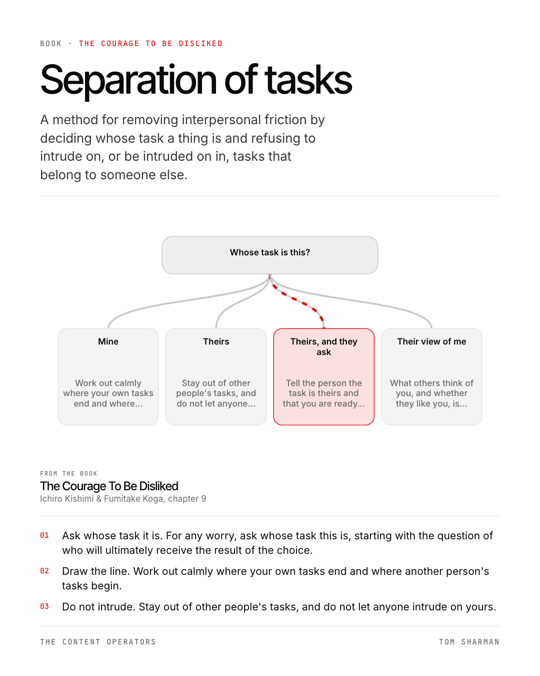
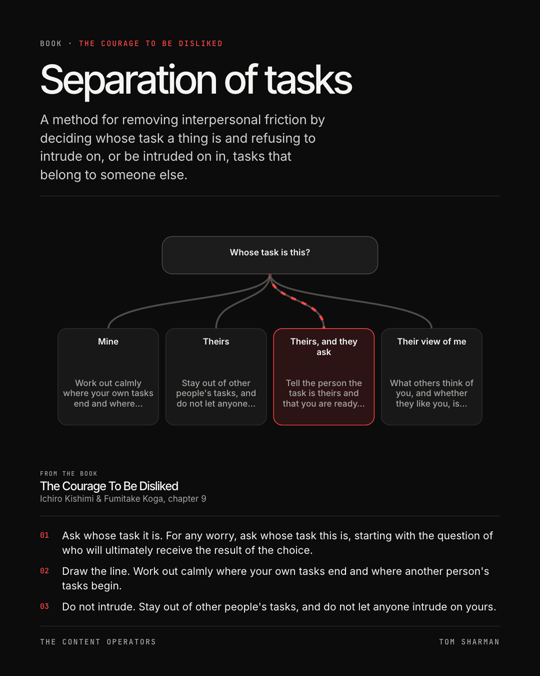
A method for removing interpersonal friction by deciding whose task a thing is and refusing to intrude on, or be intruded on in, tasks that belong to someone else.
- Ask whose task it is. For any worry, ask whose task this is, starting with the question of who will ultimately receive the result of the choice.
- Draw the line. Work out calmly where your own tasks end and where another person's tasks begin.
- Do not intrude. Stay out of other people's tasks, and do not let anyone intrude on yours.
- Offer help without taking over. Tell the person the task is theirs and that you are ready to assist when asked, without forcing it.
- Leave judgement of you with them. What others think of you, and whether they like you, is their task, so you carry on with your own.
From chapter: THE THIRD NIGHT: DISCARD OTHER PEOPLE’S TASKS, pp. 114–153
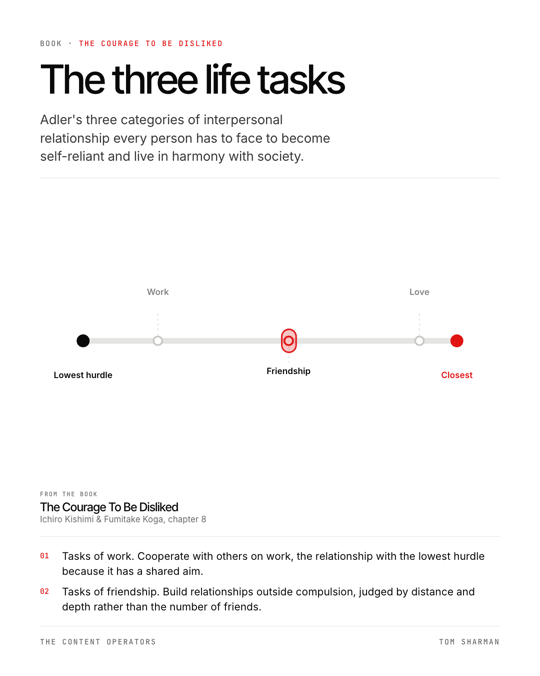
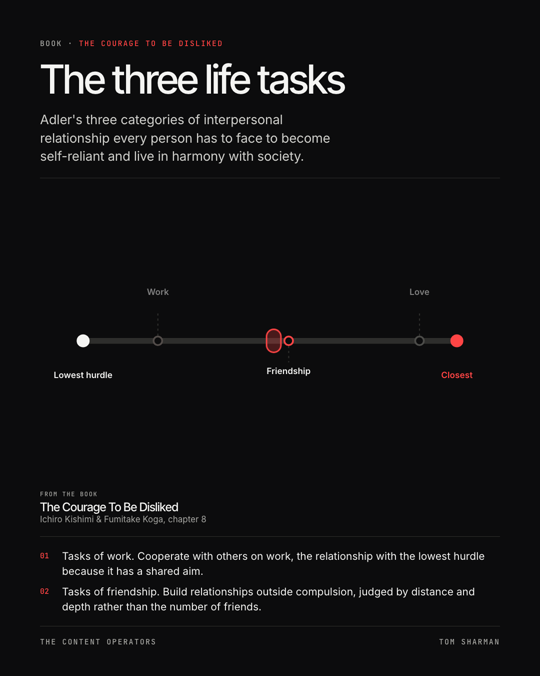
Adler's three categories of interpersonal relationship every person has to face to become self-reliant and live in harmony with society.
- Tasks of work. Cooperate with others on work, the relationship with the lowest hurdle because it has a shared aim.
- Tasks of friendship. Build relationships outside compulsion, judged by distance and depth rather than the number of friends.
- Tasks of love. Handle the closest relationships, partners and family, without restricting or controlling the other person.
From chapter: THE SECOND NIGHT: ALL PROBLEMS ARE INTERPERSONAL RELATIONSHIP PROBLEMS, pp. 57–113
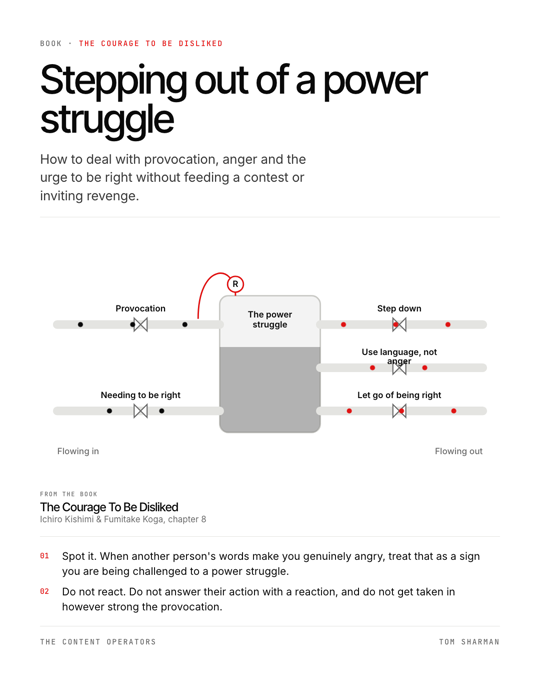
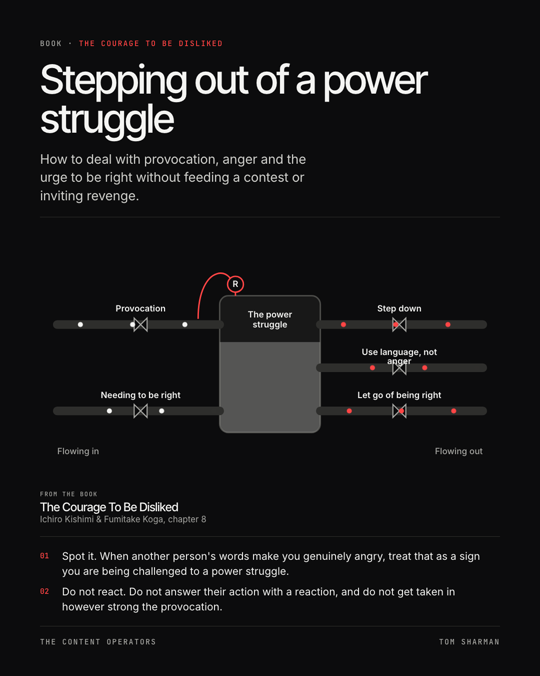
How to deal with provocation, anger and the urge to be right without feeding a contest or inviting revenge.
- Spot it. When another person's words make you genuinely angry, treat that as a sign you are being challenged to a power struggle.
- Do not react. Do not answer their action with a reaction, and do not get taken in however strong the provocation.
- Step down. Withdraw from the conflict as soon as you sense it, since winning only starts the revenge stage.
- Use language, not anger. Say what you mean in words, because communication is possible without anger.
- Let go of being right. Admit mistakes and apologise freely, as stepping down is not defeat.
From chapter: THE SECOND NIGHT: ALL PROBLEMS ARE INTERPERSONAL RELATIONSHIP PROBLEMS, pp. 57–113
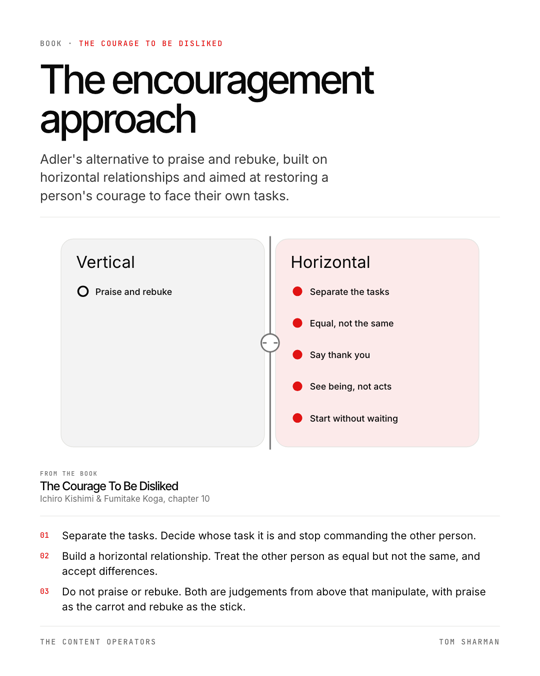
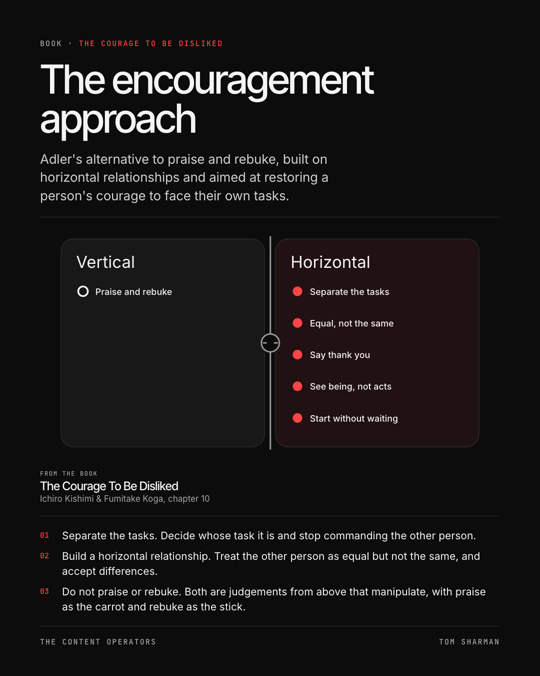
Adler's alternative to praise and rebuke, built on horizontal relationships and aimed at restoring a person's courage to face their own tasks.
- Separate the tasks. Decide whose task it is and stop commanding the other person.
- Build a horizontal relationship. Treat the other person as equal but not the same, and accept differences.
- Do not praise or rebuke. Both are judgements from above that manipulate, with praise as the carrot and rebuke as the stick.
- Say thank you. Express gratitude, joy or respect in the way you would to a friend who helped you.
- See being, not acts. Value people for being there, starting from zero rather than subtracting from an ideal image.
- Start without waiting. Begin yourself, whether or not others cooperate.
From chapter: THE FOURTH NIGHT: WHERE THE CENTRE OF THE WORLD IS, pp. 154–197
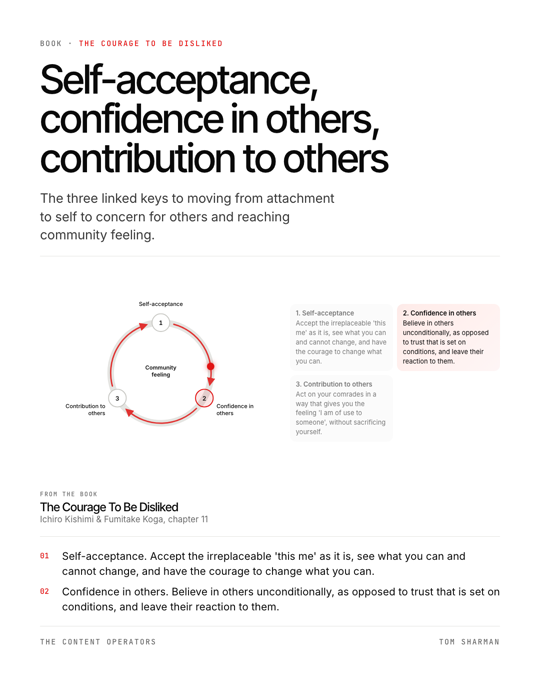
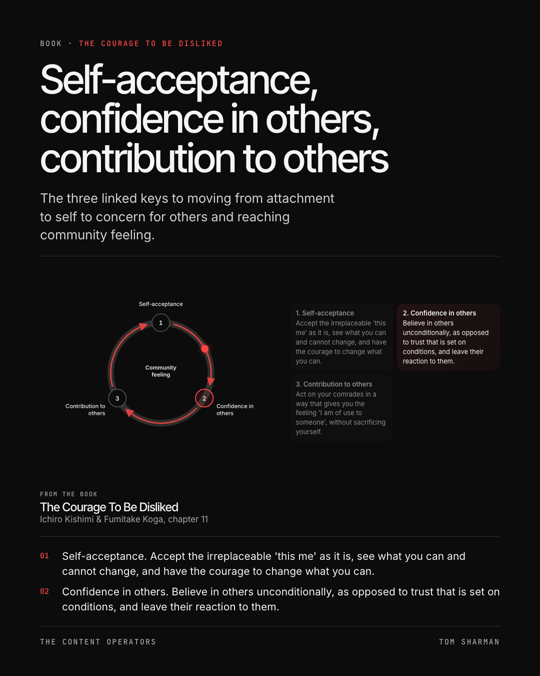
The three linked keys to moving from attachment to self to concern for others and reaching community feeling.
- Self-acceptance. Accept the irreplaceable 'this me' as it is, see what you can and cannot change, and have the courage to change what you can.
- Confidence in others. Believe in others unconditionally, as opposed to trust that is set on conditions, and leave their reaction to them.
- Contribution to others. Act on your comrades in a way that gives you the feeling 'I am of use to someone', without sacrificing yourself.
From chapter: THE FIFTH NIGHT: TO LIVE IN EARNEST IN THE HERE AND NOW, pp. 198–255
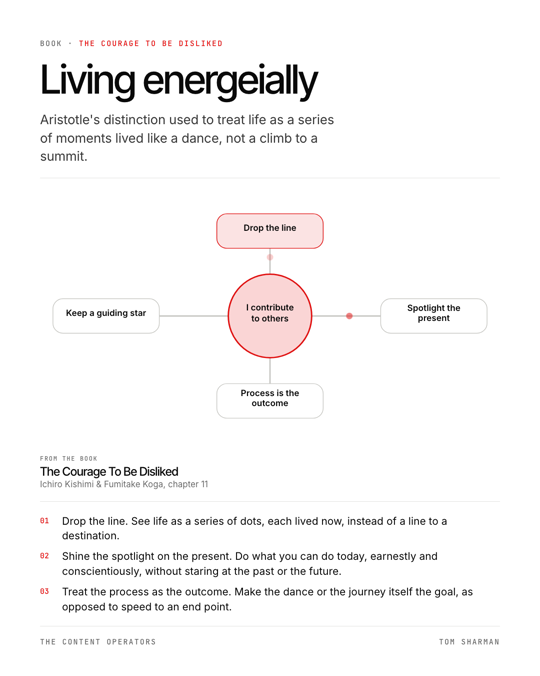
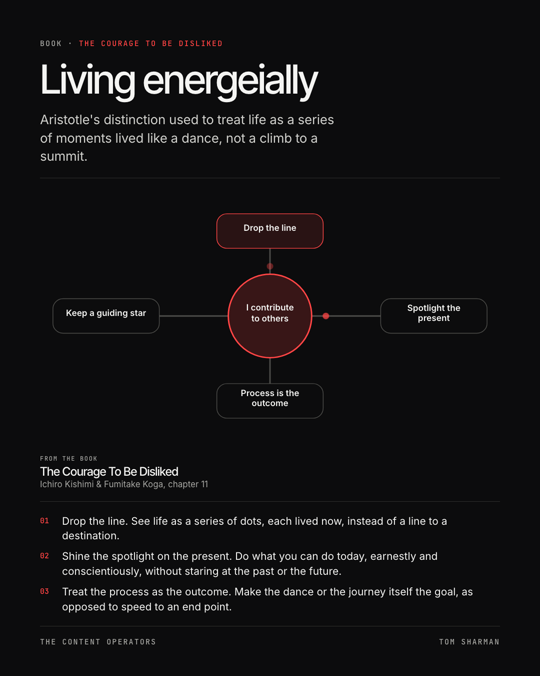
Aristotle's distinction used to treat life as a series of moments lived like a dance, not a climb to a summit.
- Drop the line. See life as a series of dots, each lived now, instead of a line to a destination.
- Shine the spotlight on the present. Do what you can do today, earnestly and conscientiously, without staring at the past or the future.
- Treat the process as the outcome. Make the dance or the journey itself the goal, as opposed to speed to an end point.
- Keep a guiding star. Steer by 'I contribute to others' when the way is unclear, and ignore whether you are disliked.
From chapter: THE FIFTH NIGHT: TO LIVE IN EARNEST IN THE HERE AND NOW, pp. 198–255
Working with Tom on this
Tom works with creators and founders one to one, from a single session to a fractional role. Work with Tom
Back to the bookshelf