Bookshelf
How Tom uses this
Biological War backs one of Tom's lessons. Under each of his lessons, what the book says about it, and on which pages.
- Assumptions made too fast, and risk avoided
The book shows the limit of move-fast risk-taking, since one irreversible mistake such as a lab leak cannot be recovered, which matches the concept's exception for anything that damages the brand. pp. 27, 47, 165 and 166.
What it argues
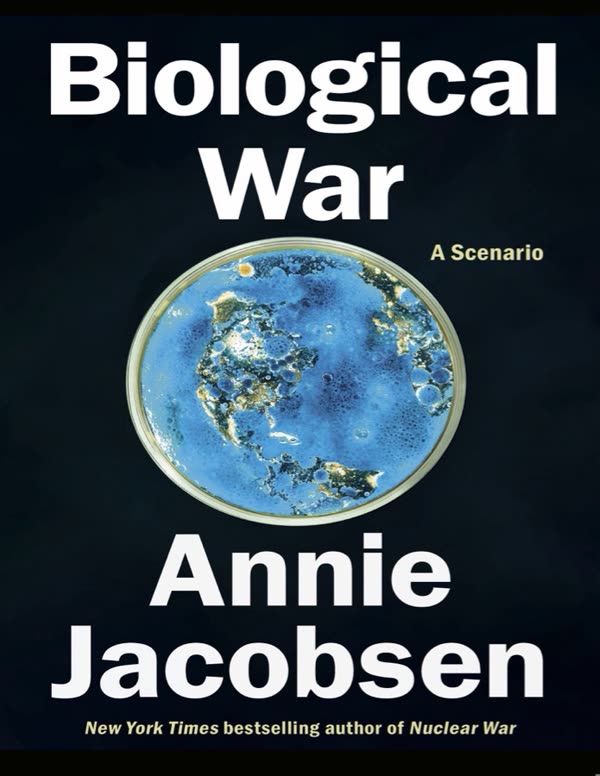
Jacobsen builds a six-day scenario in which an explosion at Russia's Vector Institute releases a genetically modified pneumonic plague that reaches Los Angeles, Dallas and the world within days. The argument runs through the history of recombinant DNA, Soviet Biopreparat and the post-9/11 build-up of high-containment labs and gain-of-function research. Her claim is that a biological attack or lab leak is a wicked problem: invisible, spread by breathing, fatal to the first responders, and fast enough that once it is here it is already too late. Surveillance gaps, slow diagnostics, thin hospital capacity, contradictory messaging and low public trust turn an outbreak into civil collapse and martial law. The engineered plague's real payload is the destruction of trust in medicine and government, and she ends by asking for guardrails and oversight before synthetic biology and AI outrun the rules.
Worth keeping
- Contagion moves at the speed of travel: one infected person reached six continents within a day, so the first twelve to twenty-four hours decide the outcome (p. 82, p. 90).
- Superspreader events multiply transmission, and the book models R0 11 times 4 for 44 infections per case in close quarters (p. 112 to 113).
- The people least covered by surveillance start the outbreak unseen: about 800,000 homeless Americans are missing from the CDC's BioSense data (p. 165, p. 200).
- Time is the Achilles' heel: the Strategic National Stockpile push package takes twelve hours and a new generation of infection arrives every eighteen to twenty-four hours (p. 192 to 195).
- Disguising guesswork as facts erodes trust; forecasts for a novel pathogen are about as reliable as a coin toss (p. 232 to 234).
- A cover story can be broken by checking one plain fact, such as marmots hibernating in January (p. 123).
- The Soviet chimera weapon is a booby trap that weaponises trust: the antibiotic that should cure triggers the fatal encephalitis gene (p. 269 to 270).
- The wicked problems of a biological attack: invisible, spread by breathing, responders are exposed first, and panic collapses the medical system (p. 169 to 170).
- War games such as TOPOFF 2000 and Dark Winter end when order collapses, which hides what comes next (p. 178, p. 244 to 245).
- The tools to engineer life are advancing faster than the rules that govern them, and that gap is where existential danger lives (p. 298).
The questions it answers
- Which of my stories travel, and which only feel like they should?
An influencer's 90-second explainer reaches 15 million views by cutting contradictory official clips together with conspiracy, a fictional case of outrage and clarity travelling faster than accuracy (p. 215 to 218, p. 221).
The frameworks
3 frameworks, one animation each Every framework, step by step
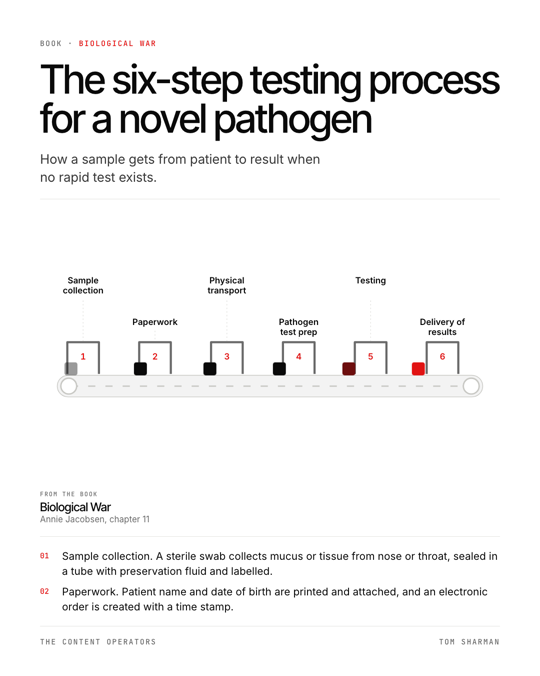
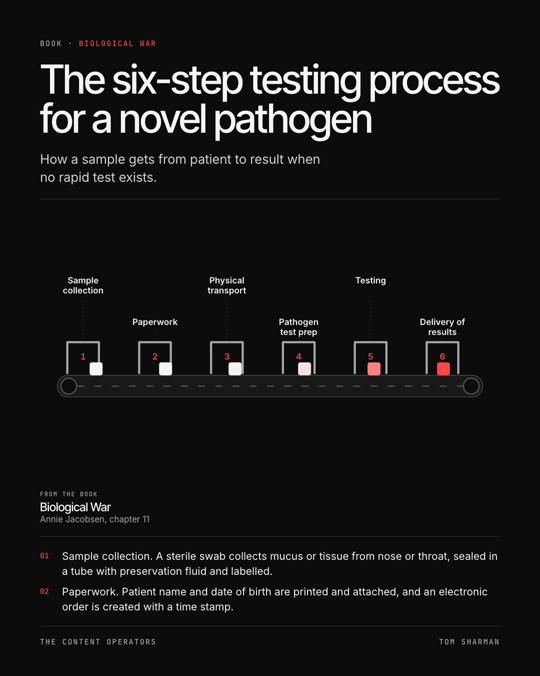
How a sample gets from patient to result when no rapid test exists.
- Sample collection. A sterile swab collects mucus or tissue from nose or throat, sealed in a tube with preservation fluid and labelled.
- Paperwork. Patient name and date of birth are printed and attached, and an electronic order is created with a time stamp.
- Physical transport. A medical courier authorised for contagious pathogens carries the sample in an insulated pouch.
- Pathogen test prep. A technician logs the sample by barcode, confirms its integrity and prepares it.
- Testing. Rapid antigen (about 15 minutes), PCR (about 1 to 3 hours) or culture (about 1 to 3 days), reviewed by a human supervisor.
- Delivery of results. A human pushes the electronic result to the facility, the patient or both.
From chapter: Part III: Once It’s Here, It’s Already Too Late, pp. 108–160
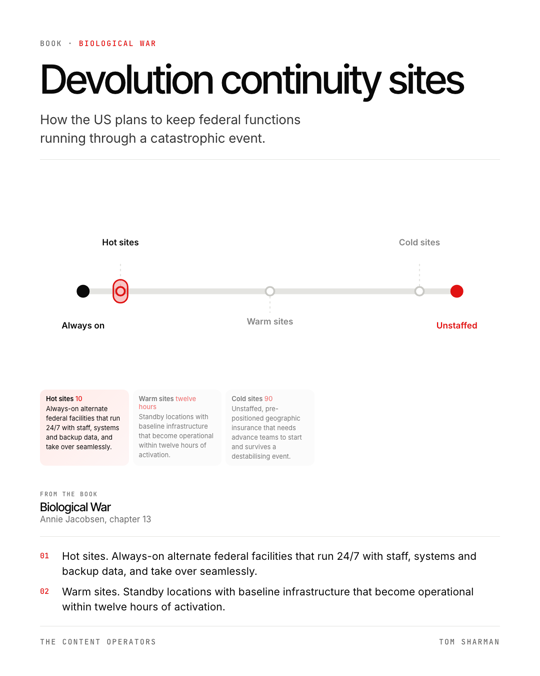
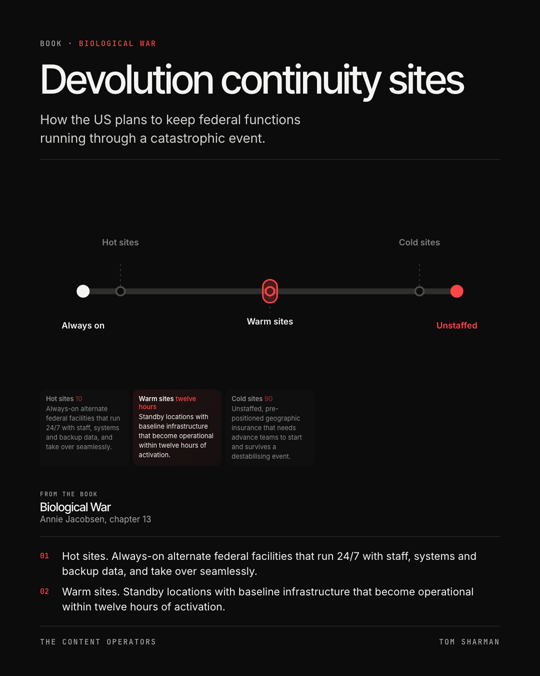
How the US plans to keep federal functions running through a catastrophic event.
- Hot sites. Always-on alternate federal facilities that run 24/7 with staff, systems and backup data, and take over seamlessly.
- Warm sites. Standby locations with baseline infrastructure that become operational within twelve hours of activation.
- Cold sites. Unstaffed, pre-positioned geographic insurance that needs advance teams to start and survives a destabilising event.
From chapter: Part V: Martial Law, pp. 227–292
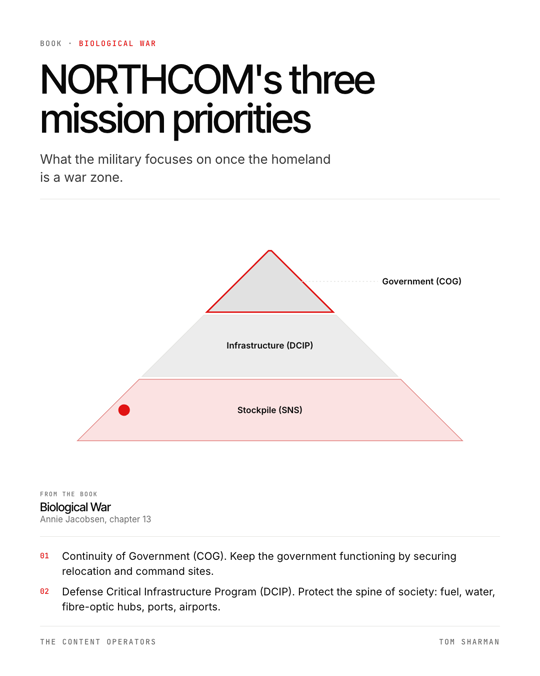
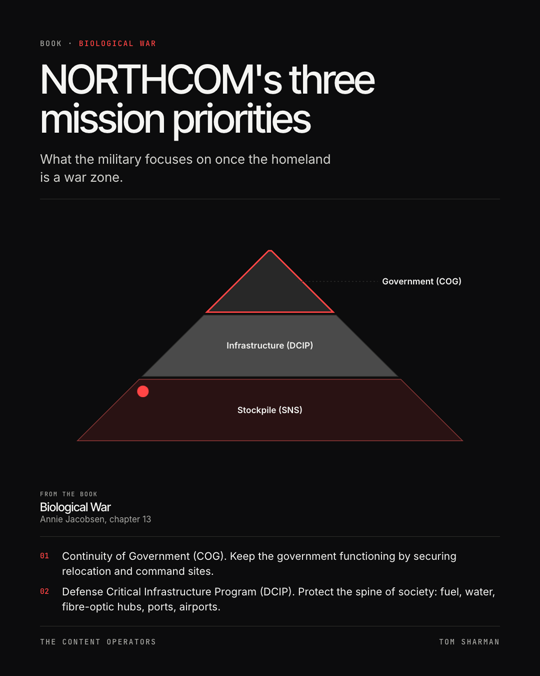
What the military focuses on once the homeland is a war zone.
- Continuity of Government (COG). Keep the government functioning by securing relocation and command sites.
- Defense Critical Infrastructure Program (DCIP). Protect the spine of society: fuel, water, fibre-optic hubs, ports, airports.
- Strategic National Stockpile (SNS). Move the medicine from secret depots to the states.
From chapter: Part V: Martial Law, pp. 227–292
Working with Tom on this
Tom builds and runs content teams inside creator and founder businesses, as a fractional Head of Content. Fractional Head of Content, UK
Back to the bookshelf