Bookshelf
How Tom uses this
Day Trading Attention backs five of Tom's lessons. Under each of his lessons, what the book says about it, and on which pages.
- Two to three a day, LinkedIn five times a weekday
He tells brands to post four or five times a day on each platform and two to five pieces a day on LinkedIn for B2B, which backs the high-cadence plan. pp. 74, 136 and 223. In the book: Cohorts with teeth, Strategic organic content checklist, Spending a small ad budget against what works, Finding and testing local influencers, First hires for a social content team.
- Short form first, LinkedIn on winners, YouTube last
He says to post organically, amplify what overperforms, use LinkedIn for decision makers and lean on YouTube analytics and TV screens for the slower, produced layer. pp. 75, 99, 138 and 145. In the book: Cohorts with teeth, Strategic organic content checklist, Spending a small ad budget against what works.
- People online are selfish, so lead with what they get
He says to make content for the person consuming it, not for yourself, and to give value before asking. pp. 15, 85, 95 and 96. In the book: Cohorts with teeth, Strategic organic content checklist, Spending a small ad budget against what works.
- Signals show before numbers, and numbers come at month four
He says to hold off judging a strategy for 50 to 100 days and to read comments and above-average posts as early signals. pp. 74, 99 and 114. In the book: Cohorts with teeth, Strategic organic content checklist, Spending a small ad budget against what works.
- Week one is an audit, and two formats are never up for testing
He endorses podcast clips and straight-to-camera selfie videos as easy, repeatable formats, and 80/20 keeps most output on what already works. pp. 42, 149, 216 and 226. In the book: The modern advertising framework, Finding and testing local influencers, First hires for a social content team.
What it argues
Vaynerchuk argues that marketing is now a day trader's game, where the winners find underpriced attention and learn to tell stories there. Interest-graph feeds such as TikTok's For You page, which every platform is copying, distribute content on how relevant it is to viewers rather than on follower count, so creative is the variable of success. His modern advertising framework starts with narrow cohorts, adds platform and culture knowledge, a high volume of strategic organic content, paid amplification of whatever overperforms, higher-production videos people want to watch and post-creative strategy, which means reading comments to decide what to make next. Posting volume is how you discover what quality is, and he says to wait 50 to 100 days before judging. Part 4 treats each platform as a different room with its own psychology, Part 5 catalogues thirty-six content formats, and Part 6 answers thirty real scenarios. He closes on AI and voice assistants, where brand built on cheap attention decides who gets named.
Worth keeping
- Underpriced attention is the opportunity, defined as low cost relative to the actual attention you get (pp. 10-11).
- Creative is the variable of success, because follower count no longer caps reach (pp. 25, 28).
- Define cohorts with teeth and treat them like an accordion, adding and removing them as comments show who responds (pp. 47-49).
- Post four or five times a day on each platform and wait 50 to 100 days before saying a strategy is not working (p. 74).
- Turn organic overperformers into ads and spread a small budget across several winners, as in the plumber with $700 (pp. 99-100).
- Run every post through the hook test: the first three seconds decide whether anyone sees the rest (pp. 80-82, 129).
- Comments are research and content, and a post-creative strategist reads every one (pp. 114-120).
- Ad fatigue is solved with more creative variations, not a bigger budget: fifty-five more ads for the lawn care business (p. 103).
- Build the personal brands of 15 to 25 people inside B2B companies, so no one person is the face (pp. 138, 185, 241).
- Use the 80/20 rule so one content style does not become a rut (p. 226).
The questions it answers
- What makes a format repeatable, as opposed to a hit that happened once?
He offers the Rolling Stones Rule, evergreen trends and content pillars as ways a winning message can be reposted and varied again and again (pp. 157-159, 211-212).
- How do you build a personal brand that generates inbound rather than requiring outbound?
He says to post at volume on interest-graph platforms, keep the profile friction free, build personal brands of executives and let DMs and partnership offers follow (pp. 94, 138, 185, 241).
- What does AI actually change about the shape of a content team?
He expects AI to let teams make and test tens of thousands of pieces a month and to change search and shopping into voice and chatbot requests (pp. 222, 256-257).
- What is the smallest team that can produce at the volume I am used to?
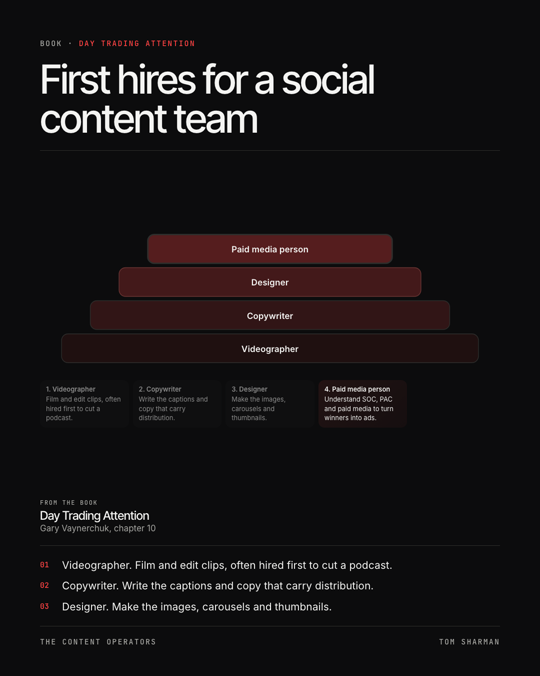
He recommends starting with four people, a videographer, a copywriter, a designer and a strategic paid media person, plus a post-creative strategist reading comments (pp. 119, 247-248).
- Which of my stories travel, and which only feel like they should?
He says to compare each post against your account average, look at who the platform served it to and read the comments, rather than guessing (pp. 26-27, 99, 114-116).
The frameworks
6 frameworks, one animation each Every framework, step by step
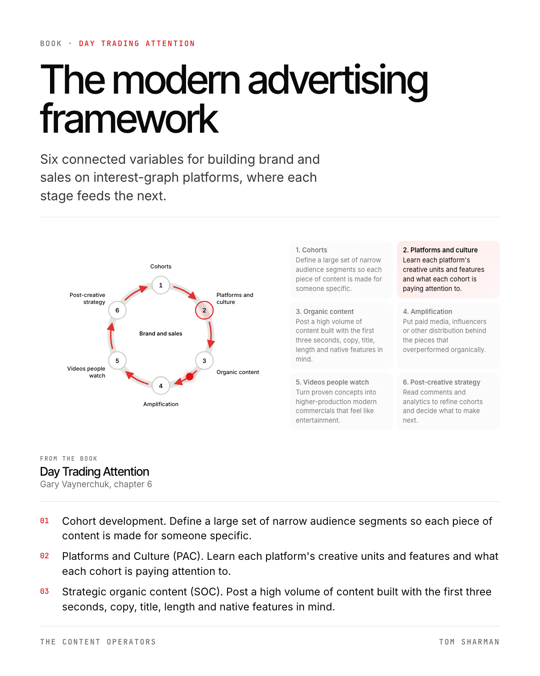
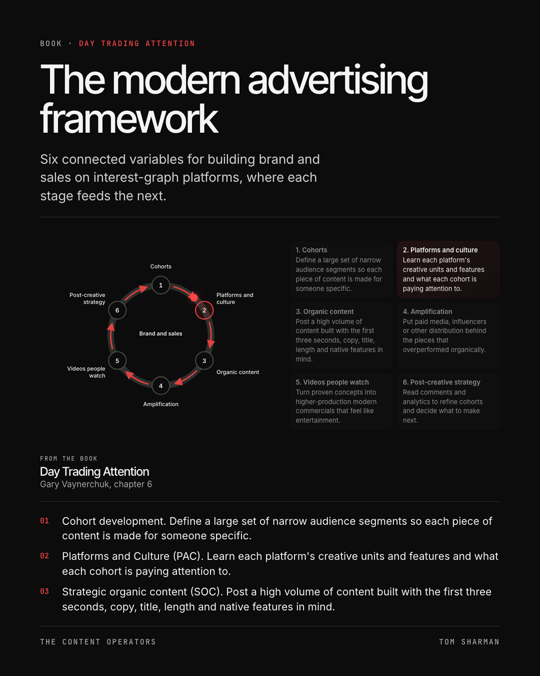
Six connected variables for building brand and sales on interest-graph platforms, where each stage feeds the next.
- Cohort development. Define a large set of narrow audience segments so each piece of content is made for someone specific.
- Platforms and Culture (PAC). Learn each platform's creative units and features and what each cohort is paying attention to.
- Strategic organic content (SOC). Post a high volume of content built with the first three seconds, copy, title, length and native features in mind.
- Amplification. Put paid media, influencers or other distribution behind the pieces that overperformed organically.
- Videos people want to watch. Turn proven concepts into higher-production modern commercials that feel like entertainment.
- Post-creative strategy (PCS). Read comments and analytics to refine cohorts and decide what to make next.
From chapter: Part 2: The Modern Advertising Framework, pp. 29–45
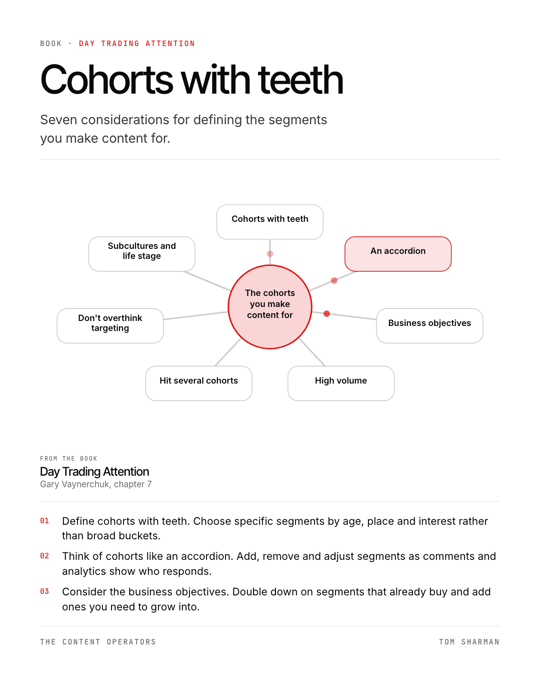
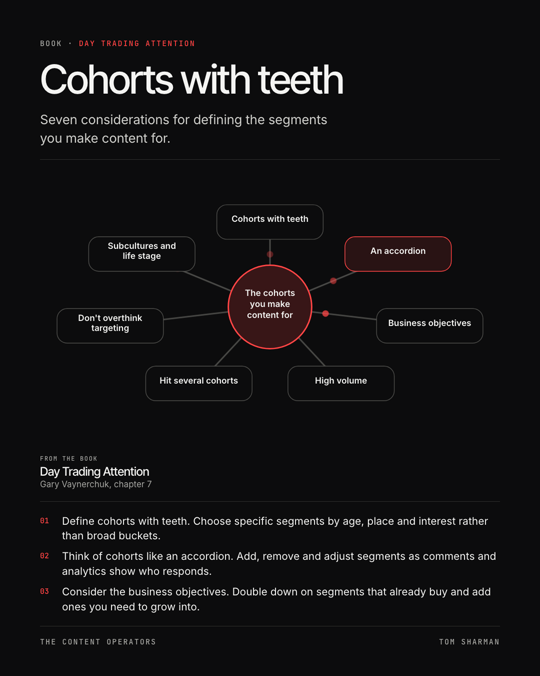
Seven considerations for defining the segments you make content for.
- Define cohorts with teeth. Choose specific segments by age, place and interest rather than broad buckets.
- Think of cohorts like an accordion. Add, remove and adjust segments as comments and analytics show who responds.
- Consider the business objectives. Double down on segments that already buy and add ones you need to grow into.
- Define a high volume of cohorts. Make many segments so each piece of content can be sharper and more relevant.
- Let creative hit multiple cohorts. Treat cohort labels as hypotheses and do not be crippled when content fits several.
- Consider but do not overthink media addressability. Remember that platforms may serve your ads to better segments than the ones you targeted.
- Consider subcultures, life stage and psychographics. Use affinities, life stages and cultural trends as well as demographics.
From chapter: Part 3: The Core Variables, pp. 46–123
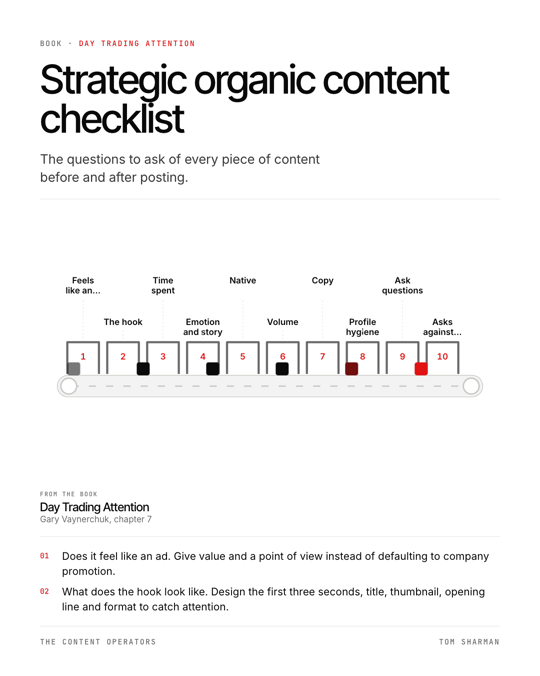
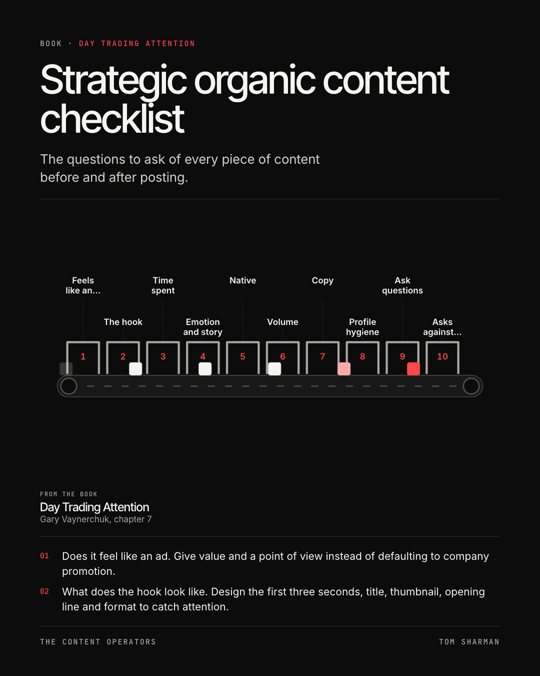
The questions to ask of every piece of content before and after posting.
- Does it feel like an ad. Give value and a point of view instead of defaulting to company promotion.
- What does the hook look like. Design the first three seconds, title, thumbnail, opening line and format to catch attention.
- Do people spend time with it. Check watch time, retention and engagement analytics for what to improve.
- Does it evoke emotion and tell a story. Keep attention through the whole piece with information, thought or entertainment.
- Is it native to the platform. Use the platform's sizes, in-app features, contextual copy and cultural trends.
- Is the volume high enough. Post often enough to learn what quality means on each platform.
- Is the copy optimised. Use the caption to address cohorts and add curiosity and context.
- What is your profile hygiene. Make sure people know who you are and what to do next once they click through.
- Do you show different sides of yourself. Share personal and professional sides to create more points of relevance.
- Do you ask the audience questions. Use polls and opinions to get insights on what to make.
- Do you balance asks with value. Mix valuable posts with sales-focused ones, as in Jab, Jab, Jab, Right Hook.
From chapter: Part 3: The Core Variables, pp. 46–123
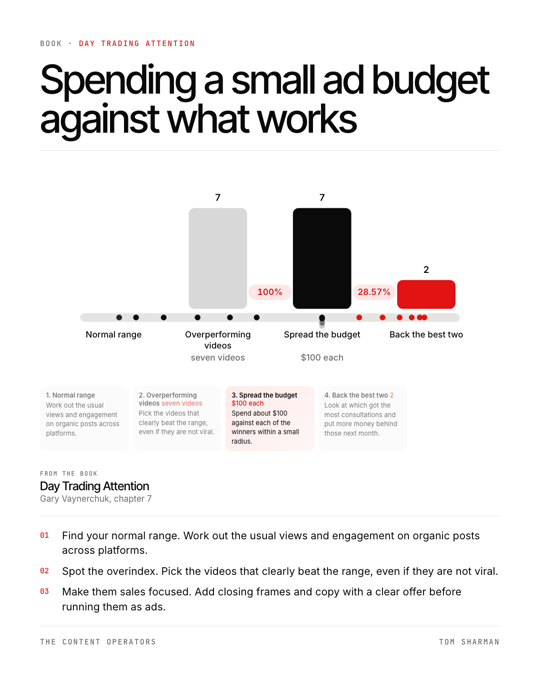
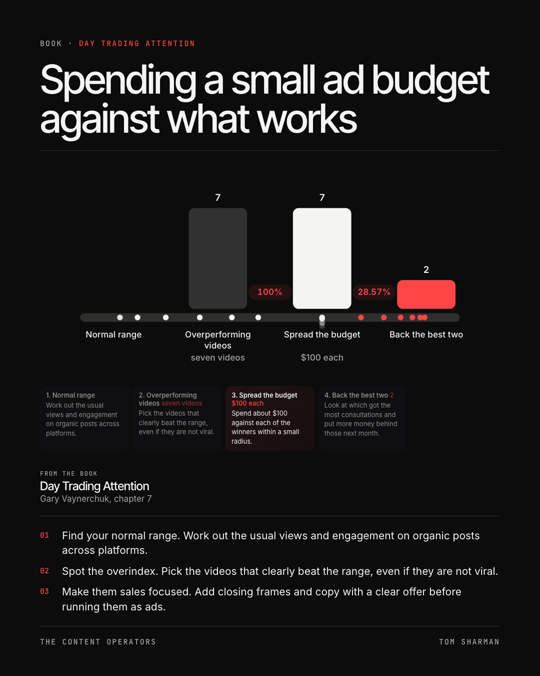
His plumber example of turning organic winners into local ads without wasting budget.
- Find your normal range. Work out the usual views and engagement on organic posts across platforms.
- Spot the overindex. Pick the videos that clearly beat the range, even if they are not viral.
- Make them sales focused. Add closing frames and copy with a clear offer before running them as ads.
- Spread the budget. Spend about $100 against each of the winners within a small radius.
- Back the best two. Look at which got the most consultations and put more money behind those next month.
- Repurpose natively. Adapt the winners for other platforms with native titles and test them organically first.
From chapter: Part 3: The Core Variables, pp. 46–123
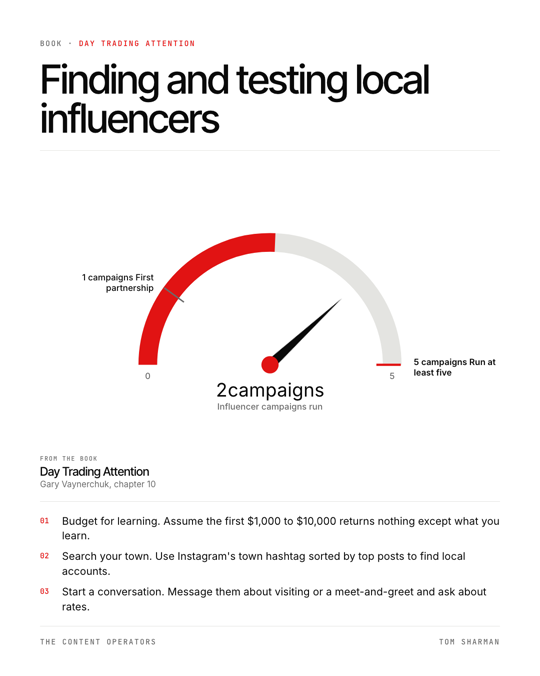
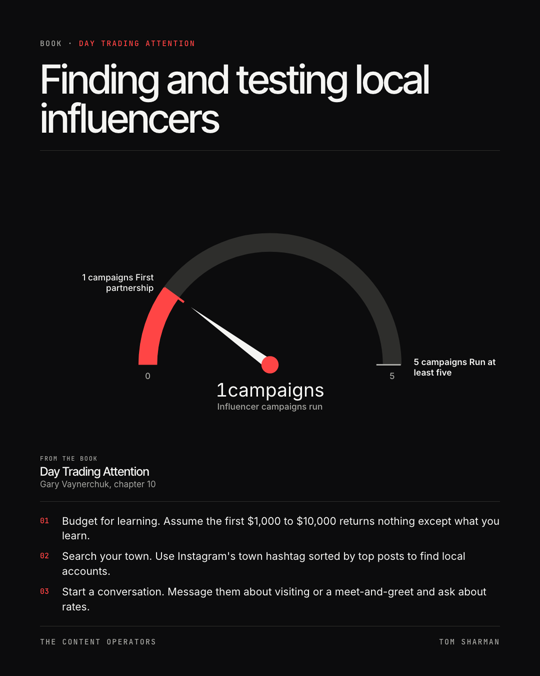
His salon scenario for researching, selecting and engaging influencers who drive results.
- Budget for learning. Assume the first $1,000 to $10,000 returns nothing except what you learn.
- Search your town. Use Instagram's town hashtag sorted by top posts to find local accounts.
- Start a conversation. Message them about visiting or a meet-and-greet and ask about rates.
- Try the first partnership. Learn from it, even if it flops.
- Run at least five. Do not judge influencer marketing until five campaigns have flopped.
- Test both big and local. Try the highest-followed local person and a nearby alpha mom with a small audience.
From chapter: Part 6: Real-Life Scenarios, pp. 220–255
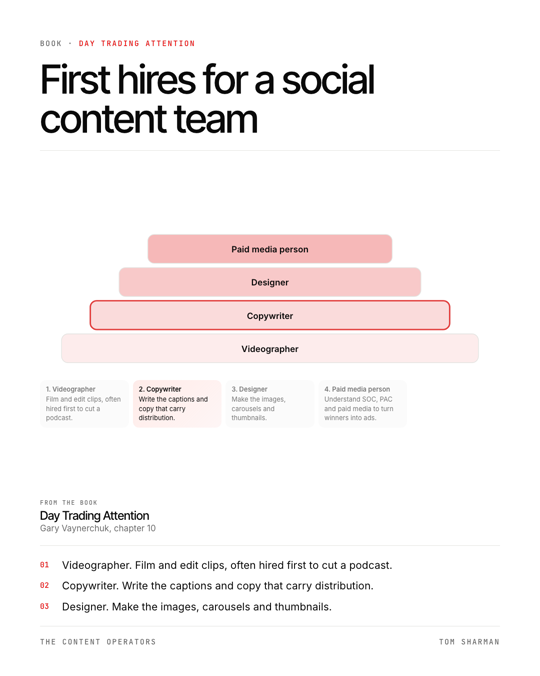
The four people he recommends once you know the craft yourself.
- Videographer. Film and edit clips, often hired first to cut a podcast.
- Copywriter. Write the captions and copy that carry distribution.
- Designer. Make the images, carousels and thumbnails.
- Strategic paid media person. Understand SOC, PAC and paid media to turn winners into ads.
From chapter: Part 6: Real-Life Scenarios, pp. 220–255
Working with Tom on this
Tom works with creators and founders one to one, from a single session to a fractional role. Work with Tom
Back to the bookshelf