Bookshelf
How Tom uses this
Invention backs five of Tom's lessons and argues with one. Under each of his lessons, what the book says about it, and on which pages.
- A brand that compounds has a mission and an enemy
Dyson built his launch advertising around naming the enemy, the bag, with the line No bag, no loss of suction, and the mission of constant suction. pp. 111 and 112.
- The brand is the argument
The clear bin and the Paris gallery showroom with products on plinths let the product and its engineering make the case, before any claim is read. pp. 111, 199 and 293. In the book: The Dyson Institute model.
- It is about their business, told as what the audience learns
Dyson's advertising explained how the technology works so the audience learned something, instead of using slick sales lines. pp. 44, 202 and 203.
- Assumptions made too fast, and risk avoided
Dyson ignored research that said the DC01 was too dear and that nobody would want a clear bin, and backed his instinct with real results. pp. 111 and 307.
- Macro and micro at the same time
Jake describes his father as obsessed with both the micro detail, reading every legal word, and the big picture. p. 370. In the book: Learn as you go.
Where it disagrees with Tom
What it argues
Dyson argues that invention is endurance, patient observation and a willingness to fail, so the eureka moment is folklore, as 5,127 prototypes changed one at a time showed. A designer who wants to bring new products to market has to own the whole chain of design, making and selling, and keep the patents, the company and the shareholding under his own control, a lesson he learned by losing the Ballbarrow company in 1979. Experts, focus groups and market research steer people toward what already exists, so he trusts instinct, builds core technologies like the digital motor in-house and explains the engineering plainly to customers. Growth meant going global, selling direct, moving production to Asia, and a readiness to kill a successful product or cancel a £500 million electric car when the economics failed. He wraps this in a case for education that teaches by making and failing, and for private family ownership that can take long risks.
Worth keeping
- Invention is endurance and patient observation, and failure is the raw material: 5,127 prototypes, 5,126 of them failures (p. 5, 6, 84).
- Change one thing at a time and see what that change did; breakthroughs come from empirical testing and rarely from eureka moments (p. 83).
- Hold your patent, avoid shareholders and keep absolute control of your company: the Ballbarrow was lost because he assigned the patent to the company (p. 77, 78).
- Do not copy the opposition and do not worry about market research; the Mini and the Walkman would have died in focus groups (p. 45, 53, 77).
- Control the whole process of design, making and selling, and build the core technologies (like the digital motor) in-house (p. 39, 57, 152).
- Explain the technology plainly and let the founder front it: the inventor-entrepreneur story with 5,127 prototypes sold in America and failed in Europe (p. 202, 203).
- Sell direct to customers and cut the middleman, from Dyson stores to farm produce (p. 214, 262, 263).
- Price on the value you built: cutting the Contrarotator by £200 sold the same number and lost more money (p. 126).
- Be willing to kill a successful product with a better one, and cancel a project when the economics fail, even at £500 million (p. 163, 238, 311).
- Learning by making, trial and error and failing is the best education, and the Dyson Institute pays undergraduates to work on real products (p. 271, 285, 288).
Which project it moves forward
The Content Operators launch
The launch is about selling a built product to a first cohort, and the book shows owning the IP, explaining it plainly, selling direct and pricing on value over market research.
The questions it answers
- How do you build a personal brand that generates inbound rather than requiring outbound?
Dyson's inventor-entrepreneur story in his own ads, with the 5,127 prototypes hook, made US customers and even immigration officers recognise him (p. 202).
- Which of my stories travel, and which only feel like they should?
The 5,127 prototypes story landed in America and Japan but failed in Europe, where buyers wanted a large established firm, so a story travels by market (p. 202, 203).
- How do you price and sell a tool you built for yourself?
Designing for yourself as the user lowers risk (p. 58), the DC01 sold at five times the going price once its benefit was explained, and the Contrarotator shows underpricing loses money (p. 117, 126).
- What is the smallest team that can produce at the volume I am used to?
Dyson used a flat structure with all the necessary specialists on each product team, and a ventilator took 450 people, while the car grew from ten to five hundred (p. 236, 250).
- What makes a format repeatable, as opposed to a hit that happened once?
Dyson applies a few core technologies, the cyclone and the digital motor, across many products, so each new product builds on a repeatable engine (p. 131, 156).
The frameworks
4 frameworks, one animation each Every framework, step by step
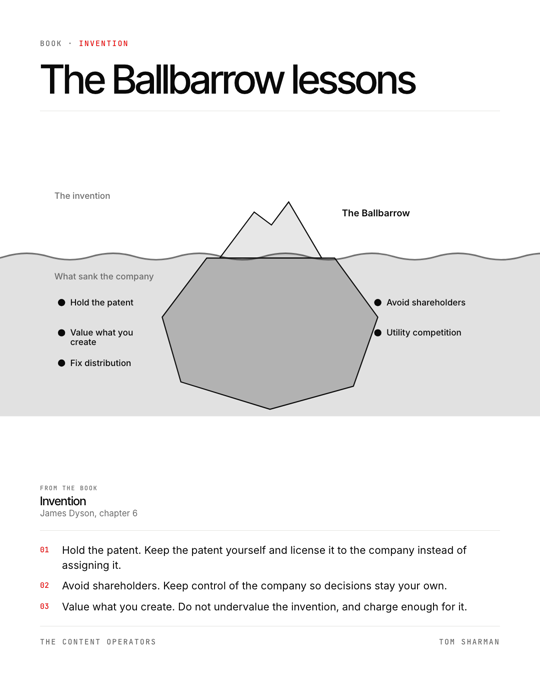
What Dyson says he learned from losing his first company, as rules for protecting an invention.
- Hold the patent. Keep the patent yourself and license it to the company instead of assigning it.
- Avoid shareholders. Keep control of the company so decisions stay your own.
- Value what you create. Do not undervalue the invention, and charge enough for it.
- Do not sell against a utility product. Avoid competing on price against a cheap traditional product with no new expense.
- Fix distribution. Avoid selling one product to many individual outlets through a wholesaler, which leaves no margin.
From chapter: Chapter Four: The Ballbarrow, pp. 63–79
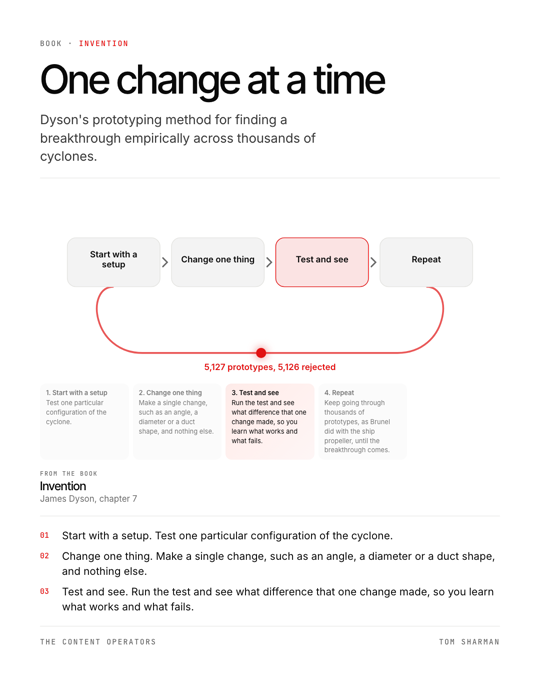
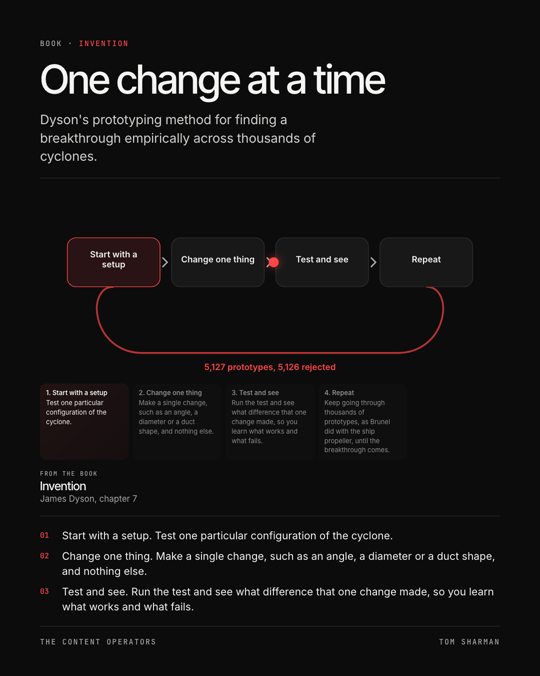
Dyson's prototyping method for finding a breakthrough empirically across thousands of cyclones.
- Start with a setup. Test one particular configuration of the cyclone.
- Change one thing. Make a single change, such as an angle, a diameter or a duct shape, and nothing else.
- Test and see. Run the test and see what difference that one change made, so you learn what works and what fails.
- Repeat. Keep going through thousands of prototypes, as Brunel did with the ship propeller, until the breakthrough comes.
From chapter: Chapter Five: The Coach House, pp. 80–102
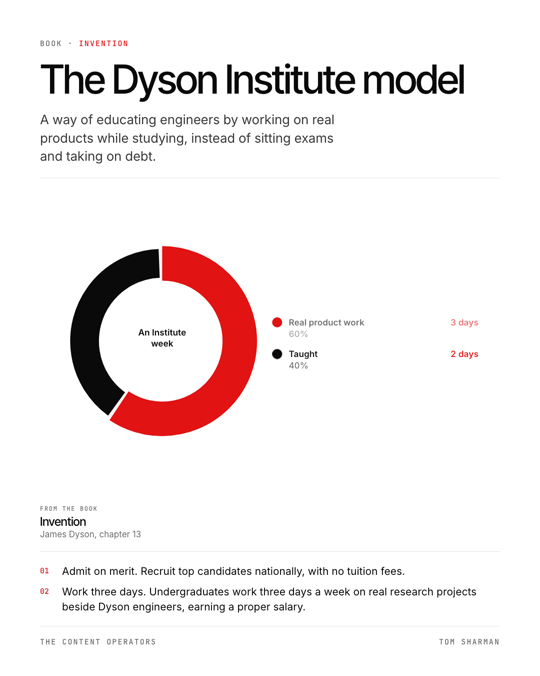
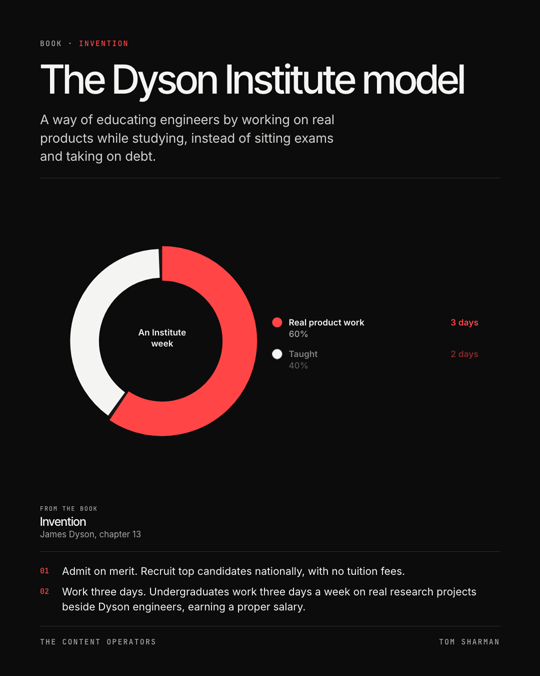
A way of educating engineers by working on real products while studying, instead of sitting exams and taking on debt.
- Admit on merit. Recruit top candidates nationally, with no tuition fees.
- Work three days. Undergraduates work three days a week on real research projects beside Dyson engineers, earning a proper salary.
- Teach two days. Teach the remaining two days, over 47 weeks a year and four years, which Dyson estimates is two and a half times the teaching of traditional universities.
- Put them in a home of their own. House them in factory-built pods on the campus so they feel like independent individuals.
- Free them to leave. Graduate them debt-free and not tied to Dyson, hoping many choose to stay.
From chapter: Chapter Eleven: Education, pp. 271–302
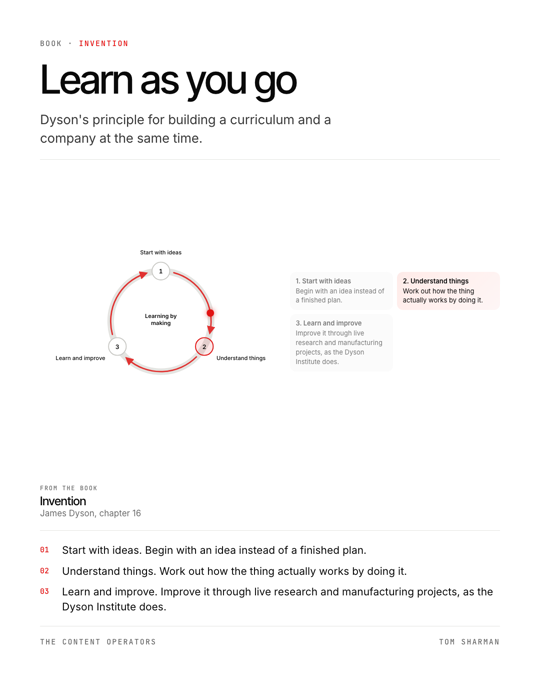
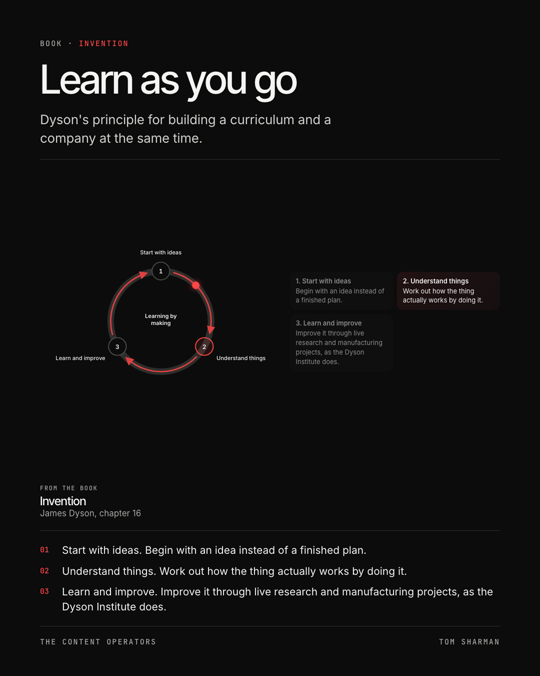
Dyson's principle for building a curriculum and a company at the same time.
- Start with ideas. Begin with an idea instead of a finished plan.
- Understand things. Work out how the thing actually works by doing it.
- Learn and improve. Improve it through live research and manufacturing projects, as the Dyson Institute does.
From chapter: Postscript: Jake Dyson, pp. 368–372
Working with Tom on this
Tom works with creators and founders one to one, from a single session to a fractional role. Work with Tom
Back to the bookshelf