Bookshelf
What it argues
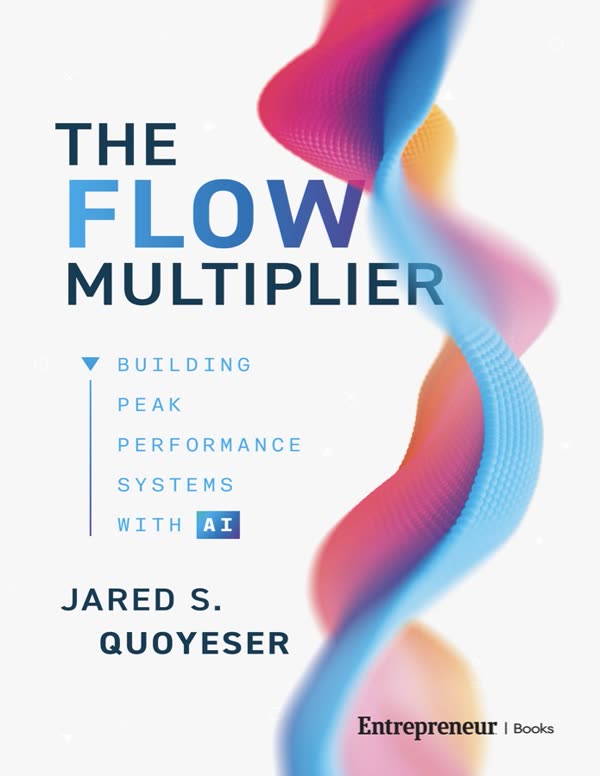
Quoyeser argues that senior people plateau because they run on busyness, notifications and meetings, which feels productive and is not. Flow, the effortless state where time distorts, can be made predictable by engineering the environment, protecting ninety-minute blocks and keeping a short AI stack that removes admin. The PEAK Performance Framework (Prepare, Execute, Amplify through cycles, Keep growing) borrows from elite athletic training, so recovery is planned in weekly and monthly cycles and treated as part of the work. A set of mindset habits (consistency, commitment, structure, flexibility) and a goal system of one overarching goal with 1A, 1B and 1C priorities keep the effort pointed. The evidence is largely the author's own experience and coaching, plus some cited research that is thinly sourced.
Worth keeping
- Protect two ninety-minute blocks a week as the home base for deep work, and label them FLOW (p. 60, p. 103).
- Batch messages, email and meetings into set windows, and tell people when you are unavailable (p. 124).
- Run work in three hard weeks and one lighter integration week (p. 100).
- Use AI for admin and deep research only, and audit weekly whether the stack saves time or adds busywork (p. 66, p. 134).
- Pick one overarching goal with 1A driver, 1B support and 1C future priorities, and apply the ladder-up test (p. 136 to 139).
- Put the phone out of reach and turn notifications off before any deep block (p. 59).
- Block recovery on Friday afternoons and take microbreaks of five to ten minutes between meetings (p. 95, p. 99).
- Plan the year in a week of backward planning, with three major goals, then recalibrate at six months (p. 113).
- Score the four self-assessments first so there is a baseline to compare against (p. 43 to 51).
- Check the 500 percent flow figure against its source before quoting it (p. 30, p. 144).
The frameworks
4 frameworks, one animation each Every framework, step by step
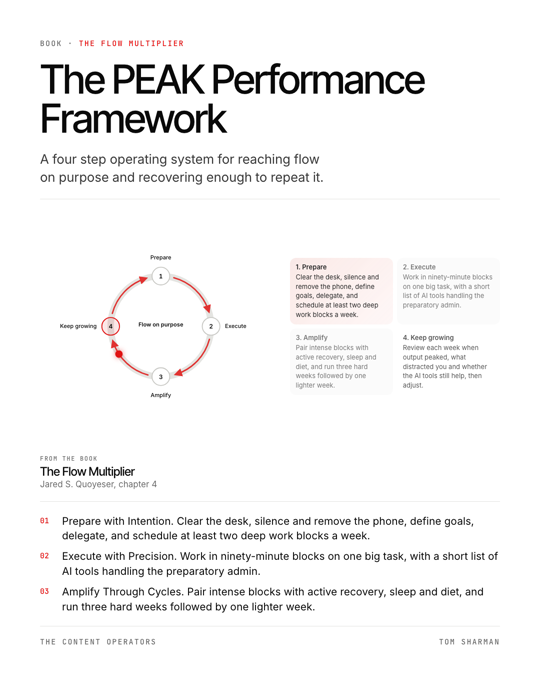
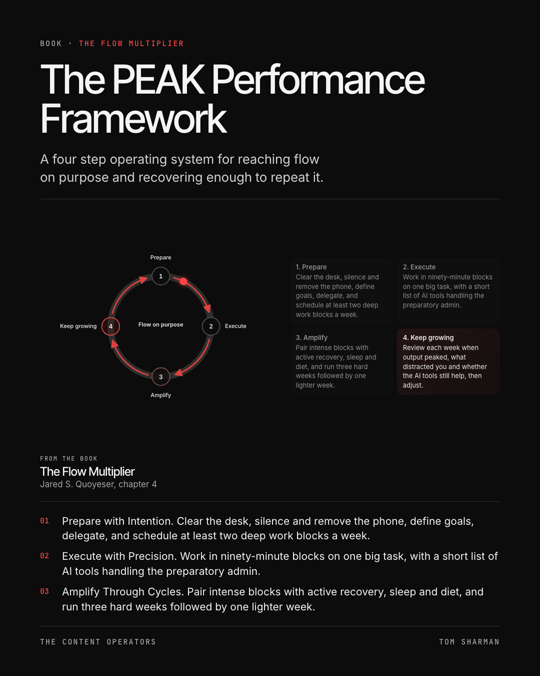
A four step operating system for reaching flow on purpose and recovering enough to repeat it.
- Prepare with Intention. Clear the desk, silence and remove the phone, define goals, delegate, and schedule at least two deep work blocks a week.
- Execute with Precision. Work in ninety-minute blocks on one big task, with a short list of AI tools handling the preparatory admin.
- Amplify Through Cycles. Pair intense blocks with active recovery, sleep and diet, and run three hard weeks followed by one lighter week.
- Keep Growing. Review each week when output peaked, what distracted you and whether the AI tools still help, then adjust.
From chapter: Contents, pp. 9–143
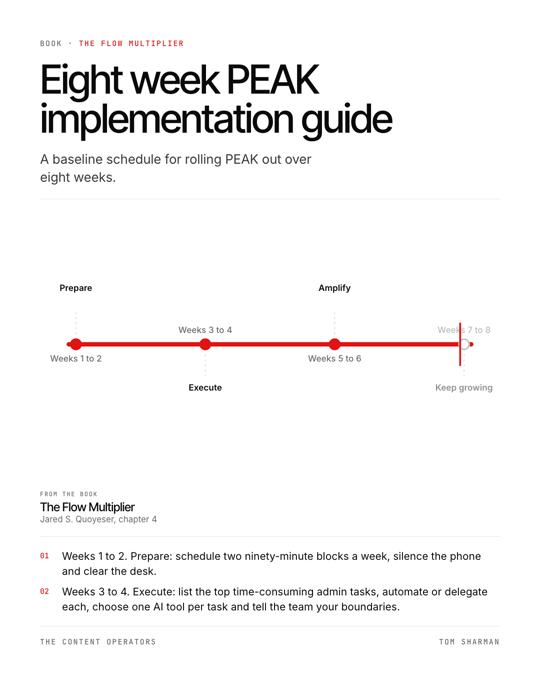
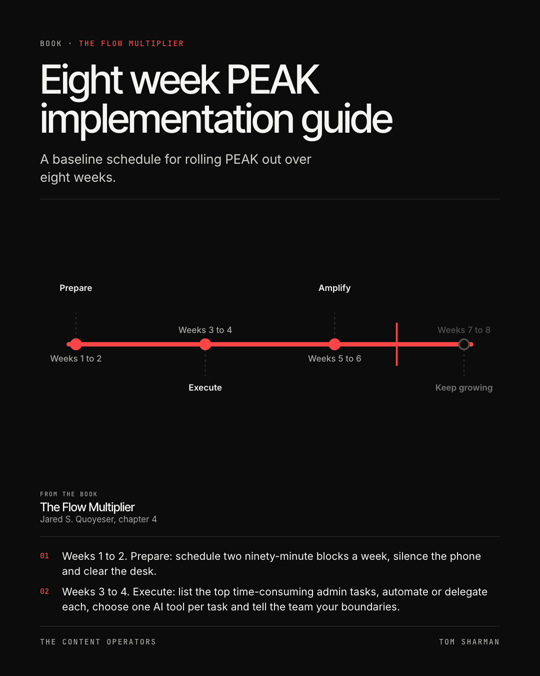
A baseline schedule for rolling PEAK out over eight weeks.
- Weeks 1 to 2. Prepare: schedule two ninety-minute blocks a week, silence the phone and clear the desk.
- Weeks 3 to 4. Execute: list the top time-consuming admin tasks, automate or delegate each, choose one AI tool per task and tell the team your boundaries.
- Weeks 5 to 6. Amplify: plan two to three flow blocks a week, add two recovery methods and track sleep and energy.
- Weeks 7 to 8. Keep growing: review what worked, refine the AI suite and recovery, and plan monthly cycles of three hard weeks and one easier.
From chapter: Contents, pp. 9–143
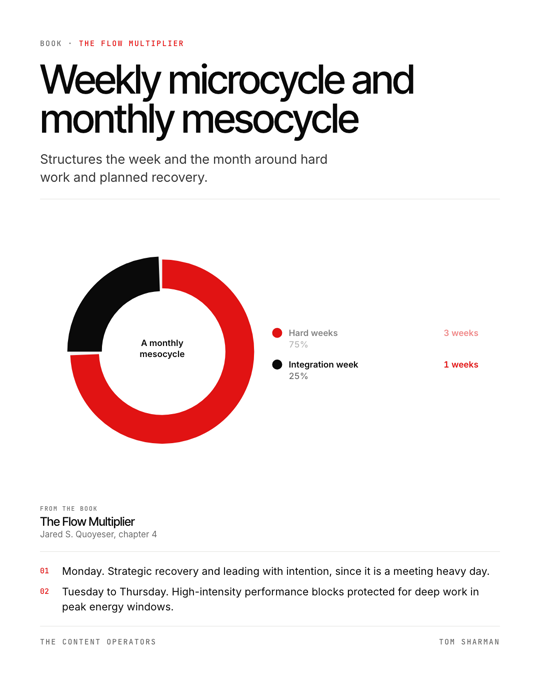
Structures the week and the month around hard work and planned recovery.
- Monday. Strategic recovery and leading with intention, since it is a meeting heavy day.
- Tuesday to Thursday. High-intensity performance blocks protected for deep work in peak energy windows.
- Friday. Active recovery, with the calendar blocked from one o'clock onward.
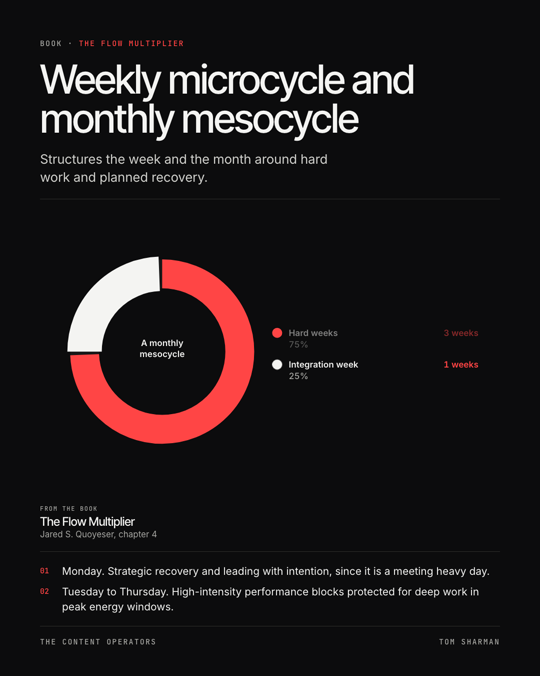
- Monthly mesocycle. Three weeks of progressive intensive work, then one week of integration, reflection and recovery.
From chapter: Contents, pp. 9–143
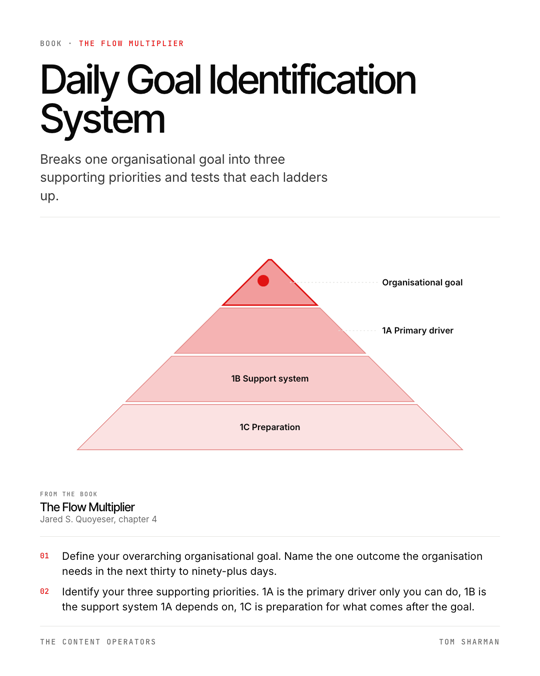
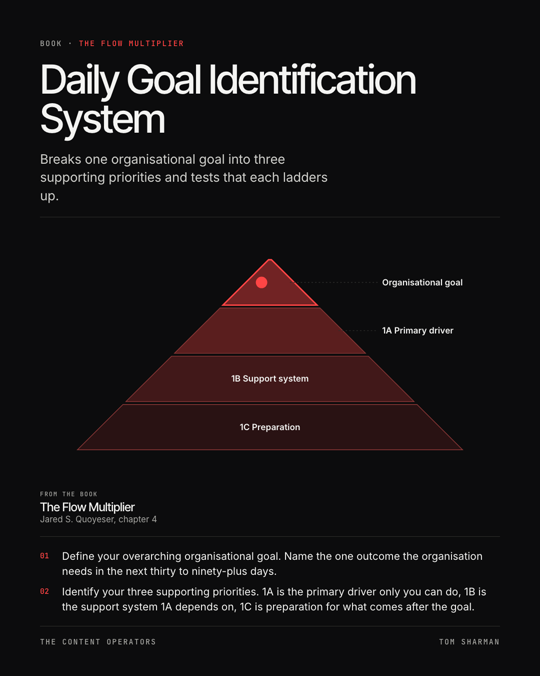
Breaks one organisational goal into three supporting priorities and tests that each ladders up.
- Define your overarching organisational goal. Name the one outcome the organisation needs in the next thirty to ninety-plus days.
- Identify your three supporting priorities. 1A is the primary driver only you can do, 1B is the support system 1A depends on, 1C is preparation for what comes after the goal.
- The ladder-up test. Say how each of 1A, 1B and 1C helps achieve the goal, and drop any that cannot be explained.
From chapter: Contents, pp. 9–143
Working with Tom on this
Tom works with creators and founders one to one, from a single session to a fractional role. Work with Tom
Back to the bookshelf