What it argues
Flynn argues that a business built on superfans is future proof, because people who feel special stay through platform, algorithm and technology change. The sales funnel tracks numbers while the Pyramid of Fandom tracks feelings, and the climb from casual audience to active audience to connected community to superfans is made of many small, human moments over time. Each stage has named strategies, from learning the audience's own words to personalised videos, fan hires and VIP access. Service comes first and money follows as a byproduct, so around 1,000 true fans is enough. The final part warns that superfans bring responsibility: mistakes, burnout, over-automation and real safety risks.
Every framework, step by step
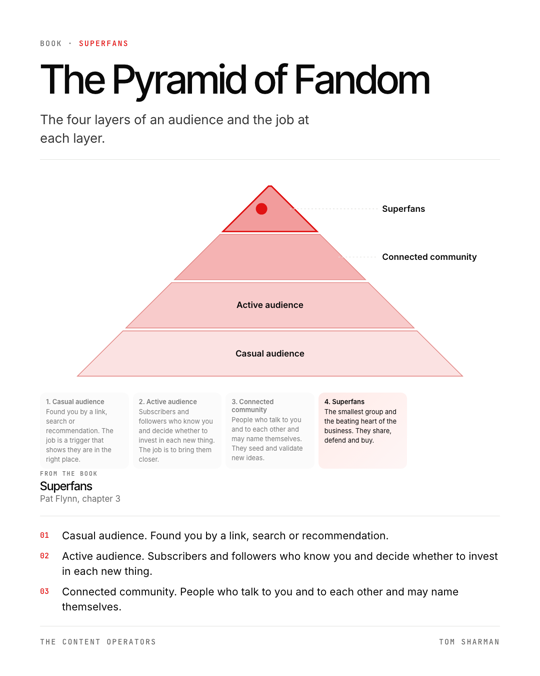
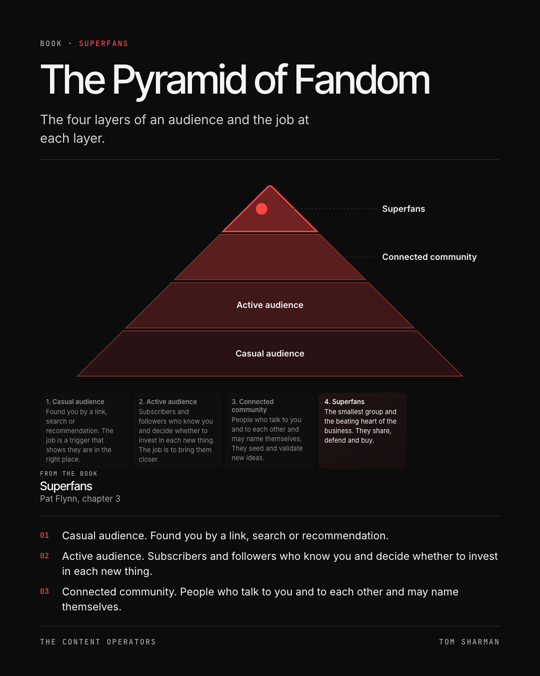
The four layers of an audience and the job at each layer.
- Casual audience. Found you by a link, search or recommendation. The job is a trigger that shows they are in the right place.
- Active audience. Subscribers and followers who know you and decide whether to invest in each new thing. The job is to bring them closer.
- Connected community. People who talk to you and to each other and may name themselves. They seed and validate new ideas.
- Superfans. The smallest group and the beating heart of the business. They share, defend and buy.
From chapter: Introduction: The Superfan Paradigm, pp. 20–33
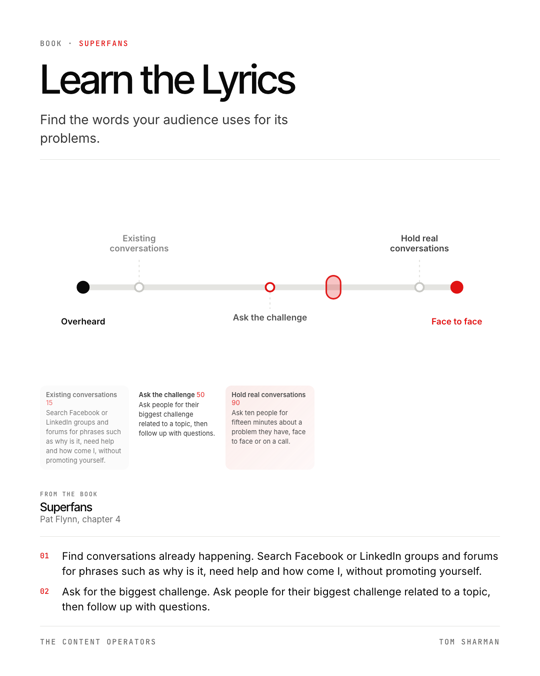
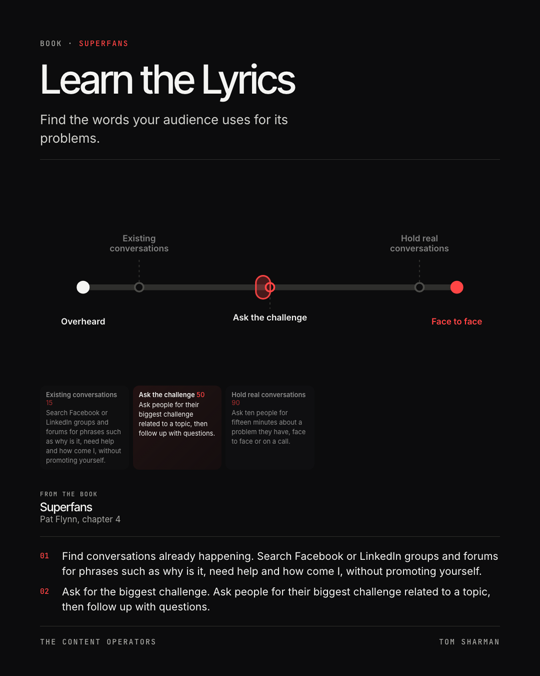
Find the words your audience uses for its problems.
- Find conversations already happening. Search Facebook or LinkedIn groups and forums for phrases such as why is it, need help and how come I, without promoting yourself.
- Ask for the biggest challenge. Ask people for their biggest challenge related to a topic, then follow up with questions.
- Hold real conversations. Ask ten people for fifteen minutes about a problem they have, face to face or on a call.
From chapter: Part 1: Casual Audience to Active Audience, pp. 34–72
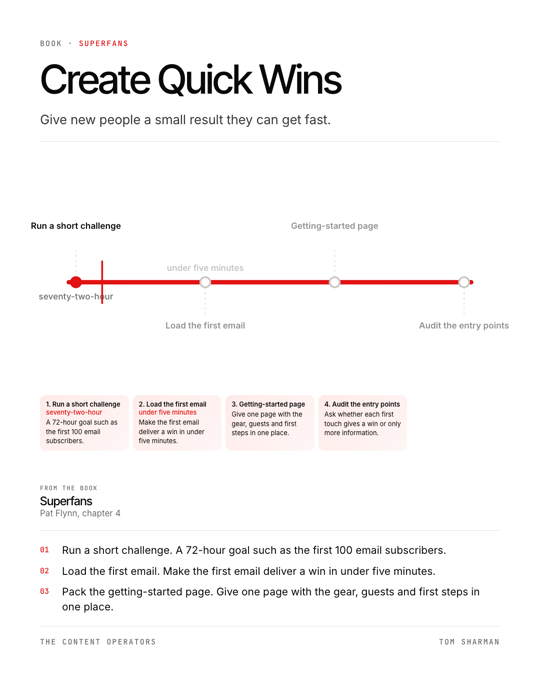
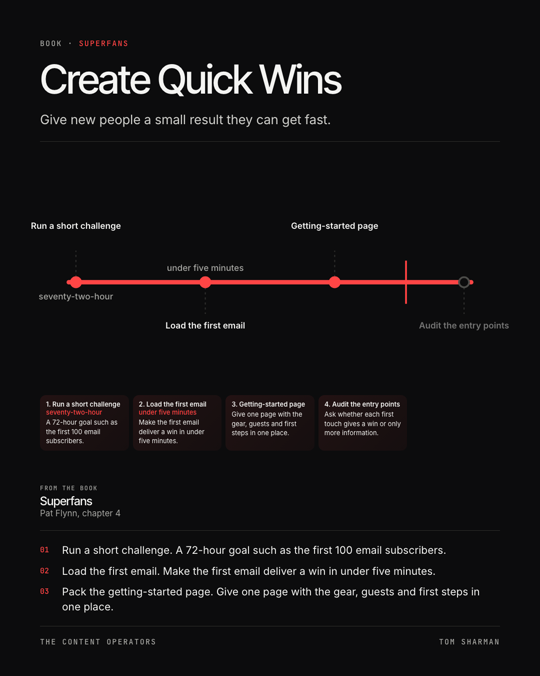
Give new people a small result they can get fast.
- Run a short challenge. A 72-hour goal such as the first 100 email subscribers.
- Load the first email. Make the first email deliver a win in under five minutes.
- Pack the getting-started page. Give one page with the gear, guests and first steps in one place.
- Audit the entry points. Ask whether each first touch gives a win or only more information.
From chapter: Part 1: Casual Audience to Active Audience, pp. 34–72
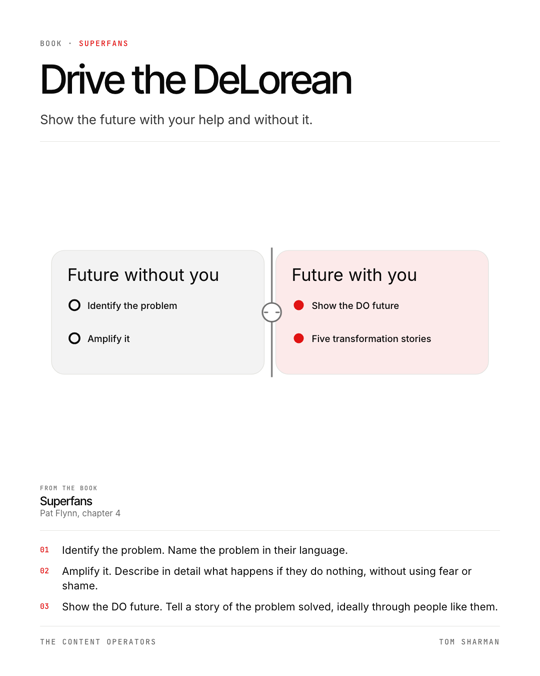
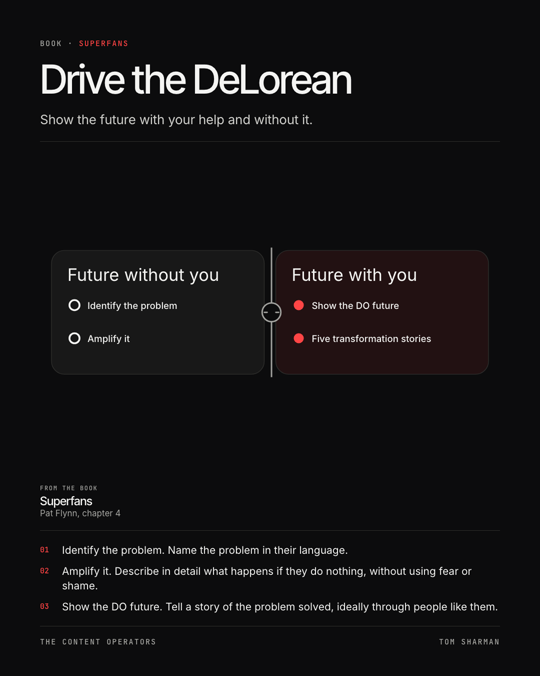
Show the future with your help and without it.
- Identify the problem. Name the problem in their language.
- Amplify it. Describe in detail what happens if they do nothing, without using fear or shame.
- Show the DO future. Tell a story of the problem solved, ideally through people like them.
- Collect five transformation stories. Gather before, after and what-if from your audience and use them in your messages.
From chapter: Part 1: Casual Audience to Active Audience, pp. 34–72
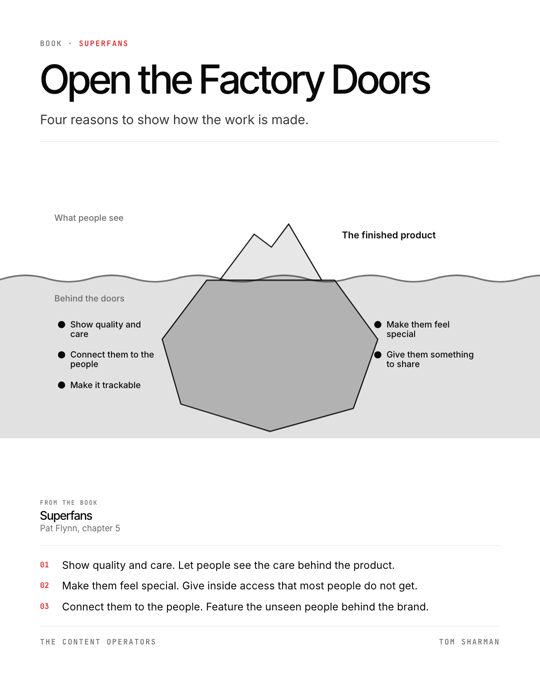
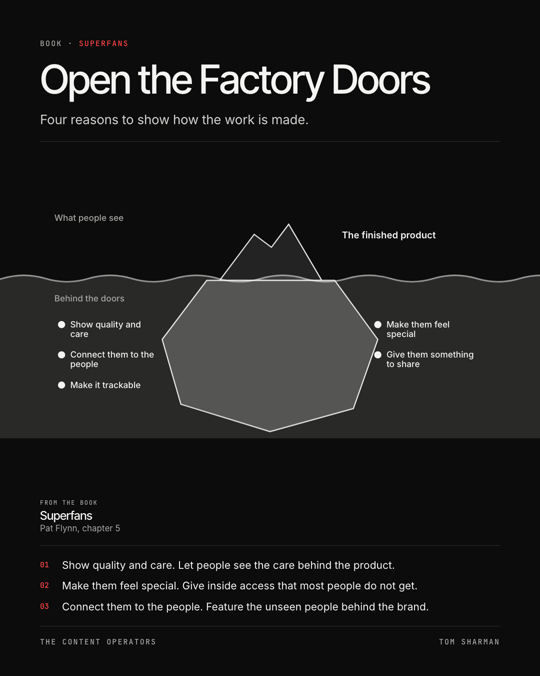
Four reasons to show how the work is made.
- Show quality and care. Let people see the care behind the product.
- Make them feel special. Give inside access that most people do not get.
- Connect them to the people. Feature the unseen people behind the brand.
- Give them something to share. Behind-the-scenes facts get passed on.
- Make it trackable. Share something measurable each month, as with income reports.
From chapter: Part 2: Active Audience to Connected Community, pp. 73–130
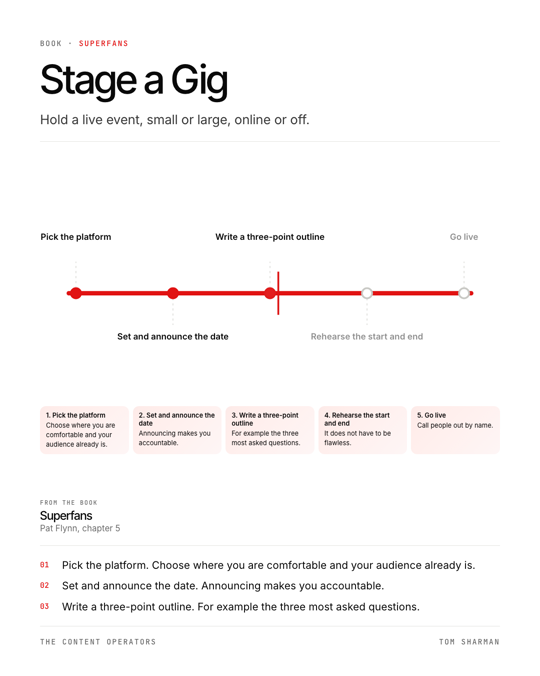
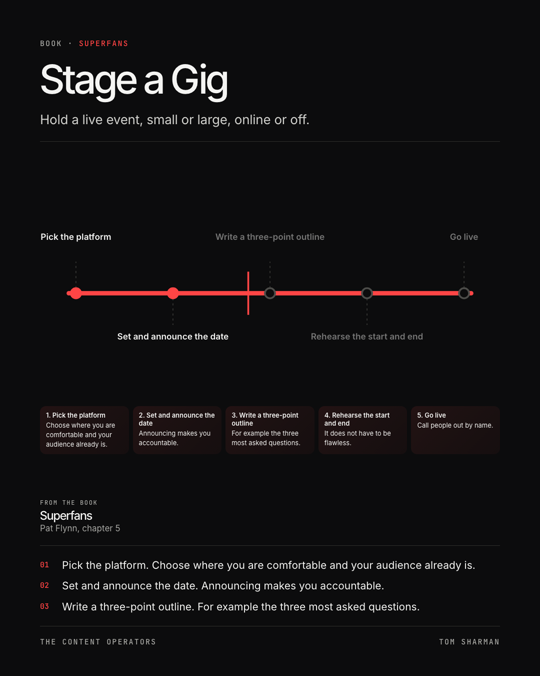
Hold a live event, small or large, online or off.
- Pick the platform. Choose where you are comfortable and your audience already is.
- Set and announce the date. Announcing makes you accountable.
- Write a three-point outline. For example the three most asked questions.
- Rehearse the start and end. It does not have to be flawless.
- Show up and go live. Call people out by name.
From chapter: Part 2: Active Audience to Connected Community, pp. 73–130
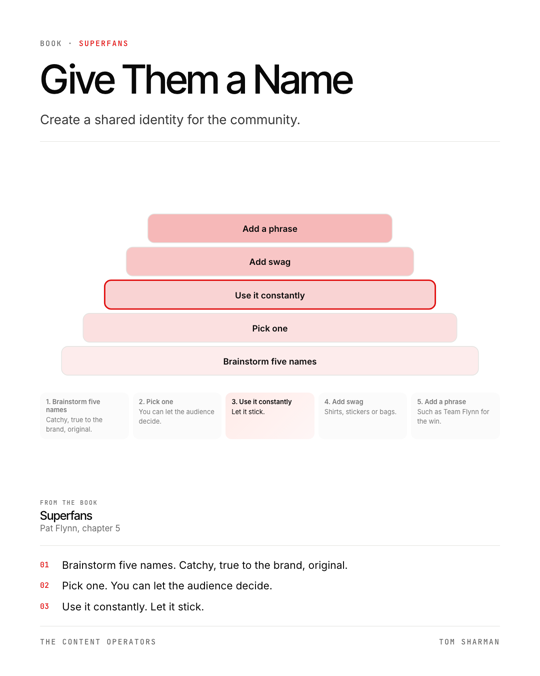
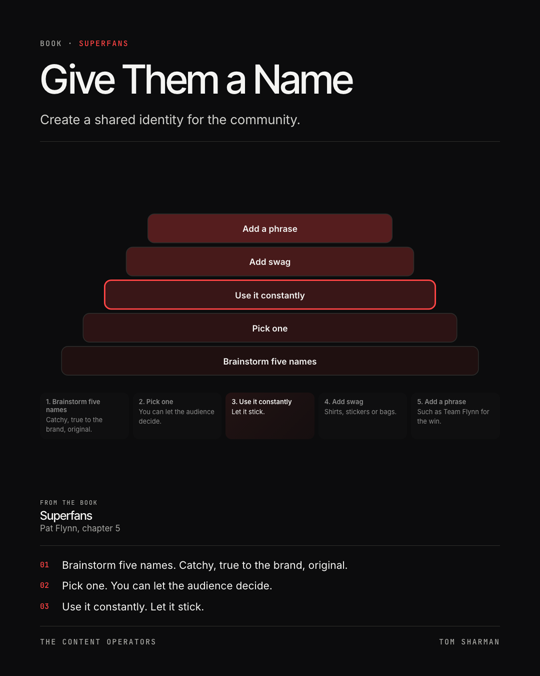
Create a shared identity for the community.
- Brainstorm five names. Catchy, true to the brand, original.
- Pick one. You can let the audience decide.
- Use it constantly. Let it stick.
- Add swag. Shirts, stickers or bags.
- Add a phrase. Such as Team Flynn for the win.
From chapter: Part 2: Active Audience to Connected Community, pp. 73–130
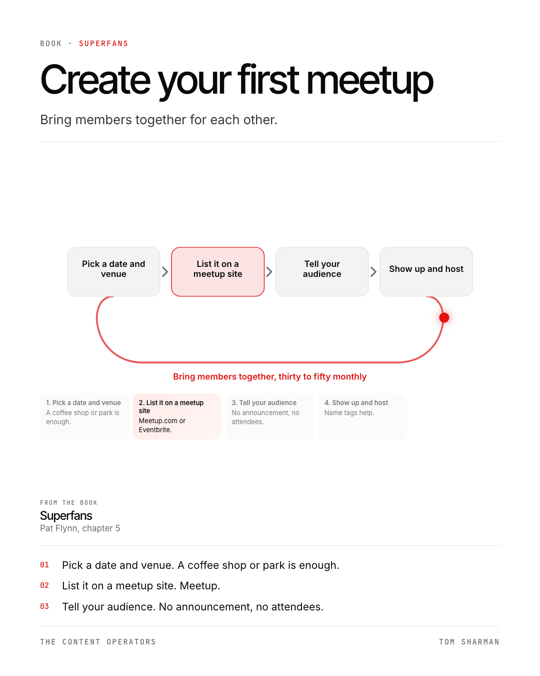
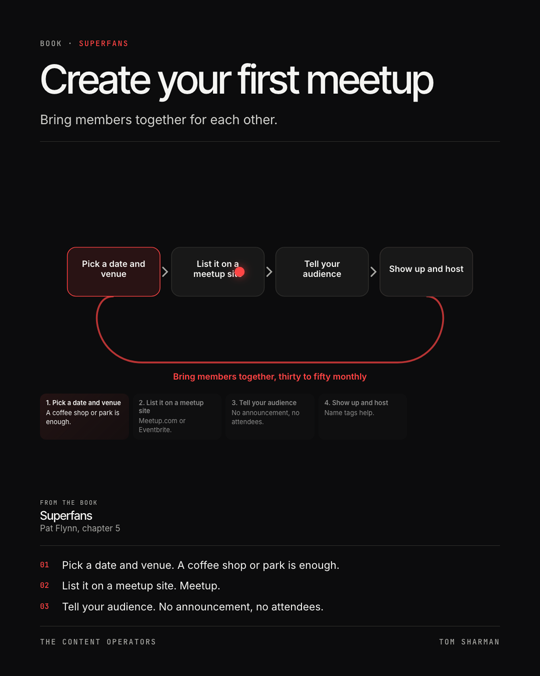
Bring members together for each other.
- Pick a date and venue. A coffee shop or park is enough.
- List it on a meetup site. Meetup.com or Eventbrite.
- Tell your audience. No announcement, no attendees.
- Show up and host. Name tags help.
From chapter: Part 2: Active Audience to Connected Community, pp. 73–130
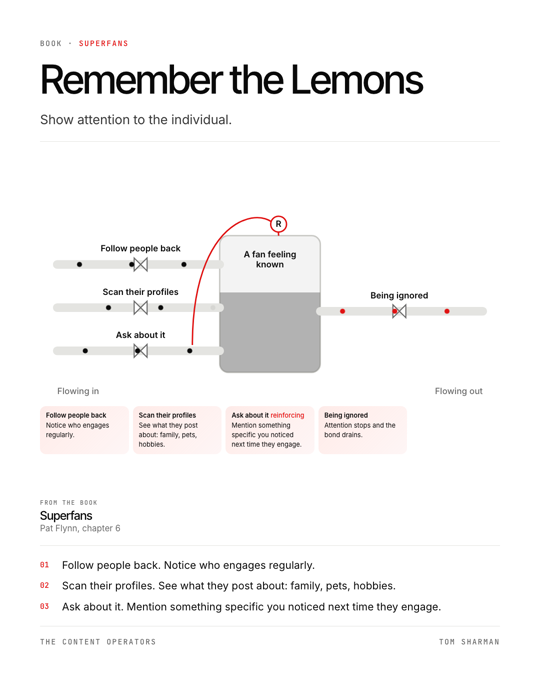
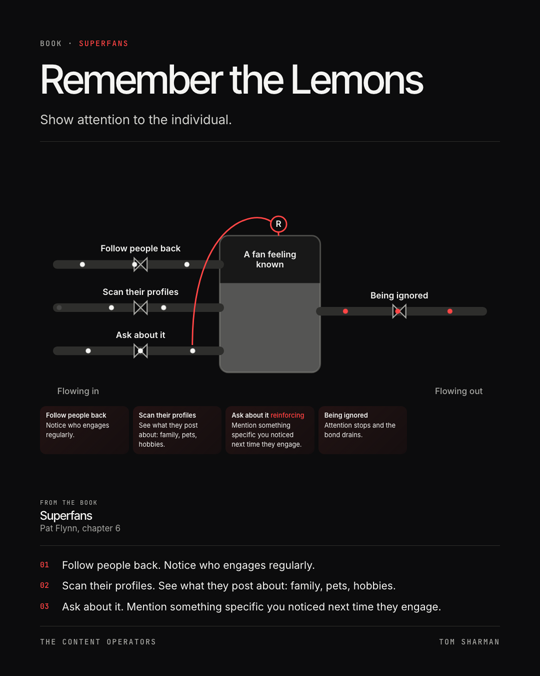
Show attention to the individual.
- Follow people back. Notice who engages regularly.
- Scan their profiles. See what they post about: family, pets, hobbies.
- Ask about it. Mention something specific you noticed next time they engage.
From chapter: Part 3: Connected Community to Superfans, pp. 131–168
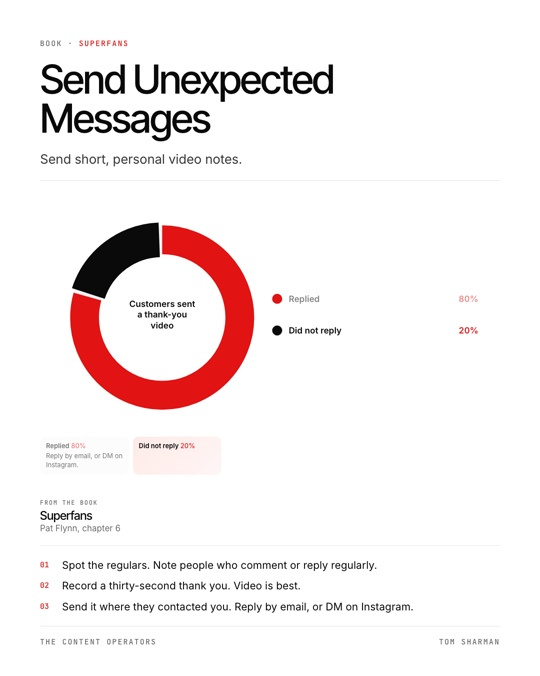
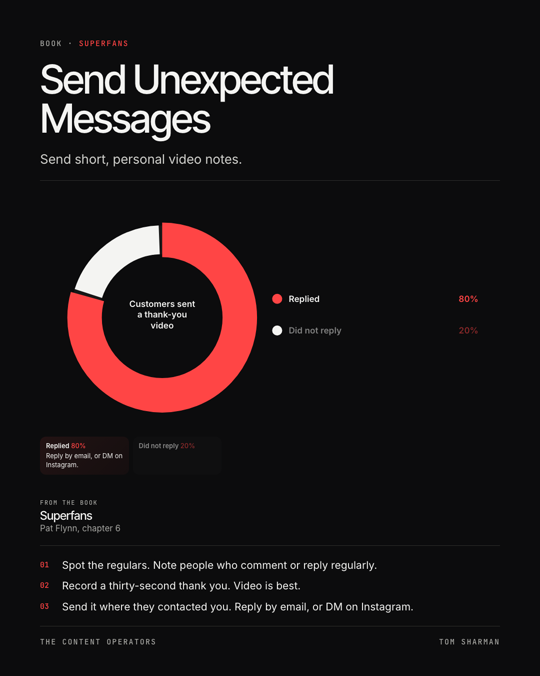
Send short, personal video notes.
- Spot the regulars. Note people who comment or reply regularly.
- Record a thirty-second thank you. Video is best.
- Send it where they contacted you. Reply by email, or DM on Instagram.
From chapter: Part 3: Connected Community to Superfans, pp. 131–168
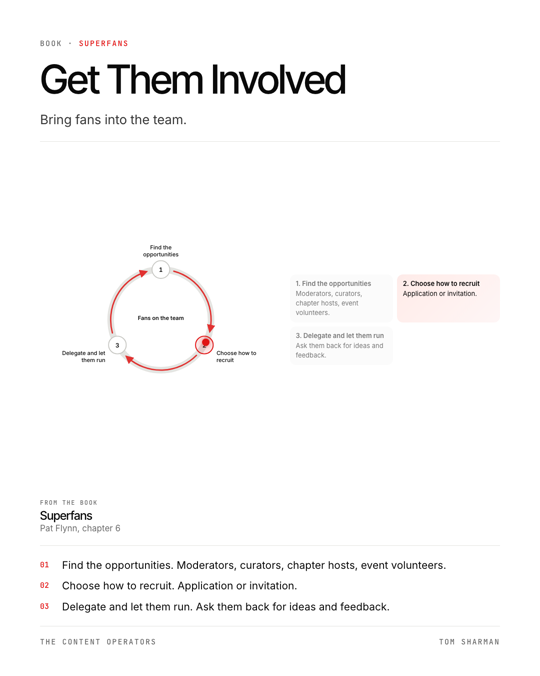
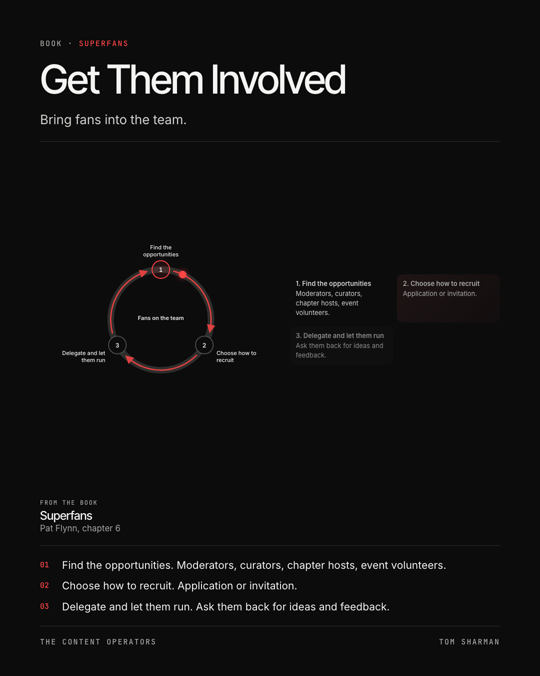
Bring fans into the team.
- Find the opportunities. Moderators, curators, chapter hosts, event volunteers.
- Choose how to recruit. Application or invitation.
- Delegate and let them run. Ask them back for ideas and feedback.
From chapter: Part 3: Connected Community to Superfans, pp. 131–168
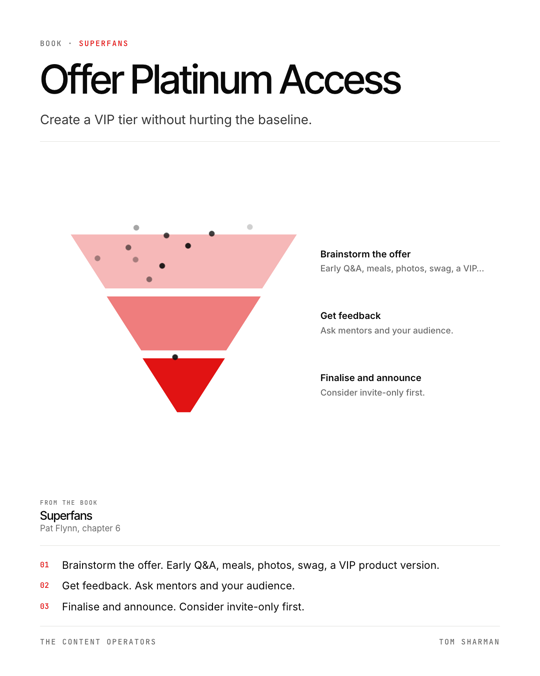
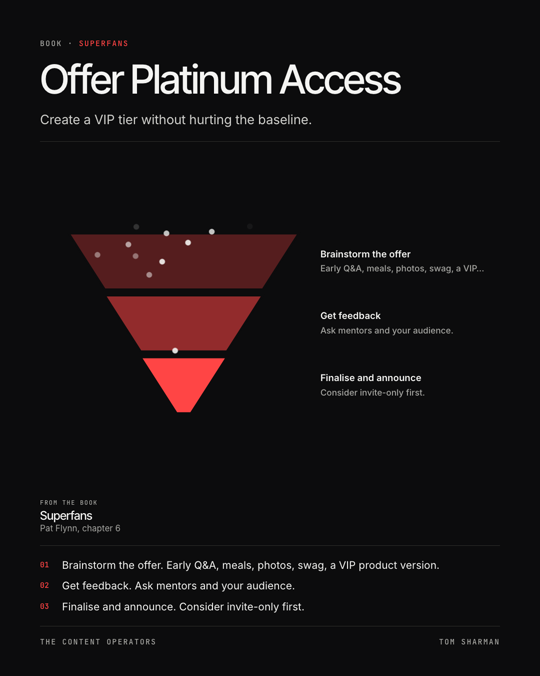
Create a VIP tier without hurting the baseline.
- Brainstorm the offer. Early Q&A, meals, photos, swag, a VIP product version.
- Get feedback. Ask mentors and your audience.
- Finalise and announce. Consider invite-only first.
From chapter: Part 3: Connected Community to Superfans, pp. 131–168
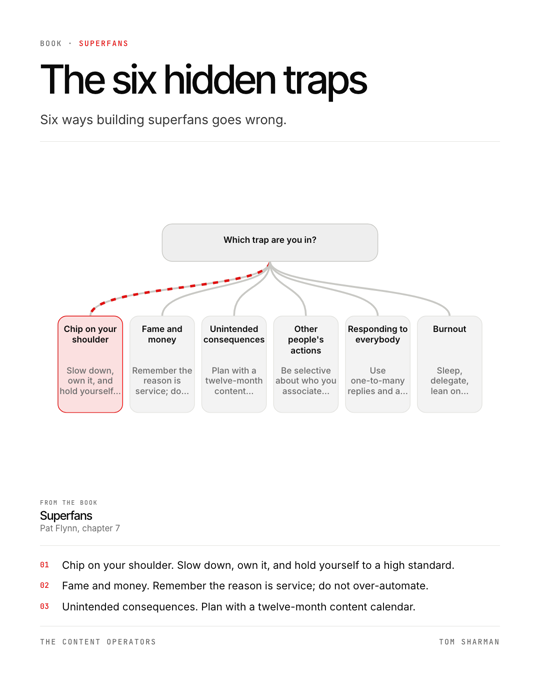
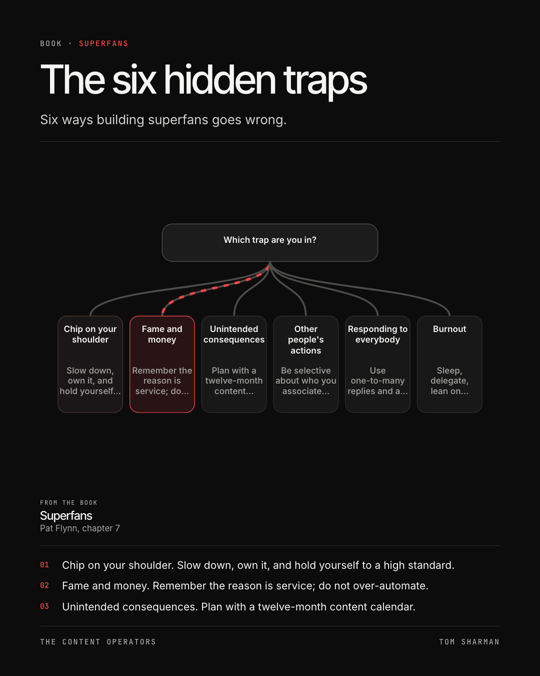
Six ways building superfans goes wrong.
- Chip on your shoulder. Slow down, own it, and hold yourself to a high standard.
- Fame and money. Remember the reason is service; do not over-automate.
- Unintended consequences. Plan with a twelve-month content calendar.
- Other people's actions. Be selective about who you associate with.
- Responding to everybody. Use one-to-many replies and a team, not impersonation.
- Burnout. Sleep, delegate, lean on others, stay focused.
From chapter: Part 4: The Dark Side of Building Superfans, pp. 169–189
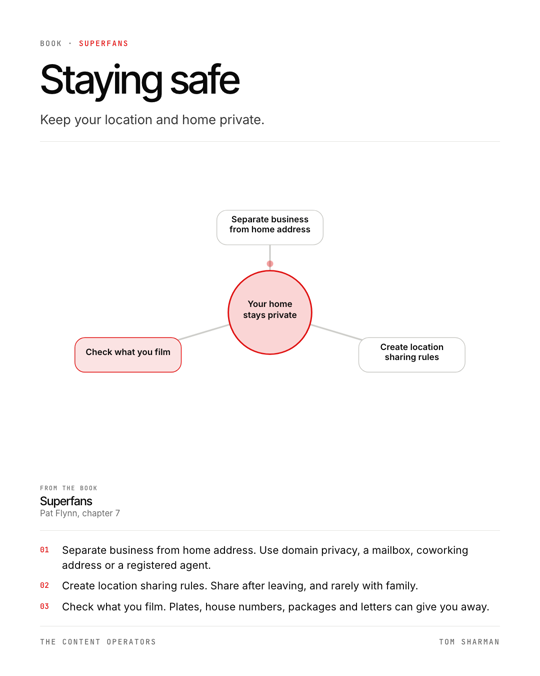
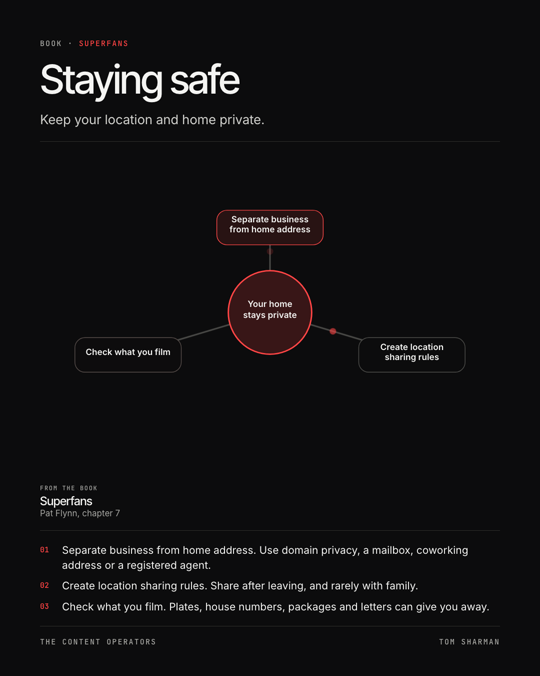
Keep your location and home private.
- Separate business from home address. Use domain privacy, a mailbox, coworking address or a registered agent.
- Create location sharing rules. Share after leaving, and rarely with family.
- Check what you film. Plates, house numbers, packages and letters can give you away.
From chapter: Part 4: The Dark Side of Building Superfans, pp. 169–189
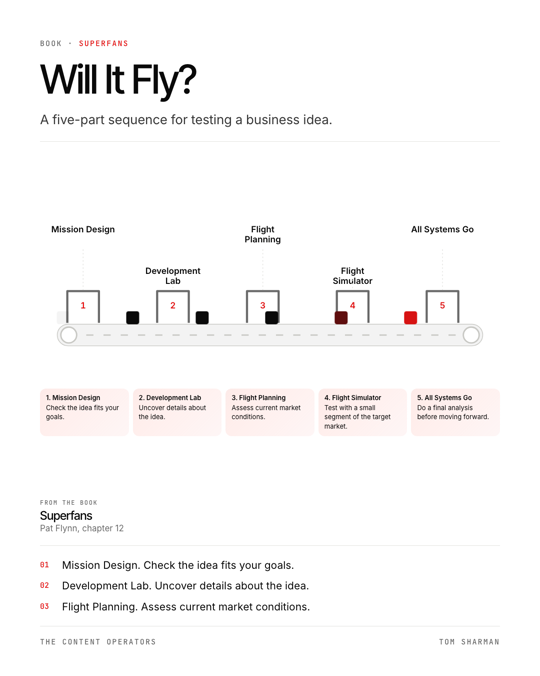
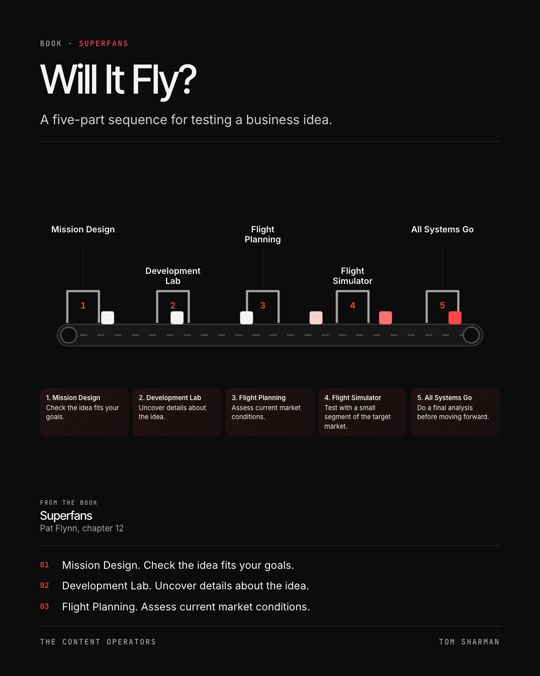
A five-part sequence for testing a business idea.
- Mission Design. Check the idea fits your goals.
- Development Lab. Uncover details about the idea.
- Flight Planning. Assess current market conditions.
- Flight Simulator. Test with a small segment of the target market.
- All Systems Go. Do a final analysis before moving forward.
From chapter: Let Go: My Unexpected Path from Panic to Profits and Purpose, pp. 201–204