What it argues
Grede argues that success starts with taking complete responsibility for yourself, and that the thinking behind your actions counts for more than any playbook. She sets out a sequence: write a concrete vision, learn to manage anger, fear, guilt, sadness and joy, replace a set of cultural Old Thoughts with new ones, and then act quickly. The Old Thoughts cover trade-offs, money, career, family, building a business and leadership, and each is answered from her own record, from the agency she sold to Good American and SKIMS. The business thread is practical: bootstrap, take cash off the table, get product and price right before marketing, take shortcuts, study competitors and treat business as transactional. The leadership thread is an enterprise mentality, three shared priorities, honest feedback and a team run as a team, with loyalty to the vision. She closes with three East London operating principles and fourteen basic rules for success.
Every framework, step by step
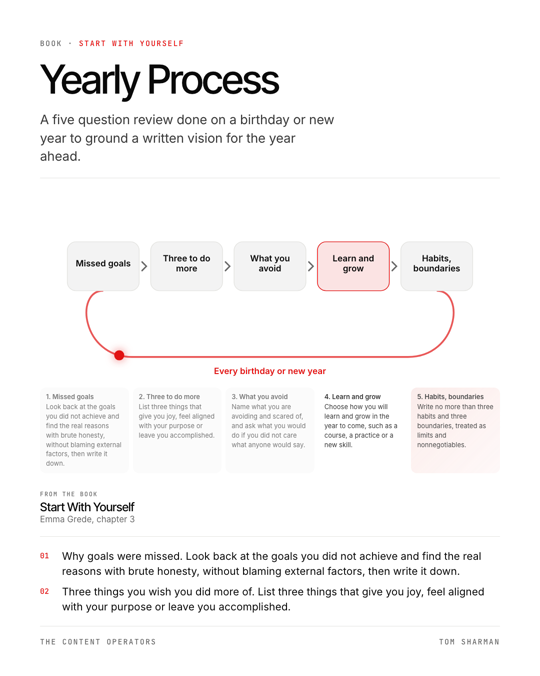
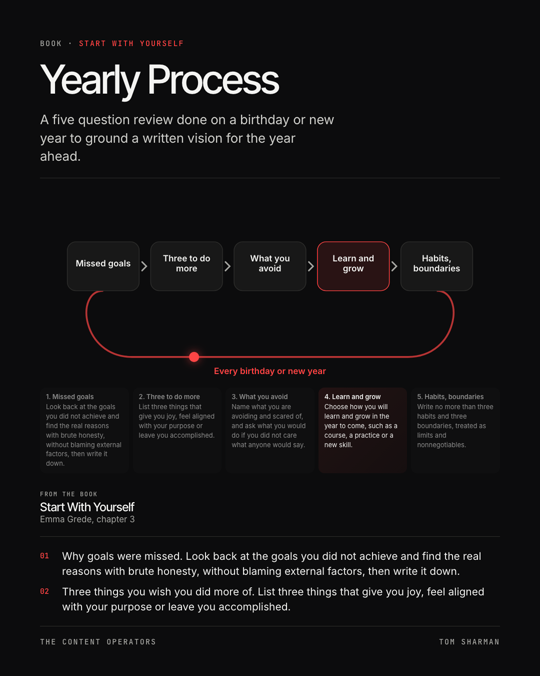
A five question review done on a birthday or new year to ground a written vision for the year ahead.
- Why goals were missed. Look back at the goals you did not achieve and find the real reasons with brute honesty, without blaming external factors, then write it down.
- Three things you wish you did more of. List three things that give you joy, feel aligned with your purpose or leave you accomplished.
- What you are avoiding. Name what you are avoiding and scared of, and ask what you would do if you did not care what anyone would say.
- How you will learn and grow. Choose how you will learn and grow in the year to come, such as a course, a practice or a new skill.
- Habits and boundaries. Write no more than three habits and three boundaries, treated as limits and nonnegotiables.
From chapter: Part One: Vision, pp. 12–22
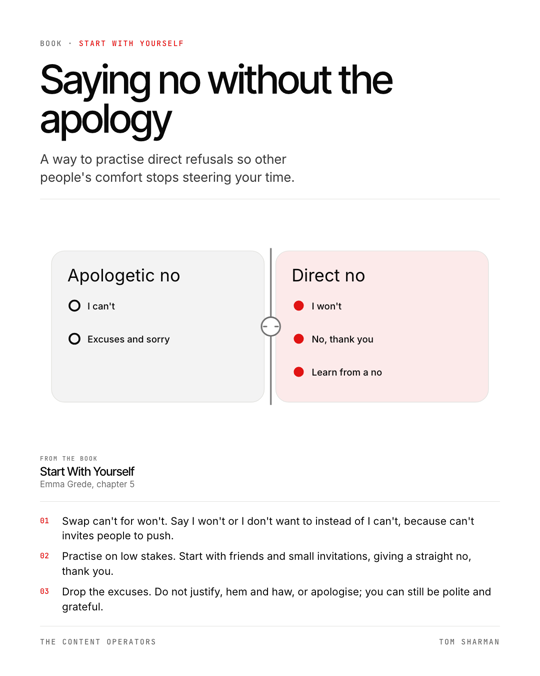
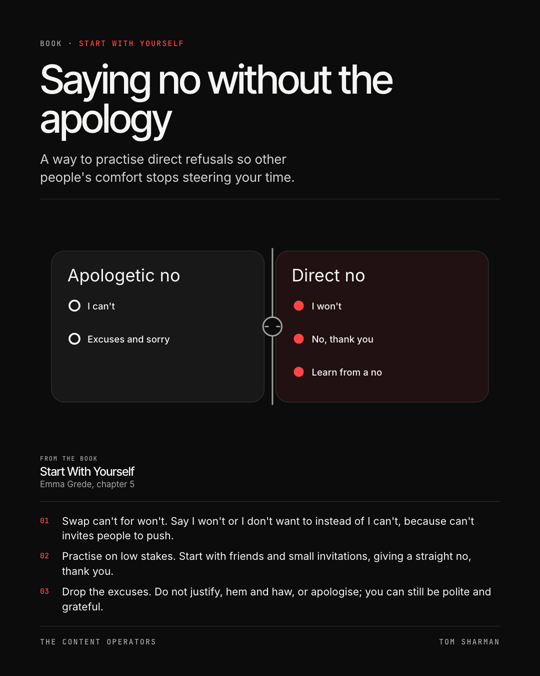
A way to practise direct refusals so other people's comfort stops steering your time.
- Swap can't for won't. Say I won't or I don't want to instead of I can't, because can't invites people to push.
- Practise on low stakes. Start with friends and small invitations, giving a straight no, thank you.
- Drop the excuses. Do not justify, hem and haw, or apologise; you can still be polite and grateful.
- Learn from a no you hear. Treat a no as information, ask questions and look for the lesson, then drop the defensiveness.
From chapter: Part Three: Old Thoughts, pp. 49–237
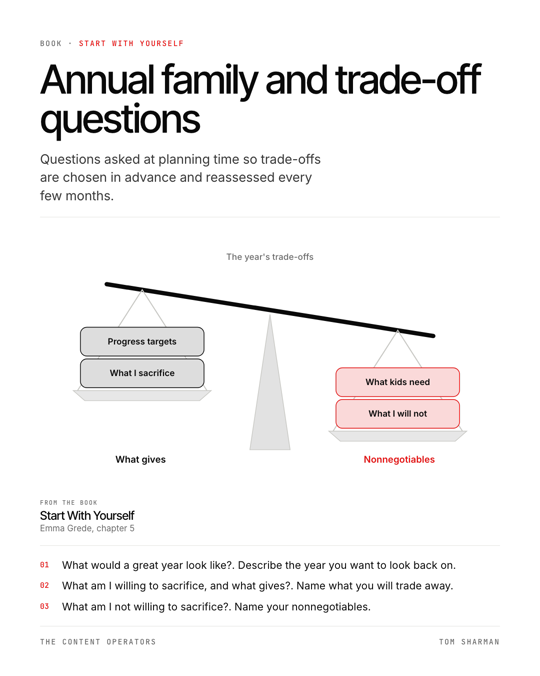
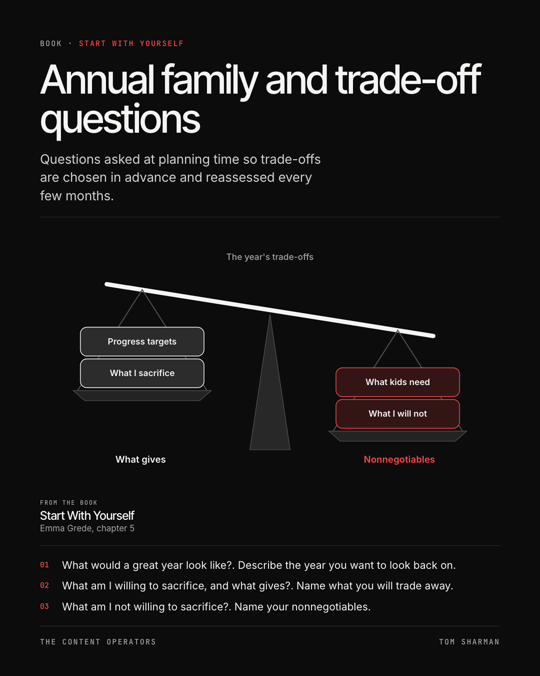
Questions asked at planning time so trade-offs are chosen in advance and reassessed every few months.
- What would a great year look like?. Describe the year you want to look back on.
- What am I willing to sacrifice, and what gives?. Name what you will trade away.
- What am I not willing to sacrifice?. Name your nonnegotiables.
- What progress do I want to make and where?. Set the targets.
- How do I want to look back in twelve months?. Test the plan against the end point.
- What is important to my kids?. Check family priorities are in the plan.
- Work backward. Move step by step in chronological order from the year end to today, then turn it into to-do lists and home screen bullets.
From chapter: Part Three: Old Thoughts, pp. 49–237
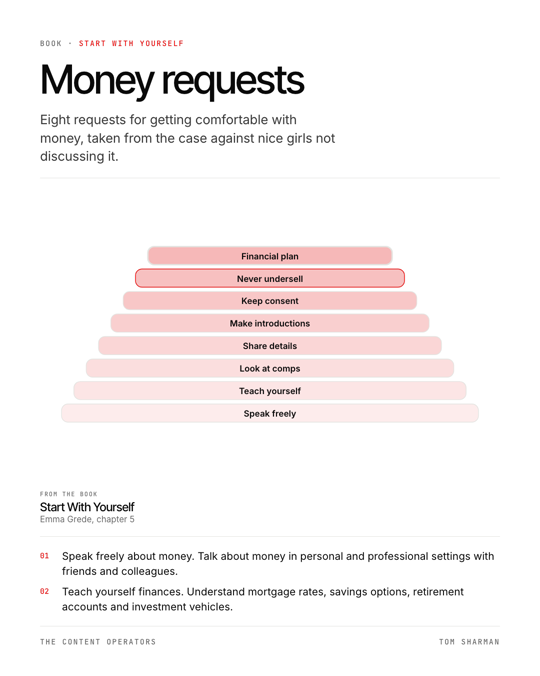
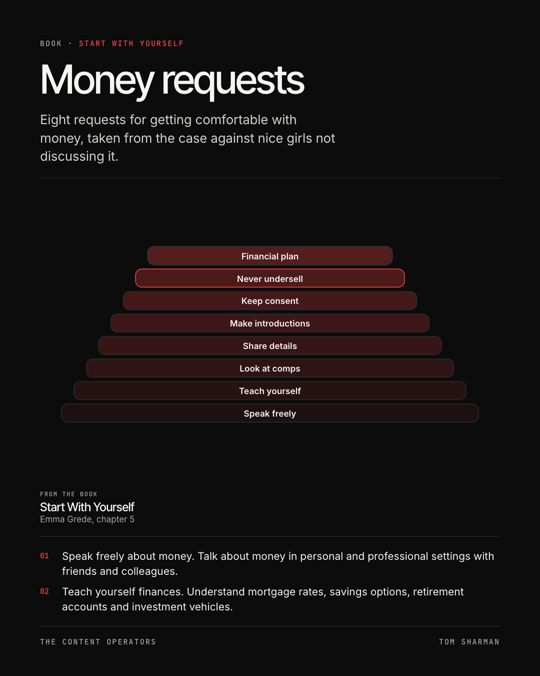
Eight requests for getting comfortable with money, taken from the case against nice girls not discussing it.
- Speak freely about money. Talk about money in personal and professional settings with friends and colleagues.
- Teach yourself finances. Understand mortgage rates, savings options, retirement accounts and investment vehicles.
- Look at comps. Always check comparables for what you do professionally.
- Share the details. Offer information with the details intact that you would normally keep to yourself.
- Make introductions. Introduce accountants, bankers, lawyers and dealmakers who helped you.
- Keep consent. Never let anyone make financial decisions for you without your understanding and consent.
- Never undersell. Do not give your services away free without making it clear you are doing so.
- Make financial plans. Write and follow a financial plan.
From chapter: Part Three: Old Thoughts, pp. 49–237
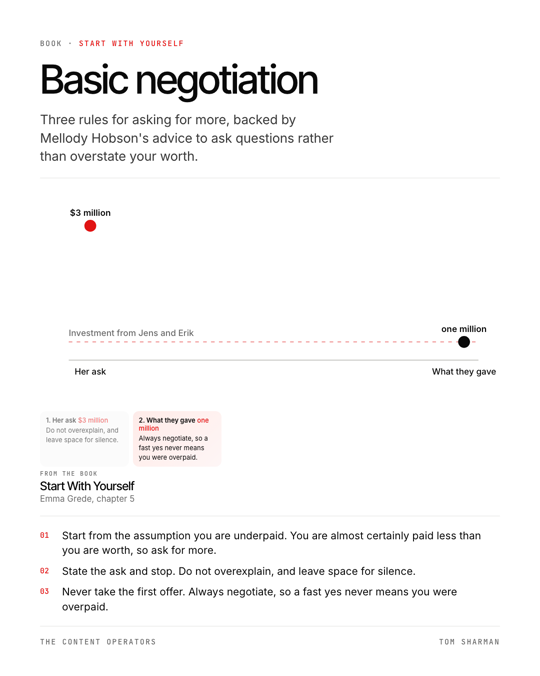
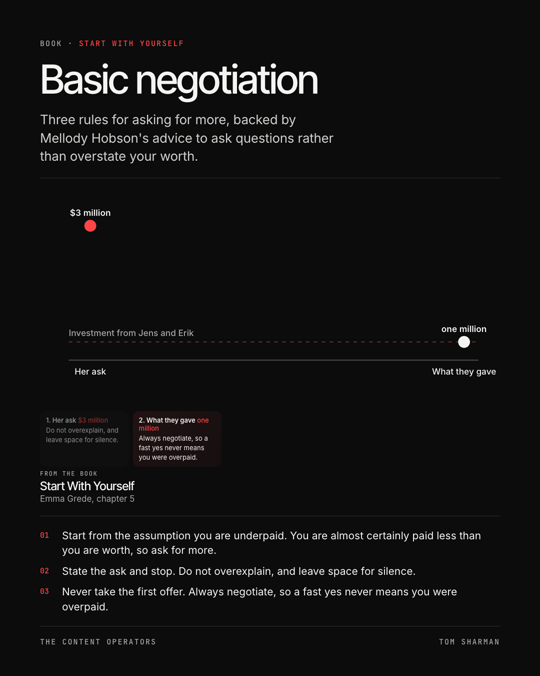
Three rules for asking for more, backed by Mellody Hobson's advice to ask questions rather than overstate your worth.
- Start from the assumption you are underpaid. You are almost certainly paid less than you are worth, so ask for more.
- State the ask and stop. Do not overexplain, and leave space for silence.
- Never take the first offer. Always negotiate, so a fast yes never means you were overpaid.
- Build leverage. Create a competing offer, runway, an independent route or a firm belief in your value so you can walk away.
From chapter: Part Three: Old Thoughts, pp. 49–237
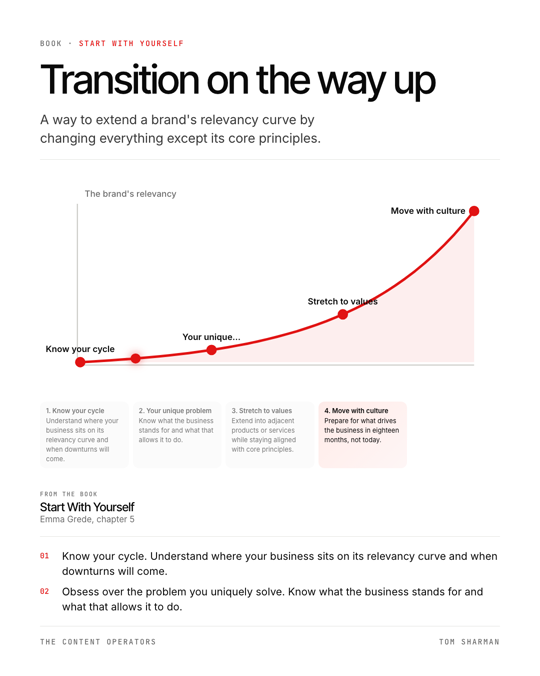
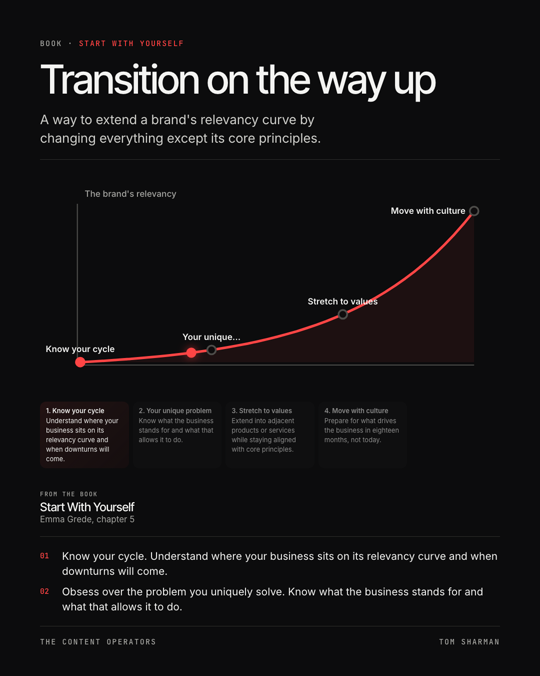
A way to extend a brand's relevancy curve by changing everything except its core principles.
- Know your cycle. Understand where your business sits on its relevancy curve and when downturns will come.
- Obsess over the problem you uniquely solve. Know what the business stands for and what that allows it to do.
- Move as far as your values allow. Extend into adjacent products or services while staying aligned with core principles.
- Keep moving with the culture. Prepare for what drives the business in eighteen months, not today.
From chapter: Part Three: Old Thoughts, pp. 49–237
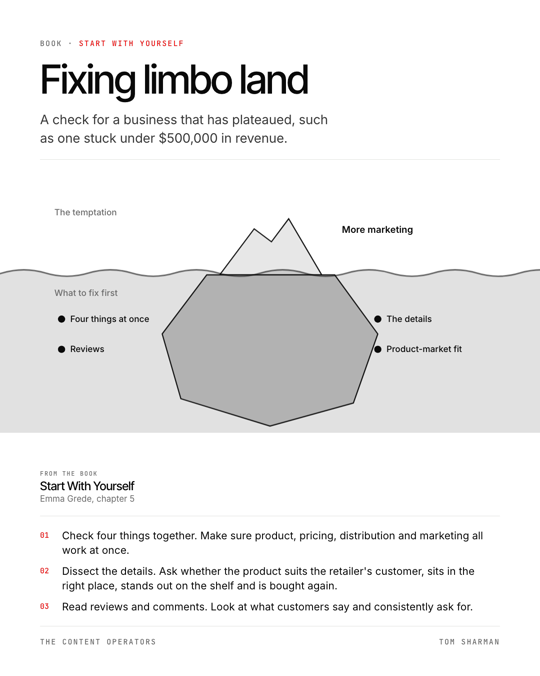
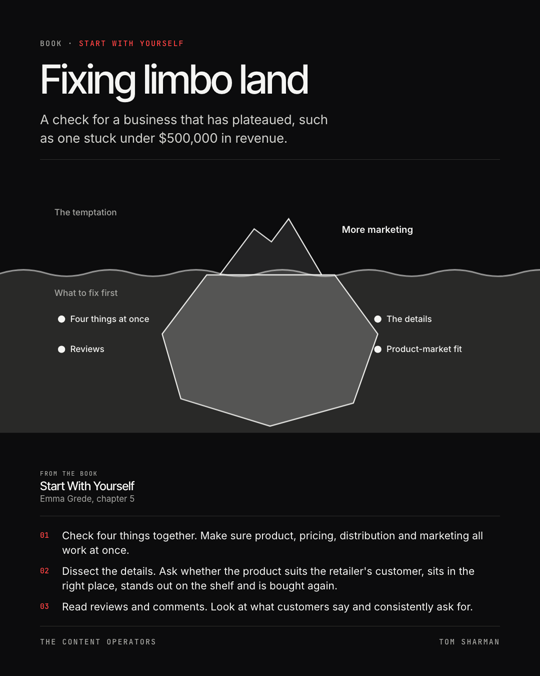
A check for a business that has plateaued, such as one stuck under $500,000 in revenue.
- Check four things together. Make sure product, pricing, distribution and marketing all work at once.
- Dissect the details. Ask whether the product suits the retailer's customer, sits in the right place, stands out on the shelf and is bought again.
- Read reviews and comments. Look at what customers say and consistently ask for.
- Check for product-market fit. Be honest about whether there is a real thing here and rightsize ambition if not.
- Do not spend more on marketing. Spending more on marketing pours resources into a leaky colander; fix the core business first.
From chapter: Part Three: Old Thoughts, pp. 49–237
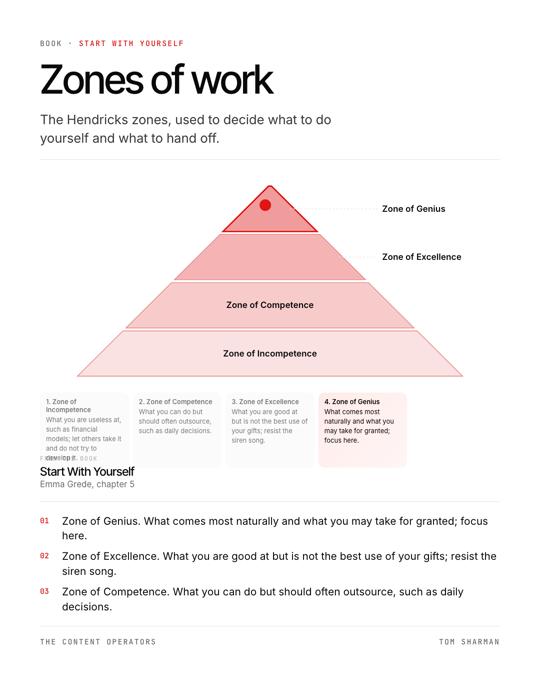
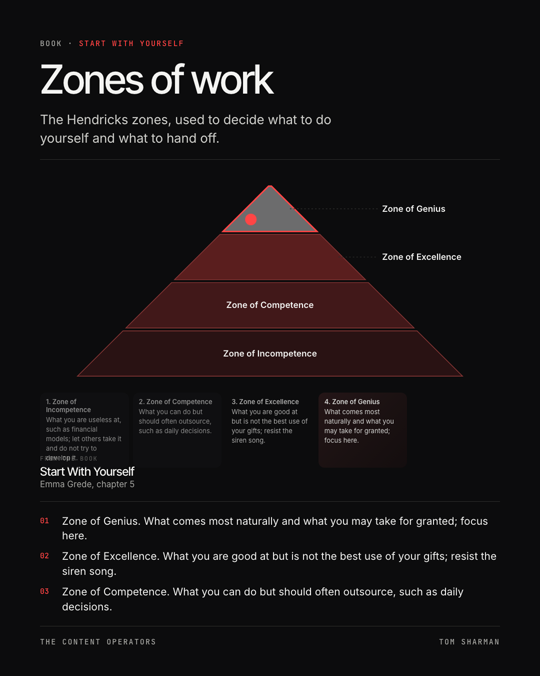
The Hendricks zones, used to decide what to do yourself and what to hand off.
- Zone of Genius. What comes most naturally and what you may take for granted; focus here.
- Zone of Excellence. What you are good at but is not the best use of your gifts; resist the siren song.
- Zone of Competence. What you can do but should often outsource, such as daily decisions.
- Zone of Incompetence. What you are useless at, such as financial models; let others take it and do not try to develop it.
From chapter: Part Three: Old Thoughts, pp. 49–237
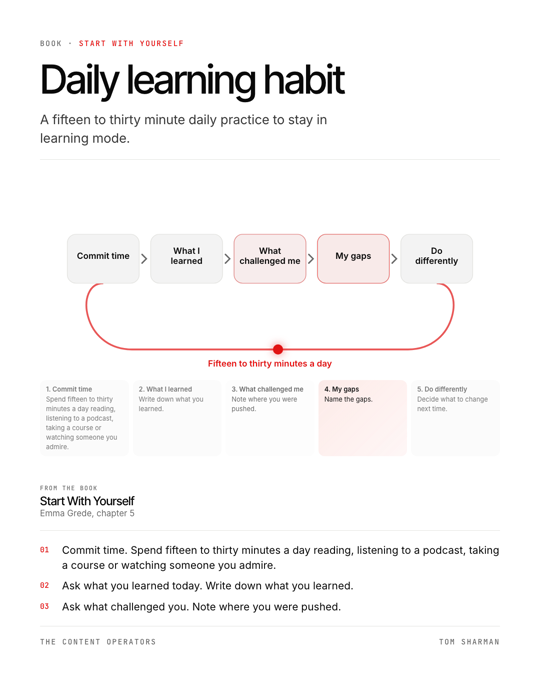
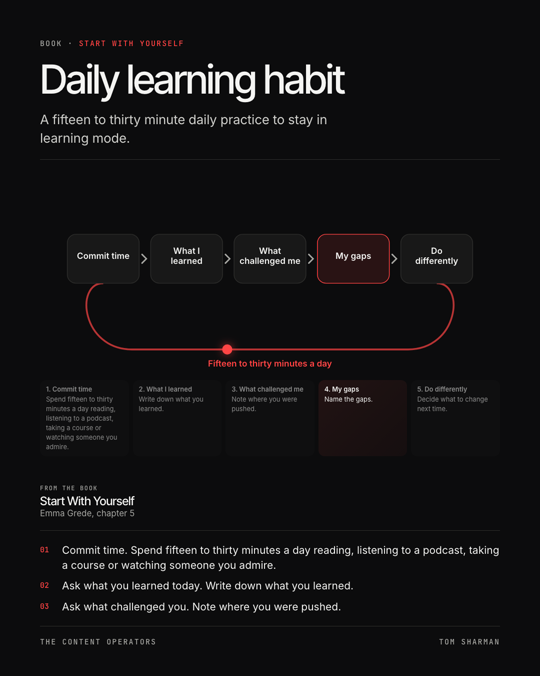
A fifteen to thirty minute daily practice to stay in learning mode.
- Commit time. Spend fifteen to thirty minutes a day reading, listening to a podcast, taking a course or watching someone you admire.
- Ask what you learned today. Write down what you learned.
- Ask what challenged you. Note where you were pushed.
- Ask where your gaps are. Name the gaps.
- Ask what you could do differently. Decide what to change next time.
From chapter: Part Three: Old Thoughts, pp. 49–237
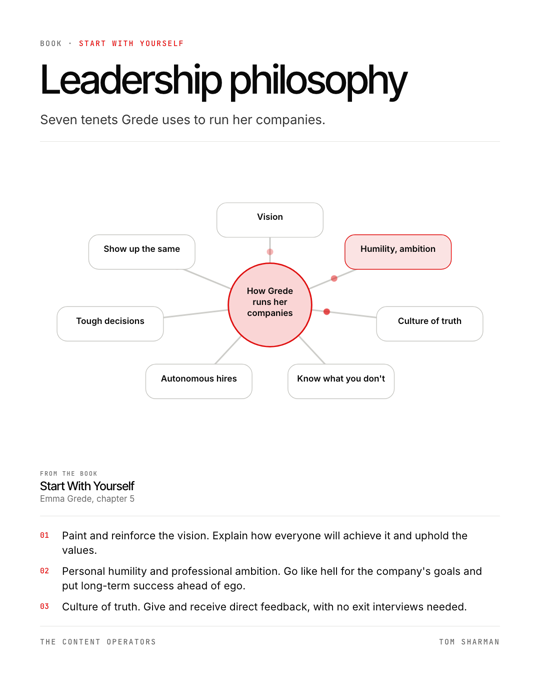
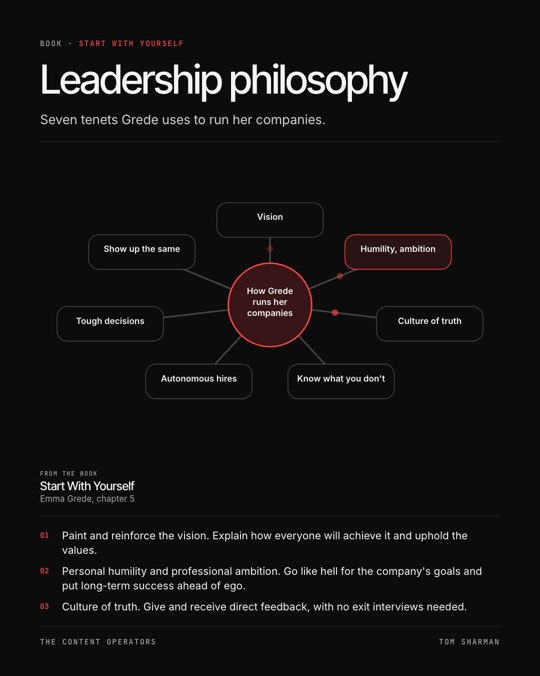
Seven tenets Grede uses to run her companies.
- Paint and reinforce the vision. Explain how everyone will achieve it and uphold the values.
- Personal humility and professional ambition. Go like hell for the company's goals and put long-term success ahead of ego.
- Culture of truth. Give and receive direct feedback, with no exit interviews needed.
- Know what you don't know. Surround yourself with talent who do.
- Hire disciplined, autonomous people. Let them do their thing and shine.
- Make tough decisions. Including letting people go who are not effective.
- Show up consistently. Be the same person every day so people can predict you.
From chapter: Part Three: Old Thoughts, pp. 49–237
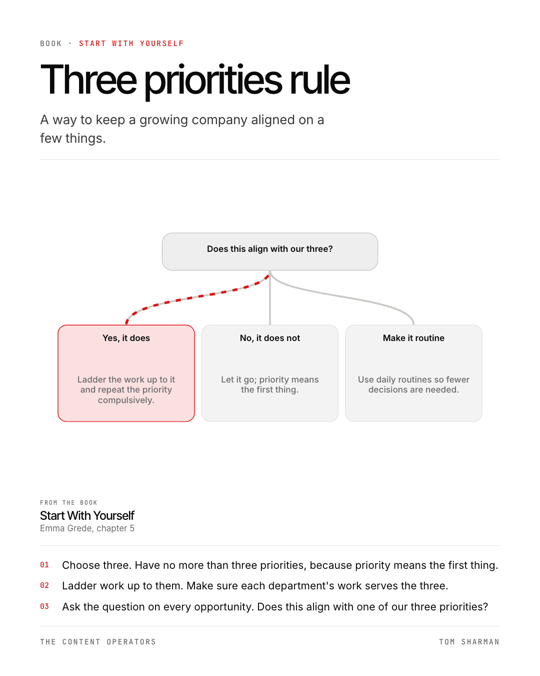
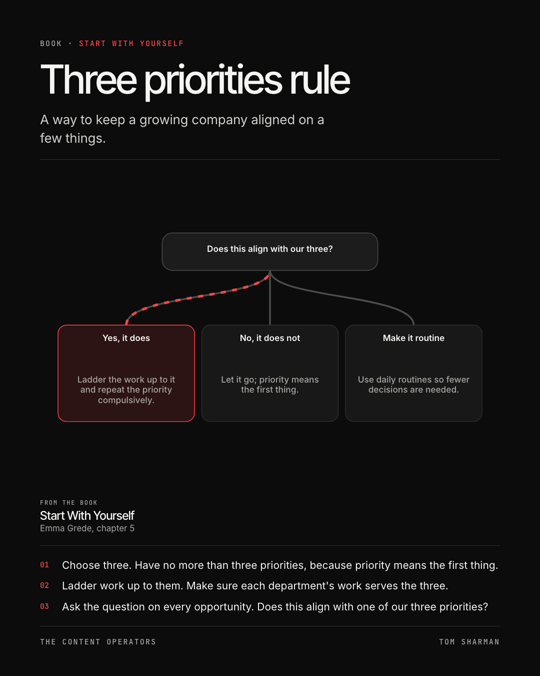
A way to keep a growing company aligned on a few things.
- Choose three. Have no more than three priorities, because priority means the first thing.
- Ladder work up to them. Make sure each department's work serves the three.
- Ask the question on every opportunity. Does this align with one of our three priorities?
- Repeat compulsively. Keep galvanising the team toward the same few goals.
- Build routines. Use daily routines so fewer decisions are needed and focus becomes culture.
From chapter: Part Three: Old Thoughts, pp. 49–237
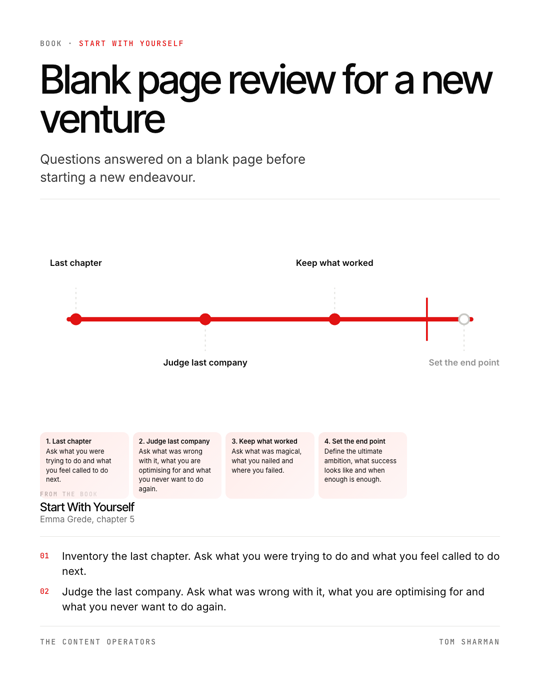
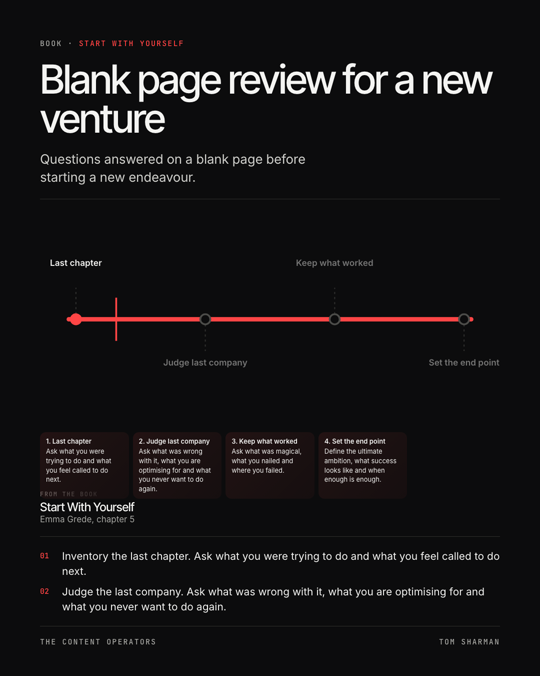
Questions answered on a blank page before starting a new endeavour.
- Inventory the last chapter. Ask what you were trying to do and what you feel called to do next.
- Judge the last company. Ask what was wrong with it, what you are optimising for and what you never want to do again.
- Keep what worked. Ask what was magical, what you nailed and where you failed.
- Set the end point. Define the ultimate ambition, what success looks like and when enough is enough.
From chapter: Part Three: Old Thoughts, pp. 49–237
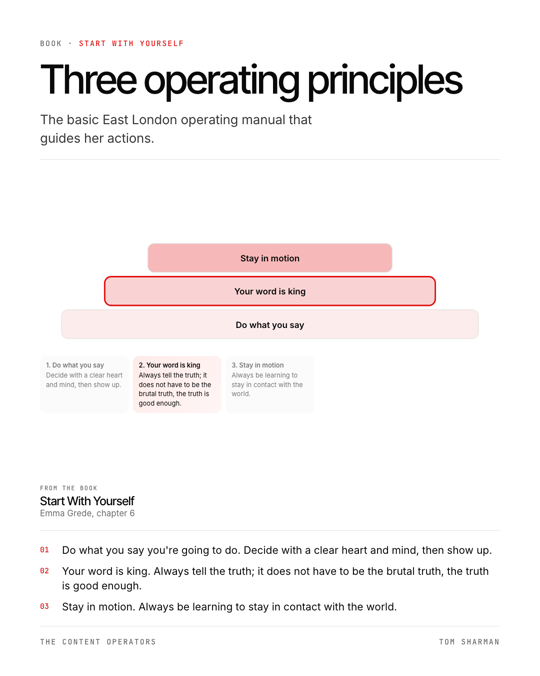
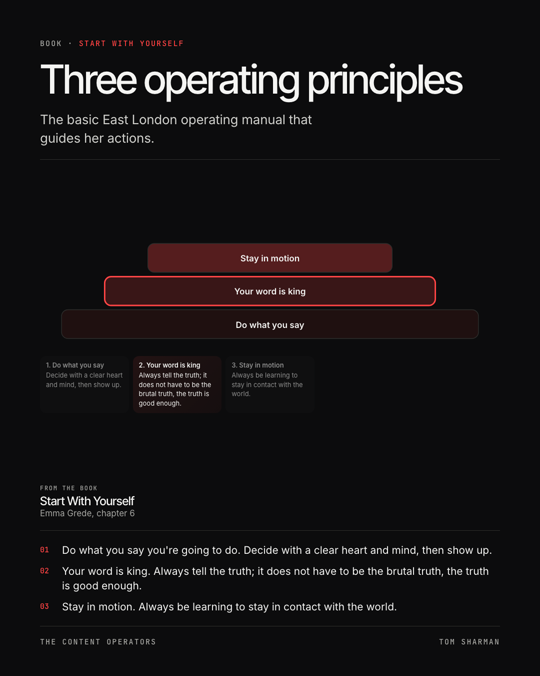
The basic East London operating manual that guides her actions.
- Do what you say you're going to do. Decide with a clear heart and mind, then show up.
- Your word is king. Always tell the truth; it does not have to be the brutal truth, the truth is good enough.
- Stay in motion. Always be learning to stay in contact with the world.
From chapter: Part Four: Action!, pp. 238–243
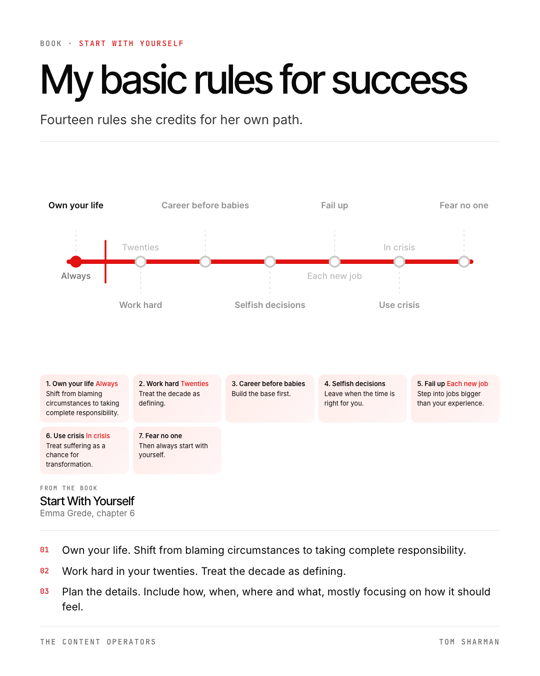
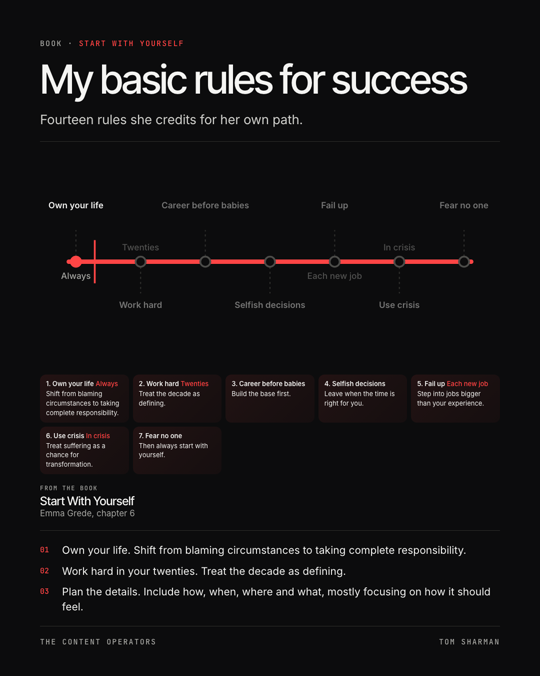
Fourteen rules she credits for her own path.
- Own your life. Shift from blaming circumstances to taking complete responsibility.
- Work hard in your twenties. Treat the decade as defining.
- Plan the details. Include how, when, where and what, mostly focusing on how it should feel.
- Find a supportive partner. Pick someone who is a real partner.
- Establish your career before babies. Build the base first.
- Make selfish professional decisions. Leave when the time is right for you.
- Leverage every job and contact. Use each to do the next thing.
- Move away from people who don't serve you. Create distance.
- Call BS, including on yourself. Be honest.
- Fail up. Step into jobs bigger than your experience.
- Get up after failing. Learn each time.
- Use crisis. Treat suffering as a chance for transformation.
- Put what you care about at the centre. Do it without making it about marketing.
- Refuse to be afraid of anyone. Then always start with yourself.
From chapter: Part Four: Action!, pp. 238–243