Bookshelf
How Tom uses this
So You've Been Publicly Shamed backs two of Tom's lessons. Under each of his lessons, what the book says about it, and on which pages.
What it argues
Ronson argues that the return of public shaming through social media is a form of citizen justice that has outrun any sense of proportion. People pile on because they believe they are doing something good, and instant feedback rewards each of them for condemning, so the crowd never has a reason to stop. The targets are often ordinary people who told a bad joke, such as Justine Sacco and Lindsey Stone, and the damage lasts because the search results never fade. He shows that the old crowd theories of contagion and group madness do not explain the behaviour, and that shame deadens people, which is the root of violence in the prison cases he describes. His proposal is modest: take part in condemnation only where there is a real victim, and give people a way back, as Jim McGreevey's therapeutic unit did for Raquel.
Worth keeping
- People who pile on a stranger think they are doing something good, so the motive to resist is a decision to stop and look at the cost (p. 62, p. 79).
- The terror of being found out sits in nearly everyone, which is why a single mistake in public can feel like the end of a career (p. 21).
- A shaming cannot be undone by apology alone, because audiences wanted Lehrer to be emotional and read his flat, intellectual speech as shamelessness (p. 38).
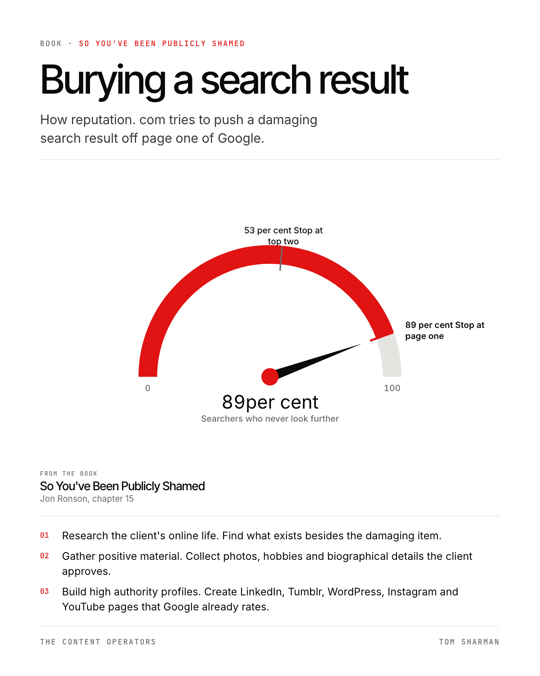
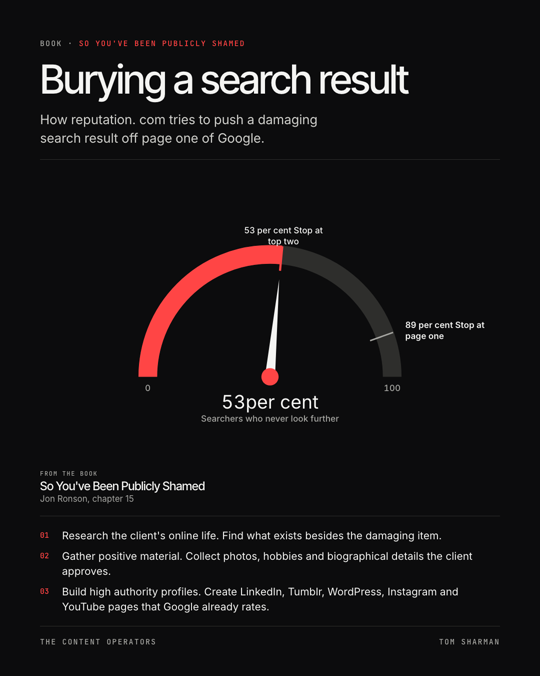
- Page one of Google decides what people think of you: 53 per cent never go past the first two results and 89 per cent never go past the first page (p. 157).
- Reputation repair works by flooding Google with positive material that looks natural, and the cost is a bland public self (p. 157 to p. 159).
- Feedback loops change behaviour with no punishment, and on social media they reward condemnation, which keeps the pile-on going and makes everyone more conformist (p. 166 to p. 167).
- Max Mosley survived because there was little shaming to survive, and Andrew Ferreira found the same: the consequences were smaller than the imagined ones (p. 111, p. 109).
- Shame precedes serious violence, and de-shaming institutions such as Gilligan's prison communities cut it (p. 147, p. 149).
- When the crowd attacks, own the story or write a third one, rather than let the imposed one define you (p. 119).
- Google made about $120,000 from Justine Sacco's destruction, and the people who did the annihilating got nothing (p. 164).
The questions it answers
- How do you build a personal brand that generates inbound rather than requiring outbound?
The book shows that page one of Google defines a person, and that 53 per cent of searchers never pass the first two results, so a brand has to be seeded with positive material before any crisis.
- Which of my stories travel, and which only feel like they should?
Stories travel when they give the audience a villain, a clear verdict and a way to join in, as the Justine Sacco story did, and feedback loops reward each reshare.
The frameworks
4 frameworks, one animation each Every framework, step by step
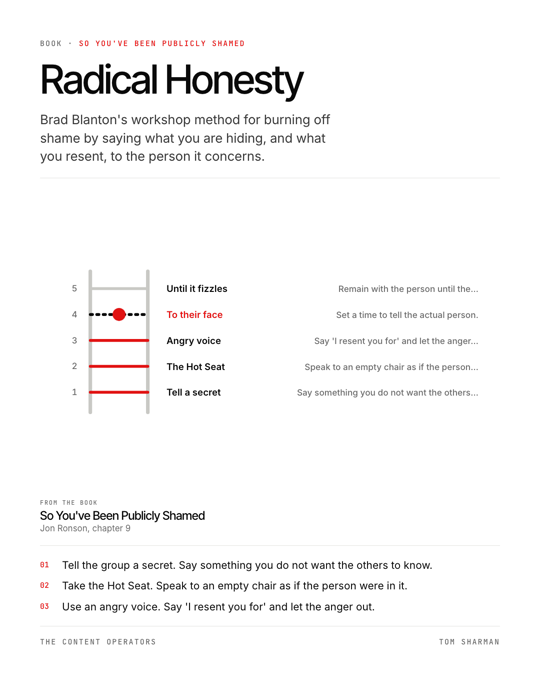
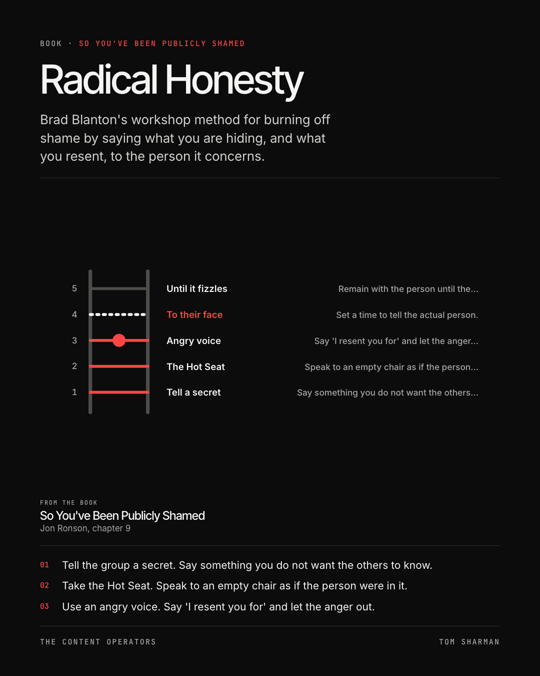
Brad Blanton's workshop method for burning off shame by saying what you are hiding, and what you resent, to the person it concerns.
- Tell the group a secret. Say something you do not want the others to know.
- Take the Hot Seat. Speak to an empty chair as if the person were in it.
- Use an angry voice. Say 'I resent you for' and let the anger out.
- Say it to their face. Set a time to tell the actual person.
- Stay until it fizzles. Remain with the person until the resentments run out.
From chapter: 8. The Shame Eradication Workshop, pp. 93–105
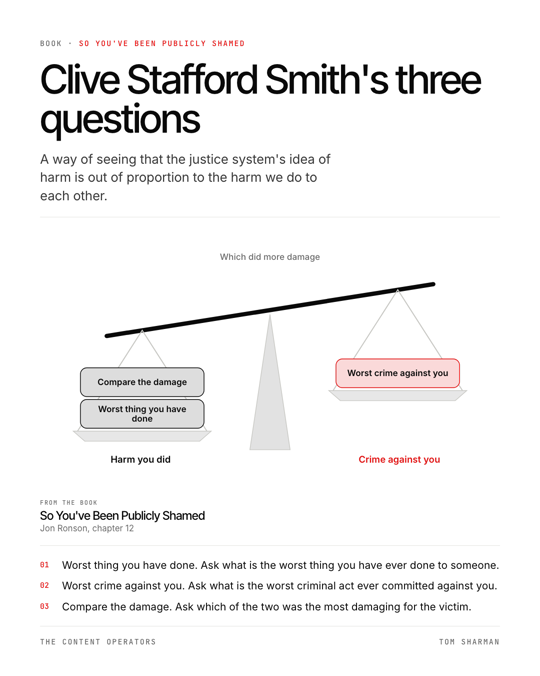
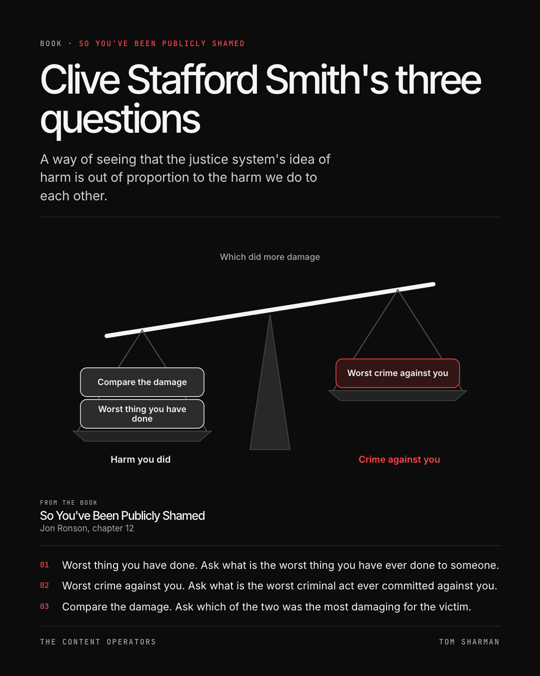
A way of seeing that the justice system's idea of harm is out of proportion to the harm we do to each other.
- Worst thing you have done. Ask what is the worst thing you have ever done to someone.
- Worst crime against you. Ask what is the worst criminal act ever committed against you.
- Compare the damage. Ask which of the two was the most damaging for the victim.
From chapter: 11. The Man Who Can Change the Google Search Results, pp. 122–137
How reputation.com tries to push a damaging search result off page one of Google.
- Research the client's online life. Find what exists besides the damaging item.
- Gather positive material. Collect photos, hobbies and biographical details the client approves.
- Build high authority profiles. Create LinkedIn, Tumblr, WordPress, Instagram and YouTube pages that Google already rates.
- Schedule content to look natural. Publish on a strategic calendar so Google does not detect manipulation.
- Blast during reversion. Add content when rankings wobble and the algorithm is uncertain.
From chapter: 14. Cats and Ice Cream and Music, pp. 156–162
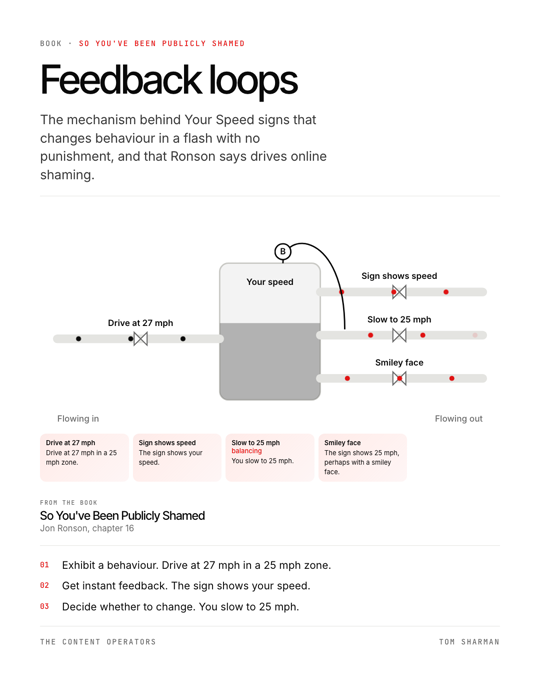
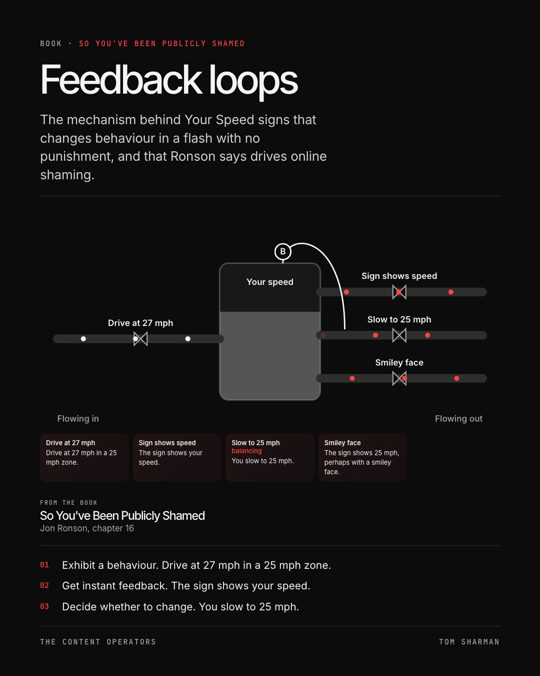
The mechanism behind Your Speed signs that changes behaviour in a flash with no punishment, and that Ronson says drives online shaming.
- Exhibit a behaviour. Drive at 27 mph in a 25 mph zone.
- Get instant feedback. The sign shows your speed.
- Decide whether to change. You slow to 25 mph.
- Get feedback on the decision. The sign shows 25 mph, perhaps with a smiley face.
From chapter: 15. Your Speed, pp. 163–167
Working with Tom on this
Tom works with creators and founders one to one, from a single session to a fractional role. Work with Tom
Back to the bookshelf