Bookshelf
How Tom uses this
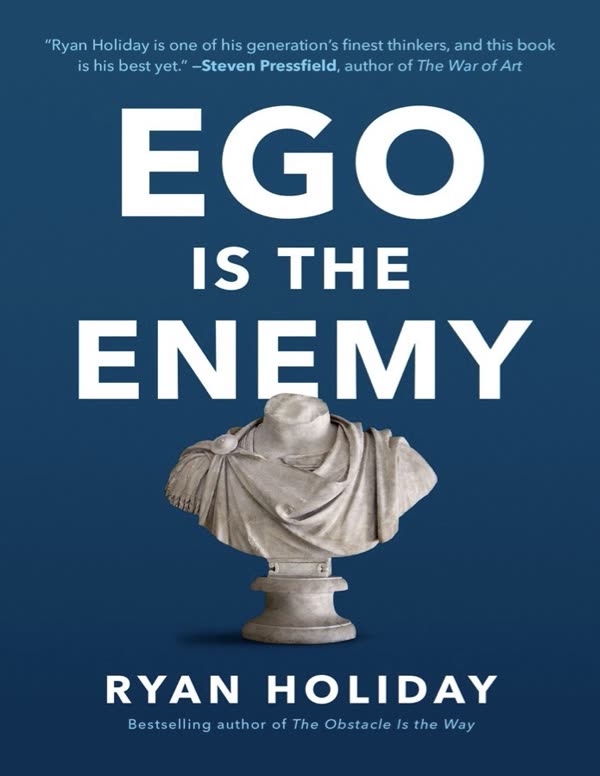
Ego Is the Enemy backs four of Tom's lessons. Under each of his lessons, what the book says about it, and on which pages.
- Macro and micro at the same time
Holiday says a leader's days shift from doing to deciding, with priorities set at the top and trusted people doing the rest, which matches Tom staying at two altitudes and coaching instead of becoming the bottleneck. pp. 113 and 116. In the book: The Standard of Performance.
- Turn down anyone unclear about their commitment
Holiday warns that passion without purpose produces people who can describe everything they will do but cannot show progress, which is the signal Tom screens for when he asks founders about commitment. p. 55. In the book: The canvas strategy, Plus, minus and equal.
- Signals show before numbers, and numbers come at month four
Bill Walsh went two seasons at 2 and 14 while looking for evidence elsewhere than the scoreboard that the team was turning around, which is reading early signals before the numbers arrive. pp. 144 and 145. In the book: The impartial spectator, Alive time or dead time.
- People online are selfish, so lead with what they get
The canvas strategy says to think of something you can do for every person you meet and to look at it entirely from their benefit, which is leading with what the other person gets. pp. 60 and 61. In the book: The canvas strategy, Plus, minus and equal.
What it argues
Holiday argues that ego, an unhealthy belief in our own importance, is the main thing that stops people from achieving what they want, keeping what they achieve and recovering from failure. He splits a working life into three stages, aspiring, succeeding and failing, and shows through historical case studies how ego damages each one. Quiet, patient figures such as Sherman, Marshall, Merkel and Katharine Graham are set against Howard Hughes, John DeLorean and Dov Charney. The remedies are practical habits: silence while working, a permanent student mindset, purpose with realism instead of passion, serving others through the canvas strategy, deciding what matters to you, organising yourself and others, and keeping an inner scorecard. He closes by saying ego must be swept away every day because the dust always returns.
Worth keeping
- Talking about your goals uses up the same energy as doing them, so stay quiet while you build (p. 38).
- The canvas strategy: help the people above you succeed, let them take credit, and you build a bank of favours and control the direction of the path (pp. 58-62).
- Purpose is passion with boundaries, and realism means asking where to start and how you will know you are moving (pp. 55-56).
- Do not turn your rise into a narrative; Bill Walsh credited his Standard of Performance and not a master plan (pp. 100-101).
- Start with deceptively small things and keep your identity small (p. 102).
- Decide how much is enough and what is important to you, or the default becomes more (pp. 106-107).
- Leadership shifts from doing to deciding, so set priorities and build the system around the work (pp. 113-116).
- Use dead time as alive time, and let the effort be enough because rewards are out of your control (pp. 148-153).
- Keep an inner scorecard measured against your potential, and review lucky wins as hard as losses (pp. 166-168).
- Perfecting the personal usually leads to professional success, and ego needs sweeping every day (p. 182).
The questions it answers
- What makes a format repeatable, as opposed to a hit that happened once?
Walsh credits a Standard of Performance made of small exact details for the 49ers' wins, and the team failed when it drifted back to believing its own story (pp. 100-101).
- How do you build a personal brand that generates inbound rather than requiring outbound?
The canvas strategy builds relationships and a reputation for being indispensable by helping others first, and the talk chapter warns that announcing yourself drains the work (pp. 38, 60-61).
- Which of my stories travel, and which only feel like they should?
The chapter on telling yourself a story says retold narratives round off the luck and doubt, so facts and the real order of events should outrank the tidy version (pp. 100-102).
The frameworks
5 frameworks, one animation each Every framework, step by step
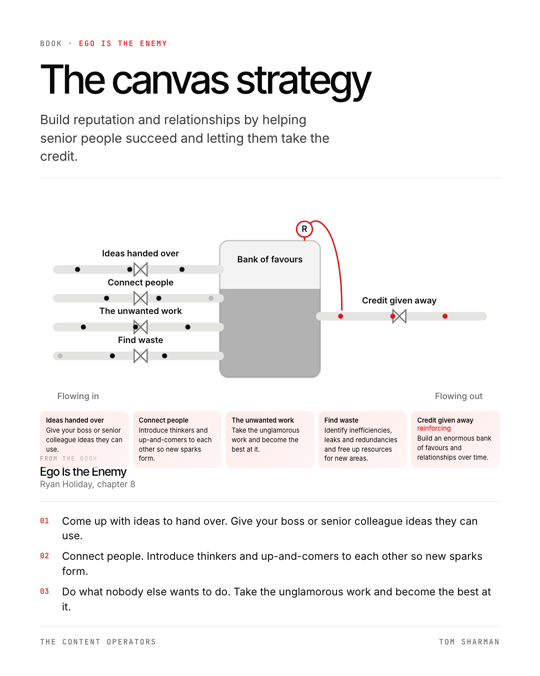
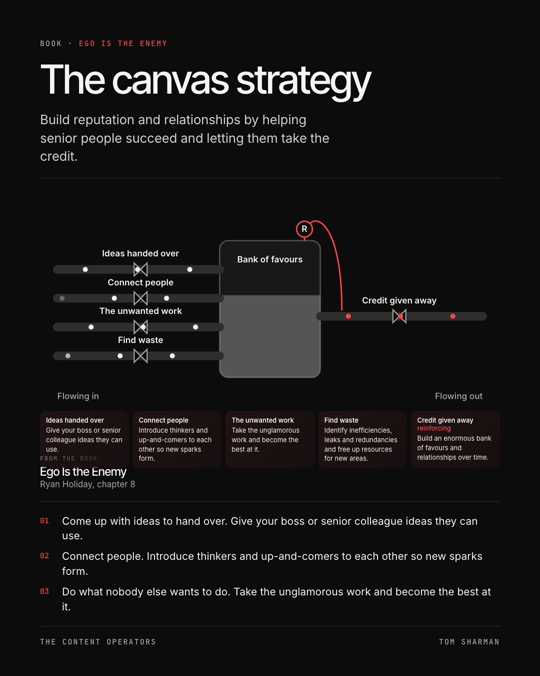
Build reputation and relationships by helping senior people succeed and letting them take the credit.
- Come up with ideas to hand over. Give your boss or senior colleague ideas they can use.
- Connect people. Introduce thinkers and up-and-comers to each other so new sparks form.
- Do what nobody else wants to do. Take the unglamorous work and become the best at it.
- Find waste. Identify inefficiencies, leaks and redundancies and free up resources for new areas.
- Produce more than everyone and give ideas away. Build an enormous bank of favours and relationships over time.
From chapter: PART I: ASPIRE, pp. 25–84
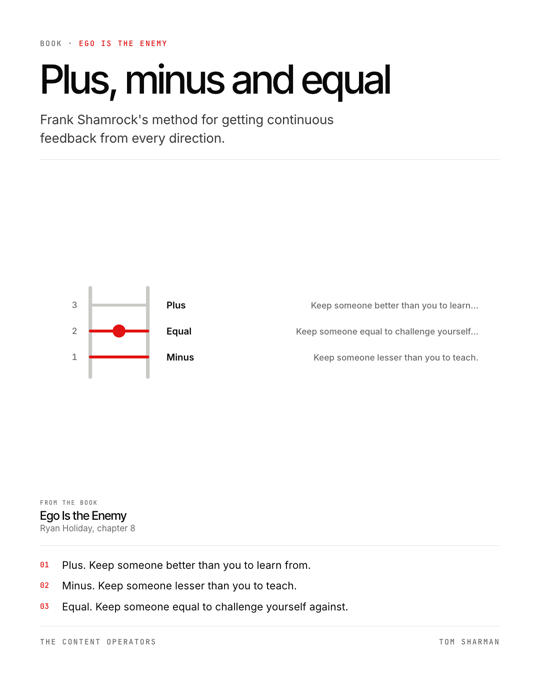
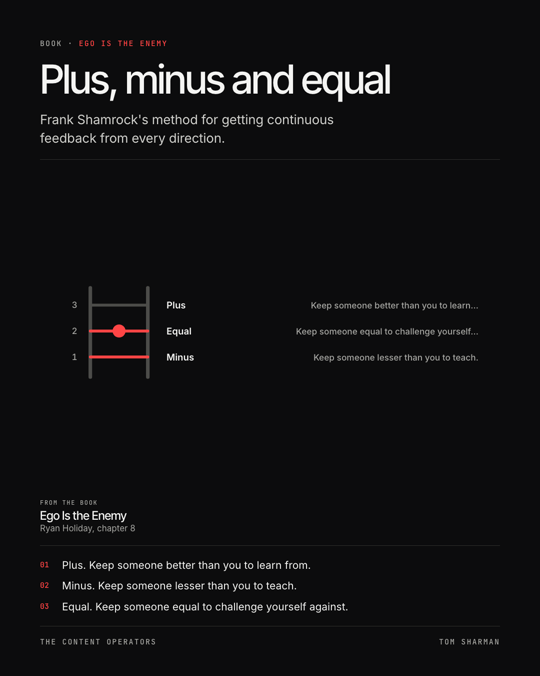
Frank Shamrock's method for getting continuous feedback from every direction.
- Plus. Keep someone better than you to learn from.
- Minus. Keep someone lesser than you to teach.
- Equal. Keep someone equal to challenge yourself against.
From chapter: PART I: ASPIRE, pp. 25–84
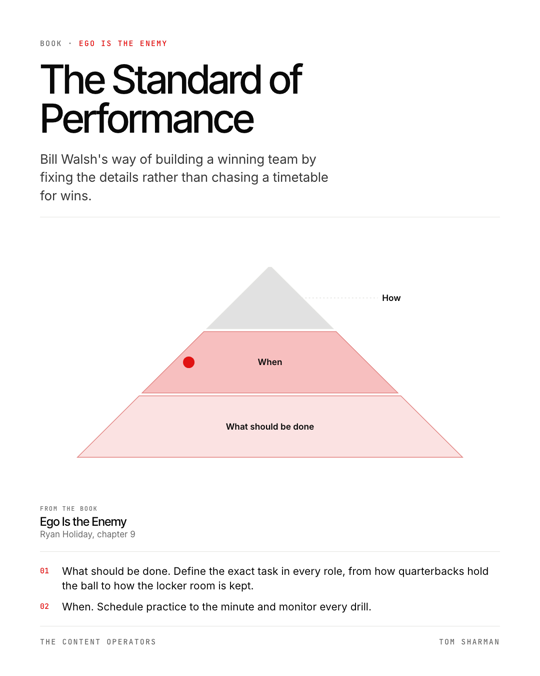
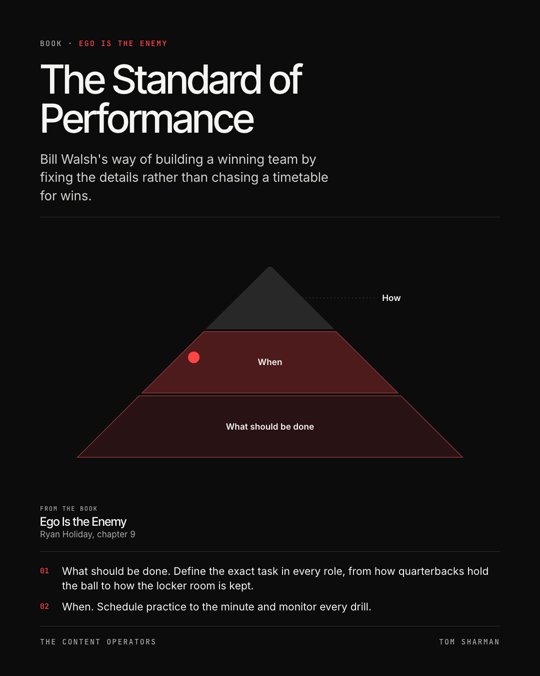
Bill Walsh's way of building a winning team by fixing the details rather than chasing a timetable for wins.
- What should be done. Define the exact task in every role, from how quarterbacks hold the ball to how the locker room is kept.
- When. Schedule practice to the minute and monitor every drill.
- How. Grade execution down to the inch and enforce effort, sportsmanship and neatness throughout the organisation.
From chapter: PART II: SUCCESS, pp. 85–133
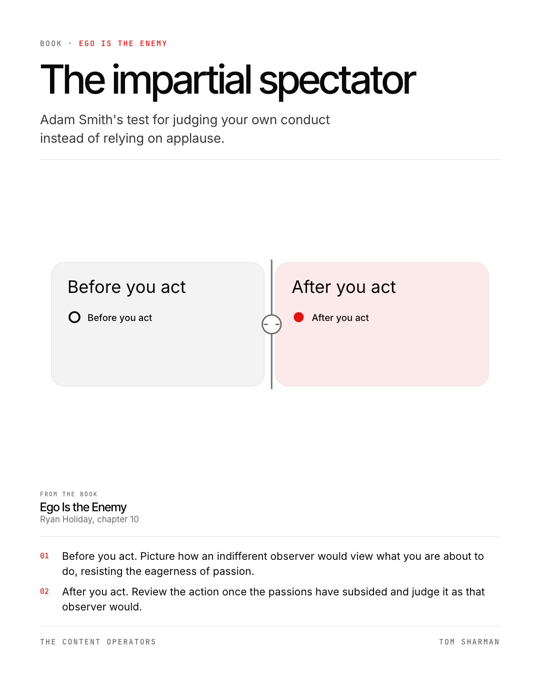
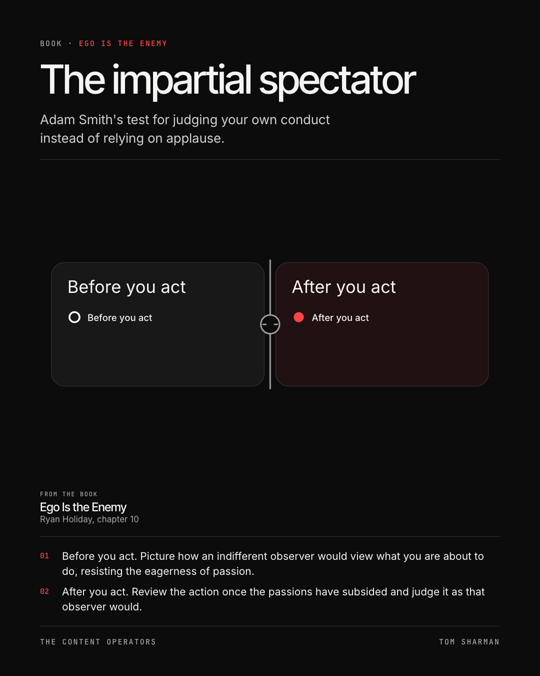
Adam Smith's test for judging your own conduct instead of relying on applause.
- Before you act. Picture how an indifferent observer would view what you are about to do, resisting the eagerness of passion.
- After you act. Review the action once the passions have subsided and judge it as that observer would.
From chapter: PART III: FAILURE, pp. 134–182
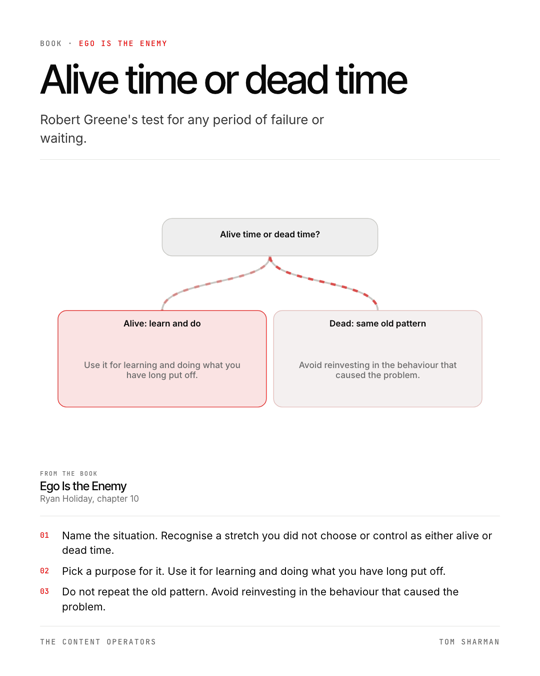
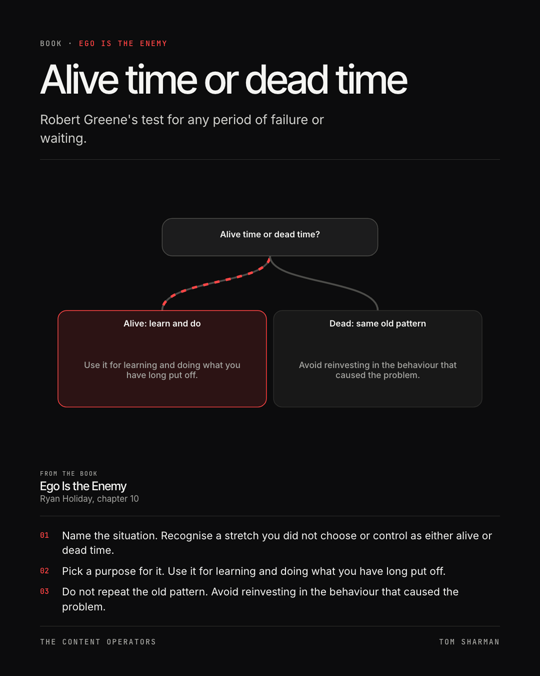
Robert Greene's test for any period of failure or waiting.
- Name the situation. Recognise a stretch you did not choose or control as either alive or dead time.
- Pick a purpose for it. Use it for learning and doing what you have long put off.
- Do not repeat the old pattern. Avoid reinvesting in the behaviour that caused the problem.
From chapter: PART III: FAILURE, pp. 134–182
Back to the bookshelf