Bookshelf
How Tom uses this
The Algorithm backs three of Tom's lessons. Under each of his lessons, what the book says about it, and on which pages.
- Week one is an audit, and two formats are never up for testing
Both say to learn the real process before changing anything, and to keep a few things fixed so that effort goes where it matters. pp. 34 and 78. In the book: The Algorithm, Map the process and circle what the customer pays for, Cycle time and touch time, Karim's three conditions.
- Assumptions made too fast, and risk avoided
McNeill's culture of questioning requirements and backing people who take initiative, even when some fail, matches the idea of backing yourself on data plus gut. pp. 19 and 43. In the book: The Algorithm, Map the process and circle what the customer pays for, Cycle time and touch time, Karim's three conditions.
- Move the people you have before you hire
Nikki Monterroso's battlefield promotion and the reuse of existing staff in new roles show the same preference for moving people who know the process. p. 52. In the book: The Algorithm, Map the process and circle what the customer pays for, Cycle time and touch time, Karim's three conditions.
What it argues
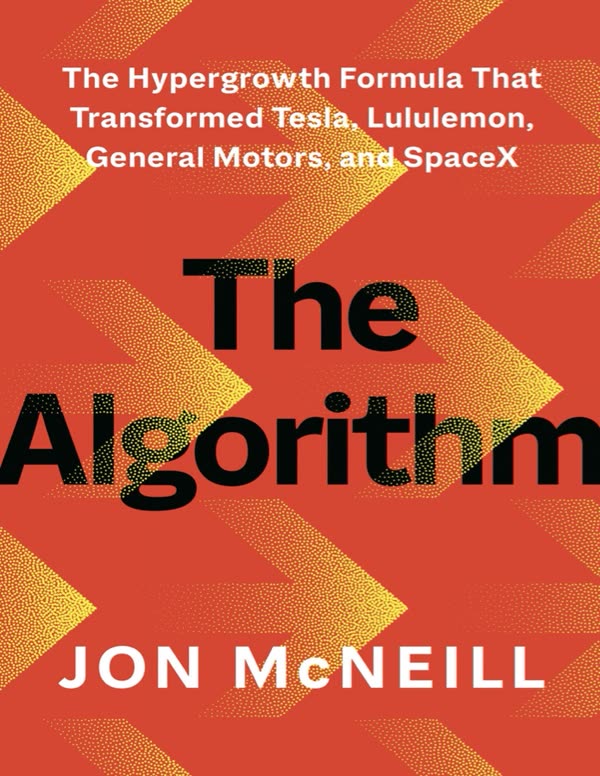
McNeill argues that any business can grow exponentially by running every process through five ordered steps: question every requirement, delete every possible step, simplify and optimise, accelerate cycle time, and automate last. Most rules are customs, most steps are not paid for by the customer, and speed only pays once the process is simple. Automation done early freezes a bad design in code. He adds three cultural ingredients that make the steps stick: define the product as the customer's whole experience, have the top executive hold weekly urgent problem-solving sessions with small teams, and use your own product daily. Tesla, GM, Lululemon and McNeill's DVx start-ups serve as case studies.
Worth keeping
- Treat rules as recommendations until proved otherwise; ask who made the rule and whether they have data (p. 19).
- Circle the steps the customer pays for and delete the rest, then expect to reinstate about 10 percent (p. 34).
- Cut choices: 300,000 configurations down to two packages lifted sales by more than 20 percent (pp. 36 to 37).
- Replace long training with one aspirational sentence people can act on: 'Be so great that they'll talk about you at dinner' (p. 49).
- Cycle time minus touch time is the prize; a four-week car repair had eight hours of work (p. 61).
- Automate last: hand-build the process first, as Amazon, DoorDash and the Tesla tent line did (pp. 78 to 79).
- Run the first version of a tool by hand with Excel, Forms and Zapier before writing software, as Curbee did over seven months (p. 86).
- A small team reporting to a senior executive who clears roadblocks is the structure for innovating at speed (p. 69).
- Hold a weekly problem-solving cadence with the person who can decide, and know the details (pp. 107 to 111).
- If customers need YouTube to find a switch, the design needs a tweak; use your own product and competitors' (p. 123).
The questions it answers
- What does AI actually change about the shape of a content team?
Stash built an AI coach with a team of seven after a one-month prototype, and the book says to automate only once the human process is understood.
- What is the smallest team that can produce at the volume I am used to?
GM's Hummer team and Stash's 'Ninjas' show small teams with one decision-maker and a senior sponsor shipping at speed (pp. 67 to 69, 115 to 116).
- How do you price and sell a tool you built for yourself?
Curbee began as DVx's own mobile repair business used as a lab, run by hand for seven months, and only then became a subscription product for 500 dealerships (pp. 83 to 86).
The frameworks
7 frameworks, one animation each Every framework, step by step
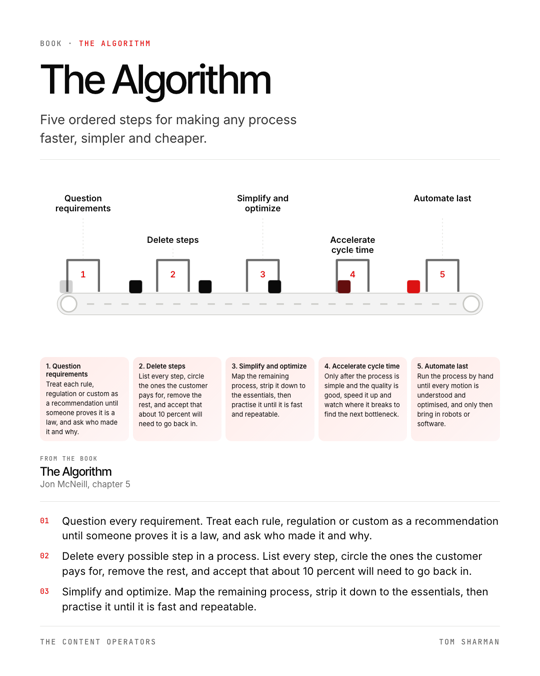
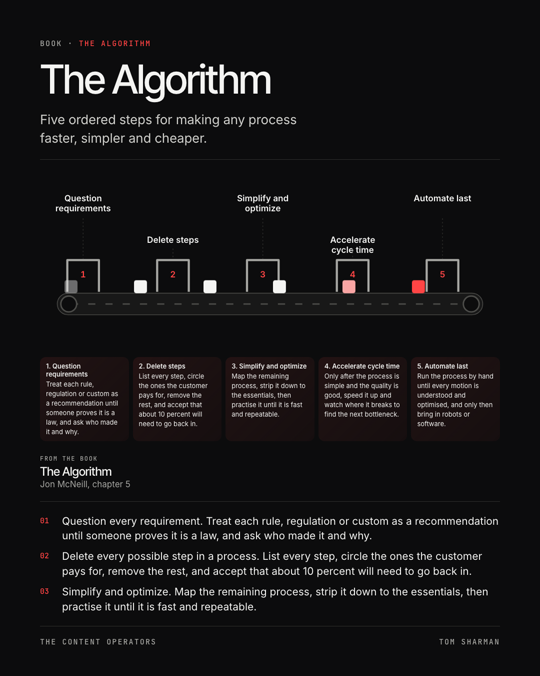
Five ordered steps for making any process faster, simpler and cheaper.
- Question every requirement. Treat each rule, regulation or custom as a recommendation until someone proves it is a law, and ask who made it and why.
- Delete every possible step in a process. List every step, circle the ones the customer pays for, remove the rest, and accept that about 10 percent will need to go back in.
- Simplify and optimize. Map the remaining process, strip it down to the essentials, then practise it until it is fast and repeatable.
- Accelerate cycle time. Only after the process is simple and the quality is good, speed it up and watch where it breaks to find the next bottleneck.
- Automate last. Run the process by hand until every motion is understood and optimised, and only then bring in robots or software.
From chapter: Part I: Principles of the Algorithm, pp. 17–94
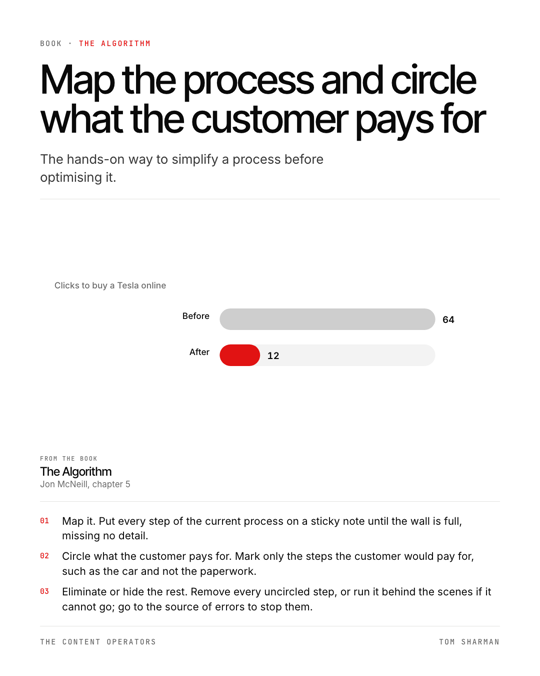
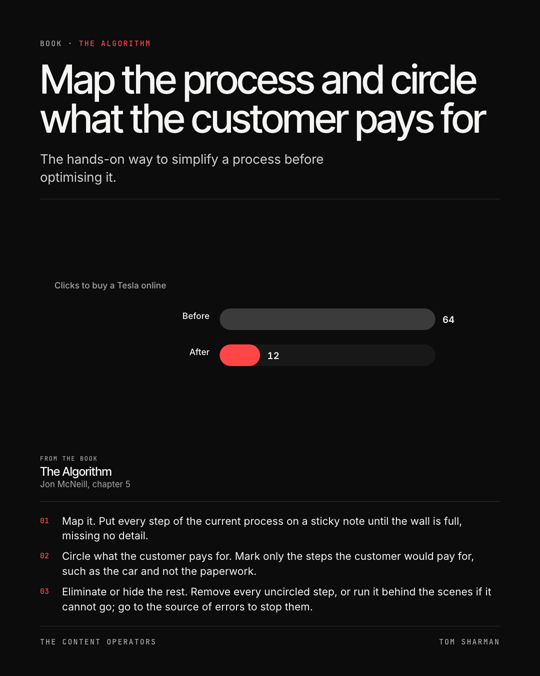
The hands-on way to simplify a process before optimising it.
- Map it. Put every step of the current process on a sticky note until the wall is full, missing no detail.
- Circle what the customer pays for. Mark only the steps the customer would pay for, such as the car and not the paperwork.
- Eliminate or hide the rest. Remove every uncircled step, or run it behind the scenes if it cannot go; go to the source of errors to stop them.
- Optimise and practise. Time what remains, break it into sequenced chunks, and repeat it until it is fast.
From chapter: Part I: Principles of the Algorithm, pp. 17–94
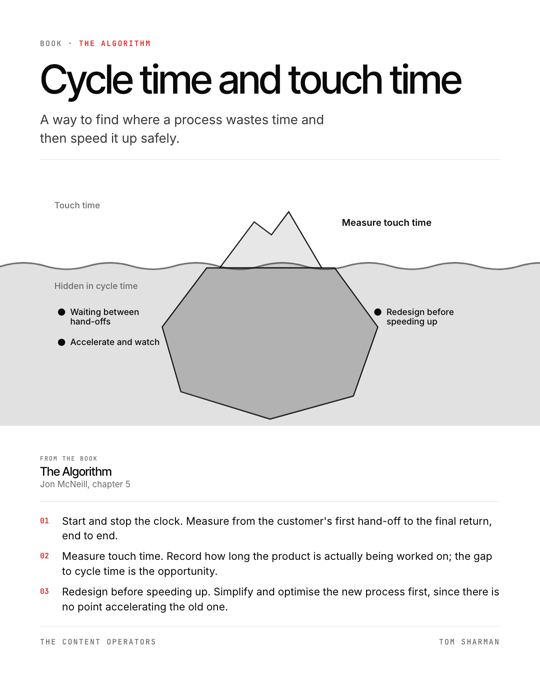
A way to find where a process wastes time and then speed it up safely.
- Start and stop the clock. Measure from the customer's first hand-off to the final return, end to end.
- Measure touch time. Record how long the product is actually being worked on; the gap to cycle time is the opportunity.
- Redesign before speeding up. Simplify and optimise the new process first, since there is no point accelerating the old one.
- Accelerate and watch it break. Push for 50 percent faster each week and fix whatever the speed exposes.
From chapter: Part I: Principles of the Algorithm, pp. 17–94
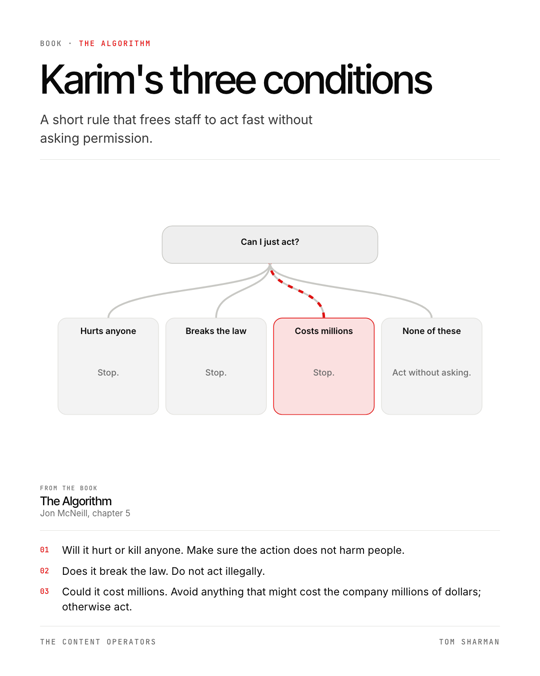
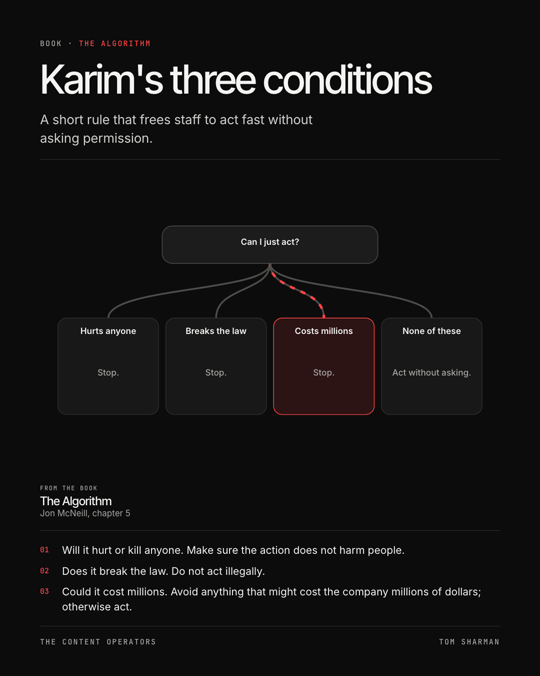
A short rule that frees staff to act fast without asking permission.
- Will it hurt or kill anyone. Make sure the action does not harm people.
- Does it break the law. Do not act illegally.
- Could it cost millions. Avoid anything that might cost the company millions of dollars; otherwise act.
From chapter: Part I: Principles of the Algorithm, pp. 17–94
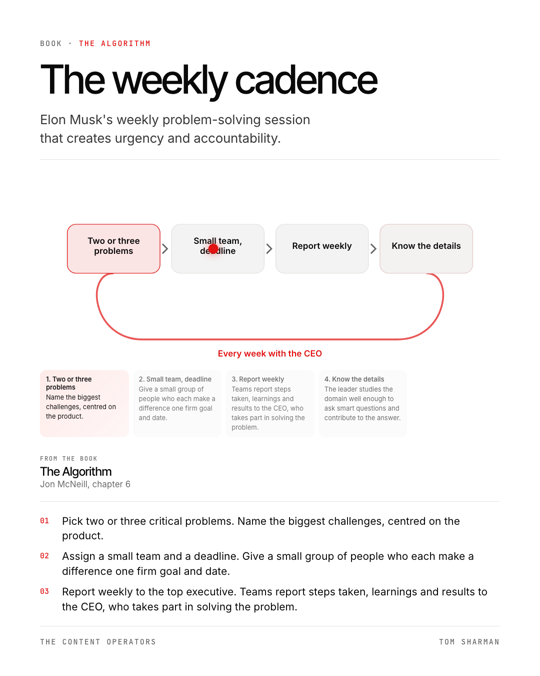
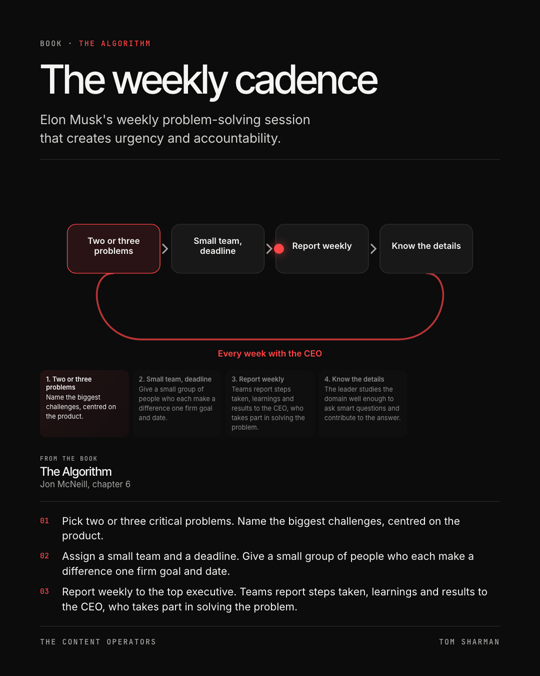
Elon Musk's weekly problem-solving session that creates urgency and accountability.
- Pick two or three critical problems. Name the biggest challenges, centred on the product.
- Assign a small team and a deadline. Give a small group of people who each make a difference one firm goal and date.
- Report weekly to the top executive. Teams report steps taken, learnings and results to the CEO, who takes part in solving the problem.
- Know the details. The leader studies the domain well enough to ask smart questions and contribute to the answer.
From chapter: Part II: The Three Cultural Ingredients of the Algorithm, pp. 95–127
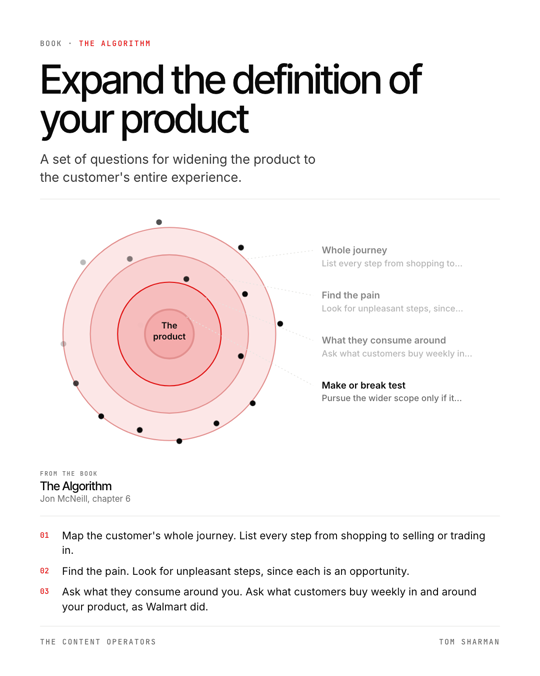
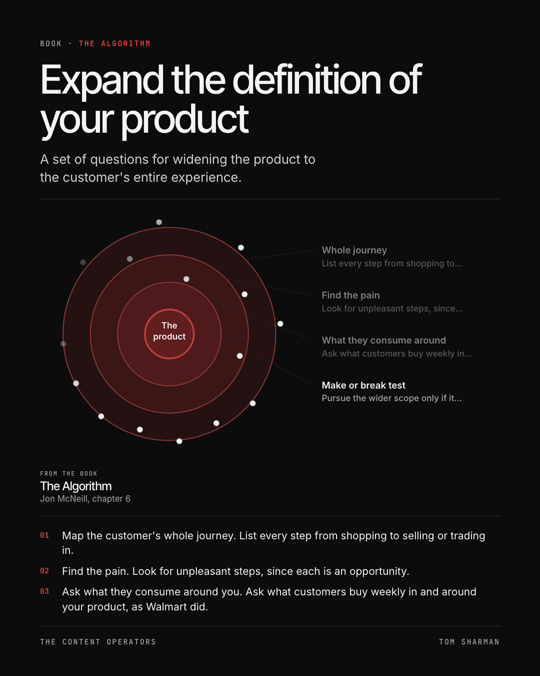
A set of questions for widening the product to the customer's entire experience.
- Map the customer's whole journey. List every step from shopping to selling or trading in.
- Find the pain. Look for unpleasant steps, since each is an opportunity.
- Ask what they consume around you. Ask what customers buy weekly in and around your product, as Walmart did.
- Test if it makes or breaks adoption. Pursue the wider scope only if it decides whether you win or lose the market.
From chapter: Part II: The Three Cultural Ingredients of the Algorithm, pp. 95–127
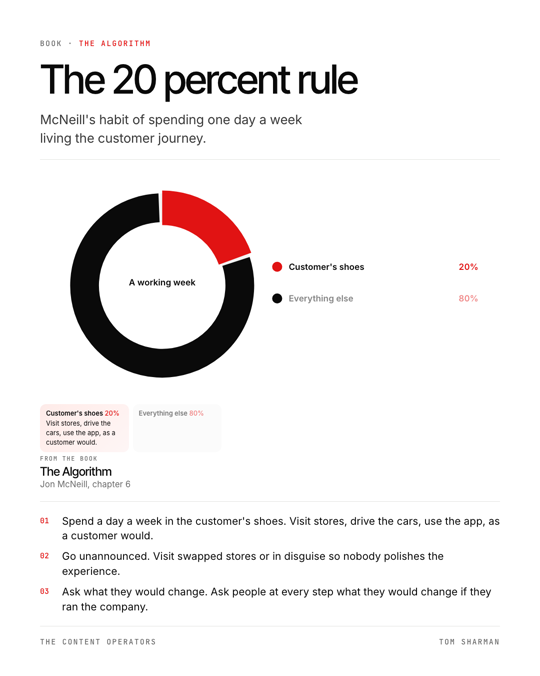
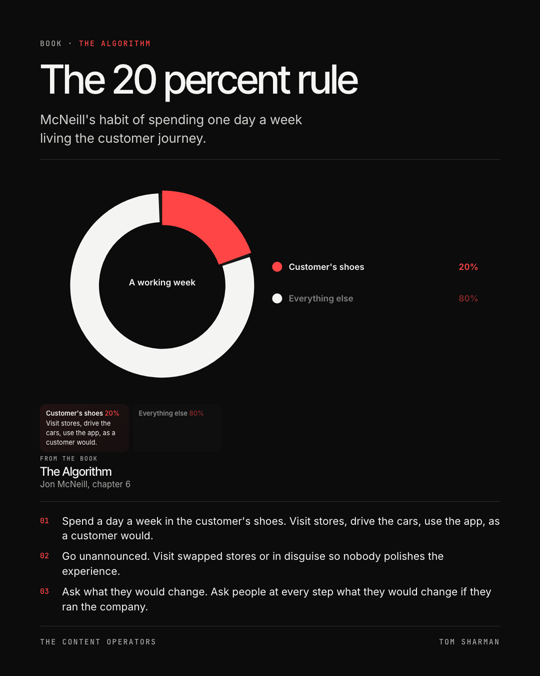
McNeill's habit of spending one day a week living the customer journey.
- Spend a day a week in the customer's shoes. Visit stores, drive the cars, use the app, as a customer would.
- Go unannounced. Visit swapped stores or in disguise so nobody polishes the experience.
- Ask what they would change. Ask people at every step what they would change if they ran the company.
- Send feedback and close the loop. Write up observations quickly so the owner fixes them within a day or a week.
From chapter: Part II: The Three Cultural Ingredients of the Algorithm, pp. 95–127
Working with Tom on this
Tom works with creators and founders one to one, from a single session to a fractional role. Work with Tom
Back to the bookshelf