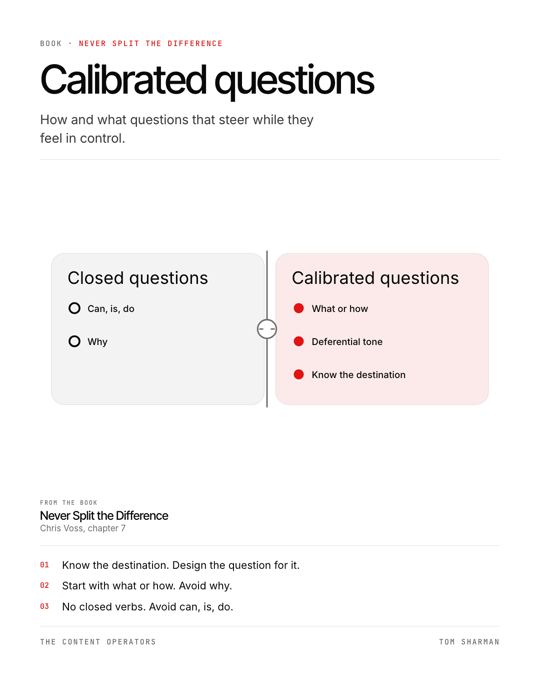
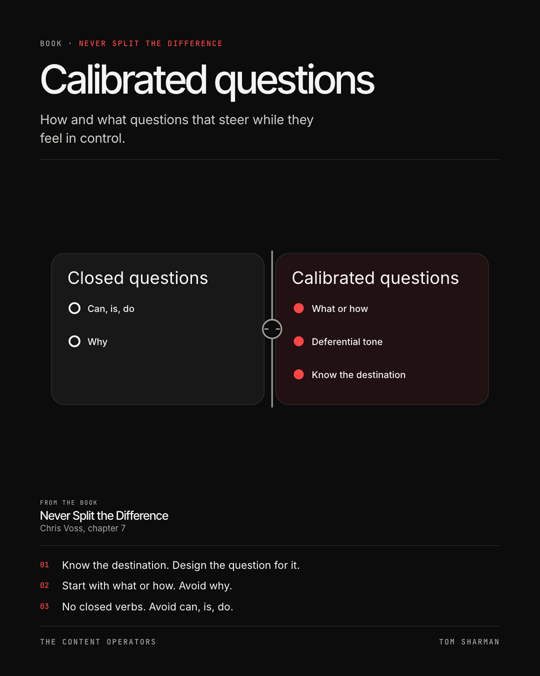
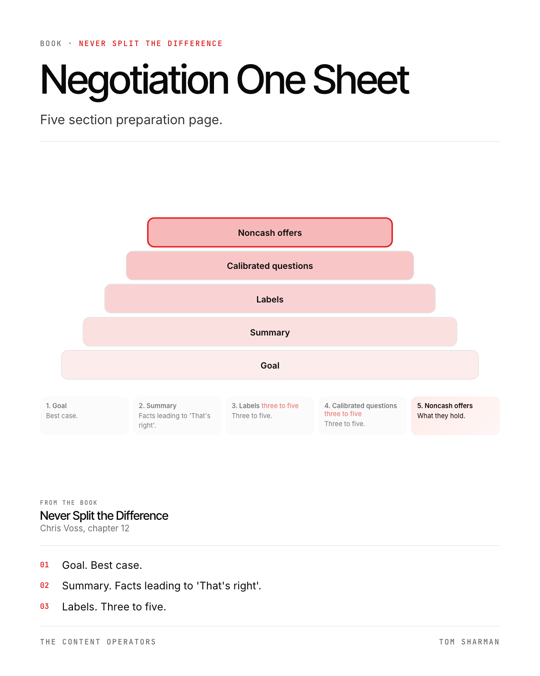
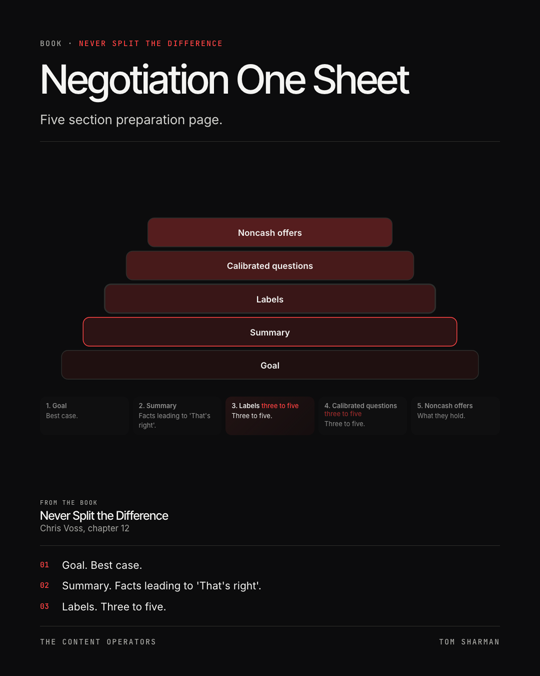
Voss's prepared question 'What does doing nothing cost you?' matches the cost half of Tom's intake question, though he warns that a bare 'why' puts people on the defensive. pp. 127, 208 and 209.In the book:Calibrated questions, Negotiation One Sheet.
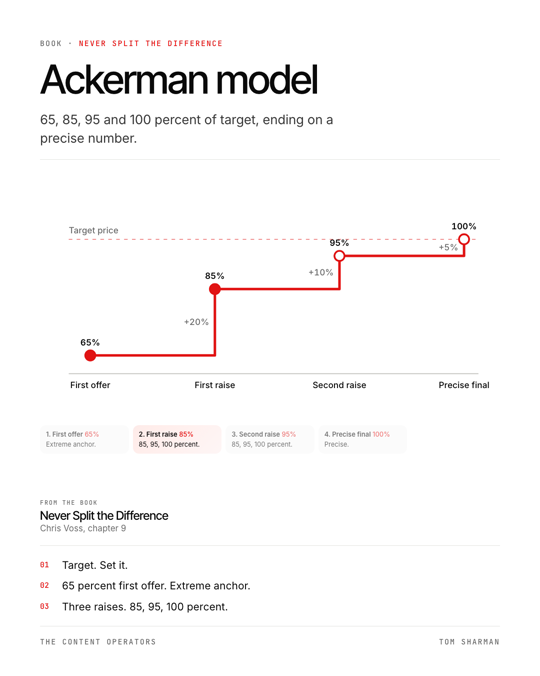
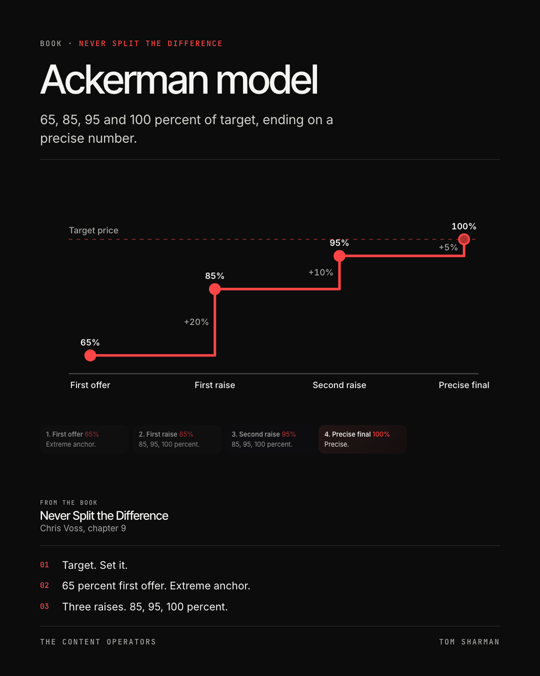
Voss says 'No No means no go' and that you must be ready to walk, which backs Tom's refusal of founders who will not commit. pp. 78 and 167.In the book:Ackerman model.
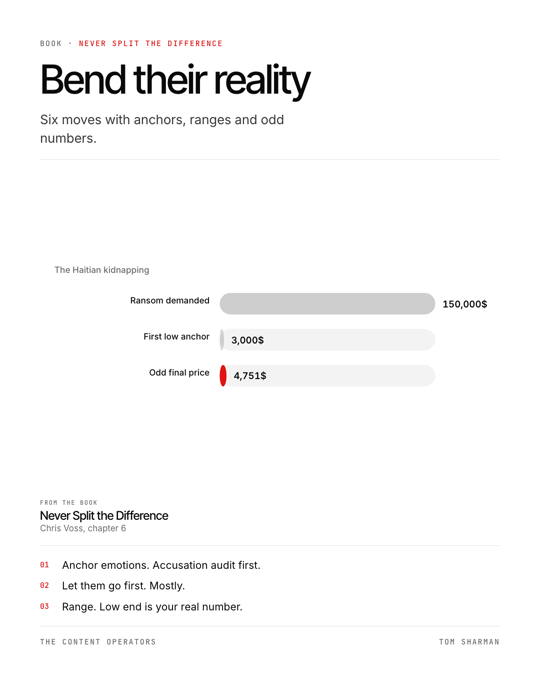
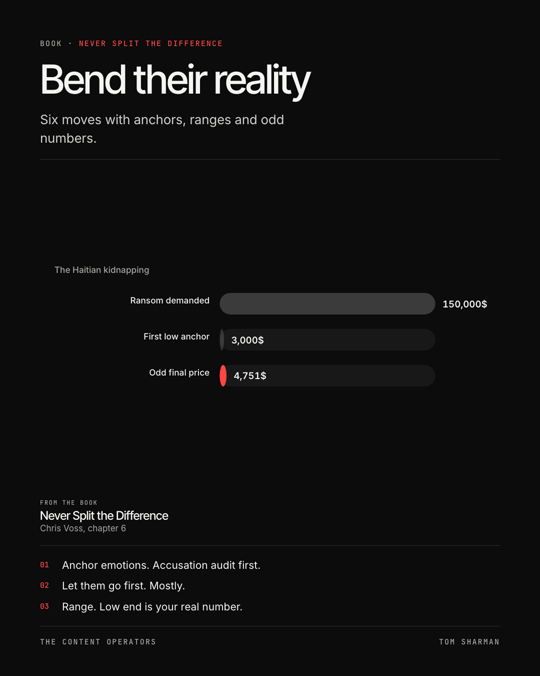
Voss says persuasion happens in the counterpart's world and that sellers should find what people are really buying. pp. 72, 80 and 105.In the book:Bend their reality.
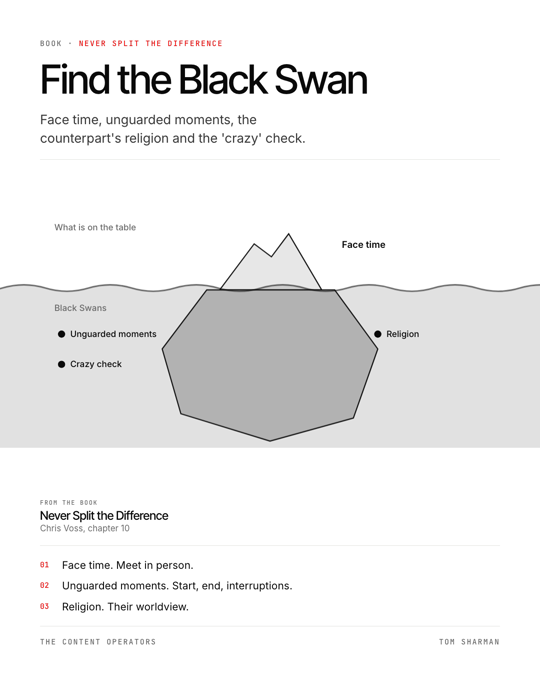
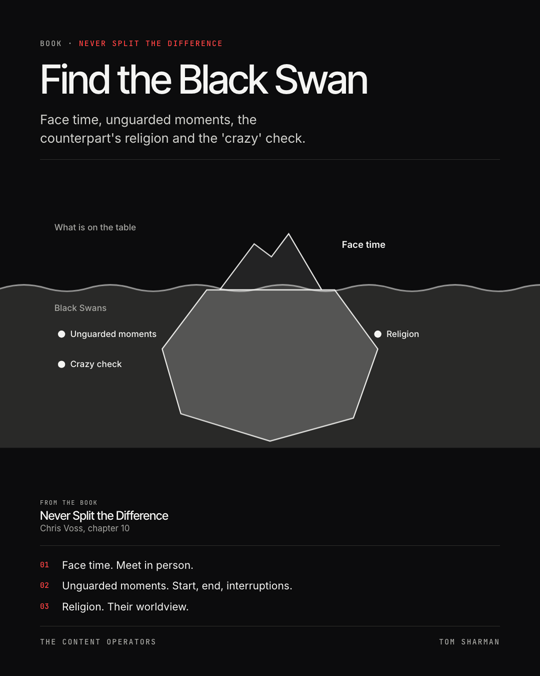
Voss says counterparts with hidden interests and cheaper options look irrational until you uncover the constraint. p. 192.In the book:Find the Black Swan.
What it argues
Voss argues that negotiation is communication with results, and that people are emotional, not rational, so the winning tools are psychological. You listen more than you talk, using mirrors, labels and summaries to reach a 'That's right', and you invite 'No' because it makes people feel safe and in control. Calibrated 'how' and 'what' questions give the counterpart the illusion of control while you steer, and they gently refuse bad terms so the other side bids against itself. Compromise is the enemy, so you set an ambitious goal, take or throw an extreme anchor, use the Ackerman steps and stay ready to walk. The rare unknown unknowns, the Black Swans, are found through face time, listening for the counterpart's worldview, and treating 'crazy' behaviour as a clue.
Worth keeping
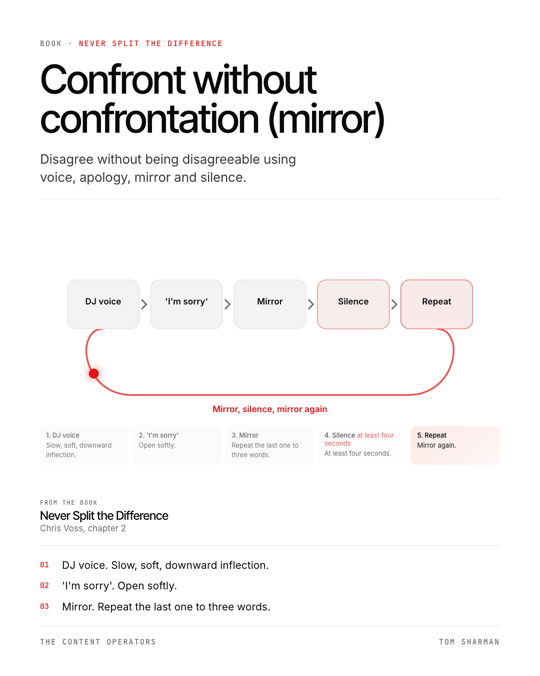
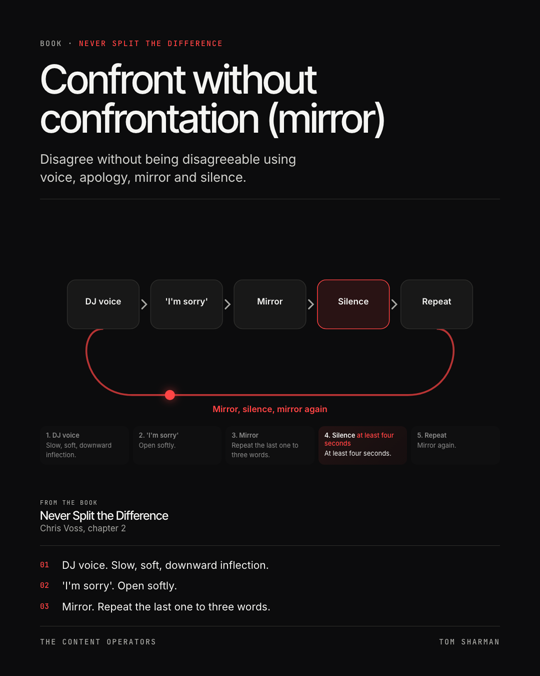
Mirror the last one to three words, then stay silent for at least four seconds (p. 40).
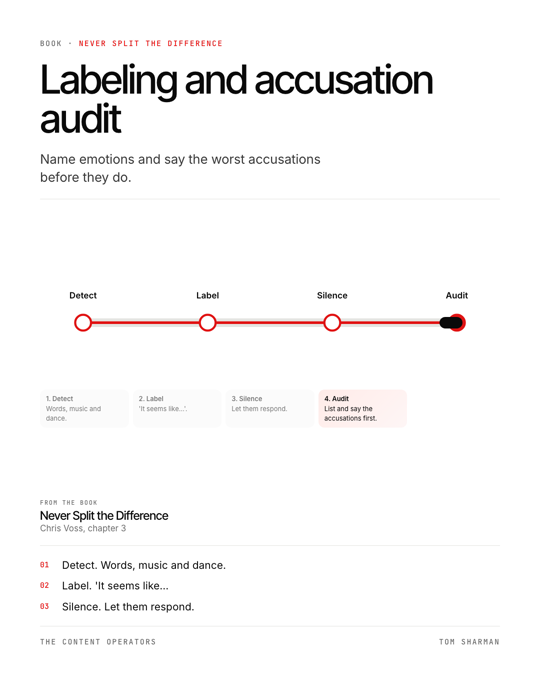
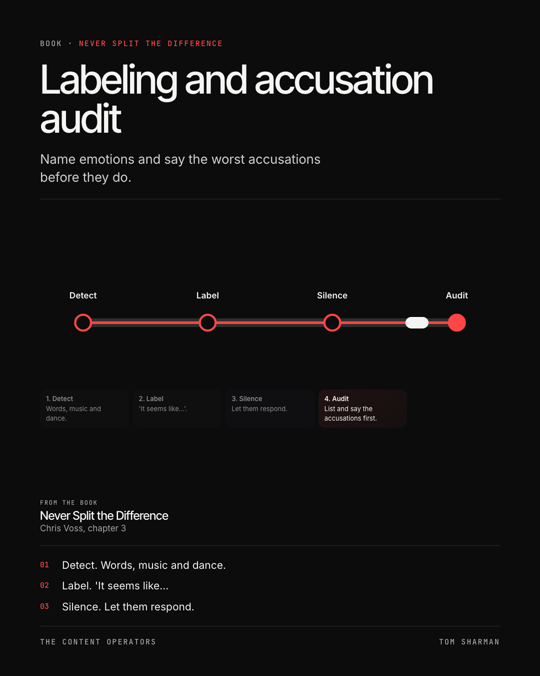
Label the emotion with 'It seems like', then stop talking (p. 49 to p. 50).
Run an accusation audit before any hard ask, and say the worst accusations first (p. 56).
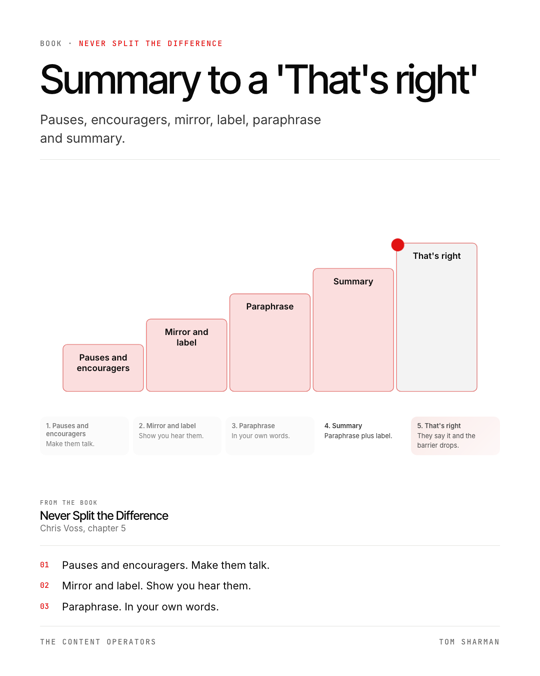
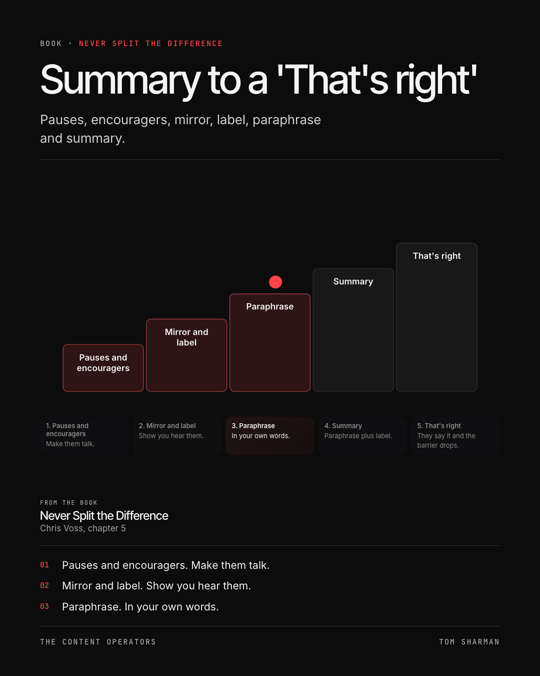
Get 'That's right' by summarising paraphrase plus label, because 'You're right' means go away (p. 87 to p. 89).
'No' starts the negotiation, so ask 'Is now a bad time to talk?' and use 'Have you given up on this project?' on silent contacts (p. 73, p. 78).
Never split the difference, and treat deadlines as mostly imaginary (p. 97 to p. 98).
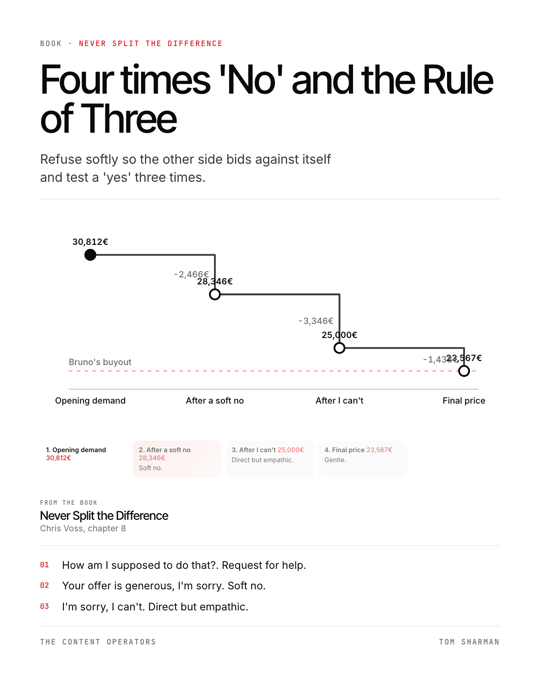
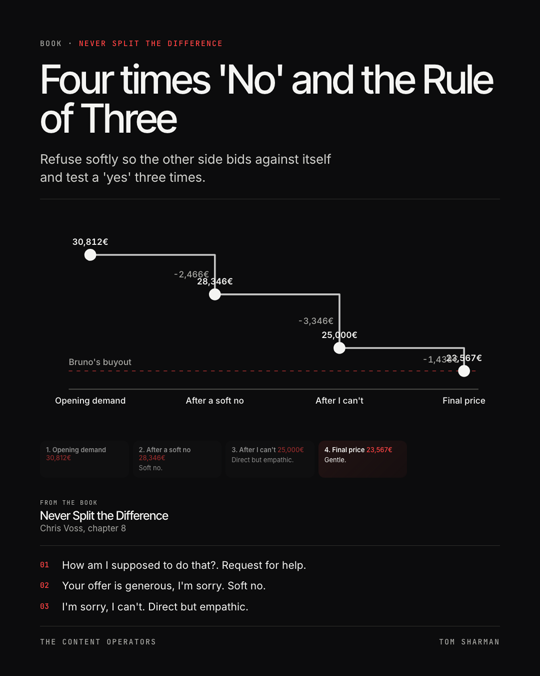
Ask calibrated 'how' and 'what' questions, avoid 'why', and use 'How am I supposed to do that?' as a polite no (p. 127, p. 138).
Ackerman model: 65, 85, 95 and 100 percent of target, ending on a precise nonround number plus a nonmonetary item (p. 169).
Check who is behind the table, and test a 'yes' with the Rule of Three (p. 141, p. 146).
Prepare with the Negotiation One Sheet, because you fall to your highest level of preparation (p. 204).
The questions it answers
What is content operations actually worth to a company, in money?
Voss says anchor with a range from comparable deals, let the other side name a figure first, use precise numbers and pivot to nonmonetary terms so a rate gets a basis.
How do you price and sell a tool you built for yourself?
He gives an Ackerman price plan, an accusation audit before the ask, and calibrated questions such as 'What does doing nothing cost you?' to sell without discounting.