Bookshelf
How Tom uses this
Man's Search for Meaning backs two of Tom's lessons. Under each of his lessons, what the book says about it, and on which pages.
What it argues
Frankl argues that the primary human drive is a will to meaning, and that it holds under any conditions, even the worst. The book shows this through his years in the camps, where prisoners with a future task, a person or an unfinished work to live for survived best, and where everyone kept the last freedom to choose their attitude. He then sets out logotherapy: meaning is specific to one person in one moment, found in work, love or the stance taken to unavoidable suffering. Success and happiness cannot be pursued, they ensue as a by-product of dedication to something beyond yourself. Freedom is only half the story and must be matched by responsibility.
Worth keeping
- He who has a why to live for can bear almost any how, so find the reason first (p. 68, p. 88).
- Everything can be taken from a person except the choice of attitude (p. 59).
- Stop asking what you expect from life and recognise that life is asking you (p. 68).
- Success and happiness cannot be pursued, they must ensue as a side effect of dedication to a cause greater than yourself (p. 9, p. 113).
- Mental health needs tension toward a worthwhile, freely chosen goal, not a tensionless state (p. 89).
- The meaning of life is specific to a person and a moment, like the best chess move depending on the position (p. 91).
- Meaning comes by deed, by experience or love, and by the attitude taken to unavoidable suffering (p. 93).
- Unemployment neurosis equated jobless with useless and useless with meaningless, and unpaid meaningful activity lifted it (p. 115).
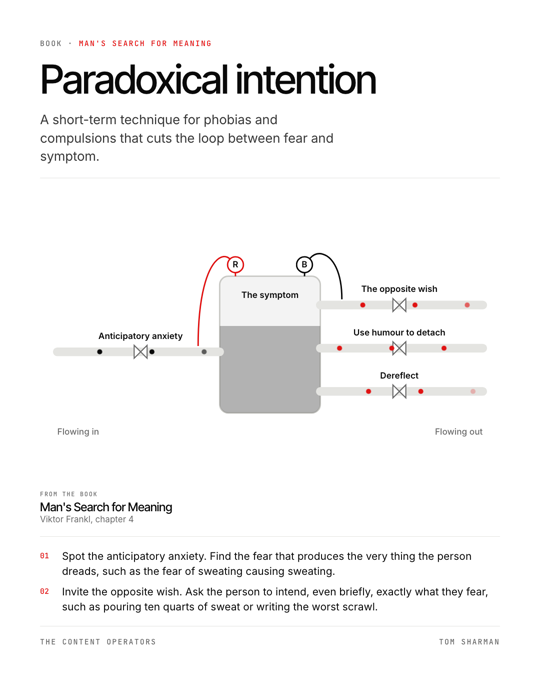
- Paradoxical intention breaks the fear and symptom loop by wishing for what you fear (p. 102).
- Frankl's one-sentence meaning of his life, guessed by a student, was to help others find the meaning of theirs (p. 134).
The frameworks
4 frameworks, one animation each Every framework, step by step
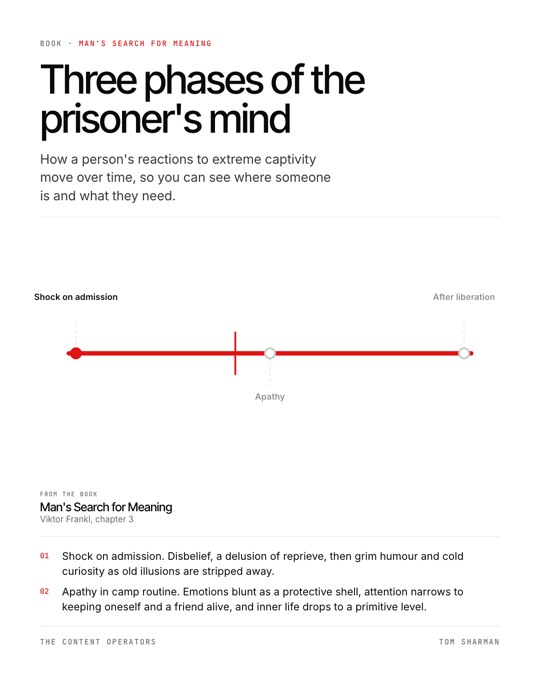
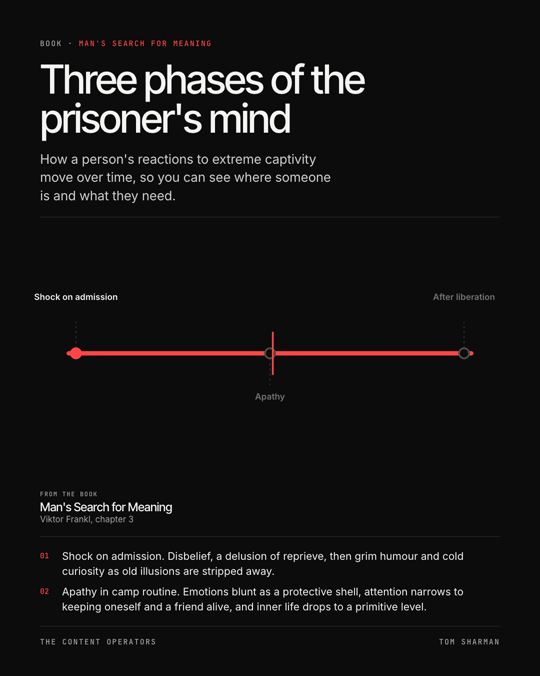
How a person's reactions to extreme captivity move over time, so you can see where someone is and what they need.
- Shock on admission. Disbelief, a delusion of reprieve, then grim humour and cold curiosity as old illusions are stripped away.
- Apathy in camp routine. Emotions blunt as a protective shell, attention narrows to keeping oneself and a friend alive, and inner life drops to a primitive level.
- After liberation. Depersonalisation first, then the risk of moral deformity, bitterness at others and disillusionment when home is not what was dreamed of.
From chapter: I, pp. 10–81
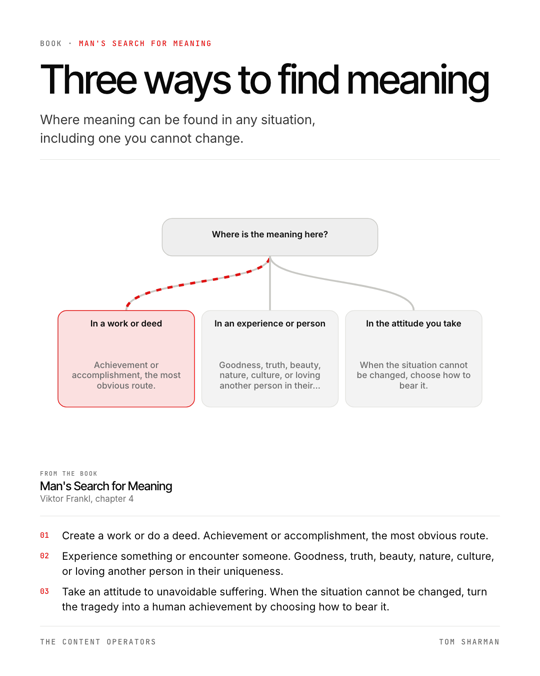
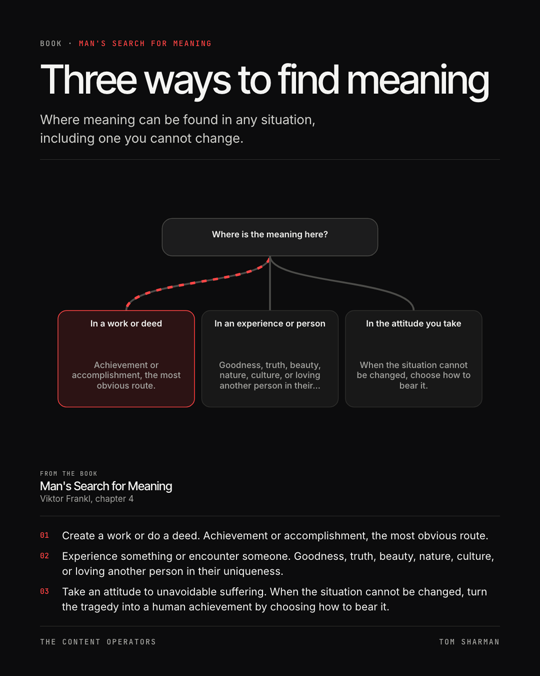
Where meaning can be found in any situation, including one you cannot change.
- Create a work or do a deed. Achievement or accomplishment, the most obvious route.
- Experience something or encounter someone. Goodness, truth, beauty, nature, culture, or loving another person in their uniqueness.
- Take an attitude to unavoidable suffering. When the situation cannot be changed, turn the tragedy into a human achievement by choosing how to bear it.
From chapter: II, pp. 82–111
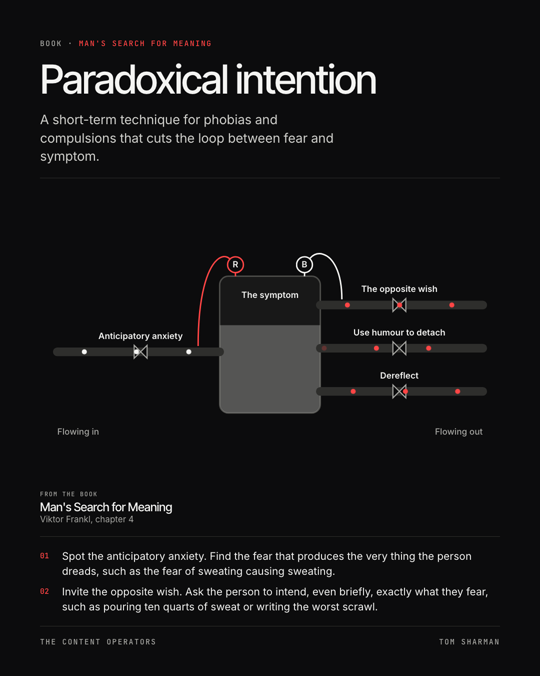
A short-term technique for phobias and compulsions that cuts the loop between fear and symptom.
- Spot the anticipatory anxiety. Find the fear that produces the very thing the person dreads, such as the fear of sweating causing sweating.
- Invite the opposite wish. Ask the person to intend, even briefly, exactly what they fear, such as pouring ten quarts of sweat or writing the worst scrawl.
- Use humour to detach. Self-detachment through laughing at the symptom takes the wind out of the anxiety.
- Dereflect toward a purpose. Turn attention away from self and toward a task, a partner or a vocation so the loop does not restart.
From chapter: II, pp. 82–111
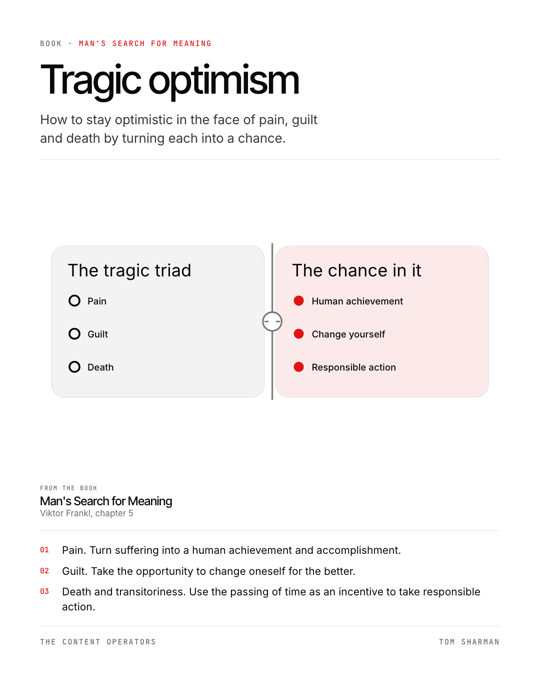
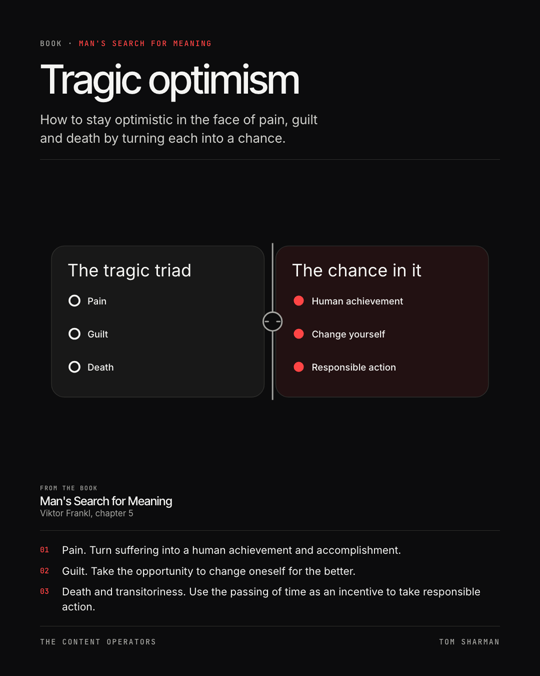
How to stay optimistic in the face of pain, guilt and death by turning each into a chance.
- Pain. Turn suffering into a human achievement and accomplishment.
- Guilt. Take the opportunity to change oneself for the better.
- Death and transitoriness. Use the passing of time as an incentive to take responsible action.
From chapter: Postscript 1984, pp. 112–125
Working with Tom on this
Tom sets the formats, the cadence and the team for short-form content, as a short-form content strategist. Short-form content strategist, UK
Back to the bookshelf