Bookshelf
How Tom uses this
Elon Musk backs four of Tom's lessons and argues with two. Under each of his lessons, what the book says about it, and on which pages.
- A brand that compounds has a mission and an enemy
Musk's missions (Mars, sustainable energy, free speech) and his named enemies, from short-sellers to the woke-mind virus, are what make his companies and tweets compound attention. pp. 13, 121, 334 and 545. In the book: The algorithm.
- Assumptions made too fast, and risk avoided
Musk combines data with gut and backs himself on calculated risks, accepting that an unflown rocket or an odd design costs less than killing momentum. pp. 187, 255 and 727.
- Turn down anyone unclear about their commitment
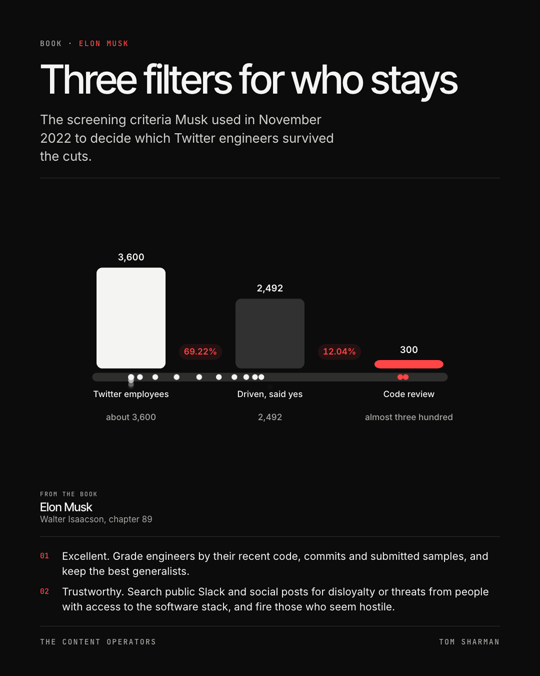
Musk screens for commitment by making Twitter staff opt in to being hardcore and by hiring for attitude over skills. pp. 422, 598 and 660. In the book: Three filters for who stays.
- Content is how a company wins talent
AI Day is run explicitly as a recruiting event, and Musk judges a presentation by whether anyone would want to join after seeing it. pp. 477 and 478.
Where it disagrees with Tom
What it argues
Isaacson argues that Musk's achievements and his damage come from the same wiring. A South African childhood of bullying and an abusive father gave him a very high pain threshold, a switched-off fear response and a craving for crisis and risk. He starts from a mission, builds companies on first principles and vertical integration, drives teams with maniacal urgency and surges, and puts engineers next to the line. The same traits produce demon mode, impulsive firings, ruptured relationships, reckless tweets and the Twitter takeover. The final question is whether you can have the rockets and the electric cars without accepting the man who is risk-seeking, unfiltered and hard to restrain.
Worth keeping
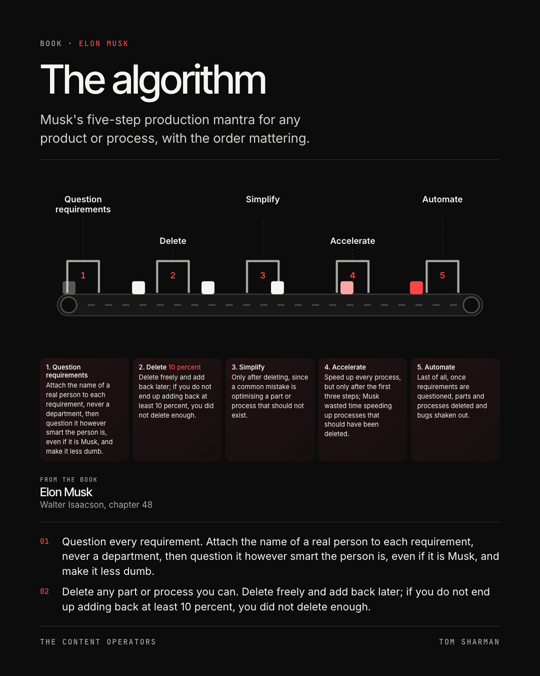
- The algorithm in five steps: question every requirement and name the person behind it, delete, simplify, accelerate, then automate last (pp. 341-342).
- The idiot index, the ratio of a finished part's cost to its raw materials, as a way to find what to redesign (p. 128).
- Put design engineers beside the assembly line and design the factory as carefully as the product, the machine that builds the machine (pp. 138, 267-268, 469).
- A mission first and a business model second, such as Starlink existing to fund Mars (pp. 120-121, 387).
- A single metric as a lodestar, such as cost per pound to orbit or miles per intervention (pp. 130, 711).
- Hire and keep for attitude, and let staff opt in to a hardcore culture with a simple yes button (pp. 422, 660-661).
- Go as close to the source as possible, asking the line workers who do the welding how thin the walls can be (p. 394).
- Fail fast and keep eleven items on the risk list, never just ten (pp. 143, 188, 727).
- Impossible deadlines can force first-principles thinking but demoralise people when they are physically impossible (p. 143).
- Open-loop warning: friends who tell you when you have no feedback, after the pedo tweet, funding secured and the Sacramento servers (pp. 352, 703).
The questions it answers
- What is the smallest team that can produce at the volume I am used to?
Twitter went from about 8,000 staff to just over 2,000 and Musk argued a small group of exceptional, driven engineers beats a team a hundred times larger, aiming for 150 as on Autopilot.
- What does AI actually change about the shape of a content team?
Tesla's imitation-learning planner cut tens of thousands of hand-written rules and Musk keeps arguing that a few excellent generalists plus AI beat large teams, with humans needed for judgment and grading.
- How do you build a personal brand that generates inbound rather than requiring outbound?
Musk gets free publicity by courting controversy and joking on Twitter, and cofounders, investors and engineers approach him because of the mission, though the same posture cost him advertisers.
The frameworks
7 frameworks, one animation each Every framework, step by step
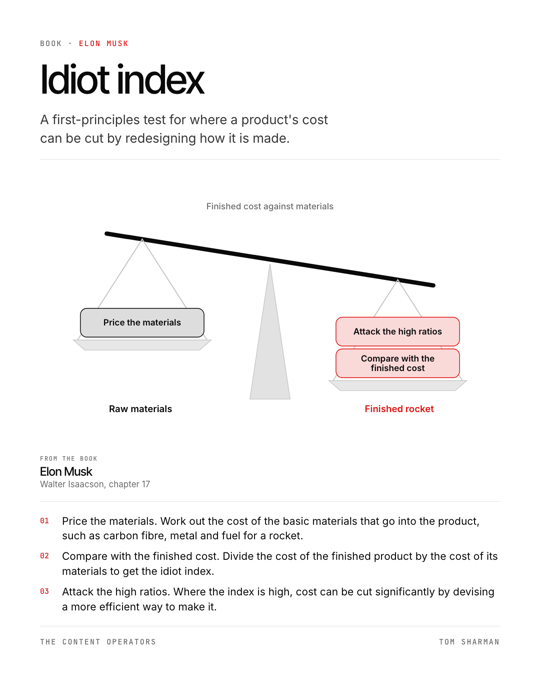
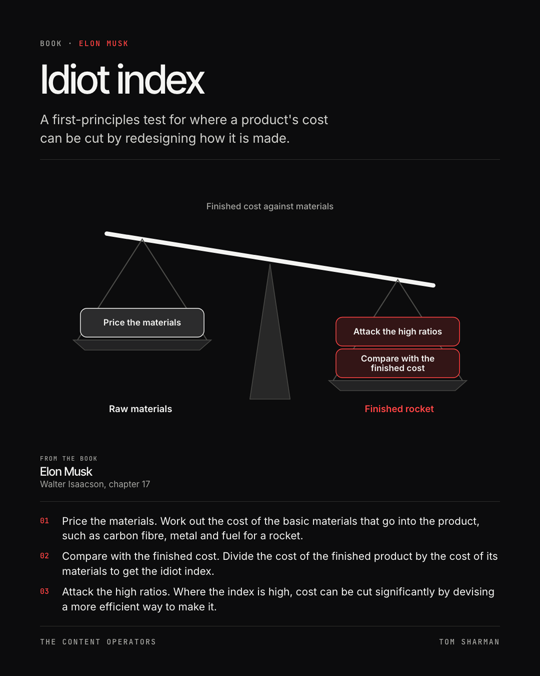
A first-principles test for where a product's cost can be cut by redesigning how it is made.
- Price the materials. Work out the cost of the basic materials that go into the product, such as carbon fibre, metal and fuel for a rocket.
- Compare with the finished cost. Divide the cost of the finished product by the cost of its materials to get the idiot index.
- Attack the high ratios. Where the index is high, cost can be cut significantly by devising a more efficient way to make it.
From chapter: Chapter 15: Rocket Man: SpaceX, 2002, pp. 124–130
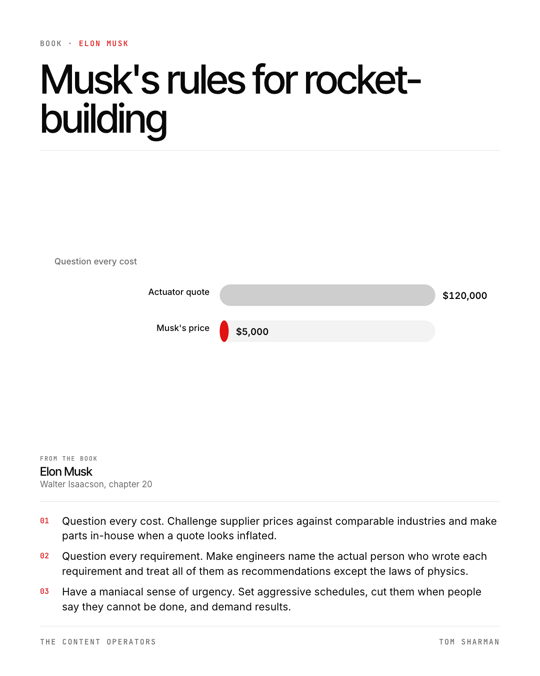
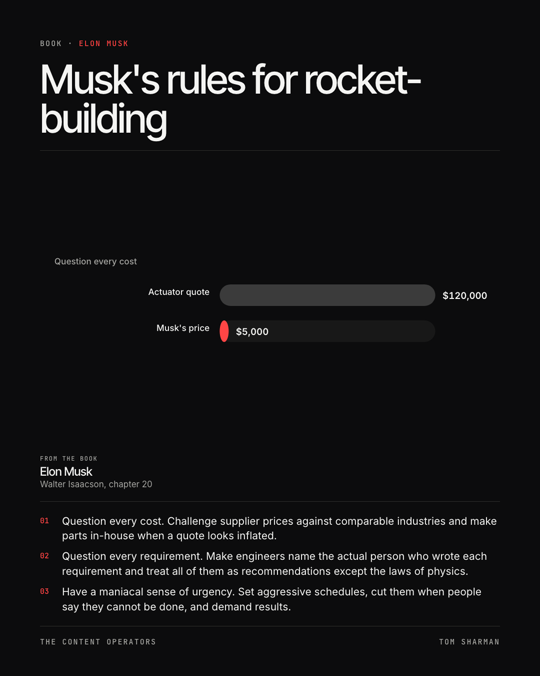
Four operating habits for building hardware fast and cheaply, which became the first steps of his later algorithm.
- Question every cost. Challenge supplier prices against comparable industries and make parts in-house when a quote looks inflated.
- Question every requirement. Make engineers name the actual person who wrote each requirement and treat all of them as recommendations except the laws of physics.
- Have a maniacal sense of urgency. Set aggressive schedules, cut them when people say they cannot be done, and demand results.
- Learn by failing. Prototype, test, blow things up, revise and try again, and fly with fewer tests than the specifications require.
- Improvise. Fix problems on the spot with whatever is at hand rather than waiting months to replace parts.
From chapter: Chapter 18: Musk’s Rules for Rocket-Building: SpaceX, 2002–2003, pp. 140–146
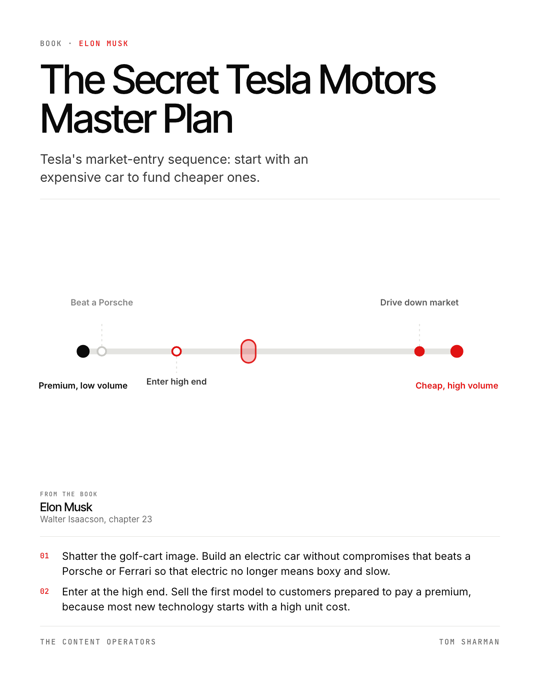
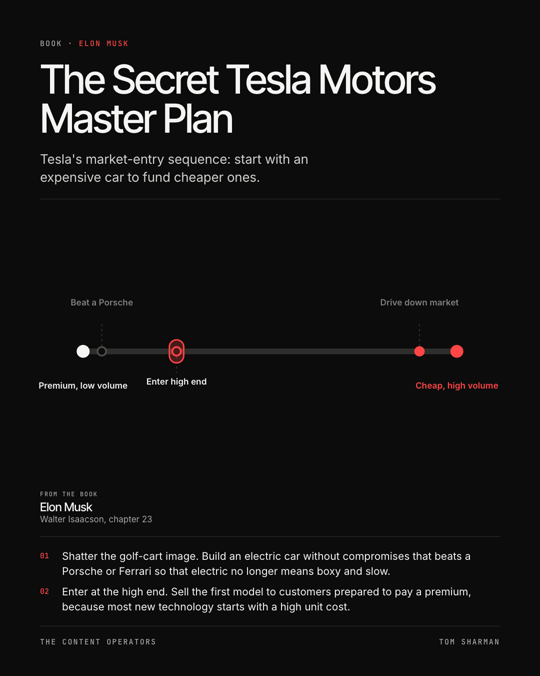
Tesla's market-entry sequence: start with an expensive car to fund cheaper ones.
- Shatter the golf-cart image. Build an electric car without compromises that beats a Porsche or Ferrari so that electric no longer means boxy and slow.
- Enter at the high end. Sell the first model to customers prepared to pay a premium, because most new technology starts with a high unit cost.
- Drive down market. Move as fast as possible to higher unit volume and lower prices with each successive model.
From chapter: Chapter 21: The Roadster: Tesla, 2004–2006, pp. 162–174
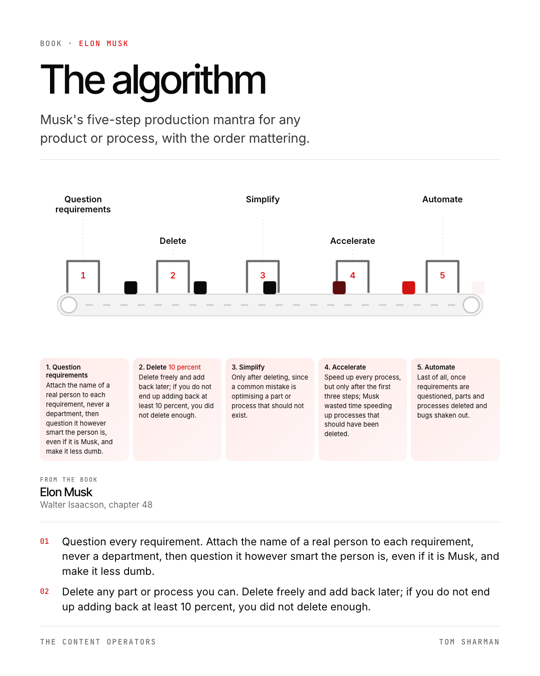
Musk's five-step production mantra for any product or process, with the order mattering.
- Question every requirement. Attach the name of a real person to each requirement, never a department, then question it however smart the person is, even if it is Musk, and make it less dumb.
- Delete any part or process you can. Delete freely and add back later; if you do not end up adding back at least 10 percent, you did not delete enough.
- Simplify and optimize. Only after deleting, since a common mistake is optimising a part or process that should not exist.
- Accelerate cycle time. Speed up every process, but only after the first three steps; Musk wasted time speeding up processes that should have been deleted.
- Automate. Last of all, once requirements are questioned, parts and processes deleted and bugs shaken out.
From chapter: Chapter 46: Fremont Factory Hell: Tesla, 2018, pp. 331–345
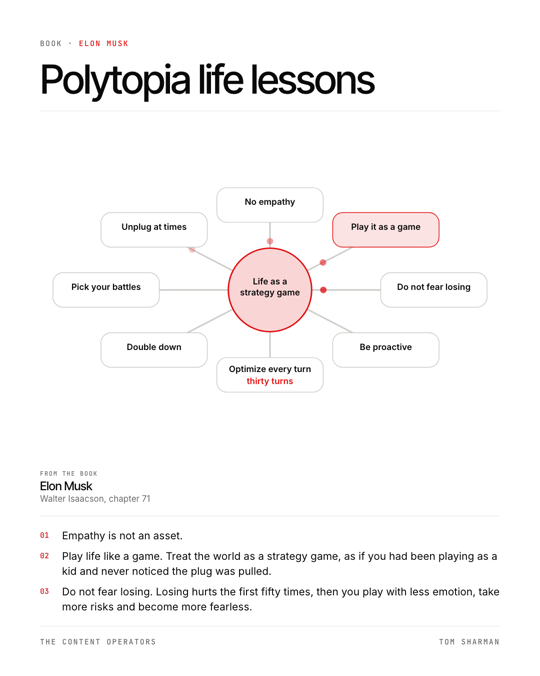
Strategy-game maxims that Kimbal and Shivon Zilis drew from playing Polytopia with Musk, and how he applies them to running companies.
- Empathy is not an asset. When you remove empathy from play you see how Musk thinks; Kimbal says his empathy gene has hurt him in business.
- Play life like a game. Treat the world as a strategy game, as if you had been playing as a kid and never noticed the plug was pulled.
- Do not fear losing. Losing hurts the first fifty times, then you play with less emotion, take more risks and become more fearless.
- Be proactive. Set the strategy yourself rather than reacting to what everyone else does, which Zilis found mirrors her work behaviour.
- Optimize every turn. You get a set number of turns in life, so do not let any slide, or you will never get to Mars.
- Double down. Keep pushing the edge of what is possible and put everything back into the game to grow.
- Pick your battles. If six tribes swipe at you and you swipe back at all, you run out of resources; Zilis calls it front minimization.
- Unplug at times. The game can wreck a marriage or fill your dreams, so step away, a lesson Musk never mastered.
From chapter: Chapter 69: Politics: 2020–2022, pp. 500–510
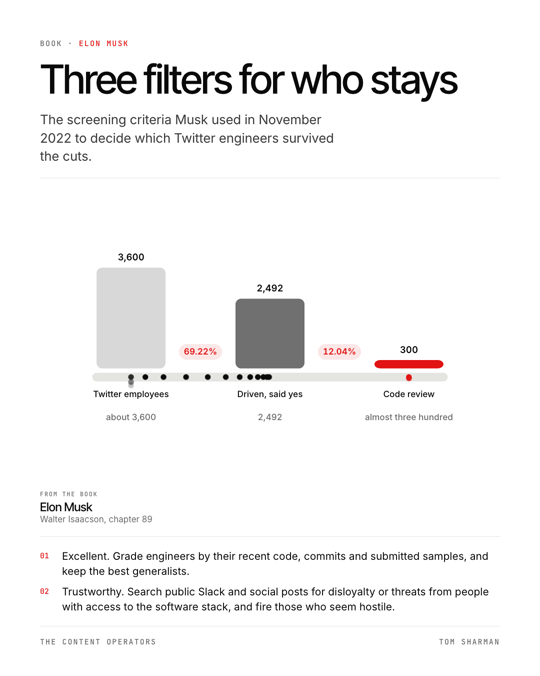
The screening criteria Musk used in November 2022 to decide which Twitter engineers survived the cuts.
- Excellent. Grade engineers by their recent code, commits and submitted samples, and keep the best generalists.
- Trustworthy. Search public Slack and social posts for disloyalty or threats from people with access to the software stack, and fire those who seem hostile.
- Driven. Make employees opt in with a yes button to a hardcore Twitter, with those who do not receiving three months of severance.
From chapter: Chapter 87: All In: Twitter, November 10–18, 2022, pp. 656–662
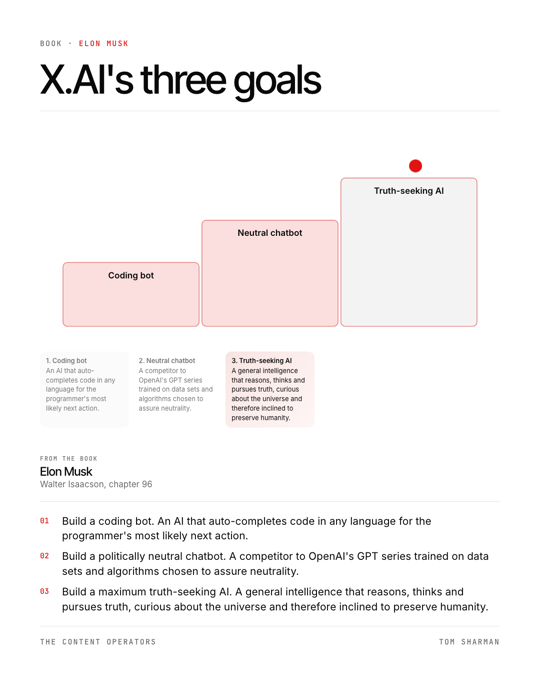
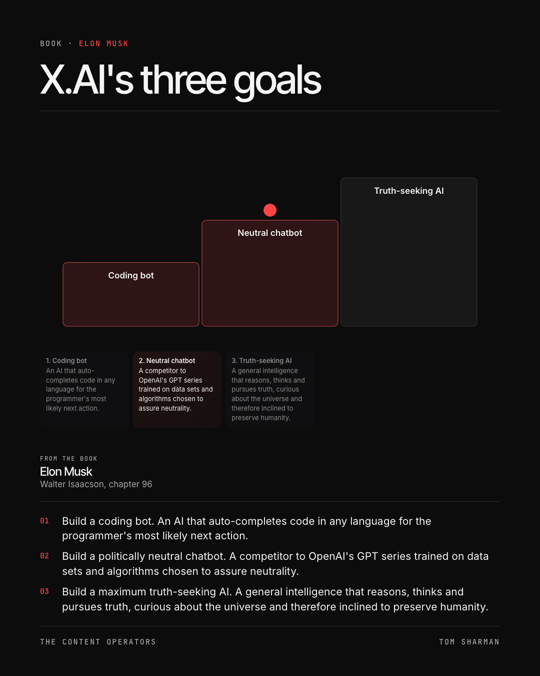
The three assignments Musk gave his new AI company in April 2023.
- Build a coding bot. An AI that auto-completes code in any language for the programmer's most likely next action.
- Build a politically neutral chatbot. A competitor to OpenAI's GPT series trained on data sets and algorithms chosen to assure neutrality.
- Build a maximum truth-seeking AI. A general intelligence that reasons, thinks and pursues truth, curious about the universe and therefore inclined to preserve humanity.
From chapter: Chapter 94: AI for Humans: X.AI, 2023, pp. 714–721
Working with Tom on this
Tom sets the formats, the cadence and the team for short-form content, as a short-form content strategist. Short-form content strategist, UK
Back to the bookshelf