Four operating habits for building hardware fast and cheaply, which became the first steps of his later algorithm.
Walter Isaacson's framework, from Elon Musk, pp. 140 to 146.
Question every cost
Challenge supplier prices against comparable industries and make parts in-house when a quote looks inflated.
Question every requirement
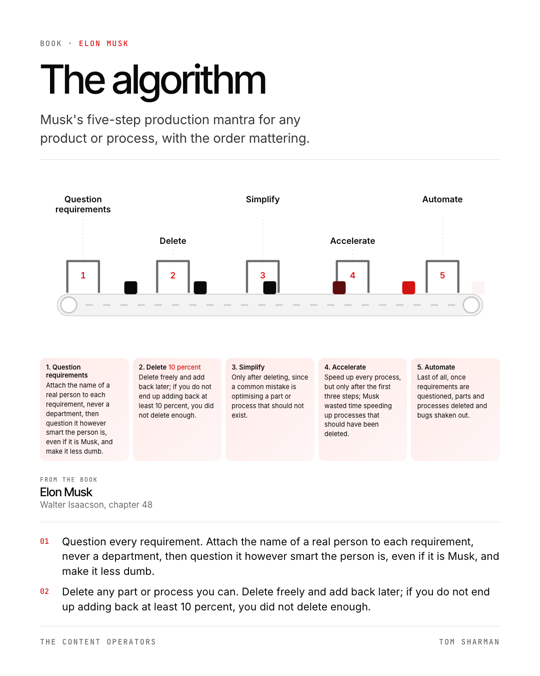
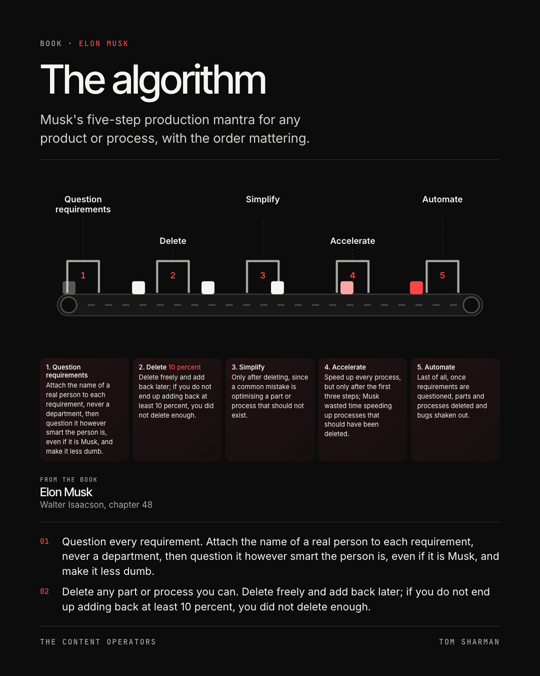
Make engineers name the actual person who wrote each requirement and treat all of them as recommendations except the laws of physics.
Have a maniacal sense of urgency
Set aggressive schedules, cut them when people say they cannot be done, and demand results.
Learn by failing
Prototype, test, blow things up, revise and try again, and fly with fewer tests than the specifications require.
Improvise
Fix problems on the spot with whatever is at hand rather than waiting months to replace parts.
From chapter: Chapter 18: Musk’s Rules for Rocket-Building: SpaceX, 2002–2003, pp. 140–146
Isaacson sets out Musk's rules for rocket-building. Question every cost and make components in-house, which cut a $250,000 valve and a $120,000 actuator to a fraction. Question every requirement and know the name of the person who wrote it, treating all requirements except physics as recommendations. Have a maniacal sense of urgency by cutting schedules, which sometimes works and demoralises when impossible. Learn by failing with fast iteration, and improvise fixes on the spot, as with the McGregor test site and the epoxy-fix that failed. The rules later became his five-step algorithm.