A way of educating engineers by working on real products while studying, instead of sitting exams and taking on debt.
James Dyson's framework, from Invention, pp. 271 to 302.
Admit on merit
Recruit top candidates nationally, with no tuition fees.
Work three days
Undergraduates work three days a week on real research projects beside Dyson engineers, earning a proper salary.
Teach two days
Teach the remaining two days, over 47 weeks a year and four years, which Dyson estimates is two and a half times the teaching of traditional universities.
Put them in a home of their own
House them in factory-built pods on the campus so they feel like independent individuals.
Free them to leave
Graduate them debt-free and not tied to Dyson, hoping many choose to stay.
From chapter: Chapter Eleven: Education, pp. 271–302
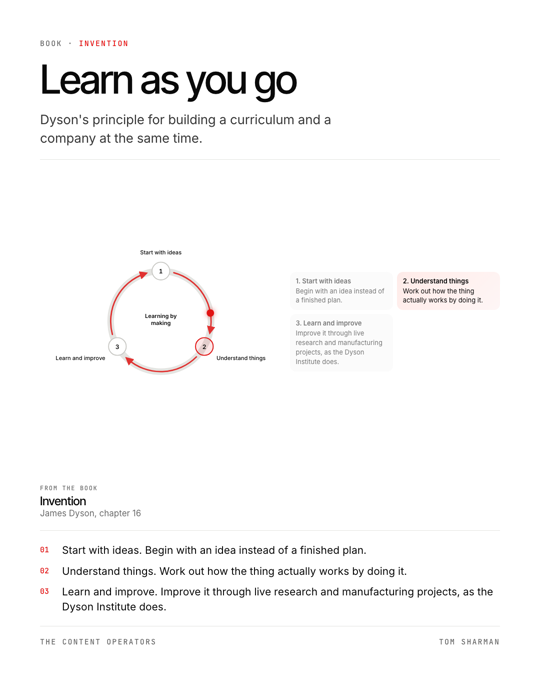
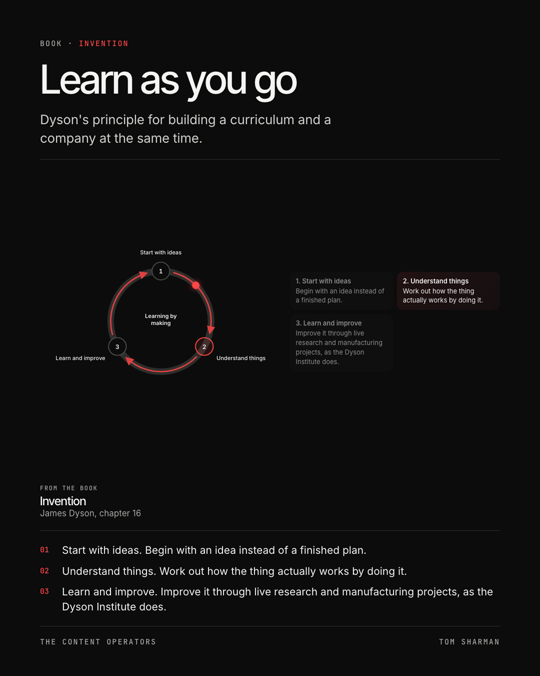
Dyson argues that making things, failing and learning by doing are the best education for engineers, and that British schools and politicians have undervalued design and technology since the war. He tells how the James Dyson Foundation (founded 2002) tried and failed to open an academy school in Bath, ran a six-year project in five Bath schools, and then used Jo Johnson's challenge to found the Dyson Institute, where undergraduates work three days a week for a salary and pay no fees. He then covers gifts to Cambridge, Imperial and the RCA, the James Dyson Award, medical giving and a new building at Gresham's.